


 |
市場調查報告書
商品編碼
2066572
醫用包裝薄膜:市場佔有率分析、產業趨勢與統計、成長預測(2026-2031)Medical Packaging Films - Market Share Analysis, Industry Trends & Statistics, Growth Forecasts (2026 - 2031) |
||||||

※ 本網頁內容可能與最新版本有所差異。詳細情況請與我們聯繫。
根據 Mordor Intelligence 預測,醫療包裝薄膜市場規模將從 2025 年的 81.3 億美元成長到 2026 年的 85.2 億美元,然後在 2031 年達到 107.5 億美元,2026 年至 2031 年的複合年成長率為 4.76%。
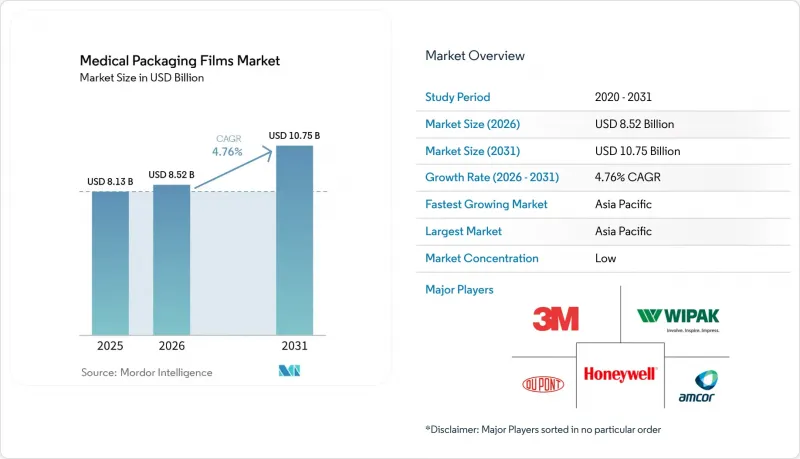
本報告涵蓋材料類型(塑膠薄膜、金屬和鋁薄膜)、產品類型(熱成型薄膜、高阻隔薄膜等)、應用(袋子和包裝袋、吸塑包裝等)、最終用戶(製藥商、醫療設備製造商等)、技術(吹膜擠出等)和地區(北美、歐洲、亞太地區等)。
全球醫用包裝薄膜市場趨勢及洞察
慢性病盛行率上升
隨著非傳染性疾病發生率的不斷上升,包裝正從被動的容器轉變為積極支持患者用藥依從性的工具。在糖尿病臨床試驗中,與標準包裝相比,壓延式泡殼包裝可使糖化血紅素(HbA1c)水平降低0.95%,證實了包裝的臨床價值。隨著人口老化和多重用藥的增加,製藥公司被迫採用與電子健康平台和智慧用藥提醒系統同步的單劑量製劑。監管機構現在將標籤檢視和包裝設計視為安全用藥的關鍵要素,這一點體現在FDA指南的不斷更新中。因此,能夠認證以患者為中心的設計的薄膜供應商,在整個醫療包裝薄膜市場中都擁有長期穩定的市場需求。
生質塑膠和再生材料的永續性計劃
歐盟關於最低再生材料含量的指令正在加速生物聚合物的普及應用。 Avient 的生物基產品系列 Mevopur 在符合 ISO 10993 標準的同時,碳足跡減少了 25%。 Amcor 的 SureForm Pro ICE 在滿足現有醫院廢棄物處理流程的直接回收標準的同時,塑膠總用量減少了 40%。挑戰在於其耐滅菌性。高壓釜和伽馬射線滅菌循環會劣化可堆肥樹脂,因此需要 PLA、PHA 和 EVOH 的合金配方,以維持其阻隔性能。美國醫療保健系統的採購團隊現在已將環境因素納入其競標標準,這使得永續基材的先驅者在醫療包裝薄膜市場中獲得了價格優勢。
石油衍生聚合物價格波動
2024年,能源價格飆升導致每磅樹脂成本上漲3-5美分,擠壓了與醫用級供應合約掛鉤的加工商的利潤空間。沒有避險能力的中小型企業面臨著長達六個月的成本轉嫁延遲,這使它們面臨客戶流失和生產線停產的風險。醫療行業嚴格的變更管理規定阻礙了樹脂的快速替代,與一般包裝行業相比,增加了醫療行業的風險。大型企業正透過購買期貨和將擠出設施建在裂解裝置附近來應對,但這些資本密集型措施進一步擴大了醫用包裝薄膜市場的競爭差距。
細分市場分析
到2025年,塑膠薄膜將維持84.72%的市場佔有率,而向生物基材料的轉變將推動其複合年成長率達到7.12%。聚乙烯薄膜因其密封性能和伽馬射線穩定性而備受青睞,是批量生產藥品包裝袋的基礎材料。採用EVOH內襯的共擠出薄膜滿足了使用乾冰運輸的生技藥品管瓶的氧氣阻隔性要求。在這些產品中,PLA/PHA共混物已獲得醫院的試點訂單,旨在減少40%的廢棄物排放。金屬箔佔據了特定的細分市場,例如透皮貼片內襯,在這些市場中,氧氣透過率(OTR)低於0.05 cc/m²/經皮至關重要。此外,醫療包裝薄膜行業的公司正在投資相容劑化學,以使多層薄膜廢料能夠在不發生分層的情況下進行機械回收。
進一步的進展將取決於檢驗醫院滅菌器的水熱分解路徑,並確保其符合EN 13432堆肥標準。在採購中,推廣「從搖籃到搖籃 (C2C)」認證的供應商往往更受青睞,但他們的產品仍需經受121 度C蒸氣滅菌和60 kGy電子束輻照循環,且不得降低拉伸強度。因此,醫療包裝薄膜市場的下一波浪潮很可能源自於將傳統樹脂與生物基黏合層結合的混合結構,從而在加工性能和使用後合規性之間取得平衡。
目前,高阻隔薄膜的銷售額佔比為24.55%,預計到2031年將以8.33%的複合年成長率成長,超過整個醫療包裝薄膜市場的成長速度。這項需求與單株抗體的日益普及密切相關,單株抗體的氧氣透過率必須低於0.1 cc/m²/天。 TekniPlex公司在無塵室生產的7層吹塑成型結構融合了EVOH和環烯烴聚合物,將低溫運輸穩定性從72小時延長至120小時。共擠出和複合薄膜仍是銷售量主力,預計到2025年將佔據43.05%的市場佔有率,這得益於其在從輸液袋到診斷包裝袋等廣泛應用領域的多功能性。然而,與更優異的蒸氣阻隔性能相關的溢價利潤盈利,促使現有製造商透過引入氣泡籠系統來維修其生產線,以適應超薄EVOH薄膜。
此外,共擠出生產商正在將NFC電路和感溫變色油墨應用於產品中,以將實體屏障功能與數位認證功能結合。隨著無菌填充和包裝生產線從蒸氣滅菌轉向等離子體滅菌,耐過氧化氫塗層將變得至關重要。
區域分析
亞太地區正引領醫療包裝薄膜市場發展,預計到2025年將佔全球銷售額的38.21%,並在2031年之前維持6.11%的複合年成長率,創歷史新高。中國生物製藥生產的擴張以及印度學名藥的推廣,推動了對阻隔性蓋膜和熱成型薄膜的需求。印度政府的激勵措施,例如生產連結獎勵計畫計畫(PLI),可報銷製藥包裝廠高達5%的資本投資,促使新增產能集中在古吉拉突邦和特倫甘納邦。菲律賓經FDA批准的經濟特區是一個區域典範,透過將薄膜加工商集中於一處,顯著降低了物流成本並加快了驗證週期。在日本,對超潔淨室擠出成型的高階需求持續存在;而在韓國,合約研發生產機構(CDMO)的快速發展,正帶動系列化包裝袋複合材料訂單的穩步成長。
北美地區依然至關重要,這主要得益於《藥品安全追蹤法案》(DSCSA) 的實施,該法案將加速藥品序列化進程,預計到2024年11月即可全面實現。生物製藥在該地區的重要性日益提升,推動了低溫運輸包裝袋的普及。尤其是在安姆科(Amcor)和貝瑞(Berry)合併之後,美墨邊境沿線集中了11家擠出工廠。醫院正在加速推進“永續採購”,因此更傾向於使用含有消費後回收(PCR)材料的PE/PP單絲,這也影響著加工商的研發重點。加拿大國家健康保險計劃(NHIS)計劃於2027年推出,預計將擴大慢性病治療的覆蓋範圍,間接增加對泡殼包裝的需求,並推動醫療包裝薄膜市場的成長。
歐洲雖然市場成熟,但卻執行全球最嚴格的生態設計法規。隨著監管機構加強對含氯基材的審查,德國已成為高價值無聚偏二氯乙烯(PVdC)阻隔薄膜訂單的中心。法國2025年修訂的「生產者延伸責任制」(EPR)規定,不可回收包裝形式的費用將逐步提高,從而鼓勵轉向單一材料EVOH-PE。英國脫歐後,英國藥品和保健產品監管局(MHRA)的序列化標準與歐盟標準有所不同,導致同時服務於歐盟和英國通路的包裝需要雙重編碼,這使得生產線配置更加複雜。在南歐,北歐大型製藥公司近岸外包業務蓬勃發展,一家西班牙泡殼包裝廠預計到2025年其出貨量將成長5.4%。
在拉丁美洲,儘管仍處於早期階段,但隨著巴西國家衛生監督局 (ANVISA) 最終批准 RDC 680 法規,要求在 2026 年前實現全面整合,相關需求正在迅速成長。跨國合約研發生產機構 (CDMO) 正在墨西哥投資,以滿足美國根據《美墨加協定》(USMCA) 提出的需求,旨在透過近岸外包在降低成本和確保業務永續營運之間取得平衡。海灣合作理事會 (GCC) 正在根據「2030 年願景」生技藥品填充和包裝設施進行現代化改造,並逐步增加高阻隔薄膜的進口,直至區域擠出產能擴大。這些發展共同鞏固了該地區在醫療包裝薄膜市場規格細微差異方面的決定性地位。
其他好處:
- Excel格式的市場預測(ME)表
- 3個月的分析師支持
目錄
第1章:引言
- 研究假設和市場定義
- 調查範圍
第2章:調查方法
第3章執行摘要
第4章 市場狀況
- 市場概覽
- 市場促進因素
- 慢性病盛行率增加
- 生質塑膠和可回收產品的永續性計劃
- 亞太地區製藥業的擴張
- 居家照護和即時診斷試劑盒的需求激增。
- 數位序列化和智慧防偽膜
- 利用3D列印技術發展個人化藥物設備
- 市場限制因素
- 石油聚合物價格波動
- 高昂的監管合規成本
- 與紙質滅菌包裝的競爭
- 多層薄膜的回收基礎設施尚不完善。
- 供應鏈分析
- 監理情勢
- 技術展望
- 波特五力分析
第5章 市場規模與成長預測
- 材料類型
- 塑膠薄膜
- 聚乙烯(LDPE、HDPE、LLDPE)
- 聚丙烯
- 聚氯乙烯
- 聚碳酸酯
- 聚對苯二甲酸乙二酯
- 聚醯胺
- 乙烯-乙烯醇共聚物(EVOH)
- 生質塑膠
- 金屬膜和鋁膜
- 塑膠薄膜
- 依產品類型
- 熱成型薄膜
- 透氣多孔薄膜
- 高阻隔膜
- 共擠出複合薄膜
- 透過使用
- 袋子和小袋
- 吸塑包裝
- 管和泡沫填充密封件
- 包裝採用有蓋獨立小袋/條狀包裝
- 用於包裝袋的診斷試紙和覆膜紙
- 最終用戶
- 製藥生產
- 醫療設備製造商
- 診斷檢查室
- 醫院和診所
- 居家醫療套件組裝公司
- 透過技術
- 吹膜擠出成型
- 鑄膜擠出成型
- 溶劑/擠壓塗布
- 按地區
- 北美洲
- 美國
- 加拿大
- 墨西哥
- 歐洲
- 德國
- 英國
- 法國
- 義大利
- 西班牙
- 俄羅斯
- 其他歐洲國家
- 亞太地區
- 中國
- 印度
- 日本
- 韓國
- 澳洲和紐西蘭
- 其他亞太國家
- 中東和非洲
- 中東
- GCC
- 土耳其
- 其他中東國家
- 非洲
- 南非
- 埃及
- 其他非洲國家
- 中東
- 南美洲
- 巴西
- 阿根廷
- 其他南美國家
- 北美洲
第6章 競爭情勢
- 市場集中度
- 策略趨勢
- 市佔率分析
- 公司簡介
- Amcor Plc
- DuPont de Nemours Inc.
- 3M Company
- Honeywell International Inc.
- Klockner Pentaplast Group
- Wipak Oy
- Renolit Medical
- PolyCine GmbH
- Glenroy Inc.
- Toray Industries Inc.
- Dunmore Corporation
- Covestro AG
- Sealed Air Corporation
- Constantia Flexibles Group
- Tekni-Plex Inc.
- Mondi Group
- UFlex Ltd.
- Coveris Holding
- Aptar Group Inc.
- West Pharmaceutical Services
第7章 市場機會與未來展望
According to Mordor Intelligence, the medical packaging films market size is expected to grow from USD 8.13 billion in 2025 to USD 8.52 billion in 2026 and is forecast to reach USD 10.75 billion by 2031 at 4.76% CAGR over 2026-2031.
This report is Segmented by Material Type ( Plastic Films and Metallic and Aluminum Films), Product Type (Thermoformable Films, High-Barrier Films, and More), Application (Bags and Pouches, Blister Packs, and More), End-User (Pharmaceutical Manufacturing, Medical Device Manufacturers, and More), Technology(blown Film Extrusion, and More) and Geography (North America, Europe, Asia-Pacific, and More)
Global Medical Packaging Films Market Trends and Insights
Rising Prevalence of Chronic Diseases
Growing noncommunicable disease incidence is transforming packaging from passive containment into active adherence tools. Calendar blister designs lowered HbA1c by 0.95% versus standard packs in diabetes trials, underscoring packaging's clinical value. Aging demographics intensify polypharmacy, pushing drug makers to adopt unit-dose formats that synchronize with e-health platforms and smart pill reminders. Regulators now treat labeling and package configuration as integral to safe use, as reflected in successive FDA guidance updates. Consequently, film suppliers capable of certifying patient-centric designs secure long-term demand across the medical packaging films market.
Sustainability Push for Bioplastics and Recyclables
EU directives mandating minimum recycled content are accelerating biopolymer uptake. Avient's Mevopur bio-based series cuts carbon footprints by 25% while maintaining ISO 10993 compliance. Amcor's SureForm Pro ICE reduced overall plastic by 40% yet met drop-in recyclability thresholds across existing hospital streams. The challenge is sterilization resilience: autoclave and gamma cycles can degrade compostable resins, prompting alloyed formulations of PLA, PHA, and EVOH that preserve barrier integrity. Procurement teams in US health systems now assign environmental weighting in tenders, giving early movers in sustainable substrates a pricing premium within the medical packaging films market.
Volatile Petroleum-Based Polymer Prices
Resin costs climbed 3-5 cents per pound in 2024 amid energy spikes, compressing margins for converters locked into medical-grade supply contracts. Smaller firms, lacking hedging leverage, face pass-through lags of up to six months, risking account attrition or line shutdowns. Strict change-control rules in healthcare impede rapid resin substitution, amplifying exposure versus general packaging segments. Larger players respond by forward-buying and co-locating extrusion near cracker complexes, yet this capital intensity widens the competitive gap in the medical packaging films market.
Other drivers and restraints analyzed in the detailed report include:
- Pharmaceutical Manufacturing Expansion in Asia-Pacific
- Surge in Home-Based Care and POC Diagnostic Kits
- High Regulatory Validation Costs
For complete list of drivers and restraints, kindly check the Table Of Contents.
Segment Analysis
Plastic films retained 84.72% share in 2025, and their internal shift toward bio-derivatives is propelling a 7.12% CAGR. Polyethylene grades, valued for sealability and gamma stability, underpin high-volume pharma pouches. EVOH-lined co-extrusions meet oxygen barrier thresholds for biologic vials shipped on dry ice. Within this mix, PLA/PHA blends are capturing pilot-scale orders from hospitals that target a 40% waste-footprint reduction. Metallic foils hold isolated niches where sub-0.05 cc/m2/day OTR is non-negotiable, such as transdermal patch liners. Additionallyy, medical packaging films industry participants invest in compatibilizer chemistries so multilayer off-cuts enter mechanical recycling without delaminating.
Further gains hinge on validating hot-water disintegration paths for hospital sterilants and aligning with EN 13432 compostability standards. Suppliers promoting cradle-to-cradle certifications gain procurement preference, though they must still pass 121 °C steam sterilization and 60 kGy e-beam cycles without tensile loss. Consequently, the next wave of the medical packaging films market will likely derive from hybrid structures that fuse conventional resins with bio-derived tie layers, balancing processability with end-of-life compliance.
High-barrier films, currently 24.55% of revenue, will expand at 8.33% CAGR through 2031, outpacing the broader medical packaging films market. Demand tracks the proliferation of monoclonal antibodies that mandate oxygen transmission rates below 0.1 cc/m2/day. TekniPlex's cleanroom-produced, seven-layer blown structures integrate EVOH and cyclic olefin polymers, extending cold-chain stability from 72 hours to 120 hours. Co-extruded and laminated films remain the volume backbone, controlling 43.05% share in 2025 thanks to format versatility that spans IV bags to diagnostic pouching. Nevertheless, price premiums for vapor-barrier upgrades yield outsized profitability, encouraging incumbents to retrofit lines with bubble-cage systems for ultra-thin EVOH placement.
Co-extruders also embed NFC circuits and thermochromic inks, merging a physical barrier with digital authentication. Looking forward, hydrogen-peroxide-resistant coatings will be essential as aseptic fill-finish lines pivot from steam to vaporized-plasma sterilants.
Geography Analysis
Asia-Pacific dominates the medical packaging films market with 38.21% revenue share in 2025 and the highest 6.11% CAGR to 2031. China's biologics build-out and India's generics push intensify demand for high-barrier lidding and thermoform webs. Government incentives such as India's Production Linked Incentive scheme reimburse up to 5% of capital outlays on pharma-adjacent packaging plants, tilting fresh capacity toward Gujarat and Telangana. The Philippines' FDA-certified ecozone illustrates a regional blueprint where co-located film converters slash logistics costs and expedite validation cycles. Japan sustains premium demand for ultra-cleanroom extrusion, while South Korea's CDMO boom adds steady orders for serialized pouch laminate.
North America remains pivotal as DSCSA enforcement pushes universal serialization by November 2024. The region's biologics weightings lift cold-chain pouch uptake, especially post-Amcor-Berry consolidation that clusters 11 extrusion sites across the US-Mexico border. Hospitals accelerating "sustainable purchasing" prefer PCR-infused PE/PP mono-materials, shaping converter R&D priorities. Canada's national pharmacare plan, slated for 2027, is projected to widen access to chronic therapies, indirectly escalating blister demand and reinforcing the medical packaging films market trajectory.
Europe, although mature, enforces the world's strictest eco-design statutes. Germany anchors high-value orders for PVdC-free barrier films, as regulators scrutinize chlorine-based substrates. France's 2025 Extended Producer Responsibility amendment imposes escalating fees on unrecyclable formats, prompting a pivot to mono-material EVOH-PE. The UK's post-Brexit MHRA serialization divergence necessitates dual coding on packs servicing both EU and UK channels, complicating line configurations. Southern Europe enjoys near-shore outsourcing from Northern pharma giants; Spanish blistering plants recorded 5.4% shipment gains in 2025.
Latin America shows nascent but fast-rising requirements as Brazil's ANVISA finalizes RDC 680 for full aggregation by 2026. Multinational CDMOs invest in Mexico to service US demand under USMCA, blending cost savings with near-shoring resilience. The Gulf Cooperation Council is modernizing biologics fill-finish halls under Vision 2030, adding incremental high-barrier film imports until regional extrusion capacity scales. Collectively, these developments cement geography as a determinant of specification nuance across the medical packaging films market.
- Amcor Plc
- DuPont de Nemours Inc.
- 3M Company
- Honeywell International Inc.
- Klockner Pentaplast Group
- Wipak Oy
- Renolit Medical
- PolyCine GmbH
- Glenroy Inc.
- Toray Industries Inc.
- Dunmore Corporation
- Covestro AG
- Sealed Air Corporation
- Constantia Flexibles Group
- Tekni-Plex Inc.
- Mondi Group
- UFlex Ltd.
- Coveris Holding
- Aptar Group Inc.
- West Pharmaceutical Services
Additional Benefits:
- The market estimate (ME) sheet in Excel format
- 3 months of analyst support
TABLE OF CONTENTS
1 INTRODUCTION
- 1.1 Study Assumptions and Market Definition
- 1.2 Scope of the Study
2 RESEARCH METHODOLOGY
3 Executive Summary
4 Market Landscape
- 4.1 Market Overview
- 4.2 Market Drivers
- 4.2.1 Rising prevalence of chronic diseases
- 4.2.2 Sustainability push for bioplastics and recyclables
- 4.2.3 Pharmaceutical manufacturing expansion in APAC
- 4.2.4 Surge in home-based care and POC diagnostic kits
- 4.2.5 Digital serialization and smart anti-counterfeit films
- 4.2.6 Growth of 3D-printed personalized drug devices
- 4.3 Market Restraints
- 4.3.1 Volatile petroleum-based polymer prices
- 4.3.2 High regulatory validation costs
- 4.3.3 Competition from paper-based sterile packs
- 4.3.4 Weak recycling infra for multi-layer films
- 4.4 Supply-Chain Analysis
- 4.5 Regulatory Landscape
- 4.6 Technological Outlook
- 4.7 Porter's Five Forces Analysis
- 4.7.1 Threat of New Entrants
- 4.7.2 Bargaining Power of Buyers
- 4.7.3 Bargaining Power of Suppliers
- 4.7.4 Threat of Substitutes
- 4.7.5 Competitive Rivalry
5 MARKET SIZE AND GROWTH FORECASTS (VALUE)
- 5.1 By Material Type
- 5.1.1 Plastic Films
- 5.1.1.1 Polyethylene (LDPE, HDPE, LLDPE)
- 5.1.1.2 Polypropylene
- 5.1.1.3 Polyvinyl Chloride
- 5.1.1.4 Polycarbonate
- 5.1.1.5 Polyethylene Terephthalate
- 5.1.1.6 Polyamide
- 5.1.1.7 Ethylene Vinyl Alcohol Copolymer (EVOH)
- 5.1.1.8 Bioplastics
- 5.1.2 Metallic and Aluminum Films
- 5.1.1 Plastic Films
- 5.2 By Product Type
- 5.2.1 Thermoformable Films
- 5.2.2 Breathable and Porous Films
- 5.2.3 High-Barrier Films
- 5.2.4 Co-extruded and Laminated Films
- 5.3 By Application
- 5.3.1 Bags and Pouches
- 5.3.2 Blister Packs
- 5.3.3 Tubes and Form-Fill-Seal
- 5.3.4 Lidding and Sachets/Stick Packs
- 5.3.5 Diagnostic Strip and Pouch Laminates
- 5.4 By End-user
- 5.4.1 Pharmaceutical Manufacturing
- 5.4.2 Medical Device Manufacturers
- 5.4.3 Diagnostic Laboratories
- 5.4.4 Hospitals and Clinics
- 5.4.5 Home Healthcare Kit Assemblers
- 5.5 By Technology
- 5.5.1 Blown Film Extrusion
- 5.5.2 Cast Film Extrusion
- 5.5.3 Solvent / Extrusion Coating
- 5.6 By Geography
- 5.6.1 North America
- 5.6.1.1 United States
- 5.6.1.2 Canada
- 5.6.1.3 Mexico
- 5.6.2 Europe
- 5.6.2.1 Germany
- 5.6.2.2 United Kingdom
- 5.6.2.3 France
- 5.6.2.4 Italy
- 5.6.2.5 Spain
- 5.6.2.6 Russia
- 5.6.2.7 Rest of Europe
- 5.6.3 Asia-Pacific
- 5.6.3.1 China
- 5.6.3.2 India
- 5.6.3.3 Japan
- 5.6.3.4 South Korea
- 5.6.3.5 Australia and New Zealand
- 5.6.3.6 Rest of Asia-Pacific
- 5.6.4 Middle East and Africa
- 5.6.4.1 Middle East
- 5.6.4.1.1 GCC
- 5.6.4.1.2 Turkey
- 5.6.4.1.3 Rest of Middle East
- 5.6.4.2 Africa
- 5.6.4.2.1 South Africa
- 5.6.4.2.2 Egypt
- 5.6.4.2.3 Rest of Africa
- 5.6.4.1 Middle East
- 5.6.5 South America
- 5.6.5.1 Brazil
- 5.6.5.2 Argentina
- 5.6.5.3 Rest of South America
- 5.6.1 North America
6 COMPETITIVE LANDSCAPE
- 6.1 Market Concentration
- 6.2 Strategic Moves
- 6.3 Market Share Analysis
- 6.4 Company Profiles {(includes Global level Overview, Market level overview, Core Segments, Financials as available, Strategic Information, Market Rank/Share for key companies, Products and Services, and Recent Developments)}
- 6.4.1 Amcor Plc
- 6.4.2 DuPont de Nemours Inc.
- 6.4.3 3M Company
- 6.4.4 Honeywell International Inc.
- 6.4.5 Klockner Pentaplast Group
- 6.4.6 Wipak Oy
- 6.4.7 Renolit Medical
- 6.4.8 PolyCine GmbH
- 6.4.9 Glenroy Inc.
- 6.4.10 Toray Industries Inc.
- 6.4.11 Dunmore Corporation
- 6.4.12 Covestro AG
- 6.4.13 Sealed Air Corporation
- 6.4.14 Constantia Flexibles Group
- 6.4.15 Tekni-Plex Inc.
- 6.4.16 Mondi Group
- 6.4.17 UFlex Ltd.
- 6.4.18 Coveris Holding
- 6.4.19 Aptar Group Inc.
- 6.4.20 West Pharmaceutical Services
7 Market Opportunities and Future Outlook
- 7.1 White-space and Unmet-Need Assessment

 2026-2030年全球醫用包裝薄膜市場
 醫用包裝薄膜市場:依產品類型、材料類型、技術、最終用戶和應用分類-2026-2032年全球市場預測
 全球醫療包裝薄膜市場
 全球醫用包裝薄膜市場規模、佔有率、趨勢和成長分析報告(2026-2034年)醫用包裝薄膜市場規模、佔有率、成長率及全球產業分析:按類型、應用和地區的洞察,2026-2034年預測
 醫用包裝薄膜市場規模、佔有率和趨勢分析報告:按產品、應用、最終用途、地區和細分市場預測,2026-2033年
 醫療包裝薄膜市場規模、佔有率和成長分析(按產品類型、材料類型、應用、最終用途產業和地區分類)-2026-2033年產業預測醫療包裝薄膜市場:未來預測(2025-2030)
 2024-2032 年醫用包裝薄膜市場機會、成長動力、產業趨勢分析與預測