


 |
市場調查報告書
商品編碼
2066545
精簡型用戶端:市場佔有率分析、行業趨勢和統計數據、成長預測(2026-2031)Thin Client - Market Share Analysis, Industry Trends & Statistics, Growth Forecasts (2026 - 2031) |
||||||

※ 本網頁內容可能與最新版本有所差異。詳細情況請與我們聯繫。
據 Mordor Intelligence 稱,2025 年精簡型用戶端市場價值 50 億美元,預計到 2031 年將從 2026 年的 53.9 億美元成長至 78.7 億美元,預測期(2026-2031 年)複合年成長率為 7.86%。
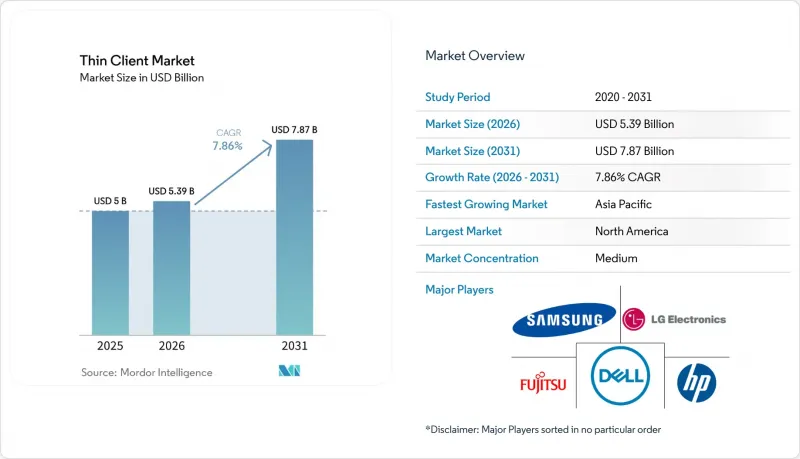
本報告按類型(硬體、軟體、服務)、最終用戶產業(銀行、金融服務和保險 (BFSI)、IT 和電信、醫療保健、政府、製造業等)、外形規格(桌上型電腦、一體機、行動裝置)、作業系統(Windows、Linux、Chrome OS、其他作業系統)、部署模式(本地部署、雲端部署、混合部署)和地區部署、混合部署)和地區部署。市場預測以價值(美元)表示。
全球精簡型用戶端市場趨勢與洞察
疫情後混合辦公模式下的VDI熱潮
虛擬桌面基礎架構 (VDI) 已從小眾 IT 專案發展成為分散式員工的標準存取層級。通用動力資訊科技公司 (General Dynamics Information Technology) 採用 Zscaler 的零信任雲端平台,在一個月內保障了數千個遠端連線的安全,同時符合聯邦法規要求。博爾頓國民醫療服務體系基金會 (Bolton NHS Foundation Trust) 部署了基於 IGEL 作業系統的精簡型用戶端終端,這些終端可以在病房之間移動,將臨床醫生的登入時間縮短至三秒。這正是知識工作者超越辦公桌的工作流程的一個例子。律師事務所和保險公司也正在採用類似的模式,提供受管理的存取權限,而無需為每位律師或代理人配備全配置 PC。因此,精簡型用戶端市場並非受益於疫情帶來的暫時性需求激增,而是受益於工作空間交付系統的結構性重塑。
強制性終端成本降低和節能
精簡型用戶端通常只消耗塔式電腦三分之一的電量,使用壽命可達八年以上,因此在公用事業成本方面的節省顯而易見。歐洲公共部門採購負責人在競標評估中越來越重視能耗,這使得傳統桌上型電腦處於劣勢。聯想將於2025年3月發布的V100 Q售價低於200美元,顯示廠商為了達到嚴格的成本目標,不惜一切代價剔除不必要的功能。結合集中式管理,大幅減少了現場維護次數,零售和政府機構大規模部署的總生命週期成本將大幅下降。隨著2027年起能源效率法規的日益嚴格,預計這一趨勢還將持續。
新興市場網路延遲不穩定
印度的「數位公共基礎設施」覆蓋了數百萬公民,但農村地區4G網路覆蓋的不足導致精簡型用戶端播放速度變慢。儘管馬哈拉斯特拉邦都市區的政府機構ERPNext部署進展順利,但在吞吐量低於2Mbps的偏遠地區卻舉步維艱。不丹和沙烏地阿拉伯首都地區以外的地區也出現了類似的限制。在遠端醫療和數位教室中,間歇性的延遲會影響使用者體驗,迫使使用者切換到本地PC,從而阻礙精簡型用戶端的廣泛部署,直到光纖和5G網路等基礎設施到位。
細分市場分析
預計到2025年,精簡型用戶端市場(硬體)規模將達到30.6億美元,其中實體終端將佔總營收的61.24%。然而,隨著客戶轉向能夠利用多廠商設備的訂閱授權模式,軟體和服務領域正以11.62%的複合年成長率快速擴張,是硬體市場成長的兩倍。 IGEL的2025 COSMOS平台為任何x86或Arm客戶端提供統一的控制平面,從而簡化了現有PC的再利用,無需進行完整的硬體更換。雲端軟體集團正在投資16.5億美元用於微軟Azure的容量建設,以預先支援託管桌面會話,這印證了終端的價值正在轉移到編配軟體。
供應商正透過將精簡型用戶端韌體與重新貼牌的迷你電腦捆綁銷售,並透過年度支援計劃實現盈利來應對這一挑戰。戴爾2025會計年度財報顯示,其硬體部門的利潤率面臨壓力,而基礎建設服務部門的銷售額則呈現強勁成長。隨著Windows 10支援即將結束,IT團隊正在購買可在舊處理器上穩定運行的安全作業系統鏡像,並推遲資本支出。儘管2026年至2031年間設備出貨量可能仍會成長,但隨著企業越來越傾向使用SaaS主機而非客製化設備,硬體市佔率預計將逐步下降。
到2025年,IT和通訊業將成為消費主力軍,佔精簡型用戶端市場佔有率的28.48%。這反映了多年來服務台和網路營運中心(NOC)環境中對虛擬桌面基礎架構(VDI)的廣泛應用。同時,醫療保健產業展現出最高的成長率,到2031年,其年複合成長率(CAGR)將達到9.26%,這主要得益於強制性電子健康記錄和資料主權法規對安全終端需求的增加。印度的ESIC部署了31,000個虛擬桌面,用於集中管理病患資料並減少支援存取次數。英國的Pennine Acute Hospitals透過改用無風扇終端,降低了電力消耗和維修工單數量,每年節省了50萬英鎊(約63萬美元)的成本。
儘管零售、製造和教育並非主要行業,但它們仍然從精簡型用戶端支援的標準化工作流程中獲益匪淺。在零售業,銷售點 (POS) 終端依靠精簡型用戶端的可靠性和安全性來確保交易順暢並最大限度地減少停機時間。同樣,在製造業,現場終端利用精簡型用戶端的耐用性和高效性來簡化操作並保持生產力。在教育領域,精簡型用戶端正被應用於課堂實驗室,憑藉其低故障率、簡化的管理和封閉的軟體堆疊,有助於創造安全可控的學習環境。這些優勢的結合帶來了多元化的基本客群,為這些行業提供了穩定性,並減輕了特定產業經濟波動的影響。
區域分析
預計到2025年,北美地區的銷售額將佔全球總銷售額的37.58%,這主要得益於零信任法規的合法化實施以及企業設備的大規模更新換代。網路安全和基礎設施安全局(CISA)在其2025年1月發布的評估報告中確認,將在該機構全面實施多因素身份驗證。此舉顯著增加了對無狀態設備的訂單,這些設備能夠建立強大的終端安全態勢。此外,私人承包商為了保持其獲得政府合約的資格,也開始採用類似的標準,從而在國防、醫療保健和金融服務等關鍵領域實現了安全架構的統一。
亞太地區正崛起為主要的成長引擎,預計到2031年,市場將以10.47%的複合年成長率成長。印度、印尼和越南等國正在大力投資公共服務的雲端基礎設施數位化。這些地區的「帳戶聚合器」框架使金融機構能夠安全地存取公民數據,同時,管理人員也越來越傾向於使用集中式客戶端,以確保個人記錄不會保留在分店的電腦上。工業領域也取得了顯著進展,例如富士康將虛擬機器串流傳輸到生產現場進行品管,有效減少了工廠停機時間。為了滿足不斷成長的需求,IGEL於2024年10月與CXA合作,在新加坡設立了一個中心,旨在縮短通路前置作業時間並為客戶提供本地語言支援。
在歐洲,市場呈現穩定成長態勢,這主要得益於嚴格的資料保護合規要求和碳排放減排目標,這些因素促使低功耗終端的普及。同時,在南美和中東,需求成長僅限於特定產業,特別是政府機構和石油天然氣產業。該地區值得關注的進展是聯想與Alat公司成立了一家價值20億美元的合資企業,計劃於2025年成立,推出為沿岸地區建立一個區域性供應基地。此舉反映出市場對該地區基礎設施的信心日益增強,並預期其未來能夠支持市場擴張。
其他好處:
- Excel格式的市場預測(ME)表
- 3個月的分析師支持
目錄
第1章:引言
- 研究假設和市場定義
- 調查範圍
第2章:調查方法
第3章執行摘要
第4章 市場狀況
- 市場概覽
- 市場促進因素
- 疫情後虛擬桌面基礎架構(VDI)蓬勃發展,混合辦公模式也隨之出現。
- 終端成本和能源效率法規
- 網路安全日益重要/零信任的採用
- AI-PC 更新將有助於從傳統 PC 遷移到精簡型用戶端。
- 範圍 2 碳排放報告正在推動低功耗終端的採用。
- 邊緣運算和分散式辦公室模式的擴展正在推動集中式終端模型的發展。
- 市場限制因素
- 新興市場網路延遲不穩定
- GPU密集型工作負載的效能差距
- DaaS/VDI 的每席成本不斷上漲
- 周邊設備驅動程式支援分散
- 產業價值鏈分析
- 監理情勢
- 技術展望
- 波特五力分析
第5章 市場規模與成長預測
- 按類型
- 硬體
- 軟體和服務
- 按最終用戶行業分類
- BFSI
- IT/通訊
- 衛生保健
- 政府
- 零售
- 製造業
- 教育
- 按外形規格
- 桌面精簡型用戶端
- 一體化精簡型用戶端
- 行動精簡型用戶端
- 透過作業系統
- Windows
- Linux
- Chrome OS
- 其他作業系統
- 按部署模式
- 現場
- 雲
- 混合
- 按地區
- 北美洲
- 美國
- 加拿大
- 墨西哥
- 南美洲
- 巴西
- 阿根廷
- 其他南美國家
- 歐洲
- 德國
- 英國
- 法國
- 義大利
- 西班牙
- 其他歐洲國家
- 亞太地區
- 中國
- 日本
- 韓國
- 印度
- 其他亞太國家
- 中東和非洲
- 中東
- 阿拉伯聯合大公國
- 沙烏地阿拉伯
- 其他中東國家
- 非洲
- 南非
- 奈及利亞
- 其他非洲國家
- 中東
- 北美洲
第6章 競爭情勢
- 市場集中度
- 策略趨勢
- 市佔率分析
- 公司簡介
- Dell Technologies
- HP Inc.
- Lenovo Group
- IGEL Technology
- 10ZiG Technology
- NComputing
- Centerm Information
- Samsung Electronics
- LG Electronics
- NEC Corporation
- Fujitsu Ltd.
- Cisco Systems
- Advantech Co.
- ClearCube Technology
- Praim Srl
- Leadtek Research
- Stratodesk
- Microsoft(Windows 365 Link)
- VMware(Horizon Edge)
第7章 市場機會與未來展望
According to Mordor Intelligence, the thin client market size was valued at USD 5 billion in 2025 and estimated to grow from USD 5.39 billion in 2026 to reach USD 7.87 billion by 2031, at a CAGR of 7.86% during the forecast period (2026-2031).
This report is Segmented by Type (Hardware, Software, and Services), End-User Industry (BFSI, IT and Telecom, Healthcare, Government, Manufacturing, and More), Form Factor (Desktop, All-In-One, and Mobile), Operating System (Windows, Linux, Chrome OS, and Other Operating Systems), Deployment Model (On-Premise, Cloud, and Hybrid), and Geography. The Market Forecasts are Provided in Terms of Value (USD).
Global Thin Client Market Trends and Insights
Post-Pandemic Hybrid Work VDI Boom
Virtual desktop infrastructure shifted from a niche IT project to a default access layer for distributed staff. General Dynamics Information Technology adopted Zscaler's zero-trust cloud to secure thousands of remote connections in one month, keeping federal compliance intact. Bolton NHS Foundation Trust trimmed clinician log-on time to three seconds with IGEL OS thin terminals that roam between wards, illustrating workflows beyond knowledge-worker desks. Legal practices and insurers repeat the model to deliver governed access without shipping full PCs to each lawyer or agent. The thin client market, therefore, benefits from a structural redesign in workspace provisioning rather than a temporary pandemic spike.
Endpoint Cost and Energy-Saving Mandates
Thin clients typically draw one-third the power of tower PCs and last 8 years or more, delivering measurable utility savings. Public-sector buyers in Europe increasingly score bids on wattage, putting legacy desktops at a disadvantage. Lenovo's sub-USD 200 V100 Q, launched in March 2025, shows how vendors strip non-essentials to meet aggressive cost targets. When paired with centralized management that slashes on-site visits, the total lifecycle bill for mass deployments in retail or government facilities drops sharply. Energy efficiency regulations will tighten after 2027, extending this tailwind.
Unreliable Network Latency in Emerging Markets
India's Digital Public Infrastructure covers millions of citizens, yet 4G coverage gaps in rural areas slow thin client streaming sessions. ERPNext roll-outs for state services work smoothly in urban Maharashtra but struggle in remote districts where throughput drops below 2 Mbps. Bhutan and Saudi Arabia experienced similar constraints outside capital regions. For telehealth or digital classrooms, intermittent latency harms user experience and can prompt fallback to local PCs, hindering broader thin-client deployment until fiber or 5G densification arrives.
Other drivers and restraints analyzed in the detailed report include:
- Rising Cybersecurity and Zero-Trust Roll-Outs
- AI-PC Refresh Pushes Legacy PC Conversions
- GPU-Intensive Workload Performance Gaps
For complete list of drivers and restraints, kindly check the Table Of Contents.
Segment Analysis
The thin client market size for hardware equaled USD 3.06 billion in 2025, giving physical terminals a 61.24% revenue lead. Yet software and services is expanding at 11.62% CAGR, twice the hardware pace, as customers pivot to subscription licenses that unlock multi-vendor devices. IGEL's 2025 COSMOS platform provides a single control plane for any x86 or Arm client, encouraging reuse of existing PCs rather than outright hardware swaps. Cloud Software Group invested USD 1.65 billion in Microsoft Azure capacity to pre-stage managed desktop sessions, proving that endpoint value is shifting to orchestration software.
Vendors adapt by bundling thin firmware on rebadged mini-PCs while monetizing annual support tiers. Dell's fiscal 2025 report revealed margin pressure in hardware but strong pull-through on infrastructure services. Under the Windows 10 end-of-support deadline, IT teams license secure OS images that run well on aging processors, deferring capital spend. Over 2026-2031, hardware share is expected to decline gradually as enterprises favor SaaS consoles over proprietary terminals, even though absolute device shipments may still rise.
IT and telecom led consumption with 28.48% of the thin client market share in 2025, reflecting long-standing VDI adoption in help desks and NOC environments. Healthcare, however, posts the fastest 9.26% CAGR through 2031 as electronic health record mandates and data-sovereignty statutes elevate secure endpoint demand. India's ESIC rolled out 31,000 virtual desktops, centralizing patient data and trimming support visits. Pennine Acute Hospitals in the United Kingdom saved GBP 500,000 (USD 630,000) annually after switching to fanless units that cut power and break-fix tickets.
Retail, manufacturing, and education, while not leading sectors, still derive significant benefits from adopting standardized workflows enabled by thin clients. In the retail sector, point-of-sale stations rely on thin clients' reliability and security to ensure seamless transactions and minimize downtime. Similarly, in manufacturing, shop-floor terminals leverage the durability and efficiency of thin clients to streamline operations and maintain productivity. In the education sector, classroom labs use thin clients for their low failure rates, simplified management, and locked-down software stacks, which help create a secure, controlled learning environment. These advantages collectively contribute to a diversified customer base, providing stability and mitigating the impact of vertical cyclicality across these industries.
Geography Analysis
North America accounted for 37.58% of 2025 revenue, driven by the implementation of codified zero-trust regulations and extensive enterprise refresh programs. The Cybersecurity and Infrastructure Security Agency (CISA) confirmed in its January 2025 scorecard that multifactor authentication had been deployed agency-wide. This development significantly boosted orders for stateless devices capable of enforcing a robust endpoint posture. Additionally, private contractors have adopted similar standards to remain eligible for government contracts, thereby aligning security architectures across critical sectors such as defense, healthcare, and financial services ecosystems.
Asia-Pacific is emerging as the primary growth engine, with the market projected to grow at a compound annual growth rate (CAGR) of 10.47% through 2031. Countries like India, Indonesia, and Vietnam are channeling substantial digitization funds into public-service cloud infrastructure. The Account Aggregator framework in these regions enables lenders to securely access citizen data, while administrators increasingly favor centrally managed clients to ensure personal records remain off branch PCs. The industrial sector is also witnessing significant advancements, as demonstrated by Foxconn, which streams virtual machines to shop floors for quality control purposes, effectively reducing plant downtime. To cater to the growing demand, IGEL established a Singapore hub in collaboration with CXA in October 2024, aiming to shorten channel lead times and provide local language support to its customers.
Europe is experiencing steady growth, primarily driven by stringent data-protection compliance requirements and carbon reduction targets that incentivize the adoption of low-wattage endpoints. Meanwhile, South America and the Middle East exhibit selective demand growth, particularly in government and oil-and-gas verticals. A notable development in the region includes Lenovo's USD 2 billion venture with Alat in 2025, which aims to establish a regional supply base for the Gulf. This move reflects growing confidence in the region's infrastructure readiness and its potential to support future market expansion.
- Dell Technologies
- HP Inc.
- Lenovo Group
- IGEL Technology
- 10ZiG Technology
- NComputing
- Centerm Information
- Samsung Electronics
- LG Electronics
- NEC Corporation
- Fujitsu Ltd.
- Cisco Systems
- Advantech Co.
- ClearCube Technology
- Praim Srl
- Leadtek Research
- Stratodesk
- Microsoft (Windows 365 Link)
- VMware (Horizon Edge)
Additional Benefits:
- The market estimate (ME) sheet in Excel format
- 3 months of analyst support
TABLE OF CONTENTS
1 INTRODUCTION
- 1.1 Study Assumptions and Market Definition
- 1.2 Scope of the Study
2 RESEARCH METHODOLOGY
3 EXECUTIVE SUMMARY
4 MARKET LANDSCAPE
- 4.1 Market Overview
- 4.2 Market Drivers
- 4.2.1 Post-Pandemic Hybrid-Work VDI Boom
- 4.2.2 Endpoint Cost and Energy-Saving Mandates
- 4.2.3 Rising Cybersecurity/Zero-Trust Roll-Outs
- 4.2.4 AI-PC Refresh Unlocks Legacy PC-to-Thin-Client Conversions
- 4.2.5 Scope-2 Carbon Reporting Pushes Low-Wattage Endpoints
- 4.2.6 Edge Computing and Distributed Workforce Expansion Driving Centralized Endpoint Models
- 4.3 Market Restraints
- 4.3.1 Unreliable Network Latency in Emerging Markets
- 4.3.2 GPU-Intensive Workload Performance Gaps
- 4.3.3 DaaS / VDI Seat-Price Inflation
- 4.3.4 Fragmented Peripheral Driver Support
- 4.4 Industry Value Chain Analysis
- 4.5 Regulatory Landscape
- 4.6 Technological Outlook
- 4.7 Porter's Five Forces Analysis
- 4.7.1 Bargaining Power of Suppliers
- 4.7.2 Bargaining Power of Buyers
- 4.7.3 Threat of New Entrants
- 4.7.4 Threat of Substitutes
- 4.7.5 Intensity of Competitive Rivalry
5 MARKET SIZE AND GROWTH FORECASTS (VALUE)
- 5.1 By Type
- 5.1.1 Hardware
- 5.1.2 Software and Services
- 5.2 By End-User Industry
- 5.2.1 BFSI
- 5.2.2 IT and Telecom
- 5.2.3 Healthcare
- 5.2.4 Government
- 5.2.5 Retail
- 5.2.6 Manufacturing
- 5.2.7 Education
- 5.3 By Form Factor
- 5.3.1 Desktop Thin Clients
- 5.3.2 All-in-one Thin Clients
- 5.3.3 Mobile Thin Clients
- 5.4 By Operating System
- 5.4.1 Windows
- 5.4.2 Linux
- 5.4.3 Chrome OS
- 5.4.4 Other Operating Systems
- 5.5 By Deployment Model
- 5.5.1 On-Premise
- 5.5.2 Cloud
- 5.5.3 Hybrid
- 5.6 By Geography
- 5.6.1 North America
- 5.6.1.1 United States
- 5.6.1.2 Canada
- 5.6.1.3 Mexico
- 5.6.2 South America
- 5.6.2.1 Brazil
- 5.6.2.2 Argentina
- 5.6.2.3 Rest of South America
- 5.6.3 Europe
- 5.6.3.1 Germany
- 5.6.3.2 United Kingdom
- 5.6.3.3 France
- 5.6.3.4 Italy
- 5.6.3.5 Spain
- 5.6.3.6 Rest of Europe
- 5.6.4 Asia-Pacific
- 5.6.4.1 China
- 5.6.4.2 Japan
- 5.6.4.3 South Korea
- 5.6.4.4 India
- 5.6.4.5 Rest of Asia-Pacific
- 5.6.5 Middle East and Africa
- 5.6.5.1 Middle East
- 5.6.5.1.1 United Arab Emirates
- 5.6.5.1.2 Saudi Arabia
- 5.6.5.1.3 Rest of Middle East
- 5.6.5.2 Africa
- 5.6.5.2.1 South Africa
- 5.6.5.2.2 Nigeria
- 5.6.5.2.3 Rest of Africa
- 5.6.5.1 Middle East
- 5.6.1 North America
6 COMPETITIVE LANDSCAPE
- 6.1 Market Concentration
- 6.2 Strategic Moves
- 6.3 Market Share Analysis
- 6.4 Company Profiles (includes Global-level Overview, Market-level Overview, Core Segments, Financials, Strategic Info, Market Rank/Share, Products and Services, Recent Developments)
- 6.4.1 Dell Technologies
- 6.4.2 HP Inc.
- 6.4.3 Lenovo Group
- 6.4.4 IGEL Technology
- 6.4.5 10ZiG Technology
- 6.4.6 NComputing
- 6.4.7 Centerm Information
- 6.4.8 Samsung Electronics
- 6.4.9 LG Electronics
- 6.4.10 NEC Corporation
- 6.4.11 Fujitsu Ltd.
- 6.4.12 Cisco Systems
- 6.4.13 Advantech Co.
- 6.4.14 ClearCube Technology
- 6.4.15 Praim Srl
- 6.4.16 Leadtek Research
- 6.4.17 Stratodesk
- 6.4.18 Microsoft (Windows 365 Link)
- 6.4.19 VMware (Horizon Edge)
7 MARKET OPPORTUNITIES AND FUTURE OUTLOOK
- 7.1 White-Space and Unmet-need Assessment


