


 |
市場調查報告書
商品編碼
2066533
機器人作業系統:市場佔有率分析、產業趨勢與統計、成長預測(2026-2031)Robot Operating System - Market Share Analysis, Industry Trends & Statistics, Growth Forecasts (2026 - 2031) |
||||||

※ 本網頁內容可能與最新版本有所差異。詳細情況請與我們聯繫。
根據 Mordor Intelligence 估計,機器人作業系統市場在 2026 年的價值將達到 7.6 億美元,高於 2025 年的 6.7 億美元,預計到 2031 年將達到 13.8 億美元。
預計 2026 年至 2031 年的複合年成長率為 12.73%。
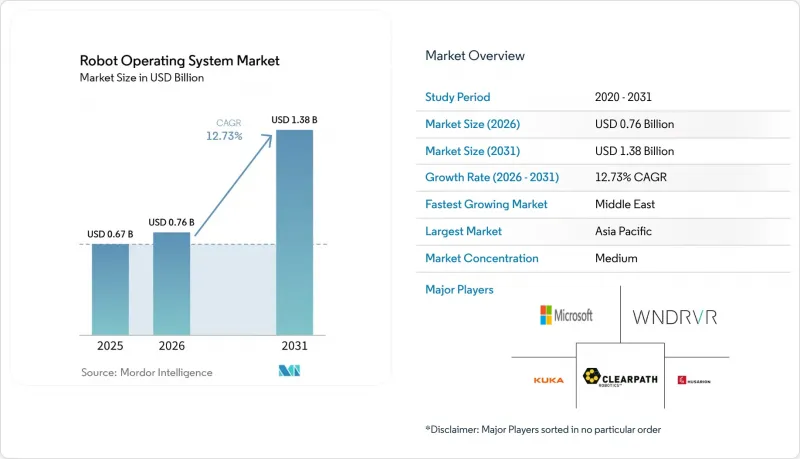
本報告按機器人類型(工業機器人、服務機器人)、終端用戶產業(汽車產業等)、元件(軟體堆疊、服務)、部署模式(本地部署、雲端部署)、作業系統發行版(ROS 1 等)、硬體架構支援(x86 等)和地區進行細分。市場預測以美元計價。
全球機器人作業系統市場趨勢及洞察
擴大ROS相容協作機器人在汽車組裝的應用
汽車製造商正在擴大協作機器人的應用範圍,以縮短生產週期並解決熟練勞動力短缺問題。大眾、通用汽車和特斯拉正在部署基於ROS的協作機器人,用於粘合、檢測和螺絲擰緊等任務,在提高工位產能的同時,保持較高的一次合格率。 Stellantis公司位於米拉菲奧裡(Mirafiori)的工廠,將行動機械手臂與擴增實境(AR)引導數位雙胞胎回饋同步,將組裝效率提高了27%。這些由ROS 2驅動的協作機器人受益於DDS中間件,該中間件消除了單點故障,並支援安全參數的即時更新。市場成長仍然與感測器成本的降低以及即插即用工具的普及密切相關,這些工具能夠縮短混合車型生產線的整合時間。
雲端模擬平台的擴展
工業開發人員擴大在虛擬環境中檢驗機器人的全部工作負載,然後再將硬體部署到工廠車間。 FogROS2-FT 框架透過將運算密集的運動規劃查詢卸載到多個雲端點,將模擬成本降低了 2.2 倍,並提高了容錯能力。 AWS RoboMaker 和類似服務具有持續整合鉤子,每次程式碼提交都會觸發自動回歸測試,從而縮短開發週期。開發人員正在利用這些管線迭代感知和抓取演算法,而無需停止實際生產線,從而加快新產品運作速度。
分散式 ROS 網路的網路安全漏洞
ROS 1 節點依賴未加密的 TCPROS 主題,這些主題容易受到欺騙和重播攻擊,可能危及安全關鍵型執行器的安全。雖然 ROS 2 透過 DDS 整合了身份驗證和存取控制插件,但當機器人部署跨越多個 VLAN 時,仍然經常出現設定錯誤。最近的滲透測試表明,醫療機器人部署中存在證書管理不足的問題,促使營運商實施零信任策略、網路分段和即時異常檢測。行業組織目前正在發布安全加固指南,但許多中小製造商缺乏網路安全負責人來應用建議的修補程式。
細分市場分析
到2025年,工業機器人將佔銷售額的56.40%,這反映了它們在焊接、堆疊和數控加工輔助等領域的長期應用。FANUC累計出貨量突破100萬台的里程碑,凸顯了其部署規模的規模與成熟度。在這些部署案例中,協作機器人佔汽車產業的四分之一,顯示多車生產線正顯著轉向人機協作。服務機器人,特別是用於物流的自主移動機器人(AMR)和醫院配送機器人,預計到2031年將以16.55%的複合年成長率成長,這主要得益於電子商務履約需求的成長以及為提高患者照護品質所做的努力。
服務業的蓬勃發展勢頭顯而易見,導航平台與人工智慧視覺相結合的應用日益普及,例如貨架補貨和自主清潔等任務。供應商正利用 ROS 2 的即時品質保證功能,確保大規模設施內 SLAM 地圖的一致性。隨著訂閱費用與設施管理預算相符,面向專業環境的服務小組機器人作業系統市場預計將迅速擴張。工業製造商正擴大將分析儀表板和預測性維護功能整合到系統中,以提高運作指標。
到2025年,汽車製造商將佔據23.60%的市場佔有率,並正利用基於ROS的運動規劃和品質檢測流程來管理更多車型變體,同時避免中斷生產線。基於六足機器人的對準系統支援駕駛輔助功能所需的頭燈校準和光學感測器定位。在連網自動駕駛汽車的展示中,ROS 2同步的自主移動機器人(AMR)標籤器進一步展示如何即時補充零件箱,從而提高生產線末端工位的吞吐量。
醫療產業正以15.62%的複合年成長率(CAGR)保持最快的成長速度。基於ROS的手術輔助系統利用確定性循環時序來協調多軸刀具路徑,並實現嚴格的運動學精確度目標。諸如PeTRA之類的醫院物流平台將ROS 2與先進的人機互動(HRI)模組相結合,能夠在人群中導航並即時回應患者的生命徵象。隨著醫療機構向手術室數位轉型,用於醫療機器人的機器人作業系統市場預計將擴展到診斷和復健領域。
區域分析
預計到2025年,亞太地區將佔全球銷售額的37.65%,主要得益於中國、日本和韓國在自動化領域的大規模投資。在上海舉辦的「ROSCon China」大會吸引了超過200名參與者,充分展現了當地社群的強大實力。政府資助正在加速科技的應用。韓國的「科技谷」補貼計畫支援小型電子工廠使用人工智慧推理加速器,而新加坡的「ART C」測試平台正在試行先進的3D視覺庫。隨著國內供應商將低成本機械臂推廣到東協的製造地,該地區的機器人作業系統市場預計將繼續保持類似的成長速度。
預計中東地區將維持最高的成長率,到2031年年均複合成長率將達到16.78%。沙烏地阿拉伯的「2030願景」和阿拉伯聯合大公國的「3000億行動」等國家計畫正著力發展機器人技術,以實現經濟多元化並擺脫對油氣資源的依賴。在杜拜政府支持的示範區,監管合規程序已簡化,因此能夠快速試行部署倉儲機器人和手術機器人。區域系統整合商正與歐洲零件製造商合作,實現供應鏈本地化,並協助實現自給自足的目標。
北美仍然是創新中心,匯聚了領先的ROS維護負責人和超大規模雲端服務供應商。 ROS工業聯盟美洲分會向航太、石油天然氣和食品加工等產業的成員公司引入開放原始碼品質保證流程。大學透過引導自適應操控研究成果衍生出衍生公司並吸引創投,維持豐富的新創企業創業投資。生產回流和先進製造設備的稅收優惠政策進一步刺激了市場需求。
在歐洲,除了工業機器人部署密度高之外,各國政府也強制推行自動化,並專注於網路安全。僅德國就佔歐洲機器人部署總量的三分之一,並且正在推動現有基於ROS的設施維修,作為「工業4.0」框架的一部分。西班牙和匈牙利等國在2024年實現了兩位數的機器人擁有量成長。在歐登塞舉行的會議上,合作研發成為重點,一家丹麥協作機器人製造商和人工智慧研究人員正在攜手合作,致力於將自適應取放功能商業化。
其他好處:
- Excel格式的市場預測(ME)表
- 3個月的分析師支持
目錄
第1章:引言
- 研究假設和市場定義
- 調查範圍
第2章:調查方法
第3章執行摘要
第4章 市場狀況
- 市場概覽
- 市場促進因素
- 擴大ROS相容協作機器人在汽車組裝中的應用(亞洲)
- 雲端模擬平台擴充(北美和歐洲)
- 政府資助的機器人測試設施激增(亞太地區和中東地區)
- 將 ROS 2 與 5G 和邊緣 AI 整合到 AMR(全球)
- 開放原始碼工業庫(ROS-Industrial)的快速傳播
- 供應商向長期支援 (LTS) 版本遷移
- 市場限制因素
- 分散式 ROS 網路的網路安全漏洞
- 硬體抽象層在各OEM廠商之間分散
- 新興市場缺乏認證的ROS專業人員
- 安全關鍵型應用中即時確定性面臨的挑戰
- 價值供應鏈分析
- 技術展望
- 波特五力分析
第5章 市場規模與成長預測
- 按機器人類型
- 工業機器人
- 多關節
- SCARA
- 平行/Delta
- 笛卡爾類型/線性類型
- 協作機器人(cobots)
- 服務機器人
- 商用服務機器人
- 物流機器人
- 醫療保健和醫療機器人
- 國防與安全機器人
- 農業機器人
- 個人與家庭服務機器人
- 商用服務機器人
- 工業機器人
- 按最終用戶行業分類
- 車
- 電氣和電子設備
- 醫療保健和生命科學
- 電子商務與物流
- 航太/國防
- 食品/飲料
- 農業
- 教育/研究
- 其他材質(金屬、塑膠等)
- 按組件
- 軟體堆疊
- ROS核心庫
- 中介軟體/通訊工具
- 仿真和視覺化(Gazebo、RViz)
- 服務
- 系統整合和諮詢
- 支援與維護
- 培訓和認證
- 軟體堆疊
- 按作業系統分發
- ROS 1
- ROS 2
- 其他變體(ROS-工業版、微型ROS版)
- 部署模式
- 現場
- 雲(ROS-aaS)
- 按地區
- 北美洲
- 美國
- 加拿大
- 墨西哥
- 南美洲
- 巴西
- 阿根廷
- 其他南美國家
- 歐洲
- 德國
- 英國
- 法國
- 義大利
- 西班牙
- 其他歐洲國家
- 北歐的
- 瑞典
- 挪威
- 丹麥
- 芬蘭
- 冰島
- 中東
- GCC
- 土耳其
- 其他中東國家
- 非洲
- 南非
- 其他非洲國家
- 亞太地區
- 中國
- 日本
- 韓國
- 印度
- 印尼
- 其他亞太國家
- 北美洲
第6章 競爭情勢
- 市場集中度
- 策略趨勢
- 市佔率分析
- 公司簡介
- Microsoft Corporation
- Amazon Web Services Inc.
- Clearpath Robotics Inc.
- KUKA AG
- Bosch Rexroth AG
- ABB Ltd.
- FANUC Corp.
- Yaskawa Electric Corp.
- Universal Robots A/S
- Open Robotics(Intrinsic)
- Wind River Systems Inc.
- Husarion Inc.
- Brain Corporation
- Neobotix GmbH
- PAL Robotics SL
- Locus Robotics Corp.
- Milvus Robotics
- iRobot Corporation
- Omron Corporation
- Siasun Robot & Automation
- Fetch Robotics(Zebra)
- Teradyne Mobility(AGV)
第7章 市場機會與未來展望
According to Mordor Intelligence, the robot operating system market size in 2026 is estimated at USD 0.76 billion, growing from 2025 value of USD 0.67 billion with 2031 projections showing USD 1.38 billion, growing at 12.73% CAGR over 2026-2031.
This report is Segmented by Robot Type (Industrial Robots, Service Robots), End-User Industry (Automotive, and More), Component (Software Stack, Services), Deployment Mode (On-Premise, Cloud), Operating System Distribution (ROS 1, and More), Hardware Architecture Support (x86, and More) and by Geography. The Market Forecasts are Provided in Terms of Value (USD).
Global Robot Operating System Market Trends and Insights
Growing Adoption of ROS-enabled Cobots in Automotive Assembly Lines
Automotive groups are boosting collaborative-robot deployment to improve takt times and address skilled-labour gaps. Volkswagen, General Motors, and Tesla have integrated ROS-based cobots for gluing, inspection, and screw-fastening tasks, lifting station throughput and maintaining high first-pass yields. Stellantis demonstrated a 27% assembly-efficiency gain by synchronizing mobile manipulators with augmented-reality guidance and digital-twin feedback at its Mirafiori plant. Cobots configured with ROS 2 benefit from DDS middleware, which removes single points of failure and enables live safety-parameter updates. Growth remains linked to falling sensor costs and plug-and-play tooling that cuts integration time for mixed-model lines.
Expansion of Cloud-based Simulation Platforms
Industrial developers increasingly validate full robot workloads in virtual environments before placing hardware on a factory floor. The FogROS2-FT framework offloads compute-heavy motion-planning queries to multiple cloud endpoints, reducing simulation costs by 2.2X and strengthening fault tolerance. AWS RoboMaker and similar services attach continuous-integration hooks, so each code commit triggers automated regression tests, shortening development sprints. Developers use these pipelines to iterate perception and grasping algorithms without halting physical production lines, accelerating go-live timelines for new SKUs.
Cyber-Security Vulnerabilities in Distributed ROS Networks
ROS 1 nodes rely on unencrypted TCPROS topics that can be spoofed or replayed, exposing safety-critical actuators. Although ROS 2 embeds authentication and access-control plugins through DDS, misconfigurations remain common when fleets span multiple VLANs. Recent penetration tests revealed weak certificate management in healthcare robotics deployments, prompting operators to institute zero-trust policies, segmented networks, and real-time anomaly detection. Industry consortia now issue hardening guides, yet small and medium manufacturers often lack cyber-security personnel to apply recommended patches.
Other drivers and restraints analyzed in the detailed report include:
- Surge in Government-Funded Robotics Testbeds
- Integration of ROS 2 with 5G and Edge-AI for AMRs
- Scarcity of Certified ROS Talent in Emerging Markets
For complete list of drivers and restraints, kindly check the Table Of Contents.
Segment Analysis
Industrial robots contributed 56.40% of 2025 revenue, reflecting long-established use in welding, palletizing, and CNC tending tasks. FANUC's one-millionth unit milestone underscores the scale and installed base maturity. Within that cohort, cobots represent one-quarter of automotive deployments, highlighting the push toward human-machine collaboration on mixed-model lines. Service robots, particularly logistics AMRs and hospital couriers, are set to post a 16.55% CAGR through 2031, propelled by e-commerce fulfilment pressures and patient-care quality initiatives.
Service-segment momentum is evident in rising deployments of navigation-ready platforms paired with AI vision for shelf-restocking and autonomous cleaning. Vendors leverage ROS 2's real-time quality-of-service settings to keep SLAM maps consistent across large facilities. The Robot operating system market size for service units serving professional environments is forecast to expand rapidly as subscription pricing aligns with facility-management budgets. Industrial manufacturers increasingly bundle analytics dashboards, adding predictive-maintenance overlays that sharpen uptime metrics.
Automotive producers accounted for a commanding 23.60% slice of 2025 revenue, using ROS-based motion planning and quality-inspection pipelines to manage higher model variants without line stoppages. Hexapod alignment systems support headlamp calibration and optical-sensor positioning needed for driver-assistance features. Connected automated vehicle demonstrators further show how AMR tuggers synchronized by ROS 2 can replenish parts bins just-in-time, lifting throughput across end-of-line stations.
Healthcare records the steepest ascent with a 15.62% CAGR. ROS-based surgical assistants employ deterministic loop timing to coordinate multi-axis tool paths, meeting stringent kinematic accuracy targets. Hospital logistics platforms such as PeTRA combine ROS 2 with advanced HRI modules to navigate crowds and respond to patient vitals in real time. As providers digitize operating rooms, the Robot operating system market size for healthcare robotics is expected to broaden into diagnostics and rehabilitation.
Geography Analysis
Asia-Pacific held 37.65% of global revenue in 2025 due to heavy automation investment in China, Japan, and South Korea. Shanghai's ROSCon China attracted more than 200 firms, signifying local community depth. Government funding accelerates adoption: South Korea's Tech Valley subsidies underwrite AI inference accelerators for small-batch electronics plants, while Singapore's ART C testbeds trial advanced 3D vision libraries. The Robot operating system market size in the region is projected to keep pace as domestic suppliers extend low-cost arms into ASEAN manufacturing corridors.
The Middle East records the fastest 16.78% CAGR through 2031. National programs such as Saudi Arabia's Vision 2030 and the UAE's Operation 300bn lean on robotics to diversify away from hydrocarbons. Government-backed demonstration zones in Dubai simplify regulatory compliance, allowing rapid pilot launch for warehouse and surgical robots. Regional system integrators partner with European component makers to localize supply chains, reinforcing self-sufficiency goals.
North America remains an innovation nucleus, hosting core ROS maintainers and hyperscale cloud providers. The ROS-Industrial Consortium Americas showcases open-source quality-assurance pipelines to a membership spanning aerospace, oil & gas, and food processing. Universities funnel research on adaptive manipulation into spin-offs that secure venture capital, sustaining a rich start-up pipeline. Demand is further buoyed by reshoring initiatives and tax incentives for advanced manufacturing equipment.
Europe combines strong industrial-robot density with government mandates for cyber-secure automation. Germany alone houses one-third of Europe's installed base and pushes ROS-based retrofits as part of its Industrie 4.0 framework. Countries such as Spain and Hungary logged double-digit robot-stock growth in 2024. Conferences in Odense underscore collaborative R&D, linking Danish cobot makers with AI researchers to commercialize adaptive pick-and-place functions.
- Microsoft Corporation
- Amazon Web Services Inc.
- Clearpath Robotics Inc.
- KUKA AG
- Bosch Rexroth AG
- ABB Ltd.
- FANUC Corp.
- Yaskawa Electric Corp.
- Universal Robots A/S
- Open Robotics (Intrinsic)
- Wind River Systems Inc.
- Husarion Inc.
- Brain Corporation
- Neobotix GmbH
- PAL Robotics SL
- Locus Robotics Corp.
- Milvus Robotics
- iRobot Corporation
- Omron Corporation
- Siasun Robot & Automation
- Fetch Robotics (Zebra)
- Teradyne Mobility (AGV)
Additional Benefits:
- The market estimate (ME) sheet in Excel format
- 3 months of analyst support
TABLE OF CONTENTS
1 INTRODUCTION
- 1.1 Study Assumptions and Market Definition
- 1.2 Scope of the Study
2 RESEARCH METHODOLOGY
3 EXECUTIVE SUMMARY
4 MARKET LANDSCAPE
- 4.1 Market Overview
- 4.2 Market Drivers
- 4.2.1 Growing Adoption of ROS-enabled Cobots in Automotive Assembly Lines (Asia)
- 4.2.2 Expansion of Cloud-based Simulation Platforms (North America and Europe)
- 4.2.3 Surge in Government-funded Robotics Testbeds (APAC and Middle East)
- 4.2.4 Integration of ROS 2 with 5G & Edge-AI for AMRs (Global)
- 4.2.5 Rapid Proliferation of Open-Source Industrial Libraries (ROS-Industrial)
- 4.2.6 Vendor Shift toward Long-Term Support (LTS) Distributions
- 4.3 Market Restraints
- 4.3.1 Cyber-Security Vulnerabilities in Distributed ROS Networks
- 4.3.2 Fragmented Hardware Abstraction Layers Across OEMs
- 4.3.3 Scarcity of Certified ROS Talent in Emerging Markets
- 4.3.4 Real-Time Determinism Challenges in Safety-Critical Apps
- 4.4 Value / Supply-Chain Analysis
- 4.5 Technological Outlook
- 4.6 Porter's Five Forces Analysis
- 4.6.1 Bargaining Power of Suppliers
- 4.6.2 Bargaining Power of Consumers
- 4.6.3 Threat of New Entrants
- 4.6.4 Threat of Substitutes
- 4.6.5 Intensity of Competitive Rivalry
5 MARKET SIZE AND GROWTH FORECASTS (VALUE)
- 5.1 By Robot Type
- 5.1.1 Industrial Robots
- 5.1.1.1 Articulated
- 5.1.1.2 SCARA
- 5.1.1.3 Parallel/Delta
- 5.1.1.4 Cartesian/Linear
- 5.1.1.5 Collaborative Robots (Cobots)
- 5.1.2 Service Robots
- 5.1.2.1 Professional Service Robots
- 5.1.2.1.1 Logistics Robots
- 5.1.2.1.2 Healthcare and Medical Robots
- 5.1.2.1.3 Defense and Security Robots
- 5.1.2.1.4 Agricultural Robots
- 5.1.2.2 Personal and Domestic Service Robots
- 5.1.2.1 Professional Service Robots
- 5.1.1 Industrial Robots
- 5.2 By End-user Industry
- 5.2.1 Automotive
- 5.2.2 Electrical and Electronics
- 5.2.3 Healthcare and Life Sciences
- 5.2.4 E-commerce and Logistics
- 5.2.5 Aerospace and Defense
- 5.2.6 Food and Beverage
- 5.2.7 Agriculture
- 5.2.8 Education and Research
- 5.2.9 Others (Metal, Plastics, etc.)
- 5.3 By Component
- 5.3.1 Software Stack
- 5.3.1.1 Core ROS Libraries
- 5.3.1.2 Middleware / Communication Tools
- 5.3.1.3 Simulation & Visualization (Gazebo, RViz)
- 5.3.2 Services
- 5.3.2.1 System Integration and Consulting
- 5.3.2.2 Support and Maintenance
- 5.3.2.3 Training and Certification
- 5.3.1 Software Stack
- 5.4 By Operating System Distribution
- 5.4.1 ROS 1
- 5.4.2 ROS 2
- 5.4.3 Other Variants (ROS-Industrial, micro-ROS)
- 5.5 By Deployment Mode
- 5.5.1 On-premise
- 5.5.2 Cloud-based (ROS-aaS)
- 5.6 By Geography
- 5.6.1 North America
- 5.6.1.1 United States
- 5.6.1.2 Canada
- 5.6.1.3 Mexico
- 5.6.2 South America
- 5.6.2.1 Brazil
- 5.6.2.2 Argentina
- 5.6.2.3 Rest of South America
- 5.6.3 Europe
- 5.6.3.1 Germany
- 5.6.3.2 United Kingdom
- 5.6.3.3 France
- 5.6.3.4 Italy
- 5.6.3.5 Spain
- 5.6.3.6 Rest of Europe
- 5.6.4 Nordics
- 5.6.4.1 Sweden
- 5.6.4.2 Norway
- 5.6.4.3 Denmark
- 5.6.4.4 Finland
- 5.6.4.5 Iceland
- 5.6.5 Middle East
- 5.6.5.1 GCC
- 5.6.5.2 Turkey
- 5.6.5.3 Rest of Middle East
- 5.6.6 Africa
- 5.6.6.1 South Africa
- 5.6.6.2 Rest of Africa
- 5.6.7 Asia-Pacific
- 5.6.7.1 China
- 5.6.7.2 Japan
- 5.6.7.3 South Korea
- 5.6.7.4 India
- 5.6.7.5 Indonesia
- 5.6.7.6 Rest of Asia-Pacific
- 5.6.1 North America
6 COMPETITIVE LANDSCAPE
- 6.1 Market Concentration
- 6.2 Strategic Moves
- 6.3 Market Share Analysis
- 6.4 Company Profiles (includes Global level Overview, Market level overview, Core Segments, Financials as available, Strategic Information, Market Rank/Share for key companies, Products & Services, and Recent Developments)
- 6.4.1 Microsoft Corporation
- 6.4.2 Amazon Web Services Inc.
- 6.4.3 Clearpath Robotics Inc.
- 6.4.4 KUKA AG
- 6.4.5 Bosch Rexroth AG
- 6.4.6 ABB Ltd.
- 6.4.7 FANUC Corp.
- 6.4.8 Yaskawa Electric Corp.
- 6.4.9 Universal Robots A/S
- 6.4.10 Open Robotics (Intrinsic)
- 6.4.11 Wind River Systems Inc.
- 6.4.12 Husarion Inc.
- 6.4.13 Brain Corporation
- 6.4.14 Neobotix GmbH
- 6.4.15 PAL Robotics SL
- 6.4.16 Locus Robotics Corp.
- 6.4.17 Milvus Robotics
- 6.4.18 iRobot Corporation
- 6.4.19 Omron Corporation
- 6.4.20 Siasun Robot & Automation
- 6.4.21 Fetch Robotics (Zebra)
- 6.4.22 Teradyne Mobility (AGV)
7 MARKET OPPORTUNITIES AND FUTURE OUTLOOK
- 7.1 White-space and Unmet-Need Assessment

 ROS機器人全球市場規模、佔有率、趨勢和成長分析報告(2026-2034年)
 移動機械手臂市場-2026-2032年全球市場預測機器人作業系統市場:2026-2032年全球市場預測(依產品、機器人類型、授權模式、自主等級、運作環境、應用、部署模式、產業和客戶類型分類)
 2026年基於ROS的機器人全球市場報告2026年全球機器人作業系統市場報告
 機器人作業系統市場,按機器人類型、按應用、按最終用戶、按國家和地區 - 行業分析、市場規模、市場佔有率及預測(2025 年至 2032 年)行動機械手市場,按類型、按應用、按最終用戶、按國家和地區 - 行業分析、市場規模、市場佔有率及預測(2025 年至 2032 年)
 機器人作業系統市場機會、成長動力、產業趨勢分析及 2025 - 2034 年預測
 機器人作業系統市場-全球產業規模、佔有率、趨勢、機會和預測(按產品、應用、最終用途、地區和競爭細分,2020-2030 年預測)
 機器人作業系統市場規模、佔有率、趨勢分析報告(按機器人類型、應用、最終用途、地區、細分市場預測,2025 年至 2033 年)