


 |
市場調查報告書
商品編碼
2066493
三防膠:市場佔有率分析、產業趨勢與統計、成長預測(2026-2031)Conformal Coatings - Market Share Analysis, Industry Trends & Statistics, Growth Forecasts (2026 - 2031) |
||||||

※ 本網頁內容可能與最新版本有所差異。詳細情況請與我們聯繫。
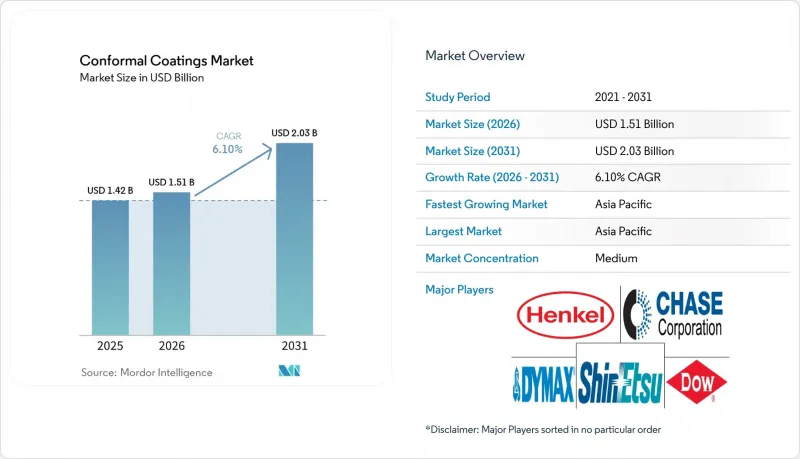
根據 Mordor Intelligence 預測,三防膠市場規模將從 2025 年的 14.2 億美元成長到 2026 年的 15.1 億美元,然後在 2031 年達到 20.3 億美元,2026 年至 2031 年的複合年成長率為 6.10%。
本報告材料類型(丙烯酸、環氧樹脂、矽酮等)、技術(溶劑型、水性、紫外光固化、混合/其他先進系統)、應用方法(噴塗、浸塗等)、終端用戶行業(家用電子電器、汽車等)和地區(亞太、北美、歐洲等)進行細分。市場預測以美元計價。
全球三防膠市場趨勢與洞察
保護微電路對於 5G 智慧型手機和物聯網穿戴裝置至關重要。
在射頻前端和麵積小於 10 mm² 的層壓被動元件中,間隙非常小,因此介電常數小於 3 且厚度可控在 ±5 µm 以內的塗層對於防止電阻漂移至關重要。穿戴式裝置需要生物相容性薄膜,能夠承受 10 萬次彎曲循環,同時保持 IPC-CC-830C 3 級可靠性。越南和印度的代工組裝透過採用選擇性機器人點膠技術,減少了 40% 的材料用量,從而消除了相機模組和軟性 OLED 驅動板中的手動遮蔽步驟。受此產能擴張的推動,杜邦互連解決方案在 2024 年第三季實現了兩位數的低內部成長。製造商還將紫外線固化面漆與透明丙烯酸底漆結合使用,以加速固化並保持 AOI 可見性。
低地球軌道衛星和航空電子設備需要高性能塗層。
計畫於2024年至2030年間發射的1萬多顆低地球軌道衛星,每顆衛星將攜帶50至200個基板,這些基板必須能夠承受原子氧、-150 度C至+125 度C的溫度循環以及100 krad的輻射環境。聚對二甲苯和氟聚合物奈米塗層的性能優於AR型丙烯酸材料,其介電強度超過5 kV/mm,總質量損失小於1%。 2024年,漢高在中國的電子業務實現了兩位數的銷售成長,部分原因是其航空電子專案。航太原始設備製造商(OEM)目前正在對用於15,000公尺高空線傳操縱系統的矽膠系統進行認證,該高度由於低壓更容易發生電暈放電。一條精度為±0.1毫米的自動化真空沉澱線已將相位陣列模組的初始良率提高到98%。
紫外線固化不透明薄膜返工/檢驗的複雜性
不透明的UV塗層可在數秒內固化,但會妨礙AOI相機依照IPC-A-610 3級要求檢驗焊點。去除塗錯的塗層通常需要機械拋光或等離子處理,這會增加細間距QFN封裝焊盤脫落的風險。目前,混合生產線在AOI關鍵區域使用透明UV材料,在其他區域使用彩色塗層,這將使夾具和製程增加15%的成本。諾信公司的Select Coat SL-1040可記錄噴嘴流量和UV曝光量,從而將返工率控制在1%以下。 EMS供應商報告稱,技術人員仍需2-4小時的培訓才能從溶劑型系統切換到UV系統。
細分市場分析
到2025年,丙烯酸類三防膠將主導三防膠市場,佔44.24%的市場。由於組裝製造商優先考慮低成本、廣泛相容性和易於返工等因素,預計該市場將以6.88%的複合年成長率成長。同時,矽基材料因其在-60 度C至+200 度C溫度範圍內的穩定性以及低彈性模量而具有較高的定價合理性,即使在熱循環條件下也能保持焊點的完整性。環氧樹脂基塗層因其耐化學性而在汽車引擎室盒應用中仍然佔據一席之地,但其脆性限制了其應用。胺甲酸乙酯和氨基甲酸酯基塗層在需要超過10萬次彎曲壽命的折疊式設備中表現出色。新興的氟聚合物奈米塗層因其接觸角達到110°或更高且具有防汗性能,在穿戴式裝置中備受青睞,其厚度小於10µm的薄膜需求量很大。
信越化學將於2024年推出KRW-6000矽膠樹脂,該樹脂兼具水性和150 度C下30分鐘固化的特性,在滿足OEM廠商RoHS合規要求的同時,不會影響生產效率。目前,總擁有成本(TCO)是材料選擇的關鍵因素,它不僅考慮原料成本,還考慮資本投資、固化所需的能源消耗以及在歐洲和日本的延伸生產者責任制(EPR)法規下廢棄產品的處置成本。雖然IPC-CC-830C AR型和SR型產品佔據了75%的市場認證佔有率,但2024年修訂的IPC-HDBK-830A標準正式增加了含氟聚合物的指南,以期推動下一代材料的應用。先進的混合產品,例如雙固化環氧-丙烯酸酯混合物,主要面向介電強度達到4 kV/mm、導熱係數達到1 W/mK或更高的電池管理系統(BMS)電源模組。
溶劑型產品憑藉其廣泛的潤濕性和在汽車行業PPAP(生產前批准)流程中的成熟認證,預計到2025年將繼續佔據三防膠市場55.78%的佔有率。同時,紫外光固化塗料正經歷快速成長,預計到2031年將以7.13%的複合年成長率成長,主要得益於其零VOC排放、一秒固化時間和節能(可將烘箱能耗降低80%)等優勢。水性系統在法規優先於加工能力的領域越來越受歡迎,儘管其在80 度C下乾燥時間長達60分鐘,但市佔率已成長至近五分之一。混合化學產品在高壓逆變器的灌封和封裝中發揮重要作用。
越南主要電子製造服務 (EMS) 公司在 2024 年安裝了 200 多條紫外線 LED 光固化隧道,用於智慧型手機天線和無線充電線圈的塗覆,從而減少了 30% 的安裝面積。汽車雷射雷達 (LiDAR) 模組的測試表明,使用紫外光固化矽油可將無黏性時間從 45 分鐘縮短至 60 秒,同時保持符合 MIL-STD-810H 標準的性能。諾信 (Nordson) 2024 年第二季財報顯示,其半導體部門的需求下降了 22%,而其工業精密解決方案部門由於塗覆設備的強勁表現,收入成長了 2%。目前仍存在的挑戰包括不透明薄膜的自動光學檢測 (AOI) 的局限性,但原位螢光測量技術的整合實現了對厚度達 50µm 的薄膜進行即時檢驗,從而減少了預固化缺陷。
區域分析
預計到2025年,亞太地區將佔三防膠市場42.35%的佔有率,並在2031年之前以7.67%的複合年成長率加速成長。隨著智慧型手機和資料中心專案的重啟,中國市場在2024年實現復甦,漢高公司報告稱,電子產業實現了兩位數的成長。東南亞國協在2024年吸引了310億美元的電子產業外國直接投資(FDI),鞏固了其作為半導體後端加工中心的地位。印度的生產連結獎勵計畫計劃(PLI)和5G基地台的建設正在推動符合RoHS標準並獲得印度標準局(BIS)認證的塗層生產線的普及。韓國和日本仍然是軟性顯示器和汽車電子領域的創新中心,促使供應商分別在首爾和東京設立技術中心。
北美的需求主要由航太、國防和電動車製造業所驅動。 《晶片與科學法案》和《通貨膨脹削減法案》預計2030年將為美國國內晶圓廠帶來超過1000億美元的投資,從而提振對IPC認證塗層的需求。 3M電子事業部在2024年推出了169款新產品,展現了對半導體封裝保護材料的專注。墨西哥的下加利福尼亞走廊正在成為電動車電子產品的中心,而加拿大的蒙特婁產業叢集則滿足了航空電子塗層的需求。
在歐洲,德國、法國和英國嚴格執行RoHS和REACH標準,這推動了水性塗料和紫外光固化塗料技術的應用。陶氏高性能材料與塗料事業部2023年的銷售額為84.97億美元,其矽酮產品供應給歐洲的汽車和工業客戶。北歐的電動車電池超級工廠和離岸風力發電轉換器需要耐鹽塗料。南美洲、中東和非洲市場仍在發展中,但持續成長,巴西汽車產業和沙烏地阿拉伯的智慧城市計畫都對耐嚴苛氣候的保護膜有特定需求。
其他好處:
- Excel格式的市場預測(ME)表
- 3個月的分析師支持
目錄
第1章:引言
- 研究假設和市場定義
- 調查範圍
第2章:調查方法
第3章執行摘要
第4章 市場狀況
- 市場概覽
- 市場促進因素
- 5G智慧型手機和物聯網穿戴裝置需要透過微型電路進行保護。
- 低地球軌道衛星和航空電子設備需要高性能塗層。
- 過渡到符合RoHS標準的低VOC水處理系統和紫外線系統法規
- 通訊基礎設施的擴展和5G的部署
- 在航太和國防電子領域中得到更廣泛的應用
- 市場限制因素
- 紫外線固化不透明薄膜的再加工與檢測的複雜性
- 矽酮單體價格波動
- 供不應求
- 價值鏈分析
- 波特五力分析
第5章 市場規模與成長預測
- 材料類型
- 丙烯酸纖維
- 環氧樹脂
- 胺甲酸乙酯/聚氨酯
- 矽酮
- 其他材料類型(氟樹脂、奈米塗層)
- 透過技術
- 溶劑型
- 水溶液
- 紫外線固化型
- 混合/其他先進系統
- 透過操作方法
- 噴塗(霧化/成膜)
- 浸塗
- 刷塗
- 其他操作方法(選擇性/機器人輔助塗覆和化學氣相沉積(CVD))
- 按最終用戶行業分類
- 家用電子產品
- 汽車(內燃機、電動車、高級駕駛輔助系統)
- 航太/國防
- 醫療、生命科學與電子
- 其他終端用戶產業(工業、電力和能源)
- 按地區
- 亞太地區
- 中國
- 印度
- 日本
- 韓國
- 東南亞國協
- 其他亞太國家
- 北美洲
- 美國
- 加拿大
- 墨西哥
- 歐洲
- 德國
- 英國
- 義大利
- 法國
- 北歐國家
- 其他歐洲國家
- 南美洲
- 巴西
- 阿根廷
- 其他南美國家
- 中東和非洲
- 沙烏地阿拉伯
- 南非
- 其他中東和非洲國家
- 亞太地區
第6章 競爭情勢
- 市場集中度
- 策略趨勢
- 市佔率和排名分析
- 公司簡介
- 3M
- Actnano Inc.
- Altana AG
- Bostik(Arkema)
- Chase Corp.
- Chemtronics(KEMET)
- CHT UK Ltd
- Dow
- Dymax
- Electrolube
- Europlasma NV
- HB Fuller Company
- Henkel AG & Co. KGaA
- Illinois Tool Works Inc.
- MG Chemicals
- Nordson Corporation
- Panacol-Elosol GmbH
- PVA
- Shin-Etsu Chemical Co., Ltd.
第7章 市場機會與未來展望
According to Mordor Intelligence, the conformal coatings market size is expected to grow from USD 1.42 billion in 2025 to USD 1.51 billion in 2026 and is forecast to reach USD 2.03 billion by 2031 at 6.10% CAGR over 2026-2031.
This report is Segmented by Material Type (Acrylic, Epoxy, Silicone and More), Technology (Solvent-Based, Water-Based, UV-Cured, and Hybrid/Other Advanced Systems), Operation Method (Spray Coating, Dip Coating, and More), End-User Industry (Consumer Electronics, Automotive, and More), and Geography (Asia-Pacific, North America, Europe, and More). The Market Forecasts are Provided in Terms of Value (USD).
Global Conformal Coatings Market Trends and Insights
5G Smartphones and IoT Wearables Require Mini-Circuit Protection
Sub-10 mm2 RF front-ends and stacked passives leave little clearance, compelling coatings with dielectric constants below 3 and +-5 µm thickness control to prevent impedance drift. Wearables demand biocompatible films that survive 100,000 flex cycles yet retain IPC-CC-830C Class 3 reliability. Contract assemblers in Vietnam and India saved 40% of material by switching to selective robotic dispensing, eliminating manual masking on camera modules and flexible OLED driver boards. DuPont's Interconnect Solutions reported low-double-digit organic growth in Q3 2024 on the back of these ramps. Manufacturers also pair UV-cured topcoats with transparent acrylic under-layers to speed cure and preserve AOI visibility.
LEO Satellites and Avionics Electronics Need High-Performance Coatings
More than 10 000 LEO satellites slated for launch between 2024 and 2030 each carry 50-200 boards that must withstand atomic oxygen, -150 °C to +125 °C cycling, and 100 krad radiation environments. Parylene and fluoropolymer nano-coatings deliver dielectric strength above 5 kV/mm and outgassing below 1% total mass loss, surpassing Type AR acrylics. Henkel logged double-digit electronics growth in China during 2024, partially tied to avionics programs. Aerospace OEMs now qualify silicone systems for fly-by-wire control at 15 000 m where low pressure invites corona discharge. Automated vacuum deposition lines with +-0.1 mm accuracy improve first-pass yield to 98% on phased-array modules.
Rework/Inspection Complexity of UV-Cured Opaque Films
Opaque UV coatings cure within seconds, yet block AOI cameras from verifying solder joints required under IPC-A-610 Class 3. Mechanical abrasion or plasma is often the only route to remove misapplied films, risking pad lift on fine-pitch QFNs. Hybrid lines now apply transparent UV material on AOI-critical zones and pigmented coating elsewhere, adding 15% overhead in fixtures and recipes. Nordson's Select Coat SL-1040 logs nozzle flow and UV dose to cut rework under 1%. EMS players still cite 2-4 hour training curves for technicians switching from solvent to UV systems.
Other drivers and restraints analyzed in the detailed report include:
- Regulatory Shift to RoHS-Compliant Low-VOC Water/UV Systems
- Expansion of Telecom Infrastructure and 5G Rollout
- Silicone-Monomer Price Volatility
For complete list of drivers and restraints, kindly check the Table Of Contents.
Segment Analysis
Acrylics led the conformal coatings market with 44.24% share in 2025 and are forecast to grow at 6.88% CAGR as assemblers value low cost, broad compatibility, and easy rework. Silicone chemistries, meanwhile, deliver -60 °C to +200 °C stability and low modulus that preserves solder joint integrity under thermal cycling, justifying premium pricing. Epoxies remain entrenched in under-hood automotive boxes for their chemical resistance, although brittleness limits take-rate. Urethanes and polyurethanes win in foldable devices demanding flex life above 100,000 cycles. Emerging fluoropolymer nano-coatings are logging demand for sub-10 µm films with contact angles more than 110° that repel sweat in wearables.
Silicone's KRW-6000, launched by Shin-Etsu in 2024, marries water dispersibility with 30-minute cure at 150 °C, answering OEM calls for RoHS compliance without throughput penalties. Total cost-of-ownership now dictates material decisions, blending raw resin price with capital, cure-energy loads, and end-of-life disposal under extended producer rules in Europe and Japan. IPC-CC-830C Type AR and Type SR products account for 75% of market qualifications, yet the 2024 IPC-HDBK-830A update formally added fluoropolymer guidance, foreshadowing next-gen adoption. Advanced hybrids, such as dual-cure epoxy-acrylate blends, target BMS power modules requiring 4 kV/mm dielectric strength and >=1 W/mK thermal conductivity.
Solvent-based still occupy 55.78% of the conformal coatings market size in 2025, owing to broad wetting and established approvals across automotive PPAPs. UV-cured, however, are accelerating at 7.13% CAGR through 2031, driven by zero-VOC status, one-second cures, and energy savings that cut oven power by 80%. Water-based systems gain favor where regulation trumps throughput, rising to nearly one-fifth of volume despite 60-minute dry times at 80 °C. Hybrid chemistries serve potting and encapsulation roles in high-voltage inverters.
EMS giants in Vietnam installed over 200 UV-LED tunnels in 2024 to coat smartphone antennas and wireless charging coils, trimming floor space 30%. Automotive trials on LiDAR modules show UV silicones slicing tack-free time from 45 minutes to 60 seconds while sustaining MIL-STD-810H performance. Nordson's Q2 2024 saw Industrial Precision Solutions rise 2% on coatings equipment even as semiconductor demand sagged 22% in its Advanced Technology arm. Persistent barriers include opaque-film AOI limits, but integration of in-situ fluorometry now validates 50 µm thickness in real time, mitigating defects before cure.
Geography Analysis
Asia-Pacific generated 42.35% of conformal coatings market revenue in 2025 and is accelerating at 7.67% CAGR through 2031. China rebounded in 2024 as smartphone and data center projects resumed, with Henkel citing double-digit electronics growth. ASEAN nations secured USD 31 billion electronics FDI in 2024, cementing their role as back-end semiconductor hubs. India's PLI incentives and 5G base-station buildout are spurring RoHS-compliant coating lines tied to Bureau of Indian Standards approvals. South Korea and Japan remain innovation centers for flex displays and automotive electronics, prompting suppliers to open tech centers in Seoul and Tokyo.
North America's demand is supported by aerospace, defense, and EV manufacturing. The CHIPS and Science Act and Inflation Reduction Act will funnel more than USD 100 billion toward domestic fabs through 2030, boosting demand for IPC-qualified coatings . 3M's Electronics division launched 169 new products in 2024, showing a push for protective materials in semiconductor packaging. Mexico's Baja California corridor is becoming an EV electronics hot spot, while Canada's Montreal cluster services avionics coating needs.
In Europe, Germany, France, and the United Kingdom enforce strict RoHS and REACH standards, propelling water-based and UV chemistries. Dow's Performance Materials & Coatings reported USD 8.497 billion sales in 2023, with silicones serving European auto and industrial clients. Nordic EV battery gigafactories and offshore wind converters need salt-fog-resistant coatings. South America and the Middle East and Africa remain nascent but are growing as Brazil's auto sector and Saudi smart-city projects specify protective films for harsh climates.
- 3M
- Actnano Inc.
- Altana AG
- Bostik (Arkema)
- Chase Corp.
- Chemtronics (KEMET)
- CHT UK Ltd
- Dow
- Dymax
- Electrolube
- Europlasma NV
- H.B. Fuller Company
- Henkel AG & Co. KGaA
- Illinois Tool Works Inc.
- MG Chemicals
- Nordson Corporation
- Panacol-Elosol GmbH
- PVA
- Shin-Etsu Chemical Co., Ltd.
Additional Benefits:
- The market estimate (ME) sheet in Excel format
- 3 months of analyst support
TABLE OF CONTENTS
1 Introduction
- 1.1 Study Assumptions and Market Definition
- 1.2 Scope of the Study
2 Research Methodology
3 Executive Summary
4 Market Landscape
- 4.1 Market Overview
- 4.2 Market Drivers
- 4.2.1 5G Smartphones and IoT Wearables Require Mini-Circuit Protection
- 4.2.2 LEO Satellites and Avionics Electronics Need High-Performance Coatings
- 4.2.3 Regulatory Shift to Rohs-Compliant Low-VOC Water/UV Systems
- 4.2.4 Expansion of Telecom Infrastructure and 5G Rollout
- 4.2.5 Increasing Aerospace and Defence Electronics Applications
- 4.3 Market Restraints
- 4.3.1 Rework/Inspection Complexity of UV-Cured Opaque Films
- 4.3.2 Silicone-Monomer Price Volatility
- 4.3.3 Scarcity of High-Purity Parylene Dimer
- 4.4 Value Chain Analysis
- 4.5 Porter's Five Forces Analysis
- 4.5.1 Bargaining Power of Suppliers
- 4.5.2 Bargaining Power of Consumers
- 4.5.3 Threat of New Entrants
- 4.5.4 Threat of Substitutes
- 4.5.5 Degree of Competition
5 Market Size and Growth Forecasts (Value)
- 5.1 By Material Type
- 5.1.1 Acrylic
- 5.1.2 Epoxy
- 5.1.3 Urethane/Polyurethane
- 5.1.4 Silicone
- 5.1.5 Other Material Types (Fluoropolymer, Nano-coatings)
- 5.2 By Technology
- 5.2.1 Solvent-Based
- 5.2.2 Water-Based
- 5.2.3 UV-Cured
- 5.2.4 Hybrid/Other Advanced Systems
- 5.3 By Operation Method
- 5.3.1 Spray Coating (Atomised/Film)
- 5.3.2 Dip Coating
- 5.3.3 Brush Coating
- 5.3.4 Other Operation Methods (Selective/Robotic Dispense and Chemical Vapour Deposition (CVD))
- 5.4 By End-user Industry
- 5.4.1 Consumer Electronics
- 5.4.2 Automotive (ICE, EV, ADAS)
- 5.4.3 Aerospace and Defense
- 5.4.4 Medical and Life-Sciences Electronics
- 5.4.5 Other End-user Industries (Industrial, Power and Energy)
- 5.5 By Geography
- 5.5.1 Asia-Pacific
- 5.5.1.1 China
- 5.5.1.2 India
- 5.5.1.3 Japan
- 5.5.1.4 South Korea
- 5.5.1.5 ASEAN Countries
- 5.5.1.6 Rest of Asia-Pacific
- 5.5.2 North America
- 5.5.2.1 United States
- 5.5.2.2 Canada
- 5.5.2.3 Mexico
- 5.5.3 Europe
- 5.5.3.1 Germany
- 5.5.3.2 United Kingdom
- 5.5.3.3 Italy
- 5.5.3.4 France
- 5.5.3.5 NORDIC Countries
- 5.5.3.6 Rest of Europe
- 5.5.4 South America
- 5.5.4.1 Brazil
- 5.5.4.2 Argentina
- 5.5.4.3 Rest of South America
- 5.5.5 Middle-East and Africa
- 5.5.5.1 Saudi Arabia
- 5.5.5.2 South Africa
- 5.5.5.3 Rest of Middle-East and Africa
- 5.5.1 Asia-Pacific
6 Competitive Landscape
- 6.1 Market Concentration
- 6.2 Strategic Moves
- 6.3 Market Share(%)/Ranking Analysis
- 6.4 Company Profiles (includes Global-level Overview, Market-level Overview, Core Segments, Financials as available, Strategic Information, Products and Services, Recent Developments)
- 6.4.1 3M
- 6.4.2 Actnano Inc.
- 6.4.3 Altana AG
- 6.4.4 Bostik (Arkema)
- 6.4.5 Chase Corp.
- 6.4.6 Chemtronics (KEMET)
- 6.4.7 CHT UK Ltd
- 6.4.8 Dow
- 6.4.9 Dymax
- 6.4.10 Electrolube
- 6.4.11 Europlasma NV
- 6.4.12 H.B. Fuller Company
- 6.4.13 Henkel AG & Co. KGaA
- 6.4.14 Illinois Tool Works Inc.
- 6.4.15 MG Chemicals
- 6.4.16 Nordson Corporation
- 6.4.17 Panacol-Elosol GmbH
- 6.4.18 PVA
- 6.4.19 Shin-Etsu Chemical Co., Ltd.
7 Market Opportunities and Future Outlook
- 7.1 White-space and Unmet-Need Assessment

 陶瓷三防膠市場:全球市場預測,2026-2032年
 電子領域的敷形塗層:全球市場三防膠市場:2026-2032年全球市場預測(依材料、固化機制、功能、塗層厚度範圍、終端用戶產業、應用方法及通路分類)
 全球三防膠市場-產業規模、佔有率、趨勢、機會、預測:按類型、最終用途、地區和競爭格局分類,2021-2031年
 三防膠剝離劑市場:按類型、配方、最終用途行業和地區分類三防膠市場:依材料、終端應用產業及地區分類電子設備用三防膠市場:依塗層材料、應用方法、厚度範圍、固化系統和最終用戶分類-2026-2032年全球預測
 三防膠市場規模、佔有率、成長及全球產業分析:按產品、最終用途產業和地區分類的洞察與預測(2026-2034 年)
 三防膠市場規模、佔有率、趨勢和預測:按類型、技術、應用方法、最終用途和地區分類,2026-2034年
 三防膠市場分析及預測(至2035年):依類型、產品類型、服務、技術、應用、材料類型、製程、最終用戶、功能分類