


 |
市場調查報告書
商品編碼
2066476
詐欺偵測與預防(FDP):市佔率分析、產業趨勢與統計、成長預測(2026-2031 年)Fraud Detection and Prevention (FDP) - Market Share Analysis, Industry Trends & Statistics, Growth Forecasts (2026 - 2031) |
||||||

※ 本網頁內容可能與最新版本有所差異。詳細情況請與我們聯繫。
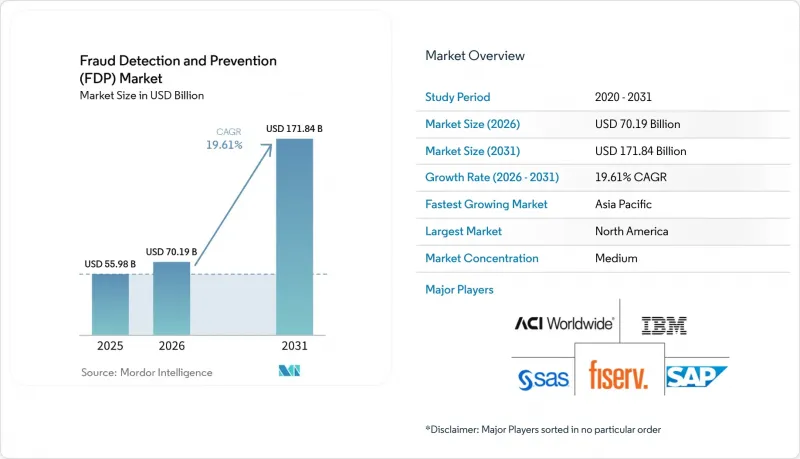
據 Mordor Intelligence 稱,詐欺偵測和預防市場預計將從 2025 年的 559.8 億美元成長到 2026 年的 701.9 億美元,到 2031 年達到 1,718.4 億美元,2026 年至 2031 年的複合年成長率為 19.61%。
本報告按組件(解決方案和服務)、部署模式(雲端和本地部署)、組織規模(中小企業和大型企業)、最終用戶行業(銀行、金融服務和保險、零售和電子商務、醫療保健等)以及地區進行細分。市場預測以美元計價。
全球詐欺檢測與預防 (FDP) 市場趨勢及洞察
數位支付和電子商務交易量的成長
隨著消費者轉向缺乏實體安全功能的線上管道,非接觸式銀行卡交易如今已成為全球詐欺損失的主要來源。歐洲中央銀行的報告顯示,2024年,非接觸式銀行卡詐欺將佔所有銀行卡詐欺的79%。光是2025年12月,印度的統一支付介面(UPI)就處理了167.3億筆交易,年增45%,這給其傳統的批量處理舊有系統帶來了巨大壓力。跨境電子商務讓詐欺偵測變得更加複雜,因為特定地區的風險模式很少能推廣到其他地區,迫使商家維護特定地區的模式。商家正在採用被動式生物識別來平衡詐欺防範和客戶體驗,而支付促進者正在整合網路訊息,使即使是小規模商家也能利用整個聯盟的訊號。
嚴格遵守反洗錢和PSD2 SCA相關法規
一系列監管變革正在強制推行多因素認證、持續監控和可審計的工作流程。歐洲銀行管理局 (EBA) 加強了 2024 年強客戶認證 (SCA) 的豁免要求,降低了無摩擦支付的閾值,迫使發卡機構採用基於風險的支付引擎。目前正在審議中的支付服務指令 3 (PSD3) 草案將於 2025 年生效,該草案將把已通過核准的推送支付詐騙的責任範圍擴大到匯款銀行,並將檢測責任轉移到交易發起階段。在美國,金融犯罪執法網路 (FinCEN) 的受益所有權規則要求檢驗控制結構,這提高了人們對圖資料庫分析的興趣。跨國金融機構需要協調各國不同的資料保留要求,因此採用了聯邦學習方法,該方法可以在將訓練資料保留在國家境內的同時共用模型權重。
誤報率過高會對客戶體驗造成不利影響。
在現行規則下,合法訂單的誤判率仍高達兩位數,導致營運成本增加、客戶終身價值下降,有時甚至超過直接詐欺損失。人工審核每筆被標記的交易成本為 10 至 15 美元,這對低利潤商家來說是一筆不小的負擔。行為生物辨識技術(可捕捉擊鍵節奏和設備傾斜角度)有望將誤報率降低到 3% 以下,但由於許多用戶許可框架將持續行為追蹤視為敏感個人數據,因此該技術的推廣應用進展緩慢。跨境訂單受到的影響尤其嚴重,因為陌生的 IP 位址資訊會觸發速度檢查,導致購物車遺棄和聲譽受損。
細分市場分析
預計到2025年,詐欺偵測和預防解決方案市場將達到歷史新高,佔據平台、身分驗證閘道和報告儀表板66.26%的市場佔有率,並帶來快速的投資回報。然而,託管檢測、模型檢驗和監管諮詢等服務的成長速度超過了軟體包。金融機構認知到,自適應詐欺預防是一個持續的過程,需要每週更新模型並不斷完善合規性映射。專業的顧問公司現在提供將資料科學專業知識與SaaS儀表板結合的服務,使銀行能夠在不放棄策略控制的情況下外包特徵工程。報告和視覺化模組曾經只是輔助角色,但隨著即時風險敞口指標影響資本配置決策,它們在董事會層面也越來越受到重視。詐欺偵測和身分驗證的整合模糊了各個元件之間的界限,從而實現了在整個客戶生命週期中進行統一的風險評分。
從長遠來看,商品化的壓力迫使供應商透過專有資料網路和低延遲推理來脫穎而出。 IBM 計畫於 2025 年發布的基於使用量的詐欺偵測即服務 (收費 Detection as a Service) 清楚地展示了計量收費模式如何將成本與實際交易風險掛鉤。根據財務風險和監管嚴格程度來編配正變得至關重要。金融機構現在將 30% 到 40% 的詐欺預防預算分配給外部服務,這推動了從資本支出 (Capex) 技術採購向以可衡量的損失減少結果為重點的營運支出 (OpEx)夥伴關係關係的轉變。
預計到 2025 年,雲端運算將佔總收入的 63.82%,到 2031 年將成長約 19.95%。這主要得益於彈性運算,它使反詐騙團隊推出GPU叢集來訓練圖神經網路。即時擴展功能支援每週無停機重新部署模型,而領先的超大規模超大規模資料中心業者供應商的安全認證也滿足了大多數監管機構的要求。在資料主權法規禁止跨境傳輸或資料中心近期投資仍處於折舊免稅額期的情況下,本地部署仍然適用。混合架構透過在本地評估高風險交易,同時在雲端資料湖中聚合匿名化匯總數據,從而平衡資料居住規則和機器學習效率。 2024 年,歐洲銀行管理局 (EBA) 明確指出,外包到雲端並不意味著課責轉移,這增強了風險委員會對遷移關鍵工作負載的信心。
全球各大銀行正日益採用多重雲端策略,以避免被單一供應商鎖定,並將運算資源分散到不同區域以增強容錯能力。然而,工具鏈的差異會使資料同步變得複雜,模型版本漂移也可能導致不同管道決策的不一致。幾家美國中型銀行在2025年底採用的Google雲端虛擬私有雲端(VPC)部署模式表明,如果客戶能夠掌控自己的加密金鑰,就有可能說服監管機構。
區域分析
2025年,北美地區佔全球整體營收的31.87%。這主要得益於強勁的消費支出,而強勁的消費支出又源自於高數位支付普及率和完善的合規體系。美國聯邦貿易委員會(FTC)在2023年報告稱,消費者詐騙損失高達100億美元,凸顯了經營團隊主管亟需改善管理實務。加拿大即時鐵路(Real-Time Rail)和美國聯邦即時支付系統(FedNow)等即時支付系統正在縮短支付處理時間,迫使銀行將模型評分延遲降低到一秒以內。監管機構對第三方服務供應商的監管力度不斷加強,要求金融機構對供應商模型的可解釋性和是否存在偏見進行審計。
亞太地區是成長最快的地區,預計年複合成長率將達到20.43%,主要得益於印度、中國、澳洲和日本支付基礎設施的現代化。印度的統一支付介面(UPI)到2025年12月將處理167.3億筆交易,促使印度儲備銀行(RBI)強制要求對高額轉帳進行額外身份驗證(RBI.ORG.IN)。中國的數位人民幣試點計畫正在將無現金生態系統擴展到地方縣,但也帶來了新的詐欺途徑,例如線下錢包中的身份盜竊。日本修訂後的反洗錢指南強調持續監控而非基於規則的檢查,這刺激了對人工智慧平台和其他技術的需求。澳洲的新支付平台(NPP)預計在2024年將處理12億筆即時轉賬,這將暴露其為批量處理ACH文件而構建的欺詐分析系統的缺陷。
歐洲仍佔較大佔有率,主要得益於PSD2「強客戶認證」的要求,但2024年非面對面銀行卡交易造成的損失高達42億歐元(45億美元)。 27個成員國對此指令的不同解讀使跨國營運變得複雜,促使銀行實施可配置的策略引擎,並允許區域性規則的調整。在南美洲,巴西的「Pix」系統在2024年記錄了420億筆交易,促使各國央行實施交易上限和夜間暫停交易等措施,這推動了相關領域的發展。在中東和非洲,行動支付詐欺分析的部署正在加速,以保護那些沒有銀行帳戶但參與數位生態系統的人。
其他好處:
- Excel格式的市場預測(ME)表
- 3個月的分析師支持
目錄
第1章:引言
- 研究假設和市場定義
- 調查範圍
第2章:調查方法
第3章執行摘要
第4章 市場狀況
- 市場概覽
- 市場促進因素
- 數位支付和電子商務交易量的成長
- 嚴格遵守反洗錢和PSD2 SCA相關法規
- 利用人工智慧和機器學習模型提高即時檢測精度
- 透過代幣化和引入 EMV 3-D Secure 2.3 來減少非面對面交易中的詐欺行為。
- 開放銀行和即時支付基礎設施的普及為詐欺行為創造了新的途徑。
- 生成式人工智慧驅動的深度造假和合成身分攻擊正在推動對自適應 FDP 的投資。
- 市場限制因素
- 誤報率過高會對客戶體驗造成不利影響。
- 與分散的遺留核心系統整合的複雜性
- 缺乏用於高級機器學習訓練的標籤詐欺資料集
- GDPR 和 CCPA 對資料共用的限制
- 產業價值鏈分析
- 監理情勢
- 技術展望
- 波特五力分析
- 宏觀經濟因素對市場的影響
第5章 市場規模與成長預測
- 按組件
- 解決方案
- 詐欺分析
- 認證
- 彙報
- 視覺化
- 其他規則
- 服務
- 解決方案
- 部署模式
- 雲
- 現場
- 按組織規模
- 小型企業
- 大公司
- 按最終用戶行業分類
- BFSI
- 零售與電子商務
- IT/通訊
- 衛生保健
- 能源公用事業
- 製造業
- 政府/公共部門
- 其他終端用戶產業
- 按地區
- 北美洲
- 美國
- 加拿大
- 墨西哥
- 南美洲
- 巴西
- 阿根廷
- 其他南美國家
- 歐洲
- 英國
- 德國
- 法國
- 義大利
- 西班牙
- 其他歐洲國家
- 亞太地區
- 中國
- 日本
- 韓國
- 印度
- 澳洲
- 其他亞太國家
- 中東
- 沙烏地阿拉伯
- 阿拉伯聯合大公國
- 土耳其
- 其他中東國家
- 非洲
- 南非
- 奈及利亞
- 埃及
- 其他非洲國家
- 北美洲
第6章 競爭情勢
- 市場集中度
- 策略趨勢
- 市佔率分析
- 公司簡介
- SAP SE
- IBM Corporation
- SAS Institute Inc.
- ACI Worldwide Inc.
- Fiserv Inc.
- Experian PLC
- DXC Technology Company
- BAE Systems PLC
- RSA Security LLC(Dell Technologies)
- Oracle Corporation
- NICE Ltd
- Equifax Inc.
- LexisNexis Risk Solutions
- Fair Isaac Corporation(FICO)
- Cybersource Corporation(Visa)
- Global Payments Inc.
- Feedzai SA
- Signifyd Inc.
- Riskified Ltd.
- Kount Inc.
第7章 市場機會與未來展望
According to Mordor Intelligence, the fraud detection and prevention market size is expected to increase from USD 55.98 billion in 2025 to USD 70.19 billion in 2026 and reach USD 171.84 billion by 2031, growing at a CAGR of 19.61% over 2026-2031.
This report is Segmented by Component (Solutions, and Services), Deployment Mode (Cloud, and On-Premises), Organization Size (Small and Medium Enterprises, and Large Enterprises), End-User Industry (BFSI, Retail and E-Commerce, Healthcare, and More), and by Geography. The Market Forecasts are Provided in Terms of Value (USD).
Global Fraud Detection and Prevention (FDP) Market Trends and Insights
Rising Digital Payments And E-Commerce Transaction Volumes
Card-not-present transactions account for the majority of global fraud losses as consumers shift to online channels where physical security features are absent. The European Central Bank reported that card-not-present fraud accounted for 79% of total card fraud in 2024. India's Unified Payments Interface processed 16.73 billion transactions in December 2025 alone, a 45% year-over-year increase that strained batch-oriented legacy systems. Cross-border e-commerce complicates detection because region-specific risk patterns rarely generalize, compelling vendors to maintain localized models. Merchants are adopting passive biometrics to balance fraud control and customer friction, and payment facilitators aggregate network intelligence so even small sellers benefit from consortium-wide signals.
Stringent Regulatory Compliance For AML And PSD2 SCA
Successive rulemakings are mandating multi-factor authentication, continuous monitoring, and auditable workflows. The European Banking Authority's tightened Strong Customer Authentication exemptions in 2024 narrowed frictionless-payment thresholds, prompting issuers to deploy risk-based engines. Proposed Payment Services Directive 3, which is circulating in 2025, would extend liability for authorized push-payment fraud to sending banks, shifting detection to the initiation layer. In the United States, FinCEN's beneficial-ownership rule requires verification of control structures, driving interest in graph-database analytics. Multinational institutions must reconcile divergent data-residency obligations, leading to federated learning approaches that keep training data within national borders while sharing model weights.
High False-Positive Rates Undermining Customer Experience
Legacy rules still misclassify legitimate orders at double-digit rates, generating operational cost and lifetime-value erosion that sometimes exceed direct fraud losses. Manual reviews can cost USD 10-15 per flagged transaction, burdening merchants with thin margins. Behavioral biometrics that capture keystroke cadence and device-tilt angles promise to cut false positives below 3%, yet deployment lags because many consent frameworks treat continuous behavior capture as sensitive personal data. Cross-border orders suffer most, since unfamiliar IP geographies trip velocity checks, leading to cart abandonment and reputational damage.
Other drivers and restraints analyzed in the detailed report include:
- AI And Machine Learning Models Increasing Real-Time Detection Accuracy
- Tokenization And EMV 3-D Secure 2.3 Adoption Reducing Card-Not-Present Fraud
- Integration Complexity With Fragmented Legacy Core Systems
For complete list of drivers and restraints, kindly check the Table Of Contents.
Segment Analysis
The fraud detection and prevention market size for solutions reached its highest level in 2025, capturing 66.26% of platforms, authentication gateways, and reporting dashboards delivered rapid ROI. Yet services, including managed detection, model validation, and regulatory advisory, are expanding faster than packaged software. Institutions are learning that adaptive fraud defense is an ongoing process requiring weekly model refreshes and ever-evolving compliance mapping. Specialist consultancies now bundle data-science talent with SaaS dashboards so banks can outsource feature engineering without ceding strategic oversight. Reporting and visualization modules that once sat on the sidelines are gaining board-level attention because real-time exposure metrics influence capital-allocation decisions. Consolidation of fraud detection with identity verification blurs component boundaries, enabling unified risk scoring across the customer lifecycle.
Longer term, commoditization pressures solutions vendors to differentiate through proprietary data networks and low-latency inference. IBM's 2025 expansion of consumption-priced fraud detection as a service illustrates how pay-as-you-go models align costs with actual transaction risk. Workflow orchestration that prioritizes alerts based on financial risk and regulatory severity is becoming table stakes. Institutions now allocate 30-40% of their fraud-prevention budget to external services, reinforcing the shift from capex technology purchases to opex partnerships focused on measurable loss-reduction outcomes.
Cloud captured 63.82% of 2025 revenue, growing around 19.95% through 2031, as elastic compute lets fraud teams spin up GPU clusters for graph neural network training on demand. Real-time scaling means weekly model redeployments are complete without downtime, and security certifications from major hyperscalers satisfy most supervisory expectations. On-premises installations persist where data-sovereignty statutes prohibit cross-border transfer or where recent datacenter investments remain on depreciation schedules. Hybrid architectures, which score high-risk transactions locally while pooling de-identified aggregates in cloud data lakes, reconcile residency rules with machine-learning efficiency. The European Banking Authority clarified in 2024 that cloud outsourcing does not transfer accountability, giving risk committees confidence to migrate critical workloads.
Multi-cloud strategies gain traction among global banks keen to avoid single-vendor lock-in and to distribute compute across regions for resilience. Still, divergent toolchains complicate data synchronization, and model version drift can lead to inconsistent decisions across channels. Google Cloud's virtual-private-cloud deployment pattern, adopted by several mid-tier U.S. banks in late 2025, shows regulators can be convinced when customers retain encryption-key control.
Geography Analysis
North America generated 31.87% of global revenue in 2025 as high digital-payment penetration and robust compliance frameworks kept spending elevated. The U.S. Federal Trade Commission logged USD 10 billion in consumer fraud losses in 2023, reinforcing board-level urgency for improved controls. Real-time rails such as the Real-Time Rail in Canada and FedNow in the United States are shortening settlement windows, forcing banks to reduce model-scoring latency to sub-second levels. Regulatory scrutiny intensifies around third-party service providers, compelling financial institutions to audit vendor models for explainability and bias.
Asia-Pacific is the fastest-growing region, projected to post a 20.43% CAGR as India, China, Australia, and Japan modernize payments infrastructure. India's UPI handled 16.73 billion transactions in December 2025, catalyzing Reserve Bank mandates for additional authentication on high-ticket transfers RBI.ORG.IN. China's digital-yuan pilots expand cashless ecosystems to rural counties, adding novel fraud vectors such as identity spoofing in offline wallets. Japan's revised AML guidelines emphasize continuous monitoring over rule-based checks, stimulating demand for AI platforms such as. Australia's New Payments Platform processed 1.2 billion instant transfers in 2024, exposing gaps in fraud-analytics stacks built for batch ACH files.
Europe maintains significant share on the strength of PSD2 Strong Customer Authentication mandates, yet card-not-present losses still reached EUR 4.2 billion (USD 4.5 billion) in 2024. Fragmented interpretations across 27 member states complicate multinational rollouts, prompting banks to deploy configurable policy engines capable of local overrides. South America gains momentum as Brazil's Pix clocked 42 billion transactions in 2024, leading the Central Bank to impose transaction caps and nightly cooling-off periods. The Middle East and Africa regions accelerate adoption of mobile-money fraud analytics to protect unbanked populations joining digital ecosystems.
- SAP SE
- IBM Corporation
- SAS Institute Inc.
- ACI Worldwide Inc.
- Fiserv Inc.
- Experian PLC
- DXC Technology Company
- BAE Systems PLC
- RSA Security LLC (Dell Technologies)
- Oracle Corporation
- NICE Ltd
- Equifax Inc.
- LexisNexis Risk Solutions
- Fair Isaac Corporation (FICO)
- Cybersource Corporation (Visa)
- Global Payments Inc.
- Feedzai SA
- Signifyd Inc.
- Riskified Ltd.
- Kount Inc.
Additional Benefits:
- The market estimate (ME) sheet in Excel format
- 3 months of analyst support
TABLE OF CONTENTS
1 INTRODUCTION
- 1.1 Study Assumptions and Market Definition
- 1.2 Scope of the Study
2 RESEARCH METHODOLOGY
3 EXECUTIVE SUMMARY
4 MARKET LANDSCAPE
- 4.1 Market Overview
- 4.2 Market Drivers
- 4.2.1 Rising Digital Payments and E-Commerce Transaction Volumes
- 4.2.2 Stringent Regulatory Compliance for AML and PSD2 SCA
- 4.2.3 AI and Machine Learning Models Increasing Real-Time Detection Accuracy
- 4.2.4 Tokenization and EMV 3-D Secure 2.3 Adoption Reducing Card-Not-Present Fraud
- 4.2.5 Proliferation of Open Banking and Instant-Payment Rails Creating New Fraud Vectors
- 4.2.6 Generative AI Deepfake and Synthetic Identity Attacks Pushing Adaptive FDP Investments
- 4.3 Market Restraints
- 4.3.1 High False-Positive Rates Undermining Customer Experience
- 4.3.2 Integration Complexity with Fragmented Legacy Core Systems
- 4.3.3 Scarcity of Labeled Fraud Datasets for Advanced ML Training
- 4.3.4 Data-Sharing Constraints Imposed by GDPR and CCPA
- 4.4 Industry Value Chain Analysis
- 4.5 Regulatory Landscape
- 4.6 Technological Outlook
- 4.7 Porter's Five Forces Analysis
- 4.7.1 Bargaining Power of Suppliers
- 4.7.2 Bargaining Power of Buyers
- 4.7.3 Threat of New Entrants
- 4.7.4 Threat of Substitutes
- 4.7.5 Intensity of Competitive Rivalry
- 4.8 Impact of Macroeconomic Factors on the Market
5 MARKET SIZE AND GROWTH FORECASTS (VALUE)
- 5.1 By Component
- 5.1.1 Solutions
- 5.1.1.1 Fraud Analytics
- 5.1.1.2 Authentication
- 5.1.1.3 Reporting
- 5.1.1.4 Visualization
- 5.1.1.5 Other Components
- 5.1.2 Services
- 5.1.1 Solutions
- 5.2 By Deployment Mode
- 5.2.1 Cloud
- 5.2.2 On-premises
- 5.3 By Organization Size
- 5.3.1 Small and Medium Enterprises
- 5.3.2 Large Enterprises
- 5.4 By End-user Industry
- 5.4.1 BFSI
- 5.4.2 Retail and E-Commerce
- 5.4.3 IT and Telecom
- 5.4.4 Healthcare
- 5.4.5 Energy and Utilities
- 5.4.6 Manufacturing
- 5.4.7 Government and Public Sector
- 5.4.8 Other End-user Industries
- 5.5 By Geography
- 5.5.1 North America
- 5.5.1.1 United States
- 5.5.1.2 Canada
- 5.5.1.3 Mexico
- 5.5.2 South America
- 5.5.2.1 Brazil
- 5.5.2.2 Argentina
- 5.5.2.3 Rest of South America
- 5.5.3 Europe
- 5.5.3.1 United Kingdom
- 5.5.3.2 Germany
- 5.5.3.3 France
- 5.5.3.4 Italy
- 5.5.3.5 Spain
- 5.5.3.6 Rest of Europe
- 5.5.4 Asia-Pacific
- 5.5.4.1 China
- 5.5.4.2 Japan
- 5.5.4.3 South Korea
- 5.5.4.4 India
- 5.5.4.5 Australia
- 5.5.4.6 Rest of Asia-Pacific
- 5.5.5 Middle East
- 5.5.5.1 Saudi Arabia
- 5.5.5.2 United Arab Emirates
- 5.5.5.3 Turkey
- 5.5.5.4 Rest of Middle East
- 5.5.6 Africa
- 5.5.6.1 South Africa
- 5.5.6.2 Nigeria
- 5.5.6.3 Egypt
- 5.5.6.4 Rest of Africa
- 5.5.1 North America
6 COMPETITIVE LANDSCAPE
- 6.1 Market Concentration
- 6.2 Strategic Moves
- 6.3 Market Share Analysis
- 6.4 Company Profiles (includes Global Level Overview, Market Level Overview, Core Segments, Financials as available, Strategic Information, Market Rank/Share, Products and Services, Recent Developments)
- 6.4.1 SAP SE
- 6.4.2 IBM Corporation
- 6.4.3 SAS Institute Inc.
- 6.4.4 ACI Worldwide Inc.
- 6.4.5 Fiserv Inc.
- 6.4.6 Experian PLC
- 6.4.7 DXC Technology Company
- 6.4.8 BAE Systems PLC
- 6.4.9 RSA Security LLC (Dell Technologies)
- 6.4.10 Oracle Corporation
- 6.4.11 NICE Ltd
- 6.4.12 Equifax Inc.
- 6.4.13 LexisNexis Risk Solutions
- 6.4.14 Fair Isaac Corporation (FICO)
- 6.4.15 Cybersource Corporation (Visa)
- 6.4.16 Global Payments Inc.
- 6.4.17 Feedzai SA
- 6.4.18 Signifyd Inc.
- 6.4.19 Riskified Ltd.
- 6.4.20 Kount Inc.
7 MARKET OPPORTUNITIES AND FUTURE OUTLOOK
- 7.1 White-Space and Unmet-Need Assessment

 全球詐欺偵測與預防市場規模、佔有率、趨勢及成長分析報告(2026-2034年)
 全球銀行、金融服務和保險 (BFSI) 行業詐欺偵測與預防 (FDP) 市場:按產品/服務、詐欺類型、機構規模、用例和地區分類 - 預測至 2031 年
 全球詐欺偵測與預防 (FDP) 市場(至 2031 年):按詐欺類型(身分詐欺、支付詐欺、內部詐欺、投資詐欺)、產品類別(解決方案(詐欺分析、身分驗證、GRC)、服務)、產業(銀行、金融服務和保險 (BFSI)、醫療保健、零售)和地區分類
 詐欺偵測與預防市場:2026-2032年全球市場預測(依組件、技術、部署模式、組織規模及最終用途分類)
 詐騙偵測與預防市場:市場規模、佔有率和趨勢分析(按組件、應用、公司規模、行業和地區分類),細分市場預測(2026-2033 年)
 2026-2030年全球詐騙偵測與預防市場
 2026年全球詐騙偵測與預防市場報告2026年全球智慧人工智慧(AI)詐騙偵測與預防市場報告客戶轉型過程中的詐欺偵測與預防:人為安全
 詐欺偵測與預防市場分析及預測(至 2035 年):按類型、產品類型、服務、技術、組件、應用、部署類型、最終用戶和解決方案分類