


 |
市場調查報告書
商品編碼
2066445
農業曳引機:市場佔有率分析、行業趨勢和統計數據、成長預測(2026-2031 年)Agricultural Tractors - Market Share Analysis, Industry Trends & Statistics, Growth Forecasts (2026 - 2031) |
||||||

※ 本網頁內容可能與最新版本有所差異。詳細情況請與我們聯繫。
根據 Mordor Intelligence 預測,農業曳引機市場規模將從 2025 年的 745 億美元成長到 2026 年的 784 億美元,到 2031 年將達到 1,031 億美元,2026 年至 2031 年的複合年成長率預計為 5.63%。
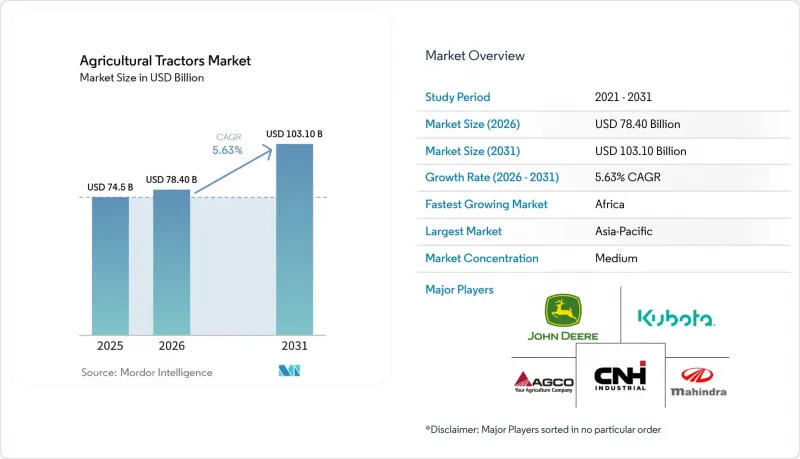
本報告按功率輸出(40馬力以下、40-100馬力、101-200馬力、200馬力以下)、驅動方式(兩輪驅動和四輪驅動)、引擎類型(柴油、電動、混合動力)、曳引機類型(通用型、行間曳引機等)以及地區(北美、南美、歐洲、亞太、中東和非洲)進行細分。市場預測以美元計價。
全球農業曳引機市場趨勢及洞察
政府繼續對機械化進行補貼
政府支持的機械化計畫在維持印度、撒哈拉以南非洲和東南亞等地區對農業曳引機的需求方面繼續發揮著至關重要的作用。在印度,根據「農業機械化申報」計畫提供的補貼仍然是確保機械化程度較低地區獲得曳引機的關鍵因素。在奈及利亞,一項於2025年實施的系統性機械化部署計劃,透過機械化服務供應商以租賃購買模式部署了2000台重型曳引機。與政府直接擁有相比,這體現了更有組織的籌資策略。這種轉變正在影響製造商進入農業曳引機市場的方式,因為車隊中的仲介業者需要大規模的資金籌措、服務規劃和零件支援。此外,預計到2025年,中國作物種植、收割和加工的機械化率將達到75.5%,這為尋求加速農業現代化的鄰國樹立了標竿。
將精密農業融入現有車隊
精密農業的普及速度正在迅速提升,其應用範圍已涵蓋所有現有農機設備,遠超新曳引機銷售的成長趨勢。隨著數位化功能透過升級改造不斷整合,這一趨勢對農用曳引機市場產生了重大影響。精密農業應用將使作物年產量提高 5%,燃油消耗量每年減少 1.47 億加侖。這推動了售後改裝市場的需求,因為使用多家製造商農機的農民希望獲得統一的指導和數據工具,而無需等待整套設備更換週期。因此,能夠支援現有設備基礎設施而非僅依賴新設備銷售的製造商和技術供應商,正在農用曳引機市場中佔據優勢。
高昂的購置成本和日益嚴格的機械設備融資條件
借貸成本上升和信貸條件收緊正在推遲農用曳引機市場的購買決策,尤其是在美國的高價位農機領域。在美國,大馬力曳引機市場中,預計2025年425馬力以上曳引機的零售價格將年減3.2%,競標價格預計將下降6.7%。這反映出買家信心減弱以及經銷商因庫存持有成本增加而面臨的財務負擔。這種影響因農場規模而異,大型農場主可以利用二手設備市場的機會,而小規模農場則面臨資金籌措挑戰和設備更換週期延遲的問題。因此,農用曳引機市場正變得日益兩極化,對價格敏感的高階農機需求不斷增強,而對入門級和通用型曳引機的需求則在減弱。
細分市場分析
到2025年,40-100馬力細分市場將佔據農業曳引機市場42.9%的最大佔有率。該細分市場將繼續保持其主導地位,因為它非常適合新興農業經濟體的多樣化耕作、運輸、犁地和通用作業。中功率高功率曳引機在亞太地區、南美洲和非洲部分地區等農場需要兼顧燃油效率和農具相容性的地區廣泛應用。小規模農場更傾向於選擇這類曳引機,因為與高功率機型相比,它們具有更高的操作柔軟性和更低的擁有成本。該細分市場需求的穩定表明,人們對多功能農業機械的需求將持續存在。
預計2023年至2026年間,功率超過200馬力的農用曳引機市場將以7.5%的複合年成長率(CAGR)實現最高增速。這一成長主要受北美、巴西和東歐等地區農場整合加劇以及對大規模田間作業效率日益成長的需求所驅動。大規模商業農場主正採用大馬力設備來擴大耕地面積並減少季節性運作。主要製造商正致力於開發配備精密農業系統的先進行間作物種植和高產能曳引機平台。然而,在全球開發中國家,中型曳引機仍然是銷售的主力軍。
到2025年,兩輪驅動曳引機將佔據農業曳引機市場71.8%的佔有率,成為最大的細分市場。這些曳引機憑藉其低廉的初始成本、簡單的維護要求以及適用於犁地、運輸和行栽作物等優勢,保持著市場領先地位。它們在印度、東南亞和非洲部分地區廣受歡迎,這些地區的中小農戶優先考慮的是價格實惠和操作簡便。此外,該細分市場還受益於廣泛的經銷商網路以及低馬力應用中較低的油耗。綜合這些因素,兩輪驅動曳引機成為許多開發中國家注重成本的農業企業的理想選擇。
在農業曳引機市場,四輪驅動曳引機細分市場預計將在2026年至2031年間以7.6%的複合年成長率(CAGR)實現最高成長。在北美、巴西和東歐等地區,由於農場規模擴大以及對更廣泛農業機械的需求,高牽引力曳引機系統的應用正在不斷成長。大規模商業農場更傾向於選擇四輪驅動曳引機,因為它們可以提高牽引力、減少車輪打滑,並能勝任高強度的田間作業。製造商也不斷擴展其高階曳引機產品線,這些曳引機配備了先進的液壓系統和針對大規模農業最佳化的精密農業技術。此細分市場的成長反映了全球農業市場對生產力日益成長的需求,而非完全拋棄傳統的兩輪驅動平台。
區域分析
受印度和中國強勁的機械化需求驅動,亞太地區預計到2025年將佔據全球農業曳引機市場38.6%的最大佔有率。印度仍然是世界領先的曳引機消費國之一,這主要得益於中小農場對通用曳引機的廣泛應用。中國透過擴大先進農業機械的普及和提升國內生產能力,持續推動農業機械化進程。在日本和韓國,市場對專為特定農業作業設計的緊湊型、高精度曳引機的需求仍然強勁。該地區受益於政府主導的機械化項目、農村地區農業機械資金籌措的改善以及本地生產能力的提升,所有這些因素都有利於生產具成本效益的曳引機並出口到世界各地的鄰近農業國家。
預計非洲將經歷最高的成長率,2026年至2031年複合年成長率將達到7.6%,主要得益於農業機械化投資的增加和系統性採購計畫的擴展。奈及利亞、加納、肯亞和坦尚尼亞等國的政府正透過曳引機融資舉措和公私合營農業現代化項目,加強對農業機械化的支持力度。該地區正從零散的設備採購轉向系統化的分銷和服務模式,從而改善設備的長期可及性。全球製造商也正在加強其經銷商網路和經銷夥伴關係,以提高在該地區的市場滲透率。在商業農業活動不斷擴大、政策日益重視糧食安全和提高農業生產力的國家,成長尤為強勁。
在北美和歐洲,利率上升和農業盈利的波動影響了2025年初和2026年初的設備採購決策,導致需求趨勢波動。儘管面臨這些挑戰,但更新換代需求和持續機械化的需求支撐了部分市場。根據美國農業機械製造商協會(AEM)的數據,截至2025年6月,加拿大農業曳引機總銷量年增1.6%,其中四輪驅動曳引機銷量成長24.7%。這表明對高功率農業機械和大規模農業運營的投資持續成長。相較之下,西歐部分市場的註冊量在需求逐漸穩定之前一直較為低迷。
其他好處:
- Excel格式的市場預測(ME)表
- 3個月的分析師支持
目錄
第1章:引言
- 研究假設和市場定義
- 調查範圍
第2章:調查方法
第3章執行摘要
第4章 市場狀況
- 市場概覽
- 市場促進因素
- 政府繼續對機械化進行補貼
- 將精密農業融入現有車隊
- 對老舊曳引機的更換需求
- 將高功率四輪驅動系統引進大型農場
- 「改裝優先」自動駕駛與導航系統升級
- 果園、葡萄園和溫室中特色作物的電氣化
- 市場限制因素
- 高昂的購置成本和日益收緊的機械設備融資
- 符合排放氣體法規的柴油動力系統成本不斷上漲
- 農業部門現金流下滑和季節性貸款缺口
- 電動車和自動駕駛汽車的經銷商和服務體系存在差距。
- 監理情勢
- 技術展望
- 波特五力分析
第5章 市場規模與成長預測
- 依輸出類型
- 小於40馬力
- 40~100 HP
- 101~200 HP
- 200馬力或以上
- 透過驅動系統
- 兩輪驅動
- 四輪驅動
- 按引擎類型
- 柴油引擎
- 電的
- 混合
- 曳引機類型
- 公用事業
- 系列
- 果園和葡萄園
- 自動駕駛
- 按地區
- 北美洲
- 美國
- 加拿大
- 墨西哥
- 其他北美國家
- 南美洲
- 巴西
- 阿根廷
- 其他南美國家
- 歐洲
- 德國
- 法國
- 俄羅斯
- 英國
- 義大利
- 其他歐洲國家
- 亞太地區
- 中國
- 印度
- 日本
- 澳洲
- 韓國
- 其他亞太國家
- 中東
- 沙烏地阿拉伯
- 土耳其
- 阿拉伯聯合大公國
- 其他中東國家
- 非洲
- 南非
- 埃及
- 奈及利亞
- 其他非洲國家
- 北美洲
第6章 競爭情勢
- 市場集中度
- 策略趨勢
- 市佔率分析
- 公司簡介
- Deere & Company
- CNH Industrial NV
- AGCO Corporation
- Kubota Corporation
- Mahindra & Mahindra Limited
- CLAAS KGaA mbH
- SDF SpA
- Yanmar Holdings Co., Ltd.
- Argo Tractors SpA(ARGO SpA)
- Weichai Lovol Intelligent Agricultural Technology Co., Ltd.
- LS Mtron Ltd.(LS Corp.)
- Daedong Corporation
- International Tractors Limited
- Tractors and Farm Equipment Limited(Amalgamations Group)
- YTO Group Corporation(China National Machinery Industry Corporation)
第7章 市場機會與未來展望
According to Mordor Intelligence, the agricultural tractors market size is anticipated to increase from USD 74.5 billion in 2025 to USD 78.40 billion in 2026 and reach USD 103.10 billion by 2031, growing at a CAGR of 5.63% over 2026-2031.
This report is Segmented by Power Output (Less Than 40 HP, 40-100 HP, 101-200 HP, and More Than 200 HP), by Drive Type (2-Wheel Drive and 4-Wheel Drive), by Engine Type (Diesel, Electric, and Hybrid), by Tractor Type (Utility, Row-Crop, and More), and by Geography (North America, South America, Europe, Asia-Pacific, Middle East, and Africa). The Market Forecasts are Provided in Terms of Value (USD).
Global Agricultural Tractors Market Trends and Insights
Government Mechanization Subsidy Continuity
Government-supported mechanization programs continue to play a significant role in sustaining demand for the agricultural tractors market in regions such as India, Sub-Saharan Africa, and Southeast Asia. In India, subsidies provided under the Sub-Mission on Agricultural Mechanization remain a key factor in ensuring tractors are accessible in districts with lower levels of mechanization. In Nigeria, a structured mechanization rollout in 2025 introduced 2,000 heavy-capacity tractors through mechanization service providers under a lease-to-own model, reflecting a more organized procurement strategy compared to direct public ownership. This shift influences how manufacturers approach the agricultural tractors market, as fleet intermediaries require large-scale financing, service planning, and parts support. Additionally, China's 75.5% mechanization rate for crop planting, harvesting, and processing by 2025 serves as a benchmark for neighboring countries aiming to accelerate agricultural modernization .
Precision Agriculture Integration Across Installed Fleets
Precision agriculture adoption is advancing more rapidly across existing equipment fleets than new tractor sales alone indicate. This trend is significant for the agricultural tractors market, as digital capabilities are increasingly being integrated through upgrades. The economic benefits are becoming more evident, with the Association of Equipment Manufacturers and Kearney estimating that current precision agriculture adoption has increased annual crop production in the United States by 5% and reduced fuel consumption by 147 million gallons annually in 2025 . This is driving demand for retrofitting, as mixed-brand farm operators seek unified guidance and data tools without waiting for a complete equipment replacement cycle. Consequently, the agricultural tractors market is favoring manufacturers and technology providers capable of supporting the existing equipment base, rather than relying solely on new equipment sales.
High Acquisition Cost and Tighter Machinery Financing
Higher borrowing costs and tighter credit conditions are delaying purchase decisions in the agricultural tractors market, particularly for high-value machinery categories in the United States. In the United States high-horsepower segment, retail values for tractors above 425 HP decreased by 3.2% year-over-year in 2025, while auction values declined by 6.7%. This reflects weaker buyer sentiment and the financial strain caused by elevated dealer carrying costs. The impact varies across farm sizes, with large-scale operators taking advantage of opportunities in the used-equipment market, while smaller farms face greater financing challenges and delayed replacement cycles. Consequently, the agricultural tractors market is becoming increasingly polarized, with stronger demand for advanced premium machinery and weaker demand for entry-level and utility tractor models in more price-sensitive farming segments.
Other drivers and restraints analyzed in the detailed report include:
- High-Horsepower and 4-Wheel Drive Adoption on Large Farms
- Retrofit-First Autonomy and Guidance Upgrades
- Emissions-Compliant Diesel Powertrain Cost Inflation
For complete list of drivers and restraints, kindly check the Table Of Contents.
Segment Analysis
The agricultural tractors market share for the 40-100 HP segment led with the largest 42.9% in 2025. This segment remains dominant due to its suitability for mixed farming, haulage, tillage, and utility operations in emerging agricultural economies. Mid-range tractors are widely adopted in regions such as Asia-Pacific, South America, and parts of Africa, where farms require a balance of fuel efficiency and implement compatibility. Smaller farms favor these tractors for their operational flexibility and lower ownership costs compared to high-horsepower models. The stability in demand for this segment highlights the continued reliance on versatile, utility-focused farm mechanization.
The agricultural tractors market size for the more than 200 HP segment is forecast to grow at the fastest 7.5% CAGR from 2026 to 203. This growth is driven by increasing farm consolidation and the rising need for large-scale field productivity in regions such as North America, Brazil, and Eastern Europe. Large commercial operators are adopting higher horsepower equipment to enhance field coverage and reduce seasonal operating time. Premium manufacturers are focusing on developing advanced row-crop and high-capacity tractor platforms equipped with precision farming systems. However, mid-range tractors continue to form the structural volume base in developing agricultural economies worldwide.
2-wheel drive tractors accounted for the largest 71.8% of the agricultural tractors market share in 2025. These tractors maintain their dominance due to lower upfront costs, simpler maintenance requirements, and their suitability for light tillage, transport, and row-crop farming activities. They are widely preferred in regions such as India, Southeast Asia, and parts of Africa, where small and medium-sized farms prioritize affordability and operational simplicity. Additionally, the segment benefits from extensive dealer networks and lower fuel consumption in lower-horsepower applications. This combination ensures that 2-wheel drive tractors remain the preferred choice for cost-sensitive agricultural operations in several developing economies.
The agricultural tractors market size for the 4-wheel drive tractor segment is projected to grow at the fastest CAGR of 7.6% from 2026 to 2031. The adoption of higher-traction tractor systems is increasing in regions such as North America, Brazil, and Eastern Europe, driven by expanding farm sizes and the need for wider implement usage. Large commercial farms favor 4-wheel drive configurations for their ability to enhance drawbar pull, reduce wheel slippage, and support heavy-duty field operations. Manufacturers are also broadening their premium tractor portfolios with advanced hydraulic systems and precision farming technologies tailored for large-scale farming. The growth in this segment reflects rising productivity demands rather than a complete shift away from traditional 2-wheel drive platforms in global agricultural markets.
Geography Analysis
Asia-Pacific held the largest 38.6% agricultural tractors market share in 2025, supported by strong mechanization demand across India and China. India remained one of the leading tractor-consuming countries globally, primarily due to the widespread adoption of utility tractors on small and medium-sized farms. China continued to enhance agricultural mechanization through increased adoption of advanced farming equipment and the expansion of domestic manufacturing capabilities. Japan and South Korea sustained demand for compact, precision-oriented tractors tailored for specialized agricultural operations. The region benefits from government-backed mechanization programs, improved rural equipment financing access, and growing local manufacturing capacity, which supports cost-effective tractor production and exports to neighboring agricultural economies worldwide.
Africa is projected to grow at the fastest 7.6% CAGR from 2026 to 2031 due to rising mechanization investments and expanding organized procurement programs. Governments in countries such as Nigeria, Ghana, Kenya, and Tanzania are increasing support for farm mechanization through tractor financing initiatives and public-private agricultural modernization programs. The region is transitioning from fragmented equipment purchases to structured distribution and service-provider models, enhancing long-term equipment accessibility. Global manufacturers are also strengthening dealer networks and distribution partnerships to improve market penetration in the region. Growth is particularly robust in countries with expanding commercial farming activities and a heightened policy focus on food security and agricultural productivity improvements.
North America and Europe experienced varied demand trends in 2025 and early 2026, driven by higher interest rates and fluctuating farm profitability, which impacted equipment purchasing decisions. Despite these challenges, replacement demand and the need for ongoing mechanization supported specific markets. According to the Association of Equipment Manufacturers (AEM), total Canadian agricultural tractor sales increased by 1.6% year-to-date as of June 2025, while sales of 4-wheel-drive tractors grew by 24.7%, indicating sustained investment in high-power farm machinery and large-scale agricultural operations . In contrast, several Western European markets saw weaker registrations before demand gradually stabilized.
- Deere & Company
- CNH Industrial N.V.
- AGCO Corporation
- Kubota Corporation
- Mahindra & Mahindra Limited
- CLAAS KGaA mbH
- SDF S.p.A.
- Yanmar Holdings Co., Ltd.
- Argo Tractors S.p.A. (ARGO S.p.A.)
- Weichai Lovol Intelligent Agricultural Technology Co., Ltd.
- LS Mtron Ltd. (LS Corp.)
- Daedong Corporation
- International Tractors Limited
- Tractors and Farm Equipment Limited (Amalgamations Group)
- YTO Group Corporation (China National Machinery Industry Corporation)
Additional Benefits:
- The market estimate (ME) sheet in Excel format
- 3 months of analyst support
TABLE OF CONTENTS
1 Introduction
- 1.1 Study Assumptions and Market Definition
- 1.2 Scope of the Study
2 Research Methodology
3 Executive Summary
4 Market Landscape
- 4.1 Market Overview
- 4.2 Market Drivers
- 4.2.1 Government mechanization subsidy continuity
- 4.2.2 Precision agriculture integration across installed fleets
- 4.2.3 Replacement demand for an aging tractor fleet
- 4.2.4 High-horsepower and 4-wheel drive adoption on large farms
- 4.2.5 Retrofit-first autonomy and guidance upgrades
- 4.2.6 Specialty-crop electrification in orchards, vineyards, and greenhouses
- 4.3 Market Restraints
- 4.3.1 High acquisition cost and tighter machinery financing
- 4.3.2 Emissions-compliant diesel powertrain cost inflation
- 4.3.3 Weak farm cash flows and seasonal credit access gaps
- 4.3.4 Dealer and service-readiness gap for electric and autonomous models
- 4.4 Regulatory Landscape
- 4.5 Technological Outlook
- 4.6 Porter's Five Forces Analysis
- 4.6.1 Bargaining Power of Buyers
- 4.6.2 Bargaining Power of Suppliers
- 4.6.3 Threat of New Entrants
- 4.6.4 Threat of Substitutes
- 4.6.5 Intensity of Competitive Rivalry
5 Market Size and Growth Forecasts (Value)
- 5.1 By Power Output
- 5.1.1 Less than 40 HP
- 5.1.2 40-100 HP
- 5.1.3 101-200 HP
- 5.1.4 More than 200 HP
- 5.2 By Drive Type
- 5.2.1 2-Wheel Drive
- 5.2.2 4-Wheel Drive
- 5.3 By Engine Type
- 5.3.1 Diesel
- 5.3.2 Electric
- 5.3.3 Hybrid
- 5.4 By Tractor Type
- 5.4.1 Utility
- 5.4.2 Row-Crop
- 5.4.3 Orchard and Vineyard
- 5.4.4 Autonomous
- 5.5 By Geography
- 5.5.1 North America
- 5.5.1.1 United States
- 5.5.1.2 Canada
- 5.5.1.3 Mexico
- 5.5.1.4 Rest of North America
- 5.5.2 South America
- 5.5.2.1 Brazil
- 5.5.2.2 Argentina
- 5.5.2.3 Rest of South America
- 5.5.3 Europe
- 5.5.3.1 Germany
- 5.5.3.2 France
- 5.5.3.3 Russia
- 5.5.3.4 United Kingdom
- 5.5.3.5 Italy
- 5.5.3.6 Rest of Europe
- 5.5.4 Asia-Pacific
- 5.5.4.1 China
- 5.5.4.2 India
- 5.5.4.3 Japan
- 5.5.4.4 Australia
- 5.5.4.5 South Korea
- 5.5.4.6 Rest of Asia-Pacific
- 5.5.5 Middle East
- 5.5.5.1 Saudi Arabia
- 5.5.5.2 Turkey
- 5.5.5.3 United Arab Emirates
- 5.5.5.4 Rest of Middle East
- 5.5.6 Africa
- 5.5.6.1 South Africa
- 5.5.6.2 Egypt
- 5.5.6.3 Nigeria
- 5.5.6.4 Rest of Africa
- 5.5.1 North America
6 Competitive Landscape
- 6.1 Market Concentration
- 6.2 Strategic Moves
- 6.3 Market Share Analysis
- 6.4 Company Profiles (Includes Global Level Overview, Market Level Overview, Core Segments, Financials as Available, Strategic Information, Market Rank/Share for Key Companies, Products and Services, and Recent Developments)
- 6.4.1 Deere & Company
- 6.4.2 CNH Industrial N.V.
- 6.4.3 AGCO Corporation
- 6.4.4 Kubota Corporation
- 6.4.5 Mahindra & Mahindra Limited
- 6.4.6 CLAAS KGaA mbH
- 6.4.7 SDF S.p.A.
- 6.4.8 Yanmar Holdings Co., Ltd.
- 6.4.9 Argo Tractors S.p.A. (ARGO S.p.A.)
- 6.4.10 Weichai Lovol Intelligent Agricultural Technology Co., Ltd.
- 6.4.11 LS Mtron Ltd. (LS Corp.)
- 6.4.12 Daedong Corporation
- 6.4.13 International Tractors Limited
- 6.4.14 Tractors and Farm Equipment Limited (Amalgamations Group)
- 6.4.15 YTO Group Corporation (China National Machinery Industry Corporation)
7 Market Opportunities and Future Outlook

 2026年全球果園曳引機市場報告
 農業曳引機市場:2026-2032年全球市場預測(按曳引機類型、功率範圍、燃料類型、應用和最終用戶分類)
 果園曳引機市場機會、成長要素、產業趨勢分析及2026-2035年預測
 農業曳引機市場規模、佔有率和趨勢分析報告:按引擎功率、傳動系統、推進系統、地區和細分市場預測(2026-2033 年)2026年全球小型農用曳引機市場報告2026年全球農業曳引機租賃市場報告
 農業曳引機市場:按作業方式、引擎功率、類型、驅動方式和地區分類電動農用曳引機市場:2026-2032年全球市場預測(按推進方式、驅動系統、運作小時數、自主等級、功率輸出、作物類型、應用、最終用戶和銷售管道)農業曳引機市場:按引擎功率、產品類型、曳引機類型、應用和銷售管道,全球預測,2026-2032年
 農業曳引機市場規模、佔有率、成長及全球產業分析:按類型、應用和地區分類-2026-2034年洞察與預測