

 |
市場調查報告書
商品編碼
2066408
英國農業機械:市場佔有率分析、行業趨勢和統計數據以及成長預測(2026-2031 年)United Kingdom Agricultural Machinery - Market Share Analysis, Industry Trends & Statistics, Growth Forecasts (2026 - 2031) |
||||||

※ 本網頁內容可能與最新版本有所差異。詳細情況請與我們聯繫。
據 Mordor Intelligence 稱,2025 年英國農業機械市場價值為 22.5 億美元,預計到 2031 年將達到 30.2 億美元,而 2026 年為 23.6 億美元,預測期(2026-2031 年)的複合年成長率為 5.01%。
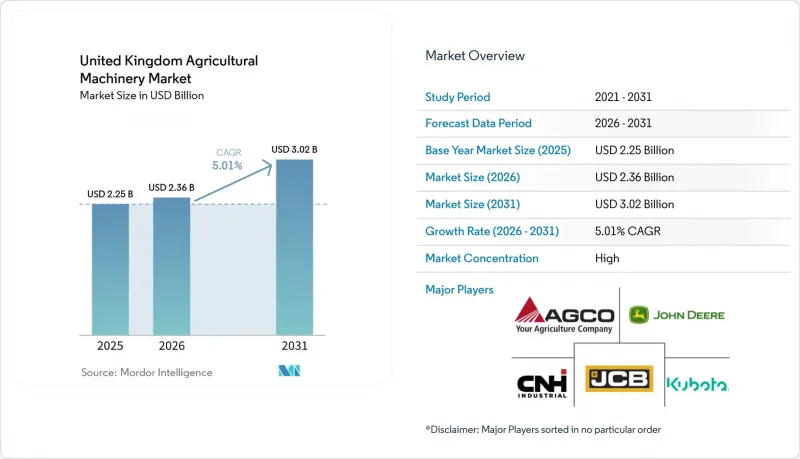
本報告按機械類型(曳引機、農具、灌溉設備、收割設備、乾草和飼料設備以及其他機械)進行分類。市場預測以美元計價。
英國農業機械市場趨勢與洞察
勞動力短缺正在加速機械化進程。
英國超過40%的農場報告勞動力短缺,這促使農場加強對自主和半自動農業機械的投資,以取代人工勞動。儘管季節性工人簽證配額已擴大至2029年的4.5萬人,但政府也積極推動一項政策,投資5,000萬英鎊(約6,300萬美元)用於自動化,以減少對移民勞工的長期依賴。 Fieldwork Robotics公司的覆盆子採摘系統表明,連續運作和類人加工能力使得採用機器人技術具有良好的投資回報率。不斷上漲的人事費用正在推動英國農業機械市場對能夠長時間運作且只需極少人工干預的設備的需求。
政府對農業機械的津貼計畫和稅收優惠
農業設備與技術基金為每位申請者提供1,000至25,000英鎊(1,250至31,250美元)的資助,而提高農場生產力計劃則為機器人技術和精準系統提供高達500,000英鎊(625,000美元)的資金。每件津貼的設備必須使用五年,從而為設備供應商提供可預測的需求週期。津貼標準優先考慮減少碳排放和動物福利指標,鼓勵購買配備感測器的農業設備、自動駕駛系統以及減少土壤壓實的解決方案。這些獎勵直接提高了英國農業機械市場的整體設備周轉率,尤其是在傳統上推遲重大投資的中小型農場。
高昂的初始成本和維修成本
英格蘭及威爾斯註冊會計師協會 (ICAEW) 指出,儘管大型生產商現金流充裕,但仍在推遲設備採購。這反映出單位成本上升和資金籌措困難。 AGCO 公司 2025 年第一季的銷售額預計將下降 30%,這表明對成本敏感的買家正在削減津貼,對於許多小規模企業來說,設備的生命週期成本仍然過高,這阻礙了英國農業機械市場的預期擴張。
細分市場分析
到2025年,曳引機將佔英國農業機械市場的54.42%。該細分市場的成長仍然主要受更新換代和馬力升級的驅動,同時自動駕駛和遠端資訊處理功能的整合也將成為標配。雖然100馬力以下的曳引機在銷量中佔有一定佔有率,但150馬力以上的大馬力曳引機憑藉其高階定價和全棧式技術,佔據了市場主導地位。迪爾公司佔據的多數市場佔有率凸顯了整合導航、互聯互通和售後服務網路在降低整個英國農業機械市場總擁有成本(TCO)方面的重要性。
預計到2031年,灌溉設備的年複合成長率(CAGR)將達到7.74%,在所有類別中增速最高,這直接反映了降雨量的不確定性和日益嚴格的用水法規。中心支軸式噴灌系統與土壤濕度感測器的結合,使農場能夠遵守英國環境署的水資源管理指南,而滴灌技術在高價值園藝領域也越來越受歡迎。精準灌溉透過減少徑流和投入浪費,協助實現再生農業的目標,凸顯了氣候變遷的嚴峻性如何推動英國農業機械市場的產品多元化。儘管收割機、飼料機械和耕作設備的需求穩定,但隨著水資源管理在農場中變得日益重要,它們的成長落後於灌溉設備。
其他好處:
- Excel格式的市場預測(ME)表
- 3個月的分析師支持
目錄
第1章:引言
- 研究假設和市場定義
- 調查範圍
第2章:調查方法
第3章執行摘要
第4章 市場狀況
- 市場概覽
- 市場促進因素
- 勞動力短缺正在加速機械化進程。
- 政府對農業機械的津貼計畫和稅收優惠
- 精密農業和數位化的需求
- 鼓勵再生農業的獎勵推動了對低壓實設備的需求。
- 農業機器人試驗平台的擴建正在加速原型機的普及。
- 為實現淨零排放而強制推行的電氣化政策正在推動電動曳引機的銷售。
- 市場限制因素
- 高昂的初始成本和維修成本
- 連網裝置的網路安全與資料隱私風險
- 農村地區電網容量有限,減緩了家用電器的普及速度。
- 英國脫歐後,由於認證標準差異導致合規成本增加
- 監理情勢
- 技術展望
- 波特五力分析
第5章 市場規模與成長預測
- 按機器類型
- 聯結機
- 小於50馬力
- 50~100 HP
- 100~150 HP
- 150馬力或以上
- 裝置
- 犁
- 光環
- 耕耘機和中耕機
- 其他設備(播種機、滾筒等)
- 灌溉機械
- 噴水灌溉
- 滴灌
- 其他灌溉設備(中心支軸式噴灌系統、微型噴灌等)
- 收割機械
- 結合
- 飼料收割機
- 其他收割機(馬鈴薯收割機、甜菜收割機等)
- 乾草和飼料機械
- 割草機和壓草機
- 打包機
- 其他乾草飼料機械(耙草機、翻曬機)
- 其他類型的機械
- 聯結機
第6章 競爭情勢
- 市場集中度
- 策略趨勢
- 市佔率分析
- 公司簡介
- Deere & Company
- CNH Industrial NV
- AGCO Corporation
- Kubota Corporation
- Claas KGaA mbH
- JC Bamford Excavators Ltd.
- Kuhn Group(Bucher Industries AG)
- SDF Group SpA
- Bernard Krone Holding SE & Co. KG
- Horsch Maschinen GmbH
- Amazone-Werke H. Dreyer SE & Co. KG
- GRIMME Landmaschinenfabrik GmbH & Co. KG
- LEMKEN GmbH & Co. KG
- Vaderstad Group
第7章 市場機會與未來展望
According to Mordor Intelligence, the united kingdom agricultural machinery market size was valued at USD 2.25 billion in 2025 and estimated to grow from USD 2.36 billion in 2026 to reach USD 3.02 billion by 2031, at a CAGR of 5.01% during the forecast period (2026-2031).
This report is Segmented by Machinery Type (Tractor, Equipment, Irrigation Machinery, Harvesting Machinery, Haying and Forage Machinery, and Other Machinery Types). The Market Forecasts are Provided in Terms of Value (USD).
United Kingdom Agricultural Machinery Market Trends and Insights
Shortage of labor accelerating mechanization
More than 40% of British farms report an insufficient workforce, a figure that has intensified capital outlays toward autonomous and semi-autonomous machinery capable of substituting manual labor. Seasonal-worker visas have been extended to 45,000 positions through 2029, yet government policy is simultaneously investing GBP 50 million (USD 63 million) in automation to reduce long-term reliance on migrant labor. Fieldwork Robotics' raspberry-picking system exemplifies how continuous operation and human-comparable throughput shift return-on-investment calculations in favor of robotics. As labor costs rise, specification requirements move toward equipment that can work longer hours with limited oversight, reinforcing demand across the United Kingdom agricultural machinery market.
Government grant schemes and tax relief on farm machinery
The Farming Equipment and Technology Fund awards between GBP 1,000 and GBP 25,000 (USD 1,250 to USD 31,250) per applicant, while the Improving Farm Productivity program finances up to GBP 500,000 (USD 625,000) for robotics and precision systems. Each funded item must remain in use for five years, providing equipment suppliers with predictable demand cycles. Grant scoring frameworks prioritize carbon reduction and animal welfare metrics, steering purchases toward sensor-rich implements, autonomous guidance, and low-compaction solutions. These incentives directly lift overall equipment turnover within the United Kingdom agricultural machinery market, especially for small and mid-sized farms that historically delayed high-ticket investments.
High upfront and maintenance costs
The Institute of Chartered Accountants in England and Wales notes that large producers are delaying equipment purchases despite healthy cash flows, reflecting rising unit prices and tighter financing. AGCO Corporation's Q1 2025 revenue fell 30%, a signal that cost-sensitive buyers are pruning capital budgets. Maintenance burdens compound the hurdle modern combines and tractors require proprietary diagnostic software, cloud subscriptions, and specialized technicians. Even with grant offsets, many small operations find lifecycle costs prohibitive, trimming projected expansion of the United Kingdom agricultural machinery market.
Other drivers and restraints analyzed in the detailed report include:
- Regenerative-farming incentives driving low-compaction equipment demand
- Net-Zero electrification mandates catalyzing electric tractor purchases
- Cybersecurity and data privacy risks in connected machinery
For complete list of drivers and restraints, kindly check the Table Of Contents.
Segment Analysis
Tractors accounted for a 54.42% share of the United Kingdom agricultural machinery market in 2025. Segment expansion remains tethered to replacement cycles and horsepower upgrades, with autonomous and telematics integration becoming default specifications. Within tractors, models under 100 horsepower dominate volume, yet high-horsepower units above 150 horsepower capture disproportionate revenue due to their premium pricing and full-stack technology. Deere & Company's majority share highlights the importance of integrated guidance, connectivity, and after-sales networks that lower the total cost of ownership across the United Kingdom agricultural machinery market.
Irrigation equipment posted an 7.74% CAGR outlook through 2031, the strongest among all categories, and a direct response to unpredictable rainfall and tightening abstraction permits. Pivot systems coupled with soil-moisture sensors help farms align with the Environment Agency's water-management directives, while drip technology gains traction in high-value horticulture. Precision irrigation supports regenerative objectives by reducing runoff and input waste, underscoring how climate volatility drives product diversification within the United Kingdom agricultural machinery market size framework. Harvesters, forage machinery, and tillage implements also report steady demand, but their growth trails irrigation as water stewardship rises on farm agendas.
List of Companies Covered in this Report:
- Deere & Company
- CNH Industrial N.V.
- AGCO Corporation
- Kubota Corporation
- Claas KGaA mbH
- J.C. Bamford Excavators Ltd.
- Kuhn Group (Bucher Industries AG)
- SDF Group S.p.A.
- Bernard Krone Holding SE & Co. KG
- Horsch Maschinen GmbH
- Amazone-Werke H. Dreyer SE & Co. KG
- GRIMME Landmaschinenfabrik GmbH & Co. KG
- LEMKEN GmbH & Co. KG
- Vaderstad Group
Additional Benefits:
- The market estimate (ME) sheet in Excel format
- 3 months of analyst support
TABLE OF CONTENTS
1 Introduction
- 1.1 Study Assumptions and Market Definition
- 1.2 Scope of the Study
2 Research Methodology
3 Executive Summary
4 Market Landscape
- 4.1 Market Overview
- 4.2 Market Drivers
- 4.2.1 Shortage of labor accelerating mechanization
- 4.2.2 Government grant schemes and tax relief on farm machinery
- 4.2.3 Demand for precision agriculture and digitalization
- 4.2.4 Regenerative-farming incentives driving low-compaction equipment demand
- 4.2.5 Expansion of agri-robotics testbeds boosting prototype uptake
- 4.2.6 Net-Zero electrification mandates catalyzing electric tractor purchases
- 4.3 Market Restraints
- 4.3.1 High upfront and maintenance costs
- 4.3.2 Cybersecurity and data privacy risks in connected machinery
- 4.3.3 Rural grid-capacity limits slowing electric-equipment adoption
- 4.3.4 Post-Brexit certification divergence escalating compliance costs
- 4.4 Regulatory Landscape
- 4.5 Technological Outlook
- 4.6 Porter's Five Forces Analysis
- 4.6.1 Bargaining Power of Suppliers
- 4.6.2 Bargaining Power of Buyers
- 4.6.3 Threat of New Entrants
- 4.6.4 Threat of Substitute Products
- 4.6.5 Intensity of Competitive Rivalry
5 Market Size and Growth Forecasts (Value)
- 5.1 By Machinery Type
- 5.1.1 Tractor
- 5.1.1.1 Less than 50 HP
- 5.1.1.2 50 to 100 HP
- 5.1.1.3 100 to 150 HP
- 5.1.1.4 Above 150 HP
- 5.1.2 Equipment
- 5.1.2.1 Plows
- 5.1.2.2 Harrows
- 5.1.2.3 Cultivators and Tillers
- 5.1.2.4 Other Equipment (Seed Drills, Rollers, etc.)
- 5.1.3 Irrigation Machinery
- 5.1.3.1 Sprinkler Irrigation
- 5.1.3.2 Drip Irrigation
- 5.1.3.3 Other Irrigation Machinery (Center Pivot Systems, Micro Sprinklers, etc.)
- 5.1.4 Harvesting Machinery
- 5.1.4.1 Combine Harvesters
- 5.1.4.2 Forage Harvesters
- 5.1.4.3 Other Harvesting Machinery (Potato Harvesters, Beet Harvesters, etc.)
- 5.1.5 Haying and Forage Machinery
- 5.1.5.1 Mowers and Conditioners
- 5.1.5.2 Balers
- 5.1.5.3 Other Haying and Forage Machinery (Rakes, Tedders)
- 5.1.6 Other Machinery Types
- 5.1.1 Tractor
6 Competitive Landscape
- 6.1 Market Concentration
- 6.2 Strategic Moves
- 6.3 Market Share Analysis
- 6.4 Company Profiles (Includes Global Level Overview, Market level Overview, Core Segments, Financials as Available, Strategic Information, Market Rank/Share for Key Companies, Products and Services, and Recent Developments)
- 6.4.1 Deere & Company
- 6.4.2 CNH Industrial N.V.
- 6.4.3 AGCO Corporation
- 6.4.4 Kubota Corporation
- 6.4.5 Claas KGaA mbH
- 6.4.6 J.C. Bamford Excavators Ltd.
- 6.4.7 Kuhn Group (Bucher Industries AG)
- 6.4.8 SDF Group S.p.A.
- 6.4.9 Bernard Krone Holding SE & Co. KG
- 6.4.10 Horsch Maschinen GmbH
- 6.4.11 Amazone-Werke H. Dreyer SE & Co. KG
- 6.4.12 GRIMME Landmaschinenfabrik GmbH & Co. KG
- 6.4.13 LEMKEN GmbH & Co. KG
- 6.4.14 Vaderstad Group
7 Market Opportunities and Future Outlook

 全球農業機械市場規模、佔有率、趨勢和成長分析報告(2026-2034年)
 農業機械設備市場:2026-2032年全球市場預測(按類型、功率輸出、引擎類型、變速箱類型、自動化程度、移動性、所有權類型、應用、最終用戶和銷售管道)
 農業切碎機市場-全球產業規模、佔有率、趨勢、機會和預測:按產品類型、自動化等級、商業模式、地區和競爭格局分類,2021-2031年
 2026年全球農業加長型堆高機市場報告
 農業及農業機械市場規模、佔有率及成長分析:依設備類型、產量、自動化程度、應用、驅動系統、最終用戶、銷售管道及地區分類-2026-2033年產業預測
 2034年農業打包機市場預測-全球產品、動力來源、配置、技術、應用、最終用戶和區域分析2034年農產品出口品質監測市場預測-按組件、參數、產品/服務類型、最終用戶和地區分類的全球分析
 農業機械市場規模、佔有率和成長分析:按機器類型、自動化程度、動力來源、所有權類型、應用、最終用途和地區分類-2026-2033年產業預測
 農業機械市場:依產品類型、應用和地區分類農業機械市場:依產品類型和地區分類