


 |
市場調查報告書
商品編碼
2066386
PET包裝:市場佔有率分析、產業趨勢與統計、成長預測(2026-2031年)PET Packaging - Market Share Analysis, Industry Trends & Statistics, Growth Forecasts (2026 - 2031) |
||||||

※ 本網頁內容可能與最新版本有所差異。詳細情況請與我們聯繫。
據 Mordor Intelligence 稱,2025 年 PET 包裝市場價值為 744.1 億美元,預計將從 2026 年的 784.4 億美元成長到 2031 年的 1022.5 億美元,2026 年至 2031 年的複合年成長率為 5.44%。
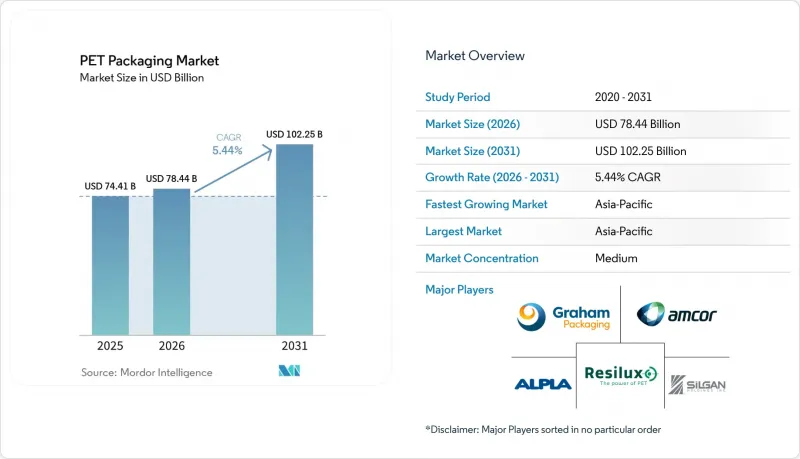
本報告按包裝類型(硬質PET包裝和軟質PET包裝)、產品類型(瓶/罐、袋/小袋等)、樹脂等級(原生PET和再生PET)、終端用戶行業(食品飲料、醫藥、個人護理/化妝品、家居用品、工業產品等)以及地區進行細分。市場預測以美元(USD)為單位。
全球PET包裝市場趨勢與洞察
高可回收性和輕量化設計的優勢
PET包裝市場持續受益於一種機制,即輕量化和可回收性相輔相成而非相互競爭。減少樹脂用量可降低材料成本和運輸負擔,同時,同樣的包裝也能無縫融入許多終端應用領域的現有回收流程。這一點意義重大,因為商業灌裝生產線長期以來致力於最佳化寶特瓶的性能,尤其是在飲料行業,規模和生產線速度仍然是關鍵因素。 PET在食品接觸應用的回收方面也具有監管優勢。根據歐盟相關框架,目前唯一獲準用於食品接觸的再生塑膠材料回收途徑是消費後PET的機械回收。因此,採購團隊越來越重視輕量化,不僅將其視為降低成本的措施,更將其視為與合約續約、產品組合合規性和長期供應穩定性相關的循環包裝的必要條件。由於鮮有替代材料能夠在商業規模上同時提供材料效率和閉合迴路的可行性,PET包裝市場將繼續受益於此雙重優勢。
歐洲和美國強制要求在食品中使用回收PET材料。
PET包裝市場的發展已不再局限於政策意圖,而是受到具有強制性實施期限的法規的驅動。在歐洲,《一次性塑膠指令》規定,自2025年1月起,PET飲料瓶中必須含有25%的再生材料;而《包裝和包裝廢棄物法規》預計將在2030年和2040年進一步加強對食品接觸包裝再生材料含量的要求。在美國,加州AB 793法案規定,自2025年起,飲料瓶中必須含有25%的再生材料,並設定了2030年達到50%的目標。這些分階段實施的法規使得等待現貨市場供應成為一種高風險策略,迫使品牌所有者比以往更早簽訂長期回收協議。因此,在整個PET包裝市場,資金配置決策正轉向那些能夠在法規實施期限前獲得符合標準的食品級rPET的回收商、加工商和轉換商。此外,PET包裝市場的影響力正在向亞洲蔓延,因為符合歐美食品接觸標準的供應商正成為全球消費品牌更具吸引力的出口合作夥伴。
原生PET樹脂價格波動
PET包裝市場仍容易受到原物料價格波動的影響,因為原生PET的經濟效益與純對苯二甲酸和乙二醇密切相關。這些原料價格持續影響加工商的利潤率,尤其是在採購合約無法跟上上游價格波動的情況下。對於缺乏長期供應鏈或一體化採購結構的中小型加工商而言,這種利潤率壓力尤其顯著。在這種情況下,樹脂價格的波動會抵銷價格上漲帶來的利潤,使得在合約期間與客戶談判更加困難。因此,PET包裝市場面臨越來越大的產業整合壓力,因為大型企業可以透過規模、地理和合約結構來分散原料風險。雖然這種限制不會改變PET的長期需求前景,但它會擾亂短期盈利,並有利於那些能夠及早鎖定原料來源的加工商。
細分市場分析
預計到2025年,硬質PET包裝將佔PET包裝市場佔有率的64.78%,顯示其在大批量填充系統中佔據強大的地位。瓶裝水、碳酸飲料和食用油仍然依賴寶特瓶寶特瓶,因為幾十年來,生產線的速度、阻隔性能和回收系統都是圍繞著PET瓶建造的。因此,即使品牌所有者被迫提高永續性指標,更換包裝材料也會帶來巨大的成本。此外,PET包裝產業也受惠於硬質PET已整合到回收系統中,支持在監管最嚴格的市場中實現「瓶到瓶」的循環利用。這種結構性優勢使得硬質PET包裝很可能在整個預測期內繼續保持其在PET包裝市場的主導地位。
預計到2031年,軟包裝PET將以5.98%的複合年成長率成長,超過硬包裝PET,顯示其在終端應用領域的重要性日益凸顯。這一成長主要得益於單一材料設計在某些食品和個人護理應用中取代了不可回收的多層複合材料。這意義重大,因為它拓展了PET的應用範圍,使其能夠應用於以往難以大規模回收的多種阻隔材料組合領域。因此,PET包裝市場在軟包裝和硬包裝應用領域均呈現同步成長,而非簡單的形式轉變。這種平衡有利於擴大產能的投資,因為加工商既能滿足穩定的瓶裝需求,又能應對軟包裝應用領域的高成長需求。在PET包裝市場,能夠將軟包裝創新與客戶可在其採購流程中實施的檢驗可回收性聲明相結合的供應商將繼續保持競爭優勢。
到2025年,瓶罐將佔PET包裝市場規模的68.91%,在產品價值層面構成無可爭議的核心。這一主導地位反映了全球飲料產業長期以來對專用瓶子收集、分類和回收基礎設施的投入。這一穩固的基礎降低了替代風險,因為競爭產品必須同時滿足成本、規模和下游相容性要求。瓶罐在食品、家居用品和醫藥行業也仍然佔據核心地位,因為產品的可見度和包裝完整性會影響消費者的購買決策。因此,目前PET包裝市場的大部分價值都來自瓶罐仍是商業標準的類別。
預計到2031年,小袋和小袋將以6.22%的複合年成長率成長,繼續保持PET包裝市場成長最快的產品類型。它們在低收入消費市場仍然極具吸引力,因為在這些市場,一次性使用價格至關重要,而且分銷網路更傾向於輕量化包裝。此外,在非洲和中東部分地區,瓶坯的重要性日益凸顯,因為本地吹塑成型比進口成品瓶更經濟。另一方面,印度和奈及利亞的監管變化為這個細分市場帶來了巨大的政策不確定性,使得小袋的未來前景不再明朗。簡而言之,雖然PET包裝市場短期內仍有小袋主導成長的空間,但與專注於瓶裝包裝的資產相比,圍繞這種包裝形式建立的產能從中長期來看風險更大。能夠提供價格實惠且易於符合法規的包裝規格的加工商,將在PET包裝市場中佔據更有利的地位,因為該市場正在適應各地區政策實施的不平衡。
區域分析
到2025年,亞太地區將佔據PET包裝市場47.38%的佔有率,顯著超越其他任何地區。預計到2031年,該地區將以6.42%的複合年成長率成長,成為PET包裝市場成長最快的地區。中國和印度仍然是主要驅動力。中國在樹脂和包裝領域擁有龐大的規模,而印度在食品加工和個人保健產品製造領域正迅速擴張。在印度,印度食品標準局(FSSAI)規定,自2026會計年度起,一級硬質塑膠包裝的再生材料含量必須達到30%,這進一步提升了印度在再生材料規劃方面的重要性。這推動了對國內rPET產能的投資增加,進一步增強了印度成為未來區域供應中心的潛力。日本和韓國在開發高規格瓶子方面繼續發揮關鍵作用,尤其是在高階飲料和營養補充劑領域,這些領域對阻隔性能和設計精度要求極高。
歐洲仍然是PET包裝市場監管最嚴格的地區,這持續影響需求、投資時機和採購行為。歐盟的《一次性塑膠指令》已規定,自2025年1月起,PET飲料瓶的再生材料含量必須達到25%。此外,《包裝和包裝廢棄物條例》將於2026年8月12日生效,預計將進一步收緊對再生材料含量的要求。在英國,則面臨不同的成本壓力。自2026年起,再生材料含量低於30%的包裝將被徵收每噸228.82英鎊(307.75美元)的塑膠包裝稅。這些法規正推動食品接觸級rPET的需求以現有供應難以滿足的速度成長。北美也出現了類似的趨勢。儘管加州的AB 793法案旨在促進再生材料含量標準的遵守,但加工商也必須應對國內供應鏈中更嚴格的採購條件。因此,這些地區的PET包裝市場正在經歷合約簽訂速度加快、垂直整合程度提高以及對可追溯再生材料供應日益成長的興趣。
在非洲,由於都市化、零售業正常化以及消費品向獨立包裝轉變等多種因素,預計將實現強勁成長,這些因素持續支撐全部區域的需求。同時,針對某些一次性產品的政策措施正在改變投資重點,奈及利亞的監管進程表明,政府將加強對小袋的監管力度,並加大對可回收硬質PET產品的支持。在南美洲,瓶裝水、碳酸飲料和食用油產業預計將穩定擴張。同時,在中東,各方正在努力平衡原物料採購風險和對本地製造業的投資,預計這將有助於未來降低對進口的依賴。
其他好處:
- Excel格式的市場預測(ME)表
- 3個月的分析師支持
目錄
第1章:引言
- 研究假設和市場定義
- 調查範圍
第2章:調查方法
第3章執行摘要
第4章 市場狀況
- 市場概覽
- 市場促進因素
- 高可回收性和輕量化設計的優勢
- 歐洲和美國強制要求在食品中使用再生PET材料。
- 擴大化學回收基礎設施
- 電子商務對耐衝擊、輕質包裝的需求
- 將數位浮水印整合到自動化分類系統中
- 採用單一材料PET瓶蓋及封蓋,以實現瓶對瓶回收。
- 市場限制因素
- 原生PET樹脂價格波動
- 開發中國家禁止使用一次性包裝袋的趨勢
- rPET瓶供應缺口
- 消費者轉向無塑膠替代包裝
- 產業價值鏈分析
- 監理情勢
- 技術展望
- 波特五力分析
- 宏觀經濟因素對市場的影響
第5章 市場規模與成長預測
- 按包裝類型
- 硬質PET包裝
- 軟性PET包裝
- 依產品類型
- 瓶子和罐子
- 小袋和小袋
- 托盤和翻蓋
- 蓋子、瓶蓋和封口
- 預成型件和其他產品類型
- 依樹脂等級
- 處女寵物
- 回收PET
- 按最終用戶行業分類
- 食品/飲料
- 製藥
- 個人護理化妝品
- 家
- 工業產品
- 其他終端用戶產業
- 按地區
- 北美洲
- 美國
- 加拿大
- 墨西哥
- 南美洲
- 巴西
- 阿根廷
- 其他南美國家
- 歐洲
- 英國
- 德國
- 法國
- 義大利
- 其他歐洲國家
- 亞太地區
- 中國
- 日本
- 印度
- 韓國
- 其他亞太國家
- 中東和非洲
- 中東
- 阿拉伯聯合大公國
- 沙烏地阿拉伯
- 其他中東國家
- 非洲
- 南非
- 埃及
- 其他非洲國家
- 中東
- 北美洲
第6章 競爭情勢
- 市場集中度
- 策略趨勢
- 市佔率分析
- 公司簡介
- Amcor plc
- Resilux NV
- Gerresheimer AG
- ALPLA Werke Alwin Lehner GmbH and Co KG
- Silgan Holdings Inc.
- Graham Packaging Company LP
- GTX Hanex Plastic Sp. z oo
- Dunmore Corporation
- Comar LLC
- TOPPAN Holdings Inc.
- Huhtamaki Oyj
- Nampak Ltd.
- Plastipak Holdings Inc.
- ACTI PACK SAS
- RETAL Industries Ltd.
- Sealed Air Corporation
- Pactiv Evergreen Inc.
- Uflex Ltd.
- Zhongfu Industrial Co. Ltd.
- Novapet SA
第7章 市場機會與未來展望
According to Mordor Intelligence, the PET packaging market size was valued at USD 74.41 billion in 2025 and is forecasted to grow from USD 78.44 billion in 2026 to USD 102.25 billion by 2031, advancing at a CAGR of 5.44% during 2026-2031.
This report is Segmented by Packaging Format (Rigid PET Packaging, and Flexible PET Packaging), Product Type (Bottles and Jars, Pouches and Sachets, and More), Resin Grade (Virgin PET, and Recycled PET), End-User Industry (Food and Beverage, Pharmaceuticals, Personal Care and Cosmetics, Household, Industrial Goods, and More), and Geography. The Market Forecasts are Provided in Terms of Value (USD).
Global PET Packaging Market Trends and Insights
High Recyclability And Light-Weighting Advantage
The PET packaging market continues to gain from the way light-weighting and recyclability reinforce each other rather than compete with each other. Lower resin use reduces material cost and transport load, while the same package still fits into an established recycling stream in many end uses. This matters because commercial filling lines have already spent years optimizing PET bottle performance, especially in beverages where scale and line speed remain decisive. The regulatory position of food-contact recycling also favors PET because post-consumer mechanical PET recycling remains the only currently authorized route for recycled plastic materials intended for food contact under the relevant EU framework. Procurement teams are therefore treating weight reduction less as a narrow cost exercise and more as a circular packaging requirement tied to contract renewal, portfolio compliance, and long-run supply stability. The PET packaging market is likely to keep benefiting from this dual advantage because few alternative substrates can match both material efficiency and closed-loop acceptance at a commercial scale.
Food-Grade Recycled PET Mandates In Europe And The United States
The PET packaging market is being pushed forward by rules that have already moved beyond policy intent and into enforceable timelines. In Europe, the Single-Use Plastics Directive required 25% recycled content in PET beverage bottles from January 2025, and the Packaging and Packaging Waste Regulation is expected to take recycled-content requirements further for contact-sensitive packaging by 2030 and 2040. In the United States, California AB 793 required 25% recycled content in beverage bottles from 2025 and set a 50% threshold for 2030. These staggered rules are forcing brand owners to sign longer offtake agreements earlier than they would under normal market conditions because waiting for spot supply is becoming a riskier strategy. That is shifting capital decisions across the PET packaging market toward recyclers, processors, and converters that can secure compliant food-grade rPET ahead of enforcement deadlines. The PET packaging market is also seeing spillover into Asia because suppliers that can meet Western food-contact standards are becoming more attractive export partners for global consumer brands.
Volatility In Virgin PET Resin Prices
The PET packaging market remains exposed to feedstock volatility because virgin PET economics are closely tied to purified terephthalic acid and monoethylene glycol. These inputs still shape converter margins, especially where procurement contracts lag changes in upstream pricing. Margin stress is most visible among smaller converters that lack long-term supply cover or integrated sourcing positions. In those cases, resin swings can erase pricing gains and make customer negotiations more difficult during the contract period. The PET packaging market is therefore seeing stronger pressure toward consolidation because larger players can spread raw material risk across scale, geography, and contract structure. This restraint does not change the long-run demand case for PET, but it does make near-term profitability less stable and rewards converters that can lock in feedstock access earlier.
Other drivers and restraints analyzed in the detailed report include:
- Expansion Of Chemical Recycling Infrastructure
- E-Commerce Demand For Impact-Resistant Lightweight Packaging
- Emerging Bans On Single-Use Sachets In Developing Countries
For complete list of drivers and restraints, kindly check the Table Of Contents.
Segment Analysis
Rigid PET packaging held 64.78% of the PET packaging market share in 2025, which shows how firmly the category is anchored in high-volume filling systems. Bottled water, carbonated drinks, and edible oils still rely on PET bottles because line speed, barrier performance, and collection systems have been built around them for decades. That makes material switching expensive, even when brand owners are under pressure to improve sustainability metrics. The PET packaging industry also benefits from the fact that rigid PET is already embedded in recovery systems that support bottle-to-bottle recycling in the most regulated markets. This structural advantage means rigid formats are likely to remain the volume base of the PET packaging market throughout the forecast period.
Flexible PET packaging is projected to grow at a 5.98% CAGR through 2031, which is faster than rigid PET packaging and points to widening end-use relevance. Growth is being supported by mono-material designs that are replacing non-recyclable multi-layer laminates in selected food and personal care applications. This is important because it expands PET into categories that had previously favored barrier combinations that were harder to recycle at scale. The PET packaging market is therefore seeing growth in flexible and rigid applications at the same time, rather than a simple shift from one format to the other. That balance supports broader capacity investment because converters can serve stable bottle demand while also chasing higher-growth flexible use cases. The PET packaging market should continue to reward suppliers that can link flexible innovation to recyclability claims that customers can verify in procurement processes.
Bottles and jars accounted for a 68.91% share of the PET packaging market size in 2025, making them the clear anchor of product-level value. Their lead reflects the global beverage sector's long investment cycle in bottle-specific collection, sorting, and recycling infrastructure. This installed base keeps replacement risk low because competing formats would need to match cost, scale, and downstream compatibility at the same time. Bottles and jars also remain central in food, household, and pharmaceutical applications where product visibility and container integrity shape buying decisions. As a result, the PET packaging market still draws much of its current value from categories where bottles and jars remain the commercial default.
Pouches and sachets are forecasted to grow at a 6.22% CAGR through 2031, which keeps them as the fastest-growing product type in the PET packaging market. Their appeal remains strongest in low-income consumer markets where single-serve price points matter and distribution networks favor lightweight packaging. Preforms are also becoming more important in parts of Africa and the Middle East, where local blow-molding can be more economical than importing finished bottles. At the same time, the outlook for sachets is no longer straightforward because legislation in India and Nigeria has introduced a real policy overhang for this sub-segment. This means the PET packaging market still has room for sachet-led growth in the near term, but capacity built around that format now carries more medium-term risk than bottle-focused assets. Converters that can serve both affordable pack sizes and more regulation-ready formats will be better placed as the PET packaging market adapts to uneven policy enforcement across regions.
Geography Analysis
Asia-Pacific held 47.38% of the PET packaging market share in 2025, which kept it well ahead of every other region. The region is projected to grow at a 6.42% CAGR through 2031, which makes it the fastest-growing geography in the PET packaging market. China and India remain the main anchors because one combines a very large resin and packaging scale, while the other is expanding quickly across food processing and personal care manufacturing. India has become more important for recycled content planning because its FSSAI rule requires 30% recycled content in Category-1 rigid plastic packaging from FY2026. This is drawing more investment into domestic rPET capacity and strengthening the case for India as a future regional supply hub. Japan and South Korea continue to matter for higher-specification bottle development, especially in premium beverages and nutraceutical formats where barrier performance and design precision carry more weight.
Europe remains the most tightly regulated region in the PET packaging market, and this continues to shape demand, investment timing, and sourcing behavior. The EU Single-Use Plastics Directive already required 25% recycled content in PET beverage bottles from January 2025, while the Packaging and Packaging Waste Regulation began its application phase on August 12, 2026, and is expected to tighten recycled-content expectations further over time. The UK is adding separate cost pressure because its Plastic Packaging Tax rose to GBP 228.82 (USD 307.75) per tonne in 2026 for packs with less than 30% recycled content. These rules are increasing the demand for food-contact-grade rPET faster than the existing supply can comfortably support. North America is facing a related pattern because California AB 793 is pushing recycled-content compliance while converters also manage tighter sourcing conditions for domestic supply. The PET packaging market in these regions is therefore moving toward earlier contracting, more vertical integration, and stronger interest in traceable recycled supply.
Africa is anticipated to witness robust growth due to various factors like urbanization, retail formalization, and the move toward individually packaged consumer goods, which continue to support demand across the region. At the same time, policy action against some single-use formats is changing investment priorities, with Nigeria's regulatory process signaling more pressure on sachets and a stronger case for recoverable rigid PET formats. South America is expected to deliver moderate but steady expansion in bottled water, carbonated beverages, and edible oil, while the Middle East is balancing feedstock risk with local manufacturing investment that should reduce import dependence over time.
- Amcor plc
- Resilux NV
- Gerresheimer AG
- ALPLA Werke Alwin Lehner GmbH and Co KG
- Silgan Holdings Inc.
- Graham Packaging Company LP
- GTX Hanex Plastic Sp. z o.o.
- Dunmore Corporation
- Comar LLC
- TOPPAN Holdings Inc.
- Huhtamaki Oyj
- Nampak Ltd.
- Plastipak Holdings Inc.
- ACTI PACK S.A.S
- RETAL Industries Ltd.
- Sealed Air Corporation
- Pactiv Evergreen Inc.
- Uflex Ltd.
- Zhongfu Industrial Co. Ltd.
- Novapet S.A.
Additional Benefits:
- The market estimate (ME) sheet in Excel format
- 3 months of analyst support
TABLE OF CONTENTS
1 INTRODUCTION
- 1.1 Study Assumptions and Market Definition
- 1.2 Scope of the Study
2 RESEARCH METHODOLOGY
3 EXECUTIVE SUMMARY
4 MARKET LANDSCAPE
- 4.1 Market Overview
- 4.2 Market Drivers
- 4.2.1 High Recyclability and Light-Weighting Advantage
- 4.2.2 Food-Grade Recycled PET Mandates in Europe and United States
- 4.2.3 Expansion of Chemical Recycling Infrastructure
- 4.2.4 E-Commerce Demand for Impact-Resistant Lightweight Packaging
- 4.2.5 Integration of Digital Watermarking for Automated Sorting
- 4.2.6 Adoption of Mono-Material PET Caps and Closures Enabling Bottle-to-Bottle Recycling
- 4.3 Market Restraints
- 4.3.1 Volatility in Virgin PET Resin Prices
- 4.3.2 Emerging Bans on Single-Use Sachets in Developing Countries
- 4.3.3 Supply Gap in Bottle-Grade rPET
- 4.3.4 Consumer Shift Toward Plastic-Free Packaging Alternatives
- 4.4 Industry Value Chain Analysis
- 4.5 Regulatory Landscape
- 4.6 Technological Outlook
- 4.7 Porter's Five Forces Analysis
- 4.7.1 Bargaining Power of Suppliers
- 4.7.2 Bargaining Power of Buyers
- 4.7.3 Threat of New Entrants
- 4.7.4 Threat of Substitutes
- 4.7.5 Intensity of Competitive Rivalry
- 4.8 Impact of Macroeconomic Factors on the Market
5 MARKET SIZE AND GROWTH FORECASTS (VALUE)
- 5.1 By Packaging Format
- 5.1.1 Rigid PET Packaging
- 5.1.2 Flexible PET Packaging
- 5.2 By Product Type
- 5.2.1 Bottles and Jars
- 5.2.2 Pouches and Sachets
- 5.2.3 Trays and Clamshells
- 5.2.4 Lids-Caps and Closures
- 5.2.5 Preforms and Other Product Types
- 5.3 By Resin Grade
- 5.3.1 Virgin PET
- 5.3.2 Recycled PET
- 5.4 By End-User Industry
- 5.4.1 Food and Beverage
- 5.4.2 Pharmaceuticals
- 5.4.3 Personal Care and Cosmetics
- 5.4.4 Household
- 5.4.5 Industrial Goods
- 5.4.6 Other End-User Industries
- 5.5 By Geography
- 5.5.1 North America
- 5.5.1.1 United States
- 5.5.1.2 Canada
- 5.5.1.3 Mexico
- 5.5.2 South America
- 5.5.2.1 Brazil
- 5.5.2.2 Argentina
- 5.5.2.3 Rest of South America
- 5.5.3 Europe
- 5.5.3.1 United Kingdom
- 5.5.3.2 Germany
- 5.5.3.3 France
- 5.5.3.4 Italy
- 5.5.3.5 Rest of Europe
- 5.5.4 Asia-Pacific
- 5.5.4.1 China
- 5.5.4.2 Japan
- 5.5.4.3 India
- 5.5.4.4 South Korea
- 5.5.4.5 Rest of Asia-Pacific
- 5.5.5 Middle East and Africa
- 5.5.5.1 Middle East
- 5.5.5.1.1 United Arab Emirates
- 5.5.5.1.2 Saudi Arabia
- 5.5.5.1.3 Rest of the Middle East
- 5.5.5.2 Africa
- 5.5.5.2.1 South Africa
- 5.5.5.2.2 Egypt
- 5.5.5.2.3 Rest of Africa
- 5.5.5.1 Middle East
- 5.5.1 North America
6 COMPETITIVE LANDSCAPE
- 6.1 Market Concentration
- 6.2 Strategic Moves
- 6.3 Market Share Analysis
- 6.4 Company Profiles (includes Global Level Overview, Market Level Overview, Core Segments, Financials as available, Strategic Information, Market Rank/Share, Products and Services, Recent Developments)
- 6.4.1 Amcor plc
- 6.4.2 Resilux NV
- 6.4.3 Gerresheimer AG
- 6.4.4 ALPLA Werke Alwin Lehner GmbH and Co KG
- 6.4.5 Silgan Holdings Inc.
- 6.4.6 Graham Packaging Company LP
- 6.4.7 GTX Hanex Plastic Sp. z o.o.
- 6.4.8 Dunmore Corporation
- 6.4.9 Comar LLC
- 6.4.10 TOPPAN Holdings Inc.
- 6.4.11 Huhtamaki Oyj
- 6.4.12 Nampak Ltd.
- 6.4.13 Plastipak Holdings Inc.
- 6.4.14 ACTI PACK S.A.S
- 6.4.15 RETAL Industries Ltd.
- 6.4.16 Sealed Air Corporation
- 6.4.17 Pactiv Evergreen Inc.
- 6.4.18 Uflex Ltd.
- 6.4.19 Zhongfu Industrial Co. Ltd.
- 6.4.20 Novapet S.A.
7 MARKET OPPORTUNITIES AND FUTURE OUTLOOK
- 7.1 White-Space and Unmet-Need Assessment

 2026-2034年全球PET硬質熱成型塑膠包裝市場規模、佔有率、趨勢與成長分析報告
 北美硬質寶特瓶市場規模、佔有率和趨勢分析報告:按樹脂類型、產能、應用、國家和細分市場預測(2026-2033年)PET硬質熱成型塑膠包裝市場規模、佔有率和趨勢分析報告:按產品、最終用途、地區和細分市場分類(2026-2033年)
 PET包裝市場規模、佔有率、趨勢和預測:按包裝類型、形狀、填充技術、最終用戶和地區分類(2026-2034年)
 PET包裝市場:依產品類型、包裝類型、終端用戶產業及地區分類全球PET包裝市場規模、佔有率、趨勢和成長分析報告(2026-2034年)PET包裝市場規模、佔有率、成長及全球產業分析:按類型、應用和地區分類,並預測至2026-2034年
 2026年全球PET包裝市場報告2026年全球PET飲料包裝市場報告
 醫藥市場PET包裝:按包裝類型、藥品類型、填充和封裝工藝、永續性解決方案以及最終用戶分類-2026年至2032年全球市場預測