


 |
市場調查報告書
商品編碼
2066380
天花板片:市場佔有率分析、產業趨勢與統計、成長預測(2026-2031)Ceiling Tiles - Market Share Analysis, Industry Trends & Statistics, Growth Forecasts (2026 - 2031) |
||||||

※ 本網頁內容可能與最新版本有所差異。詳細情況請與我們聯繫。
根據 Mordor Intelligence 預測,天花板片市場預計將從 2025 年的 79.7 億美元成長到 2026 年的 86.8 億美元,到 2031 年達到 133 億美元,2026 年至 2031 年的複合年成長率預計為 8.91%。
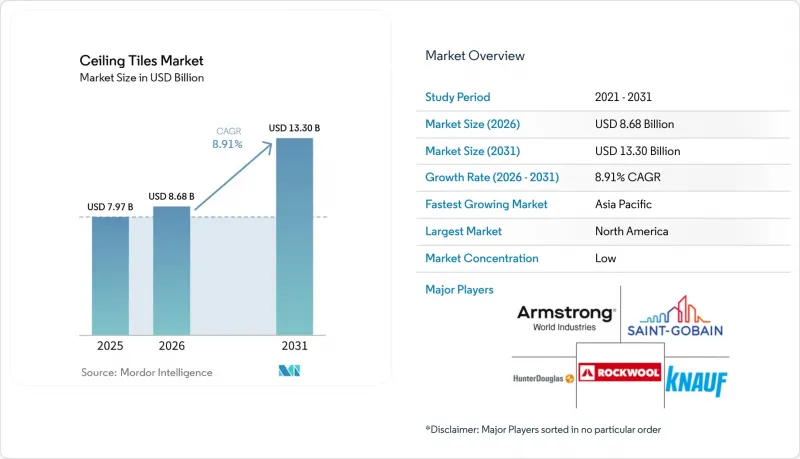
本報告按原料(礦物棉、金屬、石膏及其他)、性能(吸音/非吸音)、應用領域(住宅、商業、工業、公共設施)和地區(亞太、北美、歐洲、南美、中東和非洲)進行細分。市場預測以美元計價。
全球天花板片市場趨勢及洞察
開放式辦公室中吸音系統的快速普及
隨著混合辦公模式的演變,對更安靜的協作區域的需求日益成長。 Rockfon 的 Sonar dB35 吸音板降噪係數 (NRC) 高達 0.95,在企業維修工程中得到了廣泛應用。同時,Armstrong 的 TechZone Ultima 系統在美國新興的 A 級辦公室市場也佔有了一席之地。美國聲學學會 (ASA) 2024 年的一項研究揭示了一個令人擔憂的趨勢:在面積超過 5,000 平方英尺的樓層中,降噪係數低於 0.80 的天花板片會導致生產力下降。 Knauf 的 Heradesign 木絲天花板不僅符合 WELL 建築標準的混響要求,而且其仿生美學設計在歐洲也越來越受歡迎。這些趨勢凸顯了天花板片市場對聲音分級產品的強勁需求。
綠建築認證正在促進歐洲礦棉維修。
2025年,歐盟建築性能指令2024/1275將要求各國政府公佈公共建築的全生命週期碳排放基準。此舉也促進了已獲得環境產品聲明(EPD)認證的礦棉板的使用。聖戈班的「Ecophone Master Rigid」系列產品已獲得北歐白天鵝認證,並在德國維修市場廣受歡迎。同時,採用回收材料製造並符合BREEAM「優秀」認證標準的Rockfon「Sonar dB35」系列產品在英國醫院競標中脫穎而出。鑑於這些趨勢,受該指令推動的維修項目,歐洲天花板片市場呈現成長態勢。
能源價格波動推高了礦物棉的成本。
2025年上半年,歐洲天然氣期貨價格較2024年上漲。天然氣價格的飆升推高了洛克豐和聖戈班兩家公司的生產成本。同時,美國礦物棉產業的生產者物價指數(PPI)也較去年同期上漲。此外,進口現貨液化天然氣的亞洲中小型製造商的利潤率也面臨壓力。這種情況正在削弱這些公司在天花板片市場的競爭力。
細分市場分析
到2025年,礦棉將佔據天花板片市場41.12%的佔有率,因為建築師重視其兼具隔熱和隔音性能的優勢。金屬板(主要由鋁製成)由於其卓越的防潮性能和機場、地鐵所需的A1級防火等級,正以9.03%的複合年成長率成長。石膏板在注重成本的住宅建築中仍然佔據主導地位,但在印度和東南亞,其利潤率正受到來自POP(發泡聚苯乙烯)的競爭擠壓。複合材料、PVC和木質產品則迎合了追求自然美感的高階細分市場,這些市場透過定製圖案來滿足需求。
亞太地區是金屬材料崛起的主要驅動力,香港「三跑道系統」和印度地鐵擴建工程等工程均採用了EN 13501-1和IS 1646, 2023防火標準。在歐洲和北美,受環境產品聲明(EPD)和WELL聲學評分日益重視的推動,礦棉正逐漸成為維修工程的主流材料。石膏因其成本績效效益而繼續被使用,但其易受潮的特性使其在浴室和潮濕氣候中的應用面臨挑戰。市場趨勢表明,天花板片行業正朝著低碳原料的方向發展,例如Armstrong的「Ultima LEC」瓷磚等生物基創新產品體現了這一趨勢。
區域分析
預計到2025年,北美將佔全球銷售額的35.34%,這主要得益於LEED v4.1和WELL認證的普及以及穩定的維修需求。亞太地區預計將以10.56%的複合年成長率成長,主要驅動力是需要防火解決方案的項目,例如中國的地鐵站、印度的機場維修以及東協的交通樞紐。歐洲市場佔有率依然強勁,這主要得益於符合歐盟建築性能指令的礦棉維修工程。拉丁美洲以及中東和非洲地區的成長率保持在中等個位數,主要驅動力是巴西的住宅開工量以及海灣合作理事會(GCC)國家的高階開發項目。
2024年,中國建築產值成長,礦棉和金屬瓦的使用主要集中在1級和2級商業建築。在日本,隨著老舊建築的增多,隔音維修正在推進;而在越南、泰國和印度尼西亞,更嚴格的消防安全法規推動了對A1級產品的需求成長。受快速都市化和日益嚴格的安全標準的推動,亞洲地區的天花板片市場前景最為光明。
其他好處:
- Excel格式的市場預測(ME)表
- 3個月的分析師支持
目錄
第1章:引言
- 研究假設和市場定義
- 調查範圍
第2章:調查方法
第3章執行摘要
第4章 市場狀況
- 市場概覽
- 市場促進因素
- 開放式辦公室中音響系統的快速普及
- 綠建築認證正在促進歐洲維修中礦物棉的使用。
- 亞洲主要大都會圈機場擴建工程強制使用防火磁磚。
- 數位印刷石膏磚使海灣合作理事會(GCC)的豪華住宅優質化。
- 使用生物基粘合劑。
- 市場限制因素
- 能源價格波動推高了礦物棉的成本。
- 瀝青砂漿等替代品所帶來的威脅。
- 低成本的石膏天花板片阻礙了石膏板在亞太地區的廣泛應用。
- 價值鏈分析
- 波特五力分析
第5章 市場規模與成長預測
- 按成分
- 礦棉
- 金屬
- 石膏
- 其他材料(複合材料、塑膠、木材)
- 按特徵
- 聲學
- 非聲學
- 透過使用
- 住宅
- 商業的
- 產業
- 公共機構
- 按地區
- 亞太地區
- 中國
- 印度
- 日本
- 韓國
- 東南亞國協
- 其他亞太國家
- 北美洲
- 美國
- 加拿大
- 墨西哥
- 歐洲
- 德國
- 英國
- 法國
- 義大利
- 西班牙
- 北歐的
- 其他歐洲國家
- 南美洲
- 巴西
- 阿根廷
- 其他南美國家
- 中東和非洲
- 沙烏地阿拉伯
- 阿拉伯聯合大公國
- 南非
- 奈及利亞
- 其他中東和非洲國家
- 亞太地區
第6章 競爭情勢
- 市場集中度
- 策略趨勢
- 市佔率和排名分析
- 公司簡介
- AWI Licensing LLC
- Foshan Ron Building Material Trading
- Georgia-Pacific
- Guangzhou Titan Building Materials Co., Ltd.
- Haining Shamrock Import & Export Co. Ltd.
- Hunter Douglas NV
- Imerys
- Kingspan Group
- Knauf Group
- Mada Gypsum Company
- New Ceiling Tiles LLC
- Odenwald Faserplattenwerk GmbH
- PVC Ceilings SA
- ROCKWOOL A/S
- Saint-Gobain
- SAS International
- Shandong Huamei Building Materials Co., Ltd.
- Techno Ceiling Products
- USG Corporation
第7章 市場機會與未來展望
According to Mordor Intelligence, the ceiling tiles market size is expected to increase from USD 7.97 billion in 2025 to USD 8.68 billion in 2026 and reach USD 13.30 billion by 2031, growing at a CAGR of 8.91% over 2026-2031.
This report is Segmented by Raw Material (Mineral Wool, Metal, Gypsum, and Others), Property (Acoustic and Non-Acoustic), Application (Residential, Commercial, Industrial, and Institutional), and Geography (Asia Pacific, North America, Europe, South America, and Middle-East and Africa). The Market Forecasts are Provided in Terms of Value (USD).
Global Ceiling Tiles Market Trends and Insights
Rapid Adoption of Acoustic Systems in Open-Plan Offices
As hybrid work models evolve, the demand for quieter collaboration zones intensifies. Rockfon's Sonar dB35 panels, boasting a 0.95 NRC, experienced increased adoption driven by corporate retrofits. Meanwhile, Armstrong's TechZone Ultima system made its mark in the new U.S. Class A office segment. A 2024 study by the Acoustical Society of America revealed a concerning trend: ceiling absorption coefficients dipping below 0.80 are linked to a decline in productivity for floorplates larger than 5,000 sq ft . Knauf's Heradesign wood-wool tiles not only meet the reverberation standards of the WELL Building Standard but also offer the biophilic aesthetics that have gained traction in Europe. These trends highlight the robust demand for acoustic-grade products in the ceiling tiles market.
Green-Building Credits Boosting Mineral-Wool Retrofits in Europe
By 2025, the EU's Building Performance Directive 2024/1275 mandates that governments unveil whole-life carbon benchmarks for public buildings. This move also promotes the use of mineral-wool tiles that come with Environmental Product Declarations. Saint-Gobain's Ecophon Master Rigid, boasting Nordic Swan certification, has gained traction in Germany's retrofit market. Meanwhile, Rockfon's Sonar dB35 line, crafted with recycled content, meets the criteria for BREEAM Excellent credits, bolstering bids for hospitals in the U.K. Given these developments, the European ceiling tiles market is poised for growth, driven by directive-led retrofits.
Energy-Price Volatility Inflating Mineral-Wool Costs
In the first half of 2025, European natural-gas futures increased compared to 2024. This surge in gas prices led to a rise in production costs for both Rockfon and Saint-Gobain. Meanwhile, the U.S. Producer Price Index (PPI) for mineral-wool manufacturing also experienced a year-over-year increase. Additionally, smaller Asian producers, who are importing spot LNG, are experiencing margin compression. This situation is diminishing their competitiveness in the ceiling tiles market.
Other drivers and restraints analyzed in the detailed report include:
- Metro and Airport Build-Outs Mandating Non-Combustible Tiles in Asia
- Digital-Print Gypsum Tiles Enabling Premiumization in GCC Luxury Real Estate
- Threat from Substitutes Such as Asphalt, Mortar, and Low-Cost POP Ceilings
For complete list of drivers and restraints, kindly check the Table Of Contents.
Segment Analysis
Mineral wool owned 41.12% of the ceiling tiles market share in 2025 as architects valued its thermal and acoustic duality. Metal panels, mainly aluminum, are rising at a 9.03% CAGR because they resist humidity and carry A1 fire ratings required at airports and metros. Gypsum tiles dominate cost-conscious residential builds, though POP competition is squeezing margins in India and Southeast Asia. Composite, PVC, and wood options serve luxury niches seeking organic aesthetics with customized graphics.
Asia Pacific is the backbone of metal's rise, with projects like Hong Kong's Three Runway System and India's metro expansion referencing EN 13501-1 and IS 1646:2023 non-combustible standards. In Europe and North America, mineral wool holds sway in retrofits, driven by the importance of environmental product declarations and WELL acoustic scores. Gypsum's cost-effectiveness ensures its continued use, yet its moisture sensitivity poses challenges in bathrooms and humid climates. Highlighting a market trend, bio-based innovations like Armstrong's Ultima LEC tile signal a move towards lower-carbon raw materials in the ceiling tiles industry.
Geography Analysis
North America held 35.34% of 2025 revenue, supported by LEED v4.1 and WELL adoption, plus stable retrofit demand. Asia Pacific is forecast to grow at a 10.56% CAGR, reflecting China's metro stations, India's airport upgrades, and ASEAN's transit hubs, all of which call for non-combustible solutions. Europe's share stays resilient through mineral-wool retrofits that satisfy the EU Building Performance Directive. Latin America and the Middle East-Africa register mid-single-digit expansion driven by Brazil's residential starts and GCC luxury developments.
China's construction output increased in 2024, concentrating mineral wool and metal tile usage in Tier-1 and Tier-2 commercial builds. Japan's aging stock spurs acoustic retrofits, while Vietnam, Thailand, and Indonesia tighten fire codes, inviting A1-rated products. The ceiling tiles market outlook remains most upbeat in Asia, where rapid urbanization converges with stricter safety standards.
- AWI Licensing LLC
- Foshan Ron Building Material Trading
- Georgia-Pacific
- Guangzhou Titan Building Materials Co., Ltd.
- Haining Shamrock Import & Export Co. Ltd.
- Hunter Douglas N.V.
- Imerys
- Kingspan Group
- Knauf Group
- Mada Gypsum Company
- New Ceiling Tiles LLC
- Odenwald Faserplattenwerk GmbH
- PVC Ceilings SA
- ROCKWOOL A/S
- Saint-Gobain
- SAS International
- Shandong Huamei Building Materials Co., Ltd.
- Techno Ceiling Products
- USG Corporation
Additional Benefits:
- The market estimate (ME) sheet in Excel format
- 3 months of analyst support
TABLE OF CONTENTS
1 Introduction
- 1.1 Study Assumptions and Market Definition
- 1.2 Scope of the Study
2 Research Methodology
3 Executive Summary
4 Market Landscape
- 4.1 Market Overview
- 4.2 Market Drivers
- 4.2.1 Rapid adoption of acoustic systems in open-plan offices
- 4.2.2 Green-building credits boosting mineral-wool retrofits in Europe
- 4.2.3 Metro airport build-outs mandating non-combustible tiles in Asia
- 4.2.4 Digital-print gypsum tiles enabling premiumisation in GCC luxury real estate
- 4.2.5 Bio-based binders cutting embodied-carbon of mineral-fibre tiles
- 4.3 Market Restraints
- 4.3.1 Energy-price volatility inflating mineral-wool costs
- 4.3.2 Threat from substitutes such as asphalt mortar
- 4.3.3 Low-cost POP ceilings constraining gypsum-tile uptake in Asia-Pacific
- 4.4 Value Chain Analysis
- 4.5 Porter's Five Forces Analysis
- 4.5.1 Bargaining Power of Suppliers
- 4.5.2 Bargaining Power of Buyers
- 4.5.3 Threat of New Entrants
- 4.5.4 Threat of Substitutes
- 4.5.5 Degree of Competition
5 Market Size and Growth Forecasts (Value)
- 5.1 By Raw Material
- 5.1.1 Mineral Wool
- 5.1.2 Metal
- 5.1.3 Gypsum
- 5.1.4 Others (Composite, Plastic and Wood)
- 5.2 By Property
- 5.2.1 Acoustic
- 5.2.2 Non-Acoustic
- 5.3 By Application
- 5.3.1 Residential
- 5.3.2 Commercial
- 5.3.3 Industrial
- 5.3.4 Institutional
- 5.4 By Geography
- 5.4.1 Asia Pacific
- 5.4.1.1 China
- 5.4.1.2 India
- 5.4.1.3 Japan
- 5.4.1.4 South Korea
- 5.4.1.5 ASEAN Countries
- 5.4.1.6 Rest of Asia Pacific
- 5.4.2 North America
- 5.4.2.1 United States
- 5.4.2.2 Canada
- 5.4.2.3 Mexico
- 5.4.3 Europe
- 5.4.3.1 Germany
- 5.4.3.2 United Kingdom
- 5.4.3.3 France
- 5.4.3.4 Italy
- 5.4.3.5 Spain
- 5.4.3.6 Nordics
- 5.4.3.7 Rest of Europe
- 5.4.4 South America
- 5.4.4.1 Brazil
- 5.4.4.2 Argentina
- 5.4.4.3 Rest of South America
- 5.4.5 Middle-East and Africa
- 5.4.5.1 Saudi Arabia
- 5.4.5.2 United Arab Emirates
- 5.4.5.3 South Africa
- 5.4.5.4 Nigeria
- 5.4.5.5 Rest of Middle-East and Africa
- 5.4.1 Asia Pacific
6 Competitive Landscape
- 6.1 Market Concentration
- 6.2 Strategic Moves
- 6.3 Market Share(%)/Ranking Analysis
- 6.4 Company Profiles (includes Global level Overview, Market level overview, Core Segments, Financials as available, Strategic Information, Market Rank/Share for key companies, Products and Services, and Recent Developments)
- 6.4.1 AWI Licensing LLC
- 6.4.2 Foshan Ron Building Material Trading
- 6.4.3 Georgia-Pacific
- 6.4.4 Guangzhou Titan Building Materials Co., Ltd.
- 6.4.5 Haining Shamrock Import & Export Co. Ltd.
- 6.4.6 Hunter Douglas N.V.
- 6.4.7 Imerys
- 6.4.8 Kingspan Group
- 6.4.9 Knauf Group
- 6.4.10 Mada Gypsum Company
- 6.4.11 New Ceiling Tiles LLC
- 6.4.12 Odenwald Faserplattenwerk GmbH
- 6.4.13 PVC Ceilings SA
- 6.4.14 ROCKWOOL A/S
- 6.4.15 Saint-Gobain
- 6.4.16 SAS International
- 6.4.17 Shandong Huamei Building Materials Co., Ltd.
- 6.4.18 Techno Ceiling Products
- 6.4.19 USG Corporation
7 Market Opportunities and Future Outlook
- 7.1 White-space and Unmet-Need Assessment

 天花板片市場:依材料、安裝類型、厚度、最終用途和通路分類-全球預測,2026-2032年
 天花板片:全球市場
 全球天花板片市場:機會與策略展望(至2035年)
 天花板片市場規模、佔有率、趨勢和預測:按類型、最終用途和地區分類,2026-2034 年2026年全球天花板片市場報告2026年全球層壓石膏天花板片市場報告
 天花板片市場-全球產業規模、佔有率、趨勢、機會和預測:按材料類型、特性、最終用戶、地區和競爭格局分類,2021-2031年
 天花板片市場規模、佔有率和成長分析(按材質、屬性類型、最終用戶和地區分類)—2026-2033年產業預測
 美國天花板片市場規模、佔有率和趨勢分析報告:按應用、材料和細分市場預測(2025-2033 年)北美天花板片市場規模、佔有率和趨勢分析報告:按產品、最終用途、國家和細分市場預測,2025 年至 2033 年