


 |
市場調查報告書
商品編碼
2066379
鋯:市場佔有率分析、產業趨勢與統計、成長預測(2026-2031)Zirconium - Market Share Analysis, Industry Trends & Statistics, Growth Forecasts (2026 - 2031) |
||||||

※ 本網頁內容可能與最新版本有所差異。詳細情況請與我們聯繫。
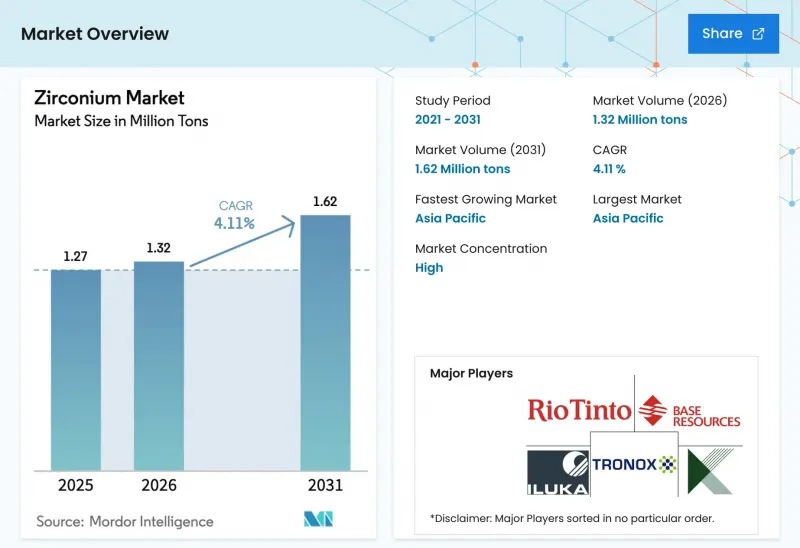
根據 Mordor Intelligence 預測,鋯市場規模將從 2025 年的 127 萬噸和 2026 年的 132 萬噸成長到 2031 年的 162 萬噸,2026 年至 2031 年的年複合成長率(CAGR)為 4.11%。
本報告按鋯的類型(鋯、氧化鋯及其他)、應用(鋯粉/磨砂、鋯遮光劑、耐火材料、鋯化學品、鋯金屬及合金)和地區(生產分析:澳大利亞、巴西、中國、印度、印尼等;消費分析:中國、美國、日本等)進行細分。市場預測以噸為單位。
全球鋯市場趨勢與洞察
來自鑄造和耐火材料行業的持續需求
2025年,全球鑄造業大量使用鋯砂製造精密型芯和模具,這得益於鋯砂優異的性能,例如低熱膨脹係數和化學惰性。雖然在對成本敏感的應用中,鉻鐵礦和橄欖石砂比鋯砂更受歡迎,但諾拉姆科技的砂回收專利在維持鋯砂在歐洲的價值方面發揮了關鍵作用。耐火材料製造商透過將氧化鋯與氧化鎂和氧化鋁混合來延長爐子的使用壽命,從而提高了對氧化鋯的需求,儘管尋找替代品十分困難。同時,歐洲嚴格的放射性廢棄物處置法規促進了閉合迴路鑄造製程的發展,確保了鋯砂的供應。
鋯基遮光劑在先進陶瓷的應用日益廣泛
到2025年,陶瓷產業將佔據鋯砂使用量的大部分,而數位印刷磁磚的普及提高了每平方公尺的鋯含量。中國和印度作為全球主要的瓷磚生產國,對遮光劑的需求不斷成長,進而帶動了超低鐵粉末的需求。積層製造領域對細粒鋯砂的需求逐年飆升,在電子和可再生能源設備產業催生了高階細分市場。伊爾卡資源公司抓住這些趨勢,擴大了研磨產能,以最大限度地掌握這些盈利的銷售機會。
鑄造和耐火材料應用中鉻鐵礦/橄欖石的替代品
鉻鐵礦價格更實惠,耐火性能與其他材料相當。同時,其較低的二氧化矽含量降低了矽肺病的風險。因此,歐洲和北美的鑄造廠正在考慮逐步淘汰鋯石。 Nolam Technologies公司已獲得一項專利,該專利涉及從回收砂中選擇性提取鉻鐵礦或鋯石的方法,從而減少了對未利用原料的依賴。耐火材料製造商越來越傾向於使用氧化鎂-氧化鋁混合物,並將氧化鋯的使用限制在極端高溫區域。
細分市場分析
2025年,鋯石佔據市場主導地位,佔總銷售量的88.89%。澳洲和南非在供應鏈中發揮了關鍵作用,確保了向成熟的陶瓷和鑄造行業穩定供應鋯石。隨著成熟礦場轉向開採新礦床,鋯石在鋯產業的市場規模不僅在2025年達到了顯著水平,而且進入了穩定成長的軌道。儘管鋯石在銷售方面佔據主導地位,但其價格走勢與建設週期密切相關,這使得礦業公司容易受到產業波動的影響。
同時,儘管氧化鋯的加工量較小,但預計2026年至2031年間的複合年成長率將達到5.27%。這一成長主要得益於固態電池、生物陶瓷和航太塗料等應用領域對高純度氧化鋯需求的激增。擅長供應亞微米級粉末的生產商已獲得顯著的價格溢價和更高的盈利。 Energy Fuels公司採用ASM公司的高純度技術的策略性舉措,凸顯了該產業渴望獲得以往由中國加工商佔據的利潤空間。相較之下,其他品種,例如巴德雷石,由於蘊藏量主要集中在俄羅斯以及相關的地緣政治挑戰,仍處於小眾市場。
區域分析
到2025年,中國將佔據全球鋯消費量的53.36%,預計在2026年至2031年的預測期內,年複合成長率將達到4.78%。憑藉其廣泛的物流網路和在鋯化工領域的主導地位,中國國內鋯價格低於全球平均水平。然而,美國關稅和歐盟的「友善回流」政策正促使陶瓷和合金買家尋求多元化採購管道,增加從澳洲和非洲的採購。到2025年中期,中國核子反應爐建設將成為鋯的主要消費領域,隨著新產能的獲批,這一趨勢預計將持續到2031年。
2023年,北美開始在猶他州和喬治亞建造新的加工廠,旨在收回先前因中國消耗大量精礦而流失的增值部分。與美國固態電池舉措相關的鋯市場目前小規模,但隨著電動車製造商對LLZO電解液的試驗,該市場正迅速發展。預計到2025年,歐洲將佔據相當大的需求佔有率,高純度陶瓷和航太塗層的需求成為優先考慮因素。 《基本原料法案》設定的加工目標正在推動法國和德國的合資企業,但這些計畫資本密集,因此面臨許多挑戰。
2023年,澳洲和南非成為鋯石主要生產國,供應全球大部分開採鋯石。然而,由於礦山資產老化,重啟現有礦山的運作已成為當務之急。 2026年3月,力拓集團批准重啟其位於莫三比克的祖爾蒂南礦(Zulti South mine)的營運;伊爾卡集團(ILCA)的巴拉納爾多(Barranardo)計畫也於2025年底擴大了年產能。預計到2031年,莫三比克、馬達加斯加和肯亞的新生產基地將能夠實現年供應,前提是它們符合授權、社會及治理(ESG)合規要求。印度正憑藉瓷磚出口和對核能合金的投資擴大其市場佔有率。同時,俄羅斯專注於巴德雷(Badeley)礦區,這不僅加強了其國內安全,也限制了其全球擴張。
其他好處:
- Excel格式的市場預測(ME)表
- 3個月的分析師支持
目錄
第1章:引言
- 研究假設和市場定義
- 調查範圍
第2章:調查方法
第3章執行摘要
第4章 市場狀況
- 市場概覽
- 市場促進因素
- 來自鑄造業和耐火材料行業的持續需求。
- 鋯基遮光劑在先進陶瓷和塗料的應用日益廣泛
- 氧化鋯固體電解質在新一代電池中的商業化應用
- 「友善回流」政策和歐盟的《關鍵原物料法》正在推動新的煉油產能擴張。
- 用於航太隔熱塗層的高純度氧化鋯
- 市場限制因素
- 鑄造和耐火材料領域的鉻鐵礦橄欖石交代作用
- 加強重礦砂開採相關的放射性及環境、社會和治理(ESG)法規。
- 中國在下游產業的支配地位以及美國關稅對供應鏈的擾亂
- 價值鏈分析
- 波特五力模型
- 全球供應分析
- 監理政策分析
- 貿易分析(前5-10個國家)
- 價格趨勢分析
- 生產成本分析
第5章 市場規模與成長預測
- 按發生類型
- 鋯石
- 氧化鋯
- 其他類型
- 透過使用
- 鋯粉/碎砂
- 鋯石遮光片
- 耐火材料(氧化鋯)
- 鋯化學產品(氯氧化鋯、碳酸鹽鋯、硫酸鋯)
- 鋯金屬及合金
- 按地區
- 生產分析
- 澳洲
- 巴西
- 中國
- 印度
- 印尼
- 南非
- 烏克蘭
- 世界其他地區
- 消費分析
- 中國
- 美國
- 日本
- EU
- 印度
- 俄羅斯
- 世界其他地區
- 生產分析
第6章 競爭情勢
- 市場集中度
- 策略趨勢
- 市佔率和排名分析
- 公司簡介
- Astron Group
- Australian Strategic Materials Ltd.
- Base Resources Ltd
- Energy Fuels Inc.
- Eramet SA
- Iluka Resources Limited
- Image Resources NL
- Iwatani Corporation
- Kenmare Resources plc
- Lanka Mineral Sands Ltd
- Mineral Commodities Ltd
- Rio Tinto
- The Chemours Company
- Tronox Holdings plc
第7章 市場機會與未來展望
According to Mordor Intelligence, the zirconium market size is projected to expand from 1.27 million tons in 2025 and 1.32 million tons in 2026 to 1.62 million tons by 2031, registering a CAGR of 4.11% between 2026 to 2031.
This report is Segmented by Occurrence Type (Zircon, Zirconia, and Other Types), Application (Zircon Flour/Milled Sand, Zircon Opacifier, Refractories, Zircon Chemicals, and Zircon Metal and Alloys), and Geography (Production Analysis: Australia, Brazil, China, India, Indonesia, and More; Consumption Analysis: China, United States, Japan, and More). The Market Forecasts are Provided in Terms of Volume (Tons).
Global Zirconium Market Trends and Insights
Sustained Demand from Foundry and Refractory Industries
In 2025, global foundries, emphasizing zircon's prized qualities such as low thermal expansion and chemical inertness, heavily relied on zircon sand for precision cores and molds. Although cost-sensitive applications began favoring chromite and olivine over zircon, a sand recycling patent from Noram Technology played a pivotal role in preserving zircon's value in Europe. Refractory formulators, by blending zirconia with magnesia and alumina, extended furnace life, driving up zirconia demand despite its substitution hurdles. Meanwhile, Europe's stringent radioactive waste disposal regulations championed closed-loop foundry operations, ensuring the retention of zircon fractions.
Rising Use of Zircon-Based Opacifiers in Advanced Ceramics
In 2025, ceramics claimed a substantial portion of zircon sand usage, with digitally printed tiles enhancing zircon loading per square meter. As the primary producers of the world's tiles, China and India amplified their demand for opacifiers, leading to a need for ultra-low-iron powders. The appetite for finer grades in additive manufacturing surged annually, carving premium niches in electronics and renewable energy devices. Capitalizing on this trend, Iluka Resources boosted its milling capacity to capitalize on these profitable sales.
Substitution by Chromite/Olivine in Foundry and Refractories
Chromite, being more affordable, rivals its counterparts in refractoriness. At the same time, olivine's reduced silica content mitigates the risk of silicosis. As a result, foundries across Europe and North America are contemplating a gradual transition away from zircon. Noram Technology has secured a patent for a method that selectively extracts either chromite or zircon from recycled sand, thereby lessening the reliance on virgin materials. Refractory manufacturers are increasingly favoring magnesia-alumina blends, reserving zirconia for zones subjected to extreme heat.
Other drivers and restraints analyzed in the detailed report include:
- Commercialization of Zirconia Solid Electrolytes for Next-Gen Batteries
- Friend-Shoring and EU Critical Raw Materials Act
- Tightening Radioactivity and ESG Rules on Heavy-Mineral-Sand Mining
For complete list of drivers and restraints, kindly check the Table Of Contents.
Segment Analysis
In 2025, zircon dominated the market, constituting a substantial 88.89% of the total volume. With both Australia and South Africa playing pivotal roles in the supply chain, established ceramics and foundry sectors enjoyed a steady influx of zircon. As mature mines transitioned to new orebodies, the market size for zircon in the zirconium sector not only reached a notable level in 2025 but was also set on a trajectory of steady growth. While zircon led in terms of volume, its pricing dynamics were intricately linked to construction cycles, exposing miners to the sector's fluctuations.
On the other hand, zirconia, despite its smaller tonnage, is projected to grow at a 5.27% CAGR during the 2026-2031 period. This anticipated growth is fueled by the surging demand for high-purity zirconia in applications such as solid-state batteries, bioceramics, and aerospace coatings. Producers adept at offering sub-micron powders enjoyed a significant price premium, enhancing their profitability. Energy Fuels' strategic move to adopt ASM's high-purity technology highlights the industry's ambition to seize margins that have historically benefited Chinese processors. In contrast, other variants such as baddeleyite remained in a niche position, hampered by reserves predominantly located in Russia and the geopolitical challenges that accompany them.
Geography Analysis
In 2025, China held a dominant 53.36% share of global consumption and is projected to grow at a CAGR of 4.78% through the forecast period of 2026-2031. China's extensive logistics network and leading role in zirconium chemicals enable it to maintain domestic prices below global averages. However, U.S. tariffs and EU friend-shoring regulations are prompting ceramic and alloy buyers to diversify, increasingly sourcing from Australia and Africa. By mid-2025, Chinese reactor constructions were major consumers of zirconium, and with new capacity approvals, this trend is anticipated to persist through 2031.
In 2023, North America, having utilized a significant amount of concentrates, began establishing new processing facilities in Utah and Georgia, with the goal of reclaiming value that was previously ceded to Chinese refiners. Although the zirconium market tied to U.S. solid-state battery initiatives is currently modest, it is swiftly gaining momentum as electric vehicle producers experiment with LLZO electrolytes. Europe, which accounted for a substantial share of 2025's demand, is prioritizing high-purity ceramics and aerospace coatings. The processing targets set by the Critical Raw Materials Act have spurred joint ventures in France and Germany, though the capital-intensive nature of these projects presents challenges.
In 2023, Australia and South Africa emerged as the primary sources for the majority of the world's mined zircon. Yet, with aging assets, there is an urgent call for brownfield restarts. In March 2026, Rio Tinto approved a restart at Zulti South in Mozambique, while Iluka's Balranald project ramped up its annual capacity in late 2025. Newer hubs in Mozambique, Madagascar, and Kenya are eyeing a potential annual supply by 2031, contingent on permitting and ESG compliance. India is carving out a larger share, driven by tile exports and investments in nuclear alloys. On the other hand, while Russia's emphasis on baddeleyite bolsters its internal security, it curtails its global outreach.
- Astron Group
- Australian Strategic Materials Ltd.
- Base Resources Ltd
- Energy Fuels Inc.
- Eramet SA
- Iluka Resources Limited
- Image Resources NL
- Iwatani Corporation
- Kenmare Resources plc
- Lanka Mineral Sands Ltd
- Mineral Commodities Ltd
- Rio Tinto
- The Chemours Company
- Tronox Holdings plc
Additional Benefits:
- The market estimate (ME) sheet in Excel format
- 3 months of analyst support
TABLE OF CONTENTS
1 Introduction
- 1.1 Study Assumptions and Market Definition
- 1.2 Scope of the Study
2 Research Methodology
3 Executive Summary
4 Market Landscape
- 4.1 Market Overview
- 4.2 Market Drivers
- 4.2.1 Sustained demand from foundry and refractory industries
- 4.2.2 Rising use of zircon-based opacifiers in advanced ceramics and coatings
- 4.2.3 Commercialization of zirconia solid electrolytes for next-gen batteries
- 4.2.4 Friend-shoring and EU Critical Raw Materials Act spurring new refining capacity
- 4.2.5 High-purity zirconia for aerospace thermal-barrier coatings
- 4.3 Market Restraints
- 4.3.1 Substitution by chromite/olivine in foundry and refractories
- 4.3.2 Tightening radioactivity and ESG rules on heavy-mineral-sand mining
- 4.3.3 Chinese downstream dominance and US tariffs disrupting supply chains
- 4.4 Value Chain Analysis
- 4.5 Porter's Five Forces
- 4.5.1 Bargaining Power of Suppliers
- 4.5.2 Bargaining Power of Consumers
- 4.5.3 Threat of New Entrants
- 4.5.4 Threat of Substitutes
- 4.5.5 Degree of Competition
- 4.6 Supply Analysis (Global)
- 4.7 Regulatory Policy Analysis
- 4.8 Trade Analysis (Top 5-10 Countries)
- 4.9 Price Trend Analysis
- 4.10 Production Cost Analysis
5 Market Size and Growth Forecasts (Volume)
- 5.1 By Occurrence Type
- 5.1.1 Zircon
- 5.1.2 Zirconia
- 5.1.3 Other Types
- 5.2 By Application
- 5.2.1 Zircon Flour/Milled Sand
- 5.2.2 Zircon Opacifier
- 5.2.3 Refractories (Zirconia)
- 5.2.4 Zircon Chemicals (Oxychloride, Carbonate, Sulfate)
- 5.2.5 Zircon Metal and Alloys
- 5.3 By Geography
- 5.3.1 Production Analysis
- 5.3.1.1 Australia
- 5.3.1.2 Brazil
- 5.3.1.3 China
- 5.3.1.4 India
- 5.3.1.5 Indonesia
- 5.3.1.6 South Africa
- 5.3.1.7 Ukraine
- 5.3.1.8 Rest of the World
- 5.3.2 Consumption Analysis
- 5.3.2.1 China
- 5.3.2.2 United States
- 5.3.2.3 Japan
- 5.3.2.4 European Union
- 5.3.2.5 India
- 5.3.2.6 Russia
- 5.3.2.7 Rest of the World
- 5.3.1 Production Analysis
6 Competitive Landscape
- 6.1 Market Concentration
- 6.2 Strategic Moves
- 6.3 Market Share(%)/Ranking Analysis
- 6.4 Company Profiles (includes Global Overview, Market Overview, Core Segments, Financials, Strategic Information, Products and Services, Recent Developments)
- 6.4.1 Astron Group
- 6.4.2 Australian Strategic Materials Ltd.
- 6.4.3 Base Resources Ltd
- 6.4.4 Energy Fuels Inc.
- 6.4.5 Eramet SA
- 6.4.6 Iluka Resources Limited
- 6.4.7 Image Resources NL
- 6.4.8 Iwatani Corporation
- 6.4.9 Kenmare Resources plc
- 6.4.10 Lanka Mineral Sands Ltd
- 6.4.11 Mineral Commodities Ltd
- 6.4.12 Rio Tinto
- 6.4.13 The Chemours Company
- 6.4.14 Tronox Holdings plc
7 Market Opportunities and Future Outlook
- 7.1 White-space and Unmet-Need Assessment

 鋯市場-2026-2032年全球市場預測
 鋯市場報告:按礦物類型、形態、最終用途和地區分類(2026-2034 年)
 全球氧化鋯珠市場規模、佔有率、趨勢和成長分析報告(2026-2034年)
 2026-2030年全球釔安定氧化鋯市場氧化鋯奈米顆粒分散體市場按產品類型、應用和終端用戶產業分類 - 全球預測(2026-2032 年)氧化鋯珠市場按材質類型、尺寸、純度、應用、終端用戶產業和分銷管道分類-2026-2032年全球預測釔安定氧化鋯奈米顆粒市場:按粒徑、純度等級、製造程序、產品類型、應用和最終用途行業分類的全球預測(2026-2032年)釔安定氧化鋯磨料珠市場(依珠粒尺寸、材料等級、最終用途產業、應用與銷售管道),全球預測,2026-2032年鋯基碳酸鹽市場按形態、純度等級、化學類型、應用和銷售管道,全球預測(2026-2032)非蒸煮髮型吸氣劑材料市場:按材料類型、形態、活化溫度、應用、終端用戶產業和分銷管道分類-2026-2032年全球預測