


 |
市場調查報告書
商品編碼
2065787
羅漢果:市場佔有率分析、產業趨勢與統計、成長預測(2026-2031)Luo Han Guo - Market Share Analysis, Industry Trends & Statistics, Growth Forecasts (2026 - 2031) |
||||||

※ 本網頁內容可能與最新版本有所差異。詳細情況請與我們聯繫。
根據 Mordor Intelligence 預測,羅漢果市場規模預計將從 2025 年的 1.406 億美元成長到 2026 年的 1.592 億美元,到 2031 年達到 2.958 億美元,2026 年至 2031 年的複合年成長率為 13.2%。
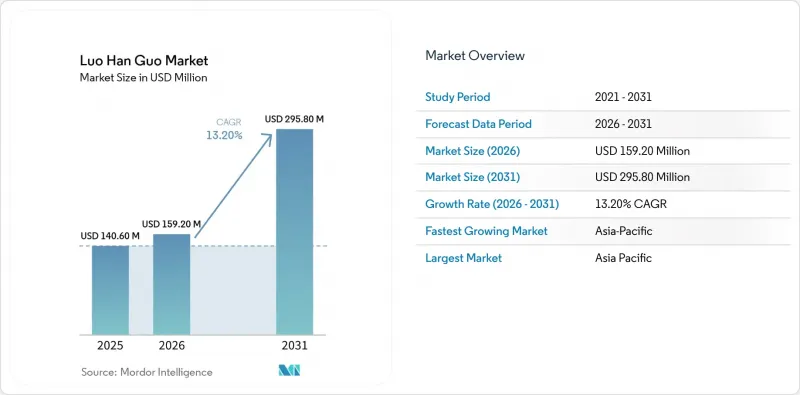
本報告按地區(北美、南美、歐洲、亞太及其他地區)分類,內容包括生產分析(數量)、消費分析(價值和數量)、進口分析(價值和數量)、出口分析(價值和數量)、批發價格趨勢分析及預測。市場預測以價值(美元)和數量(公噸)兩種單位呈現。
全球羅漢果市場趨勢與洞察
對零卡路里甜味劑「潔淨標示」的需求
根據國際食品資訊理事會(IFIC)發布的《2025年食品與健康調查》,34%的消費者認為「低糖」是健康食品的重要屬性,凸顯了消費者減少糖攝取的顯著趨勢。隨著製造商調整產品配方以滿足潔淨標示的要求,這一趨勢推動了對羅漢果等天然零卡路里甜味劑的需求。對減糖的關注也促使人們用植物來源替代品取代人工甜味劑,尤其是在飲料和零食領域,並凸顯了羅漢果在不斷演變的產品配方中,既能提供功能性又能提高標籤透明度的重要作用。
糖尿病和肥胖症盛行率增加
根據國際糖尿病聯盟(IDF)的預測,到2024年,全球20至79歲的成年人中將有5.89億人患有糖尿病,凸顯了低糖飲食日益成長的需求。隨著糖尿病盛行率的上升,消費者和生產者都更加重視更健康的糖替代品,這導致對低升糖指數、零卡路里甜味劑(如羅漢果)的需求增加。因此,食品和飲料公司正在改進其產品配方,尤其是在機能飲料和代餐產品方面,以滿足代謝健康的需求。這一趨勢凸顯了羅漢果在應對因糖尿病和肥胖問題而引發的飲食變化方面日益重要的作用。
種植主要限於廣西壯族自治區和湖南省。
羅漢果種植面積極為有限,仍是限制羅漢果市場發展的主要因素,阻礙了供應擴張,並使其極易受到區域性供應中斷的影響。據墨爾本大學的研究人員稱,到2024年,超過90%的羅漢果產量將集中在中國廣西壯族自治區的龍勝縣、靈桂縣和永福縣。這種對單一微氣候的依賴加劇了惡劣天氣和季節變化的風險,導致供應不穩定。因此,生產商面臨採購難題和業務擴張機會受限的問題,阻礙了市場的永續發展。
區域分析
2025年,亞太地區將佔羅漢果市場佔有率的45%,預計2026年至2031年間,該地區市場規模將以14.6%的複合年成長率(CAGR)高速成長。亞太地區的成長主要得益於中國羅漢果提取基地的擴張以及東南亞試種種植的進展,這些因素共同強化了供應鏈。廣西壯族自治區垂直整合的產業生態系統,在萊恩天然原料等公司的支持下,實現了規模經濟效益。此外,日本機能飲料產業正在推動高階市場需求,尤其是對獲得有機認證和「非基因工程項目認證」(Non-GMO Project Verified)的產品的需求。新興的東南亞市場也為市場成長做出了貢獻,這主要得益於可支配收入的增加以及為遏止糖尿病蔓延而實施的糖稅政策。
北美是全球第二大消費市場,而美國是首個採用該成分的市場,早在十多年前就獲得了美國食品藥物管理局(FDA) 的「公認安全 (GRAS)」認證。然而,提案於 2025 年徵收的關稅正在造成成本壓力,除非透過擴大國內加工能力(例如萊恩公司位於印第安納州的工廠)來緩解其影響,否則可能會阻礙短期市場成長。加拿大擁有類似的法規結構,並受益於一體化的跨境供應鏈,但其較小的人口規模限制了其整體銷售量潛力。
在歐洲,隨著法規的日益清晰,羅漢果的推廣應用正穩步推進。英國食品標準局 (FSA) 於 2024 年將羅漢果萃取物列為“新穎性產品”,這促進了羅漢果煎劑的使用。然而,羅漢果苷 V 含量超過 50% 的萃取物尚未獲得歐洲食品安全局 (EFSA) 的批准,導致標準不一,高純度產品的推廣速度也較為緩慢。南歐的烘焙師和糕點師非常重視羅漢果的熱穩定性,但與北歐相比,他們的認知度仍然較低。中東、非洲和南美洲正成為羅漢果的新興市場。糖尿病盛行率的上升以及跨國公司推出相關飲料表明,羅漢果在早期階段具有潛在的市場需求。然而,高昂的進口成本以及在零售店難以找到羅漢果產品,阻礙了其在這些地區的全面市場滲透。
- Excel格式的市場預測(ME)表
- 3個月的分析師支持
目錄
第1章:引言
- 研究假設和市場定義
- 調查範圍
第2章:調查方法
第3章執行摘要
第4章 市場狀況
- 市場概覽
- 市場促進因素
- 對零卡路里甜味劑潔淨標示的需求
- 糖尿病和肥胖症盛行率增加
- 擴大含有天然成分的新飲料產品推出
- 北美和歐洲的監管批准
- 透過人工智慧技術進行風味調節,改善風味。
- 2025年關稅體系帶來的供應鏈多元化
- 市場限制因素
- 種植主要限於廣西和湖南兩省。
- 與甜菊糖相比,萃取和純化成本更高。
- 歐盟對新食品的嚴格監管正在推遲這些產品的上市。
- 亞熱帶地區作物產量隨氣候變化而變化
- 機會
- 任務
- 價值鏈分析
- 人工智慧技術及其在產業的應用
- 原物料市場分析
- 種子
- 肥料
- 殺蟲劑
- 分銷通路分析
- 市場情緒分析
- PESTLE分析
第5章 市場規模與成長預測
- 按地區
- 北美洲
- 美國
- 生產分析(產量)
- 消費分析(消費量和消費體積)
- 進口市場分析(進口額、進口量、主要供應市場)
- 出口市場分析(出口額、出口量、主要出口目的地市場)
- 批發價格趨勢分析與預測。
- 法律規範
- 主要公司列表
- 物流和基礎設施
- 季節性分析
- 加拿大
- 生產分析(產量)
- 消費分析(消費量和消費體積)
- 進口市場分析(進口額、進口量、主要供應市場)
- 出口市場分析(出口額、出口量、主要出口目的地市場)
- 批發價格趨勢分析與預測。
- 法律規範
- 主要公司列表
- 物流和基礎設施
- 季節性分析
- 美國
- 南美洲
- 巴西
- 生產分析(產量)
- 消費分析(消費量和消費體積)
- 進口市場分析(進口額、進口量、主要供應市場)
- 出口市場分析(出口額、出口量、主要出口目的地市場)
- 批發價格趨勢分析與預測。
- 法律規範
- 主要公司列表
- 物流和基礎設施
- 季節性分析
- 阿根廷
- 生產分析(產量)
- 消費分析(消費量和消費體積)
- 進口市場分析(進口額、進口量、主要供應市場)
- 出口市場分析(出口額、出口量、主要出口目的地市場)
- 批發價格趨勢分析與預測。
- 法律規範
- 主要公司列表
- 物流和基礎設施
- 季節性分析
- 巴西
- 歐洲
- 德國
- 生產分析(產量)
- 消費分析(消費量和消費體積)
- 進口市場分析(進口額、進口量、主要供應市場)
- 出口市場分析(出口額、出口量、主要出口目的地市場)
- 批發價格趨勢分析與預測。
- 法律規範
- 主要公司列表
- 物流和基礎設施
- 季節性分析
- 法國
- 生產分析(產量)
- 消費分析(消費量和消費體積)
- 進口市場分析(進口額、進口量、主要供應市場)
- 出口市場分析(出口額、出口量、主要出口目的地市場)
- 批發價格趨勢分析與預測。
- 法律規範
- 主要公司列表
- 物流和基礎設施
- 季節性分析
- 英國
- 生產分析(產量)
- 消費分析(消費量和消費體積)
- 進口市場分析(進口額、進口量、主要供應市場)
- 出口市場分析(出口額、出口量、主要出口目的地市場)
- 批發價格趨勢分析與預測。
- 法律規範
- 主要公司列表
- 物流和基礎設施
- 季節性分析
- 西班牙
- 生產分析(產量)
- 消費分析(消費量和消費體積)
- 進口市場分析(進口額、進口量、主要供應市場)
- 出口市場分析(出口額、出口量、主要出口目的地市場)
- 批發價格趨勢分析與預測。
- 法律規範
- 主要公司列表
- 物流和基礎設施
- 季節性分析
- 義大利
- 生產分析(產量)
- 消費分析(消費量和消費體積)
- 進口市場分析(進口額、進口量、主要供應市場)
- 出口市場分析(出口額、出口量、主要出口目的地市場)
- 批發價格趨勢分析與預測。
- 法律規範
- 主要公司列表
- 物流和基礎設施
- 季節性分析
- 德國
- 亞太地區
- 中國
- 生產分析(產量)
- 消費分析(消費量和消費體積)
- 進口市場分析(進口額、進口量、主要供應市場)
- 出口市場分析(出口額、出口量、主要出口目的地市場)
- 批發價格趨勢分析與預測。
- 法律規範
- 主要公司列表
- 物流和基礎設施
- 季節性分析
- 日本
- 生產分析(產量)
- 消費分析(消費量和消費體積)
- 進口市場分析(進口額、進口量、主要供應市場)
- 出口市場分析(出口額、出口量、主要出口目的地市場)
- 批發價格趨勢分析與預測。
- 法律規範
- 主要公司列表
- 物流和基礎設施
- 季節性分析
- 泰國
- 生產分析(產量)
- 消費分析(消費量和消費體積)
- 進口市場分析(進口額、進口量、主要供應市場)
- 出口市場分析(出口額、出口量、主要出口目的地市場)
- 批發價格趨勢分析與預測。
- 法律規範
- 主要公司列表
- 物流和基礎設施
- 季節性分析
- 馬來西亞
- 生產分析(產量)
- 消費分析(消費量和消費體積)
- 進口市場分析(進口額、進口量、主要供應市場)
- 出口市場分析(出口額、出口量、主要出口目的地市場)
- 批發價格趨勢分析與預測。
- 法律規範
- 主要公司列表
- 物流和基礎設施
- 季節性分析
- 中國
- 中東
- 沙烏地阿拉伯
- 生產分析(產量)
- 消費分析(消費量和消費體積)
- 進口市場分析(進口額、進口量、主要供應市場)
- 出口市場分析(出口額、出口量、主要出口目的地市場)
- 批發價格趨勢分析與預測。
- 法律規範
- 主要公司列表
- 物流和基礎設施
- 季節性分析
- 阿拉伯聯合大公國
- 生產分析(產量)
- 消費分析(消費量和消費體積)
- 進口市場分析(進口額、進口量、主要供應市場)
- 出口市場分析(出口額、出口量、主要出口目的地市場)
- 批發價格趨勢分析與預測。
- 法律規範
- 主要公司列表
- 物流和基礎設施
- 季節性分析
- 沙烏地阿拉伯
- 非洲
- 南非
- 生產分析(產量)
- 消費分析(消費量和消費體積)
- 進口市場分析(進口額、進口量、主要供應市場)
- 出口市場分析(出口額、出口量、主要出口目的地市場)
- 批發價格趨勢分析與預測。
- 法律規範
- 主要公司列表
- 物流和基礎設施
- 季節性分析
- 奈及利亞
- 生產分析(產量)
- 消費分析(消費量和消費體積)
- 進口市場分析(進口額、進口量、主要供應市場)
- 出口市場分析(出口額、出口量、主要出口目的地市場)
- 批發價格趨勢分析與預測。
- 法律規範
- 主要公司列表
- 物流和基礎設施
- 季節性分析
- 南非
- 北美洲
第6章 最終用途與應用
- 主要應用和新興應用
- 產業特定消費細分
第7章 競爭情勢
- 競爭格局概述
- 市場集中度分析
第8章 市場機會與未來展望
According to Mordor Intelligence, the luo han guo market size is projected to grow from USD 140.6 million in 2025 to USD 159.20 million in 2026, reaching USD 295.80 million by 2031, with a CAGR of 13.2% during the period 2026-2031.
This report is Segmented by Geography (North America, South America, Europe, Asia-Pacific, and More). The Report Includes Production Analysis (Volume), Consumption Analysis (Value and Volume), Import Analysis (Value and Volume), Export Analysis (Value and Volume), Wholesale Price Trend Analysis and Forecast, and More. The Market Forecasts are Provided in Terms of Value (USD) and Volume (Metric Tons)
Global Luo Han Guo Market Trends and Insights
Clean-Label Demand for Zero-Calorie Sweeteners
According to the International Food Information Council's 2025 Food and Health Survey, 34% of consumers consider "low in sugar" a key attribute of healthy food, highlighting a significant shift toward reduced sugar consumption. This trend is driving increased demand for natural, zero-calorie sweeteners like monk fruit (Luo Han Guo), as manufacturers reformulate products to meet clean-label requirements. The focus on sugar reduction is also prompting the replacement of artificial sweeteners with plant-based alternatives, particularly in beverages and snacks, emphasizing monk fruit's role in providing both functionality and label transparency in evolving product formulations.
Rising Prevalence of Diabetes and Obesity
According to the International Diabetes Federation, 589 million adults aged 20-79 were living with diabetes globally in 2024, underscoring the growing need for sugar-controlled diets. This increasing prevalence of diabetes is driving demand for low-glycemic, zero-calorie sweeteners such as luo han guo, as both consumers and manufacturers prioritize healthier sugar alternatives. As a result, food and beverage companies are reformulating products, particularly functional beverages and diet-focused offerings, to meet metabolic health requirements. This trend highlights monk fruit's expanding role in addressing dietary changes driven by concerns about diabetes and obesity.
Cultivation Confined Largely to Guangxi and Hunan Provinces
The extreme geographic concentration of cultivation continues to be a significant limitation for the Luo Han Guo market, restricting supply scalability and increasing susceptibility to regional disruptions. According to the researchers of the University of Melbourne, as of 2024, over 90% of monk fruit production is concentrated in Longsheng, Lingui, and Yongfu counties within Guangxi Province, China. This reliance on a single microclimate amplifies the risks associated with adverse weather conditions and seasonal variability, resulting in supply instability. Consequently, manufacturers encounter sourcing challenges and limited opportunities for expansion, which impede sustained market growth.
Other drivers and restraints analyzed in the detailed report include:
- Expansion of Natural-Ingredient Beverage Launches
- Regulatory Approvals in North America and the European Union
- High Extraction and Purification Costs versus Stevia
For complete list of drivers and restraints, kindly check the Table Of Contents.
Geography Analysis
Asia-Pacific accounted for 45% of the Luo Han Guo market share in 2025, and the market size is projected to grow at at he fastest 14.6% CAGR from 2026 to 2031. The region's growth is driven by the expansion of Chinese extraction hubs and Southeast Asian test plantings, which enhance supply routes. Guangxi's vertically integrated ecosystems, supported by companies such as Layn Natural Ingredients, provide a scale advantage. Additionally, Japan's functional beverage sector fuels premium demand, particularly for certified-organic and Non-GMO Project Verified grades. Emerging Southeast Asian markets also contribute to growth, supported by rising disposable incomes and sugar-tax initiatives aimed at addressing diabetes prevalence.
North America ranked second in consumption, with the United States being the earliest adopter due to the Food and Drug Administration's Generally Recognized as Safe (GRAS) status granted over a decade ago. However, the proposed 2025 tariff introduces cost pressures that may hinder short-term market growth unless domestic processing expansions, such as Layn's Indiana facility, mitigate these impacts. Canada follows similar regulatory frameworks and benefits from integrated cross-border supply chains, though its smaller population limits overall volume potential.
Europe is advancing at a steady pace as regulatory clarity improves. The United Kingdom Food Standards Agency's 2024 non-novel ruling has facilitated the use of monk fruit decoctions. However, extracts with mogroside V content above 50% still await European Food Safety Authority (EFSA) approval, leading to fragmented specifications and slower adoption of high-purity products. Southern European bakery and confectionery manufacturers value monk fruit's heat stability, but awareness remains lower compared to Northern Europe. The Middle East, Africa, and South America are emerging markets for Luo Han Guo. Rising diabetes prevalence and multinational beverage launches indicate early demand potential. However, high import costs and limited retail availability continue to delay significant market penetration in these regions.
- The market estimate (ME) sheet in Excel format
- 3 months of analyst support
TABLE OF CONTENTS
1 Introduction
- 1.1 Study Assumptions and Market Definition
- 1.2 Scope of the Study
2 Research Methodology
3 Executive Summary
4 Market Landscape
- 4.1 Market Overview
- 4.2 Market Drivers
- 4.2.1 Clean-label demand for zero-calorie sweeteners
- 4.2.2 Rising prevalence of diabetes and obesity
- 4.2.3 Expansion of natural-ingredient beverage launches
- 4.2.4 Regulatory approvals in North America and Europe
- 4.2.5 AI-enabled flavor-modulation improving taste profiles
- 4.2.6 Supply-chain diversification driven by 2025 tariff regime
- 4.3 Market Restraints
- 4.3.1 Cultivation confined largely to Guangxi and Hunan provinces
- 4.3.2 High extraction and purification costs vs. stevia
- 4.3.3 Tight novel-food regulations delaying European Union product roll-outs
- 4.3.4 Climate-change-linked crop-yield volatility in subtropics
- 4.4 Opportunities
- 4.5 Challenges
- 4.6 Value Chain Analysis
- 4.7 Technologies and usage of AI in the Industry
- 4.8 Input Market Analysis
- 4.8.1 Seeds
- 4.8.2 Fertilizers
- 4.8.3 Crop Protection Chemicals
- 4.9 Distribution Channel Analysis
- 4.10 Market Sentiment Analysis
- 4.11 PESTLE Analysis
5 Market Size and Growth Forecast (Value and Volume)
- 5.1 By Geography
- 5.1.1 North America
- 5.1.1.1 United States
- 5.1.1.1.1 Production Analysis (Production Volume)
- 5.1.1.1.2 Consumption Analysis (Consumption Value and Volume)
- 5.1.1.1.3 Import Market Analysis (Import Value, Volume, and Key Supplying Markets)
- 5.1.1.1.4 Export Market Analysis (Export Value, Volume, and Key Destination Markets)
- 5.1.1.1.5 Wholesale Price Trend Analysis and Forecast
- 5.1.1.1.6 Regulatory Framework
- 5.1.1.1.7 List of Key Players
- 5.1.1.1.8 Logistics and Infrastructure
- 5.1.1.1.9 Seasonality Analysis
- 5.1.1.2 Canada
- 5.1.1.2.1 Production Analysis (Production Volume)
- 5.1.1.2.2 Consumption Analysis (Consumption Value and Volume)
- 5.1.1.2.3 Import Market Analysis (Import Value, Volume, and Key Supplying Markets)
- 5.1.1.2.4 Export Market Analysis (Export Value, Volume, and Key Destination Markets)
- 5.1.1.2.5 Wholesale Price Trend Analysis and Forecast
- 5.1.1.2.6 Regulatory Framework
- 5.1.1.2.7 List of Key Players
- 5.1.1.2.8 Logistics and Infrastructure
- 5.1.1.2.9 Seasonality Analysis
- 5.1.1.1 United States
- 5.1.2 South America
- 5.1.2.1 Brazil
- 5.1.2.1.1 Production Analysis (Production Volume)
- 5.1.2.1.2 Consumption Analysis (Consumption Value and Volume)
- 5.1.2.1.3 Import Market Analysis (Import Value, Volume, and Key Supplying Markets)
- 5.1.2.1.4 Export Market Analysis (Export Value, Volume, and Key Destination Markets)
- 5.1.2.1.5 Wholesale Price Trend Analysis and Forecast
- 5.1.2.1.6 Regulatory Framework
- 5.1.2.1.7 List of Key Players
- 5.1.2.1.8 Logistics and Infrastructure
- 5.1.2.1.9 Seasonality Analysis
- 5.1.2.2 Argentina
- 5.1.2.2.1 Production Analysis (Production Volume)
- 5.1.2.2.2 Consumption Analysis (Consumption Value and Volume)
- 5.1.2.2.3 Import Market Analysis (Import Value, Volume, and Key Supplying Markets)
- 5.1.2.2.4 Export Market Analysis (Export Value, Volume, and Key Destination Markets)
- 5.1.2.2.5 Wholesale Price Trend Analysis and Forecast
- 5.1.2.2.6 Regulatory Framework
- 5.1.2.2.7 List of Key Players
- 5.1.2.2.8 Logistics and Infrastructure
- 5.1.2.2.9 Seasonality Analysis
- 5.1.2.1 Brazil
- 5.1.3 Europe
- 5.1.3.1 Germany
- 5.1.3.1.1 Production Analysis (Production Volume)
- 5.1.3.1.2 Consumption Analysis (Consumption Value and Volume)
- 5.1.3.1.3 Import Market Analysis (Import Value, Volume, and Key Supplying Markets)
- 5.1.3.1.4 Export Market Analysis (Export Value, Volume, and Key Destination Markets)
- 5.1.3.1.5 Wholesale Price Trend Analysis and Forecast
- 5.1.3.1.6 Regulatory Framework
- 5.1.3.1.7 List of Key Players
- 5.1.3.1.8 Logistics and Infrastructure
- 5.1.3.1.9 Seasonality Analysis
- 5.1.3.2 France
- 5.1.3.2.1 Production Analysis (Production Volume)
- 5.1.3.2.2 Consumption Analysis (Consumption Value and Volume)
- 5.1.3.2.3 Import Market Analysis (Import Value, Volume, and Key Supplying Markets)
- 5.1.3.2.4 Export Market Analysis (Export Value, Volume, and Key Destination Markets)
- 5.1.3.2.5 Wholesale Price Trend Analysis and Forecast
- 5.1.3.2.6 Regulatory Framework
- 5.1.3.2.7 List of Key Players
- 5.1.3.2.8 Logistics and Infrastructure
- 5.1.3.2.9 Seasonality Analysis
- 5.1.3.3 United Kingdom
- 5.1.3.3.1 Production Analysis (Production Volume)
- 5.1.3.3.2 Consumption Analysis (Consumption Value and Volume)
- 5.1.3.3.3 Import Market Analysis (Import Value, Volume, and Key Supplying Markets)
- 5.1.3.3.4 Export Market Analysis (Export Value, Volume, and Key Destination Markets)
- 5.1.3.3.5 Wholesale Price Trend Analysis and Forecast
- 5.1.3.3.6 Regulatory Framework
- 5.1.3.3.7 List of Key Players
- 5.1.3.3.8 Logistics and Infrastructure
- 5.1.3.3.9 Seasonality Analysis
- 5.1.3.4 Spain
- 5.1.3.4.1 Production Analysis (Production Volume)
- 5.1.3.4.2 Consumption Analysis (Consumption Value and Volume)
- 5.1.3.4.3 Import Market Analysis (Import Value, Volume, and Key Supplying Markets)
- 5.1.3.4.4 Export Market Analysis (Export Value, Volume, and Key Destination Markets)
- 5.1.3.4.5 Wholesale Price Trend Analysis and Forecast
- 5.1.3.4.6 Regulatory Framework
- 5.1.3.4.7 List of Key Players
- 5.1.3.4.8 Logistics and Infrastructure
- 5.1.3.4.9 Seasonality Analysis
- 5.1.3.5 Italy
- 5.1.3.5.1 Production Analysis (Production Volume)
- 5.1.3.5.2 Consumption Analysis (Consumption Value and Volume)
- 5.1.3.5.3 Import Market Analysis (Import Value, Volume, and Key Supplying Markets)
- 5.1.3.5.4 Export Market Analysis (Export Value, Volume, and Key Destination Markets)
- 5.1.3.5.5 Wholesale Price Trend Analysis and Forecast
- 5.1.3.5.6 Regulatory Framework
- 5.1.3.5.7 List of Key Players
- 5.1.3.5.8 Logistics and Infrastructure
- 5.1.3.5.9 Seasonality Analysis
- 5.1.3.1 Germany
- 5.1.4 Asia-Pacific
- 5.1.4.1 China
- 5.1.4.1.1 Production Analysis (Production Volume)
- 5.1.4.1.2 Consumption Analysis (Consumption Value and Volume)
- 5.1.4.1.3 Import Market Analysis (Import Value, Volume, and Key Supplying Markets)
- 5.1.4.1.4 Export Market Analysis (Export Value, Volume, and Key Destination Markets)
- 5.1.4.1.5 Wholesale Price Trend Analysis and Forecast
- 5.1.4.1.6 Regulatory Framework
- 5.1.4.1.7 List of Key Players
- 5.1.4.1.8 Logistics and Infrastructure
- 5.1.4.1.9 Seasonality Analysis
- 5.1.4.2 Japan
- 5.1.4.2.1 Production Analysis (Production Volume)
- 5.1.4.2.2 Consumption Analysis (Consumption Value and Volume)
- 5.1.4.2.3 Import Market Analysis (Import Value, Volume, and Key Supplying Markets)
- 5.1.4.2.4 Export Market Analysis (Export Value, Volume, and Key Destination Markets)
- 5.1.4.2.5 Wholesale Price Trend Analysis and Forecast
- 5.1.4.2.6 Regulatory Framework
- 5.1.4.2.7 List of Key Players
- 5.1.4.2.8 Logistics and Infrastructure
- 5.1.4.2.9 Seasonality Analysis
- 5.1.4.3 Thailand
- 5.1.4.3.1 Production Analysis (Production Volume)
- 5.1.4.3.2 Consumption Analysis (Consumption Value and Volume)
- 5.1.4.3.3 Import Market Analysis (Import Value, Volume, and Key Supplying Markets)
- 5.1.4.3.4 Export Market Analysis (Export Value, Volume, and Key Destination Markets)
- 5.1.4.3.5 Wholesale Price Trend Analysis and Forecast
- 5.1.4.3.6 Regulatory Framework
- 5.1.4.3.7 List of Key Players
- 5.1.4.3.8 Logistics and Infrastructure
- 5.1.4.3.9 Seasonality Analysis
- 5.1.4.4 Malaysia
- 5.1.4.4.1 Production Analysis (Production Volume)
- 5.1.4.4.2 Consumption Analysis (Consumption Value and Volume)
- 5.1.4.4.3 Import Market Analysis (Import Value, Volume, and Key Supplying Markets)
- 5.1.4.4.4 Export Market Analysis (Export Value, Volume, and Key Destination Markets)
- 5.1.4.4.5 Wholesale Price Trend Analysis and Forecast
- 5.1.4.4.6 Regulatory Framework
- 5.1.4.4.7 List of Key Players
- 5.1.4.4.8 Logistics and Infrastructure
- 5.1.4.4.9 Seasonality Analysis
- 5.1.4.1 China
- 5.1.5 Middle East
- 5.1.5.1 Saudi Arabia
- 5.1.5.1.1 Production Analysis (Production Volume)
- 5.1.5.1.2 Consumption Analysis (Consumption Value and Volume)
- 5.1.5.1.3 Import Market Analysis (Import Value, Volume, and Key Supplying Markets)
- 5.1.5.1.4 Export Market Analysis (Export Value, Volume, and Key Destination Markets)
- 5.1.5.1.5 Wholesale Price Trend Analysis and Forecast
- 5.1.5.1.6 Regulatory Framework
- 5.1.5.1.7 List of Key Players
- 5.1.5.1.8 Logistics and Infrastructure
- 5.1.5.1.9 Seasonality Analysis
- 5.1.5.2 United Arab Emirates
- 5.1.5.2.1 Production Analysis (Production Volume)
- 5.1.5.2.2 Consumption Analysis (Consumption Value and Volume)
- 5.1.5.2.3 Import Market Analysis (Import Value, Volume, and Key Supplying Markets)
- 5.1.5.2.4 Export Market Analysis (Export Value, Volume, and Key Destination Markets)
- 5.1.5.2.5 Wholesale Price Trend Analysis and Forecast
- 5.1.5.2.6 Regulatory Framework
- 5.1.5.2.7 List of Key Players
- 5.1.5.2.8 Logistics and Infrastructure
- 5.1.5.2.9 Seasonality Analysis
- 5.1.5.1 Saudi Arabia
- 5.1.6 Africa
- 5.1.6.1 South Africa
- 5.1.6.1.1 Production Analysis (Production Volume)
- 5.1.6.1.2 Consumption Analysis (Consumption Value and Volume)
- 5.1.6.1.3 Import Market Analysis (Import Value, Volume, and Key Supplying Markets)
- 5.1.6.1.4 Export Market Analysis (Export Value, Volume, and Key Destination Markets)
- 5.1.6.1.5 Wholesale Price Trend Analysis and Forecast
- 5.1.6.1.6 Regulatory Framework
- 5.1.6.1.7 List of Key Players
- 5.1.6.1.8 Logistics and Infrastructure
- 5.1.6.1.9 Seasonality Analysis
- 5.1.6.2 Nigeria
- 5.1.6.2.1 Production Analysis (Production Volume)
- 5.1.6.2.2 Consumption Analysis (Consumption Value and Volume)
- 5.1.6.2.3 Import Market Analysis (Import Value, Volume, and Key Supplying Markets)
- 5.1.6.2.4 Export Market Analysis (Export Value, Volume, and Key Destination Markets)
- 5.1.6.2.5 Wholesale Price Trend Analysis and Forecast
- 5.1.6.2.6 Regulatory Framework
- 5.1.6.2.7 List of Key Players
- 5.1.6.2.8 Logistics and Infrastructure
- 5.1.6.2.9 Seasonality Analysis
- 5.1.6.1 South Africa
- 5.1.1 North America
6 End Use and Application
- 6.1 Primary Applications and Emerging Applications
- 6.2 Consumption Breakdown by Industries
7 Competitive Landscape
- 7.1 Overview of the Competition
- 7.2 Recent Developments
- 7.3 Market Concentration Analysis
8 Market Opportunities and Future Outlook

 2026年全球乙醇市場報告
 乙醇市場:按類型、來源、等級、生產方法、銷售管道、應用和最終用戶產業分類-2026-2032年全球市場預測
 乙醇衍生物市場:依產品類型、終端用戶產業、通路及地區分類
 2-丁氧基乙醇市場規模、佔有率和成長分析:按功能、應用、最終用途產業、純度水準、分銷管道和地區分類-2026年至2033年產業預測乙醇市場:依生產製程、原料、終端用戶產業及地區分類
 生質燃料及其副產品:原料、燃料、高附加價值副產品及設備
 全球乙醇市場(2026-2036 年)乙醇市場規模、佔有率、成長及全球產業分析:按類型和應用分類,區域洞察及2026-2034年預測乙醇衍生物市場:2026-2032年全球市場預測(依衍生物類型、生產流程、終端用戶產業及通路分類)2026年全球乙醇衍生物市場報告