


 |
市場調查報告書
商品編碼
2065784
絲綢:市場佔有率分析、行業趨勢和統計數據、成長預測(2026-2031 年)Silk - Market Share Analysis, Industry Trends & Statistics, Growth Forecasts (2026 - 2031) |
||||||

※ 本網頁內容可能與最新版本有所差異。詳細情況請與我們聯繫。
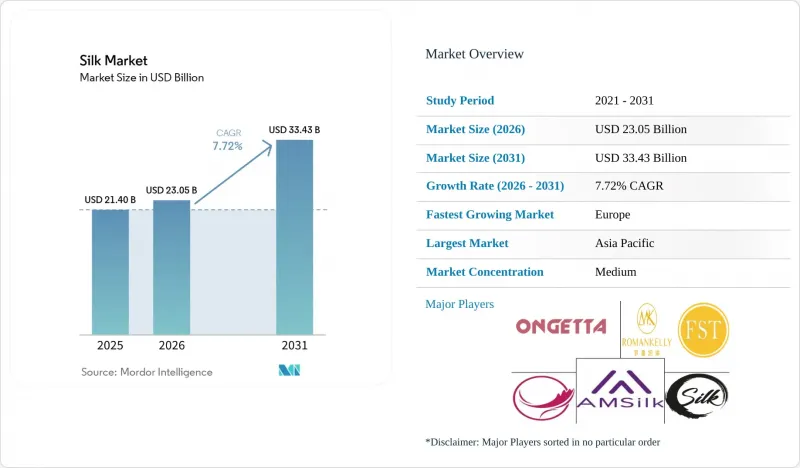
根據 Mordor Intelligence 預測,絲綢市場規模將從 2025 年的 214 億美元成長到 2026 年的 230.5 億美元,然後在 2031 年達到 334.3 億美元,2026 年至 2031 年的複合年成長率為 7.72%。
本報告按類型(桑蠶絲、柞蠶絲、柞蠶絲、木嘎蠶絲等)、應用領域(紡織服裝、室內裝潢、化妝品及個人護理等)及地區(北美、歐洲、亞太、南美、中東和非洲)進行細分。市場預測以美元計價。
全球絲綢市場趨勢與洞察
高階服裝和家用紡織品需求不斷成長
即使全球奢侈品消費正轉向體驗式價值提案,絲綢固有的光澤和垂墜感依然支撐著高級產品的穩定需求。中國消費者可支配收入的成長正在推動該地區對手工絲綢服飾和高檔床上用品的需求。奢侈品牌透過將傳統概念與永續發展訊息結合,偏好偏愛天然纖維的千禧世代和Z世代。相對獨立於快時尚週期之外,使絲綢生產商能夠保持定價權,從而支撐絲綢市場的長期成長。
蠶業和紡紗技術的進步
透過選擇性育種和基因改造,人們培育出了高產絲、抗病性強、纖維品質優良的蠶品種。利用pH值控制技術促進奈米纖維的形成,推動了人造絲紡絲技術的發展,使其強度可與天然纖維媲美。日本農業研究機構(NARO)已將基因改造蠶生產的螢光蠶繭商業化,拓展了其在創造性和技術應用方面的潛力。添加大豆粕的人工飼料能夠穩定蠶繭品質,並降低原料價格波動帶來的風險。中國紗線廠引進數位雙胞胎技術,提高了加工能力,減少了廢棄物,充分展現了工業4.0工具如何提升整個絲綢市場的生產力。
生產成本高和生絲價格波動
絲綢生產涉及30多道工序,導致人事費用居高不下。蠶繭價格的波動擠壓了紡紗廠的利潤空間,抑制了其擴大產能的意願。受此影響,中國2023年絲綢出口額下降14%至8.01億美元。生絲供應持續緊張可能會減緩絲綢市場短期內的成長動能。
細分市場分析
2025年,桑蠶絲仍佔絲綢市場最大佔有率,銷售額達70.65%。生物工程蜘蛛絲雖然仍處於發展階段,但預計到2031年將以18.73%的複合年成長率快速成長,這反映了大量創業投資投資和中試生產的成功。蜘蛛絲具有優異的抗張強度和輕質特性,使其成為國防裝備、航太複合材料和高階運動用品的理想材料。拜羅伊特大學利用CRISPR技術研發的螢光絲,展現了透過基因編輯技術改造蛋白質鏈以實現特定功能的能力。傳統的柞蠶絲和蓖麻蠶絲正在開闢符合倫理道德的小眾市場,而木嘎蠶絲則繼續保持高階價格,成為高級時裝界的奢侈品。隨著重組蛋白研發的不斷深入,蜘蛛絲可望在商業化生產的基礎上,佔據更大的市場佔有率。
桑蠶絲能否繼續保持其主導地位,取決於中國和印度已建立的養蠶和紡絲網路。然而,利潤率的下降迫使紡絲企業推出混紡布料和功能性塗層。政府支持的抗病蠶種培育計畫有望穩定桑蠶產量並抑製成本飆升。同時,合成生物學新創公司正致力於透過最佳化發酵培養基和下游純化工藝,實現與傳統蠶絲成本持平。生物工程與傳統養蠶技術的融合預示著未來絲綢市場將呈現多元化格局,基因改造品種與傳統纖維將並存。
區域分析
到2025年,亞太地區將佔全球絲綢市場的61.92%,其中中國儘管面臨勞動力短缺和價格波動,仍將出口價值8.01億美元的絲綢。印度在2023會計年度生產了36582噸生絲,並在「絲綢大全」(Silk Samagra)計畫下擴大了桑樹面積,這表明印度公共部門持續支持絲綢產業。越南的絲綢出口額達到1.43億美元,為印度紡紗廠提供絲綢,並實現了區域供應來源的多元化。機械化生產帶來了細菌污染的挑戰,促使人們更多地採用奈米鉑-聚六亞甲基消毒劑,這種消毒劑的性能優於傳統的處理方法。南海海域的緊張局勢凸顯了物流的脆弱性,迫使絲綢買家在市場上尋求多種供應來源。
歐洲是成長最快的地區,預計到2031年將以7.19%的複合年成長率成長。義大利透過從中國進口價值1.61億美元的生絲進行手工精加工,鞏固了其在全球奢侈品供應鏈中的地位。歐盟的絲織工坊向具有環保意識且願意支付溢價的消費者銷售可追溯、環境影響小的絲綢。像AMSilk這樣的生物工程衍生公司正在擴大用於高性能鞋類和醫療設備的重組纖維的生產,這構成了該地區創新叢集的基礎。
北美正專注於高性能和生物醫學應用領域的細分市場。 2024年,美國進口了價值1,465萬美元的絲綢用於專業下游加工。克雷格生物程序實驗室(Kraig Biocraft Laboratories)在越南經營一家試點農場,並計劃在國內開展紡絲業務,以滿足國防相關合約。中東和非洲市場仍在發展中,但隨著奢侈品消費的成長、絲綢在禮儀服飾中的文化親和性,以及物流和零售基礎設施的日益成熟,未來需求成長的基礎正在奠定。
其他好處:
- Excel格式的市場預測(ME)表
- 3個月的分析師支持
目錄
第1章:引言
- 研究假設和市場定義
- 調查範圍
第2章:調查方法
第3章執行摘要
第4章 市場狀況
- 市場概覽
- 市場促進因素
- 奢華服裝和家用紡織品需求不斷成長
- 蠶桑養殖和紗線撚製技術進步。
- 政府補貼和綜合發展計劃
- 加速絲素蛋白在生物醫學領域的應用
- 兼具可追溯性和道德。
- 擴大實驗室培養蜘蛛絲的生產,用於功能性服裝。
- 市場限制因素
- 生產成本高和生絲價格波動
- 與合成纖維和再生纖維素的競爭
- 與氣候變遷相關的作物病害發生
- 供應鏈集中風險
- 監理情勢
- 技術展望
- 波特五力模型
第5章 市場規模與成長預測
- 按類型
- 桑蠶絲
- 柞蠶絲
- 伊利西克
- 穆加絲綢
- 透過生物工程技術生產的蜘蛛絲
- 透過使用
- 紡織服裝
- 家居佈置
- 化妝品和個人護理
- 生物醫學及組織工程
- 營養功能性食品及食品添加物
- 按地區
- 北美洲
- 美國
- 加拿大
- 墨西哥
- 其他北美國家
- 南美洲
- 巴西
- 阿根廷
- 其他南美國家
- 歐洲
- 德國
- 英國
- 法國
- 義大利
- 西班牙
- 挪威
- 芬蘭
- 其他歐洲國家
- 亞太地區
- 中國
- 印度
- 日本
- 澳洲
- 其他亞太國家
- 中東
- 土耳其
- 沙烏地阿拉伯
- 阿拉伯聯合大公國
- 其他中東國家
- 非洲
- 南非
- 奈及利亞
- 埃及
- 其他非洲國家
- 北美洲
第6章 競爭情勢
- 市場集中度
- 策略趨勢
- 市佔率分析
- 公司簡介
- Anhui Silk Co. Ltd.
- Wujiang First Textile Co. Ltd.
- Zhejiang Jiaxin Silk Corp. Ltd.
- Hangzhou Lihai Silk Co. Ltd.
- Shanghai Silk Group Co. Ltd.
- Hangzhou Wensli Silk Culture Co. Ltd.
- Sichuan Nanchong Liuhe Group Co. Ltd.
- Barth and Konenkamp Seiden GmbH and Co. KG
- SILK & PROGRESS, spol. s ro
- Ongetta Srl
- AMSilk GmbH
- Kraig Biocraft Laboratories, Inc.
- Suzhou Kuangjie Trading Co., Ltd.
- Wujiang Wanshiyi Silk Co. Ltd.
第7章 市場機會與未來展望
According to Mordor Intelligence, the silk market size is expected to grow from USD 21.4 billion in 2025 to USD 23.05 billion in 2026 and is forecast to reach USD 33.43 billion by 2031 at 7.72% CAGR over 2026-2031.
This report is Segmented by Type (Mulberry Silk, Tussar Silk, Eri Silk, Muga Silk, and More), by Application (Textiles and Apparel, Home Furnishings, Cosmetics and Personal Care, and More), and by Geography (North America, Europe, Asia-Pacific, South America, Middle East, and Africa). The Market Forecasts are Provided in Terms of Value (USD).
Global Silk Market Trends and Insights
Rising Demand for Luxury Apparel and Home Textiles
Silk's intrinsic luster and drape underpin steady premium demand even as global luxury spending shifts toward experiential value propositions. Chinese consumers' rising disposable income sustains regional appetite for hand-crafted silk garments and upscale bedding. Luxury brands couple heritage narratives with sustainability messaging, satisfying Millennial and Gen Z preferences for natural fibers. Relative insulation from fast-fashion cycles enables silk producers to maintain pricing power, supporting the long-term growth arc of the silk market.
Technological Advances in Sericulture and Reeling
Selective breeding and genetic modification have led to silkworm strains with higher silk yield, disease resistance, and better fiber quality. pH-controlled nanofibril formation insights are guiding artificial silk spinning techniques that rival native fibers' strength. Japan's NARO commercialized fluorescent cocoons generated by genetically modified silkworms, widening creative and technical applications. Artificial diets formulated with soybean meal ensure consistent cocoon quality, easing feedstock volatility. Digital twins in Chinese reeling plants lift throughput and cut wastage, illustrating how Industry 4.0 tools raise productivity across the silk market.
High Production Cost and Raw-Silk Price Volatility
Silk production involves more than 30 discrete steps, keeping labor costs elevated. Cocoon price swings compress mill margins and dampen the willingness to scale capacity. China's 2023 export decline of 14% to USD 801 million reflects these supply-side pressures. A persistently tight raw silk supply can curtail the near-term growth pulse of the silk market.
Other drivers and restraints analyzed in the detailed report include:
- Government Subsidies and Integrated Development Programs
- Accelerating Biomedical Use of Silk Fibroin
- Competition from Synthetics and Regenerated Cellulose
For complete list of drivers and restraints, kindly check the Table Of Contents.
Segment Analysis
Mulberry silk retained the largest slice of the silk market size in 2025, capturing 70.65% of revenue. Bio-engineered spider silk, though nascent, is accelerating at a 18.73% CAGR through 2031, reflecting sizeable venture capital flows and pilot-scale production wins. Superior tensile strength and light weight make spider silk attractive for defense wear, aerospace composites, and premium sports gear. The University of Bayreuth's CRISPR-enabled fluorescent silk showcases how genetic editing can tailor protein chains for specialized functions. Traditional tussar and eri varieties are carving ethical niches, while muga silk continues to fetch luxury premiums in niche couture circles. Intensifying Research and Development around recombinant proteins suggests spider silk will secure a larger silk market share as commercial output scales.
The Continued dominance of mulberry hinges on well-entrenched farming and reeling networks in China and India. Yet margin headwinds push mills to introduce blended fabrics and performance coatings. State-backed breeding programs for disease-resistant silkworms may stabilize yields and curb cost spikes. Meanwhile, synthetic biology startups target cost parity with conventional filament grades by optimizing fermentation media and downstream purification. The convergence of bio-engineering and legacy sericulture points to a diversified future silk market where engineered variants coexist with heritage fibers.
Geography Analysis
Asia-Pacific accounted for 61.92% of the silk market in 2025, with China exporting USD 801 million of silk despite labor shortages and price turbulence. India produced 36,582 metric tons of raw silk in FY 2023 and expanded mulberry acreage under Silk Samagra, signaling continued public-sector backing. Vietnam recorded USD 143 million in exports, supplying Indian mills and diversifying regional supply. Mechanization brings bacterial-load challenges, prompting the adoption of nano platinum-poly hexamethylene disinfectants that outperform legacy treatments. Maritime tensions in the South China Sea highlight logistics vulnerabilities, pushing buyers to dual-source within the silk market.
Europe is the fastest-growing region, advancing at a 7.19% CAGR through 2031. Italy imported USD 161 million of Chinese greige silk for artisanal finishing, reinforcing its role in global luxury supply chains. EU workshops market traceable, low-impact silk to eco-conscious consumers willing to pay premiums. Bio-engineered spin-outs such as AMSilk are scaling recombinant fibers for performance footwear and medical devices, anchoring regional innovation clusters.
North America focuses on high-performance and biomedical niches. The United States imported USD 14.65 million of silk in 2024 for specialized downstream processing. Kraig Biocraft Laboratories operates pilot farms in Vietnam, yet plans domestic spinning for defense contracts. The Middle East and Africa remain nascent but show rising luxury consumption and cultural affinity for silk in ceremonial attire, setting the stage for future demand pickup as logistics and retail infrastructures mature.
- Anhui Silk Co. Ltd.
- Wujiang First Textile Co. Ltd.
- Zhejiang Jiaxin Silk Corp. Ltd.
- Hangzhou Lihai Silk Co. Ltd.
- Shanghai Silk Group Co. Ltd.
- Hangzhou Wensli Silk Culture Co. Ltd.
- Sichuan Nanchong Liuhe Group Co. Ltd.
- Barth and Konenkamp Seiden GmbH and Co. KG
- SILK & PROGRESS, spol. s r.o.
- Ongetta Srl
- AMSilk GmbH
- Kraig Biocraft Laboratories, Inc.
- Suzhou Kuangjie Trading Co., Ltd.
- Wujiang Wanshiyi Silk Co. Ltd.
Additional Benefits:
- The market estimate (ME) sheet in Excel format
- 3 months of analyst support
TABLE OF CONTENTS
1 Introduction
- 1.1 Study Assumptions and Market Definition
- 1.2 Scope of the Study
2 Research Methodology
3 Executive Summary
4 Market Landscape
- 4.1 Market Overview
- 4.2 Market Drivers
- 4.2.1 Rising demand for luxury apparel and home textiles
- 4.2.2 Technological advances in sericulture and reeling
- 4.2.3 Government subsidies and integrated development programs
- 4.2.4 Accelerating biomedical use of silk fibroin
- 4.2.5 Eco-sericulture hubs for traceable ethical silk
- 4.2.6 Scale-up of lab-grown spider silk for performance wear
- 4.3 Market Restraints
- 4.3.1 High production cost and raw-silk price volatility
- 4.3.2 Competition from synthetics and regenerated cellulose
- 4.3.3 Climate change-linked crop disease outbreaks
- 4.3.4 Supply-chain concentration risk
- 4.4 Regulatory Landscape
- 4.5 Technological Outlook
- 4.6 Porter's Five Forces
- 4.6.1 Bargaining Power of Suppliers
- 4.6.2 Bargaining Power of Buyers
- 4.6.3 Threat of New Entrants
- 4.6.4 Threat of Substitutes
- 4.6.5 Intensity of Competitive Rivalry
5 Market Size and Growth Forecasts (Value)
- 5.1 By Type
- 5.1.1 Mulberry Silk
- 5.1.2 Tussar Silk
- 5.1.3 Eri Silk
- 5.1.4 Muga Silk
- 5.1.5 Bio-engineered Spider Silk
- 5.2 By Application
- 5.2.1 Textiles and Apparel
- 5.2.2 Home Furnishings
- 5.2.3 Cosmetics and Personal Care
- 5.2.4 Biomedical and Tissue Engineering
- 5.2.5 Nutraceutical and Food Additives
- 5.3 By Geography
- 5.3.1 North America
- 5.3.1.1 United States
- 5.3.1.2 Canada
- 5.3.1.3 Mexico
- 5.3.1.4 Rest of North America
- 5.3.2 South America
- 5.3.2.1 Brazil
- 5.3.2.2 Argentina
- 5.3.2.3 Rest of South America
- 5.3.3 Europe
- 5.3.3.1 Germany
- 5.3.3.2 United Kingdom
- 5.3.3.3 France
- 5.3.3.4 Italy
- 5.3.3.5 Spain
- 5.3.3.6 Norway
- 5.3.3.7 Finland
- 5.3.3.8 Rest of Europe
- 5.3.4 Asia-Pacific
- 5.3.4.1 China
- 5.3.4.2 India
- 5.3.4.3 Japan
- 5.3.4.4 Australia
- 5.3.4.5 Rest of Asia-Pacific
- 5.3.5 Middle East
- 5.3.5.1 Turkey
- 5.3.5.2 Saudi Arabia
- 5.3.5.3 United Arab Emirates
- 5.3.5.4 Rest of Middle East
- 5.3.6 Africa
- 5.3.6.1 South Africa
- 5.3.6.2 Nigeria
- 5.3.6.3 Egypt
- 5.3.6.4 Rest of Africa
- 5.3.1 North America
6 Competitive Landscape
- 6.1 Market Concentration
- 6.2 Strategic Moves
- 6.3 Market Share Analysis
- 6.4 Company Profiles (includes Global level Overview, Market level overview, Core Segments, Financials as available, Strategic Information, Market Rank/Share, Products and Services, and Recent Developments)
- 6.4.1 Anhui Silk Co. Ltd.
- 6.4.2 Wujiang First Textile Co. Ltd.
- 6.4.3 Zhejiang Jiaxin Silk Corp. Ltd.
- 6.4.4 Hangzhou Lihai Silk Co. Ltd.
- 6.4.5 Shanghai Silk Group Co. Ltd.
- 6.4.6 Hangzhou Wensli Silk Culture Co. Ltd.
- 6.4.7 Sichuan Nanchong Liuhe Group Co. Ltd.
- 6.4.8 Barth and Konenkamp Seiden GmbH and Co. KG
- 6.4.9 SILK & PROGRESS, spol. s r.o.
- 6.4.10 Ongetta Srl
- 6.4.11 AMSilk GmbH
- 6.4.12 Kraig Biocraft Laboratories, Inc.
- 6.4.13 Suzhou Kuangjie Trading Co., Ltd.
- 6.4.14 Wujiang Wanshiyi Silk Co. Ltd.


