


 |
市場調查報告書
商品編碼
2065776
雲端安全態勢管理:市場佔有率分析、產業趨勢與統計、成長預測(2026-2031)Cloud Security Posture Management - Market Share Analysis, Industry Trends & Statistics, Growth Forecasts (2026 - 2031) |
||||||

※ 本網頁內容可能與最新版本有所差異。詳細情況請與我們聯繫。
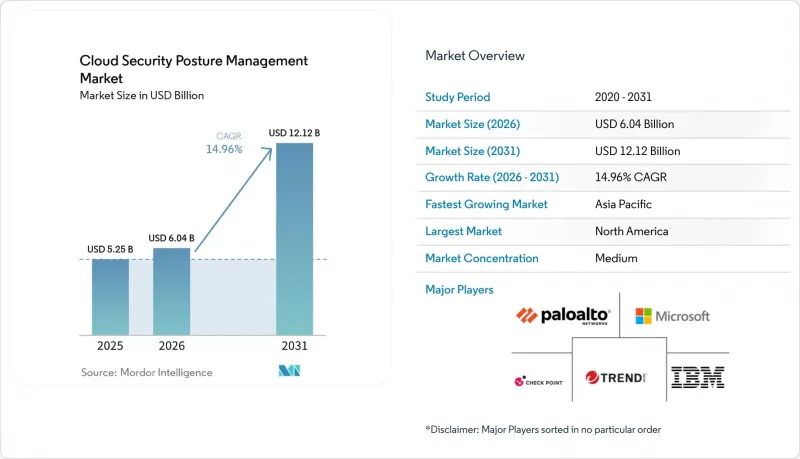
根據 Mordor Intelligence 預測,雲端安全態勢管理市場規模將從 2025 年的 52.5 億美元和 2026 年的 60.4 億美元成長到 2031 年的 121.2 億美元,2026 年至 2031 年的年複合成長率(CAGR)為 14.96%。
本報告按組件(解決方案和服務)、雲端模式(基礎設施即服務 (IaaS)、平台即服務 (PaaS) 等)、部署模式(公共雲端、私有雲端等)、組織規模(大型企業和中小企業)、行業(銀行、金融服務和保險 (BFSI)、醫療保健、製造業等)和地區進行細分。市場預測以美元 (USD) 為單位。
全球雲端安全態勢管理 (CSPM) 市場趨勢與洞察
將CSPM整合到雲端原生應用程式保護平台(CNAPP)生態系統中
雲端安全態勢管理正迅速從獨立儀錶板轉向整合式雲端安全應用平台 (CNAPP) 套件中的基礎模組。這種轉變使安全團隊擺脫了單獨管理冗餘主機和策略的負擔。 Aqua Security 決定在容器和工作負載控制之外提供態勢分析,這表明其能夠透過單一策略平台追蹤從建置到運行過程中的錯誤配置。這種演變正在推動雲端安全態勢管理市場的成長。部署整合平台的組織報告稱,由於警報與資產上下文和攻擊路徑相關聯,平均修復時間 (MTTR) 顯著縮短。他們還透過同一台主機將防護措施整合到開發平臺中,從而在配置漂移影響生產資源之前就加以緩解。與身分管治模組的整合可以顯示雲端帳戶中的權限侵蝕情況,進一步縮小隱藏的攻擊面。這些變化共同加強了 DevOps 和 SecOps 之間的回饋循環,增加了從單一功能產品提供者切換到其他產品的成本。
人工智慧驅動的自動化維修引擎的興起
目前,人工智慧 (AI) 工具讀取配置圖,根據業務影響對偵測結果進行排序,並透過基礎設施即程式碼 (IaC) 拉取請求執行修復。早期採用者報告稱,自動產生的糾正措施通常可在部署後 90 天內將未處理的雲警報積壓量減少一半。確定性策略引擎透過提供精確的 JSON 和 YAML 變更建議(而非通用的最佳實務建議)來減少人為錯誤。這種方法解決了全球雲端安全技能缺口問題,同時使高階分析師能夠專注於威脅搜尋。對於服務提供者而言,糾正措施的徹底性是一個明顯的差異化因素,因為客戶不僅重視平台檢測到的內容,還重視其無需人工核准流程即可快速採取行動的能力。擁有分析層和自動化工作流程的供應商可以透過專有的機器學習模型進一步提高客戶留存率,這些模型會隨著租戶資料量的增加而變得更加準確。
安全營運團隊的警報疲勞和技能不足
雲端安全態勢管理在風險視覺化方面取得了成功,但也導致許多安全營運中心 (SOC) 難以應對。企業每天通常會收到數千個態勢警報,卻無法及時招募分析師進行分類處理。根據 Fortinet 的現場數據,即使是大規模團隊也只能調查每日偵測到的一小部分,配置錯誤往往無法解決,這損害了使用者對工具的信心。自動化雖然減輕了部分負擔,但將策略調整和修正整合到 CI/CD 管道中仍然需要高水準的專業知識。因此,託管服務的使用正在不斷成長,但對於網路安全預算本已捉襟見肘的中小型企業而言,其成本無疑是一筆不小的負擔。
細分市場分析
預計到2025年,解決方案領域仍將佔據雲端安全態勢管理 (CSPM) 市場66.45%的佔有率,這證實了偵測和報告功能仍然是大多數買家的切入點。然而,由於企業面臨將警報轉化為永久性策略變更的營運複雜性,預計到2031年,服務領域將以15.12%的複合年成長率成長。託管服務合作夥伴提供持續調優、自訂規則設計和全天候故障排查等服務,但許多團隊缺乏執行這些任務的內部資源。服務合約的激增也反映出併購前和合規認證對態勢評估的需求日益成長,顧問公司正迅速將這一細分市場貨幣化。因此,平台供應商正在加強服務合作夥伴關係並建立內部諮詢團隊,以防止收入流失。
技能缺口的擴大進一步推動了雲端安全服務的普及,尤其是在那些無法聘請全職雲端安全架構師的中型企業中。提供按效果而非按小時收費的打包服務供應商越來越受歡迎,因為這種模式與降低風險的目標直接相關。在整個預測期內,用於人工智慧驅動的糾正措施的整合服務預計將實現最快成長。這是因為確定性策略引擎需要謹慎的管治,以避免生產環境中出現意外的配置變更。
預計到 2025 年,基礎設施即服務 (IaaS) 環境將佔據雲端安全態勢管理 (CSPM) 市場 48.92% 的佔有率,凸顯了虛擬機器和容器工作負載的傳統主導地位。然而,SaaS 資源預計將以 15.2% 的複合年成長率 (CAGR) 實現最高成長。這是因為業務部門持續部署生產力套件、CRM 平台和協作工具,這些工具會將敏感資料儲存在傳統邊界之外。 SaaS 安全態勢管理模組透過掃描租戶級設定、未使用的 API 令牌和過多的共用連結來彌補這一差距。採用這些功能的公司發現,在停用被忽視的帳戶和第三方整合後,風險會迅速降低。
此外,隨著無伺服器和託管資料庫服務的普及,平台即服務 (PaaS) 也逐漸成為主流選擇。在此領域,安全態勢管理需要理解臨時功能以及最小權限原則,並根據具體情況靈活運用。傳統的爬蟲工具依賴持久伺服器,因此無法充分應對這些挑戰。能夠在 IaaS、PaaS 和 SaaS 之間提供一致策略語言的供應商,透過降低三個獨立工具堆疊的維運負擔,正在贏得經營團隊的支持。這種轉變鞏固了人們對雲端安全態勢管理的認知:它是一個涵蓋所有雲端交付模式的通用控制層。
區域分析
預計到2025年,北美將維持35.02%的收入佔有率,這得益於其高度成熟的雲端運算應用、高度集中的安全廠商以及FedRAMP等嚴格的框架。 FedRAMP要求政府機構和承包商維護已記錄的配置基準。聯邦政府對零信任計畫的持續投入支撐了平台支出,而蓬勃發展的創投生態系統則為那些實施人工智慧原生糾錯功能的創新新創公司提供資金支持。加拿大公司也日益遵守美國的安全標準,促成了跨境管理服務合約的簽訂,並提升了區域收入。
亞太地區預計將以15.55%的複合年成長率成為該地區成長最快的市場,這主要得益於各國政府立法推進資料本地化,並為建設本地雲端資料中心提供稅收優惠。日本、印度和澳洲的大規模國家數位化計畫已將雲端安全態勢報告納入採購指南,從而有效地強制要求政府支持的工作負載採用相關工具。同時,馬來西亞將於2024年頒布的《網路安全法》要求對關鍵產業的營運商進行持續監控,這將加速供應商進入東南亞市場,並為本地系統整合商創造通路拓展機會。
歐洲的合規環境十分複雜,其核心是GDPR和新通過的人工智慧法規,這些法規要求演算法決策必須透明。這促使企業尋求能夠按需產生跨司法管轄區審計追蹤的安全態勢儀錶板。德國和法國正在主導舉措) ,該計劃呼籲在國內進行資料處理,迫使服務提供者推出歐盟專屬的託管區域。同時,英國脫歐後監管的差異也推動了對雙重合規映射的需求,使得擁有彈性策略引擎的平台更受青睞。拉丁美洲、中東和非洲雖然仍在發展中,但作為極具吸引力的擴張區域,超大規模資料中心業者能夠幫助當地企業存取最新的API。
其他好處:
- Excel格式的市場預測(ME)表
- 3個月的分析師支持
目錄
第1章:引言
- 研究假設和市場定義
- 調查範圍
第2章:調查方法
第3章執行摘要
第4章 市場狀況
- 市場概覽
- 市場促進因素
- 將 CSPM 整合到雲端原生應用程式保護平台 (CNAPP) 中
- 人工智慧驅動的自動化維修引擎的興起
- 零信任和責任分擔審計的擴展
- 監管機構正在推動創建即時雲端配置報告。
- 中型企業多重雲端無序擴張
- 保險業主導的安全評分卡要求
- 市場限制因素
- 安全營運團隊的警報疲勞和技能不足
- CWPP/CIEM 工具的重疊造成了預算摩擦。
- 部分 SaaS/PaaS 供應商的 API 功能有限
- 主權雲端專案中資料居住要求的障礙
- 價值供應鏈分析
- 監管情勢和合規趨勢
- 技術展望
- 波特五力分析
第5章 市場規模與成長預測
- 按組件
- 解決方案
- 服務
- 透過雲端模型
- Infrastructure as a Service(IaaS)
- Platform as a Service(PaaS)
- Software as a Service(SaaS)
- 部署模式
- 公共雲端
- 私有雲端
- 混合雲端
- 按組織規模
- 大公司
- 中小企業
- 按行業
- 銀行、金融和保險(BFSI)
- 衛生保健
- 零售與電子商務
- IT/通訊
- 政府/公共部門
- 教育
- 製造業
- 其他
- 按地區
- 北美洲
- 美國
- 加拿大
- 墨西哥
- 歐洲
- 德國
- 英國
- 法國
- 義大利
- 西班牙
- 俄羅斯
- 其他歐洲國家
- 亞太地區
- 中國
- 日本
- 印度
- 韓國
- 澳洲和紐西蘭
- 其他亞太國家
- 南美洲
- 巴西
- 阿根廷
- 其他南美國家
- 中東和非洲
- 中東
- 阿拉伯聯合大公國
- 沙烏地阿拉伯
- 土耳其
- 其他中東國家
- 非洲
- 南非
- 奈及利亞
- 其他非洲國家
- 中東
- 北美洲
第6章 競爭情勢
- 市場集中度
- 策略趨勢
- 市佔率分析
- 公司簡介
- Palo Alto Networks
- Check Point Software Technologies
- Microsoft
- Trend Micro
- IBM
- Fortinet
- McAfee
- AWS
- Oracle
- Qualys
- Wiz
- Orca Security
- Lacework
- Aqua Security
- Tenable
- Cisco Systems
- VMware
- CrowdStrike
- Zscaler
- Rapid7
第7章 市場機會與未來展望
According to Mordor Intelligence, the cloud security posture management market size is projected to expand from USD 5.25 billion in 2025 and USD 6.04 billion in 2026 to USD 12.12 billion by 2031, registering a CAGR of 14.96% between 2026 to 2031.
This report is Segmented by Component (Solutions, and Services), Cloud Model (Infrastructure As A Service (IaaS), Platform As A Service (PaaS), and More), Deployment Mode (Public Cloud, Private Cloud, and More), Organization Size (Large Enterprises, and SMEs), Industry Vertical (BFSI, Healthcare, Manufacturing, and More), and Geography. The Market Forecasts are Provided in Terms of Value (USD).
Global Cloud Security Posture Management Market Trends and Insights
Integration of CSPM into Cloud-Native Application Protection Platform (CNAPP) ecosystems
cloud security posture management is rapidly shifting from a standalone dashboard to a foundational module inside unified CNAPP suites, a change that relieves security teams from juggling overlapping consoles and policies. Aqua Security's decision to ship posture analytics alongside container and workload controls shows how a single policy plane can now trace misconfigurations from build to runtime This evolution is driving growth in the cloud security posture management market,Organizations deploying converged platforms report materially lower mean-time-to-remediate because alerts arrive already correlated with asset context and exploit pathways. The same console also pushes guardrails back into developer pipelines, which curbs drift before it reaches production resources. Integrations with identity governance modules further reduce hidden attack surfaces by exposing privilege creep inside cloud accounts. Collectively, these changes tighten the feedback loop between DevOps and SecOps and raise the switching costs for point-product providers.
Rise of AI-assisted auto-remediation engines
Artificial-intelligence tooling now reads configuration graphs, ranks findings by business impact, and triggers fixes through Infrastructure-as-Code pull requests. Early adopters note that auto-generated remediation often cuts the backlog of open cloud alerts in half during the first 90 days of use. Deterministic policy engines reduce human error by proposing precise JSON or YAML changes instead of generalized best-practice advice. The approach counters the global cloud-security skills gap and frees senior analysts to focus on threat hunting, For providers, remediation depth becomes a clear differentiator because customers evaluate not just what the platform detects but how quickly it can act without manual approval loops. Vendors that own both the analytics layer and the automation workflow gain further stickiness through proprietary machine-learning models that improve with tenant data volume.
Alert fatigue and skills shortage in SecOps teams
The very success of cloud security posture management in surfacing risk has overwhelmed many security operations centers. Enterprises often receive thousands of posture alerts per day and cannot hire analysts fast enough to triage them. Fortinet field data show that even large teams investigate only a fraction of daily findings, leaving misconfigurations unaddressed and eroding trust in the tooling. Automation alleviates part of the burden, yet significant expertise remains necessary to tune policies and integrate fixes into CI/CD pipelines. As a result, managed-service options grow in popularity, but their cost pressures smaller businesses already coping with tight cybersecurity budgets.
Other drivers and restraints analyzed in the detailed report include:
- Expansion of zero-trust and shared-responsibility audits
- Regulatory push for real-time cloud-configuration reporting
- Tool overlap with CWPP and CIEM creating budget friction
For complete list of drivers and restraints, kindly check the Table Of Contents.
Segment Analysis
Solutions segment retained 66.45% share of the Cloud Security Posture Management market in 2025, confirming that detection and reporting remain the entry point for most buyers. Yet the Services category is expanding at 15.12% CAGR through 2031 as enterprises confront the operational complexity of turning alerts into lasting policy change. Managed-service partners offer continuous tuning, custom rule engineering, and 24X7 triage, activities that many teams lack the internal bandwidth to perform. The surge in service contracts also reflects growing demand for posture assessments prior to mergers or compliance certifications, a niche that consulting firms are quick to monetize. Platform vendors therefore boost service alliances or build in-house advisory teams to prevent revenue leakage.
The widening skills gap further fuels service uptake, particularly among mid-market organizations that cannot afford full-time cloud-security architects. Providers that deliver packaged offerings with outcome-based pricing-rather than hourly billing-gain traction because they map directly to risk-reduction goals. Over the forecast horizon, integration services for AI-driven remediation should see the fastest growth, given that deterministic policy engines require careful governance to avoid unintended configuration changes in production environments.
Infrastructure as a Service environments held 48.92% share of the Cloud Security Posture Management market in 2025, underscoring the historical dominance of virtual-machine and container workloads. However, SaaS resources will log the highest 15.2% CAGR because business units continue to adopt productivity suites, CRM platforms, and collaboration tools that store sensitive data outside the traditional perimeter. SaaS Security Posture Management modules plug this gap by scanning tenant-level settings, unused API tokens, and excessive sharing links. Enterprises adopting these capabilities note rapid risk reduction when orphaned accounts and third-party integrations are disabled.
Platform as a Service also enters mainstream consideration as serverless and managed database services proliferate. Here, posture management must understand ephemeral functions and context-aware least privilege, tasks poorly addressed by legacy scrapers that assume persistent servers. Vendors that expose consistent policy languages across IaaS, PaaS, and SaaS win executive support by curbing the operational burden of three separate tooling stacks. The shift cements the perception of cloud security posture management as a universal control layer spanning the full spectrum of cloud-delivery models.
Geography Analysis
North America retained 35.02% revenue share in 2025 owing to mature cloud adoption, a dense concentration of security vendors, and stringent frameworks such as FedRAMP that push agencies and contractors to maintain documented configuration baselines. Continued federal investment in zero-trust programs sustains platform spending, while a healthy venture ecosystem funds disruptive start-ups that introduce AI-native remediation features. Canadian enterprises increasingly align with U.S. security standards, enabling cross-border managed-service deals that lift regional revenue.
Asia-Pacific will deliver the fastest regional CAGR at 15.55% as governments legislate data-localization practices and provide tax incentives for local cloud datacenter builds. Large-scale national digitization projects in Japan, India, and Australia embed cloud-security posture reporting in procurement guidelines, effectively mandating tool deployment in state-backed workloads. Meanwhile, the Malaysian Cyber Security Act of 2024 requires continuous monitoring for critical-sector operators, accelerating vendor entry into Southeast Asian markets and creating channel opportunities for local systems integrators.
Europe exhibits a complex compliance landscape anchored by GDPR and newly adopted artificial-intelligence regulations that demand transparency in algorithmic decision-making. Enterprises thus seek posture dashboards that can produce multi-jurisdiction audit trails on demand. Germany and France spearhead sovereign-cloud initiatives that call for in-country data processing, prompting providers to launch EU-only hosting zones. In parallel, the United Kingdom's post-Brexit regulatory divergence drives demand for dual compliance mappings, which favors platforms with flexible policy engines. Latin America, the Middle East, and Africa remain nascent but attractive expansion territories as hyperscaler region launches bring modern APIs within reach of local businesses.
- Palo Alto Networks
- Check Point Software Technologies
- Microsoft
- Trend Micro
- IBM
- Fortinet
- McAfee
- AWS
- Oracle
- Qualys
- Wiz
- Orca Security
- Lacework
- Aqua Security
- Tenable
- Cisco Systems
- VMware
- CrowdStrike
- Zscaler
- Rapid7
Additional Benefits:
- The market estimate (ME) sheet in Excel format
- 3 months of analyst support
TABLE OF CONTENTS
1 INTRODUCTION
- 1.1 Study Assumptions and Market Definition
- 1.2 Scope of the Study
2 RESEARCH METHODOLOGY
3 EXECUTIVE SUMMARY
4 MARKET LANDSCAPE
- 4.1 Market Overview
- 4.2 Market Drivers
- 4.2.1 Integration of CSPM into Cloud Native Application Protection Platform (CNAPP) platforms
- 4.2.2 Rise of AI-assisted auto-remediation engines
- 4.2.3 Expansion of zero-trust and shared-responsibility audits
- 4.2.4 Regulatory push for real-time cloud-config reporting
- 4.2.5 Multi-cloud sprawl in mid-market enterprises
- 4.2.6 Insurance-driven security scorecard requirements
- 4.3 Market Restraints
- 4.3.1 Alert-fatigue and skills shortage in SecOps teams
- 4.3.2 Tool overlap with CWPP / CIEM creating budget friction
- 4.3.3 Limited API depth for some SaaS/PaaS providers
- 4.3.4 Data-residency barriers in sovereign-cloud projects
- 4.4 Value / Supply-Chain Analysis
- 4.5 Regulatory and Compliance Landscape
- 4.6 Technological Outlook
- 4.7 Porter's Five Forces Analysis
- 4.7.1 Bargaining Power of Suppliers
- 4.7.2 Bargaining Power of Consumers
- 4.7.3 Threat of New Entrants
- 4.7.4 Threat of Substitutes
- 4.7.5 Intensity of Competitive Rivalry
5 MARKET SIZE AND GROWTH FORECASTS (VALUES)
- 5.1 By Component
- 5.1.1 Solutions
- 5.1.2 Services
- 5.2 By Cloud Model
- 5.2.1 Infrastructure as a Service (IaaS)
- 5.2.2 Platform as a Service (PaaS)
- 5.2.3 Software as a Service (SaaS)
- 5.3 By Deployment Mode
- 5.3.1 Public Cloud
- 5.3.2 Private Cloud
- 5.3.3 Hybrid Cloud
- 5.4 By Organization Size
- 5.4.1 Large Enterprises
- 5.4.2 Small and Medium Enterprises (SMEs)
- 5.5 By Industry Vertical
- 5.5.1 Banking Finance Services and Insurances (BFSI)
- 5.5.2 Healthcare
- 5.5.3 Retail and E-commerce
- 5.5.4 IT and Telecommunication
- 5.5.5 Government and Public Sector
- 5.5.6 Education
- 5.5.7 Manufacturing
- 5.5.8 Others
- 5.6 By Geography
- 5.6.1 North America
- 5.6.1.1 United States
- 5.6.1.2 Canada
- 5.6.1.3 Mexico
- 5.6.2 Europe
- 5.6.2.1 Germany
- 5.6.2.2 United Kingdom
- 5.6.2.3 France
- 5.6.2.4 Italy
- 5.6.2.5 Spain
- 5.6.2.6 Russia
- 5.6.2.7 Rest of Europe
- 5.6.3 Asia-Pacific
- 5.6.3.1 China
- 5.6.3.2 Japan
- 5.6.3.3 India
- 5.6.3.4 South Korea
- 5.6.3.5 Australia and New Zealand
- 5.6.3.6 Rest of Asia-Pacific
- 5.6.4 South America
- 5.6.4.1 Brazil
- 5.6.4.2 Argentina
- 5.6.4.3 Rest of South America
- 5.6.5 Middle East and Africa
- 5.6.5.1 Middle East
- 5.6.5.1.1 United Arab Emirates
- 5.6.5.1.2 Saudi Arabia
- 5.6.5.1.3 Turkey
- 5.6.5.1.4 Rest of Middle East
- 5.6.5.2 Africa
- 5.6.5.2.1 South Africa
- 5.6.5.2.2 Nigeria
- 5.6.5.2.3 Rest of Africa
- 5.6.5.1 Middle East
- 5.6.1 North America
6 COMPETITIVE LANDSCAPE
- 6.1 Market Concentration
- 6.2 Strategic Moves
- 6.3 Market Share Analysis
- 6.4 Company Profiles (includes Global level Overview, Market level overview, Core Segments, Financials as available, Strategic Information, Market Rank/Share for key companies, Products and Services, and Recent Developments)
- 6.4.1 Palo Alto Networks
- 6.4.2 Check Point Software Technologies
- 6.4.3 Microsoft
- 6.4.4 Trend Micro
- 6.4.5 IBM
- 6.4.6 Fortinet
- 6.4.7 McAfee
- 6.4.8 AWS
- 6.4.9 Oracle
- 6.4.10 Qualys
- 6.4.11 Wiz
- 6.4.12 Orca Security
- 6.4.13 Lacework
- 6.4.14 Aqua Security
- 6.4.15 Tenable
- 6.4.16 Cisco Systems
- 6.4.17 VMware
- 6.4.18 CrowdStrike
- 6.4.19 Zscaler
- 6.4.20 Rapid7
7 MARKET OPPORTUNITIES AND FUTURE OUTLOOK
- 7.1 White-space and Unmet Need Analysis

 雲端安全態勢管理市場:按組件、雲端服務、安全措施、企業規模、雲端服務供應商、國家和地區分類-產業分析、市場規模、市場佔有率和預測(2026-2033 年)
 雲端安全態勢管理市場:依組件、產業、部署模式和組織規模分類-2026年至2032年全球市場預測
 2026年全球雲端安全態度管理市場報告
 雲端安全態勢管理市場規模、佔有率和成長分析(按部署模式、服務類型、最終用戶產業、技術重點、合規標準和地區分類)-2026-2033年產業預測
 全球雲端安全態勢管理市場規模、佔有率、趨勢和成長分析報告(2026-2034年)雲端安全態勢管理市場規模、佔有率、成長及全球產業分析:依組件、部署模式、企業類型、雲端模型、產業和地區劃分的洞察與預測(2026-2034 年)
 雲端安全態勢管理市場 - 全球產業規模、佔有率、趨勢、機會及預測(按產品類型、雲端服務模式、公司規模、產業垂直領域、地區和競爭格局分類,2021-2031 年)Frost Radar:雲端安全態勢管理,2025
 雲端安全態勢管理 (CSPM) 市場預測至 2032 年:按組件、部署、企業規模、最終用戶和區域分類的全球分析
 全球雲端安全態勢管理市場