


 |
市場調查報告書
商品編碼
2065769
工業分銷:市場佔有率分析、產業趨勢與統計、成長預測(2026-2031)Industrial Distribution - Market Share Analysis, Industry Trends & Statistics, Growth Forecasts (2026 - 2031) |
||||||

※ 本網頁內容可能與最新版本有所差異。詳細情況請與我們聯繫。
據 Mordor Intelligence 稱,2025 年工業分銷市場價值為 8.43 兆美元,預計到 2031 年將達到 11.53 兆美元,而 2026 年為 8.88 兆美元,預測期(2026-2031 年)的複合年成長率為 5.35%。
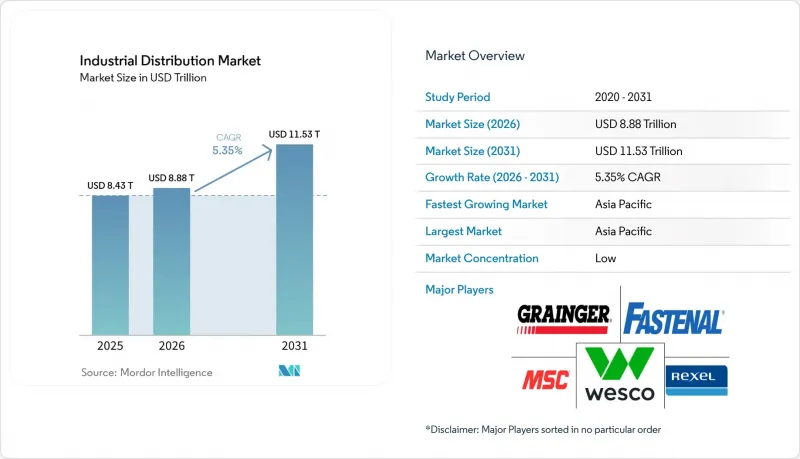
本報告按產品(電器、緊固件、暖通空調設備等)、配銷通路(線下(分店/內部銷售等)、終端用戶行業(製造業、建築/基礎設施等)和地區進行細分。市場預測以美元計價。
全球工業分銷市場趨勢與洞察
工業IoT(IIoT) 與自動化實施
即時資產監控使經銷商能夠從被動的訂單訂單轉向數據驅動的補貨服務。邊緣運算與預測分析的結合,減少了意外停機時間,並允許根據機器運行狀況訊號調整存量基準。西門子的工業基礎設施模型表明,生成式人工智慧縮短了工程週期,並為連接OEM平台和工廠用戶的經銷商創造了業務收益。對互聯感測器的投資也推動了對高精度電子元件和安全網路設備的需求。
大型基礎設施項目管道
美國價值2兆美元的專案計畫以及中國為智慧基礎設施投入的1.5兆美元,正推動電力電纜、開關設備和建築耗材的大量訂單。擁有專案管理支援和準時交貨能力的經銷商正拿下大規模供應合約。在東南亞,隨著各國政府加快機場、鐵路和可再生能源建設,市場動能也日益強勁,為提供區域庫存和技術支援的經銷商創造了有利環境。
價格波動
鋼鐵價格每季波動幅度可達15%至20%,因此需要動態定價和避險策略來避免庫存估值損失。價格下跌時,客戶會推遲下單,導致分銷商庫存增加並佔用資金。能源價格波動進一步加劇了運輸預算和需求預測的複雜性。
細分市場分析
預計到2025年,電氣產品銷售額將佔總銷售額的26.97%,主要得益於其在電網升級和資料中心建設中的重要性。隨著可再生能源併網和工廠自動化推動需求成長,電氣產品的工業分銷市場預計將穩步擴張。安全設備和個人防護設備(PPE)的複合年成長率(CAGR)為9.38%,這得益於全球安全法規和企業風險緩解措施。同時,工業緊固件和暖通空調設備也受惠於持續的建設項目開工和基礎設施升級。
隨著電子商務物流履約倉庫自動化,物料輸送系統的投資也蓬勃發展。軸承和動力傳動部件的維護、維修和大修 (MRO) 需求強勁,這與預測性維護計劃密切相關。雖然市場正逐漸轉向使用長週期合成潤滑油,但數位化狀態監測仍有助於及時補充潤滑油。互聯工具和測量設備將機械精度與雲端分析相結合,從而拓展了經銷商的服務範圍。
區域分析
預計到2025年,亞太地區將佔全球銷售額的36.21%,並在2031年之前以8.55%的複合年成長率持續成長,這主要得益於中國10兆美元的製造業產值以及印度化工行業的兩位數成長。區域供應鏈向東南亞的多元化發展正在加強跨境分銷。當地分銷商正在充分發揮自身優勢,例如多語言能力和對不同法規的熟悉程度。
北美是一個成熟且創新主導的市場。 Glager 2024 年 172 億美元的銷售額反映了該地區規模經濟和對電子商務驅動型採購的強勁需求。隨著 85% 的製造商計劃應用人工智慧,對互聯組件的需求正在成長,而基礎設施立法正在推動電網和寬頻升級方面的資本投資。大宗商品價格波動和不斷上漲的運費正在推動製造業回流和本地倉庫的建立。
歐洲正面臨推動變革的政策壓力。碳邊境調節機制(CBAM)將使進口鋼鐵成本在2026年前每噸上漲約16.19%,迫使經銷商確保區域庫存並購買低排放材料。索能達(Sonepar)在2024年斥資20億美元進行的收購計畫凸顯了正在進行的產業重組,旨在擴大規模並拓展服務組合。永續性目標的推動也提高了人們對節能產品和循環經濟相關產品的關注。
由於產業多元化規劃,中東和非洲預計將逐步成長;同時,拉丁美洲對採礦基礎設施和汽車製造業的投資也不斷擴大。儘管外匯波動和政治不穩定仍然是令人擔憂的問題,但基礎設施的長期匱乏為擁有強大風險管理能力的經銷商提供了成長機會。
其他好處:
- Excel格式的市場預測(ME)表
- 3個月的分析師支持
目錄
第1章:引言
- 研究假設和市場定義
- 調查範圍
第2章:調查方法
第3章執行摘要
第4章 市場狀況
- 市場概覽
- 市場促進因素
- 工業IoT和自動化實施
- 大型基礎設施項目管道
- 電子商務主導MRO(維護、維修和大修)履約業務快速成長
- 加強職業安全健康法規
- 利用OEM廠商和經銷商之間的API實現自動補貨
- 碳邊境調整促進區域庫存中心發展
- 市場限制因素
- 價格波動
- 全球物流成本不斷上漲
- OEM風險分擔協議正在給利潤率帶來壓力。
- 透過OEM直銷電子商務管道造成的蠶食
- 供應鏈分析
- 監理情勢
- 技術展望
- 波特五力模型
- 產業價值鏈分析
- 宏觀經濟趨勢影響評估
第5章 市場規模與成長預測
- 依產品
- 電器
- 緊固件
- 暖通空調設備
- 安全/個人防護用品
- 物料輸送和包裝
- 動力傳動和軸承
- 工業流體和潤滑劑
- 工具/設備
- 其他產品
- 透過分銷管道
- 線下(分店/內部銷售)
- 線上/電子商務平台
- 按最終用戶行業分類
- 製造業
- 建築和基礎設施
- 能源公用事業
- 採礦和金屬
- 化學品和工藝
- 運輸/倉儲業
- 醫療和藥品
- 其他
- 按地區
- 北美洲
- 美國
- 加拿大
- 墨西哥
- 南美洲
- 巴西
- 阿根廷
- 其他南美國家
- 歐洲
- 英國
- 德國
- 法國
- 義大利
- 西班牙
- 俄羅斯
- 其他歐洲國家
- 亞太地區
- 中國
- 印度
- 日本
- 韓國
- 澳洲和紐西蘭
- 東南亞
- 其他亞太國家
- 中東和非洲
- 中東
- 沙烏地阿拉伯
- 阿拉伯聯合大公國
- 土耳其
- 其他中東國家
- 非洲
- 南非
- 奈及利亞
- 肯亞
- 其他非洲國家
- 中東
- 北美洲
第6章 競爭情勢
- 市場集中度
- 策略趨勢
- 市佔率分析
- 公司簡介
- WW Grainger Inc.
- Fastenal Company
- WESCO International Inc.
- MSC Industrial Direct Co. Inc.
- Airgas Inc.
- Motion Industries Inc.
- Winsupply Inc.
- Applied Industrial Technologies Inc.
- MRC Global Inc.
- Sonepar USA
- Rexel Group
- Graybar Electric Co.
- HD Supply(HD Inc.)
- Anixter International
- Ferguson PLC
- Bisco Industries
- Kimball Midwest
- DistributionNOW
- Bunzl PLC
- Lawson Products Inc.
- Endries International
- Grainger MonotaRO(Japan)
第7章 市場機會與未來展望
According to Mordor Intelligence, the industrial distribution market size was valued at USD 8.43 trillion in 2025 and estimated to grow from USD 8.88 trillion in 2026 to reach USD 11.53 trillion by 2031, at a CAGR of 5.35% during the forecast period (2026-2031).
This report is Segmented by Product (Electrical Supplies, Fasteners, HVAC Equipment, and More), Distribution Channel (Offline (Branch / Inside Sales), and More), End-User Industry (Manufacturing, Construction and Infrastructure, and More), and by Geography. The Market Forecasts are Provided in Terms of Value (USD).
Global Industrial Distribution Market Trends and Insights
Industrial IoT and automation adoption
Real-time asset monitoring enables distributors to shift from reactive order fulfillment to data-driven replenishment services. Edge computing paired with predictive analytics cuts unplanned downtime and aligns stocking levels with machine health signals. Siemens' industrial foundation models illustrate how generative AI shortens engineering cycles and unlocks service revenue for distributors who bridge OEM platforms with factory users. Investments in connected sensors also pull through demand for high-precision electrical components and secure networking gear.
Infrastructure megaproject pipelines
A USD 2 trillion project slate in the United States and USD 1.5 trillion earmarked by China for smart infrastructure are translating into bulk orders for power cables, switchgear, and construction consumables. Distributors with project-management support and just-in-time delivery capabilities win large supply contracts. Southeast Asia adds momentum as governments accelerate airport, rail, and renewable energy builds, which favor distributors offering regional inventory and technical assistance.
Commodity-price volatility
Steel prices can fluctuate 15-20% within a quarter, forcing dynamic pricing and hedge strategies to avoid inventory write-downs. Customers delay orders when prices fall, inflating distributor stock and tying up cash. Energy price swings further complicate freight budgeting and demand planning.
Other drivers and restraints analyzed in the detailed report include:
- E-commerce-led MRO fulfillment boom
- Stricter workplace-safety regulations
- Global logistics cost inflation
For complete list of drivers and restraints, kindly check the Table Of Contents.
Segment Analysis
Electrical supplies contributed 26.97% of 2025 revenue, confirming their importance in power grid upgrades and data-center builds. The industrial distribution market size for electrical supplies is expected to climb steadily as renewable energy connections and factory automation lift unit demand. Safety and PPE products, growing at 9.38% CAGR, benefit from global safety mandates and corporate risk mitigation, while industrial fasteners and HVAC equipment ride steady construction starts and infrastructure upgrades.
Material-handling systems are attracting investment as e-commerce fulfillment pushes warehouses toward automation. Bearings and power-transmission parts see resilient MRO demand tied to predictive maintenance schedules. Lubricants face substitution by synthetics with longer drain intervals, yet digital condition-monitoring still spurs timely replenishment. Connected tools and instruments blend mechanical precision with cloud analytics, widening distributor service scopes.
Geography Analysis
Asia-Pacific held 36.21% revenue in 2025 and is set to compound at 8.55% CAGR through 2031 on the back of USD 10 trillion in Chinese manufacturing output and India's double-digit chemicals expansion. Growing regional supply-chain diversification into Southeast Asia strengthens cross-border distribution flows. Local distributors gain advantage from multilingual support and familiarity with varying regulatory codes.
North America represents a mature yet innovation-driven arena. Grainger's USD 17.2 billion 2024 sales underscore scale efficiencies and the region's appetite for e-commerce-enabled procurement. Manufacturers' 85% AI adoption plans lift demand for connected components, while infrastructure legislation channels capital into grid and broadband upgrades. Commodity swings and freight inflation motivate reshoring and regional warehousing.
Europe faces transformational policy pressures. The Carbon Border Adjustment Mechanism will raise imported steel costs by about 16.19% per ton by 2026, prompting distributors to stock regionally and source lower-emission materials. Sonepar's USD 2 billion acquisition spree in 2024 highlights ongoing consolidation aimed at scale gains and broader service portfolios. Sustainability goals spur interest in energy-efficient products and circular-economy offerings.
The Middle East and Africa record incremental gains from industrial diversification plans, while Latin America draws spending into mining infrastructure and auto manufacturing. Currency volatility and political instability remain watchpoints, but long-term infrastructure gaps present growth headroom for distributors with robust risk-management capabilities.
- W.W. Grainger Inc.
- Fastenal Company
- WESCO International Inc.
- MSC Industrial Direct Co. Inc.
- Airgas Inc.
- Motion Industries Inc.
- Winsupply Inc.
- Applied Industrial Technologies Inc.
- MRC Global Inc.
- Sonepar USA
- Rexel Group
- Graybar Electric Co.
- HD Supply (HD Inc.)
- Anixter International
- Ferguson PLC
- Bisco Industries
- Kimball Midwest
- DistributionNOW
- Bunzl PLC
- Lawson Products Inc.
- Endries International
- Grainger MonotaRO (Japan)
Additional Benefits:
- The market estimate (ME) sheet in Excel format
- 3 months of analyst support
TABLE OF CONTENTS
1 INTRODUCTION
- 1.1 Study Assumptions and Market Definition
- 1.2 Scope of the Study
2 RESEARCH METHODOLOGY
3 EXECUTIVE SUMMARY
4 MARKET LANDSCAPE
- 4.1 Market Overview
- 4.2 Market Drivers
- 4.2.1 Industrial IoT and Automation adoption
- 4.2.2 Infrastructure megaproject pipelines
- 4.2.3 E-commerce-led MRO fulfillment boom
- 4.2.4 Stricter workplace-safety regulations
- 4.2.5 OEM-distributor API-based auto-replenishment
- 4.2.6 Carbon border adjustments push regional inventory hubs
- 4.3 Market Restraints
- 4.3.1 Commodity-price volatility
- 4.3.2 Global logistics cost inflation
- 4.3.3 OEM risk-sharing contracts squeeze margins
- 4.3.4 OEM direct e-commerce channel cannibalization
- 4.4 Supply-Chain Analysis
- 4.5 Regulatory Landscape
- 4.6 Technological Outlook
- 4.7 Porter's Five Forces
- 4.7.1 Threat of New Entrants
- 4.7.2 Bargaining Power of Suppliers
- 4.7.3 Bargaining Power of Buyers
- 4.7.4 Threat of Substitutes
- 4.7.5 Industry Rivalry
- 4.8 Industry Value Chain Analysis
- 4.9 Macroeconomic Trend Impact Assessment
5 MARKET SIZE AND GROWTH FORECASTS (VALUE)
- 5.1 By Product
- 5.1.1 Electrical Supplies
- 5.1.2 Fasteners
- 5.1.3 HVAC Equipment
- 5.1.4 Safety and PPE Supplies
- 5.1.5 Material Handling and Packaging
- 5.1.6 Power Transmission and Bearings
- 5.1.7 Industrial Fluids and Lubricants
- 5.1.8 Tools and Instruments
- 5.1.9 Other Products
- 5.2 By Distribution Channel
- 5.2.1 Offline (Branch / Inside Sales)
- 5.2.2 Online / E-commerce Platforms
- 5.3 By End-user Industry
- 5.3.1 Manufacturing
- 5.3.2 Construction and Infrastructure
- 5.3.3 Energy and Utilities
- 5.3.4 Mining and Metals
- 5.3.5 Chemicals and Process
- 5.3.6 Transportation and Warehousing
- 5.3.7 Healthcare and Pharmaceuticals
- 5.3.8 Others
- 5.4 By Geography
- 5.4.1 North America
- 5.4.1.1 United States
- 5.4.1.2 Canada
- 5.4.1.3 Mexico
- 5.4.2 South America
- 5.4.2.1 Brazil
- 5.4.2.2 Argentina
- 5.4.2.3 Rest of South America
- 5.4.3 Europe
- 5.4.3.1 United Kingdom
- 5.4.3.2 Germany
- 5.4.3.3 France
- 5.4.3.4 Italy
- 5.4.3.5 Spain
- 5.4.3.6 Russia
- 5.4.3.7 Rest of Europe
- 5.4.4 Asia-Pacific
- 5.4.4.1 China
- 5.4.4.2 India
- 5.4.4.3 Japan
- 5.4.4.4 South Korea
- 5.4.4.5 Australia and New Zealand
- 5.4.4.6 Southeast Asia
- 5.4.4.7 Rest of Asia-Pacific
- 5.4.5 Middle East and Africa
- 5.4.5.1 Middle East
- 5.4.5.1.1 Saudi Arabia
- 5.4.5.1.2 United Arab Emirates
- 5.4.5.1.3 Turkey
- 5.4.5.1.4 Rest of Middle East
- 5.4.5.2 Africa
- 5.4.5.2.1 South Africa
- 5.4.5.2.2 Nigeria
- 5.4.5.2.3 Kenya
- 5.4.5.2.4 Rest of Africa
- 5.4.5.1 Middle East
- 5.4.1 North America
6 COMPETITIVE LANDSCAPE
- 6.1 Market Concentration
- 6.2 Strategic Moves
- 6.3 Market Share Analysis
- 6.4 Company Profiles (includes Global level Overview, Market level overview, Core Segments, Financials as available, Strategic Information, Market Rank/Share, Products and Services, Recent Developments)
- 6.4.1 W.W. Grainger Inc.
- 6.4.2 Fastenal Company
- 6.4.3 WESCO International Inc.
- 6.4.4 MSC Industrial Direct Co. Inc.
- 6.4.5 Airgas Inc.
- 6.4.6 Motion Industries Inc.
- 6.4.7 Winsupply Inc.
- 6.4.8 Applied Industrial Technologies Inc.
- 6.4.9 MRC Global Inc.
- 6.4.10 Sonepar USA
- 6.4.11 Rexel Group
- 6.4.12 Graybar Electric Co.
- 6.4.13 HD Supply (HD Inc.)
- 6.4.14 Anixter International
- 6.4.15 Ferguson PLC
- 6.4.16 Bisco Industries
- 6.4.17 Kimball Midwest
- 6.4.18 DistributionNOW
- 6.4.19 Bunzl PLC
- 6.4.20 Lawson Products Inc.
- 6.4.21 Endries International
- 6.4.22 Grainger MonotaRO (Japan)
7 MARKET OPPORTUNITIES AND FUTURE OUTLOOK
- 7.1 White-space and Unmet-Need Assessment

 中國通用工業塗料(2026)印尼通用工業塗料市場(2026 年)印度通用工業塗料市場(2026 年)日本通用工業塗料市場(2026 年)美國通用工業塗料市場(2026 年)越南通用工業塗料市場(2026 年)