


 |
市場調查報告書
商品編碼
2065575
GitOps/IaC 軟體:市場佔有率分析、產業趨勢與統計資料、成長預測(2026-2031 年)GitOps And Infrastructure As-a-Code (IaC) Software - Market Share Analysis, Industry Trends & Statistics, Growth Forecasts (2026 - 2031) |
||||||

※ 本網頁內容可能與最新版本有所差異。詳細情況請與我們聯繫。
根據 Mordor Intelligence 預測,GitOps 和 IaC 軟體市場預計將從 2025 年的 19.6 億美元成長到 2026 年的 23.9 億美元,到 2031 年達到 64 億美元,2026 年至 2031 年的複合年成長率預計為 21.8%預計為 21.8%預計為 21.8%。
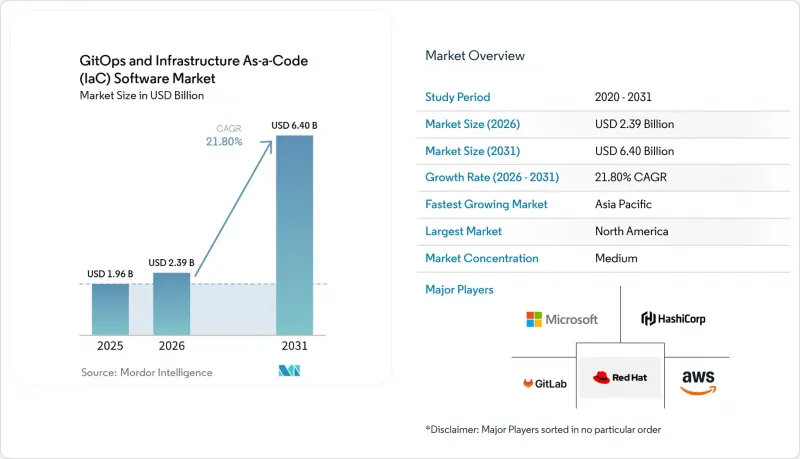
本報告按部署模式(SaaS、自託管等)、組織規模(中小企業、大型企業)、最終用戶產業(IT與電信、醫療保健與生命科學、製造業等)、雲端環境(公共雲端、私有雲端)和地區進行細分。市場預測以美元計價。
全球 GitOps 與 IaC 軟體市場趨勢與洞察
企業雲端原生應用
到 2025 年,82% 的雲端原生組織將在生產環境中採用 Kubernetes,而 GitOps 將成為容器化工作負載的事實標準交付機制。金融機構正是這轉變的典型代表。摩根士丹利在 500 多個叢集上運行 Flux,並將 GitOps 直接整合到其核心交易基礎設施中。在通訊業,NTT Docomo 透過將 GitOps 與 AWS 上的 AI 驅動自動化相結合,將其 5G 核心網路的建置時間縮短了 80%。 ArgoCD 和 Flux 已通過 CNCF 認證,通過嚴格的安全審計和可擴展性測試,證明了其企業級可靠性。因此,97% 的 ArgoCD 使用者目前在生產環境中使用該工具,其中 42% 的使用者每個實例管理超過 500 個應用程式。
遷移到 DevSecOps 管線
受監管的公司正在將安全檢查整合到聲明式管道中,以縮短人工審核週期。 Pulumi 於 2025 年 12 月發布的版本為 Terraform 和 OpenTofu 增加了統一的狀態管理功能,從而實現了以程式碼形式集中執行策略。 GitLab 18.7 版本引入了金鑰有效性掃描功能,可在部署前偵測過期憑證。歐洲銀行正在加速採用相關技術以滿足 DORA 要求,其中 Intesa Sanpaolo 報告稱,透過利用 Cisco 支援 GitOps 的 Fabric Controller,審計準備時間縮短了 70%。 PCI-DSS 自動化藍圖已經出現,將支付卡的控制系統化為不可更改的基礎架構。然而,金鑰管理仍然滯後,許多團隊仍然依賴手動金鑰輪換,這凸顯了整合金鑰庫解決方案的必要性。
以 Git 為中心的工作流程中的技能差距
英國2024年的一項工作小組調查顯示,41%的中小型企業(SME)認為DevOps“過於複雜”,35%的企業缺乏合適的人員。即使是已經實施GitOps的組織也面臨挑戰。 CNCF在2025年7月的一項調查指出,環境部署是最大的營運挑戰,許多團隊只能編寫專案流程腳本。於2025年11月發布的EKS上的託管ArgoCD減少了安裝和升級所需的工作量,縮小了中小企業的技能差距。平台工程團隊透過提供一個隱藏Git概念的自助配置網站來進一步減少摩擦,但這種方法需要專門的工程師和前期投資。大學現在開始將Kubernetes和GitOps納入課程,預計未來兩到三年內這項限制將會緩解。
細分市場分析
混合模式滿足了兩種需求:SaaS 的敏捷性和本地控制。預計到 2025 年,該解決方案將佔總收入的 46.2%,這表明市場更傾向於將 GitOps 控制器封裝在策略引擎中的整合工具鏈。混合模式預計將超越純 SaaS 模式,實現 24.2% 的複合年成長率 (CAGR)。這是因為受監管的機構部署了 SaaS 控制平面,同時在空氣間隙的虛擬私有雲端(VPC) 中運作執行代理,以保護敏感資料。 Spacelift 的 FedRAMP 認證和 AWS 的託管 ArgoCD附加元件是供應商將此架構商業化的典型案例。雖然大型銀行仍然傾向於使用自託管控制平面來滿足零信任要求,但不斷上漲的營運成本正促使它們轉向部分託管的儀表板,並將升級和修補程式外包。隨著敏感運算趨勢的發展,混合部署的 GitOps 和 IaC 軟體市場規模預計將會擴大。這種趨勢允許集中管理,同時要求在本地進行處理。
第二代平台現已整合合規套件、漂移偵測和策略即程式碼模板,使其對航太和國防承包商極具吸引力。在公共部門,採購法規日益要求SaaS提供者證明其支援私人執行模式,推動了對混合解決方案的需求。在製造業,運行Flux的邊緣叢集仍然連接到中央策略中心,同時享受佔用空間較小的代理帶來的優勢,凸顯了獨立於終端的控制平面的必要性。因此,GitOps和基礎設施即程式碼軟體市場正日益模糊曾經僵化的部署類別之間的界限,而柔軟性而非部署位置正成為主要的採購標準。
預計到 2025 年,公共雲端採用率將佔總收入的 71.8%,複合年成長率 (CAGR) 為 23.6%。原生整合是推動這一成長動能的主要因素。 AWS 提供 ArgoCD附加元件,可實現一鍵部署;Azure 將 Flux 與 AKS 捆綁在一起;Google 提供 Anthos 設定管理。私有雲端在金融和醫療保健產業仍然至關重要,資料居住要求促使工作負載遷移到本地 OpenShift叢集。混合控制平面彌合了兩種環境之間的差距,例如阿里雲的 ACK One 可以在與公共雲端資源相同的 GitOps 工作流程中編配本地叢集。
Flux 的微控制器架構非常適合資源受限的邊緣節點,這意味著 GitOps 和 IaC 軟體在本地部署中的市場佔有率不會消失,而是會重新部署到邊緣和主權雲端專案中。跨平台功能將多重雲端狀態對齊為自訂 Kubernetes 資源,從而減少了建立特定於提供者的 IaC 腳本的開銷。隨著公共雲端將託管 GitOps 商品化,差異化重點正在轉向合規性、對延遲敏感的邊緣支援以及 AI 驅動的部署策略。
區域分析
2025年,北美地區佔全球整體營收的33.6%。這主要得益於超大規模雲端的普及以及銀行業和醫療產業對DevSecOps的嚴格要求。獲得FedRAMP認證的SaaS平台,例如Spacelift,正被越來越多的聯邦機構採用。 Harness利用其在2025年12月籌集的2.4億美元資金,加速其面向財富500強企業的市場推廣。摩根士丹利和Capital One等早期採用者正將GitOps定位為核心基礎設施,展現企業級的成熟度。加拿大也呈現與美國類似的趨勢,而墨西哥的通訊業者正在試行GitOps,為5G部署做準備。
亞太地區是成長最快的地區,預計複合年成長率將達到25.8%。日本東京燃氣公司將ArgoCD與混合工作負載的服務網格結合,實現了30%的成本降低。中國國有企業正在其自主雲端上部署Flux,以符合資料本地化法規;阿里雲正在將GitOps整合到ACK One中,以管理其多叢集環境。印度的金融科技業正在利用多重雲端套利,並在AWS和Azure之間遷移工作負載,以提高成本效益。在澳洲和紐西蘭,GitOps在銀行業和政府數位化專案中的應用正在迅速推進。
在歐洲,強勁的成長主要得益於監管合規。例如,義大利聯合聖保羅銀行(Intesa Sanpaolo)透過實施符合《數位營運彈性法案》(DORA)的自動化系統,成功地將審計時間縮短了70%。繼此成功之後,德國和法國的其他金融機構也擴大採用類似的策略。中東、非洲和南美洲是新興市場,潛力大。隨著超大規模雲端服務供應商在這些地區建立本地資料中心,人們對這些地區的興趣日益濃厚。這些資料中心的建立不僅降低了延遲,還有助於應對合規挑戰,使企業能夠在當地法規結構內更有效率地運作。預計這一趨勢將進一步促進先進技術的應用,並推動這些地區的經濟成長。
其他好處:
- Excel格式的市場預測(ME)表
- 3個月的分析師支持
目錄
第1章:引言
- 研究假設和市場定義
- 調查範圍
第2章:調查方法
第3章執行摘要
第4章 市場狀況
- 市場概覽
- 市場促進因素
- 企業採用雲端原生技術
- 遷移到 DevSecOps 管線
- 多重雲端和混合雲端策略的興起
- 受監管行業對合規營運自動化的需求日益成長。
- GitOps 控制器開放原始碼社群的活性化
- 邊緣運算領域對不可竄改基礎設施的需求
- 市場限制因素
- 以 Git 為中心的工作流程中的技能差距
- 管道保密方面的安全問題
- 工具鏈碎片化與互通性問題
- 大規模傳統環境中的投資報酬率可見度低
- 產業價值鏈分析
- 監理情勢
- 技術展望
- 宏觀經濟因素對市場的影響
- 波特五力分析
第5章 市場規模與成長預測
- 按部署模式
- SaaS
- 自託管
- 混合
- 按組織規模
- 小型企業
- 大公司
- 按最終用戶行業分類
- 資訊科技/通訊
- 銀行、金融服務和保險(BFSI)
- 醫療保健和生命科學
- 零售與電子商務
- 製造業
- 政府/公共部門
- 其他
- 透過雲端環境
- 公共雲端
- 私有雲端
- 按地區
- 北美洲
- 美國
- 加拿大
- 墨西哥
- 南美洲
- 巴西
- 阿根廷
- 其他南美國家
- 歐洲
- 德國
- 英國
- 法國
- 義大利
- 西班牙
- 俄羅斯
- 其他歐洲國家
- 亞太地區
- 中國
- 日本
- 印度
- 韓國
- 澳洲和紐西蘭
- 其他亞太國家
- 中東
- 沙烏地阿拉伯
- 阿拉伯聯合大公國
- 土耳其
- 其他中東國家
- 非洲
- 南非
- 埃及
- 奈及利亞
- 其他非洲國家
- 北美洲
第6章 競爭情勢
- 市場集中度
- 策略趨勢
- 市佔率分析
- 公司簡介包括全球概覽、市場概覽、主要細分市場、可用財務資訊、策略資訊、市場排名和佔有率、產品和服務以及近期發展。
- HashiCorp Inc
- GitLab Inc
- Weaveworks Limited
- Red Hat Inc
- Amazon Web Services Inc
- Microsoft Corporation
- Google LLC
- Perforce Software Inc Puppet
- Chef Software Inc
- CloudBees Inc
- Circle Internet Services Inc
- Atlassian Corporation Plc
- GitHub Inc
- SUSE LLC
- Mirantis Inc
- Pulumi Corporation
- Spacelift Inc
- Harness Inc
- Humanitec GmbH
- JFrog Ltd
第7章 市場機會與未來展望
According to Mordor Intelligence, the gitOps and Infrastructure as Code software market size is expected to increase from USD 1.96 billion in 2025 to USD 2.39 billion in 2026 and reach USD 6.40 billion by 2031, growing at a CAGR of 21.8% over 2026-2031.
This report is Segmented by Deployment Model (SaaS, Self-Hosted, and More), Organization Size (Small and Medium Enterprises, and Large Enterprises), End-User Industry (IT and Telecommunications, Healthcare and Life Sciences, Manufacturing, and More), Cloud Environment (Public Cloud, and Private Cloud), and Geography. The Market Forecasts are Provided in Terms of Value (USD).
Global GitOps And Infrastructure As-a-Code (IaC) Software Market Trends and Insights
Cloud-Native Adoption by Enterprises
Kubernetes reached production adoption in 82% of cloud-native organizations by 2025, anchoring GitOps as the de facto delivery mechanism for containerized workloads. Financial institutions exemplify this shift: Morgan Stanley runs Flux across more than 500 clusters, embedding GitOps directly into core trading infrastructure. In telecommunications, NTT DOCOMO cut 5G core build time by 80% by pairing GitOps with AI-driven automation on AWS. Graduation of ArgoCD and Flux from the CNCF imparted enterprise-grade trust through extensive security audits and scalability tests. Consequently, 97% of ArgoCD users now operate the tool in production, and 42% manage more than 500 applications per instance.
Shift Toward DevSecOps Pipelines
Regulated enterprises are moving security checks inside declarative pipelines, reducing manual review cycles. Pulumi's December 2025 release added unified state management for Terraform and OpenTofu, enabling consolidated policy-as-code enforcement. GitLab version 18.7 introduced secret validity scanning, detecting expired credentials before deployment. European banks accelerated adoption to satisfy DORA requirements, with Intesa Sanpaolo reporting a 70% cut in audit prep time using Cisco's GitOps-backed fabric controller. PCI-DSS automation blueprints have emerged, codifying payment-card controls as immutable infrastructure. Secrets management still lags because many teams rely on manual key rotation, highlighting the need for integrated vault solutions.
Skills Gap in Git-Centric Workflows
A 2024 U.K. task-force survey showed 41% of SMEs deem DevOps too complex and 35% lack adequate talent.Even organizations already using GitOps struggle: environment promotion emerged as the top operational headache in the July 2025 CNCF survey, with many teams scripting ad-hoc workflows. Managed ArgoCD on EKS, launched November 2025, cuts installation and upgrade toil, narrowing the skill gap for SMEs. Platform engineering teams further reduce friction by exposing self-service deployment portals that hide Git concepts, though this approach demands dedicated engineers and initial investment. Universities are now embedding Kubernetes and GitOps into curricula, suggesting the constraint will ease over the next two to three years.
Other drivers and restraints analyzed in the detailed report include:
- Rise of Multi-Cloud and Hybrid-Cloud Strategies
- Growing Compliance Automation Needs in Regulated Industries
- Security Concerns Over Pipeline Secrets Management
For complete list of drivers and restraints, kindly check the Table Of Contents.
Segment Analysis
Hybrid patterns address the dual need for SaaS agility and on-premises control. Solutions captured 46.2% of 2025 revenue, illustrating a preference for integrated toolchains that wrap GitOps controllers with policy engines. The hybrid segment is forecast to register a 24.2% CAGR, outpacing pure SaaS, as regulated entities deploy SaaS control planes while running execution agents inside air-gapped virtual private clouds to protect classified data. FedRAMP clearance for Spacelift and the managed ArgoCD add-on from AWS exemplify how vendors are productizing this architecture. Large banks still favor self-hosted control planes to meet zero-trust mandates, but rising operating costs steer them toward partially hosted dashboards that offload upgrades and patches. The GitOps and Infrastructure as Code software market size for hybrid deployments is projected to expand in tandem with confidential computing trends that mandate in-country processing while permitting centralized governance.
Second-generation platforms now bundle compliance packs, drift detection, and policy-as-code templates, making them appealing to aerospace and defense contractors. In the public sector, procurement rules increasingly require proof that SaaS providers support privatized execution modes, propelling hybrid demand. Across manufacturing, edge clusters running Flux benefit from thin-footprint agents but still connect to central policy hubs, confirming that an endpoint-agnostic control plane is crucial. As a result, the GitOps and Infrastructure as Code software market continues to blur the once-rigid lines between deployment categories, leaving flexibility, not location, as the prime buying criterion.
Public cloud deployments represented 71.8% of 2025 revenue and are forecast to progress at a 23.6% CAGR. Native integrations drive momentum: AWS offers a one-click ArgoCD add-on, Azure bundles Flux into AKS, and Google ships Anthos Config Management. Private clouds remain prominent in finance and healthcare, where data residency pushes workloads onto self-hosted OpenShift clusters. Hybrid control planes now straddle both worlds, with Alibaba Cloud's ACK One orchestrating on-premises clusters in the same GitOps workflow as public cloud resources.
Flux's microcontroller architecture suits resource-constrained edge nodes, signaling that the GitOps and Infrastructure as Code software market share for on-premises deployments will not evaporate but will reposition toward edge and sovereign-cloud projects. Cross-plane reconciles multi-cloud state as custom Kubernetes resources, trimming the overhead of writing provider-specific IaC scripts. As public clouds commoditize managed GitOps, differentiation shifts to compliance features, latency-sensitive edge support, and AI-assisted rollout strategies.
Geography Analysis
North America controlled 33.6% of global revenue in 2025, buoyed by hyperscale cloud penetration and stringent DevSecOps mandates across banking and healthcare. FedRAMP-cleared SaaS platforms such as Spacelift widened federal uptake, and Harness leveraged its December 2025 USD 240 million funding to accelerate go-to-market across Fortune 500 accounts. Early adopters like Morgan Stanley and Capital One now treat GitOps as core infrastructure, validating enterprise maturity. Canada mirrors U.S. trends, while Mexican telecoms pilot GitOps for 5G roll-outs.
Asia-Pacific is the fastest-growing region, projected at a 25.8% CAGR. Japan's Tokyo Gas achieved a 30% cost reduction by combining ArgoCD with service mesh for hybrid workloads. Chinese state-owned enterprises deploy Flux in sovereign clouds to honor data localization laws, and Alibaba Cloud embeds GitOps in ACK One to manage multi-cluster estates. India's fintech community capitalizes on multi-cloud arbitrage, shifting workloads between AWS and Azure for pricing efficiency. Australia and New Zealand exhibit strong uptake in banking and government digitization projects.
Europe demonstrates robust growth driven by regulatory compliance. For instance, Intesa Sanpaolo achieved a 70% reduction in audit times by implementing automation aligned with the Digital Operational Resilience Act (DORA). This success is motivating other financial institutions across Germany and France to adopt similar strategies. The Middle East and Africa, along with South America, are emerging markets showing significant potential. These regions are witnessing growing interest as hyperscale cloud providers establish local data centers. The presence of these data centers not only reduces latency but also addresses compliance challenges, enabling businesses to operate more effectively within local regulatory frameworks. This development is expected to drive further adoption of advanced technologies and foster growth in these regions.
- HashiCorp Inc
- GitLab Inc
- Weaveworks Limited
- Red Hat Inc
- Amazon Web Services Inc
- Microsoft Corporation
- Google LLC
- Perforce Software Inc Puppet
- Chef Software Inc
- CloudBees Inc
- Circle Internet Services Inc
- Atlassian Corporation Plc
- GitHub Inc
- SUSE LLC
- Mirantis Inc
- Pulumi Corporation
- Spacelift Inc
- Harness Inc
- Humanitec GmbH
- JFrog Ltd
Additional Benefits:
- The market estimate (ME) sheet in Excel format
- 3 months of analyst support
TABLE OF CONTENTS
1 INTRODUCTION
- 1.1 Study Assumptions and Market Definition
- 1.2 Scope of the Study
2 RESEARCH METHODOLOGY
3 EXECUTIVE SUMMARY
4 MARKET LANDSCAPE
- 4.1 Market Overview
- 4.2 Market Drivers
- 4.2.1 Cloud-native adoption by enterprises
- 4.2.2 Shift toward DevSecOps pipelines
- 4.2.3 Rise of multi-cloud and hybrid-cloud strategies
- 4.2.4 Growing compliance automation needs in regulated industries
- 4.2.5 Open-source community acceleration around GitOps controllers
- 4.2.6 Demand for immutable infrastructure in edge computing
- 4.3 Market Restraints
- 4.3.1 Skills gap in Git-centric workflows
- 4.3.2 Security concerns over pipeline secrets management
- 4.3.3 Toolchain fragmentation and interoperability issues
- 4.3.4 Limited ROI visibility for large legacy environments
- 4.4 Industry Value Supply-Chain Analysis
- 4.5 Regulatory Landscape
- 4.6 Technological Outlook
- 4.7 Impact of Macroeconomic Factors on the Market
- 4.8 Porters Five Forces Analysis
- 4.8.1 Threat of New Entrants
- 4.8.2 Bargaining Power of Suppliers
- 4.8.3 Bargaining Power of Buyers
- 4.8.4 Threat of Substitutes
- 4.8.5 Competitive Rivalry
5 MARKET SIZE AND GROWTH FORECASTS (VALUE)
- 5.1 By Deployment Model
- 5.1.1 SaaS
- 5.1.2 Self Hosted
- 5.1.3 Hybrid
- 5.2 By Organization Size
- 5.2.1 Small and Medium Enterprises SMEs
- 5.2.2 Large Enterprises
- 5.3 By End User Industry
- 5.3.1 IT and Telecommunications
- 5.3.2 Banking Financial Services and Insurance BFSI
- 5.3.3 Healthcare and Life Sciences
- 5.3.4 Retail and E Commerce
- 5.3.5 Manufacturing
- 5.3.6 Government and Public Sector
- 5.3.7 Other End User Industries
- 5.4 By Cloud Environment
- 5.4.1 Public Cloud
- 5.4.2 Private Cloud
- 5.5 By Geography
- 5.5.1 North America
- 5.5.1.1 United States
- 5.5.1.2 Canada
- 5.5.1.3 Mexico
- 5.5.2 South America
- 5.5.2.1 Brazil
- 5.5.2.2 Argentina
- 5.5.2.3 Rest of South America
- 5.5.3 Europe
- 5.5.3.1 Germany
- 5.5.3.2 United Kingdom
- 5.5.3.3 France
- 5.5.3.4 Italy
- 5.5.3.5 Spain
- 5.5.3.6 Russia
- 5.5.3.7 Rest of Europe
- 5.5.4 Asia-Pacific
- 5.5.4.1 China
- 5.5.4.2 Japan
- 5.5.4.3 India
- 5.5.4.4 South Korea
- 5.5.4.5 Australia and New Zealand
- 5.5.4.6 Rest of Asia-Pacific
- 5.5.5 Middle East
- 5.5.5.1 Saudi Arabia
- 5.5.5.2 United Arab Emirates
- 5.5.5.3 Turkey
- 5.5.5.4 Rest of Middle East
- 5.5.6 Africa
- 5.5.6.1 South Africa
- 5.5.6.2 Egypt
- 5.5.6.3 Nigeria
- 5.5.6.4 Rest of Africa
- 5.5.1 North America
6 COMPETITIVE LANDSCAPE
- 6.1 Market Concentration
- 6.2 Strategic Moves
- 6.3 Market Share Analysis
- 6.4 Company Profiles includes Global Level Overview Market Level Overview Core Segments Financials as available Strategic Information Market Rank Share Products and Services Recent Developments
- 6.4.1 HashiCorp Inc
- 6.4.2 GitLab Inc
- 6.4.3 Weaveworks Limited
- 6.4.4 Red Hat Inc
- 6.4.5 Amazon Web Services Inc
- 6.4.6 Microsoft Corporation
- 6.4.7 Google LLC
- 6.4.8 Perforce Software Inc Puppet
- 6.4.9 Chef Software Inc
- 6.4.10 CloudBees Inc
- 6.4.11 Circle Internet Services Inc
- 6.4.12 Atlassian Corporation Plc
- 6.4.13 GitHub Inc
- 6.4.14 SUSE LLC
- 6.4.15 Mirantis Inc
- 6.4.16 Pulumi Corporation
- 6.4.17 Spacelift Inc
- 6.4.18 Harness Inc
- 6.4.19 Humanitec GmbH
- 6.4.20 JFrog Ltd
7 MARKET OPPORTUNITIES AND FUTURE OUTLOOK
- 7.1 White Space and Unmet Need Assessment

 功能平台市場:全球市場預測,2026-2032年
 2026年全球檢索快取層市場報告
 雲端原生軟體市場分析及預測(至 2035 年):按類型、產品類型、服務、技術、元件、應用、部署類型、最終用戶和解決方案分類
 全球雲端原生軟體市場