


 |
市場調查報告書
商品編碼
2065570
以人力資源為中心的 GRC 平台:市場佔有率分析、行業趨勢和統計數據以及成長預測(2026-2031 年)HR Governance, Risk, And Compliance (GRC) Platform - Market Share Analysis, Industry Trends & Statistics, Growth Forecasts (2026 - 2031) |
||||||

※ 本網頁內容可能與最新版本有所差異。詳細情況請與我們聯繫。
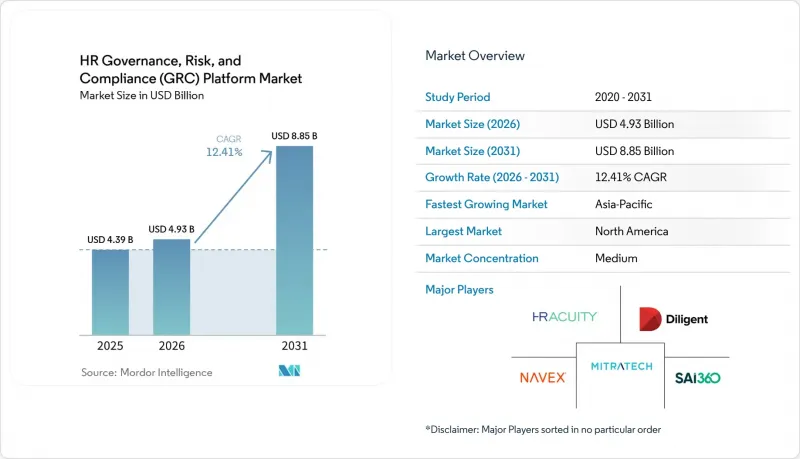
據 Mordor Intelligence 稱,2025 年人力資源 GRC 平台市值為 43.9 億美元,預計到 2031 年將達到 88.5 億美元,在 2026 年至 2031 年的預測期內,複合年成長率為 12.41%。
本報告按元件(軟體和服務)、功能(策略和流程管理等)、部署模式(雲端等)、組織規模(大型企業和中小企業)、產業(醫療保健和生命科學等)以及地區進行細分。市場預測以美元計價。
全球人力資源治理、風險與合規平台市場趨勢及洞察
勞動法和舉報方面的合規性日益複雜。
勞動法規和舉報人保護法規的進展速度已經超過了許多人工合規流程的能力。歐盟舉報人保護指令現已適用於所有27個成員國,其執行在雇主的規劃週期中變得日益明顯和緊迫。據歐盟委員會稱,歐盟法院已對五個成員國處以總合3,900萬歐元(4,400萬美元)的罰款,原因是這些成員國在將相關法規轉化為國內法方面存在延誤。這表明,執行不力將導致經濟後果。雇主面臨的挑戰不再只是政策措詞的問題。如今,每份舉報都需要結構化的接收、流轉、跟進和證據保存流程,以經得起審查。這種轉變正在推動人力資源治理、風險和合規(HR GRC)平台市場向能夠將反覆出現的勞動風險轉化為可記錄的營運流程的平台發展。
遷移到整合式雲端原生合規平台
買家越來越傾向於選擇整合策略管理、事件報告、案例管理、分析和培訓的單一平台,而不是維護眾多分散的工具。 Mitratech 於 2026 年 3 月發布了其全球 GRC 平台,進一步鞏固了這一趨勢。該平台將道德與舉報、策略管理、營運彈性、網路與 IT 風險以及合規培訓整合到一個統一的介面中。雲端原生交付是這項轉變的關鍵要素,它消除了版本控制瓶頸,加快了更新速度,並促進了跨業務部門共用分析的使用。與核心 HCM 系統整合如今已成為採購的基本要求,HR Acuity 於 2026 年 3 月參與 Workday 創新合作夥伴計畫便證明了這一點。隨著合規要求日益廣泛和細緻,HR GRC 平台市場正受益於能夠減少營運摩擦的整合雲端平台。
實施和變更管理的負擔很重。
實施仍是人力資源治理、風險與合規 (HR GRC) 平台市場推廣應用的最大障礙之一。企業級實施通常需要 6 到 12 個月,服務成本可能高達年度授權費的 1 到 2 倍,這對中型企業來說負擔過重。由於人力資源、法務、勞動和合規團隊必須在不同的權限和流程規則下使用相同系統,人力資源工作流程的營運負擔進一步加重。此外,漫長的實施週期會導致“系統並行運行期”,即新舊記錄並存,從而削弱平台旨在增強的審計追蹤的可靠性。供應商正在努力應對這項挑戰,LogicGate 於 2026 年 4 月宣布,其「Config Newton」可以將實施後的價值實現時間縮短 25%。
細分市場分析
到2025年,軟體將佔據67.14%的市場佔有率,這表明買家仍然更傾向於可配置的、持續更新的平台,而非專案主導的模式。該領域的主導地位源於這樣一個事實:一旦將政策記錄、調查歷史、證據鍊和薪資管治資料集中到一個系統中,遷移就變得異常困難。這造成了巨大的轉換成本,也幫助軟體供應商在人力資源治理、風險和合規(HR GRC)平台市場中留住長期客戶。此外,軟體還受益於對標準化控制、內部分析以及可跨地區和業務部門擴展的可重複使用工作流程範本的需求。
預計到2031年,服務業將以14.53%的複合年成長率成長。這反映出監管複雜性仍然超過了許多企業內部合規團隊的處理能力。諮詢和管理服務正日益受到關注,因為買家不僅尋求一次性設定的支持,還尋求持續監控、控制更新和專案管理方面的支持。實施和整合工作仍然至關重要。這是因為人力資源治理、風險和合規 (HR GRC) 平台的產業部署通常會同時影響人力資源系統、法律審查流程、熱線接待和報告層。供應商正在尋求透過更快捷的設定工具來減少對服務的依賴,LogicGate 基於代理程式的設定方法就是這方面的一個例證。
到2025年,政策和流程管理將佔總收入的38.29%,成為所有功能類型中佔比最大的模組。這個模組的重要性不言而喻,因為所有受監管的雇主都需要在申訴或調查開始之前進行版本控制、核准和員工宣誓驗證。事實上,政策管理是人力資源治理、風險和合規(HR GRC)平台市場中許多購買決策的基礎,因為其他功能都依賴已記錄的規則庫。與競爭對手的差異化正在從單純的文件儲存轉向與政策映射、員工核准工作流程和下游案例的更緊密整合。
預計到2031年,薪酬透明度和薪酬管治將以13.09%的複合年成長率成長,成為成長最快的職能領域。由於僅靠靜態的政策文件不足以滿足持續的資訊揭露義務,雇主正在製定新的流程,用於職位評估標準、薪資等級管治和薪酬報告。舉報、案件管理和分析等功能相互關聯時也最為有效,因為一項申訴可以觸發調查、需要參考相關政策,並在同一周期內反映在結果報告中。在人力資源治理、風險和合規(HR GRC)平台市場,能夠將這些功能整合到單一證據鏈中,而不是將它們視為獨立工具的供應商備受青睞。
區域分析
2025年,北美將佔據人力資源治理、風險與合規(HR GRC)平台市場佔有率的35.68%,成為最大的區域貢獻者。其中大部分支出將來自美國,這主要得益於聯邦和省級就業法規對大規模雇主持續推行的政策控制、報告和案例管理要求。在加拿大,工資透明度措施的實施增加了對可重複報告和薪酬管治工作流程的需求,從而推動了市場需求。墨西哥則因跨國公司對其北美業務運營中員工保護記錄和流程文件的要求而形成了另一層需求。
預計2025年,歐洲將成為全球第二大人力資源治理、風險與合規(HR GRC)平台市場。歐洲的需求成長主要得益於工資透明度法律的全國化進程、舉報機制的強化以及就業領域對人工智慧日益嚴格的審查。歐盟委員會強調了執法力度的不斷增強,此前歐盟法院對五個成員國處以總合3900萬歐元(約4,400萬美元)的罰款,原因是這些國家在舉報人保護法的全國性進程中進展緩慢。德國、法國和英國仍然是市場機會最大的國家,這得益於其大規模的雇主群體和嚴格的合規義務。然而,勞工委員會的審查和地方勞資協商機制可能會延緩實施進程,因此,亟需支持區域客製化的工作流程和結構化的員工資料管治。
預計到2031年,亞太地區將以13.44%的複合年成長率成長,成為預測期內人力資源治理、風險與合規(HR GRC)平台市場成長最快的地區。該地區的成長與跨國公司的擴張、各國勞動法的分散化以及印度、日本、韓國、澳洲和紐西蘭等國對員工資料處理的日益嚴格監管密切相關。以巴西和阿根廷為首的南美洲正作為新興市場機會吸引人們的關注,全球企業正在這些國家推動勞動管治和文件標準。儘管中東和非洲市場規模仍然較小,但隨著人們對勞動保護和更廣泛的勞動管治的期望日益系統化,阿拉伯聯合大公國和沙烏地阿拉伯的需求正在不斷成長。
其他好處:
- Excel格式的市場預測(ME)表
- 3個月的分析師支持
目錄
第1章:引言
- 研究假設和市場定義
- 調查範圍
第2章:調查方法
第3章執行摘要
第4章 市場狀況
- 市場概覽
- 市場促進因素
- 勞動法和舉報方面的合規性日益複雜。
- 遷移到整合式雲端原生合規平台
- 對可審計的政策、熱線和調查工作流程的需求日益成長。
- 擴大中小企業採用率
- 準備遵守歐盟工資透明度指令
- 人工智慧驅動的自動化招募決策的管治要求
- 市場限制因素
- 實施和變更管理的負擔很重。
- 透過廣泛的 GRC 套件實現平台整合的壓力
- 對跨境員工資料儲存位置的限制
- 員工代表委員會的審查流程延緩了工作流程的實施。
- 產業價值鏈分析
- 監理情勢
- 技術展望
- 宏觀經濟因素對市場的影響
- 波特五力分析
第5章 市場規模與成長預測
- 按組件
- 軟體
- 服務
- 實施和整合服務
- 諮詢和管理服務
- 培訓和支援服務
- 按功能
- 政策和程序管理
- 檢舉和事件管理
- 勞資關係個案管理
- 工資透明度和薪酬管治
- 分析和報告撰寫
- 其他
- 部署模式
- 基於雲端的
- 現場
- 混合
- 按組織規模
- 大公司
- 小型企業
- 按行業分類
- 銀行業、金融服務業及保險業
- 醫療保健和生命科學
- IT/通訊
- 零售與電子商務
- 製造業
- 其他
- 按地區
- 北美洲
- 美國
- 加拿大
- 墨西哥
- 南美洲
- 巴西
- 阿根廷
- 智利
- 其他南美國家
- 歐洲
- 英國
- 德國
- 法國
- 義大利
- 西班牙
- 俄羅斯
- 其他歐洲國家
- 亞太地區
- 中國
- 日本
- 印度
- 韓國
- 澳洲和紐西蘭
- 其他亞太國家
- 中東
- 阿拉伯聯合大公國
- 沙烏地阿拉伯
- 土耳其
- 其他中東國家
- 非洲
- 南非
- 奈及利亞
- 其他非洲國家
- 北美洲
第6章 競爭情勢
- 市場集中度
- 策略趨勢
- 市佔率分析
- 公司簡介
- NAVEX Global, Inc.
- Mitratech Holdings, Inc.
- HR Acuity, LLC
- ComplianceHR, LLC
- Resolver Inc.
- SAI Global Compliance, Inc.
- Ethena, Inc.
- Syndio Solutions, Inc.
- Trusaic, Inc.
- EQS Group AG
- VinciWorks Ltd.
- Whistleblowing Solutions AB
- WorkBright, Inc.
- AllVoices, Inc.
- GAN Integrity Inc.
- LogicGate, Inc.
- Riskonnect, Inc.
- Safecall Ltd.
- LRN Corporation
- Diligent Corporation
第7章 市場機會與未來展望
According to Mordor Intelligence, the hR governance, risk, and Compliance (GRC) platform market size was valued at USD 4.39 billion in 2025 and is projected to reach USD 8.85 billion by 2031, expanding at a CAGR of 12.41% during the 2026-2031 forecast period.
This report is Segmented by Component (Software, and Services), Functionality (Policy and Procedure Management, and More), Deployment Mode (Cloud-Based, and More), Organization Size (Large Enterprises, and Small and Medium-Sized Enterprises), Industry Vertical (Healthcare and Life Sciences, and More), and Geography. The Market Forecasts are Provided in Terms of Value (USD).
Global HR Governance, Risk, And Compliance (GRC) Platform Market Trends and Insights
Rising Labor and Whistleblower Compliance Complexity
The pace of labor and whistleblower regulation has moved beyond what most manual compliance processes can absorb. The EU Whistleblower Protection Directive now applies across all 27 member states, and enforcement has become more visible and more immediate in employer planning cycles. The European Commission reported that the EU Court of Justice imposed combined fines of EUR 39 million (USD 44 million) on 5 member states for delayed transposition, which signaled that weak implementation would carry financial consequences. For employers, the challenge is no longer just about policy wording; every report now needs structured intake, routing, follow-up, and evidence retention that can stand up to review. This shift is pushing the HR Governance, Risk, and Compliance (GRC) Platform Market toward platforms that can turn recurring labor risk into a documented operating process.
Shift toward Integrated Cloud-Native Compliance Platforms
Buyers increasingly prefer a single platform that combines policy management, incident reporting, case management, analytics, and training, rather than maintaining a stack of disconnected tools. Mitratech reinforced this direction in March 2026, when it launched its Global GRC Platform, bringing ethics and whistleblowing, policy management, operational resilience, cyber and IT risk, and compliance training into one interface. Cloud-native delivery is a strong part of this shift because it removes version-control bottlenecks, supports faster updates, and makes shared analytics easier to use across business units. Integration with core HCM systems is now a basic buying requirement, as shown by HR Acuity joining the Workday Innovation Partner Program in March 2026. The HR Governance, Risk, and Compliance (GRC) Platform Market is benefiting from integrated cloud platforms that reduce operational friction while compliance expectations are becoming broader and more detailed.
High Implementation and Change Management Burden
Implementation remains one of the biggest limits on faster adoption in the HR Governance, Risk, and Compliance (GRC) Platform Market. Enterprise deployments often take 6 to 12 months, and services spending can match 1 to 2 times the annual license fee, which is difficult for mid-market buyers to absorb. The operational burden is higher in HR workflows because HR, legal, employee relations, and compliance teams all need to adopt the same system while working under different permissions and process rules. Long rollouts also create a parallel-system phase in which old and new records sit side by side, weakening the audit trail the platform is supposed to strengthen. Vendors are trying to reduce this drag, and LogicGate said in April 2026 that Config Newton could reduce implementation time-to-value by 25%.
Other drivers and restraints analyzed in the detailed report include:
- EU Pay Transparency Directive Readiness
- Growing Need for Auditable Policy, Hotline, and Investigation Workflows
- Platform Consolidation Pressure from Broader GRC Suites
For complete list of drivers and restraints, kindly check the Table Of Contents.
Segment Analysis
Software held 67.14% of the market in 2025, which shows that buyers continue to prefer configurable recurring platforms over project-led engagement models. This segment led because policy records, investigation histories, attestation trails, and pay governance data become harder to move once centralized in a single system. That creates meaningful switching costs and helps software vendors retain long-term accounts in the HR Governance, Risk, and Compliance (GRC) Platform Market. Software also benefits from the need for standardized controls, internal analytics, and reusable workflow templates that can scale across regions and business units.
Services are projected to grow at a 14.53% CAGR through 2031, which reflects the fact that regulatory complexity is still outpacing the bandwidth of many internal compliance teams. Advisory and managed services are gaining traction because buyers want help with ongoing monitoring, control updates, and program administration, rather than just one-time setup. Implementation and integration work remain central because HR Governance, Risk, and Compliance (GRC) Platform industry deployments often touch HR systems, legal review processes, hotline intake, and reporting layers simultaneously. Vendors are trying to reduce service dependency with faster configuration tools, and LogicGate's agentic setup approach is one example of that push.
Policy and procedure management accounted for 38.29% of revenue in 2025, giving it the largest share among functionality types. The broad position of this module is logical because every regulated employer needs version control, approvals, and employee attestation even before a complaint or investigation begins. In practice, policy management anchors many buying decisions in the HR Governance, Risk, and Compliance (GRC) Platform Market because other functions depend on a documented rule base. Competitive differentiation is shifting away from simple document storage and toward policy mapping, employee acknowledgment workflows, and tighter linkage with downstream cases.
Pay transparency and compensation governance are projected to grow at a 13.09% CAGR through 2031, making it the fastest-growing functionality. Employers are developing new processes for job evaluation criteria, pay-band governance, and compensation reporting because a static policy file is insufficient for ongoing disclosure obligations. Whistleblowing, case management, and analytics also work best when they are connected, since one complaint can trigger an investigation, require policy reference, and feed into outcome reporting in the same cycle. The HR Governance, Risk, and Compliance (GRC) Platform Market is rewarding vendors that can integrate these functions into a single evidence chain rather than treating them as separate tools.
Geography Analysis
North America held 35.68% of the HR Governance, Risk, and Compliance (GRC) Platform market share in 2025, making it the largest regional contributor. The United States accounted for most of that spending because federal and state employment rules keep policy control, reporting, and case management requirements active across large employers. Canada added demand as pay transparency measures widened the need for repeatable reporting and compensation governance workflows. Mexico added another layer for multinationals that needed consistent worker-protection records and documented processes across North American operations.
Europe was the second-largest region in the HR Governance, Risk, and Compliance (GRC) Platform Market in 2025. The pay transparency transposition cycle, whistleblower enforcement, and tighter review of employment AI are shaping demand in Europe. The European Commission highlighted stronger enforcement momentum when the EU Court of Justice imposed combined fines of EUR 39 million (USD 44 million) on 5 member states for the delayed transposition of whistleblower legislation. Germany, France, and the United Kingdom remain the largest country opportunities because they combine large employer bases with dense compliance obligations. Works council reviews and local labor consultation practices can slow deployment, increasing the need for localized workflow support and structured employee data governance.
Asia-Pacific is projected to grow at a 13.44% CAGR through 2031, making it the fastest-growing region in the HR Governance, Risk, and Compliance (GRC) Platform market over the forecast period. Regional growth is tied to multinational expansion, fragmented national labor frameworks, and rising scrutiny of employee data handling across India, Japan, South Korea, Australia, and New Zealand. South America remains an emerging opportunity, led by Brazil and Argentina, where global employers are formalizing workforce governance and documentation standards. The Middle East and Africa still represent a smaller base, but the UAE and Saudi Arabia are widening demand as labor protection and broader workforce governance expectations become more structured.
- NAVEX Global, Inc.
- Mitratech Holdings, Inc.
- HR Acuity, LLC
- ComplianceHR, LLC
- Resolver Inc.
- SAI Global Compliance, Inc.
- Ethena, Inc.
- Syndio Solutions, Inc.
- Trusaic, Inc.
- EQS Group AG
- VinciWorks Ltd.
- Whistleblowing Solutions AB
- WorkBright, Inc.
- AllVoices, Inc.
- GAN Integrity Inc.
- LogicGate, Inc.
- Riskonnect, Inc.
- Safecall Ltd.
- LRN Corporation
- Diligent Corporation
Additional Benefits:
- The market estimate (ME) sheet in Excel format
- 3 months of analyst support
TABLE OF CONTENTS
1 INTRODUCTION
- 1.1 Study Assumptions and Market Definition
- 1.2 Scope of the Study
2 RESEARCH METHODOLOGY
3 EXECUTIVE SUMMARY
4 MARKET LANDSCAPE
- 4.1 Market Overview
- 4.2 Market Drivers
- 4.2.1 Rising Labor and Whistleblower Compliance Complexity
- 4.2.2 Shift Toward Integrated Cloud-Native Compliance Platforms
- 4.2.3 Growing Need for Auditable Policy, Hotline, and Investigation Workflows
- 4.2.4 Expanding Adoption by Small and Medium-Sized Enterprises
- 4.2.5 EU Pay Transparency Directive Readiness
- 4.2.6 Governance Needs for Employment AI and Automated Hiring Decisions
- 4.3 Market Restraints
- 4.3.1 High Implementation and Change Management Burden
- 4.3.2 Platform Consolidation Pressure From Broader GRC Suites
- 4.3.3 Cross-Border Employee Data Residency Constraints
- 4.3.4 Works Council Review Slowing Workflow Rollouts
- 4.4 Industry Value Chain Analysis
- 4.5 Regulatory Landscape
- 4.6 Technological Outlook
- 4.7 Impact of Macroeconomic Factors on the Market
- 4.8 Porter's Five Forces Analysis
- 4.8.1 Bargaining Power of Buyers
- 4.8.2 Bargaining Power of Suppliers
- 4.8.3 Threat of New Entrants
- 4.8.4 Threat of Substitutes
- 4.8.5 Intensity of Competitive Rivalry
5 MARKET SIZE AND GROWTH FORECASTS (VALUE)
- 5.1 By Component
- 5.1.1 Software
- 5.1.2 Services
- 5.1.2.1 Implementation and Integration Services
- 5.1.2.2 Advisory and Managed Services
- 5.1.2.3 Training and Support Services
- 5.2 By Functionality
- 5.2.1 Policy and Procedure Management
- 5.2.2 Whistleblowing and Incident Management
- 5.2.3 Employee Relations Case Management
- 5.2.4 Pay Transparency and Compensation Governance
- 5.2.5 Analytics and Reporting
- 5.2.6 Other Functionalities
- 5.3 By Deployment Mode
- 5.3.1 Cloud-Based
- 5.3.2 On-Premises
- 5.3.3 Hybrid
- 5.4 By Organization Size
- 5.4.1 Large Enterprises
- 5.4.2 Small and Medium-Sized Enterprises
- 5.5 By Industry Vertical
- 5.5.1 Banking, Financial Services, and Insurance
- 5.5.2 Healthcare and Life Sciences
- 5.5.3 Information Technology and Telecommunications
- 5.5.4 Retail and E-commerce
- 5.5.5 Manufacturing
- 5.5.6 Other Industry Verticals
- 5.6 By Geography
- 5.6.1 North America
- 5.6.1.1 United States
- 5.6.1.2 Canada
- 5.6.1.3 Mexico
- 5.6.2 South America
- 5.6.2.1 Brazil
- 5.6.2.2 Argentina
- 5.6.2.3 Chile
- 5.6.2.4 Rest of South America
- 5.6.3 Europe
- 5.6.3.1 United Kingdom
- 5.6.3.2 Germany
- 5.6.3.3 France
- 5.6.3.4 Italy
- 5.6.3.5 Spain
- 5.6.3.6 Russia
- 5.6.3.7 Rest of Europe
- 5.6.4 Asia-Pacific
- 5.6.4.1 China
- 5.6.4.2 Japan
- 5.6.4.3 India
- 5.6.4.4 South Korea
- 5.6.4.5 Australia and New Zealand
- 5.6.4.6 Rest of Asia-Pacific
- 5.6.5 Middle East
- 5.6.5.1 United Arab Emirates
- 5.6.5.2 Saudi Arabia
- 5.6.5.3 Turkey
- 5.6.5.4 Rest of Middle East
- 5.6.6 Africa
- 5.6.6.1 South Africa
- 5.6.6.2 Nigeria
- 5.6.6.3 Rest of Africa
- 5.6.1 North America
6 COMPETITIVE LANDSCAPE
- 6.1 Market Concentration
- 6.2 Strategic Moves
- 6.3 Market Share Analysis
- 6.4 Company Profiles (includes Global Level Overview, Market Level Overview, Core Segments, Financials as available, Strategic Information, Market Rank/Share, Products and Services, Recent Developments)
- 6.4.1 NAVEX Global, Inc.
- 6.4.2 Mitratech Holdings, Inc.
- 6.4.3 HR Acuity, LLC
- 6.4.4 ComplianceHR, LLC
- 6.4.5 Resolver Inc.
- 6.4.6 SAI Global Compliance, Inc.
- 6.4.7 Ethena, Inc.
- 6.4.8 Syndio Solutions, Inc.
- 6.4.9 Trusaic, Inc.
- 6.4.10 EQS Group AG
- 6.4.11 VinciWorks Ltd.
- 6.4.12 Whistleblowing Solutions AB
- 6.4.13 WorkBright, Inc.
- 6.4.14 AllVoices, Inc.
- 6.4.15 GAN Integrity Inc.
- 6.4.16 LogicGate, Inc.
- 6.4.17 Riskonnect, Inc.
- 6.4.18 Safecall Ltd.
- 6.4.19 LRN Corporation
- 6.4.20 Diligent Corporation
7 MARKET OPPORTUNITIES AND FUTURE OUTLOOK
- 7.1 White-Space and Unmet-Need Assessment

 歐盟人工智慧審計追蹤軟體:市場佔有率分析、產業趨勢與統計及成長預測(2026-2031 年)歐洲(歐盟)人工智慧法律人力資源合規平台:市場佔有率分析、產業趨勢與統計、成長預測(2026-2031 年)
 全球合規自動化市場(2025-2030 年)
 2026-2030年全球管治、風險與合規(GRC)平台市場
 合規軟體市場規模、佔有率和趨勢分析報告:按組件、應用、部署類型、企業規模、最終用途、地區和細分市場預測(2026-2033 年)
 管治、風險和合規 (GRC) 平台市場報告:按部署模式、解決方案、組件、服務、最終用戶、行業垂直領域和地區分類,2026-2034 年
 法律、風險和合規解決方案市場到 2035 年的分析和預測:按類型、產品、服務、技術、組件、應用、部署、最終用戶、模組和功能分類。
 2026年全球管治、風險與合規平台市場報告管治、風險和合規 (GRC) 平台市場分析及預測(至 2035 年):按類型、產品類型、服務、技術、組件、應用、最終用戶、模組和部署類型分類
 管治、風險和合規 (GRC) 平台:全球市場佔有率和排名、總收入和需求預測(2025-2031 年)