


 |
市場調查報告書
商品編碼
2065519
汽車GPU:市佔率分析、產業趨勢與統計及成長預測(2026-2031年)Automotive GPU - Market Share Analysis, Industry Trends & Statistics, Growth Forecasts (2026 - 2031) |
||||||

※ 本網頁內容可能與最新版本有所差異。詳細情況請與我們聯繫。
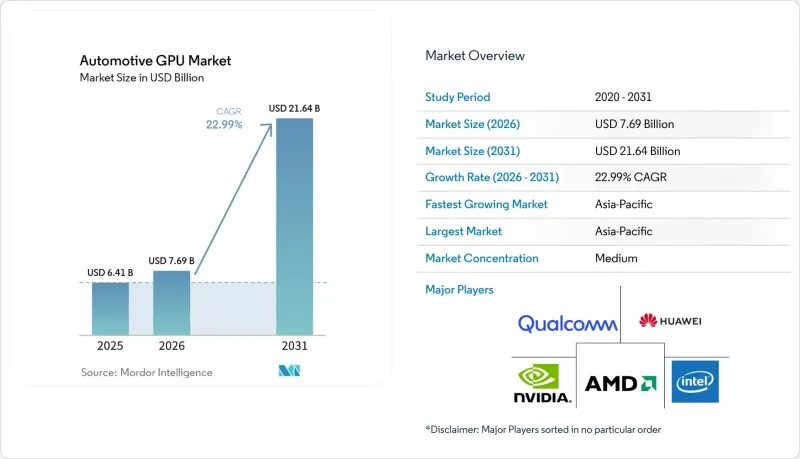
根據 Mordor Intelligence 預測,汽車 GPU 市場規模將從 2025 年的 64.1 億美元成長到 2026 年的 76.9 億美元,然後在 2031 年達到 216.4 億美元,2026 年至 2031 年的複合年成長率為 22.99%。
本報告按GPU類型(整合GPU和獨立GPU)、應用領域(資訊娛樂系統、數位駕駛座/儀錶板等)、車輛類型(乘用車和商用車)以及地區(北美、歐洲、亞太、南美等)進行細分。市場預測以美元計價。
全球汽車GPU市場趨勢及洞察
擴大使用GPU的ADAS應用
歐洲新車安全評價協會 (Euro NCAP) 的五星評級現已涵蓋免手煞車、駕駛員監控和攝影機冗餘等功能,這催生了對能夠執行視覺變壓器和感測器融合的可編程圖形核心的需求。 NVIDIA DRIVE Hyperion 等車規級晶片正在取代行動優先架構,在滿足功能安全目標的同時,還能提供數百兆次浮點運算的效能。中國都市區的自動駕駛導航程式正在利用類似的運算能力來管理多車道環島,而區域性汽車製造商正在設計 2028 年款車型,其核心將採用獨立加速器,以便透過空中下載 (OTA) 的方式啟用相關功能。這一趨勢是全球性的,但在那些主動安全功能可享有保費折扣以抵消硬體成本的地區,其普及速度最快。隨著生產規模的擴大,規模經濟將降低單位成本,進而進一步擴大普及範圍。
向軟體定義汽車過渡
將數十個電控系統整合到中央運算堆疊中,可以減輕佈線重量,簡化空中升級管理,並使原始設備製造商 (OEM) 能夠將晶片成本分攤到不同等級的產品上。 NVIDIA DRIVE Thor 將 CPU、GPU 和高速網路功能整合到單一晶片上,因此能夠同時執行駕駛座圖形、電池溫度控管和路由規劃。聯發科的 3 奈米「天瑩自動座艙」平台採用了類似的設計理念,將 NVIDIA Blackwell GPU 與專用的神經網路引擎結合,用於音訊和視覺應用。其商業邏輯極具吸引力:軟體釋放各種獲利選項,使車輛在十年內保持最新狀態並維持其殘值。諸如 ISO 26262 和更新的 ISO/SAE 21434 網路安全規則集等法規結構為持續部署提供了必要的合規基礎。
先進節點GPU供應鏈的波動
晶圓代工廠繼續優先生產資料中心加速器而非汽車晶片,導致汽車專案的交付週期延長。高頻寬記憶體供應仍然緊張,現貨價格自2025年初以來加倍,迫使一些原始設備製造商(OEM)降低前置作業時間容量。成熟製程節點的短缺加劇了這個問題,因為電源管理晶片和感測器介面共用相同產能。儘管日本、印度和美國政府都在津貼新建工廠,但鑑於目前的建設進度,情況在2027年底前不太可能有所改善。在此之前,確保庫存緩衝和從多個供應商採購(多源採購)將是主要的風險緩解措施。
細分市場分析
到2025年,整合設備將佔據汽車GPU市場59.38%的佔有率,為資訊娛樂叢集和入門級ADAS提供支持,功耗低於15瓦。這種單晶片結構降低了組件成本並簡化了散熱設計。恩智浦半導體的i.MX 95將Arm Mali GPU與緊湊型神經網路引擎結合,無需虛擬機器管理程式即可滿足ASIL-B安全等級要求,完美體現了這種平衡。在印度和東南亞等大批量生產地區,這些特性符合價格敏感型細分市場的需求,預計該市場將持續領先至2020年代中期。
同時,隨著高階OEM廠商推進L3級自動駕駛功能的前瞻性設計,獨立顯示卡市場預計將以23.68%的複合年成長率成長。 NVIDIA DRIVE Thor顯示卡應用於Gatik和五十鈴的L4級自動駕駛卡車,其集中式節點的處理能力超過2 petaFLOPS。聯發科的駕駛座平台整合了NVIDIA GPU,模糊了獨立顯示卡和整合顯示卡之間的界限,並為遊戲和視覺化應用提供了高清射線追蹤功能。因此,在自動駕駛發展藍圖最為激進的北美、歐洲和中國,由獨立顯示卡驅動的汽車GPU市場規模預計將比其他地區顯著成長。
區域分析
預計到2025年,亞太地區將佔全球銷售額的67.41%,複合年成長率達23.88%。中國正透過大力推廣電動車和國內半導體激勵政策推動市場需求。地平線機器人公司在前置相機ADAS市場佔據領先地位,而英偉達則在都市區自動駕駛計算合約中佔據重要佔有率。日本和韓國供應記憶體和電源元件,為區域價值鏈提供支援。同時,印度的半導體發展策略正在資助計畫於2027年及以後運作的生產線和先進封裝生產線。
在北美,豪華車的推出以及L2級及以上自動駕駛功能的快速普及,推動了市場擴張。通用汽車(GM)已決定在其所有未來車型中採用NVIDIA的計算技術,並使用Omniverse產生的合成數據進行檢驗。監管機構對高速公路自動駕駛的關注也加速了中階車型中自動駕駛功能的普及。加拿大的寒冷氣候測試設施正在提升感測器融合堆疊的可靠性,並間接促進了分離式加速器設計的採用率。
儘管歐洲在產量上落後於亞太地區,但在功能安全方面的嚴謹性卻遙遙領先。 Euro NCAP 2025評估協議將自動煞車和駕駛監控與碰撞安全性能置於同等重要的地位,這加速了緊湊型汽車對可程式GPU的需求。德國、法國和英國正透過大眾集團、Stellantis、寶馬和梅賽德斯-奔馳等公司對軟體定義平台的投資,在價值創造方面發揮主導作用。區域碳排放減排目標正在推動電動車的銷售,進一步擴大GPU的潛在市場。
南美、中東和非洲地區的需求仍然相對較小。雖然巴西的資訊娛樂系統升級和沙烏地阿拉伯進口豪華電動車帶動了局部需求,但由於半導體基礎設施不足和平均售價較低,這些地區的普及率仍然不高。未來,包含整合GPU的散件組裝套件(KD套件)的本地化組裝可能會增加出貨量,但在總成本下降之前,獨立加速器的應用可能仍將局限於小眾市場。
其他好處:
- Excel格式的市場預測(ME)表
- 3個月的分析師支持
目錄
第1章:引言
- 研究假設和市場定義
- 調查範圍
第2章:調查方法
第3章執行摘要
第4章 市場狀況
- 市場概覽
- 市場促進因素
- GPU加速型ADAS的廣泛應用
- 向軟體定義汽車過渡
- 對高解析度數位駕駛座的需求
- 汽車製造商與半導體供應商之間的合作關係
- 基於區域的架構的興起使得集中式運算成為可能
- 開放原始碼GPU運算框架的興起
- 市場限制因素
- 汽車環境中的溫度控管面臨的挑戰
- 高階節點GPU的供應鏈波動性
- 大眾市場汽車領域的成本敏感性
- 安全關鍵型GPU軟體認證延遲
- 產業價值鏈分析
- 監理情勢
- 技術展望
- 波特五力分析
- 宏觀經濟因素對市場的影響
第5章 市場規模與成長預測
- 按GPU類型
- 整合顯示卡
- 獨立顯示卡
- 透過使用
- 資訊娛樂系統
- 數位駕駛座/儀錶板
- ADAS和自動駕駛
- 車輛類型
- 搭乘用車
- 商用車輛
- 按地區
- 北美洲
- 美國
- 加拿大
- 墨西哥
- 歐洲
- 德國
- 英國
- 法國
- 其他歐洲國家
- 亞太地區
- 中國
- 日本
- 韓國
- 印度
- 其他亞太國家
- 南美洲
- 中東和非洲
- 北美洲
第6章 競爭情勢
- 市場集中度
- 策略趨勢
- 市佔率分析
- 公司簡介
- Nvidia Corporation
- Qualcomm Technologies, Inc.
- Intel Corporation
- Advanced Micro Devices, Inc.
- Imagination Technologies Limited
- Arm Ltd.
- Mobileye Global Inc.
- MediaTek Inc.
- Huawei Technologies Co., Ltd.
- VeriSilicon Holdings Co., Ltd.
- Socionext Inc.
- Cadence Design Systems, Inc.
- ROHM Co., Ltd.
- Vivante Corporation
第7章 市場機會與未來展望
According to Mordor Intelligence, the automotive gPU market size is expected to grow from USD 6.41 billion in 2025 to USD 7.69 billion in 2026 and is forecast to reach USD 21.64 billion by 2031 at a 22.99% CAGR over 2026-2031.
This report is Segmented by GPU Type (Integrated GPUs and Discrete GPUs), Application (Infotainment Systems, Digital Cockpit/Instrument Cluster, and More), Vehicle Type (Passenger Vehicles and Commercial Vehicles), and Geography (North America, Europe, Asia-Pacific, South America, and More). The Market Forecasts are Provided in Terms of Value (USD).
Global Automotive GPU Market Trends and Insights
Increasing GPU-Accelerated ADAS Adoption
Euro NCAP five-star scoring now rewards hands-free braking, driver monitoring, and camera redundancy, creating a pull for programmable graphics cores capable of running vision transformers and sensor fusion. Mobile-first architectures have given way to automotive-grade chips such as NVIDIA DRIVE Hyperion that deliver several hundred teraFLOPS while meeting functional-safety targets. Chinese urban navigation-on-autopilot programs use similar compute to manage multilane roundabouts, and regional OEMs are designing 2028 models around discrete accelerators so that features can be enabled over the air. The trend is global, yet penetration is fastest where insurance discounts for active safety offset the cost of the hardware. As volume scales, economies of scale reduce unit pricing and further widen the adoption curve.
Shift Toward Software-Defined Vehicles
Consolidating dozens of electronic control units into a central compute stack lowers wiring mass, eases over-the-air update management, and lets OEMs amortize silicon across trim levels. NVIDIA DRIVE Thor integrates CPU, GPU, and accelerated networking on a single die so that cockpit graphics, battery thermal control, and path planning can run concurrently. MediaTek's 3-nanometer Dimensity Auto Cockpit platform follows a similar blueprint, pairing an NVIDIA Blackwell GPU with a dedicated neural engine for voice and vision applications. The commercial logic is compelling: software unlocks monetizable options and keeps vehicles current for a decade, protecting residual value. Regulatory frameworks such as ISO 26262 and the newer ISO/SAE 21434 cybersecurity rule set supply the compliance backbone needed for continuous deployment.
Supply Chain Volatility for Advanced Node GPUs
Foundries continue to prioritize data-center accelerators over automotive volumes, leaving vehicle programs exposed to longer lead times. High-bandwidth memory remains in tight supply, and spot prices have doubled since early 2025, prompting some OEMs to ship with reduced RAM footprints. Mature-node shortages compound the issue as power-management ICs and sensor interfaces share the same capacity pool. Governments in Japan, India, and the United States are subsidizing new fabrication plants, but build-out timelines mean relief is unlikely before late 2027. Until then, buffer inventories and multi-sourcing remain the main mitigation levers.
Other drivers and restraints analyzed in the detailed report include:
- Demand for High-Resolution Digital Cockpits
- Automakers' Partnerships with Semiconductor Suppliers
- Thermal Management Challenges in Automotive Environments
For complete list of drivers and restraints, kindly check the Table Of Contents.
Segment Analysis
Integrated devices accounted for 59.38% of the Automotive GPU market share in 2025, serving infotainment clusters and entry-level ADAS within power envelopes below 15 W. Their single-die construction reduces bill-of-materials costs and simplifies thermal design. NXP's i.MX 95, which mates an Arm Mali GPU with a small neural engine, exemplifies this balance by meeting ASIL-B targets without a hypervisor. In volume regions such as India and Southeast Asia, these attributes align with price-sensitive segments, ensuring continued dominance through the middle of the decade.
Discrete accelerators, however, are forecast to grow at a 23.68% CAGR as premium OEMs future-proof designs for Level 3 features. NVIDIA DRIVE Thor powers Gatik and Isuzu's Level 4 trucks, aggregating over 2 petaFLOPS in a centralized node. MediaTek's cockpit platform embeds an NVIDIA GPU, blurring the line between discrete and integrated GPUs and enabling high-fidelity ray tracing for gaming and visualization. The Automotive GPU market size attributed to discrete boards will thus expand disproportionately in North America, Europe, and China, where autonomy roadmaps are most aggressive.
Geography Analysis
Asia-Pacific captured 67.41% of 2025 revenue and is projected to expand at a 23.88% CAGR. China anchors demand through aggressive electric vehicle penetration and domestic chip incentives; Horizon Robotics leads the front-camera ADAS market while NVIDIA holds a significant share of urban autopilot compute contracts. Japan and South Korea supply memory and power devices, sustaining the regional value chain, whereas India's semiconductor mission funds fabrication and advanced packaging lines that will come online from 2027 onward.
North America pairs premium vehicle launches with strong Level 2+ uptake. General Motors is committed to NVIDIA compute across upcoming models and relies on synthetic data generated with Omniverse for validation. Regulatory focus on hands-free highway driving stimulates adoption even in mid-tier trims. Canada's cold-climate testing grounds add credibility to sensor-fusion stacks, indirectly boosting design-win volume for discrete accelerators.
Europe trails Asia-Pacific in volume yet leads in functional-safety rigor. Euro NCAP's 2025 assessment protocols place automated braking and driver monitoring on par with crashworthiness, accelerating demand for programmable GPUs in compact cars. Germany, France, and the United Kingdom dominate value contribution through software-defined platform investments by Volkswagen Group, Stellantis, BMW, and Mercedes-Benz. Regional carbon-emission targets reinforce electric vehicle sales, further enlarging the addressable GPU pool.
South America, the Middle East, and Africa remain relatively small demand regions. Brazil's infotainment upgrades and Saudi Arabia's premium electric imports create pockets of demand, but limited semiconductor infrastructure and lower average selling prices keep penetration modest. Over time, localized assembly of knock-down kits that include integrated GPUs may boost shipments, yet discrete-accelerator uptake will remain niche until total cost declines.
- Nvidia Corporation
- Qualcomm Technologies, Inc.
- Intel Corporation
- Advanced Micro Devices, Inc.
- Imagination Technologies Limited
- Arm Ltd.
- Mobileye Global Inc.
- MediaTek Inc.
- Huawei Technologies Co., Ltd.
- VeriSilicon Holdings Co., Ltd.
- Socionext Inc.
- Cadence Design Systems, Inc.
- ROHM Co., Ltd.
- Vivante Corporation
Additional Benefits:
- The market estimate (ME) sheet in Excel format
- 3 months of analyst support
TABLE OF CONTENTS
1 INTRODUCTION
- 1.1 Study Assumptions and Market Definition
- 1.2 Scope of the Study
2 RESEARCH METHODOLOGY
3 EXECUTIVE SUMMARY
4 MARKET LANDSCAPE
- 4.1 Market Overview
- 4.2 Market Drivers
- 4.2.1 Increasing GPU-Accelerated ADAS Adoption
- 4.2.2 Shift Toward Software-Defined Vehicles
- 4.2.3 Demand for High-Resolution Digital Cockpits
- 4.2.4 Automakers' Partnerships with Semiconductor Suppliers
- 4.2.5 Rise of Zonal Architectures Enabling Centralized Computing
- 4.2.6 Emergence of Open-Source GPU Compute Frameworks
- 4.3 Market Restraints
- 4.3.1 Thermal Management Challenges in Automotive Environments
- 4.3.2 Supply Chain Volatility for Advanced Node GPUs
- 4.3.3 Cost Sensitivity in Mass-Market Vehicle Segments
- 4.3.4 Certification Lag for Safety-Critical GPU Software
- 4.4 Industry Value-Chain Analysis
- 4.5 Regulatory Landscape
- 4.6 Technological Outlook
- 4.7 Porter's Five Forces Analysis
- 4.7.1 Competitive Rivalry
- 4.7.2 Threat of New Entrants
- 4.7.3 Bargaining Power of Buyers
- 4.7.4 Bargaining Power of Suppliers
- 4.7.5 Threat of Substitutes
- 4.8 Impact of Macroeconomic Factors on the Market
5 MARKET SIZE AND GROWTH FORECASTS (VALUE)
- 5.1 By GPU Type
- 5.1.1 Integrated GPUs
- 5.1.2 Discrete GPUs
- 5.2 By Application
- 5.2.1 Infotainment Systems
- 5.2.2 Digital Cockpit / Instrument Cluster
- 5.2.3 ADAS and Autonomous Driving
- 5.3 By Vehicle Type
- 5.3.1 Passenger Vehicles
- 5.3.2 Commercial Vehicles
- 5.4 By Geography
- 5.4.1 North America
- 5.4.1.1 United States
- 5.4.1.2 Canada
- 5.4.1.3 Mexico
- 5.4.2 Europe
- 5.4.2.1 Germany
- 5.4.2.2 United Kingdom
- 5.4.2.3 France
- 5.4.2.4 Rest of Europe
- 5.4.3 Asia-Pacific
- 5.4.3.1 China
- 5.4.3.2 Japan
- 5.4.3.3 South Korea
- 5.4.3.4 India
- 5.4.3.5 Rest of Asia-Pacific
- 5.4.4 South America
- 5.4.5 Middle East and Africa
- 5.4.1 North America
6 COMPETITIVE LANDSCAPE
- 6.1 Market Concentration
- 6.2 Strategic Moves
- 6.3 Market Share Analysis
- 6.4 Company Profiles (includes Global Level Overview, Market Level Overview, Core Segments, Financials as available, Strategic Information, Market Rank/Share, Products and Services, Recent Developments)
- 6.4.1 Nvidia Corporation
- 6.4.2 Qualcomm Technologies, Inc.
- 6.4.3 Intel Corporation
- 6.4.4 Advanced Micro Devices, Inc.
- 6.4.5 Imagination Technologies Limited
- 6.4.6 Arm Ltd.
- 6.4.7 Mobileye Global Inc.
- 6.4.8 MediaTek Inc.
- 6.4.9 Huawei Technologies Co., Ltd.
- 6.4.10 VeriSilicon Holdings Co., Ltd.
- 6.4.11 Socionext Inc.
- 6.4.12 Cadence Design Systems, Inc.
- 6.4.13 ROHM Co., Ltd.
- 6.4.14 Vivante Corporation
7 MARKET OPPORTUNITIES AND FUTURE OUTLOOK
- 7.1 White-space and Unmet-need Assessment

 汽車駕駛座電子設備市場-2026-2032年全球市場預測
 汽車中間件市場預測至2034年-按中間件類型、部署模式、通訊協定、驅動系統、應用、最終用戶和地區分類的全球分析
 汽車監控器市場規模、佔有率、成長、全球產業分析、區域洞察及2026-2034年預測。
 2026年全球汽車駕駛座電子設備市場報告
 汽車駕駛座電子市場-全球產業規模、佔有率、趨勢、機會及預測(依產品、車輛類型、地區及競爭格局分類,2021-2031年)
 汽車駕駛座電子設備市場規模、佔有率和成長分析(按類型、車輛類型、商用車、乘用車類別、車輛自動駕駛程度、性別和地區分類)-2026-2033年產業預測