


 |
市場調查報告書
商品編碼
2065446
客服中心人力資源管理(WFM):市場佔有率分析、行業趨勢和統計數據以及成長預測 (2026-2031)Workforce Management (WFM) In Contact Centers - Market Share Analysis, Industry Trends & Statistics, Growth Forecasts (2026 - 2031) |
||||||

※ 本網頁內容可能與最新版本有所差異。詳細情況請與我們聯繫。
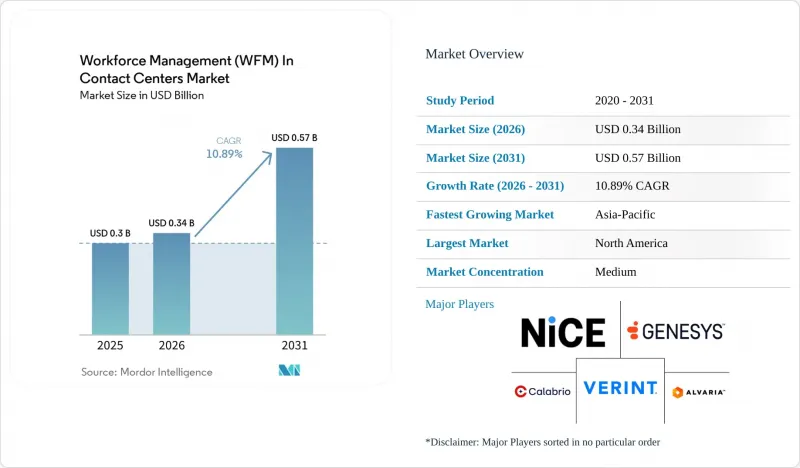
預計到 2025 年,客服中心人力資源管理(WFM) 市場價值為 3 億美元,到 2026 年成長至 3.4 億美元,到 2031 年成長至 5.7 億美元,在預測期(2026-2031 年)內複合年成長率為 10.89%。
本報告按組件(軟體和服務)、部署模式(雲端、本地部署、混合部署)、企業規模(大型企業和中小企業)、最終用戶行業(銀行、金融服務和保險 (BFSI)、IT 和電信、醫療保健、零售和電子商務、旅遊和酒店等)以及地區進行細分。市場預測以美元 (USD) 為單位。
全球客服中心人力資源管理(WFM) 市場趨勢與洞察
實施人工智慧驅動的預測和調度
在客服中心人力資源管理(WFM) 市場,人工智慧主導的預測正逐漸成為核心採購需求,而非採購週期後期可添加的選用功能。據 NICE 稱,客服中心的人工智慧預測和排班可以將預測誤差從傳統的 +/-20% 降低到 +/-5% 至 8%,直接影響人員成本和服務績效。這項改進也改變了規劃團隊的日常工作角色,因為平台可以處理大部分常規建模工作,使分析師能夠將更多時間投入到資料解讀、異常處理和營運決策中。 Verint 表示,其藍圖正與亞馬遜雲端服務 (AWS) 和亞馬遜 Bedrock 保持一致,以支援大規模語言建模工作負載,預計將在未來 24 個月內將客戶預測準確率提高高達 50%。這提高了整個客服中心勞動力管理市場的標準,因為買家不再僅僅期待功能清單的擴展,而是希望獲得實際的準確率提升。 2026 年發表在《國際智慧系統與工程應用期刊》上的一項同行評審研究也表明,即時需求預測和自然語言存取營運數據正在推動勞動力規劃從靜態規劃轉變為持續營運管理。
向雲端原生CCaaS的轉變正在加速。
在客服中心市場,人力資源管理(WFM) 最顯著的成長要素之一是雲端遷移。這是因為 WFM 系統的更換通常與整個客服中心平台的更新同步進行。 NICE 將基於雲端的人力資源管理定位為一種提供人工智慧驅動的預測、排班和日常管理功能並持續更新的手段,這與企業目前對客服中心整體客服中心的勞動力管理領域,買家可以透過更新過時的基礎設施並要求更緊密地整合互動資料、人員配置邏輯和即時自動化功能而獲益。 Aspect Software 和 Five9 於 2026 年 3 月簽署的合作協議表明,供應商如何透過即時座席狀態資料和自動化的日常人員配置調整,將 WFM 與雲端互動平台更緊密地整合。隨著越來越多的公司採用雲端生態系,平台選擇對公司在整個部署生命週期中採取的 WFM 路徑的影響越來越大。
傳統技術棧整合的複雜性
由於許多大型客服中心仍然依賴ACD、WFM工具、QA平台和HR系統之間高度客製化的連接,因此,整合舊有系統仍然是客服中心市場人力資源管理(WFM)面臨的最棘手的障礙之一。 Aspect的雲端遷移指南支援分階段遷移,因為許多組織無法一次遷移所有勞動力流程,否則可能會中斷排班、合規性和報告流程。 NICE也將與預測、排班、日常管理和通路層級規劃的廣泛整合作為其平台的支柱,這反映了買家現在對整合分散業務工作流程的重視程度。困難不僅限於技術層面。傳統規則集通常包含長期有效的加班政策、特定站點的實踐和合規邏輯,這些都需要在新系統中準確複製。這會延遲合約簽訂,並延長整個客服中心勞動力管理市場的實施時間,尤其對於擁有多個地點和業務部門的大型企業而言。因此,如果採購團隊優先考慮部署風險,那麼擁有更強大的連接器、遷移服務和更詳細配置功能的供應商將更具優勢。
細分市場分析
預計到2025年,客服中心勞動力管理(WFM)市場中,軟體將佔68.34%的佔有率,這表明即使在服務需求不斷成長的情況下,平台仍然是支出的主要重點。員工排班和勞動力最佳化佔軟體收入的32.56%,使其成為目前收入組成中最大的軟體子細分市場。勞動力分析、預測和考勤管理仍然十分重要,因為對人工智慧的投資推動了買家對能夠提高計劃準確性並增強主管對營運可見性的工具的興趣。 NICE提供了一套以人工智慧驅動的排班、預測和模擬為核心的客服中心勞動力管理套件,這反映了企業買家目前對軟體層功能的期望。客服中心產業的勞動力管理軟體領域也受益於自助服務存取和更高排班透明度的需求不斷成長,尤其是在混合辦公模式普及導致排班變更頻率增加的情況下。
在客服中心市場中,服務是人力資源管理(WFM) 領域成長最快的細分市場,預計從 2026 年到 2031 年將以 12.34% 的複合年成長率成長。這表明,即使在軟體銷售之後,買家也越來越需要支援。目前,在許多實施案例中,企業需要配置、整合、管治和持續最佳化方面的支持,才能最大限度地發揮其平台的價值。這在大規模流程外包 (BPO) 環境中尤其關鍵,因為這些環境的營運規則複雜,且內部 WFM 專業知識往往分散在多個客戶專案中。 Assembled 於 2025 年 8 月發布的「支援編排」旨在將 AI 代理、人工團隊和 BPO 合作夥伴整合到一個統一的營運視圖中,這表明了一種面向服務的環境,其中實施和營運設計與軟體本身同等重要。隨著客服中心市場的人力資源管理(WFM) 日趨成熟,擁有強大的實施和實施後支援團隊的供應商可能會比僅依賴授權收入的供應商獲得更大的價值。
在2025年的客服中心人力資源管理(WFM)市場中,雲端將佔據63.21%的佔有率,這反映了買家對可擴展交付和快速產品更新的偏好。雲端的吸引力不僅在於減少營運摩擦;與傳統的本地部署環境相比,它還使WFM平台能夠更輕鬆地利用來自客服中心、CRM和HR系統的即時數據。 NICE將基於雲端的人力資源管理定位為更廣泛的營運堆疊的一部分,該堆疊支援在單一環境中進行預測、排班、日常管理和全通路控制。這種架構至關重要,因為客服中心市場的人力資源管理現在依賴更快的發布週期以及與更廣泛的客戶經驗技術堆疊更緊密的整合。從實際角度來看,當企業需要定期進行AI更新並希望分散式團隊更輕鬆地存取系統時,雲端是預設模式。
從2026年到2031年,混合模式的複合年成長率將達到10.92%,成為市場上成長最快的部署模式。這一趨勢反映出,醫療保健、政府和銀行、金融及保險(BFSI)行業的買家仍然需要本地基礎設施來維護部分數據和流程控制,同時盡可能採用雲端分析和規劃邏輯。 Aspect的2025年遷移指南概述了一種分階段的方法,首先遷移不太關鍵的WEM工作負載,然後再遷移核心功能,這印證了混合模式是一種深思熟慮的架構,而不僅僅是一個臨時階段。雖然本地部署工具在高度客服中心的環境中仍然很重要,但剩餘遷移中最具挑戰性的往往進展最慢,因為過時的審計規則、管治模型和內部核准系統難以輕易更改。因此,聯絡中心市場的人力資源管理(WFM)呈現兩極化的趨勢。雖然雲端在整體部署率上領先,但在監管和營運可用性都至關重要的領域,混合模式的成長最為強勁。
區域分析
預計到2025年,北美將佔據客服中心人力資源管理(WFM)市場42.17%的佔有率,成為最大的區域貢獻者。該地區受益於強大的客服中心基礎設施、成熟的採購週期以及對支援勞動力合規性和營運課責的排班記錄的高需求。由於大型企業客服中心和主要供應商的集中,美國仍然是核心市場。同時,加拿大正面臨日益複雜的雙語服務需求,而墨西哥則透過近岸服務業務的擴張來推動成長。在客服中心勞動力管理(WFM)市場,北美的需求受到在不中斷運作中營運的情況下實現傳統環境現代化的需要所驅動,因此,遷移和服務支援在大多數部署中仍然發揮核心作用。
預計到2025年,歐洲將成為全球第二大市場,這主要得益於英國、德國、法國和北歐國家成熟的客服中心營運體系。該地區對勞動力管理的需求強勁,同時法規環境也更為嚴格,這不僅提升了可審計性的重要性,也要求企業投入更多精力來實施人工智慧驅動的功能。因此,西歐買家對能夠平衡資料處理需求和最新預測分析工具的混合架構表現出更大的興趣。這一趨勢對客服中心產業的人力資源管理(WFM)市場具有重大意義,因為當合規性審計成為採購流程的關鍵環節時,擁有區域基礎設施和完善管治的供應商將更具競爭力。
亞太地區是成長最快的地區,預計2026年至2031年的複合年成長率將達到12.14%。這主要得益於印度和菲律賓的持續擴張,這兩個國家對業務流程外包(BPO)的接受度以及「雲端優先」的實踐正在加速推動其普及。該地區許多市場都擁有新的客服中心設施,這使得平台替換和雲端部署相比那些存在大量傳統技術債務的地區更加容易。預計日本、韓國和澳洲將出現企業級需求,尤其是在澳大利亞,員工合規性的複雜性迫使供應商建立更專業的規劃支援系統。為了因應這種環境,Nimbus正在開發客服中心平台,充分考慮當地勞動法和營運法規對產品設計的影響。儘管南美洲、中東和非洲的銷售額仍然相對小規模,但它們仍然是重要的市場,因為近岸業務流程外包活動、政府數位化計畫和服務業務的擴張不斷為客服中心市場的勞動力管理 (WFM) 創造新的機會。
其他好處:
- Excel格式的市場預測(ME)表
- 3個月的分析師支持
目錄
第1章:引言
- 研究假設和市場定義
- 調查範圍
第2章:調查方法
第3章執行摘要
第4章 市場狀況
- 市場概覽
- 市場促進因素
- 擴展向雲端原生 CCaaS 的遷移
- 實施人工智慧驅動的需求預測和排程。
- 全通路和非同步工作負載的複雜性
- 優先考慮代理商的柔軟性和留存率
- 人類與人工智慧代理能力規劃的融合
- WFM 作為編配層,涵蓋 CCaaS、CRM、HR 和 QA。
- 市場限制因素
- 整合遺留技術棧的複雜性
- 資料隱私和演算法管治負擔
- 內部團隊和外部團隊之間的日程安排規則不一致。
- 代理人對白天自動化的抵觸情緒以及對公平性風險的擔憂。
- 產業價值鏈分析
- 監理情勢
- 技術展望
- 宏觀經濟因素對市場的影響
- 波特五力分析
第5章 市場規模與成長預測
- 按組件
- 軟體
- 員工工作日程管理與勞動力最佳化
- 考勤管理
- 勞動力分析與預測
- 休假和缺勤管理
- 任務和執行管理
- 員工自助服務和溝通
- 服務
- 軟體
- 按部署模式
- 雲
- 現場
- 混合
- 按最終用戶公司規模分類
- 大公司
- 小型企業
- 按最終用戶行業分類
- BFSI
- IT/通訊
- 衛生保健
- 零售與電子商務
- 旅遊與飯店
- 政府/公共部門
- 外包客服中心和業務流程外包
- 按地區
- 北美洲
- 美國
- 加拿大
- 墨西哥
- 南美洲
- 巴西
- 阿根廷
- 智利
- 其他南美國家
- 歐洲
- 德國
- 英國
- 法國
- 義大利
- 西班牙
- 其他歐洲國家
- 亞太地區
- 中國
- 日本
- 印度
- 澳洲
- 韓國
- 東南亞
- 其他亞太國家
- 中東
- 沙烏地阿拉伯
- 阿拉伯聯合大公國
- 土耳其
- 其他中東國家
- 非洲
- 南非
- 奈及利亞
- 其他非洲國家
- 北美洲
第6章 競爭情勢
- 市場集中度
- 策略趨勢
- 市佔率分析
- 公司簡介。
- NICE Ltd.
- Genesys Cloud Services, Inc.
- Verint Systems Inc.
- Calabrio, Inc.
- Alvaria, Inc.
- Five9, Inc.
- Talkdesk, Inc.
- Assembled, Inc.
- Playvox, Inc.
- Content Guru Inc.
- Peopleware GmbH
- Eleveo as
- UJET, Inc.
- SESTEK AS
- JaMocha Tech Pvt. Ltd.
- nimbus Trading Co Pty Ltd.
- Nextiva, Inc.
- InVision AG
- Pipkins, Inc.
- ZOOM International sro
第7章 市場機會與未來展望
According to Mordor Intelligence, the workforce management (WFM) in contact centers market was valued at USD 0.30 billion in 2025 and is estimated to grow from USD 0.34 billion in 2026 to USD 0.57 billion by 2031, at a CAGR of 10.89% during the forecast period (2026-2031).
This report is Segmented by Component (Software, and Services), Deployment Model (Cloud, On-Premises, and Hybrid), Enterprise Size (Large Enterprises, and Small and Medium-Sized Enterprises), End-User Industry (BFSI, IT and Telecom, Healthcare, Retail and E-Commerce, Travel and Hospitality, and More), and Geography. The Market Forecasts are Provided in Terms of Value (USD).
Global Workforce Management (WFM) In Contact Centers Market Trends and Insights
AI-Driven Forecasting and Scheduling Adoption
AI-led forecasting has become a core buying requirement in the workforce management (WFM) in contact centers market, rather than an optional feature added late in a procurement cycle. NICE states that AI-based forecasting and scheduling in contact centers can narrow forecasting error from the typical legacy range of +-20% to +-5-8%, thereby directly affecting staffing costs and service performance. That improvement is also changing the day-to-day role of planning teams because the platform handles more of the routine model work, while analysts spend more time on interpretation, exception handling, and operational decisions. Verint linked its roadmap to Amazon Web Services and Amazon Bedrock for large language model workloads, and the company said customers may see up to 50% better forecasting accuracy over the next 24 months. This raises the standard for the wider workforce management market in contact centers, as buyers now expect tangible accuracy gains, not just broader feature lists. A 2026 peer-reviewed study in the International Journal of Intelligent Systems and Applications in Engineering also found that real-time demand prediction and natural-language access to operational data are moving workforce planning away from static planning toward continuous operational control.
Rising Cloud-Native CCaaS Migration
Cloud migration is one of the clearest growth drivers for the workforce management (WFM) in contact centers market, as WFM replacements often occur alongside broader contact center platform renewals. NICE describes cloud-based workforce management as a way to deliver AI-powered forecasting, scheduling, and intraday management with continuous updates, which matches the operating model enterprises now want from broader contact center software. Aspect's 2025 transition guidance also points to phased cloud adoption as a practical route for moving core WFM workloads away from legacy environments without disrupting day-to-day operations. That migration path matters because workforce management in the contact center market benefits when buyers replace outdated infrastructure and seek tighter integration between interaction data, staffing logic, and real-time automation. The March 2026 partnership between Aspect Software and Five9 demonstrated how vendors are tying WFM more closely to cloud interaction platforms through real-time agent-state data and automated intraday staffing adjustments. As more enterprises commit to cloud ecosystems, platform choice increasingly shapes the WFM pathway they follow throughout the deployment lifecycle.
Legacy Stack Integration Complexity
Legacy integration remains one of the most persistent barriers in the workforce management (WFM) in contact centers market because many large contact centers still rely on deeply customized connections between ACDs, WFM tools, QA platforms, and HR systems. Aspect's cloud transition guidance supports phased migration precisely because many organizations cannot move all workforce processes at once without risking disruption to scheduling, adherence, and reporting. NICE also positions its platform around broad integration with forecasting, scheduling, intraday management, and channel-level planning, which reflects how much buyers now care about unifying disconnected operational workflows. The difficulty is not only technical, because legacy rule sets often contain years of overtime policies, site practices, and compliance logic that need to be accurately rebuilt in the new system. That slows deal conversion and extends deployment work across the workforce management in contact centers market, especially in large enterprises with multiple sites and business units. Vendors with stronger connectors, migration services, and deeper configuration are therefore better placed when procurement teams see implementation risk as the main decision point.
Other drivers and restraints analyzed in the detailed report include:
- Omnichannel and Asynchronous Workload Complexity
- Agent Flexibility and Retention Prioritization
- Data Privacy and Algorithmic Governance Burden
For complete list of drivers and restraints, kindly check the Table Of Contents.
Segment Analysis
Software accounted for 68.34% of the workforce management (WFM) in contact centers market in 2025, underscoring that platforms remain the primary focus of spending even as service demand rises. Employee scheduling and labor optimization accounted for 32.56% of software revenue, making it the largest software sub-segment in the current revenue mix. Workforce analytics and forecasting, along with time and attendance management, also remain important, as AI investment is boosting buyer interest in tools that improve planning accuracy and give supervisors better operational visibility. NICE positions its workforce management suite around AI-powered scheduling, forecasting, and simulation for contact centers, which reflects the feature depth enterprise buyers now expect from the software layer. The software side of workforce management in the contact center industry also benefits from growing demand for self-service access and clearer schedule transparency, particularly as hybrid work has made schedule changes more frequent.
Services are the fastest-growing component of the workforce management (WFM) in contact centers market, with a 12.34% CAGR during 2026-2031, indicating that buyers increasingly need help after the software sale. Many deployments now require configuration, integration, governance setup, and ongoing optimization support before enterprises can realize the full value of the platform. This is especially relevant in large BPO environments where operational rules are complex and in-house WFM expertise is often stretched across several client programs. Assembled's August 2025 launch of Support Orchestration, built to balance AI agents, human teams, and BPO partners in a single operating view, points to a service-heavy environment where rollout and operating design matter as much as the software itself. As workforce management (WFM) in the contact center market matures, vendors with strong implementation and post-deployment teams are likely to capture more value than providers that rely solely on license revenue.
Cloud accounted for 63.21% of the workforce management (WFM) in contact centers market in 2025, underscoring buyers' preference for scalable delivery and faster product updates. The appeal of the cloud is not only lower operational friction; it also enables WFM platforms to more easily use real-time data from contact centers, CRM, and HR systems than in older on-premises environments. NICE presents cloud-based workforce management as part of a broader operating stack that supports forecasting, scheduling, intraday management, and omnichannel control in one environment. That architecture matters because workforce management in the contact center market now depends on faster release cycles and closer integration with the wider customer experience technology stack. In practical terms, cloud has become the default model where enterprises want regular AI updates and simpler access for distributed teams.
Hybrid is expanding at a 10.92% CAGR during 2026-2031, which makes it the fastest-growing deployment model in the market. The pattern reflects buyers in healthcare, government, and BFSI that still need some data or process controls to remain on local infrastructure while adopting cloud analytics and planning logic where possible. Aspect's 2025 migration guidance outlined a phased approach that begins with less critical WEM workloads before moving core functions later, supporting the idea that hybrid is a deliberate architecture rather than merely a temporary stage. On-premises tools remain relevant in highly regulated settings, but the hardest remaining migrations are also the slowest because old audit rules, governance models, and internal approval structures do not change quickly. The workforce management (WFM) in contact centers market, therefore, shows a split pattern: cloud leads overall adoption, while hybrid captures the strongest growth, where regulation and operational pragmatism both matter.
Geography Analysis
North America accounted for 42.17% of the workforce management (WFM) in contact centers market share in 2025, making it the largest regional contributor. The region benefits from dense contact center infrastructure, established buying cycles, and high demand for scheduling records that support labor compliance and operational accountability. The United States remains the anchor market because large enterprise contact centers and major vendors are concentrated there, while Canada adds complexity through bilingual service requirements, and Mexico supports growth through expanding nearshore service operations. Within the workforce management (WFM) market in the contact centers market, North American demand is also shaped by the need to modernize legacy environments without disrupting live operations, which keeps migration and service support central to most deployments.
Europe ranked second in 2025, supported by mature contact center operations across the United Kingdom, Germany, France, and the Nordic countries. The region combines strong demand for workforce control with a tighter regulatory environment, which raises the value of auditability while also extending deployment effort for AI-enabled functions. Western European buyers are therefore showing greater interest in hybrid architectures that can balance data handling expectations with access to newer forecasting and analytics tools. This pattern is meaningful for the workforce management (WFM) market in the contact centers market because vendors with regional infrastructure and stronger governance can compete more effectively when compliance reviews are a major part of procurement.
Asia-Pacific is the fastest-growing region, with a 12.14% CAGR during 2026-2031, led by continued expansion in India and the Philippines, where BPO capacity and cloud-first deployment practices support faster adoption. The region benefits from newer contact center estates across many markets, making platform replacement and cloud-based rollouts easier than in regions with greater legacy technical debt. Japan, South Korea, and Australia add enterprise-grade demand, with Australia standing out for workforce compliance complexity that has pushed vendors to build more specialized planning support. Nimbus positions its contact center platform around softphone integration and compliance-focused workforce management for this environment, reflecting how local labor and operating rules can shape product design.CLOUD. South America, the Middle East, and Africa remain smaller in revenue terms, but they remain relevant because nearshore BPO activity, government digitization programs, and expanding service operations continue to create new opportunities for workforce management (WFM) in contact centers market.
- NICE Ltd.
- Genesys Cloud Services, Inc.
- Verint Systems Inc.
- Calabrio, Inc.
- Alvaria, Inc.
- Five9, Inc.
- Talkdesk, Inc.
- Assembled, Inc.
- Playvox, Inc.
- Content Guru Inc.
- Peopleware GmbH
- Eleveo a.s.
- UJET, Inc.
- SESTEK A.S.
- JaMocha Tech Pvt. Ltd.
- nimbus Trading Co Pty Ltd.
- Nextiva, Inc.
- InVision AG
- Pipkins, Inc.
- ZOOM International s.r.o.
Additional Benefits:
- The market estimate (ME) sheet in Excel format
- 3 months of analyst support
TABLE OF CONTENTS
1 INTRODUCTION
- 1.1 Study Assumptions and Market Definition
- 1.2 Scope of the Study
2 RESEARCH METHODOLOGY
3 EXECUTIVE SUMMARY
4 MARKET LANDSCAPE
- 4.1 Market Overview
- 4.2 Market Drivers
- 4.2.1 Rising Cloud-Native CCaaS Migration
- 4.2.2 AI-Driven Forecasting and Scheduling Adoption
- 4.2.3 Omnichannel and Asynchronous Workload Complexity
- 4.2.4 Agent Flexibility and Retention Prioritization
- 4.2.5 Human and AI-Agent Capacity Planning Convergence
- 4.2.6 WFM as the Orchestration Layer Across CCaaS, CRM, HR, and QA
- 4.3 Market Restraints
- 4.3.1 Legacy Stack Integration Complexity
- 4.3.2 Data Privacy and Algorithmic Governance Burden
- 4.3.3 Fragmented Scheduling Rules Across In-House and Outsourced Teams
- 4.3.4 Agent Pushback Against Intraday Automation and Perceived Fairness Risks
- 4.4 Industry Value Chain Analysis
- 4.5 Regulatory Landscape
- 4.6 Technological Outlook
- 4.7 Impact of Macroeconomic Factors on the Market
- 4.8 Porter's Five Forces Analysis
- 4.8.1 Threat of New Entrants
- 4.8.2 Bargaining Power of Suppliers
- 4.8.3 Bargaining Power of Buyers
- 4.8.4 Threat of Substitutes
- 4.8.5 Competitive Rivalry
5 MARKET SIZE AND GROWTH FORECASTS (VALUE)
- 5.1 By Component
- 5.1.1 Software
- 5.1.1.1 Employee Scheduling and Labor Optimization
- 5.1.1.2 Time and Attendance Management
- 5.1.1.3 Workforce Analytics and Forecasting
- 5.1.1.4 Leave and Absence Management
- 5.1.1.5 Task and Execution Management
- 5.1.1.6 Employee Self-service and Communication
- 5.1.2 Services
- 5.1.1 Software
- 5.2 By Deployment Model
- 5.2.1 Cloud
- 5.2.2 On-premises
- 5.2.3 Hybrid
- 5.3 By End-user Enterprise Size
- 5.3.1 Large Enterprises
- 5.3.2 Small and Medium-sized Enterprises
- 5.4 By End-user Industry
- 5.4.1 BFSI
- 5.4.2 IT and Telecom
- 5.4.3 Healthcare
- 5.4.4 Retail and E-commerce
- 5.4.5 Travel and Hospitality
- 5.4.6 Government and Public Sector
- 5.4.7 Outsourced Contact Centers and BPOs
- 5.5 By Geography
- 5.5.1 North America
- 5.5.1.1 United States
- 5.5.1.2 Canada
- 5.5.1.3 Mexico
- 5.5.2 South America
- 5.5.2.1 Brazil
- 5.5.2.2 Argentina
- 5.5.2.3 Chile
- 5.5.2.4 Rest of South America
- 5.5.3 Europe
- 5.5.3.1 Germany
- 5.5.3.2 United Kingdom
- 5.5.3.3 France
- 5.5.3.4 Italy
- 5.5.3.5 Spain
- 5.5.3.6 Rest of Europe
- 5.5.4 Asia-Pacific
- 5.5.4.1 China
- 5.5.4.2 Japan
- 5.5.4.3 India
- 5.5.4.4 Australia
- 5.5.4.5 South Korea
- 5.5.4.6 Southeast Asia
- 5.5.4.7 Rest of Asia-Pacific
- 5.5.5 Middle East
- 5.5.5.1 Saudi Arabia
- 5.5.5.2 United Arab Emirates
- 5.5.5.3 Turkey
- 5.5.5.4 Rest of Middle East
- 5.5.6 Africa
- 5.5.6.1 South Africa
- 5.5.6.2 Nigeria
- 5.5.6.3 Rest of Africa
- 5.5.1 North America
6 COMPETITIVE LANDSCAPE
- 6.1 Market Concentration
- 6.2 Strategic Moves
- 6.3 Market Share Analysis
- 6.4 Company Profiles (includes Global Level Overview, Market Level Overview, Core Segments, Financials as available, Strategic Information, Market Rank/Share, Products and Services, Recent Developments).
- 6.4.1 NICE Ltd.
- 6.4.2 Genesys Cloud Services, Inc.
- 6.4.3 Verint Systems Inc.
- 6.4.4 Calabrio, Inc.
- 6.4.5 Alvaria, Inc.
- 6.4.6 Five9, Inc.
- 6.4.7 Talkdesk, Inc.
- 6.4.8 Assembled, Inc.
- 6.4.9 Playvox, Inc.
- 6.4.10 Content Guru Inc.
- 6.4.11 Peopleware GmbH
- 6.4.12 Eleveo a.s.
- 6.4.13 UJET, Inc.
- 6.4.14 SESTEK A.S.
- 6.4.15 JaMocha Tech Pvt. Ltd.
- 6.4.16 nimbus Trading Co Pty Ltd.
- 6.4.17 Nextiva, Inc.
- 6.4.18 InVision AG
- 6.4.19 Pipkins, Inc.
- 6.4.20 ZOOM International s.r.o.
7 MARKET OPPORTUNITIES AND FUTURE OUTLOOK
- 7.1 White-Space and Unmet-Need Assessment


