


 |
市場調查報告書
商品編碼
2064496
臨床試驗包裝:市場佔有率分析、產業趨勢與統計、成長預測(2026-2031)Clinical Trial Packaging - Market Share Analysis, Industry Trends & Statistics, Growth Forecasts (2026 - 2031) |
||||||

※ 本網頁內容可能與最新版本有所差異。詳細情況請與我們聯繫。
根據 Mordor Intelligence 預測,臨床試驗包裝市場規模預計將在 2025 年達到 40.8 億美元,2026 年達到 44.4 億美元,到 2031 年達到 68.3 億美元,2026 年至 2031 年的複合年成長率為 9.01%。
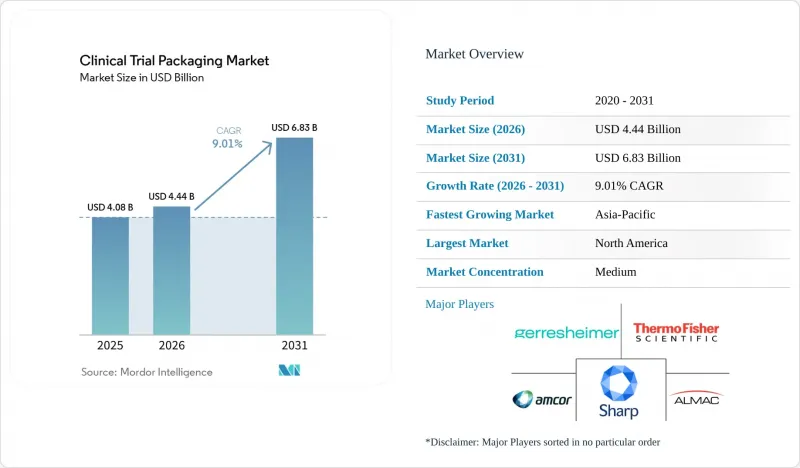
本報告按產品類型(管瓶和安瓿、注射器、泡殼包裝、瓶子、袋子和包裝袋、軟管、小袋等)、材料類型(塑膠、紙和瓦楞紙板、玻璃、金屬)、最終用戶(研究機構、臨床研究機構、製藥公司)和地區(歐洲等)進行細分。市場預測以價值(美元)表示。
全球臨床試驗包裝市場趨勢與洞察
臨床試驗數量增加,研發活性化
從2023年到2025年,由於企業補充研發管線、應對生物相似藥的壓力以及資助新治療方法的首次人體試驗,贊助商的研發預算保持高位。試驗活動的增加直接影響臨床試驗包裝市場,因為每個試驗階段都需要各自的標籤、盲法、課責和運輸流程。試驗方案的變更進一步增加了需求,因為試驗期間的方案變更可能需要對已生產的庫存進行重新貼標和重新包裝。據Clinigen公司稱,他們的按需包裝模式可實現從美國工廠48小時內出貨,並從歐盟工廠72小時內出貨。這顯示速度不再是小眾的加值服務,而是如今的標準服務。在英國,2025年「首次人體試驗」的申請數量較去年同期增加5%,顯示更廣泛的研究基礎正被整合到包裝工作流程中。
生物製藥和注射藥物的研發日益增多
目前,超過一半的I期至III期臨床試驗集中在注射劑型,並且隨著生物製藥、生物相似藥和複雜抗體計畫在開發平臺中佔據越來越大的佔有率,這一比例還在不斷上升。這種轉變對臨床試驗包裝市場來說是一個利好因素,因為與許多口服藥物相比,注射劑對萃取物/洗脫液、防潮和劑型需要更嚴格的控制。 VuRoyal強調,環烯烴聚合物注射器在高pH值生物製藥領域的應用日益廣泛,因為這些系統有助於避免玻璃分層和與矽油相互作用等問題。 SCHOTT Pharma報告稱,受用於注射生物製藥的預填充玻璃注射器需求的推動,其藥物輸送系統業務在2026年上半年的銷售額達到2.018億歐元(2.28億美元)。此外,由於安慰劑和活性藥物通常需要各自的掩蔽和二級包裝才能在盲法生物製藥試驗中看起來相同,因此對照品的控制變得更加複雜。
小批量客製化包裝高成本
小批量包裝專案在早期申辦方的單位經濟效益方面面臨挑戰,因為固定的品管和放行核准成本與生產規模不成比例。 2025年4月,《合約製藥》(Contract Pharma)指出,基於大規模商業生產的法規對小批量生產商,尤其是那些沒有模組化潔淨室、機器人灌裝或一次性使用系統的生產商來說,負擔過重。在先進醫療領域,這項挑戰更為突出,因為即使目標患者只有幾十人,驗證、穩定包裝和合格的放行核准也可能占到總宣傳活動的很大一部分。這種壓力不僅會延遲試驗的啟動,還會導致一些申辦者縮減包裝規模,從而增加後續方案偏離的風險。因此,儘管臨床試驗包裝市場持續成長,但缺乏高效小批量生產系統的供應商面臨的利潤環境遠比表面需求數據所顯示的更為嚴峻。
細分市場分析
截至2025年,注射器將佔臨床試驗包裝市場的26.34%,這反映了腸外生技藥品的強勁市場地位以及預填充製劑日益普及,後者可減少院內和居家給藥過程中的用藥錯誤。臨床試驗包裝市場仍然高度依賴注射器製劑,以確保藥物隨時可用、劑量控制,並在盲法研究中實現清晰的責任追溯。管瓶和安瓿瓶是第二大產品系列,尤其是在冷凍乾燥生物製藥、疫苗和腫瘤研究領域,這些領域仍普遍採用現場復溶。泡殼包裝在口服腫瘤和中樞神經系統計畫中也持續發揮重要作用,因為其單一劑量結構有助於醫療機構團隊進行防篡改,並便於患者追蹤。
預計試劑盒和包裝將以9.73%的複合年成長率(CAGR)實現最快成長,從2026年到2031年,這表明臨床試驗包裝市場正從單一初級容器轉向完整的、可直接用於試驗的組件。這些組件將藥物、給藥裝置、使用說明和回收材料整合到一個面向患者的單位中,通常需要經過驗證的運輸可行性,以便透過宅配方式進行運輸。 VuRoyal指出,在分散式供應項目中,對這些運輸方式進行ISTA 7D或同等檢驗的要求越來越高,這提高了二級包裝設計的技術價值。賽默飛世爾科技表示,其位於賓州森特瓦利的臨床試驗創新實驗室正在開發具有即時溫度和GPS監控功能的智慧包裝,用於分散式試劑盒,這表明供應商已開始將資料收集功能融入其包裝工作流程中。
區域分析
2025年,北美佔據了臨床試驗包裝市場38.56%的佔有率。這得歸功於眾多贊助公司、已建立的符合cGMP標準的臨床試驗包裝能力以及完善的低溫運輸基礎設施。此外,美國明確了臨床實驗藥物直接配送給患者的監管要求,也推動了該地區臨床試驗包裝市場的發展,擴大了宅配的適用範圍。 2025年9月,Almac集團完成了其在賓夕法尼亞州的第一階段擴建計劃,新增了36,100平方英尺的倉庫空間和76台超低溫冷凍庫,可提供-60 度C至-80 度C的超低溫存儲。 PCI Pharma Services也承諾在美國投資超過10億美元,用於建造無菌灌裝和包裝以及藥品和醫療設備生產能力。其中包括位於新罕布夏州貝德福德的符合GMP標準的管瓶和冷凍乾燥生產線,該生產線已於2026年5月投入運作。
到2025年,歐洲將佔據臨床試驗包裝市場第二大佔有率,其中德國、法國和英國將成為包裝、標籤和盲法活動的主要中心。在英國,修訂後的臨床試驗法規(包括I期試驗的14天審查途徑)於2026年4月28日生效;歐洲藥品管理局(EMA)則於2025年7月23日實施了ICH E6(R3)指引。歐盟GMP附件13和歐盟臨床試驗法規繼續推動對專業標籤和盲法服務的需求,因為申辦者必須降低盲法產品標籤錯誤的風險。 2026年1月,肖特製藥推出了「EVERIC lyo」及其用於光敏凍乾抗體藥物複合體(ADC)的琥珀色管瓶。該產品旨在滿足歐盟、美國和日本的光透射率要求。
預計到2031年,亞太地區臨床試驗包裝市場將以10.54%的複合年成長率成長,成為預測期內成長最快的區域叢集。這一成長主要得益於中國國內CDMO(合約研發生產機構)的擴張、印度CRO(合約研究機構)業務的拓展、韓國在生技藥品和抗體藥物複合體(ADC)生產中的作用,以及日本對自行注射和居家照護包裝的需求。 TPC市場研究公司透過Chem-Station發布的報告顯示,日本醫藥容器和包裝材料市場預計將在2024年達到2,239億日圓(15億美元),並在2025年達到2276.5億日圓(15.3億美元),其中預填充式注射器和自動注射器的成長最為顯著。中國預計將佔全球細胞和基因療法臨床試驗的30%以上,這將推動對本地低溫包裝和經驗證的低溫運輸組裝的需求成長。三星生物製劑正藉由「Bio Japan 2025」計畫加強與日本製藥公司的夥伴關係,這表明製造地與全球臨床供應鏈之間的連結將進一步加強。南美、中東和非洲仍然是最小的區域市場,巴西和南非是主要的試驗地點,但進口許可的摩擦和薄弱的低溫運輸基礎設施限制了其更廣泛的應用。
其他好處:
- Excel格式的市場預測(ME)表
- 3個月的分析師支持
目錄
第1章:引言
- 研究假設和市場定義
- 調查範圍
第2章:調查方法
第3章執行摘要
第4章 市場狀況
- 市場概覽
- 市場促進因素
- 臨床試驗數量增加,研發活性化。
- 生物製藥和注射藥物研發的擴展
- 擴展分散式和病患主導的臨床試驗模式
- 增加外包給綜合臨床供應夥伴
- ICH E6 (R3) 可追溯性和盲法要求
- 加速細胞和基因療法的臨床試驗
- 市場限制因素
- 小批量客製化包裝高成本
- 各國標籤和進口法規有差異
- 危險物質和逆向物流的限制
- 遵守歐盟運輸和包裝法規以及與包裝數據相關的負擔
- 產業價值鏈分析
- 監理情勢
- 技術展望
- 波特五力分析
第5章 市場規模與成長預測
- 依產品類型
- 管瓶和安瓿
- 注射器
- 吸塑包裝
- 瓶子
- 袋子和小袋
- 管子
- 小袋
- 其他產品類型
- 材料類型
- 塑膠
- 玻璃
- 金屬
- 造紙和瓦楞紙板用纖維
- 最終用戶
- 研究所
- 臨床研究機構
- 製藥公司
- 按地區
- 北美洲
- 美國
- 加拿大
- 墨西哥
- 南美洲
- 巴西
- 阿根廷
- 其他南美國家
- 歐洲
- 德國
- 英國
- 法國
- 義大利
- 西班牙
- 俄羅斯
- 其他歐洲國家
- 亞太地區
- 中國
- 日本
- 韓國
- 印度
- 澳洲和紐西蘭
- 其他亞太國家
- 中東和非洲
- 中東
- 沙烏地阿拉伯
- 阿拉伯聯合大公國
- 土耳其
- 其他中東國家
- 非洲
- 南非
- 奈及利亞
- 其他非洲國家
- 中東
- 北美洲
第6章 競爭情勢
- 市場集中度
- 策略趨勢
- 市佔率分析
- 公司簡介
- Almac Group Limited
- Sharp Services, LLC
- Gerresheimer AG
- Amcor plc
- Thermo Fisher Scientific Inc.
- Clinigen Limited
- PCI Pharma Services
- Bilcare Limited
- Piramal Pharma Limited
- Myonex, Inc.
- BAP Pharma Ltd.
- Corden Pharma International GmbH
- West Pharmaceutical Services, Inc.
- SCHOTT Pharma AG & Co. KGaA
- Nipro Corporation
- Stevanato Group SpA
- NextPharma Technologies Holding Limited
第7章 市場機會與未來展望
According to Mordor Intelligence, the clinical trial packaging market size is projected to be USD 4.08 billion in 2025, USD 4.44 billion in 2026, and reach USD 6.83 billion by 2031, growing at a CAGR of 9.01% from 2026 to 2031.
This report is Segmented by Product Type (Vials and Ampoules, Syringes, Blister Packs, Bottles, Bags and Pouches, Tubes, Sachets, and More), Material Type (Plastic, Paper and Corrugated Fiber, Glass, and Metal), End User (Research Laboratories, Clinical Research Organization, and Drug Manufacturing Companies), and Geography (Europe, and More). The Market Forecasts are Provided in Terms of Value (USD).
Global Clinical Trial Packaging Market Trends and Insights
Growing Clinical Trial Volumes and R&D Intensity
Sponsor R&D budgets stayed elevated across 2023 to 2025 as companies refilled pipelines, responded to biosimilar pressure, and funded first-in-human work in newer modalities. That rise in trial activity directly affects the clinical trial packaging market, as each study phase requires its own labeling, blinding, accountability, and release process. Trial amendments add another layer of demand, since mid-study protocol changes can force relabeling or repackaging of inventory that has already been produced. Clinigen reported that its on-demand packaging model ships within 48 hours from U.S. facilities and within 72 hours from EU facilities, which shows how speed has become a standard service expectation rather than a niche premium offering. The UK also saw a 5% rise in first-in-human trial applications in 2025 compared with the prior year, suggesting a broader study base entering packaging workflows.
Rising Biologics and Injectable Drug Development
More than half of Phase I to Phase III clinical trials now focus on parenteral formulations, and that mix has been moving upward as biologics, biosimilars, and complex antibody programs take a larger share of development pipelines. The clinical trial packaging market benefits from that shift because injectable therapies need more control over extractables, leachables, moisture protection, and dose presentation than many oral drugs. VuRoyal highlighted the growing use of cyclic olefin polymer syringe formats for high-pH biologics, as these systems help avoid glass delamination and silicone-oil interaction issues. SCHOTT Pharma reported H1 2026 Drug Delivery Systems revenue of EUR 201.8 million (USD 228 million), supported by demand for prefillable glass syringes used in injectable biologics. Comparator management adds further complexity because placebo and active products often require custom masking and secondary packaging to appear identical during blinded biologic studies.
High Cost of Small-Batch Customized Packaging
Small-batch packaging campaigns incur fixed quality and release costs that do not scale with volume, making unit economics difficult for early-stage sponsors. Contract Pharma noted in April 2025 that regulations built around large commercial output create disproportionate burdens for small-batch operations, especially for companies that lack modular cleanrooms, robotic filling, or single-use systems. The challenge becomes sharper in advanced therapies because validation, stability packaging, and qualified person release can consume a large share of total campaign cost, even when only dozens of patients are being served. This pressure can delay study activation and also lead some sponsors to narrow the packaging scope, increasing the risk of protocol deviation later. The clinical trial packaging market, therefore, continues to grow, but providers without efficient small-batch systems face a tougher margin environment than headline demand numbers suggest.
Other drivers and restraints analyzed in the detailed report include:
- Expansion of Decentralized and Direct-To-Patient Trial Models
- Increasing Outsourcing to Integrated Clinical Supply Partners
- Fragmented Country-Level Labeling and Import Rules
For complete list of drivers and restraints, kindly check the Table Of Contents.
Segment Analysis
Syringes held 26.34% of the clinical trial packaging market share in 2025, reflecting the strong presence of parenteral biologics and the wider use of prefilled formats that reduce dosing errors in both site-based and home-use settings. The clinical trials packaging market continues to rely heavily on syringe formats because they support ready-to-administer dosing, controlled presentation, and easier accountability in blinded studies. Vials and ampoules formed the second-largest product group, especially in lyophilized biologics, vaccines, and oncology studies, where reconstitution at the point of care remains standard. Blister packs also remained relevant for oral oncology and central nervous system programs because their unit-dose structure helps site teams manage tamper evidence and patient-level accountability.
Kits and packs are projected to record the fastest growth at a 9.73% CAGR from 2026 to 2031, indicating that the clinical trials packaging market is moving beyond individual primary containers toward complete study-ready assemblies. These formats combine the drug product, administration device, instructions for use, and return materials into a single patient-facing unit and often require validated transit performance for home delivery routes. VuRoyal stated that decentralized supply programs increasingly require ISTA 7D or equivalent testing for such shipments, which raises the technical value of secondary packaging design. Thermo Fisher Scientific said its clinical trials innovation lab in Center Valley, Pennsylvania has been developing smart packaging with real-time temperature and GPS monitoring for decentralized kit formats, which shows how providers are adding data capture into packaging workflows.
Geography Analysis
North America held 38.56% of the clinical trial packaging market share in 2025, supported by a dense sponsor base, established cGMP clinical packaging capacity, and strong cold-chain infrastructure. The clinical trials packaging market in the region also benefited from clearer U.S. regulatory treatment of direct-to-patient investigational product dispensing, which widened the addressable use cases for home-delivery formats. Almac Group completed phase one of its Pennsylvania expansion in September 2025, adding 36,100 sq. ft. of warehouse space and ultra-low temperature storage for 76 freezers at -60°C to -80°C. PCI Pharma Services also announced investment commitments totaling above USD 1 billion in U.S. sterile fill-finish and drug-device capabilities, including a GMP-ready vial and lyophilization line in Bedford, New Hampshire, commissioned in May 2026.
Europe held the second-largest share of the clinical trials packaging market in 2025, with Germany, France, and the UK as the main centers for packaging, labeling, and blinding activities. The UK introduced reformed clinical trial regulations effective April 28, 2026, including a 14-day assessment route for Phase I studies, while the European Medicines Agency implemented ICH E6(R3) from July 23, 2025. EU GMP Annex 13 and the EU Clinical Trial Regulation continue to support demand for specialized labeling and blinding services because sponsors must limit mislabeling risk in blinded products. SCHOTT Pharma launched EVERIC lyo and amber vials in January 2026 for light-sensitive lyophilized antibody-drug conjugates, and the product was designed to meet light transmission requirements in the EU, the U.S., and Japan.
Asia-Pacific is projected to expand at a 10.54% CAGR through 2031 in the clinical trials packaging market, making it the fastest-growing regional cluster in the forecast period. Growth is being driven by China's larger domestic CDMO base, India's expanding CRO footprint, South Korea's role in biologic and antibody-drug conjugate manufacturing, and Japan's demand for self-injection and home-care packaging. TPC Marketing Research reported through Chem-Station that Japan's pharmaceutical container and packaging material market reached JPY 223.9 billion (USD 1.5 billion) in 2024 and was projected to reach JPY 227.65 billion (USD 1.53 billion) in 2025, with prefilled syringes and autoinjectors posting the strongest gains. China is projected to account for more than 30% of global cell and gene therapy clinical trials, which is lifting demand for local cryogenic packaging and validated cold-chain kit assembly. Samsung Biologics used Bio Japan 2025 to deepen partnerships with Japanese pharmaceutical companies, which points to tighter links between Asia-Pacific manufacturing and global clinical supply chains. South America and the Middle East and Africa remained the smallest regional pool, with Brazil and South Africa acting as the main trial locations while import-license friction and weaker cold-chain infrastructure limited broader scale.
- Almac Group Limited
- Sharp Services, LLC
- Gerresheimer AG
- Amcor plc
- Thermo Fisher Scientific Inc.
- Clinigen Limited
- PCI Pharma Services
- Bilcare Limited
- Piramal Pharma Limited
- Myonex, Inc.
- BAP Pharma Ltd.
- Corden Pharma International GmbH
- West Pharmaceutical Services, Inc.
- SCHOTT Pharma AG & Co. KGaA
- Nipro Corporation
- Stevanato Group S.p.A.
- NextPharma Technologies Holding Limited
Additional Benefits:
- The market estimate (ME) sheet in Excel format
- 3 months of analyst support
TABLE OF CONTENTS
1 INTRODUCTION
- 1.1 Study Assumptions and Market Definition
- 1.2 Scope of the Study
2 RESEARCH METHODOLOGY
3 EXECUTIVE SUMMARY
4 MARKET LANDSCAPE
- 4.1 Market Overview
- 4.2 Market Drivers
- 4.2.1 Growing Clinical Trial Volumes and R&D Intensity
- 4.2.2 Rising Biologics and Injectable Drug Development
- 4.2.3 Expansion of Decentralized and Direct-to-Patient Trial Models
- 4.2.4 Increasing Outsourcing to Integrated Clinical Supply Partners
- 4.2.5 ICH E6(R3) Traceability and Blinding Requirements
- 4.2.6 Acceleration of Cell and Gene Therapy Trials
- 4.3 Market Restraints
- 4.3.1 High Cost of Small-Batch Customized Packaging
- 4.3.2 Fragmented Country-Level Labeling and Import Rules
- 4.3.3 Dangerous-Goods and Reverse-Logistics Constraints
- 4.3.4 EU Transport-Pack Compliance and Packaging Data Burden
- 4.4 Industry Value Chain Analysis
- 4.5 Regulatory Landscape
- 4.6 Technological Outlook
- 4.7 Porter's Five Forces Analysis
- 4.7.1 Threat of New Entrants
- 4.7.2 Bargaining Power of Suppliers
- 4.7.3 Bargaining Power of Buyers
- 4.7.4 Threat of Substitutes
- 4.7.5 Competitive Rivalry
5 MARKET SIZE AND GROWTH FORECASTS (VALUE)
- 5.1 By Product Type
- 5.1.1 Vials and Ampoules
- 5.1.2 Syringes
- 5.1.3 Blister Packs
- 5.1.4 Bottles
- 5.1.5 Bags and Pouches
- 5.1.6 Tubes
- 5.1.7 Sachets
- 5.1.8 Other Product Types
- 5.2 By Material Type
- 5.2.1 Plastic
- 5.2.2 Glass
- 5.2.3 Metal
- 5.2.4 Paper and Corrugated Fiber
- 5.3 By End User
- 5.3.1 Research Laboratories
- 5.3.2 Clinical Research Organizations
- 5.3.3 Drug Manufacturing Companies
- 5.4 By Geography
- 5.4.1 North America
- 5.4.1.1 United States
- 5.4.1.2 Canada
- 5.4.1.3 Mexico
- 5.4.2 South America
- 5.4.2.1 Brazil
- 5.4.2.2 Argentina
- 5.4.2.3 Rest of South America
- 5.4.3 Europe
- 5.4.3.1 Germany
- 5.4.3.2 United Kingdom
- 5.4.3.3 France
- 5.4.3.4 Italy
- 5.4.3.5 Spain
- 5.4.3.6 Russia
- 5.4.3.7 Rest of Europe
- 5.4.4 Asia-Pacific
- 5.4.4.1 China
- 5.4.4.2 Japan
- 5.4.4.3 South Korea
- 5.4.4.4 India
- 5.4.4.5 Australia and New Zealand
- 5.4.4.6 Rest of Asia-Pacific
- 5.4.5 Middle East and Africa
- 5.4.5.1 Middle East
- 5.4.5.1.1 Saudi Arabia
- 5.4.5.1.2 United Arab Emirates
- 5.4.5.1.3 Turkey
- 5.4.5.1.4 Rest of Middle East
- 5.4.5.2 Africa
- 5.4.5.2.1 South Africa
- 5.4.5.2.2 Nigeria
- 5.4.5.2.3 Rest of Africa
- 5.4.5.1 Middle East
- 5.4.1 North America
6 COMPETITIVE LANDSCAPE
- 6.1 Market Concentration
- 6.2 Strategic Moves
- 6.3 Market Share Analysis
- 6.4 Company Profiles (includes Global level Overview, Market level overview, Core Segments, Financials as available, Strategic Information, Market Rank/Share for key companies, Products and Services, and Recent Developments)
- 6.4.1 Almac Group Limited
- 6.4.2 Sharp Services, LLC
- 6.4.3 Gerresheimer AG
- 6.4.4 Amcor plc
- 6.4.5 Thermo Fisher Scientific Inc.
- 6.4.6 Clinigen Limited
- 6.4.7 PCI Pharma Services
- 6.4.8 Bilcare Limited
- 6.4.9 Piramal Pharma Limited
- 6.4.10 Myonex, Inc.
- 6.4.11 BAP Pharma Ltd.
- 6.4.12 Corden Pharma International GmbH
- 6.4.13 West Pharmaceutical Services, Inc.
- 6.4.14 SCHOTT Pharma AG & Co. KGaA
- 6.4.15 Nipro Corporation
- 6.4.16 Stevanato Group S.p.A.
- 6.4.17 NextPharma Technologies Holding Limited
7 MARKET OPPORTUNITIES AND FUTURE OUTLOOK
- 7.1 White-Space and Unmet-Need Assessment

 臨床試驗包裝市場:2026-2032年全球市場預測(依包裝類型、試驗階段、劑型、容器類型、材料及最終用戶分類)
 臨床試驗包裝市場規模、佔有率、成長率及全球產業分析:按類型、應用和地區的洞察,2026-2034年的預測
 臨床試驗包裝市場規模、佔有率和成長分析(按產品類型、材料類型、最終用戶和地區分類)-2026-2033年產業預測
 美國臨床實驗試驗包裝市場規模、佔有率和趨勢分析報告:按材料、產品和最終用途、細分市場預測、主要企業和競爭分析,2025-2030 年臨床試驗包裝市場規模、佔有率、趨勢分析報告:依材料、產品、最終用途、地區、細分市場預測,2025-2030全球臨床試驗包裝市場規模(按包裝類型、材料類型、最終用戶、區域範圍)預測至 2025 年
 臨床試驗包裝市場機會、成長動力、產業趨勢分析及 2025 - 2034 年預測