


 |
市場調查報告書
商品編碼
2064495
印刷紙盒:市場佔有率分析、產業趨勢與統計、成長預測(2026-2031)Printed Cartons - Market Share Analysis, Industry Trends & Statistics, Growth Forecasts (2026 - 2031) |
||||||

※ 本網頁內容可能與最新版本有所差異。詳細情況請與我們聯繫。
據 Mordor Intelligence 稱,2025 年印刷紙盒市場規模為 4,176.1 億美元,預計從 2026 年到 2031 年將以 6.19% 的複合年成長率成長,到 2031 年達到 5987.1 億美元。
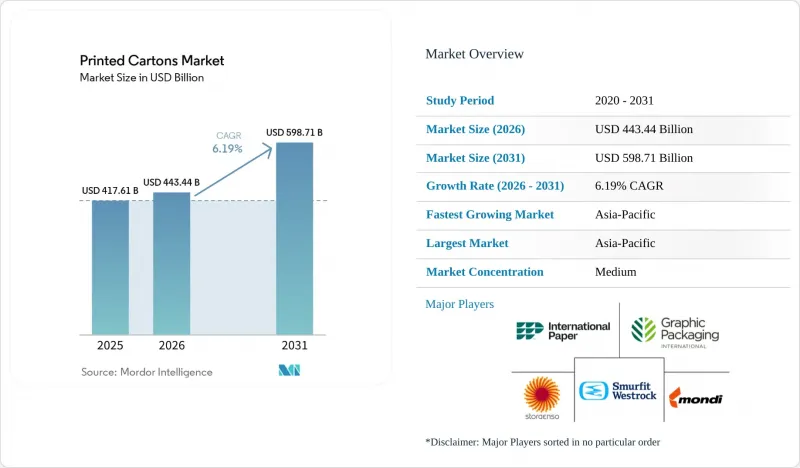
本報告按產品類型(折疊紙盒、印刷紙盒、硬紙盒)、印刷技術(膠印、柔版印刷、數位印刷、凹版印刷及其他)、最終用戶(食品飲料、家居及工業產品、個人護理及化妝品、煙草及其他)和地區進行細分。市場預測以美元計價。
全球印刷紙盒市場趨勢與洞察
從塑膠包裝過渡到可回收纖維包裝
印刷紙盒市場正經歷從塑膠包裝轉變為纖維包裝結構帶來的最大推動力。在歐洲,預計到2025年,紙張和瓦楞紙板的回收率將達到82%,這將改善再生纖維的供應,並在許多瓦楞紙板應用中縮小與原生材料的成本差距。歐盟的《包裝和包裝廢棄物條例》已於2025年2月生效,並將於2026年8月開始實施,這將為品牌商帶來越來越大的壓力,促使他們將可回收包裝推向市場。這種轉變不僅僅是材料的替代,因為品牌商們認知到,與許多塑膠替代品相比,印刷纖維紙盒具有更優異的印刷品質和貨架可見性。 Gru-Bell計劃在2027年將其所有起司獨立包裝全部更換為可折疊紙盒,每年減少4200噸塑膠用量,這表明永續性舉措正在推動市場對印刷可折疊紙盒的顯著且顯而易見的需求。
藥品序列化和防篡改包裝盒的要求
印刷紙盒市場也受惠於醫藥法令遵循,這些法規將瓦楞紙包裝提升到一個技術含量更高、更具連續性的類別。在美國,《藥品安全追蹤法案》(DSCSA) 的要求推動了對能夠支持唯一標識和可靠印刷定位的瓦楞紙板的需求,以滿足受監管包裝的要求。在歐洲,處方藥紙盒必須具有唯一識別碼和防篡改功能,這推動了對紙板品質穩定、加工精度高和印刷性能可靠的需求。這些法規迫使加工商轉向數位化和混合工作流程,因為醫藥包裝的合約維護與處理可變數據的能力密切相關。因此,醫藥紙盒面臨更高的技術要求和更長的認證週期,這支撐了印刷紙盒市場的高價位和更穩定的需求。
原料和能源成本波動
原料和能源價格上漲仍然是印刷紙盒市場加工商面臨的最緊迫壓力。 2026年第一季,北美箱板紙價格每噸淨上漲50美元,生產商計劃在2026年6月進一步提價,漲幅在每噸50至70美元之間。在歐洲,天然氣價格在2026年初超過每兆瓦時68歐元(每兆瓦時77美元),推高了全部區域的紙板生產成本。由於缺乏長期紙漿合約、現場生產能力或能源避險等保護措施,非一體化加工商承受的壓力最大。這種壓力正在加速印刷紙盒市場的整合,因為小規模企業更難在不犧牲利潤率或客戶佔有率的情況下承受反覆的成本波動。
細分市場分析
到2025年,折疊紙盒將佔印刷紙盒市場43.36%的佔有率,顯著超越瓦楞紙板和硬紙盒,成為最大的產品類型。其主導地位源自於折疊紙盒兼具印刷品質、可回收性和結構柔軟性等優點,使其適用於食品、藥品、化妝品以及眾多其他消費品應用。在印刷紙盒市場中,折疊紙盒被用作醫療保健和美容領域的初級包裝、食品和飲料領域的二級包裝以及全通路分銷的零售包裝。預計到2031年,該細分市場將以6.84%的複合年成長率成長,成為目前市場結構中規模最大且成長最快的類別。這一趨勢反映了整個印刷紙盒市場向單一材料纖維包裝的廣泛轉變、零售店展示效果的提升以及日益複雜的藥品包裝規格。
瓦楞紙箱在大批量和工業應用中仍然扮演著核心角色,在這些應用中,抗壓性、承載能力和成本控制至關重要。此外,不斷擴展的電子商務網路也惠及印刷紙箱供應商不斷成長的潛在基本客群,尤其是在亞太和南美地區,主要得益於小包裹處理量和倉儲業務的成長。雖然硬紙箱在銷售上仍然是最小的類別,但它們在高階化妝品、頂級烈酒和高階電子產品等領域仍然佔據著重要地位,其卓越的質感和結構剛性使其價格更高。不同產品類型之間的競爭格局也在改變。微瓦楞瓦楞紙板正在蠶食先前由折疊紙箱主導的展示和商店包裝市場。這種角色重疊迫使印刷紙箱行業的加工商不僅要在銷售上競爭,還要在設計能力、基材選擇和印刷機柔軟性等方面展開競爭。
區域分析
預計到2025年,亞太地區將佔據印刷紙盒市場39.14%的佔有率,並在2031年之前以7.13%的複合年成長率成長,成為規模最大且成長最快的區域市場。中國仍然是核心市場,因為針對一次性塑膠的法規推動了零售和電商通路對可折疊瓦楞紙板和瓦楞紙板製品的需求。主要本土供應商產能的提升也表明,國內需求不僅透過短期貿易流量得到滿足,也透過長期供應得到保障。印度是另一個主要的成長要素,有組織的零售業、日常消費品(FMCG)的擴張以及包裝法規的完善,促使更多品牌所有者轉向紡織品包裝。日本、韓國、澳洲和紐西蘭的需求各有特色,主要集中在高價值瓦楞紙板、數位印刷技術的應用以及支援可追溯性和高階品牌展示的包裝形式。
北美和歐洲合計是除亞太地區外印刷紙盒市場最大的價值來源。在北美,履約的成長、零售商日益嚴格的包裝規格以及對可進行序列化和防篡改包裝的藥品紙盒的需求,正在推動市場發展。歐洲的市場前景則受到《塑膠包裝法規》(PPWR) 和生產者延伸責任制 (EPR) 等可回收性法規的影響,這些法規和製度日益將包裝設計與生產者的成本結果掛鉤。英國將於 2026 年至 2027 年間分階段實施的廢棄物處理費制度表明,紙盒設計決策正迅速從一種可選的永續性選擇轉變為一項財務決策。德國憑藉其規模、對回收的承諾以及與跨國包裝買家的聯繫,仍然是重要的樞紐,但東歐低成本加工中心在注重成本的生產中的重要性日益凸顯。
南美洲和中東及非洲地區雖然整體規模較小,但由於區域產能擴張和特定品類成長的潛力,仍是印刷紙盒市場的重要策略區域。巴西憑藉其食品飲料出口、有組織的零售業發展以及日常消費品(FMCG)包裝的廣泛需求,支撐著南美洲的需求。 Smurfit Westrock 於 2026 年 3 月收購厄瓜多爾的 Cartomanabi 公司,表明主要供應商仍將南美洲視為瓦楞紙板行業充滿活力的成長平台。在中東及非洲地區,海灣國家正在投資建造現代化、零售包裝,而非洲部分地區由於藥品可追溯性和合規性要求,對高規格瓦楞紙箱的需求也在不斷成長。
其他福利
- Excel格式的市場預測(ME)表
- 3個月的分析師支持
目錄
第1章:引言
- 研究假設和市場定義
- 調查範圍
第2章:調查方法
第3章執行摘要
第4章 市場狀況
- 市場概覽
- 市場促進因素
- 從塑膠包裝過渡到可回收纖維包裝
- 對優質化和常溫保存品牌的需求
- 電子商務和全通路對二級包裝的需求
- 藥品序列化和防篡改包裝盒的要求
- 不含 PFAS 的阻隔板的創新拓展了其在食品應用領域的可能性。
- SKU 數量的增加推動了短交貨期數位紙箱的採用。
- 市場限制因素
- 原料和能源成本波動
- 與軟包裝的競爭
- 對難以回收的建築物進行生產者責任延伸費調整措施。
- 阻隔塗層認證與可回收性之間的權衡
- 產業價值鏈分析
- 監理情勢
- 技術展望
- 波特五力分析
第5章 市場規模與成長預測
- 依產品類型
- 折疊紙箱
- 印刷紙箱
- 硬紙箱
- 透過印刷技術
- 膠印
- 柔版印刷
- 數位印刷
- 凹版印刷
- 其他印刷技術
- 按最終用戶行業分類
- 飲食
- 醫療保健/製藥
- 個人護理和化妝品
- 電氣和電子設備
- 家用物品/工業產品
- 菸草
- 電子商務與零售包裝
- 其他
- 按地區
- 北美洲
- 美國
- 加拿大
- 墨西哥
- 南美洲
- 巴西
- 阿根廷
- 其他南美國家
- 歐洲
- 德國
- 英國
- 法國
- 義大利
- 西班牙
- 俄羅斯
- 其他歐洲國家
- 亞太地區
- 中國
- 日本
- 韓國
- 印度
- 澳洲和紐西蘭
- 其他亞太國家
- 中東和非洲
- 中東
- 沙烏地阿拉伯
- 阿拉伯聯合大公國
- 土耳其
- 其他中東國家
- 非洲
- 南非
- 奈及利亞
- 其他非洲地區
- 中東
- 北美洲
第6章 競爭情勢
- 市場集中度
- 策略趨勢
- 市佔率分析
- 公司簡介
- Smurfit Westrock plc
- Graphic Packaging Holding Company
- International Paper Company
- Mayr-Melnhof Karton AG
- Stora Enso Oyj
- Mondi plc
- Huhtamaki Oyj
- Rengo Co., Ltd.
- Nippon Paper Industries Co., Ltd.
- Oji Holdings Corporation
- Parksons Packaging Ltd.
- TCPL Packaging Limited
- Sonoco Products Company
- Edelmann GmbH
- Colbert Packaging Corporation
- Keystone Folding Box Co., Inc.
第7章 市場機會與未來展望
According to Mordor Intelligence, the printed cartons market size was USD 417.61 billion in 2025 and is forecast to reach USD 598.71 billion by 2031 at a CAGR of 6.19% during 2026-2031.
This report is Segmented by Product Type (Folding Cartons, Printed Corrugated Cartons, and Rigid Setup Cartons), Printing Technology (Lithographic Printing, Flexographic Printing, Digital Printing, Gravure Printing, and More), End-User (Food and Beverage, Household and Industrial Goods, Personal Care and Cosmetics, Tobacco, and More), and Geography. The Market Forecasts are Provided in Terms of Value (USD).
Global Printed Cartons Market Trends and Insights
Shift From Plastic to Recyclable Fiber Packaging
The printed cartons market is seeing its strongest structural push from the shift away from plastic to fiber-based packaging. Europe recorded a 82% recycling rate for paper and cardboard in 2025, improving the availability of secondary fiber and reducing the cost gap with virgin grades in many carton applications. The EU Packaging and Packaging Waste Regulation entered into force in February 2025 and became applicable in August 2026, raising pressure on brand owners to place recyclable packaging on the market. This shift is not only about material replacement because brands are also finding that printed fiber cartons offer stronger graphic quality and better shelf visibility than many plastic alternatives. Groupe Bel's plan to move all cheese-portion packs to folding cartons by 2027, eliminating 4,200 tonnes of plastic each year, shows how sustainability commitments are driving significant, visible demand for printed folding cartons across the market.
Pharmaceutical Serialization and Tamper-Evident Carton Requirements
The printed cartons market is also benefiting from pharmaceutical compliance rules that have elevated carton packaging to a more technical, recurring category. In the United States, DSCSA requirements have increased the need for cartons that can support unique identification and reliable print placement for regulated packs. In Europe, prescription medicine cartons also require a unique identifier and tamper-evident features, which strengthens demand for consistent board quality, precise converting, and dependable print performance. These rules are pushing converters toward digital and hybrid workflows because variable-data handling is now closely tied to contract retention in pharmaceutical packaging. The result is that pharmaceutical cartons carry higher technical requirements and longer qualification cycles, which supports premium pricing and more stable demand in the printed cartons market.
Raw Material and Energy Cost Volatility
Raw material and energy inflation remains the most immediate pressure point for converters in the printed cartons market. North American containerboard prices rose by USD 50 per tonne net in Q1 2026, and producers followed with another planned round of increases in June 2026 in the USD 50-70 per tonne range. In Europe, natural gas prices moved above EUR 68 per MWh (USD 77 per MWh) in early 2026, raising the cost base for paperboard production across the region. Non-integrated converters bear the heaviest burden because they lack protection from long-term fiber contracts, internal mill capacity, or energy hedging. This pressure is feeding consolidation in the printed cartons market because smaller operators are less able to absorb repeated cost swings without losing margin or customer share.
Other drivers and restraints analyzed in the detailed report include:
- Premiumization and Shelf-Ready Branding Demand
- E-Commerce And Omnichannel Secondary Packaging Demand
- Competition from Flexible Packaging Formats
For complete list of drivers and restraints, kindly check the Table Of Contents.
Segment Analysis
Folding cartons accounted for 43.36% of the printed cartons market size in 2025, making them the largest product type by a clear margin over corrugated cartons and rigid cartons. Their leadership stems from a blend of print quality, recyclability, and structural flexibility that suits food, pharmaceuticals, cosmetics, and many consumer goods applications. In the printed cartons market, folding cartons are used as primary packs in healthcare and beauty, secondary packs in food and beverage, and retail-ready packs in omnichannel distribution. The same segment is projected to expand at a 6.84% CAGR through 2031, making it the largest and fastest-growing category in the current market structure. That pattern reflects a broader shift toward mono-material fiber packaging, stronger retail presentation, and upgrades to pharmaceutical packaging specifications across the printed cartons market.
Corrugated cartons still hold a central role in shipping-heavy and industrial applications where crush resistance, stacking strength, and cost control matter most. They are also benefiting from the expansion of e-commerce networks, especially in Asia-Pacific and South America, where parcel volumes and warehousing activity continue to widen the addressable base for printed cartons market suppliers. Rigid cartons remain the smallest category by volume, but they preserve a strong position in luxury cosmetics, premium spirits, and high-end electronics where tactile quality and structural stiffness support higher unit pricing. Competition between product types is also shifting because micro-flute corrugated formats are moving into display and shelf-ready roles that once sat more firmly with folding cartons. That overlap is pushing converters in the printed cartons industry to sharpen design capability, substrate selection, and press flexibility rather than compete only on output volume.
Geography Analysis
Asia-Pacific held 39.14% of the printed cartons market share in 2025 and is projected to grow at a 7.13% CAGR through 2031, making it the largest and fastest-growing regional market. China remains the anchor because its restrictions on single-use plastics have supported demand for folding cartons and corrugated products across retail and e-commerce channels. Capacity additions by large local suppliers also show that domestic demand is being met by a long-term supply response rather than solely by short-term trade flows. India adds another major layer of growth, as organized retail, FMCG expansion, and packaging regulations are pushing more brand owners toward fiber-based formats. Japan, South Korea, Australia, and New Zealand have distinct demand mixes centered on higher-value cartons, digital printing adoption, and packaging formats that support traceability and premium brand presentation.
North America and Europe together represent the largest value pool outside Asia-Pacific in the printed cartons market. North America is being driven by e-commerce fulfillment growth, tighter retailer packaging specifications, and the need for pharmaceutical cartons that support serialization and tamper-evident packaging. Europe's outlook is shaped by recyclability rules under PPWR and by EPR systems that increasingly tie packaging design to cost outcomes for producers. The United Kingdom's move toward modulated disposal fees in 2026-2027 shows how quickly carton design decisions are becoming financial decisions rather than optional sustainability choices. Germany remains a large national center because of its scale, recycling discipline, and links to multinational packaging buyers, while lower-cost converting locations in Eastern Europe continue to gain relevance for cost-sensitive production.
South America and Middle East and Africa are smaller in total size, but they remain strategically important to the printed cartons market because they offer space for regional capacity expansion and category-specific growth. Brazil anchors South American demand through food and beverage exports, organized retail growth, and a broad FMCG packaging base. Smurfit Westrock's acquisition of Cartomanabi in Ecuador in March 2026 showed that major suppliers still see South America as an active corrugated growth platform. In Middle East and Africa, Gulf markets are investing in modern retail-ready packaging, while pharmaceutical traceability and compliance demands are raising the need for higher-specification cartons in parts of Africa.
- Smurfit Westrock plc
- Graphic Packaging Holding Company
- International Paper Company
- Mayr-Melnhof Karton AG
- Stora Enso Oyj
- Mondi plc
- Huhtamaki Oyj
- Rengo Co., Ltd.
- Nippon Paper Industries Co., Ltd.
- Oji Holdings Corporation
- Parksons Packaging Ltd.
- TCPL Packaging Limited
- Sonoco Products Company
- Edelmann GmbH
- Colbert Packaging Corporation
- Keystone Folding Box Co., Inc.
Additional Benefits:
- The market estimate (ME) sheet in Excel format
- 3 months of analyst support
TABLE OF CONTENTS
1 INTRODUCTION
- 1.1 Study Assumptions and Market Definition
- 1.2 Scope of the Study
2 RESEARCH METHODOLOGY
3 EXECUTIVE SUMMARY
4 MARKET LANDSCAPE
- 4.1 Market Overview
- 4.2 Market Drivers
- 4.2.1 Shift From Plastic to Recyclable Fiber Packaging
- 4.2.2 Premiumization and Shelf-Ready Branding Demand
- 4.2.3 E-commerce and Omnichannel Secondary Packaging Demand
- 4.2.4 Pharmaceutical Serialization and Tamper-Evident Carton Requirements
- 4.2.5 PFAS-Free Barrier Board Innovation Unlocking Food Applications
- 4.2.6 SKU Proliferation Favoring Short-Run Digital Cartons
- 4.3 Market Restraints
- 4.3.1 Raw Material and Energy Cost Volatility
- 4.3.2 Competition From Flexible Packaging Formats
- 4.3.3 EPR Fee Modulation Penalizing Hard-to-Recycle Structures
- 4.3.4 Barrier-Coating Qualification and Recyclability Trade-Offs
- 4.4 Industry Value Chain Analysis
- 4.5 Regulatory Landscape
- 4.6 Technological Outlook
- 4.7 Porter's Five Forces Analysis
- 4.7.1 Threat of New Entrants
- 4.7.2 Bargaining Power of Suppliers
- 4.7.3 Bargaining Power of Buyers
- 4.7.4 Threat of Substitutes
- 4.7.5 Competitive Rivalry
5 MARKET SIZE AND GROWTH FORECASTS (VALUE)
- 5.1 By Product Type
- 5.1.1 Folding Cartons
- 5.1.2 Printed Corrugated Cartons
- 5.1.3 Rigid Setup Cartons
- 5.2 By Printing Technology
- 5.2.1 Lithographic Printing
- 5.2.2 Flexographic Printing
- 5.2.3 Digital Printing
- 5.2.4 Gravure Printing
- 5.2.5 Other Printing Technologies
- 5.3 By End-User Industry
- 5.3.1 Food and Beverage
- 5.3.2 Healthcare/Pharmaceuticals
- 5.3.3 Personal Care and Cosmetics
- 5.3.4 Electrical and Electronics
- 5.3.5 Household and Industrial Goods
- 5.3.6 Tobacco
- 5.3.7 E-commerce and Retail-ready Packaging
- 5.3.8 Other End-User Industries
- 5.4 By Geography
- 5.4.1 North America
- 5.4.1.1 United States
- 5.4.1.2 Canada
- 5.4.1.3 Mexico
- 5.4.2 South America
- 5.4.2.1 Brazil
- 5.4.2.2 Argentina
- 5.4.2.3 Rest of South America
- 5.4.3 Europe
- 5.4.3.1 Germany
- 5.4.3.2 United Kingdom
- 5.4.3.3 France
- 5.4.3.4 Italy
- 5.4.3.5 Spain
- 5.4.3.6 Russia
- 5.4.3.7 Rest of Europe
- 5.4.4 Asia-Pacific
- 5.4.4.1 China
- 5.4.4.2 Japan
- 5.4.4.3 South Korea
- 5.4.4.4 India
- 5.4.4.5 Australia and New Zealand
- 5.4.4.6 Rest of Asia-Pacific
- 5.4.5 Middle East and Africa
- 5.4.5.1 Middle East
- 5.4.5.1.1 Saudi Arabia
- 5.4.5.1.2 United Arab Emirates
- 5.4.5.1.3 Turkey
- 5.4.5.1.4 Rest of Middle East
- 5.4.5.2 Africa
- 5.4.5.2.1 South Africa
- 5.4.5.2.2 Nigeria
- 5.4.5.2.3 Rest of Africa
- 5.4.5.1 Middle East
- 5.4.1 North America
6 COMPETITIVE LANDSCAPE
- 6.1 Market Concentration
- 6.2 Strategic Moves
- 6.3 Market Share Analysis
- 6.4 Company Profiles (includes Global level Overview, Market level overview, Core Segments, Financials as available, Strategic Information, Market Rank/Share for key companies, Products and Services, and Recent Developments)
- 6.4.1 Smurfit Westrock plc
- 6.4.2 Graphic Packaging Holding Company
- 6.4.3 International Paper Company
- 6.4.4 Mayr-Melnhof Karton AG
- 6.4.5 Stora Enso Oyj
- 6.4.6 Mondi plc
- 6.4.7 Huhtamaki Oyj
- 6.4.8 Rengo Co., Ltd.
- 6.4.9 Nippon Paper Industries Co., Ltd.
- 6.4.10 Oji Holdings Corporation
- 6.4.11 Parksons Packaging Ltd.
- 6.4.12 TCPL Packaging Limited
- 6.4.13 Sonoco Products Company
- 6.4.14 Edelmann GmbH
- 6.4.15 Colbert Packaging Corporation
- 6.4.16 Keystone Folding Box Co., Inc.
7 MARKET OPPORTUNITIES AND FUTURE OUTLOOK
- 7.1 White-Space and Unmet-Need Assessment

 全球印刷紙盒市場(2026-2030 年)
 印刷紙盒市場規模、佔有率和成長分析:按產品類型、材料類型、印刷技術、終端用戶產業、分銷管道和地區分類-2026-2033年產業預測
 2026年全球印刷紙盒市場報告
 全球印刷紙盒市場
 蠟塗佈紙箱和紙盒市場規模、佔有率、趨勢分析報告:按蠟、產品、最終用途、地區、細分市場預測,2025-2030 年印刷乙烯基市場規模、佔有率、趨勢分析報告:按產品、應用、地區、細分市場、預測,2025 年至 2030 年
 印刷紙箱市場機會、成長動力、產業趨勢分析及 2025 - 2034 年預測
 全球印刷紙箱市場規模研究,按最終用戶(食品和飲料、個人護理和家庭、醫療保健、其他)、按產品(瓦楞紙箱、折疊紙箱)和 2022-2032 年區域預測