


 |
市場調查報告書
商品編碼
2064342
CI/CD 工具及流水線自動化市場:市場佔有率分析、產業趨勢及統計資料、成長預測(2026-2031 年)CI/CD Tools And Pipeline Automation - Market Share Analysis, Industry Trends & Statistics, Growth Forecasts (2026 - 2031) |
||||||

※ 本網頁內容可能與最新版本有所差異。詳細情況請與我們聯繫。
根據 Mordor Intelligence 預測,CI/CD 工具和管道自動化市場將從 2025 年的 103.8 億美元成長到 2026 年的 118.5 億美元,到 2031 年達到 229.2 億美元,2026 年至 2031 年的複合成長率為 14.12%。
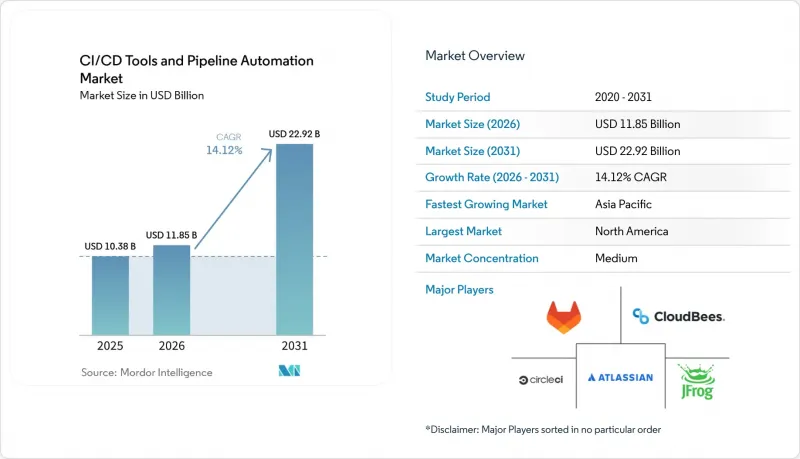
本報告按組件類型(工具/軟體平台、服務)、部署方式(雲端、本地部署、混合部署)、最終用戶公司規模(大型企業、中小企業)、最終用戶行業(銀行、金融服務和保險、醫療保健和生命科學、零售和電子商務等)以及地區進行細分。市場預測以價值(美元)表示。
全球 CI/CD 工具與流水線自動化市場趨勢及洞察
DevOps 在整個企業中的快速普及
如今,企業不再僅僅將部署頻率視為內部指標,而是視為產生收入速度的衡量標準。到2025年,78%的受訪企業表示正在積極採用GitOps,93%的企業計畫擴大其應用範圍。金融服務公司正在跨越數十個叢集同步Kubernetes清單,從而能夠在幾分鐘內將合規程式碼部署到生產環境。這種敏捷性的提升迫使落後的企業要麼加快採用速度,要麼放棄市場佔有率。 DevOps的成熟度已穩固確立其在持續整合/持續交付(CI/CD)工具和管線自動化市場中的競爭優勢。
雲端原生/容器化管線正變得越來越受歡迎。
容器化正從實驗階段邁向基礎設施階段,預計到 2025 年,82% 的企業運作Kubernetes,60% 的企業將採用針對雲端原生工作負載最佳化的管線。經濟因素是主導這一趨勢的主要動力,容器化技術可降低 30-40% 的運算成本,同時避免了以往耗費大量開發人員時間的環境漂移。到 2026 年,Kubernetes 的採用率將達到 96%,這將迫使供應商支援 Helm Chart、Kustomize Overlay 和臨時測試 Pod。除了與空氣間隙的防禦性工作負載外,本地 CI/CD 工具的重要性正在迅速下降。
整合舊有系統的複雜性
主要障礙更在於組織慣性而非純粹的技術差異。過時的平台通常缺乏現代化的API,迫使團隊創建自訂適配器,導致技術債迅速攀升。金融機構經常反映,概念驗證(PoC)專案失敗的原因在於交易處理核心無法提供即時資料。儘管提供SAP、Oracle或IBM中介軟體現成連接器的供應商已將整合週期從幾個季度縮短至幾週,但累積的工作量仍然限制著CI/CD工具和管道自動化市場的成長。
細分市場分析
儘管工具在2025年佔銷售額的75.82%,但預計到2031年,CI/CD工具和管線自動化市場的服務部分將以16.45%的年均成長率成長。隨著買家概念驗證(PoC)的需求日益成長,專家檢驗、實施專案和託管管線正成為平台採用的先決條件。塔塔諮詢服務公司(Tata Consultancy Services)已正式達成合作,共同提供人工智慧驅動的編配服務,充分展現了實施經驗如何創造價值。
同時,產業重組正在改變工具市場的格局。 GitLab 預計到 2026 年營收將達到 9.55 億美元,凸顯了市場對整合原始碼控制、持續整合/持續交付 (CI/CD)、安全性和專案管理功能的平台的需求。 Atlassian 於 2025 年斥資 10 億美元收購 DX,凸顯了嵌入式工程智慧的發展趨勢,而像 Buildkite 這樣的細分領域供應商則正在開闢以效能為中心的市場。這種轉變表明,將分析、安全和部署整合到單一控制平面中的平台如今擁有了戰略優勢。
到 2025 年,雲端解決方案將佔據 62.11% 的市場佔有率,因為靈活的定價模式能夠適應不斷變化的建置量。然而,預計到 2031 年,混合部署的市場佔有率將成長 15.76%,因為金融、醫療保健和公共部門的組織將敏感工作負載分配到本地叢集和雲端突發容量中。 ArgoCD 的聲明式同步功能可讓團隊將相同的策略應用於兩種環境,從而滿足 PCI-DSS 和 HIPAA 的稽核要求。利用 GitOps 模型,可以確保所需的系統狀態得到版本控制、可審計,並自動應用於各個環境,從而減少開發、測試和生產環境之間的配置差異。
本地部署系統僅存在於與空氣間隙的受保護環境中,其重要性正在持續下降。目前,供應商正在客戶的虛擬私有雲 (VPC) 內提供專用實例,將 SaaS 的便利性與資料管理結合。這一趨勢表明,在 CI/CD 工具和管線自動化市場中,本地部署、公共雲端和邊緣位置之間的無縫遷移將成為基本需求。
區域分析
北美擁有密集的平台供應商生態系統和眾多財富 500 強企業的支持,預計將成為領先地區,到 2025 年將佔全球收入的 38.20%。到 2026 年,DevOps 新創企業的創業融資將超過 130 億美元,競爭異常激烈,人員更迭頻繁。隨著跨境資料流動需要符合 GDPR 和各國隱私法的混合模式,加拿大和墨西哥的 DevOps 應用也不斷擴展。在北美營運的組織擴大採用混合雲和多重雲端CI/CD 架構,以滿足資料居住、主權和合規性要求,同時又不影響開發速度。
預計到2031年,亞太地區的複合年成長率將達到17.48%,成為全球成長最快的地區。印度的統一支付介面(UPI)每月處理超過100億筆交易,並依靠持續交付來更新詐欺偵測演算法,從而實現零停機時間。在中國,企業強調與阿里雲和騰訊雲整合的本土化託管;而在日本和韓國,為了遵守嚴格的網路安全法規,企業正在引進DevSecOps。在新加坡、馬來西亞和印度尼西亞,企業正在採用工件管理服務來應對強制性的資料在地化要求,這表明細微的監管差異正在推動CI/CD工具和管線自動化市場的需求成長。
在歐洲,《網路韌性法案》將於2026年8月起強制要求進行自動化安全測試和軟體配置管理(SBOM)生成,這將加速這一進程。德國、英國和法國在製造業和汽車產業的強勁推動下,引領自動化安全測試和軟體配置管理的發展。開放原始碼工具依然廣受歡迎,其中GitHub Actions、Jenkins和GitLab佔據市場主導地位。在中東,由於強制實施主權雲,自動化安全測試和軟體組態管理的發展尚處於起步階段。同時,由於通訊基礎設施和技術水準的提升,非洲和南美洲的進展較為緩慢。
其他好處:
- Excel格式的市場預測(ME)表
- 3個月的分析師支持
目錄
第1章:引言
- 市場分析與定義的前提條件
- 分析範圍
第2章 分析方法
第3章執行摘要
第4章 市場狀況
- 市場概覽
- 市場促進因素
- DevOps在公司中的快速普及
- 雲端原生/容器化管線雖然很受歡迎,但通常存在一些重大缺陷。
- 將人工智慧整合到預測性測試和編配
- 擴展 GitOps 和基礎設施即程式碼的實踐
- 日益嚴格的合規要求正在推動 DevSecOps 的自動化。
- 中小企業的低程式碼/無程式碼管線建構工具激增
- 市場限制因素
- 整合舊有系統的複雜性
- 熟練的DevOps專業人員短缺
- 工具的氾濫正成為一個嚴重的問題,同時也對管治。
- 管道配置錯誤導致的安全風險
- 產業價值鏈分析
- 監理情勢
- 技術展望
- 產業吸引力:五力分析
- 新進入者的威脅
- 供應商的議價能力
- 買方的議價能力
- 替代品的威脅
- 競爭公司之間的競爭
- 宏觀經濟因素對市場的影響
- 投資分析
第5章:預測市場規模與成長率
- 依組件類型
- 工具/軟體平台
- 服務
- 透過部署方法
- 雲
- 現場
- 混合
- 按最終用戶公司規模分類
- 大公司
- 小型企業
- 按最終用戶行業分類
- 銀行、金融服務和保險業 (BFSI)
- 醫學與生命科學
- 零售與電子商務
- 汽車和運輸業
- 資訊科技/通訊
- 政府/國防
- 製造業
- 其他終端用戶產業
- 按地區
- 北美洲
- 美國
- 加拿大
- 墨西哥
- 南美洲
- 巴西
- 阿根廷
- 其他南美國家
- 歐洲
- 德國
- 英國
- 法國
- 義大利
- 西班牙
- 俄羅斯
- 其他歐洲國家
- 亞太地區
- 中國
- 日本
- 印度
- 韓國
- 澳洲和紐西蘭
- 其他亞太國家
- 中東
- 沙烏地阿拉伯
- 阿拉伯聯合大公國
- 土耳其
- 其他中東國家
- 非洲
- 南非
- 奈及利亞
- 埃及
- 其他非洲國家
- 北美洲
第6章 競爭情勢
- 市場集中度
- 策略趨勢
- 市佔率分析
- 公司簡介
- GitLab Inc.
- CloudBees Inc.
- Circle Internet Services Inc.
- Atlassian Corporation
- Harness Inc.
- JetBrains sro
- Semaphore CI Inc.
- Buddy Sp. z oo
- Codefresh Inc.
- Spacelift Inc.
- JFrog Ltd.
- Argo Workflows
- Tekton
- Buildkite Pty Ltd.
- ThoughtWorks Inc.
- Bitrise Ltd.
- AppVeyor Systems Inc.
- DeployHub Inc.
- GitHub(Microsoft Corporation)
- ReleaseHub Inc.
第7章 市場機會與未來展望
According to Mordor Intelligence, the CI/CD tools and pipeline automation market size is expected to increase from USD 10.38 billion in 2025 to USD 11.85 billion in 2026 and reach USD 22.92 billion by 2031, growing at a CAGR of 14.12% over 2026-2031.
This report is Segmented by Component Type (Tools/Software Platforms, and Services), Deployment Model (Cloud-Based, On-Premises, and Hybrid), End-User Enterprise Size (Large Enterprises, and Small and Medium Enterprises), End-User Industry (BFSI, Healthcare and Life Sciences, Retail and ECommerce, and More), and Geography. The Market Forecasts are Provided in Terms of Value (USD).
Global CI/CD Tools And Pipeline Automation Market Trends and Insights
Rapid Adoption of DevOps Across Enterprises
Enterprises now view deployment frequency as a proxy for revenue velocity rather than an internal metric. In 2025, 78% of surveyed organizations reported active GitOps deployments, and 93% planned to expand their use. Financial services firms synchronize Kubernetes manifests across dozens of clusters, enabling code approved for compliance to reach production within minutes. The resulting agility forces laggards to accelerate adoption or cede ground, cementing DevOps maturity as a competitive differentiator inside the Continuous Integration and Continuous Delivery (CI/CD) tools and pipeline automation market.
Growing Preference for Cloud-Native and Containerized Pipelines
Containerization has shifted from experiment to foundation, with 82% of enterprises running Kubernetes in production during 2025 and 60% adopting pipelines optimized for cloud-native workloads. Economic drivers dominate, bin-packing can trim compute expense by 30%-40% while preventing environment drift that once consumed significant developer time. Kubernetes penetration hit 96% in 2026, compelling vendors to fine-tune for Helm charts, Kustomize overlays, and ephemeral test pods. Outside air-gapped defense workloads, on-premise Continuous Integration and Continuous Delivery (CI/CD) tools are rapidly losing relevance.
Legacy System Integration Complexity
The primary obstacle is organizational inertia rather than pure technical mismatch. Older platforms often lack modern APIs, forcing teams to craft custom adapters that immediately balloon technical debt. Financial institutions frequently report proof-of-concept failures because transaction-processing cores cannot expose real-time data. Vendors offering pre-built connectors for SAP, Oracle, or IBM middleware shorten integration cycles from quarters to weeks, yet the cumulative effort still throttles the trajectory of the Continuous Integration and Continuous Delivery (CI/CD) tools and pipeline automation market.
Other drivers and restraints analyzed in the detailed report include:
- Integration of AI for Predictive Testing and Orchestration
- Expansion of GitOps and Infrastructure-as-Code Practices
- Shortage of Skilled DevOps Professionals
For complete list of drivers and restraints, kindly check the Table Of Contents.
Segment Analysis
Tools commanded 75.82% revenue in 2025, yet the services arm of the CI/CD tools and pipeline automation market is poised to expand at 16.45% through 2031. Professional assessments, implementation projects, and managed pipelines are becoming prerequisites for platform adoption as buyers seek proof-of-concept validation. Tata Consultancy Services formalized alliances to deliver AI-powered orchestration, demonstrating how implementation expertise now drives value.
Meanwhile, consolidation is reshaping the tools landscape. GitLab recorded USD 955 million in fiscal-year 2026 revenue, validating demand for unified platforms that merge source control, CI/CD, security, and project management. Atlassian's USD 1 billion purchase of DX in 2025 underscores a pivot toward embedded engineering intelligence, while niche vendors like Buildkite carve performance-specific lanes. The shift indicates that strategic advantage now accrues to platforms bundling analytics, security, and deployment into a single control plane.
Cloud solutions held 62.11% share in 2025 because elastic pricing aligns with fluctuating build volumes. Yet hybrid adoption is growing by 15.76% through 2031 as financial, healthcare, and public-sector organizations split sensitive workloads between on-premises clusters and cloud burst capacity. ArgoCD's declarative synchronization lets teams apply identical policies across both realms, satisfying PCI-DSS or HIPAA audits. By leveraging a GitOps model, it ensures that the desired system state is version-controlled, auditable, and automatically enforced across environments, reducing configuration drift between development, staging, and production.
On-premises systems exist only within air-gapped defense environments, and their relevance continues to wane. Vendors now offer dedicated instances inside customer VPCs, blending SaaS convenience with data control. The trend signals that seamless movement between on-premise, public cloud, and edge locations will become the baseline expectation inside the CI/CD tools and pipeline automation market.
Geography Analysis
North America led with 38.20% revenue in 2025, buoyed by a dense ecosystem of platform providers and Fortune 500 adopters. Venture funding for DevOps startups topped USD 13 billion in 2026, sustaining high competitive churn. Canada and Mexico also scale adoption as cross-border data flows require hybrid models that respect both GDPR and national privacy statutes. Organizations operating across North America increasingly adopt hybrid and multi-cloud CI/CD architectures to ensure data residency, sovereignty, and compliance requirements are met without disrupting development velocity.
Asia-Pacific is on pace for a 17.48% CAGR to 2031, the fastest worldwide. India's Unified Payments Interface processes more than 10 billion monthly transactions and relies on continuous delivery to update fraud-detection algorithms without downtime. China emphasizes domestic hosting with Alibaba Cloud or Tencent Cloud integrations, while Japan and South Korea embed DevSecOps to meet stringent cyber rules. Singapore, Malaysia, and Indonesia adopt artifact-management services in response to data-localization mandates, illustrating how regulatory nuance fuels demand inside the CI/CD tools and pipeline automation market.
Europe is accelerating under the Cyber Resilience Act, which enforces automated security testing and SBOM generation beginning August 2026. Germany, the United Kingdom, and France lead uptake, helped by deep manufacturing and automotive footprints. Open-source tooling retains popularity, with GitHub Actions, Jenkins, and GitLab capturing much of the share. The Middle East experiences early-stage adoption driven by sovereign cloud mandates, whereas Africa and South America advance more gradually as connectivity and skills improve.
- GitLab Inc.
- CloudBees Inc.
- Circle Internet Services Inc.
- Atlassian Corporation
- Harness Inc.
- JetBrains s.r.o.
- Semaphore CI Inc.
- Buddy Sp. z o.o.
- Codefresh Inc.
- Spacelift Inc.
- JFrog Ltd.
- Argo Workflows
- Tekton
- Buildkite Pty Ltd.
- ThoughtWorks Inc.
- Bitrise Ltd.
- AppVeyor Systems Inc.
- DeployHub Inc.
- GitHub (Microsoft Corporation)
- ReleaseHub Inc.
Additional Benefits:
- The market estimate (ME) sheet in Excel format
- 3 months of analyst support
TABLE OF CONTENTS
1 INTRODUCTION
- 1.1 Study Assumptions and Market Definition
- 1.2 Scope of the Study
2 RESEARCH METHODOLOGY
3 EXECUTIVE SUMMARY
4 MARKET LANDSCAPE
- 4.1 Market Overview
- 4.2 Market Drivers
- 4.2.1 Rapid Adoption of DevOps Across Enterprises
- 4.2.2 Growing Preference for Cloud-Native and Containerised Pipelines
- 4.2.3 Integration of AI for Predictive Testing and Orchestration
- 4.2.4 Expansion of GitOps and Infrastructure-as-Code Practices
- 4.2.5 Rising Compliance Demands Driving DevSecOps Automation
- 4.2.6 Surge in Low-Code/No-Code Pipeline Builders for SMEs
- 4.3 Market Restraints
- 4.3.1 Legacy System Integration Complexity
- 4.3.2 Shortage of Skilled DevOps Professionals
- 4.3.3 Escalating Tool Sprawl and Governance Challenges
- 4.3.4 Security Risks from Misconfigured Pipelines
- 4.4 Industry Value Chain Analysis
- 4.5 Regulatory Landscape
- 4.6 Technological Outlook
- 4.7 Industry Attractiveness - Porter's Five Forces Analysis
- 4.7.1 Threat of New Entrants
- 4.7.2 Bargaining Power of Suppliers
- 4.7.3 Bargaining Power of Buyers
- 4.7.4 Threat of Substitutes
- 4.7.5 Intensity of Competitive Rivalry
- 4.8 Impact of Macroeconomic Factors on the Market
- 4.9 Investment Analysis
5 MARKET SIZE AND GROWTH FORECASTS (VALUE)
- 5.1 By Component Type
- 5.1.1 Tools/Software Platforms
- 5.1.2 Services
- 5.2 By Deployment Model
- 5.2.1 Cloud-Based
- 5.2.2 On-Premises
- 5.2.3 Hybrid
- 5.3 By End-user Enterprise Size
- 5.3.1 Large Enterprises
- 5.3.2 Small and Medium Enterprises
- 5.4 By End-user Industry
- 5.4.1 Banking, Financial Services and Insurance (BFSI)
- 5.4.2 Healthcare and Life Sciences
- 5.4.3 Retail and eCommerce
- 5.4.4 Automotive and Transportation
- 5.4.5 IT and Telecommunications
- 5.4.6 Government and Defense
- 5.4.7 Manufacturing
- 5.4.8 Other End-User Industries
- 5.5 By Geography
- 5.5.1 North America
- 5.5.1.1 United States
- 5.5.1.2 Canada
- 5.5.1.3 Mexico
- 5.5.2 South America
- 5.5.2.1 Brazil
- 5.5.2.2 Argentina
- 5.5.2.3 Rest of South America
- 5.5.3 Europe
- 5.5.3.1 Germany
- 5.5.3.2 United Kingdom
- 5.5.3.3 France
- 5.5.3.4 Italy
- 5.5.3.5 Spain
- 5.5.3.6 Russia
- 5.5.3.7 Rest of Europe
- 5.5.4 Asia-Pacific
- 5.5.4.1 China
- 5.5.4.2 Japan
- 5.5.4.3 India
- 5.5.4.4 South Korea
- 5.5.4.5 Australia and New Zealand
- 5.5.4.6 Rest of Asia-Pacific
- 5.5.5 Middle East
- 5.5.5.1 Saudi Arabia
- 5.5.5.2 United Arab Emirates
- 5.5.5.3 Turkey
- 5.5.5.4 Rest of Middle East
- 5.5.6 Africa
- 5.5.6.1 South Africa
- 5.5.6.2 Nigeria
- 5.5.6.3 Egypt
- 5.5.6.4 Rest of Africa
- 5.5.1 North America
6 COMPETITIVE LANDSCAPE
- 6.1 Market Concentration
- 6.2 Strategic Moves
- 6.3 Market Share Analysis
- 6.4 Company Profiles (includes Global Level Overview, Market Level Overview, Core Segments, Financials as available, Strategic Information, Market Rank/Share, Products and Services, Recent Developments)
- 6.4.1 GitLab Inc.
- 6.4.2 CloudBees Inc.
- 6.4.3 Circle Internet Services Inc.
- 6.4.4 Atlassian Corporation
- 6.4.5 Harness Inc.
- 6.4.6 JetBrains s.r.o.
- 6.4.7 Semaphore CI Inc.
- 6.4.8 Buddy Sp. z o.o.
- 6.4.9 Codefresh Inc.
- 6.4.10 Spacelift Inc.
- 6.4.11 JFrog Ltd.
- 6.4.12 Argo Workflows
- 6.4.13 Tekton
- 6.4.14 Buildkite Pty Ltd.
- 6.4.15 ThoughtWorks Inc.
- 6.4.16 Bitrise Ltd.
- 6.4.17 AppVeyor Systems Inc.
- 6.4.18 DeployHub Inc.
- 6.4.19 GitHub (Microsoft Corporation)
- 6.4.20 ReleaseHub Inc.
7 MARKET OPPORTUNITIES AND FUTURE OUTLOOK
- 7.1 White-Space and Unmet-Need Assessment

 全球數據管道工具市場規模、佔有率、趨勢和成長分析報告(2026-2034年)
 資料管道自動化市場預測至2034年-按組件、部署模式、管道類型、技術、應用、最終用戶和地區分類的全球分析
 資料管道工具市場:全球市場預測,2026-2032年管道網路市場:全球預測,2026-2032年
 全球管道網路市場
 2026年全球數據管道工具市場報告2026年全球管道網路市場報告
 資料管道工具市場 - 全球產業規模、佔有率、趨勢、機會和預測:按組件、類型、部署方式、公司規模、應用、最終用途、地區和競爭格局分類,2021-2031 年全球數據管道工具市場管道網路市場-全球產業規模、佔有率、趨勢、機會及預測(按產品、應用、內容、地區及競爭情況,2020-2030 年預測)