


 |
市場調查報告書
商品編碼
2063865
SMD(表面黏著技術元件) LED構裝:市場佔有率分析、產業趨勢與統計資料、成長預測(2026-2031年)SMD (Surface Mount Device) LED Package - Market Share Analysis, Industry Trends & Statistics, Growth Forecasts (2026 - 2031) |
||||||

※ 本網頁內容可能與最新版本有所差異。詳細情況請與我們聯繫。
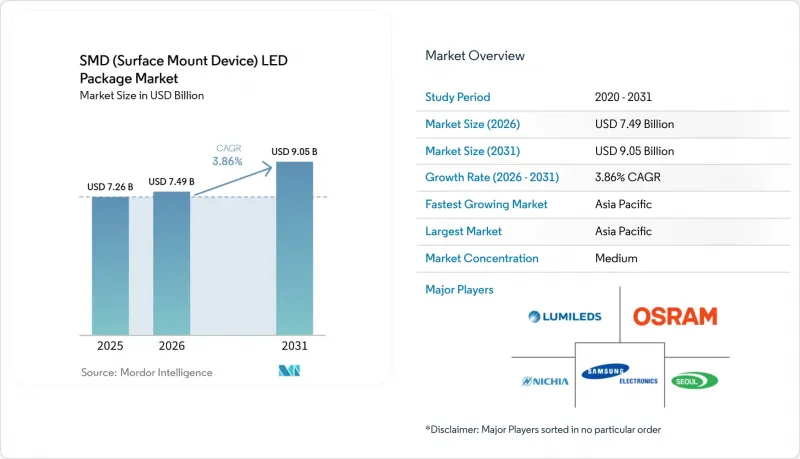
根據 Mordor Intelligence 預測,SMD LED構裝市場規模預計將在 2025 年達到 72.6 億美元,2026 年達到 74.9 億美元,到 2031 年達到 90.5 億美元,2026 年至 2031 年的複合年成長率為 3.86%。
本報告按輸出功率等級(低功率、中功率、高功率、超高功率)、發射類型(可見光、紅外線、紫外線)、關鍵材料(基板、封裝、黏合材料、磷光體)、應用領域(通用照明、汽車、顯示器、特殊應用)和地區進行細分。市場預測以美元(USD)為單位。
全球SMD(表面黏著型元件) LED構裝市場趨勢及洞察
家用電子設備的日益小型化正導致其被廣泛採用。
穿戴式裝置和智慧型手機的設計者正在將晶片面積縮小到1平方毫米以下,而SMD LED構裝製造商則被要求將Z方向高度控制在0.5毫米以下,實現更嚴格的晶片分級,並提供能夠在-10 度C至+60 度C的環境溫度範圍內將色差控制在3個標準色階以內的功率密度。 VueReal的EcoVue轉移製程預計將於2025年實現量產,屆時Garmin Fenix 8 Pro將配備全彩microLED顯示螢幕,其功耗比OLED背光低30%,即使在戶外也能達到10000尼特的亮度。友達光電(AUO)和三星顯示器(Samsung Display)都已確認將於2028年開始運作專用microLED生產線,顯示即使microLED的成本比LCD替代方案高出3-5倍,其市場需求依然長期存在。熱負載仍然是一項重大挑戰,但Aismalibar的相變晶片貼裝技術突破了200 W m⁻¹ K⁻¹的瓶頸,並分散了熱點的溫度梯度。隨著消費性電子設備邊框越來越薄,這些超薄封裝為天線和感測器提供了更多基板空間,從而支撐了市場強勁的複合年成長率。
汽車LED照明需求不斷成長
原始設備製造商 (OEM) 正從固定光束頭燈轉向矩陣式頭燈,後者可在毫秒內調暗特定發光元件。這項轉變推動了封裝要求的提高,例如在單一晶片上整合獨立控制功能以及將結溫控制在 100 度C以下。 LUXEON Altilon SMD-A 於 2025 年首次亮相,厚度為 433µm,符合聯合國法規 123 對 2026 年車型自適應遠光燈的要求。在基板上,Lumissil 的 IS32LT3365 整合了 48 個恆定電流通道和 ISO 26262 診斷功能,而 Diodes Incorporated 的 AL5958Q 則增加了 16 位元調光和電磁干擾 (EMI)頻譜功能。這些電子元件與陶瓷基板和燒結銀結相結合,實現了低於 2.5 K W⁻¹ 的熱阻,從而擴大了豪華轎車和運動型多用途車 (SUV)高功率裝置的目標市場 (TAM)。
溫度控管和散熱方面的挑戰
在功率超過 3W 的封裝中,結溫通常會超過 125 度C,導致 L70 光通量在 30,000 小時內減半,並有致命故障的風險。 COFAN 的垂直奈米碳管管介面實現了 1,500 W m-1K-1 的熱導率,但這會使每個單元的成本增加 0.50 至 1 美元,對於通用照明應用而言過於昂貴。即使是 Lumileds 的散熱墊結構也只能承受高達 3.5W 的功率,這限制了超高高功率產品在汽車和體育場照明領域的應用。除非被動材料的成本降至商品水平,否則散熱設計瓶頸將繼續拖累該領域的複合年成長率,使其下降 0.6 個百分點。
細分市場分析
預計到2031年,高功率裝置(1-3 W)的複合年成長率將達到4.22%,超過整體SMD LED構裝市場的成長速度,這主要得益於矩陣式頭燈和高棚照明燈具中對單晶片調光和陶瓷導熱路徑的需求。因此,此類SMD LED構裝的市場規模成長速度將超過中功率元件,後者在2025年佔總銷售額的30.29%。雖然中功率產品在改裝燈具中仍然至關重要,因為其發光效率目標仍保持在140 lm/W左右,但隨著OLED和microLED顯示器在背光領域的市場佔有率不斷成長,低功率裝置正逐漸轉向指示燈等細分市場。高功率(超過3 W)產品由於嚴格的結溫限制(125 度C)導致壽命顯著縮短,因此其應用僅限於需要強制風冷或液冷的場合。
汽車產業的規格正在推動對高功率LED的需求成長,這種LED需要在Z軸高度小於450微米的情況下提供超過450流明的光通量。 Diodes Incorporated的AL5958Q和Lumissil的IS32LT3365驅動器提供48個可調光通道,使OEM廠商能夠為2026款車型提供無眩光自適應駕駛光束。光學元件、驅動器和電源管理的這種組合,使得SMD LED構裝在高功率產品領域繼續保持市場佔有率成長的勢頭,而中功率封裝則繼續在商用下照燈市場佔據一席之地。隨著北美DLC標準的提高,預計這種市場分化將進一步加劇。
2025年,可見光發光裝置將佔銷售額的87.38%,而紫外線裝置目前成長最為迅猛,在公共衛生和水處理法規的推動下,其複合年成長率(CAGR)達到4.57%。與紫外線應用相關的SMD LED構裝市場規模受益於地方政府消毒設施以265奈米陣列取代汞燈,降低了40%的營運成本。紅外線領域表現強勁,主要由生物識別和駕駛員監控驅動,為供應商提供了豐富的產品系列,從而降低了價格波動。雖然可見光封裝在出貨量方面仍將保持主導地位,但隨著效率提升接近物理極限以及照明維修市場接近飽和,其成長速度將會放緩。
ams OSRAM 將於 2026 年下半年推出 200mW UV-C 組件,這進一步印證了該領域已被主流市場接受。 TrendForce 預測,到 2026 年,UV 市場規模將達到 2.15 億美元,年增 10%。基礎設施建設資金的撥備也表明,未來幾年醫療和建築空氣淨化領域將迎來一波資本投資熱潮。量子點磷光體在提升可見光產品顯色性的同時,UV 技術的應用也隨著自身需求的周期性成長而持續推進,從而鞏固了不同發光類型之間的雙管齊下發展前景。
區域分析
預計到2025年,亞太地區將佔全球SMD LED構裝銷售額的66.85%,並將以4.16%的複合年成長率持續擴大其領先優勢,直至2031年。中國廣東省等省份正在實施採購配額制度,將40%的城市照明招標競標分配給國內中小企業,以確保本地需求。同時,湖南和福建省新建的工廠正在提高基板的自給率。區域全面經濟夥伴關係協定(RCEP)下的關稅減讓進一步促進了日本和韓國的晶片生產與越南和泰國的封裝生產之間的整合,縮短了前置作業時間,並加強了區域供應鏈。
預計到2025年,北美和歐洲合計約佔全球銷售額的四分之一,但由於通用照明市場趨於飽和以及商用照明燈具更換週期延長,成長依然緩慢。儘管如此,日益嚴格的政策仍在推動對高效組件的需求。 DesignLights聯盟的SSL V6.0高級認證和歐洲A級(≥lm/W)標籤要求在OEM材料清單中使用陶瓷基板和先進磷光體,從而在銷量持平的情況下支撐了平均售價。市政智慧照明部署項目,例如Telensa在剪切機的推廣計劃和Tridonic在達姆施塔特的項目,正在引發一波升級改造浪潮,在一定程度上抵消了改裝插座需求的放緩。
儘管南美、中東和非洲總合佔有率較小,但促進供應鏈本地化的獎勵正在刺激局部需求。越南價值5億美元的北寧LED叢集以及印度與生產連結獎勵計畫,正吸引台灣和韓國的供應商參與合資計畫。雖然絕對銷售量仍然很小,但區域補貼正將部分組裝業務從中國沿海地區轉移出去,導致市場分散,並增加了曾經依賴單一國家採購的全球照明品牌的運輸成本。
其他好處:
- Excel格式的市場預測(ME)表
- 3個月的分析師支持
目錄
第1章:引言
- 研究假設和市場定義
- 調查範圍
第2章:調查方法
第3章執行摘要
第4章 市場狀況
- 市場概覽
- 市場促進因素
- 小型化消費性電子設備的廣泛應用
- 汽車LED照明需求不斷成長
- 嚴格的能源效率法規
- 擴大智慧照明基礎設施的普及應用
- 將微型LED混合封裝整合到穿戴式裝置中
- 新興市場供應鏈本地化的獎勵
- 市場限制因素
- 溫度控管和散熱方面的挑戰
- 先進包裝生產線的初始資本投資成本較高
- 價格快速下跌和利潤率承壓
- 關於銻基封裝的環境法規
- 產業價值鏈分析
- 技術分析
- 監理情勢
- 宏觀經濟因素對市場的影響
- 波特五力分析
第5章 市場規模與成長預測
- 按輸出類別
- 低功率(小於0.5瓦)
- 中功率(0.5–1 瓦)
- 高功率(1-3瓦)
- 高功率(超過 3 瓦)
- 按發光類型
- 可見光LED構裝
- 紅外線(IR) LED構裝
- 紫外線 (UV) LED構裝
- 主要材料
- 基材
- 封裝
- 黏接/晶片貼裝
- 磷光體/塗層
- 按用途/最終用途
- 通用照明(住宅、商業、工業、街道照明)
- 汽車照明
- 顯示器和背光
- 專業應用/細分市場(園藝、醫療、紫外線消毒)
- 按地區
- 北美洲
- 美國
- 加拿大
- 墨西哥
- 南美洲
- 巴西
- 阿根廷
- 其他南美國家
- 歐洲
- 德國
- 英國
- 法國
- 義大利
- 西班牙
- 其他歐洲國家
- 亞太地區
- 中國
- 日本
- 印度
- 韓國
- 澳洲和紐西蘭
- 其他亞太國家
- 中東
- 沙烏地阿拉伯
- 阿拉伯聯合大公國
- 其他中東國家
- 非洲
- 南非
- 埃及
- 其他非洲國家
- 北美洲
第6章 競爭情勢
- 市場集中度
- 策略趨勢
- 市佔率分析
- 公司簡介
- Nichia Corporation
- ams-OSRAM AG
- Lumileds Holding BV
- Cree LED(SGH Company)
- Samsung Electronics Co., Ltd.
- LG Innotek Co., Ltd.
- Seoul Semiconductor Co., Ltd.
- Everlight Electronics Co., Ltd.
- Epistar Corporation
- Lite-On Technology Corporation
- Stanley Electric Co., Ltd.
- Harvatek Corporation
- Toyoda Gosei Co., Ltd.
- NationStar Optoelectronics Co., Ltd.
- Lextar Electronics Corporation
- Bridgelux Inc.
- Dominant Opto Technologies Sdn. Bhd.
- HC Semitek Corporation
- Rohm Co., Ltd.
- Citizen Electronics Co., Ltd.
第7章 市場機會與未來展望
According to Mordor Intelligence, the SMD lED package market size is projected to be USD 7.26 billion in 2025, USD 7.49 billion in 2026, and reach USD 9.05 billion by 2031, growing at a CAGR of 3.86% from 2026 to 2031.
This report is Segmented by Power Class (Low Power, Mid Power, High Power, and Ultra-High Power), Emission Type (Visible, Infrared, and Ultraviolet), Primary Material (Substrates, Encapsulation, Bonding, and Phosphors), Application (General Lighting, Automotive, Display, and Specialty), and Geography. The Market Forecasts are Provided in Terms of Value (USD).
Global SMD (Surface Mount Device) LED Package Market Trends and Insights
Growing Adoption of Miniaturized Consumer Electronics
Wearable and smartphone designers are shrinking footprints below 1 mm2, forcing SMD LED package makers to deliver sub-0.5 mm z-heights, tighter binning and power densities that hold color shift under 3 MacAdam steps across -10 °C to +60 °C ambient. VueReal's EcoVue transfer process reached commercial volumes in 2025, enabling the Garmin Fenix 8 Pro to feature full-color micro-LED displays with 30% lower drain than OLED backlights and 10,000-nit outdoor brightness. AUO and Samsung Display each confirmed dedicated micro-LED lines for 2028 start-ups, signaling long-term demand visibility even at a three-to-five-times cost premium over liquid-crystal alternatives. Thermal loads remain critical; Aismalibar's phase-change die attach breaks 200 W m-1 K-1 to disperse hotspot gradients. As bezels shrink in consumer devices, these ultrathin packages unlock incremental board space for antennas and sensors, sustaining the driver's positive CAGR.
Increasing Demand for Automotive LED Lighting
Original equipment manufacturers (OEMs) are moving from static beams to matrix headlights that dim specific emitters in milliseconds, a shift that elevates package requirements for single-chip addressability and junction temperatures below 100 °C. The LUXEON Altilon SMD-A debuted in 2025 with a 433 µm profile, meeting United Nations Regulation 123 criteria for adaptive driving beams in 2026 model-year vehicles. Down-board, Lumissil's IS32LT3365 integrates 48 constant-current channels and ISO 26262 diagnostics, while Diodes Incorporated's AL5958Q adds 16-bit dimming and electromagnetic-interference spread-spectrum features. These electronics, combined with ceramic substrates and sintered-silver attachments, achieve a thermal resistance below 2.5 K W-1, widening the TAM for high-power devices in premium sedans and sport-utility vehicles.
Thermal Management and Heat Dissipation Challenges
Packages exceeding 3 W often drive junctions above 125 °C, halving lumen maintenance to L70 within 30,000 hours and risking catastrophic failure. COFAN's vertical carbon-nanotube interface hits 1,500 W m-1 K-1 conductivity yet adds USD 0.50-1.00 per unit, too expensive for general illumination. Even Lumileds' thermal pad architecture only supports 3.5 W, restricting ultra-high-power adoption to automotive and stadium lighting. Unless passive materials fall to commodity cost levels, thermal bottlenecks will continue to shave 0.6 percentage points off the sector's CAGR.
Other drivers and restraints analyzed in the detailed report include:
- Stringent Energy Efficiency Regulations
- Rising Deployment of Smart Lighting Infrastructure
- High Initial Capital Expenditure for Advanced Packaging Lines
For complete list of drivers and restraints, kindly check the Table Of Contents.
Segment Analysis
High-power devices (1-3 W) are set to outpace the broader SMD LED package market at a 4.22% CAGR through 2031 as matrix headlights and high-bay fixtures need single-chip dimming and ceramic thermal paths. The SMD LED package market size for this class will therefore expand faster than mid-power incumbents, which held a 30.29% revenue position in 2025. Mid-power remains indispensable in retrofit lamps where efficacy targets hover near 140 lm W-1, yet low-power devices slip toward indicator niches as OLED and micro-LED displays cannibalize backlight slots. Ultra-high-power (more than 3 W) stays confined to applications with forced-air or liquid cooling, given the severe 125 °C junction ceiling that halves service life.
Automotive specifications amplify demand for high-power formats that stack luminous flux above 450 lm with z-heights under 450 µm. Diodes Incorporated's AL5958Q and Lumissil's IS32LT3365 drivers supply 48 dimmable channels that OEMs leverage for glare-free adaptive driving beams in 2026 cars. This drivetrain of optics, drivers and power management sustains the SMD LED package market share momentum for high-power variants while mid-power packages defend commercial downlights, a dichotomy set to widen as DLC thresholds ratchet upward in North America.
Visible emitters still generate 87.38% of 2025 sales, but UV devices now post the highest slope, rising at a 4.57% CAGR on public-health and water-treatment mandates. The SMD LED package market size tied to UV applications benefits from municipal disinfection plants that replace mercury lamps with 265 nm arrays offering 40% operating-cost cuts. Infrared holds steady around biometric sensing and driver-monitoring, giving suppliers portfolio breadth that cushions pricing swings. Visible packages will continue to dominate shipment counts, yet their growth moderates as efficiency gains approach physical limits and lighting retrofits near saturation.
The arrival of 200 mW UV-C parts from ams OSRAM in late 2026 underscores mainstream acceptance. TrendForce already valued the UV segment at USD 215 million in 2026, up 10% year-over-year, and infrastructure funding pipelines suggest a multi-year capex wave in healthcare and building-air purification. As quantum-dot phosphors push color-rendering of visible products, UV adoption keeps advancing on its separate demand cycle, reinforcing a dual-track outlook across emission types.
Geography Analysis
Asia Pacific accounted for 66.85% of global SMD LED package revenue in 2025 and is projected to widen its lead, with a 4.16% CAGR through 2031. Chinese provinces such as Guangdong apply procurement quotas reserving 40% of municipal lighting bids for domestic SMEs, guaranteeing local offtake while new facilities in Hunan and Fujian extend substrate self-sufficiency. Regional Comprehensive Economic Partnership tariff relief further integrates Japanese and South Korean chip output with Vietnamese and Thai packaging, shortening lead times and hardening the regional supply moat.
North America and Europe collectively contributed roughly one-quarter of 2025 turnover, but growth remains subdued, constrained by saturation in general illumination and longer commercial-fixture replacement cycles. Even so, policy tightening continues to push value toward high-efficacy parts. The DesignLights Consortium's SSL V6.0 Premium tier and Europe's A-grade ≥ lm/W label require OEM bills of materials to adopt ceramic boards and advanced phosphors, cushioning average selling prices despite flattish volumes. Municipal smart-lighting installations, demonstrated by Telensa's Gloucestershire rollout and Tridonic's Darmstadt project, create upgrade waves that modestly offset slowdowns in retrofit sockets.
South America, the Middle East and Africa together hold a small share of global sales but supply-chain localization incentives lift pockets of demand. Vietnam's USD 500 million Bac Ninh LED cluster and India's Production-Linked Incentive of 4-6% on incremental sales lure Taiwanese and Korean suppliers into joint ventures. While absolute volumes stay small, regional subsidies peel some assembly away from coastal China, increasing fragmentation and lifting landed costs for global luminaire brands that once relied on single-country sourcing.
- Nichia Corporation
- ams-OSRAM AG
- Lumileds Holding B.V.
- Cree LED (SGH Company)
- Samsung Electronics Co., Ltd.
- LG Innotek Co., Ltd.
- Seoul Semiconductor Co., Ltd.
- Everlight Electronics Co., Ltd.
- Epistar Corporation
- Lite-On Technology Corporation
- Stanley Electric Co., Ltd.
- Harvatek Corporation
- Toyoda Gosei Co., Ltd.
- NationStar Optoelectronics Co., Ltd.
- Lextar Electronics Corporation
- Bridgelux Inc.
- Dominant Opto Technologies Sdn. Bhd.
- HC Semitek Corporation
- Rohm Co., Ltd.
- Citizen Electronics Co., Ltd.
Additional Benefits:
- The market estimate (ME) sheet in Excel format
- 3 months of analyst support
TABLE OF CONTENTS
1 INTRODUCTION
- 1.1 Study Assumptions and Market Definition
- 1.2 Scope of the Study
2 RESEARCH METHODOLOGY
3 EXECUTIVE SUMMARY
4 MARKET LANDSCAPE
- 4.1 Market Overview
- 4.2 Market Drivers
- 4.2.1 Growing Adoption of Miniaturized Consumer Electronics
- 4.2.2 Increasing Demand for Automotive LED Lighting
- 4.2.3 Stringent Energy Efficiency Regulations
- 4.2.4 Rising Deployment of Smart Lighting Infrastructure
- 4.2.5 Integration of Micro-LED Hybrid Packages into Wearables
- 4.2.6 Supply-Chain Localization Incentives in Emerging Economies
- 4.3 Market Restraints
- 4.3.1 Thermal Management and Heat Dissipation Challenges
- 4.3.2 High Initial CapEx for Advanced Packaging Lines
- 4.3.3 Rapid Price Erosion and Margin Pressure
- 4.3.4 Environmental Restrictions on Antimony-based Encapsulants
- 4.4 Industry Value-Chain Analysis
- 4.5 Technology Analysis
- 4.6 Regulatory Landscape
- 4.7 Impact of Macroeconomic Factors on the Market
- 4.8 Porter's Five Forces Analysis
- 4.8.1 Bargaining Power of Suppliers
- 4.8.2 Bargaining Power of Buyers
- 4.8.3 Threat of New Entrants
- 4.8.4 Threat of Substitutes
- 4.8.5 Intensity of Competitive Rivalry
5 MARKET SIZE AND GROWTH FORECASTS (VALUE)
- 5.1 By Power Class
- 5.1.1 Low Power (Less than 0.5 W)
- 5.1.2 Mid Power (0.5-1 W)
- 5.1.3 High Power (1-3 W)
- 5.1.4 Ultra-High Power (More than 3 W)
- 5.2 By Emission Type
- 5.2.1 Visible LED Packages
- 5.2.2 Infrared (IR) LED Packages
- 5.2.3 Ultraviolet (UV) LED Packages
- 5.3 By Primary Material
- 5.3.1 Substrates
- 5.3.2 Encapsulation
- 5.3.3 Bonding / Die-Attach
- 5.3.4 Phosphors / Coatings
- 5.4 By Application / End-Use
- 5.4.1 General Lighting (Residential, Commercial, Industrial, Street)
- 5.4.2 Automotive Lighting
- 5.4.3 Display and Backlighting
- 5.4.4 Specialty / Niche (Horticulture, Medical, UV Disinfection)
- 5.5 By Geography
- 5.5.1 North America
- 5.5.1.1 United States
- 5.5.1.2 Canada
- 5.5.1.3 Mexico
- 5.5.2 South America
- 5.5.2.1 Brazil
- 5.5.2.2 Argentina
- 5.5.2.3 Rest of South America
- 5.5.3 Europe
- 5.5.3.1 Germany
- 5.5.3.2 United Kingdom
- 5.5.3.3 France
- 5.5.3.4 Italy
- 5.5.3.5 Spain
- 5.5.3.6 Rest of Europe
- 5.5.4 Asia-Pacific
- 5.5.4.1 China
- 5.5.4.2 Japan
- 5.5.4.3 India
- 5.5.4.4 South Korea
- 5.5.4.5 Australia and New Zealand
- 5.5.4.6 Rest of Asia-Pacific
- 5.5.5 Middle East
- 5.5.5.1 Saudi Arabia
- 5.5.5.2 United Arab Emirates
- 5.5.5.3 Rest of Middle East
- 5.5.6 Africa
- 5.5.6.1 South Africa
- 5.5.6.2 Egypt
- 5.5.6.3 Rest of Africa
- 5.5.1 North America
6 COMPETITIVE LANDSCAPE
- 6.1 Market Concentration
- 6.2 Strategic Moves
- 6.3 Market Share Analysis
- 6.4 Company Profiles (includes Global Level Overview, Market Level Overview, Core Segments, Financials as available, Strategic Information, Market Rank/Share, Products and Services, Recent Developments)
- 6.4.1 Nichia Corporation
- 6.4.2 ams-OSRAM AG
- 6.4.3 Lumileds Holding B.V.
- 6.4.4 Cree LED (SGH Company)
- 6.4.5 Samsung Electronics Co., Ltd.
- 6.4.6 LG Innotek Co., Ltd.
- 6.4.7 Seoul Semiconductor Co., Ltd.
- 6.4.8 Everlight Electronics Co., Ltd.
- 6.4.9 Epistar Corporation
- 6.4.10 Lite-On Technology Corporation
- 6.4.11 Stanley Electric Co., Ltd.
- 6.4.12 Harvatek Corporation
- 6.4.13 Toyoda Gosei Co., Ltd.
- 6.4.14 NationStar Optoelectronics Co., Ltd.
- 6.4.15 Lextar Electronics Corporation
- 6.4.16 Bridgelux Inc.
- 6.4.17 Dominant Opto Technologies Sdn. Bhd.
- 6.4.18 HC Semitek Corporation
- 6.4.19 Rohm Co., Ltd.
- 6.4.20 Citizen Electronics Co., Ltd.
7 MARKET OPPORTUNITIES AND FUTURE OUTLOOK
- 7.1 White-space and Unmet-need Assessment


