


 |
市場調查報告書
商品編碼
2063855
人力資源聊天機器人和虛擬助理:市場佔有率分析、行業趨勢和統計數據以及成長預測(2026-2031 年)HR Chatbot And Virtual Assistant - Market Share Analysis, Industry Trends & Statistics, Growth Forecasts (2026 - 2031) |
||||||

※ 本網頁內容可能與最新版本有所差異。詳細情況請與我們聯繫。
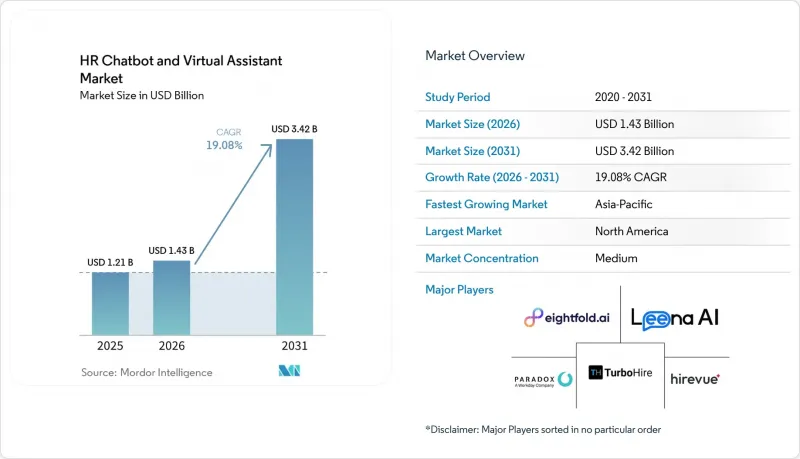
根據 Mordor Intelligence 預測,人力資源聊天機器人和虛擬助理市場將從 2025 年的 12.1 億美元成長到 2026 年的 14.3 億美元,到 2031 年達到 34.2 億美元。
預計從 2026 年到 2031 年,其複合年成長率將達到 19.08%。
本報告按組件(解決方案和服務)、應用(招聘和入職、員工自助服務、培訓和發展、人力資源服務台和案例管理等)、部署模式(雲端和本地部署)、組織規模(大型企業和中小企業)以及地區進行細分。市場預測以美元(USD)為單位。
全球人力資源聊天機器人與虛擬助理市場趨勢與洞察
利用人工智慧實現招募流程自動化的進程正在加速。
目前,大規模語言模型能夠在幾秒鐘內分析簡歷、對申請人進行排名並撰寫聯繫訊息,將篩選週期從數週縮短至數小時。 Workday計劃將Paradox整合到其人力資本平台中,這將為超過10,000家企業客戶提供人工智慧驅動的日程安排和預先篩選工作流程,加速其快速普及。此外,如果自動化功能內建於自身的記錄系統中,買家也會認為整合風險較低。競爭壓力迫使獨立的應徵者追蹤供應商在保持競爭力和被市場淘汰之間做出選擇。符合ISO/IEC 27001審計標準的日誌記錄現在已成為強制性功能,招募自動化也正從可選附加元件轉變為預設功能。
對持續運作的候選人互動方式的需求日益成長
由於長期勞動力短缺,即使是被動求職者現在也希望立即獲得有關薪資、遠距辦公政策和職業發展路徑的答案。一分鐘內即可回覆的聊天機器人滿足了這項期望,尤其是在亞太地區,到2025年底,新加坡76%的公司都將採用人工智慧人力資源工具。 JobTalk AI支援23種語言的自然對話,使負責人能夠同時聯繫到東京、孟買和聖保羅的求職者。根據企業報告,每年可節省超過800小時的負責人時間,從而騰出資源與最終候選人互動並與招募經理合作。隨著反應時間的縮短,候選人的期望值也隨之提高,形成良性循環。
加強資料隱私和偏見方面的監管。
歐盟人工智慧法強制要求對已採用的聊天機器人進行第三方合規性評估、透明度通知和人工監督,這使得產品週期延長至多18個月,並增加了合規成本。紐約市第144號地區法案強制要求每年進行偏見審計,每次違規最高罰款1,500美元。小規模供應商難以承擔這些審計成本,市場佔有率正向擁有專門合規團隊的供應商轉移。伊利諾伊州和科羅拉多的當地法規也提出了額外的要求,要求平台適應當地的司法管轄區環境。採購部門對ISO/IEC 42001認證日益成長的需求進一步加劇了這些限制。
細分市場分析
2025年,解決方案收入的64.05%來自授權和訂閱費。然而,服務板塊正以21.85%的複合年成長率快速成長。這是因為企業需要快速的工程設計、偏差審計和模型調優,以符合不斷變化的法規要求。 Paradox於2025年2月收購Eqtble,反映了合規服務捆綁銷售的趨勢。這表明市場對能夠有效應對監管挑戰的整合解決方案的需求日益成長。
從持續收入和鎖定效應的角度來看,解決方案仍然至關重要。然而,歐盟人工智慧法案將於2026年生效,這迫使許多組織尋求外部專家,從而增加了對託管服務的需求。提供一站式合規和調優服務的供應商預計將超越純粹的軟體經銷商。
隨著企業努力縮短招募週期,預計到2025年,招募和入職環節將佔總收入的43.21%。員工敬業度和健康領域成長最快,複合年成長率達20.43%,這主要得益於M42和TELUS Health等員工支援計畫的推動,這些計畫提供阿拉伯語和英語的心理健康諮詢初步支持。由於留住員工比招募更具成本效益,整合健康工具的人力資源聊天機器人和虛擬助理市場規模正在不斷擴大。
自助服務入口網站排名第二,涵蓋密碼重設和福利登記等任務。預計到2025年,馬來西亞和新加坡將有74%的員工使用此類入口網站。培訓和發展機器人透過推薦個人化學習路徑而日益普及,而人力資源服務台聊天機器人則可自動處理有關薪資和稅務問題的諮詢。
區域分析
受科技、醫療保健和零售業的推動,北美地區預計到2025年將佔全球收入的37.00%。根據第144號地方法律,強制性的、帶有偏見的審計迫使供應商建立審計日誌,這將成為全球合規標準。產業重組,例如Paychex以41億美元收購Paycor以及Paylocity收購Grayscale,顯示成熟企業正在部署聊天機器人來保護薪資核算和人力資本管理(HCM)業務。
亞太地區正以20.90%的複合年成長率快速擴張,成長率位居全球之首。到2025年,新加坡和中國都市區地區的技能型就業失業率將保持在3%以下,這將推動多語言聊天機器人(例如MapRecruit.ai的「ReA」(支援105種語言)和Hire-Match.ai的「Clara」(支援50種語言))的普及應用。 TurboHire和其他區域性公司的資金籌措輪次表明,投資者對該地區持續兩位數成長充滿信心。
歐洲正經歷穩定成長,但歐盟人工智慧法律合規性的複雜性減緩了不具備內建審計追蹤功能的系統的普及。德國、英國和法國的普及速度最快,尤其注重舉措保護平台。中東地區正透過M42和阿拉伯聯合大公國TELUS Health等健康計畫獲得發展動力。南美洲由於雲端運算普及率低而落後,但巴西和阿根廷的興趣正在成長,而非洲的南非和肯亞仍處於試點計畫的早期階段,人工智慧仍處於發展初期。
其他福利:
- Excel格式的市場預測(ME)表
- 3個月的分析師支持
目錄
第1章:引言
- 研究假設和市場定義
- 調查範圍
第2章:調查方法
第3章執行摘要
第4章 市場狀況
- 市場概覽
- 市場促進因素
- 利用人工智慧加速招募流程自動化
- 對持續線上候選人互動需求日益成長
- 遠距和混合辦公室模式的擴展
- 與人力資源資訊系統 (HRIS) 和招募管理系統 (ATS) 平台無縫整合
- 多語言人工智慧聊天機器人的出現
- 要求推行符合ESG原則的公平招募做法。
- 市場限制因素
- 加強資料隱私和偏見方面的監管。
- 複雜查詢中上下文理解的局限性
- 與舊有系統整合的複雜性
- 人工智慧招聘監管立法的風險日益增加。
- 產業價值鏈分析
- 監理情勢
- 技術展望
- 宏觀經濟因素對市場的影響
- 波特五力分析
第5章 市場規模與成長預測
- 按組件
- 解決方案
- 服務
- 透過使用
- 招募和入職
- 員工自助服務
- 培訓和人力資源開發
- 人力資源服務台與個案管理
- 員工敬業度與健康
- 部署模式
- 雲
- 現場
- 按組織規模
- 大公司
- 中小企業
- 按地區
- 北美洲
- 美國
- 加拿大
- 墨西哥
- 南美洲
- 巴西
- 阿根廷
- 其他南美國家
- 歐洲
- 德國
- 英國
- 法國
- 義大利
- 西班牙
- 其他歐洲國家
- 亞太地區
- 中國
- 印度
- 日本
- 韓國
- 澳洲
- 其他亞太國家
- 中東
- 阿拉伯聯合大公國
- 沙烏地阿拉伯
- 土耳其
- 其他中東國家
- 非洲
- 南非
- 奈及利亞
- 肯亞
- 其他非洲國家
- 北美洲
第6章 競爭情勢
- 市場集中度
- 策略趨勢
- 市佔率分析
- 公司簡介
- Paradox, Inc.
- HireVue, Inc.
- Eightfold AI, Inc.
- Mya Systems, Inc.
- Leena AI, Inc.
- JobPal GmbH
- Talkpush Limited
- XOR, Inc.
- Brazen Technologies, Inc.
- Sense Talent Labs, Inc.
- Talla, Inc.
- Wade & Wendy, Inc.
- AllyO, Inc.
- TurboHire Technologies Private Limited
- RoboRecruiter Ltd.
- VCV Inc.
- Snaphunt Pte. Ltd.
- Impress.ai Pte. Ltd.
- Leoforce LLC
- Ascendify Corporation
第7章 市場機會與未來展望
According to Mordor Intelligence, the hR chatbot and Virtual Assistant market size is expected to increase from USD 1.21 billion in 2025 to USD 1.43 billion in 2026 and reach USD 3.42 billion by 2031, growing at a CAGR of 19.08% over 2026-2031.
This report is Segmented by Component (Solutions, and Services), Application (Recruitment and Onboarding, Employee Self-Service, Training and Development, HR Helpdesk and Case Management, and More), Deployment Mode (Cloud, and On-Premises), Organization Size (Large Enterprises, and Small and Medium-Sized Enterprises), and Geography. The Market Forecasts are Provided in Terms of Value (USD).
Global HR Chatbot And Virtual Assistant Market Trends and Insights
Accelerating AI-Driven Recruitment Automation
Large language models now parse resumes, rank applicants, and draft outreach messages in seconds, shrinking screening cycles from weeks to hours. Workday's planned integration of Paradox into its human capital platform will expose AI scheduling and pre-qualification workflows to more than 10,000 enterprise customers, encouraging rapid mainstream adoption. Buyers also perceive lower integration risk when automation resides inside their system of record. Competitive pressure forces standalone applicant-tracking vendors to match this speed or face displacement. Audit-ready logs required by ISO/IEC 27001 have become a non-negotiable feature, cementing recruitment automation as a default capability rather than an optional add-on.
Rising Demand for Always-On Candidate Engagement
Persistent talent shortages push passive candidates to expect instant answers on compensation, remote-work policies, and career paths. Chatbots that respond within a minute satisfy this expectation, especially in Asia-Pacific where 76% of Singaporean firms deployed AI HR tools by late 2025. JobTalk AI supports 23 languages with natural speech, letting recruiters address applicants in Tokyo, Mumbai, and Sao Paulo simultaneously. Enterprises report reclaiming more than 800 recruiter hours each year, redirecting effort toward finalist engagement and hiring-manager collaboration. As response times fall, candidate expectations climb, creating a virtuous adoption cycle.
Increasing Data-Privacy and Bias Regulations
The European Union AI Act mandates third-party conformity assessments, transparency notices, and human-oversight controls for recruitment chatbots, adding up to 18 months to product cycles and raising compliance costs. New York City Local Law 144 imposes annual bias audits with penalties up to USD 1,500 per violation. Smaller vendors struggle to afford these audits, shifting market share toward providers with dedicated compliance teams. Regional rules in Illinois and Colorado layer additional requirements, prompting platforms to support jurisdiction-specific configurations. Procurement offices increasingly request ISO/IEC 42001 certification, reinforcing the restraint.
Other drivers and restraints analyzed in the detailed report include:
- Growth of Remote and Hybrid Work Models
- Seamless Integration With HRIS and ATS Platforms
- Limited Contextual Understanding in Complex Queries
For complete list of drivers and restraints, kindly check the Table Of Contents.
Segment Analysis
Solutions generated 64.05% of 2025 revenue through license and subscription fees. Services, however, are expanding at 21.85% CAGR because enterprises need prompt engineering, bias audits, and model tuning to stay compliant with evolving laws. Paradox's February 2025 purchase of Eqtble reflects the pivot toward bundled compliance services. This reflects the increasing demand for integrated solutions that address regulatory challenges effectively.
Solutions remain vital for recurring revenue and lock-in effects. Yet the European Union AI Act's 2026 deadline forced many organizations to seek external experts, lifting demand for managed services. Vendors offering one-stop compliance and tuning are set to outpace pure software sellers.
Recruitment and onboarding held 43.21% of 2025 revenue as firms chased faster time-to-hire. Workforce engagement and wellness is growing quickest at a 20.43% CAGR, fueled by M42 and TELUS Health's employee assistance program that triages mental health inquiries in Arabic and English. The HR Chatbot and Virtual Assistant market size attached to wellness tools is expanding as retention proves cheaper than recruitment.
Self-service portals rank second, covering password resets and benefits enrollment, with 74% of Malaysian and Singaporean staff expecting such portals by 2025. Training and development bots are emerging as they recommend personalized learning paths, while HR helpdesk chatbots automate payroll and tax queries.
Geography Analysis
North America produced 37.00% of 2025 revenue, buoyed by technology, healthcare, and retail adopters. Bias-audit mandates under Local Law 144 forced vendors to build audit logs that set global compliance benchmarks. Consolidation, including Paychex's USD 4.1 billion Paycor deal and Paylocity's Grayscale purchase, demonstrates how incumbents add chatbots to defend payroll and HCM franchises.
Asia-Pacific is expanding at a 20.90% CAGR, the fastest worldwide. Unemployment for skilled roles in Singapore and urban China stayed under 3% in 2025, spurring adoption of multilingual chatbots like MapRecruit.ai's ReA (105 languages) and Hire-Match.ai's Clara (50 languages). Funding rounds for TurboHire and other regional players show investors' confidence in sustained double-digit growth.
Europe grows steadily, though compliance complexity under the EU AI Act slows deployments that lack built-in audit trails. Germany, the United Kingdom, and France adopt fastest, focusing on privacy-ready platforms. The Middle East gains momentum through wellness initiatives such as the M42 and TELUS Health program in the UAE. South America lags due to lower cloud penetration yet sees rising interest in Brazil and Argentina, while Africa remains nascent with early pilots in South Africa and Kenya.
- Paradox, Inc.
- HireVue, Inc.
- Eightfold AI, Inc.
- Mya Systems, Inc.
- Leena AI, Inc.
- JobPal GmbH
- Talkpush Limited
- XOR, Inc.
- Brazen Technologies, Inc.
- Sense Talent Labs, Inc.
- Talla, Inc.
- Wade & Wendy, Inc.
- AllyO, Inc.
- TurboHire Technologies Private Limited
- RoboRecruiter Ltd.
- VCV Inc.
- Snaphunt Pte. Ltd.
- Impress.ai Pte. Ltd.
- Leoforce LLC
- Ascendify Corporation
Additional Benefits:
- The market estimate (ME) sheet in Excel format
- 3 months of analyst support
TABLE OF CONTENTS
1 INTRODUCTION
- 1.1 Study Assumptions and Market Definition
- 1.2 Scope of the Study
2 RESEARCH METHODOLOGY
3 EXECUTIVE SUMMARY
4 MARKET LANDSCAPE
- 4.1 Market Overview
- 4.2 Market Drivers
- 4.2.1 Accelerating AI-Driven Recruitment Automation
- 4.2.2 Rising Demand for Always-On Candidate Engagement
- 4.2.3 Growth of Remote and Hybrid Work Models
- 4.2.4 Seamless Integration With HRIS and ATS Platforms
- 4.2.5 Emergence of Multilingual Generative AI Chatbots
- 4.2.6 Pressure for ESG-Aligned Fair-Hiring Practices
- 4.3 Market Restraints
- 4.3.1 Increasing Data-Privacy and Bias Regulations
- 4.3.2 Limited Contextual Understanding in Complex Queries
- 4.3.3 Integration Complexity With Legacy Systems
- 4.3.4 Rising Risk of Anti-AI Hiring Legislation
- 4.4 Industry Value Chain Analysis
- 4.5 Regulatory Landscape
- 4.6 Technological Outlook
- 4.7 Impact of Macroeconomic Factors on the Market
- 4.8 Porter's Five Forces Analysis
- 4.8.1 Threat of New Entrants
- 4.8.2 Bargaining Power of Suppliers
- 4.8.3 Bargaining Power of Buyers
- 4.8.4 Threat of Substitutes
- 4.8.5 Competitive Rivalry
5 MARKET SIZE AND GROWTH FORECASTS (VALUE)
- 5.1 By Component
- 5.1.1 Solutions
- 5.1.2 Services
- 5.2 By Application
- 5.2.1 Recruitment and Onboarding
- 5.2.2 Employee Self-Service
- 5.2.3 Training and Development
- 5.2.4 HR Helpdesk and Case Management
- 5.2.5 Workforce Engagement and Wellness
- 5.3 By Deployment Mode
- 5.3.1 Cloud
- 5.3.2 On-Premises
- 5.4 By Organization Size
- 5.4.1 Large Enterprises
- 5.4.2 Small and Medium-Sized Enterprises (SMEs)
- 5.5 By Geography
- 5.5.1 North America
- 5.5.1.1 United States
- 5.5.1.2 Canada
- 5.5.1.3 Mexico
- 5.5.2 South America
- 5.5.2.1 Brazil
- 5.5.2.2 Argentina
- 5.5.2.3 Rest of South America
- 5.5.3 Europe
- 5.5.3.1 Germany
- 5.5.3.2 United Kingdom
- 5.5.3.3 France
- 5.5.3.4 Italy
- 5.5.3.5 Spain
- 5.5.3.6 Rest of Europe
- 5.5.4 Asia-Pacific
- 5.5.4.1 China
- 5.5.4.2 India
- 5.5.4.3 Japan
- 5.5.4.4 South Korea
- 5.5.4.5 Australia
- 5.5.4.6 Rest of Asia-Pacific
- 5.5.5 Middle East
- 5.5.5.1 United Arab Emirates
- 5.5.5.2 Saudi Arabia
- 5.5.5.3 Turkey
- 5.5.5.4 Rest of Middle East
- 5.5.6 Africa
- 5.5.6.1 South Africa
- 5.5.6.2 Nigeria
- 5.5.6.3 Kenya
- 5.5.6.4 Rest of Africa
- 5.5.1 North America
6 COMPETITIVE LANDSCAPE
- 6.1 Market Concentration
- 6.2 Strategic Moves
- 6.3 Market Share Analysis
- 6.4 Company Profiles (includes Global Level Overview, Market Level Overview, Core Segments, Financials as available, Strategic Information, Market Rank/Share, Products and Services, Recent Developments)
- 6.4.1 Paradox, Inc.
- 6.4.2 HireVue, Inc.
- 6.4.3 Eightfold AI, Inc.
- 6.4.4 Mya Systems, Inc.
- 6.4.5 Leena AI, Inc.
- 6.4.6 JobPal GmbH
- 6.4.7 Talkpush Limited
- 6.4.8 XOR, Inc.
- 6.4.9 Brazen Technologies, Inc.
- 6.4.10 Sense Talent Labs, Inc.
- 6.4.11 Talla, Inc.
- 6.4.12 Wade & Wendy, Inc.
- 6.4.13 AllyO, Inc.
- 6.4.14 TurboHire Technologies Private Limited
- 6.4.15 RoboRecruiter Ltd.
- 6.4.16 VCV Inc.
- 6.4.17 Snaphunt Pte. Ltd.
- 6.4.18 Impress.ai Pte. Ltd.
- 6.4.19 Leoforce LLC
- 6.4.20 Ascendify Corporation
7 MARKET OPPORTUNITIES AND FUTURE OUTLOOK
- 7.1 White-Space and Unmet-Need Assessment

 車載虛擬助理市場規模、佔有率和成長分析:按服務類型、技術、車輛類型、部署模式、應用和地區分類-2026-2033年產業預測
 全球數位人市場:按產品類型、互動性別、真實度、應用和最終用戶產業分類-市場規模、產業動態、機會分析和預測(2026-2035 年)
 數位人市場規模、佔有率和成長分析:按產品類型、配置層、部署架構、技術平台、最終用戶產業和地區分類-2026-2033年產業預測
 對話式銀行和人工智慧虛擬助理市場預測至2034年-全球分析(按組件、助理類型、技術、整合模式、銀行類型、最終用戶和地區分類)
 全球數位人市場:機會與策略展望(至2035年)人工智慧聊天機器人和虛擬助理市場預測至2034年-全球分析(按產品、類型、部署方式、企業規模、技術、應用、最終用戶和地區分類)2026年全球多模態情感數位人市場報告2026年全球智慧顧問市場報告2026年全球虛擬人市場報告2026年全球虛擬助理市場報告