


 |
市場調查報告書
商品編碼
2063824
堆疊式交換器:市場佔有率分析、產業趨勢與統計資料、成長預測(2026-2031)Stackable Switch - Market Share Analysis, Industry Trends & Statistics, Growth Forecasts (2026 - 2031) |
||||||

※ 本網頁內容可能與最新版本有所差異。詳細情況請與我們聯繫。
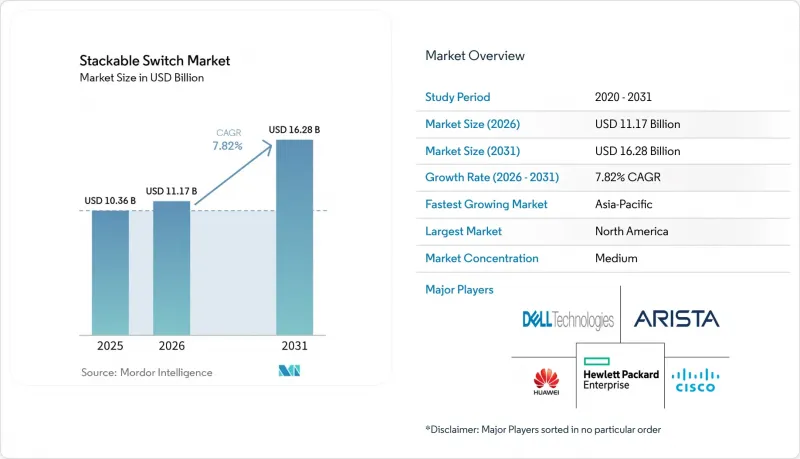
據 Mordor Intelligence 稱,2025 年堆疊式交換機市值為 103.6 億美元,預計到 2031 年將達到 162.8 億美元,而 2026 年為 111.7 億美元,預測期(2026-2031 年)的複合年成長率為 7.82%。
本報告按產品類型(可堆疊管理型交換器和可堆疊非管理型交換器)、連接埠速度(1 GbE 或更低、2.5/5 GbE、10 GbE、25-40 GbE 和 100 GbE 或更高)、連接埠數量(24 個連接埠或更少、48 個連接埠和 48 個連接埠和產業區)。市場預測以美元 (USD) 為單位。
全球可堆疊開關市場趨勢與洞察
透過採用雲端運算和物聯網擴展企業網路
混合雲端架構正推動東西向流量通過園區核心網路,迫使企業為新的交換器堆疊指定 10 Gbps 或 25 Gbps 的上行鏈路。在本地 Kubernetes叢集和公共雲端之間遷移的容器化工作負載需要低於 5 毫秒的延遲。 HPE 的 CX 6000(預計於 2026 年上市)整合了用於線上遙測的 AMD DPU,能夠滿足這項要求。預計到 2025 年,製造業中物聯網設備的密度將達到每 1000 平方英尺 47 個,高於 2023 年的 31 個,這迫使網路負責人部署更多堆疊交換器以維持低於 1 毫秒的抖動。整合的 IT-OT 架構現在承載著視訊監控、門禁控制和建築自動化流量,增加了網路分段的複雜性。透過硬體強制 VLAN 的託管堆疊交換器可以應對這項挑戰。整合 AI 推理引擎進行異常檢測的供應商進一步減輕了人手不足的 IT 團隊的維運負擔。
用於 Wi-Fi 6回程傳輸的多Gigabit(2.5/5 GbE) 端口
儘管 Wi-Fi 6E網路基地台的吞吐量可超過 2 Gbps,但傳統的 1 GbE 上行鏈路限制了禮堂和體育場館等場所的用戶體驗。 IEEE 802.3bz 多千兆埠支援透過現有的 Cat5e/Cat6 線材實現 2.5 Gbps 或 5 Gbps 的通訊,從而避免了昂貴的線纜更換。思科 Catalyst 9200 和 HPE Aruba CX 6300 於 2025 年推出了多千兆型號,加速了教育機構和酒店業的採用。 2025 年底進行的互通性測試證實,在 100 公尺長的 Cat6 線纜上,位元錯誤率低於 10-12,解決了最初對訊號完整性的擔憂。在多Gigabit線路上整合 PoE Type 3 和 Type 4 會帶來散熱方面的限制,迫使交換器製造商重新設計氣流路徑和散熱器。隨著 Wi-Fi 7 試點部署的推進,每個存取點的頻寬限制接近 5Gbps 的地區需求最高。
ASIC供應鏈的不穩定延緩了其部署。
預計2025年下半年,博通和Marvell的前置作業時間將延長至52週,園區現代化工程停滯不前,供應商訂單積壓增加。思科在2025年第三季財報中指出,園區交換器收入下降了8%,並將原因歸咎於半導體短缺。生產集中在少數幾家亞洲代工廠會帶來地緣政治風險,促使Arista和Juniper對某些型號的產品採取雙重採購策略。為了應對這種情況,各公司提前九個月訂購硬體,這佔用了資金並扭曲了季度出貨量數據。如果供不應求持續下去,一些現代化預算可能會從直接購買硬體轉向基於訂閱的管理服務。
細分市場分析
到2025年,可堆疊式管理型交換器將佔總銷售額的64.32%,凸顯了企業對集中式配置和基於SNMP的監控的依賴。此類交換器透過提供非管理型設備所不具備的生命週期自動化和韌體編配,正在推動可堆疊式交換器市場規模的成長。採用三防膠和DIN導軌安裝方式的工業級可堆疊式交換機預計到2031年將以12.52%的複合年成長率成長,這反映了工業4.0的加速普及。
目前,託管型交換器整合了片上人工智慧引擎,能夠偵測異常流量高峰並預測連接埠故障,從而簡化IT負責人有限環境下的操作。工業型交換器將PROFINET、EtherNet/IP和TSN整合到單一平台,減少了工廠機櫃的面積。非託管型交換器仍然應用於小規模辦公室和零售終端,但隨著雲端託管產品價格接近,它們在堆疊式交換器市場的佔有率正在萎縮。
到2025年,速度為1GbE或更低的連接埠將在堆疊式交換器市場佔據重要地位,出貨量佔比高達51.28%。由於其廣泛的應用以及與現有網路基礎設施的兼容性,該細分市場將繼續發揮關鍵作用。然而,隨著Wi-Fi 7試點部署凸顯Gigabit頻寬瓶頸,多Gigabit介面正以18.33%的複合年成長率(CAGR)實現顯著成長。在收發器成本下降以及向下相容線材優勢(可無縫整合到現有系統)的推動下,此速度範圍正成為市場中成長最快的細分市場。
HPE Aruba CX 6300 和 Cisco Catalyst 9200 提供 24 連接埠和 48 連接埠的多GigabitSKU,可無縫整合到現有機架中。資料中心葉層正在向 25 Gbps 和 40 Gbps 過渡,以滿足 NVMe-oF 的吞吐量需求,而 NVIDIA 的 Spectrum-X 則展示了適用於 AI 架構的 400 Gbps 可堆疊模型。自動協商功能可確保多Gigabit連接埠與傳統裝置保持互通性,並支援與折舊免稅額計畫一致的分階段升級。
區域分析
到2025年,北美將佔全球整體銷售額的37.83%,這主要得益於政府網路安全法規和高等教育機構現代化建設的推動。隨著老舊的Cat5e線纜接近使用壽命終點,各機構正在加速線纜升級,同時也進行多Gigabit交換機的升級。此外,HPE收購Juniper後,廠商整合加劇,鞏固了前三大廠商的市場地位,它們目前佔據了約60%的總出貨量。
亞太地區是成長最快的地區,預計到2031年複合年成長率將達到17.67%。中國對數位基礎設施的1.4兆美元投資以及印度300億美元的電子產品激勵措施正在推動超大規模資料中心和智慧工廠的建設。在東協地區,支援PoE供電的監控系統和環境感測器的部署正在城市中穩步推進,這增加了對高功率、高可靠性可堆疊交換器的需求,以支援這些應用。這一趨勢反映了該地區對加強城市基礎設施和智慧城市建設的重視。
歐洲堆疊式交換器市場正受到監管合規性的影響,包括GDPR和強調供應商碳足跡的新永續發展報告標準。德國、法國和英國在堆疊式交換機的應用方面處於領先地位,尤其是在汽車和金融行業,這些行業對低於10微秒的延遲有著強制性要求。這些國家正在利用先進的網路基礎設施來滿足這些產業的嚴格需求。相較之下,南美洲和中東及非洲地區對堆疊式交換機的總投資相對落後。然而,巴西、阿拉伯聯合大公國和南非等國的智慧城市項目和資料中心建設表明,這些地區存在潛在的成長機會。隨著宏觀經濟波動的緩解,這些地區對網路基礎設施的投資可能會增加,從而可能進一步推動市場擴張。
其他好處:
- Excel格式的市場預測(ME)表
- 3個月的分析師支持
目錄
第1章:引言
- 研究假設和市場定義
- 調查範圍
第2章:調查方法
第3章執行摘要
第4章 市場狀況
- 市場概覽
- 市場促進因素
- 透過採用雲端運算和物聯網技術擴展企業網路
- 支援 Wi-Fi 6回程傳輸的多千兆 (2.5/5 GBE) 連接埠
- 物聯網/VoIP終端對PoE的需求日益成長
- 將校園網路升級到 10/25/40 Gb 以太網
- 對簡化擴充性和管理的需求
- 二、三線城市的智慧建築維修
- 市場限制因素
- 底盤型開關的蠶食
- 來自白盒供應商的價格壓力
- 由於ASIC供應鏈波動,部署工作被推遲。
- 由於 SD-WAN 邊緣運算,園區交換器密度降低。
- 產業供應鏈分析
- 技術展望
- 波特五力分析
第5章 市場規模與成長預測
- 依產品類型
- 可堆疊管理型交換機
- 可堆疊式非網管交換機
- 連接埠速度
- 1 GbE 或更低 (10/100/1000)
- 2.5/5 GbE(多千兆)
- 10 GbE
- 25~40 GbE
- 100 GbE 或更高
- 按連接埠數量
- 24個連接埠或更少
- 48個端口
- 48 個或更多端口
- 不同的發展
- 企業園區
- 資料中心機架頂部
- 服務供應商優勢
- 工業網路
- 按最終用戶行業分類
- 政府/國防
- 教育
- 其他終端用戶產業
- 按地區
- 北美洲
- 美國
- 加拿大
- 墨西哥
- 南美洲
- 巴西
- 阿根廷
- 其他南美國家
- 歐洲
- 英國
- 德國
- 法國
- 義大利
- 西班牙
- 俄羅斯
- 其他歐洲國家
- 亞太地區
- 中國
- 日本
- 印度
- 韓國
- 澳洲和紐西蘭
- 其他亞太國家
- 中東和非洲
- 中東
- 阿拉伯聯合大公國
- 沙烏地阿拉伯
- 其他中東國家
- 非洲
- 南非
- 其他非洲國家
- 中東
- 北美洲
第6章 競爭情勢
- 市場集中度
- 策略趨勢
- 市佔率分析
- 公司簡介
- Cisco Systems Inc.
- Hewlett Packard Enterprise(Aruba)
- Huawei Technologies Co. Ltd.
- Arista Networks Inc.
- Dell Technologies Inc.
- Extreme Networks Inc.
- Netgear Inc.
- TP-Link Technologies Co. Ltd.
- Zyxel Communications Corp.
- Broadcom(Brocade Communications)
- D-Link Corporation
- Lenovo Group Ltd.
- MikroTik SIA
- Allied Telesis Holdings KK
- Alcatel-Lucent Enterprise
- Fortinet Inc.
- NVIDIA(Mellanox Switching)
- Edgecore Networks Corp.
- Siemens AG(Industrial Networks)
- Belden Inc.(Hirschmann)
第7章 市場機會與未來展望
According to Mordor Intelligence, the stackable switch market size was valued at USD 10.36 billion in 2025 and estimated to grow from USD 11.17 billion in 2026 to reach USD 16.28 billion by 2031, at a CAGR of 7.82% during the forecast period (2026-2031).
This report is Segmented by Product Type (Stackable Managed Switches, and Stackable Unmanaged Switches), Port Speeds (≤1 GbE, 2. 5/5 GbE, 10 GbE, 25-40 GbE, and ≥100 GbE), Port Counts (≤24 Ports, 48 Ports, and More Than 48 Ports), Deployment (Enterprise Campus, and More), End-User Industry (Government and Defence, and More), and Geography. The Market Forecasts are Provided in Terms of Value (USD).
Global Stackable Switch Market Trends and Insights
Enterprise Network Expansion Via Cloud And IoT Adoption
Hybrid-cloud architectures are flooding campus cores with east-west traffic, prompting enterprises to specify 10 Gbps or 25 Gbps uplinks in new switch stacks. Containerized workloads moving between on-premises Kubernetes clusters and public-cloud regions demand latency under 5 ms, a target met by HPE's CX 6000 launch in 2026 that embeds AMD DPUs for inline telemetry. IoT device density in manufacturing hit 47 endpoints per 1,000 sq ft in 2025, up from 31 in 2023, forcing network planners to deploy additional stackables to preserve sub-millisecond jitter. Converged IT-OT fabrics now carry video surveillance, access control, and building-automation traffic, raising segmentation complexity that managed stackables solve through hardware-enforced VLANs. Vendors embedding AI inference engines for anomaly detection further reduce operational burden in lean IT teams.
Multi-Gig (2.5/5 GbE) Ports For Wi-Fi 6 Backhaul
Wi-Fi 6E access points exceed 2 Gbps throughput, yet legacy 1 GbE uplinks throttle user experience in lecture halls and stadiums. IEEE 802.3bz multi-gig ports deliver 2.5 Gbps or 5 Gbps over existing Cat5e/Cat6, avoiding costly re-cabling. Cisco Catalyst 9200 and HPE Aruba CX 6300 shipped multi-gig variants in 2025, accelerating adoption in education and hospitality. Late-2025 interoperability tests confirmed bit-error rates below 10-12 across 100 m Cat6 runs, addressing early signal-integrity concerns. Integrating PoE Type 3 and Type 4 over multi-gig lines introduces thermal constraints, driving switch makers to redesign airflow paths and heatsinks. Demand is strongest where Wi-Fi 7 pilots are underway and bandwidth ceilings near 5 Gbps per AP.
ASIC Supply-Chain Volatility Delaying Roll-Outs
Broadcom and Marvell lead times stretched to 52 weeks in late 2025, stalling campus refresh projects and inflating vendor backlogs. Cisco cited an 8% revenue dip in campus switching during its fiscal Q3 2025 earnings, attributing the slide to silicon shortages. Concentration of production at a handful of Asian foundries injects geopolitical risk, prompting Arista and Juniper to dual-source select models. Enterprises are countering by ordering hardware nine months ahead of deployment, tying up capital and skewing quarterly shipment data. Persistent scarcity could redirect some refresh budgets toward subscription-based managed services rather than outright hardware purchases.
Other drivers and restraints analyzed in the detailed report include:
- Rising PoE Demand For IoT/VoIP Endpoints
- Campus Upgrades To 10/25/40 Gb Ethernet
- Price Pressure From White-Box Vendors
For complete list of drivers and restraints, kindly check the Table Of Contents.
Segment Analysis
Stackable managed switches generated 64.32% of 2025 revenue, underscoring enterprise reliance on centralized configuration and SNMP-based monitoring. This category anchors the stackable switch market size narrative by offering lifecycle automation and firmware orchestration that unmanaged gear lacks. Industrial stackables, fortified with conformal coatings and DIN-rail mounts, are forecast to expand at a 12.52% CAGR through 2031, reflecting intensified Industry 4.0 rollouts.
Managed models now embed on-chip AI engines that flag anomalous traffic spikes and predict port failures, streamlining operations for lean IT staffs. Industrial variants converge PROFINET, EtherNet/IP, and TSN on a single platform, trimming cabinet footprint on factory floors. Unmanaged units linger in small offices and retail POS lanes but their slice of the stackable switch market is shrinking as cloud-managed offerings approach similar pricing.
In 2025, ports with speeds of ≤1 GbE held a significant position in the stackable switch market, accounting for 51.28% of the shipment share. This segment continues to play a crucial role due to its widespread adoption and compatibility with existing network infrastructure. However, as Wi-Fi 7 pilots highlight gigabit bottlenecks, multi-gig interfaces are experiencing robust growth, with a remarkable CAGR of 18.33%. This speed tier has emerged as the fastest-growing segment in the market, driven by decreasing transceiver costs and the benefit of backward-compatible cabling, which facilitates seamless integration into current systems.
HPE Aruba CX 6300 and Cisco Catalyst 9200 provide 24- and 48-port multi-gig SKUs that slot seamlessly into existing racks. Data-center leaf layers are jumping to 25 Gbps and 40 Gbps to feed NVMe-oF throughput demands, while NVIDIA's Spectrum-X demonstrates 400 Gbps stackables for AI fabrics. Auto-negotiation keeps multi-gig ports interoperable with legacy devices, enabling phased upgrades aligned with depreciation schedules.
Geography Analysis
North America accounted for 37.83% of global revenues in 2025, driven by government cybersecurity mandates and higher-education modernization efforts. The aging Cat5e cabling, approaching its end-of-life, has prompted organizations to synchronize re-cabling efforts with multi-gig switch upgrades. Additionally, vendor consolidation, following HPE's acquisition of Juniper, has strengthened the market position of the top three vendors, who now account for approximately 60% of total shipments.
Asia Pacific is the fastest-growing territory, projected at a 17.67% CAGR to 2031. China's USD 1.4 trillion digital-infrastructure investment and India's USD 30 billion electronics incentive scheme are catalyzing hyperscale data centers and smart-factory build-outs. In ASEAN, cities are increasingly adopting PoE-powered surveillance systems and environmental sensors, which has spurred demand for rugged stackable switches with high power budgets to support these applications. This trend reflects the region's focus on enhancing urban infrastructure and smart city initiatives.
Europe's stackable switch market is shaped by regulatory compliance, including GDPR and new sustainability reporting standards that emphasize vendor carbon footprints. Germany, France, and the United Kingdom are at the forefront of deployments, particularly in the automotive and financial sectors, where sub-10 µs latency is a critical requirement. These countries are leveraging advanced network infrastructure to meet the stringent demands of these industries. In contrast, South America and the Middle East and Africa lag in overall spending on stackable switches. However, isolated smart city projects and data center developments in countries like Brazil, the UAE, and South Africa indicate potential growth opportunities. As macroeconomic volatility subsides, these regions could witness increased investments in network infrastructure, further driving market expansion.
- Cisco Systems Inc.
- Hewlett Packard Enterprise (Aruba)
- Huawei Technologies Co. Ltd.
- Arista Networks Inc.
- Dell Technologies Inc.
- Extreme Networks Inc.
- Netgear Inc.
- TP-Link Technologies Co. Ltd.
- Zyxel Communications Corp.
- Broadcom (Brocade Communications)
- D-Link Corporation
- Lenovo Group Ltd.
- MikroTik SIA
- Allied Telesis Holdings K.K.
- Alcatel-Lucent Enterprise
- Fortinet Inc.
- NVIDIA (Mellanox Switching)
- Edgecore Networks Corp.
- Siemens AG (Industrial Networks)
- Belden Inc. (Hirschmann)
Additional Benefits:
- The market estimate (ME) sheet in Excel format
- 3 months of analyst support
TABLE OF CONTENTS
1 INTRODUCTION
- 1.1 Study Assumptions and Market Definition
- 1.2 Scope of the Study
2 RESEARCH METHODOLOGY
3 EXECUTIVE SUMMARY
4 MARKET LANDSCAPE
- 4.1 Market Overview
- 4.2 Market Drivers
- 4.2.1 Enterprise Network Expansion Via Cloud and IoT Adoption
- 4.2.2 Multi-gig (2.5/5 Gbe) Ports for Wi-fi 6 Backhaul
- 4.2.3 Rising POE Demand for Iot/Voip Endpoints
- 4.2.4 Campus Upgrades to 10/25/40 Gb Ethernet
- 4.2.5 Need For Simplified Scalability and Management
- 4.2.6 Smart-building Retrofits in Tier-2/3 Cities
- 4.3 Market Restraints
- 4.3.1 Cannibalization by Chassis-based Switches
- 4.3.2 Price Pressure From White-box Vendors
- 4.3.3 ASIC Supply-chain Volatility Delaying Roll-outs
- 4.3.4 SD-WAN Edge Lowering Campus Switch Density
- 4.4 Industry Supply-Chain Analysis
- 4.5 Technological Outlook
- 4.6 Porter's Five Forces Analysis
- 4.6.1 Threat of New Entrants
- 4.6.2 Bargaining Power of Suppliers
- 4.6.3 Bargaining Power of Buyers
- 4.6.4 Threat of Substitutes
- 4.6.5 Competitive Rivalry
5 MARKET SIZE AND GROWTH FORECASTS (VALUE)
- 5.1 By Product Type
- 5.1.1 Stackable Managed Switches
- 5.1.2 Stackable Unmanaged Switches
- 5.2 By Port Speeds
- 5.2.1 <=1 GbE (10/100/1000)
- 5.2.2 2.5/5 GbE (Multi-Gig)
- 5.2.3 10 GbE
- 5.2.4 25-40 GbE
- 5.2.5 >=100 GbE
- 5.3 By Port Counts
- 5.3.1 <=24 Ports
- 5.3.2 48 Ports
- 5.3.3 More than 48 Ports
- 5.4 By Deployment
- 5.4.1 Enterprise Campus
- 5.4.2 Data Center Top-of-Rack
- 5.4.3 Service Provider Edge
- 5.4.4 Industrial Networks
- 5.5 By End-user Industry
- 5.5.1 Government and Defence
- 5.5.2 Education
- 5.5.3 Other End-user Industries
- 5.6 By Geography
- 5.6.1 North America
- 5.6.1.1 United States
- 5.6.1.2 Canada
- 5.6.1.3 Mexico
- 5.6.2 South America
- 5.6.2.1 Brazil
- 5.6.2.2 Argentina
- 5.6.2.3 Rest of South America
- 5.6.3 Europe
- 5.6.3.1 United Kingdom
- 5.6.3.2 Germany
- 5.6.3.3 France
- 5.6.3.4 Italy
- 5.6.3.5 Spain
- 5.6.3.6 Russia
- 5.6.3.7 Rest of Europe
- 5.6.4 Asia Pacific
- 5.6.4.1 China
- 5.6.4.2 Japan
- 5.6.4.3 India
- 5.6.4.4 South Korea
- 5.6.4.5 Australia and New Zealand
- 5.6.4.6 Rest of Asia Pacific
- 5.6.5 Middle East and Africa
- 5.6.5.1 Middle East
- 5.6.5.1.1 United Arab Emirates
- 5.6.5.1.2 Saudi Arabia
- 5.6.5.1.3 Rest of the Middle East
- 5.6.5.2 Africa
- 5.6.5.2.1 South Africa
- 5.6.5.2.2 Rest of Africa
- 5.6.5.1 Middle East
- 5.6.1 North America
6 COMPETITIVE LANDSCAPE
- 6.1 Market Concentration
- 6.2 Strategic Moves
- 6.3 Market Share Analysis
- 6.4 Company Profiles (includes Global Overview, Market Overview, Core Segments, Financials, Strategic Information, Market Rank/Share, Products and Services, Recent Developments)
- 6.4.1 Cisco Systems Inc.
- 6.4.2 Hewlett Packard Enterprise (Aruba)
- 6.4.3 Huawei Technologies Co. Ltd.
- 6.4.4 Arista Networks Inc.
- 6.4.5 Dell Technologies Inc.
- 6.4.6 Extreme Networks Inc.
- 6.4.7 Netgear Inc.
- 6.4.8 TP-Link Technologies Co. Ltd.
- 6.4.9 Zyxel Communications Corp.
- 6.4.10 Broadcom (Brocade Communications)
- 6.4.11 D-Link Corporation
- 6.4.12 Lenovo Group Ltd.
- 6.4.13 MikroTik SIA
- 6.4.14 Allied Telesis Holdings K.K.
- 6.4.15 Alcatel-Lucent Enterprise
- 6.4.16 Fortinet Inc.
- 6.4.17 NVIDIA (Mellanox Switching)
- 6.4.18 Edgecore Networks Corp.
- 6.4.19 Siemens AG (Industrial Networks)
- 6.4.20 Belden Inc. (Hirschmann)
7 MARKET OPPORTUNITIES AND FUTURE OUTLOOK
- 7.1 White-Space and Unmet-Need Assessment

 終端射頻交換晶片市場:全球市場預測,2026-2032年聚合物PTC復位熔絲市場:全球市場預測,2026-2032年槳式流量開關市場:全球市場預測,2026-2032年
 顯示矩陣切換器市場報告:趨勢、預測和競爭分析(至2035年)
 2026年全球波長選擇開關市場報告2026年全球正溫度係數(PTC)可重設裝置市場報告開關按鈕市場報告:趨勢、預測與競爭分析(至2035年)2026年全球交換器市場報告基礎開關市場:2026-2032年全球市場預測(依產品類型、安裝方式、額定電壓、額定電流、接點材質、IP防護等級、驅動力及最終用戶產業分類)偵測開關市場:依類型、技術、安裝方式、最終用戶和銷售管道分類-2026-2032年全球市場預測