


 |
市場調查報告書
商品編碼
2063652
液態硬膠囊:市佔率分析、產業趨勢與統計、成長預測(2026-2031)Liquid Filled Hard Capsules - Market Share Analysis, Industry Trends & Statistics, Growth Forecasts (2026 - 2031) |
||||||

※ 本網頁內容可能與最新版本有所差異。詳細情況請與我們聯繫。
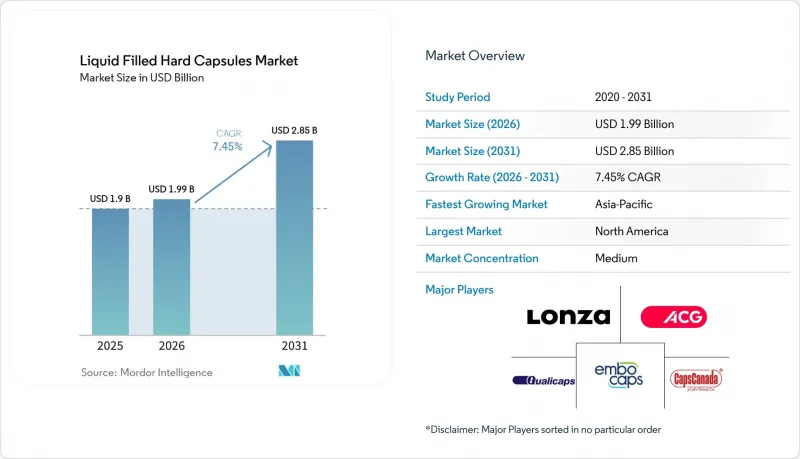
根據 Mordor Intelligence 預測,液體填充硬膠囊市場規模預計將在 2025 年達到 19 億美元,2026 年達到 19.9 億美元,到 2031 年達到 28.5 億美元,2026 年至 2031 年的複合年成長率為 7.45%。
本報告按包衣材料(明膠、羥丙甲纖維素、普魯蘭膠/其他纖維素)、填充狀態(油基液體、懸浮液、半固體/熱熔灌裝等)、密封方式(捆紮、鎖扣等)、最終用途(處方藥、成藥等)、釋放特性(速釋、緩釋)及地區進行細分。市場預測以美元計價。
全球液態填充硬膠囊市場趨勢及洞察
提高水溶性低的原料藥的生物有效性度將加速液體填充技術的應用。
許多新型小分子化合物候選藥物水溶性低,因此研發團隊採用脂質基液體填充策略,例如自乳化藥物遞送系統(SEDDS)和自微乳化藥物遞送系統(SMEDDS),以提高其在胃腸道中的溶解度和吸收率。這些系統將油與界面活性劑和助表面活性劑結合,在接觸腸液後自發形成精細乳液,從而增加面積並實現更可預測的吸收。在液體填充硬膠囊市場,此方法符合降低BCS II類和IV類化合物藥物暴露量變異性的目標。當這些化合物以傳統片劑形式給藥時,其血漿濃度曲線可能存在變異性。
製造商透過選擇避免因潮濕而發生交聯和劣化的膠囊殼,確保這些填充物在保存期限內保持穩定的溶解度。法律規範和藥典標準支持在液體口服製劑中採用品質源於設計 (QbD) 的方法,從而提高此類膠囊劑型開發和放大生產過程的可預測性。因此,在旨在消除因溶解度限制而導致的暴露風險的配方改進研發中,液體填充硬膠囊市場有望獲得更大的佔有率。
營養保健品市場的成長正在推動所有消費族群對膠囊的需求。
消費者仍然偏好易於吞嚥且吸收迅速的單劑量製劑,這推動了零售通路對油類、維生素、酵素和益生菌膠囊製劑的需求。在液態硬膠囊市場,各品牌正利用融合密封和增強的氧氣阻隔層來保護對氧化敏感的活性成分,例如omega-3脂肪酸、Coenzyme Q10和某些植物萃取物,同時增強防篡改功能。益生菌和酵素製劑則採用延遲釋放設計的羥丙甲纖維素(HPMC)膠囊。這種設計使敏感成分能夠克服胃部環境並在腸道中釋放,從而無需額外的包衣過程即可提高療效。
隨著製造商在膠原蛋白和多成分混合物等產品類別中擴大劑量範圍,單次服用規格和服用便利性仍然是決定零售產品包裝和劑型的關鍵因素。這些以用戶為中心的特性為液態填充硬膠囊市場帶來了成長機遇,其中,掩味、穩定性以及潔淨標示膠囊殼認證是關鍵的差異化因素。隨著營養保健品產品組合的多樣化,在膠囊殼、密封和填充方面擁有全面專業知識的供應商能夠迅速將新概念轉化為貨架期穩定的產品。
特殊的密封製程會增加成本和製程複雜性。
在液態填充膠囊中,通常需要採用封口或熔接密封來確保容器和密封系統的完整性,這會增加資本投入和營運負擔,與傳統硬膠囊相比,成本更高。在液態填充硬膠囊市場,形成氣密連續接合的熔接系統提供更優異的保護性能,但需要專用設備、驗證和操作人員技能,並非所有製造地都具備這些條件。隨著生產線日益複雜,企業需要驗證線上控制和檢測流程,以即時確保重量、密封完整性和外觀符合規格。這增加了品管的負擔,並可能導致小批量生產和頻繁更換產品時的技術轉移耗時更長。尋求更優異的防篡改和抗氧化性能的贊助企業可以在保存期限和品質方面獲益,但增加的複雜性可能會在競爭激烈的項目中成為一種負擔。這種權衡影響整個液態填充硬膠囊市場的設施策略和外包選擇。
細分市場分析
截至2025年,明膠膠囊在液態填充硬膠囊市場佔73.24%的佔有率。這得益於成熟的加工基礎設施以及在常用油性填充劑和懸浮液填充劑中溶解特性的良好表現。這個穩固的基礎確保了明膠在避免添加劑化學成分可能導致交聯反應的配方中,仍然是大規模生產項目的核心。贊助公司強調透過利用成熟的明膠供應網路和現場商品搭售工作流程的經驗,實現高效的認證。羥丙基甲基纖維素(HPMC)因其固有的抗醛交聯反應性、低殼水分含量以及適用於緩釋或改良釋放設計,持續快速成長。所有這些因素都增加了配方設計的合格。非基因改造、清真和純素等認證也幫助HPMC為貼標產品開闢了機遇,而這些產品是許多消費品產品系列的核心。在液體填充硬膠囊市場中,明膠的規模經濟與HPMC的功能和標籤優勢之間的動態將繼續影響膠囊殼的選擇決策,直至2031年。
預計到2031年,羥丙甲纖維素(HPMC)的複合年成長率將達到8.51%,因為更多對水敏感的活性藥物成分(API)、益生菌、酶和含溶劑的填充劑正從明膠中轉移出來,以維持穩定性和可預測的釋放。供應商已投資於熱凝膠製程和聚合物工程方面的改進,以實現pH值無關的溶解性,並在所有液體填充劑型中保持性能的一致性。在液體填充硬膠囊產業,這項技術使配方開發人員能夠設計出將緩釋特性與脂質載體結合的產品,同時保持消費者管道的關鍵標籤資訊。明膠仍然適用於穩定的中性pH值油和簡單的懸浮液,而特定產品組合的標準將繼續推動主要買家採用混合籌資策略。隨著時間的推移,受目標產品中對HPMC的信心不斷增強,以及認證來源的擴大,可能會導致植物來源膠囊殼的佔有率逐步增加。
到2025年,油基液體填充劑將佔液體填充硬膠囊市場規模的45.32%,這反映了其在易溶性維生素、油脂和荷爾蒙產品中的核心地位。由於製程簡單、操作穩定且與明膠和羥丙甲纖維素(HPMC)膠囊殼具有廣泛的兼容性,製造商仍然青睞油基載體。對於需要更高溶解度的原料藥(API),相關方案正轉向乳化系統,旨在實現高暴露量並降低患者間差異。液體填充硬膠囊市場在這一領域湧現出最大的配方創新,因為膠囊殼、密封和填充必須作為一個整體協調運作,才能在整個保存期限內保持性能。同時,設備製造商也改進了熱填充和高黏度系統的加工能力、線上控制和溫度控制,以滿足這些嚴格的加工條件。
自乳化藥物遞送系統(SEDDS)/自微乳化藥物遞送系統(SMEDDS)預計到2031年將以9.85%的複合年成長率成長。同行評審的證據表明,脂質微乳能夠提高難溶性活性藥物成分(API)的溶解度和暴露量,這項預測得到了相關證據的支持。奈米級至亞微米級的液滴尺寸控制能力能夠增加界面面積,即使在不同的給藥條件下也能促進藥物的穩定吸收。當活性成分的油溶性較低或半固體基質有效時,懸浮液和熱熔製劑發揮重要作用,但此時,為了控制沉降和溫度變化,穩健的製程控制變得至關重要。隨著開發平臺朝向更複雜的給藥目標發展,能夠整合控制釋放和溶出策略的乳化系統將在液體填充硬膠囊市場中佔據更大的佔有率。
區域分析
預計到2025年,北美將佔據液態填充硬膠囊市場34.56%的佔有率,這得益於其強大的製藥企業基礎、完善的膠囊生產基礎設施以及成熟的口服製劑監管體系。美國現行藥品生產品質管理規範(cGMP)對容器和密封系統完整性的要求和期望,有助於液態填充產品的品質和文件規範化。在氧化穩定性和標籤檢視較高的高階治療和消費品項目中,採用熔封和羥丙甲纖維素(HPMC)外殼的膠囊應用日益廣泛。該地區部署的高通量生產線支援處方藥(Rx)和非處方藥(OTC)的大量生產,為新產品上市和配方改進提供了產能基礎。預計在整個預測期內,這一生態系統將使北美保持其作為重要買家和生產商的地位。
預計到2031年,亞太地區將成為成長最快的地區,複合年成長率(CAGR)達9.32%,這反映出該地區強大的製造能力以及在藥品和膳食補充劑產品線中對優質密封和外殼材料的日益成長的需求。區域供應商和全球跨國公司正在擴大產能和技術規模,以滿足本地和出口需求,並提供更完善的產品。隨著企業推動在地化生產和設備升級,具備線上控制功能的高速生產線在關鍵生產基地已變得十分普遍。羥丙甲纖維素(HPMC)的應用日益廣泛,同時對素食和清真認證的需求也在不斷成長,從而支持了關鍵市場的零售和處方藥(Rx)應用。品質、速度和廣泛的認證選擇相結合,支撐了該地區在液態填充硬膠囊市場的強勁表現。
在歐洲,嚴格的品質標準推動著液體填充、熔封和先進釋放設計等製程經過檢驗的製造商穩步發展。相關措施包括提高包裝和綜合服務的產能,以支持製藥和消費保健產業的客戶。羥丙甲纖維素(HPMC)在需要控制水分的應用場景中得到廣泛應用,並推動了素食和清真標籤的普及。憑藉高標準的文件記錄、萃取物和洗脫測試以及進程內控制,歐洲製造商已建立起能夠滿足複雜液體填充需求的營運模式。因此,該地區在受監管市場中保持著主導地位,同時也滿足了全球液體填充硬膠囊市場的供應需求。
其他好處:
- Excel格式的市場預測(ME)表
- 3個月的分析師支持
目錄
第1章:引言
- 研究假設和市場定義
- 調查範圍
第2章:調查方法
第3章執行摘要
第4章 市場狀況
- 市場概覽
- 市場促進因素
- 提高難溶性活性藥物成分(脂質填充劑、SEDDS/SMEDDS)的生物有效性
- 營養保健品市場成長及消費者對膠囊的偏好
- 提高液體填充和密封精度
- HPMC在對水分敏感的配方和素食配方中的應用
- 高通量膠囊製造系統助力低氟高膽固醇血症(LFHC)規模化生產
- 帶狀/熔接密封提供防篡改保護和優質化。
- 市場限制因素
- 特殊密封會增加成本和製程複雜性。
- 輔料與膠囊殼的相容性,以及監管檢驗的負擔。
- 明膠供應和文化限制導致價格波動。
- 缺乏先進的密封和包裝技術,有氧氣和濕氣滲入的風險。
- 供應鏈分析
- 監理情勢
- 技術展望
- 波特五力模型
第5章 市場規模與成長預測
- 外殼材料
- 明膠
- HPMC
- 普魯蘭膠/其他纖維素
- 填充條件
- 油性液體
- 暫停
- 半固體/熱熔餡料
- 自乳化型(SEDDS/SMEDDS)
- 透過密封方法
- 環志
- 熔合密封/LEMS微噴塗
- 僅鎖定
- 按最終用途
- 處方藥
- OTC
- 營養保健品/膳食補充劑
- 按發布概要
- 立即釋放類型
- 緩釋(長效/腸溶包衣)
- 按地區
- 北美洲
- 美國
- 加拿大
- 墨西哥
- 歐洲
- 德國
- 英國
- 法國
- 義大利
- 西班牙
- 其他歐洲國家
- 亞太地區
- 中國
- 印度
- 日本
- 澳洲
- 韓國
- 其他亞太國家
- 中東和非洲
- GCC
- 南非
- 其他中東和非洲國家
- 南美洲
- 巴西
- 阿根廷
- 其他南美國家
- 北美洲
第6章 競爭情勢
- 市場集中度
- 市佔率分析
- 公司簡介
- ACG
- Aenova Group
- Ascendia Pharmaceutical Solutions
- Catalent, Inc
- CapsCanada
- Farmacapsulas
- HealthCaps India Ltd
- IMA Industria Macchine Automatiche SpA
- Lonza
- MG2 srl
- Qualicaps
- Roxlor LLC
- SaintyCo
- SEJONG PHARMATECH
- Sirio Pharma
- Suheung(EMBO CAPS)
- Sunil HealthCare Limited
- Syntegon Technology GmbH
- Vantage Nutrition
第7章 市場機會與未來展望
According to Mordor Intelligence, the liquid filled hard capsules market size is projected to be USD 1.9 billion in 2025, USD 1.99 billion in 2026, and reach USD 2.85 billion by 2031, growing at a CAGR of 7.45% from 2026 to 2031.
This report is Segmented by Shell Material (Gelatin, HPMC, Pullulan/Other Cellulose), Filling State (Oil-Based Liquids, Suspensions, Semi-solid/Hot-melt Fills, and More), Sealing Method (Banding, Lock-Only, and More), End Use (Rx Pharmaceuticals, OTC, and More), Release Profile (Immediate Release, Modified Release), and Geography. The Market Forecasts are Provided in Terms of Value (USD).
Global Liquid Filled Hard Capsules Market Trends and Insights
Bioavailability Push For Poorly Soluble APIs Drives Liquid-Fill Adoption
A large share of new small-molecule candidates presents low aqueous solubility, which steers development teams toward lipid-based liquid-fill strategies such as SEDDS and SMEDDS to increase dissolution and absorption in the gastrointestinal tract. These systems combine oils with surfactants and co-surfactants to spontaneously form fine emulsions on contact with intestinal fluids, which increases interfacial area and supports more predictable uptake. In the liquid filled hard capsules market, this approach aligns with the objective of reducing variability in drug exposure for BCS Class II and IV compounds, which can otherwise show erratic plasma profiles when delivered as conventional tablets.
Manufacturers pair these fills with shell selections that avoid cross-linking and moisture-driven degradation so that dissolution kinetics remain consistent during shelf life. Regulatory frameworks and compendial standards reinforce quality-by-design practices for liquid oral dosage forms, improving the predictability of development and scale-up paths for these capsule formats. As a result, the liquid filled hard capsules market is positioned to capture a larger share of pipeline reformulations that target solubility-limited exposure.
Nutraceutical Growth Propels Capsule Demand Across Consumer Segments
Consumers continue to prefer single-dose formats that are easy to swallow with perceived faster uptake, which has lifted capsule-based delivery for oils, vitamins, enzymes, and probiotics in retail channels. In the liquid filled hard capsules market, brands are leveraging fusion sealing and enhanced oxygen barriers to protect oxidation-sensitive actives like omega-3, CoQ10, and certain botanicals while also enhancing tamper-evidence. Probiotic and enzyme formulations are adopting HPMC shells with delayed-release designs so that sensitive ingredients survive gastric conditions before releasing in the intestine, which strengthens efficacy positioning without adding a coating operation.
As manufacturers expand dose ranges for categories like collagen or multi-ingredient blends, portion sizes and ease of regimen adherence remain central to packaging and format decisions in retail lines. These user-centric attributes are helping the liquid filled hard capsules market capture growth opportunities where taste masking, stability, and clean-label shell certifications are key differentiators. As nutraceutical portfolios diversify, suppliers with integrated shell, sealing, and fill expertise are positioned to translate new concepts into shelf-stable SKUs at speed.
Specialized Sealing Adds Cost And Process Complexity
Liquid-filled formats often require banding or fusion sealing as part of container-closure integrity, which adds steps that can raise capital and operating burdens compared to conventional hard capsules. In the liquid filled hard capsules market, fusion systems that create hermetic, continuous seams deliver premium protection, yet they call for dedicated equipment, validation, and operator skill that not all sites maintain. As lines become more advanced, firms must validate in-line controls and inspection steps that ensure weight, seal integrity, and appearance meet specifications in real time. This escalates the quality management footprint, which can lengthen tech transfers for smaller batches or frequent SKU changeovers. Sponsors that need premium tamper-evidence and oxidative protection gain shelf-life and quality benefits, but the added complexity may weigh on programs where price competition is tight. The trade-off shapes facility strategies and outsourcing choices across the liquid filled hard capsules market.
Other drivers and restraints analyzed in the detailed report include:
- Advances In Liquid Dosing And Sealing Accuracy
- HPMC Adoption For Moisture-Sensitive And Vegetarian Formulations
- Excipient-Shell Interactions Demand Extensive Validation Protocols
For complete list of drivers and restraints, kindly check the Table Of Contents.
Segment Analysis
Gelatin capsules held 73.24% of the liquid filled hard capsules market share in 2025, supported by mature processing infrastructure and well-understood dissolution behavior across common oil and suspension fills. This installed base keeps gelatin central to high-volume programs where formulations avoid excipient chemistries that could drive cross-linking. Sponsors value streamlined qualification when working with established gelatin supply networks and site-level experience in banding workflows. HPMC continues to expand faster because of inherent resistance to aldehyde-driven cross-linking, lower shell moisture, and its suitability for delayed or modified-release designs, all of which increase formulation headroom. Certification footprints that include non-GMO, halal, and vegan claims also help HPMC unlock labeled product opportunities that are central to many consumer portfolios. Within the liquid filled hard capsules market, the dynamic between gelatin's scale economics and HPMC's functional and labeling advantages will continue to shape shell selection decisions through 2031.
HPMC is projected to post an 8.51% CAGR through 2031 as more moisture-sensitive APIs, probiotics, enzymes, and solvent-containing fills shift away from gelatin to maintain stability and predictable release. Suppliers have invested in thermogelation processes and polymer-engineering advances that deliver pH-independent dissolution and consistent performance across liquid-fill modalities. In the liquid filled hard capsules industry, this capability lets formulators design products that combine delayed-release features with lipid vehicles while maintaining label claims that matter in consumer-facing channels. Gelatin remains a strong fit for stable, neutral-pH oils and simpler suspensions, so portfolio-specific criteria continue to drive hybrid procurement strategies at large buyers. Over time, rising comfort with HPMC in regulated products and the expansion of certified supply may gradually rebalance shares in favor of plant-based shells.
Oil-based liquid fills accounted for 45.32% of the liquid filled hard capsules market size in 2025, reflecting their central role in vitamins, oils, and hormone products where solubilization is straightforward. Operators continue to favor oil vehicles for their process simplicity, stable handling windows, and broad compatibility with both gelatin and HPMC shells. Where APIs demand stronger solubilization, programs migrate toward engineered emulsifying systems that deliver higher exposure with tighter inter-patient variability. This is where the liquid filled hard capsules market is seeing the greatest formulation innovation, because shell, seal, and fill must be tuned together to preserve performance across shelf life. In parallel, equipment providers have improved throughput, in-line control, and temperature management for hot fills and viscous systems that need tight processing windows.
Self-emulsifying SEDDS/SMEDDS are projected to grow at a 9.85% CAGR through 2031, reinforced by peer-reviewed evidence that lipid microemulsions improve solubilization and exposure for difficult APIs. The ability to target droplet sizes in the nano to submicron range increases interfacial area, which helps drive consistent absorption even under variable fed-state conditions. Suspension and hot-melt applications maintain clear roles where actives have low oil solubility or benefit from semi-solid matrices, yet they rely more heavily on robust process controls to manage sedimentation and thermal profiles. As pipelines evolve toward complex delivery goals, the liquid filled hard capsules market will keep allocating greater share to emulsifying systems that can integrate release control with solubilization strategies.
Geography Analysis
North America held 34.56% of the liquid filled hard capsules market in 2025, supported by a strong base of pharmaceutical sponsors, established capsule manufacturing, and mature regulatory systems for oral dosage forms. U.S. cGMP requirements and container-closure integrity expectations have helped standardize quality and documentation practices for liquid-fill programs. Capsules with fusion sealing and HPMC shells are increasing in projects where oxidative stability and label claims support premium therapies and consumer products. The region's installed base of high-throughput lines supports large-volume runs across both Rx and OTC, which anchors capacity for launches and reformulations. This ecosystem positions North America to remain an influential buyer and producer through the forecast window.
Asia-Pacific is projected to be the fastest-growing region at a 9.32% CAGR through 2031, reflecting strong manufacturing capability and increasing adoption of premium sealing and shell options in both pharmaceutical and nutraceutical pipelines. Regional suppliers and global multinationals are expanding capacity and technology stacks to serve local and export demand with higher integrity formats. As sponsors localize production and upgrade equipment, high-speed lines with in-line controls are becoming more common in leading hubs. HPMC adoption is rising alongside demand for vegetarian and halal certification, which supports retail and Rx use cases across major markets. This combination of quality, speed, and certification breadth supports the region's outperformance in the liquid filled hard capsules market.
Europe shows steady growth under rigorous quality standards that favor producers with validated processes for liquid fills, fusion sealing, and advanced release designs. Activity includes capacity additions in packaging and integrated services that support both pharma and consumer health customers. HPMC uptake is strong in use cases that require moisture management or expand labeled claims for vegetarian and halal preferences. With a high bar for documentation, extractables and leachables testing, and in-process controls, European manufacturers have built operating models that align with complex liquid-fill demands. This keeps the region well positioned in regulated markets while also serving global supply needs in the liquid filled hard capsules market.
- ACG Worldwide
- Aenova Group
- Ascendia Pharmaceutical Solutions
- Catalent, Inc
- CapsCanada
- Farmacapsulas
- HealthCaps India Ltd
- I.M.A. Industria Macchine Automatiche S.p.A.
- Lonza Group
- MG2 s.r.l.
- Qualicaps
- Roxlor LLC
- SaintyCo
- SEJONG PHARMATECH
- Sirio Pharma
- Suheung (EMBO CAPS)
- Sunil HealthCare Limited
- Syntegon Technology
- Vantage Nutrition
Additional Benefits:
- The market estimate (ME) sheet in Excel format
- 3 months of analyst support
TABLE OF CONTENTS
1 Introduction
- 1.1 Study Assumptions & Market Definition
- 1.2 Scope of the Study
2 Research Methodology
3 Executive Summary
4 Market Landscape
- 4.1 Market Overview
- 4.2 Market Drivers
- 4.2.1 Bioavailability Push for Poorly Soluble APIs (Lipid-Based Fills, SEDDS/SMEDDS)
- 4.2.2 Nutraceutical Growth and Capsule Preference
- 4.2.3 Advances in Liquid Dosing and Sealing Accuracy
- 4.2.4 HPMC Adoption for Moisture-Sensitive and Vegetarian Formulations
- 4.2.5 High-Throughput Capsule Machinery Enabling LFHC Scale-Up
- 4.2.6 Banding/Fusion Sealing Enabling Tamper-Evidence and Premiumization
- 4.3 Market Restraints
- 4.3.1 Specialized Sealing Adds Cost and Process Complexity
- 4.3.2 Excipient-Shell Compatibility and Regulatory Validation Burdens
- 4.3.3 Gelatin Supply and Cultural Constraints Create Volatility
- 4.3.4 Oxygen/Moisture Ingress Risk Without Advanced Sealing/Packaging
- 4.4 Supply-Chain Analysis
- 4.5 Regulatory Landscape
- 4.6 Technological Outlook
- 4.7 Porter's Five Forces
- 4.7.1 Threat of New Entrants
- 4.7.2 Bargaining Power of Suppliers
- 4.7.3 Bargaining Power of Buyers
- 4.7.4 Threat of Substitutes
- 4.7.5 Competitive Rivalry
5 Market Size & Growth Forecasts (Value, USD)
- 5.1 By Shell Material
- 5.1.1 Gelatin
- 5.1.2 HPMC
- 5.1.3 Pullulan / Other Cellulose
- 5.2 By Filling State
- 5.2.1 Oil-based liquids
- 5.2.2 Suspensions
- 5.2.3 Semi-solid / Hot-melt fills
- 5.2.4 Self-emulsifying (SEDDS/SMEDDS)
- 5.3 By Sealing Method
- 5.3.1 Banding
- 5.3.2 Fusion sealing / LEMS microspray
- 5.3.3 Lock-only
- 5.4 By End Use
- 5.4.1 Rx Pharmaceuticals
- 5.4.2 OTC
- 5.4.3 Nutraceuticals / Dietary Supplements
- 5.5 By Release Profile
- 5.5.1 Immediate Release
- 5.5.2 Modified Release (Sustained / Enteric)
- 5.6 By Geography
- 5.6.1 North America
- 5.6.1.1 United States
- 5.6.1.2 Canada
- 5.6.1.3 Mexico
- 5.6.2 Europe
- 5.6.2.1 Germany
- 5.6.2.2 United Kingdom
- 5.6.2.3 France
- 5.6.2.4 Italy
- 5.6.2.5 Spain
- 5.6.2.6 Rest of Europe
- 5.6.3 Asia-Pacific
- 5.6.3.1 China
- 5.6.3.2 India
- 5.6.3.3 Japan
- 5.6.3.4 Australia
- 5.6.3.5 South Korea
- 5.6.3.6 Rest of Asia-Pacific
- 5.6.4 Middle East and Africa
- 5.6.4.1 GCC
- 5.6.4.2 South Africa
- 5.6.4.3 Rest of Middle East and Africa
- 5.6.5 South America
- 5.6.5.1 Brazil
- 5.6.5.2 Argentina
- 5.6.5.3 Rest of South America
- 5.6.1 North America
6 Competitive Landscape
- 6.1 Market Concentration
- 6.2 Market Share Analysis
- 6.3 Company Profiles {(includes Global level Overview, Market level overview, Core Segments, Financials as available, Strategic Information, Market Rank/Share for key companies, Products & Services, and Recent Developments)}
- 6.3.1 ACG
- 6.3.2 Aenova Group
- 6.3.3 Ascendia Pharmaceutical Solutions
- 6.3.4 Catalent, Inc
- 6.3.5 CapsCanada
- 6.3.6 Farmacapsulas
- 6.3.7 HealthCaps India Ltd
- 6.3.8 I.M.A. Industria Macchine Automatiche S.p.A.
- 6.3.9 Lonza
- 6.3.10 MG2 s.r.l.
- 6.3.11 Qualicaps
- 6.3.12 Roxlor LLC
- 6.3.13 SaintyCo
- 6.3.14 SEJONG PHARMATECH
- 6.3.15 Sirio Pharma
- 6.3.16 Suheung (EMBO CAPS)
- 6.3.17 Sunil HealthCare Limited
- 6.3.18 Syntegon Technology GmbH
- 6.3.19 Vantage Nutrition
7 Market Opportunities & Future Outlook
- 7.1 White-space & Unmet-need Assessment


