


 |
市場調查報告書
商品編碼
2063407
自主通訊網路:市場佔有率分析、產業趨勢與統計、成長預測(2026-2031)Autonomous Telecom Networks - Market Share Analysis, Industry Trends & Statistics, Growth Forecasts (2026 - 2031) |
||||||

※ 本網頁內容可能與最新版本有所差異。詳細情況請與我們聯繫。
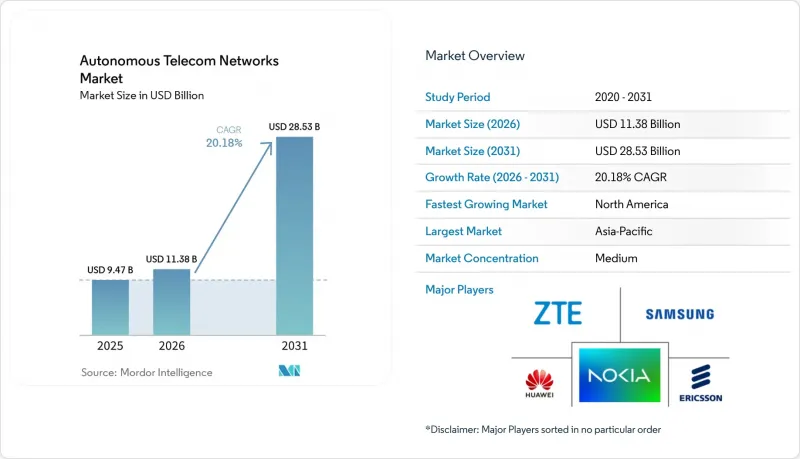
根據 Mordor Intelligence 預測,自主通訊網路市場規模將從 2025 年的 94.7 億美元和 2026 年的 113.8 億美元成長到 2031 年的 285.3 億美元,2026 年至 2031 年的年複合成長率(CAGR)為 20.18%。
本報告按組件(解決方案和服務)、網路層(無線接取網路、核心網路等)、部署模式(本地部署、雲端部署、混合部署)、最終用戶(一級行動網路營運商、二級和三級行動網路營運商等)以及地區進行細分。市場預測以價值(美元)表示。
全球自主通訊網路市場趨勢及洞察
5G網路日益複雜且流量龐大
第五代獨立組網(SA)網路在現有4G基礎設施的基礎上,融合了動態頻譜共享、大規模MIMO波束賦形和多切面編配技術。 Verizon計畫在2025年在15個大都會圈部署無線接取網路(RAN)智慧控制器,屆時4萬個行動通訊基地台的人工干預將減少68%。德國電信計畫在2025年每天處理23億次無線電測量數據,將人口密集都市區頻譜效率提升22%。隨著3GPP標準第18版(將於2024年最終定稿)強制要求在整個5G核心網中整合人工智慧/機器學習(AI/ML)介面,通訊業者若不將預測分析融入日常運營,將面臨落後於快速變化的競爭對手的風險。
降低營運成本的需求日益成長
儘管每位用戶平均收入保持不變,但5G網路密度的增加推高了電力成本、基地台租金和回程傳輸成本。西班牙電信(Telefónica)的AI故障預測程序在2025年前減少了12,000次現場服務呼叫,並將網路營運成本降低了30%。同年, 橘子透過自動化參數調整,將營運效率提高了25%。 2026年初,TELUS報告稱,平均修復時間(MTTR)縮短了40%,每GB能耗降低了18%,這意味著每年可節省8,900萬美元的成本。這些結果表明,自主工作流程可以將網路成長與人員增加分開。
人工智慧平台的大量初始投資
根據愛立信的估計,擁有5萬個基地台的一級營運商需要花費1500萬至3000萬美元來部署包含GPU伺服器和專業服務的智慧自動化平台。 Mavenir公司針對衛星電視網路的開放式無線存取網(Open RAN)計畫於2024年推出,即使在網路流量開始流動之前,其成本也已超過5,000萬美元。因此,二級通訊業者更傾向於計量型的合約模式,但即便如此,部署後前三年的總擁有成本仍比傳統架構高出40%至60%。
細分市場分析
到2025年,解決方案收入佔比將達到65.53%,但由於通訊業者在多廠商整合方面面臨挑戰和技能短缺,預計服務業務的複合年成長率將達到22.02%。 IBM透過制定藍圖,整合了傳統開源軟體、新興開放API和管治策略,從而在2025年獲得了超過2億美元的合約。因此,經常性服務費佔Netcracker收入的60%,毛利率超過40%。這證實了客製化整合和託管營運是與平台授權同等重要的利潤來源。
由於可重複使用的人工智慧模型和離岸交付中心,服務供應商的利潤率正在提升。隨著通訊業者將支出從資本支出 (Capex) 轉向營運支出 (OpEx),供應商能夠多次實現其智慧財產權的變現。Accenture,到 2026 年,電信業的託管業務收益將年增 34%,這與確保供應商在自主網路整個生命週期內參與的五年合約密切相關。因此,儘管解決方案仍佔據絕對最大佔有率,但自主電信網路市場中託管營運的市場規模成長速度超過了平台收入。
就2025年的收入而言,無線接取自動化將佔據最大佔有率,達到38.73%,但邊緣編配預計將以23.66%的複合年成長率超越所有其他層,這主要得益於企業對低於10毫秒延遲的需求。三星的AI RAN引擎將在2025年將Verizon和KDDI的小區邊緣吞吐量提升18%。 NEC的邊緣AI節點將推理處理更靠近生產線,已經幫助汽車製造商在即時影片分析方面達到六標準差品質目標。
儘管無線存取網(RAN)仍然是自主通訊網路領域最大的市場佔有率,但隨著微型資料中心在工廠、港口、體育場館和其他場所的部署,邊緣運算能力相關的市場規模正在迅速擴張。據瞻博網路(Juniper)稱,其傳輸自動化套件透過重新路由流量以繞過擁塞熱點,可將封包遺失降低 42%,這表明即使在不太顯眼的回程傳輸領域,人工智慧也能產生顯著影響。
區域分析
北美地區在2025年貢獻了36.21%的收入,預計到2031年將以19.8%的年均成長率成長。美國通訊業者已開始將5G獨立組網流量遷移到人工智慧驅動的核心網,而加拿大通訊業者已投資超過20億加幣用於自動化,以擴大覆蓋範圍至人口密度較低的省份。此外,開放式無線接取網路(Open RAN)的採購獎勵也推動了該地區的發展,這些措施減少了供應商鎖定,並鼓勵對雲端原生技術堆疊進行試驗。
預計到2031年,亞太地區將達到23.52%的最高成長率。中國移動計畫在2025年將人工智慧最佳化技術應用於超過百萬個基地台,頻譜效率提升15%。日本NTT Docomo經營一個覆蓋8萬個地點的人工智慧網路營運中心,韓國SK Telecom每年透過人工智慧驅動的網路切片技術創造超過1.12億美元的收入。印度Bharti Airtel和Reliance Jio計劃在2025年投資約12億美元用於自動化項目,凸顯了該地區的規模。
預計到2025年,歐洲將佔總支出的約22%,年複合成長率(CAGR)預估為18.5%,主要得益於強制能源效率和安全法規加速了自動化進程。德國電信的混合雲端網路在三個國家實現了99.99%的可用性,而沃達豐則透過預測性維護將現場回應時間縮短了35%。中東和非洲地區目前佔總收入的6%,這主要得益於沙烏地阿拉伯的智慧城市計畫以及阿拉伯聯合大公國的計畫。另一方面,拉丁美洲目前僅佔4%,但隨著通訊業者降低營運成本(OPEX),該地區的成長勢頭強勁。
其他好處:
- Excel格式的市場預測(ME)表
- 3個月的分析師支持
目錄
第1章:引言
- 研究假設和市場定義
- 調查範圍
第2章:調查方法
第3章執行摘要
第4章 市場狀況
- 市場概覽
- 市場促進因素
- 5G網路日益複雜,流量不斷成長。
- 降低營運成本的需求日益成長
- 熟練的網路工程師短缺
- 遷移到雲端原生服務架構
- RAN智慧型控制器(RIC)自動化實施
- 多廠商開放式無線存取網互通性需求
- 市場限制因素
- 人工智慧平台的大量初始投資
- 資料隱私和網路安全問題
- 整合舊有系統的複雜性
- 演算法偏差與可解釋性風險
- 產業價值鏈分析
- 監理情勢
- 技術展望
- 宏觀經濟因素的影響
- 波特五力分析
第5章 市場規模與成長預測
- 按組件
- 解決方案
- 服務
- 網路層
- 無線接取網路(RAN)
- 核心網路
- 交通網路
- 邊緣網路
- 端對端編配
- 部署模式
- 現場
- 雲
- 混合
- 最終用戶
- 一級行動網路營運商
- 二線和三線行動網路營運商
- 行動虛擬網路營運商(MVNO)
- 私有網路所有者(按公司和行業分類)
- 中立主機提供商
- 按地區
- 北美洲
- 美國
- 加拿大
- 墨西哥
- 南美洲
- 巴西
- 阿根廷
- 其他南美國家
- 歐洲
- 德國
- 英國
- 法國
- 義大利
- 西班牙
- 俄羅斯
- 其他歐洲國家
- 亞太地區
- 中國
- 日本
- 印度
- 韓國
- 澳洲
- 其他亞太國家
- 中東和非洲
- 中東
- 阿拉伯聯合大公國
- 沙烏地阿拉伯
- 土耳其
- 其他中東國家
- 非洲
- 南非
- 埃及
- 奈及利亞
- 其他非洲國家
- 中東
- 北美洲
第6章 競爭情勢
- 市場集中度
- 策略趨勢
- 市佔率分析
- 公司簡介
- Telefonaktiebolaget LM Ericsson
- Nokia Corporation
- Huawei Technologies Co., Ltd.
- ZTE Corporation
- Samsung Electronics Co., Ltd.
- NEC Corporation
- Cisco Systems, Inc.
- Juniper Networks, Inc.
- Hewlett Packard Enterprise Company
- IBM Corporation
- Netcracker Technology Corporation
- Amdocs Limited
- Mavenir Systems, Inc.
- Parallel Wireless, Inc.
- AirHop Communications, Inc.
- Cellwize Wireless Technologies Pte Ltd.
- PI Works Inc.
- TEOCO Corporation
- Commsquare SA
第7章 市場機會與未來展望
According to Mordor Intelligence, the autonomous telecom networks market size is projected to expand from USD 9.47 billion in 2025 and USD 11.38 billion in 2026 to USD 28.53 billion by 2031, registering a CAGR of 20.18% between 2026 to 2031.
This report is Segmented by Component (Solutions and Services), Network Layer (Radio Access Network, Core Network, and More), Deployment Mode (On-Premises, Cloud, and Hybrid), End User (Tier-1 MNOs, Tier-2 and Tier-3 MNOs, and More), and Geography. The Market Forecasts are Provided in Terms of Value (USD).
Global Autonomous Telecom Networks Market Trends and Insights
Rising 5G Network Complexity and Traffic Volume
Fifth-generation standalone networks layer dynamic spectrum sharing, massive-MIMO beam steering, and multi-slice orchestration on top of existing 4G infrastructure. Verizon deployed RAN intelligent controllers across 15 metropolitan areas in 2025 and cut manual intervention on 40,000 cell sites by 68%. Deutsche Telekom processed 2.3 billion radio measurements per day in 2025, boosting spectral efficiency by 22% in dense urban areas. Release 18 of the 3GPP standard, finalized in 2024, now mandates AI/ML interfaces throughout the 5G core, compelling operators to embed predictive analytics within routine workflows or risk falling behind faster-moving rivals.
Escalating OPEX Reduction Imperatives
Average revenue per user remains flat, yet 5G densification raises electricity, site leasing, and backhaul expenses. Telefonica's AI fault-prediction program removed 12,000 truck rolls and cut network OPEX by 30% in 2025. Orange lifted operational efficiency by 25% after automating parameter tuning in the same year. In early 2026, TELUS reported a 40% reduction in mean-time-to-repair and an 18% drop in energy consumption per gigabyte, equating to USD 89 million in annual savings. These gains illustrate how autonomous workflows decouple network growth from headcount growth.
High Upfront Investment in AI Platforms
Ericsson estimates that a Tier-1 carrier with 50,000 sites spends USD 15 million to USD 30 million to roll out its intelligent automation platform, including GPU servers and professional services. Mavenir's 2024 Open RAN project at Dish Network exceeded USD 50 million before network traffic even flowed. Tier-2 operators therefore prefer consumption-based contracts, yet the total cost of ownership in the first three years still runs 40% to 60% above that of traditional architectures.
Other drivers and restraints analyzed in the detailed report include:
- Shortage of Skilled Network Engineers
- Transition to Cloud-Native Service-Based Architectures
- Data Privacy and Cyber-Security Concerns
For complete list of drivers and restraints, kindly check the Table Of Contents.
Segment Analysis
Solutions accounted for 65.53% of revenue in 2025, yet services are forecast to expand at a 22.02% CAGR as operators confront multivendor integration challenges and skill shortages. IBM captured contracts worth more than USD 200 million in 2025 by drafting roadmaps that aligned legacy OSS, emerging open APIs, and governance policies. As a result, recurring service fees now represent 60% of Netcracker's revenue mix with gross margins above 40%, confirming that bespoke integration and managed operations have become a profit pool equal to platform licenses.
Vendor margins on services benefit from reusable AI models and offshore delivery hubs, letting providers monetize intellectual property several times over while operators shift spend from capex to opex. Accenture saw telecommunications managed-service revenue climb 34% year over year in 2026, tied to five-year engagements that lock in vendor participation across the life of an autonomous network. The autonomous telecom networks market size for managed operations is therefore rising faster than platform revenue, even though solutions remain the largest absolute bucket.
Radio access automation accounted for the largest share of 2025 revenue at 38.73%, but edge orchestration is projected to outpace every other layer with a 23.66% CAGR, driven by enterprise demand for sub-10-millisecond latency. Samsung's AI RAN engine boosted cell-edge throughput by 18% for Verizon and KDDI during 2025. NEC's edge AI nodes bring inference closer to production lines and have already enabled car manufacturers to meet six-sigma quality targets in real-time video analytics.
While the autonomous telecom networks market share remains highest in the RAN, the market size linked to edge functions is growing rapidly as factories, ports, and stadiums deploy micro data centers. Juniper says its transport automation suite reduced packet loss by 42% by rerouting traffic around congestion hotspots, demonstrating that AI's impact is meaningful even in the less visible backhaul domain.
Geography Analysis
North America, which accounted for 36.21% of 2025 revenue, is forecast to compound at 19.8% annually through 2031. U.S. carriers have already moved 5G standalone traffic onto AI-driven cores, while Canadian operators invested more than CAD 2 billion in automation to extend coverage into sparsely populated provinces. The region also benefits from Open RAN procurement incentives that reduce vendor lock-in and encourage experimentation with cloud-native stacks.
Asia-Pacific is on course to deliver the fastest expansion at 23.52% through 2031. China Mobile applied AI optimization to more than 1 million cell sites in 2025, boosting spectral efficiency by 15%. Japan's NTT DOCOMO runs an AI network operations center covering 80,000 sites, and South Korea's SK Telecom earns over USD 112 million annually from AI-enabled network slices. India's Bharti Airtel and Reliance Jio together invested roughly USD 1.2 billion in 2025 automation projects, highlighting the region's scale.
Europe held about 22% of 2025 spending and should post an 18.5% CAGR as energy-efficiency mandates and security rules accelerate automation. Deutsche Telekom's hybrid cloud network achieved 99.99% availability across three countries, while Vodafone cut truck rolls by 35% through predictive maintenance. The Middle East and Africa account for 6% of current revenue, driven by Saudi Arabia's smart-city initiatives and United Arab Emirates projects, whereas Latin America lags at 4% but is gaining momentum as carriers seek OPEX relief.
- Telefonaktiebolaget LM Ericsson
- Nokia Corporation
- Huawei Technologies Co., Ltd.
- ZTE Corporation
- Samsung Electronics Co., Ltd.
- NEC Corporation
- Cisco Systems, Inc.
- Juniper Networks, Inc.
- Hewlett Packard Enterprise Company
- IBM Corporation
- Netcracker Technology Corporation
- Amdocs Limited
- Mavenir Systems, Inc.
- Parallel Wireless, Inc.
- AirHop Communications, Inc.
- Cellwize Wireless Technologies Pte Ltd.
- P.I. Works Inc.
- TEOCO Corporation
- Commsquare SA
Additional Benefits:
- The market estimate (ME) sheet in Excel format
- 3 months of analyst support
TABLE OF CONTENTS
1 INTRODUCTION
- 1.1 Study Assumptions and Market Definition
- 1.2 Scope of the Study
2 RESEARCH METHODOLOGY
3 EXECUTIVE SUMMARY
4 MARKET LANDSCAPE
- 4.1 Market Overview
- 4.2 Market Drivers
- 4.2.1 Rising 5G Network Complexity and Traffic Volume
- 4.2.2 Escalating OPEX Reduction Imperatives
- 4.2.3 Shortage of Skilled Network Engineers
- 4.2.4 Transition to Cloud-Native Service-Based Architectures
- 4.2.5 Adoption of RAN Intelligent Controller (RIC) Automation
- 4.2.6 Multi-Vendor Open RAN Interoperability Requirements
- 4.3 Market Restraints
- 4.3.1 High Upfront Investment in AI Platforms
- 4.3.2 Data Privacy and Cyber-Security Concerns
- 4.3.3 Legacy Integration Complexity
- 4.3.4 Algorithmic Bias and Explainability Risks
- 4.4 Industry Value Chain Analysis
- 4.5 Regulatory Landscape
- 4.6 Technological Outlook
- 4.7 Impact of Macroeconomic Factors
- 4.8 Porter's Five Forces Analysis
- 4.8.1 Bargaining Power of Suppliers
- 4.8.2 Bargaining Power of Buyers
- 4.8.3 Threat of New Entrants
- 4.8.4 Threat of Substitutes
- 4.8.5 Competitive Rivalry
5 MARKET SIZE AND GROWTH FORECASTS (VALUE)
- 5.1 By Component
- 5.1.1 Solutions
- 5.1.2 Services
- 5.2 By Network Layer
- 5.2.1 Radio Access Network (RAN)
- 5.2.2 Core Network
- 5.2.3 Transport Network
- 5.2.4 Edge Network
- 5.2.5 End-to-End Orchestration
- 5.3 By Deployment Mode
- 5.3.1 On-Premises
- 5.3.2 Cloud
- 5.3.3 Hybrid
- 5.4 By End User
- 5.4.1 Tier-1 Mobile Network Operators
- 5.4.2 Tier-2 and Tier-3 Mobile Network Operators
- 5.4.3 Mobile Virtual Network Operators (MVNOs)
- 5.4.4 Private Network Owners (Enterprises and Verticals)
- 5.4.5 Neutral Host Providers
- 5.5 By Geography
- 5.5.1 North America
- 5.5.1.1 United States
- 5.5.1.2 Canada
- 5.5.1.3 Mexico
- 5.5.2 South America
- 5.5.2.1 Brazil
- 5.5.2.2 Argentina
- 5.5.2.3 Rest of South America
- 5.5.3 Europe
- 5.5.3.1 Germany
- 5.5.3.2 United Kingdom
- 5.5.3.3 France
- 5.5.3.4 Italy
- 5.5.3.5 Spain
- 5.5.3.6 Russia
- 5.5.3.7 Rest of Europe
- 5.5.4 Asia-Pacific
- 5.5.4.1 China
- 5.5.4.2 Japan
- 5.5.4.3 India
- 5.5.4.4 South Korea
- 5.5.4.5 Australia
- 5.5.4.6 Rest of Asia-Pacific
- 5.5.5 Middle East and Africa
- 5.5.5.1 Middle East
- 5.5.5.1.1 United Arab Emirates
- 5.5.5.1.2 Saudi Arabia
- 5.5.5.1.3 Turkey
- 5.5.5.1.4 Rest of Middle East
- 5.5.5.2 Africa
- 5.5.5.2.1 South Africa
- 5.5.5.2.2 Egypt
- 5.5.5.2.3 Nigeria
- 5.5.5.2.4 Rest of Africa
- 5.5.5.1 Middle East
- 5.5.1 North America
6 COMPETITIVE LANDSCAPE
- 6.1 Market Concentration
- 6.2 Strategic Moves
- 6.3 Market Share Analysis
- 6.4 Company Profiles (includes Global level Overview, Market level overview, Core Segments, Financials as available, Strategic Information, Market Rank/Share for key companies, Products and Services, and Recent Developments)
- 6.4.1 Telefonaktiebolaget LM Ericsson
- 6.4.2 Nokia Corporation
- 6.4.3 Huawei Technologies Co., Ltd.
- 6.4.4 ZTE Corporation
- 6.4.5 Samsung Electronics Co., Ltd.
- 6.4.6 NEC Corporation
- 6.4.7 Cisco Systems, Inc.
- 6.4.8 Juniper Networks, Inc.
- 6.4.9 Hewlett Packard Enterprise Company
- 6.4.10 IBM Corporation
- 6.4.11 Netcracker Technology Corporation
- 6.4.12 Amdocs Limited
- 6.4.13 Mavenir Systems, Inc.
- 6.4.14 Parallel Wireless, Inc.
- 6.4.15 AirHop Communications, Inc.
- 6.4.16 Cellwize Wireless Technologies Pte Ltd.
- 6.4.17 P.I. Works Inc.
- 6.4.18 TEOCO Corporation
- 6.4.19 Commsquare SA
7 MARKET OPPORTUNITIES AND FUTURE OUTLOOK
- 7.1 White-Space and Unmet-Need Assessment

 自主通訊交通控制市場預測至2034年-按組件、部署模式、技術、應用、最終用戶和地區分類的全球分析
 利用數位孿生技術突破自主網路中的跨域障礙
 自主網路市場規模、佔有率和趨勢分析報告:按組件類型、部署模型類型、組織規模、最終用戶、地區和細分市場預測(2026-2033 年)
 自治網路市場:按組件、網路類型、部署和應用程式分類-2026-2032年全球市場預測
 自主網路市場規模、佔有率和成長分析(按產品類型、部署模式、組織規模、最終用戶和地區分類)-2026-2033年產業預測
 自主聯網超級高鐵市場規模、佔有率和成長分析(按應用、組件、系統類型和地區分類)-2026-2033年產業預測
 全球自主網路市場
 按組件、應用、公司規模、最終用途產業、地區、機會和預測對全球自主網路市場進行評估(2018 至 2032 年)