


 |
市場調查報告書
商品編碼
2063342
物料輸送設備遠端資訊處理:市場佔有率分析、產業趨勢與統計資料、成長預測(2026-2031 年)Material Handling Equipment Telematics - Market Share Analysis, Industry Trends & Statistics, Growth Forecasts (2026 - 2031) |
||||||

※ 本網頁內容可能與最新版本有所差異。詳細情況請與我們聯繫。
根據 Mordor Intelligence 預測,物料輸送設備遠端資訊處理市場將從 2025 年的 72.9 億美元成長到 2026 年的 84.1 億美元,到 2031 年達到 171.7 億美元,2026 年至 2031 年的複合年成長率為 15.35%。
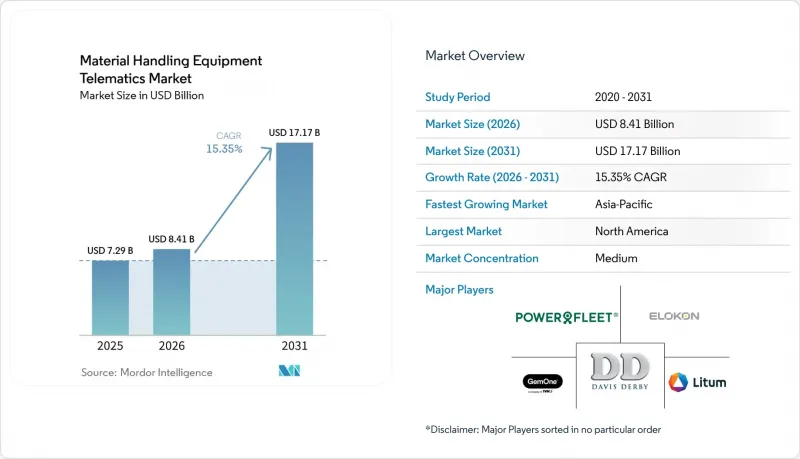
本報告按設備類型(堆高機、起重機、自動導引運輸車(AGV) 及其他)、解決方案類型(資產追蹤、車隊管理及其他)、最終用戶產業(製造業、物流倉儲業及其他)、技術(GPS、物聯網感測器、基於人工智慧的預測系統及其他)和地區進行細分。市場預測以美元 (USD) 為單位。
全球物料輸送設備遠端資訊處理市場趨勢與洞察
倉庫自動化與日益密集的電子商務履約
在日益嚴格的產能目標和更高的設備密度下,物料輸送設備遠端資訊處理市場在倉庫環境中正蓬勃發展。隨著設施自動化程度的提高,管理人員需要持續監控更多資產,以便即時了解運轉率、擁塞區域和安全事件。這種需求促使遠端資訊處理的應用範圍從位置追蹤擴展到更廣泛的控制,整體堆高機、機器人和碼頭作業。據 OneTrack 稱,人工智慧驅動的車隊智慧可以透過識別過剩產能和運轉率的設備,將車隊成本降低 15% 至 25%。這與目前最佳化車隊規模的趨勢相符。在高密度履約環境中,未監控的設備會帶來更大的營運風險,而物料輸送設備遠端資訊處理市場正在積極應對這項變化。因此,遠端資訊處理不再只是一種監控工具,而是正在成為自動化倉庫營運邏輯中不可或缺的一部分。
提高車隊運轉率和減少停機時間的需求日益成長
在倉庫和工廠營運中,快速反應至關重要,而可避免的停機造成的成本增加也推動了物料輸送設備遠端資訊處理市場的發展。營運商越來越需要能夠顯示哪些車輛處於閒置狀態、哪些設備超載以及維護風險累積位置的系統,從而在故障導致班次中斷之前就進行預防。這使得採購重點從單純的可見性轉向運轉率管理和預防措施。 MHS Lift 指出,堆高機車隊的預測性維護依賴於對機器健康指標的持續監控,使團隊能夠在問題升級為故障之前加以解決。從實際角度來看,物料輸送設備遠端資訊處理市場正在蓬勃發展,因為合理的選用和維護計劃通常比大規模自動化專案更快地帶來價值。這種更短的投資回報週期使得遠端資訊處理技術在需要快速提高營運效率的設施中更具合理性。
維修、整合和變更管理成本高。
高昂的維修和整合成本是物料輸送設備遠端資訊處理市場發展的一大障礙,尤其對於擁有老舊設備或多品牌車隊的營運商更是如此。雖然工廠預裝系統易於部署,但許多車隊所有者仍然依賴傳統設備,需要額外的硬體、客製化佈線和協議橋接器來實現數據標準化。當遠端資訊處理系統需要與倉庫管理系統、ERP 工具和特定站點的流程規則協同工作時,整合難度會進一步增加。挑戰不僅限於資本投入;當主管、技術人員和操作員必須同時採用新的數位化流程時,變更管理的負擔也會加重。由於缺乏內部 IT 和 OT 支持,小規模業者往往感受到更大的壓力。即使遠端資訊處理的長期效益顯而易見,這些成本和實施障礙也會延緩決策過程。
細分市場分析
預計到2025年,堆高機將佔據物料輸送設備遠端資訊處理市場41.28%的佔有率,成為最大的設備類別,因為它們在物流、製造、零售和低溫運輸營運中持續發揮核心作用。這一主導地位也反映了原始設備製造商(OEM)長期以來對嵌入式連接、操作員管理工具和服務整合資料層的投入。雷蒙德公司表示,其iWAREHOUSE Enterprise系統將車輛認證管理、碰撞通知和電池分析整合到一個統一的車隊智慧平台。豐田物料輸送也將MyInsights定位為原生遠端資訊處理層,支援連網堆高機的合規性、使用情況可視性和電池相關監控。雖然起重機、加長型堆高機和場內車輛在物料輸送設備遠端資訊處理市場中擴大採用遠端資訊處理功能,但它們的部署基礎設施不如堆高機標準化。這種差異使得堆高機在大多數車隊數位化專案中仍然處於核心地位。
預計到2031年,AGV(自動導引運輸車)的複合年成長率將達到15.41%,使其成為物料輸送設備遠端資訊處理市場中成長最快的設備類別。 AGV系統對遠端資訊處理的需求與其他系統截然不同,因為它們依賴於通道配置、電池狀態、交通邏輯和任務分配的持續調整。 KINEXON表示,其面向AMR和AGV環境的車隊管理系統支援集中式編配,並符合VDA 5050標準,這反映了車隊控制轉變為軟體主導的趨勢。這一點意義重大,因為AGV的成長不僅意味著連網車輛數量的增加,更意味著遠端資訊處理在主動式物流物流控制中的作用不斷擴展。因此,物料輸送設備遠端資訊處理產業正從以操作員為中心的堆高機監控擴展到覆蓋整個自動駕駛車隊的機器到系統(M2S)編配。高空作業平台和土木工程施工機械在室內或半室內環境中的應用雖然規模較小,但卻是一個新興領域,供應商正在調整遠端資訊處理技術以滿足日益複雜的基於位置的需求。
到2025年,車隊管理將佔物料輸送設備遠端資訊處理市場34.36%的佔有率,其作為大多數部署方案中基礎解決方案層的角色也將得到鞏固。買家通常仍會先部署資產視覺性、操作員認證、數位化檢查和使用情況儀錶板等功能,然後再逐步擴展到更高階的分析功能。這種順序至關重要,因為這些基本功能是後續安全、維護和生產力提升應用的基礎。豐田和Raymond都提供基於這種廣泛車隊管理模型的遠端資訊處理解決方案,將合規記錄、存取控制和使用情況可視性整合在一個操作介面中。在物料輸送設備遠端資訊處理市場,資產追蹤和安全監控仍然佔據初始支出的大部分,因為它們能夠滿足緊迫的營運需求,並且具有清晰的投資回報路徑。隨著電動車隊的擴張以及對跨班次電池使用進行更精細管理的需求日益成長,能源最佳化的重要性也日益凸顯。
預計到2031年,預測性維護將以15.56%的複合年成長率成長,並且是物料輸送設備遠端資訊處理市場中價值創造結構正在重組的一個細分領域。 MHS Lift將預測性維護定義為基於感測器資料(包括引擎溫度、電池狀態、液壓性能和其他設備健康狀況)構建的模型,從而能夠在故障發生之前解決問題。這種方法將遠端資訊處理從單純的監控工具轉變為成本管理工具,因為其最有價值的成果將是預防營運中斷,而不是報告過去的事件。能夠將原始數據轉化為技術人員和管理人員可以採取的明確維護措施的供應商的重要性也日益凸顯。因此,物料輸送設備遠端資訊處理產業正在從一個僅僅顯示發生了什麼的系統轉變為一個指導下一步的系統。有關設備安全的合規性要求也在影響設計選擇,進而支援更結構化和可審計的預測性維護工作流程。
區域分析
2025年,北美將佔據物料輸送設備遠端資訊處理市場38.54%的佔有率。該地區受益於先進的倉儲基礎設施、較高的OEM遠端資訊處理滲透率以及重視安全文件和操作員管理的法規環境。美國職業安全與健康管理局(OSHA)針對動力工業車輛的標準繼續規定操作員在倉庫和工業場所的訓練、操作和記錄保存方面的義務。美國憑藉其龐大的車隊規模、充足的自動化預算以及普遍採用的多站點營運管理模式,仍然是主要的需求中心。隨著遠端資訊處理技術擴展到安全性、可視性和跨境車輛營運領域,加拿大和墨西哥也在推動全部區域發展勢頭。
預計到2031年,亞太地區物料輸送設備遠端資訊處理市場將以15.83%的複合年成長率成長,成為該市場成長最快的地區。該地區受益於製造業多元化、電子商務履約網路擴張以及對自動化物流基礎設施的廣泛投資。在印度、韓國、東南亞和部分東亞地區,隨著新建設施能夠從一開始就部署互聯系統,而非維修現有場地佈局,遠端資訊處理技術正迎來新的發展機會。這一點意義重大,因為與傳統設施相比,新建倉庫和工業建築能夠更順暢地整合車隊管理軟體、感測器和數位化工作流程。因此,物料輸送設備遠端資訊處理市場在亞太地區正蓬勃發展,這不僅得益於市場規模的成長,也得益於適合軟體部署的營運基礎設施的建設。
歐洲仍然是物料輸送技術的第三大市場,其特點是監管嚴格且供應商生態系統成熟。該地區的採購標準尤其注重資訊安全、互通性和文件化的營運管理。 SYNAOS 強調其物流平台已獲得 ISO 27001 認證,反映出歐洲買家對產品認證中安全措施的日益重視。 Trackunit 也於 2025 年下半年擴大了與 Sunbelt Rentals 英國和愛爾蘭的合作,透過 IrisX 平台擴大了其在非公路領域互聯資產的覆蓋範圍。南美洲、中東和非洲的市場基礎尚未小規模,建築、採礦和物流項目為應用遠端資訊處理技術創造了空間,但維修成本和缺乏管治的管理系統仍然限制了其快速擴張。
其他好處
- Excel格式的市場預測(ME)表
- 3個月的分析師支持
目錄
第1章:引言
- 研究假設和市場定義
- 調查範圍
第2章:調查方法
第3章執行摘要
第4章 市場狀況
- 市場概覽
- 市場促進因素
- 倉儲自動化與電子商務履約整合的進展
- 加強對動力工業車輛的安全和合規要求。
- 提高車隊運轉率和減少停機時間的需求日益成長。
- 利用雲端運算、物聯網和人工智慧擴展遠距離診斷
- 對鋰離子電池的分析將作為車隊控制層。
- WMS與物流編配平台之間的遠端資訊處理整合
- 市場限制因素
- 維修、整合和變更管理成本高。
- 多站點車隊的網路安全和資料管治風險
- OEM和售後市場系統中不同車型之間的互通性差距。
- 在金屬機架密集的環境中以及干擾較大的室內環境中,訊號劣化。
- 產業價值鏈分析
- 監理情勢
- 技術展望
- 宏觀經濟因素對市場的影響
- 波特五力分析
第5章 市場規模與成長預測
- 依設備類型
- 堆高機
- 起重機
- 自動導引運輸車(AGV)
- 土木工程施工機械
- 加長型堆高機
- 追蹤
- 聯結機
- 高空作業平台
- 按解決方案類型
- 資產追蹤
- 車隊管理
- 預測性保護
- 安全與合規性監控
- 能源最佳化
- 營運分析
- 其他解決方案類型
- 按最終用戶行業分類
- 製造業
- 物流/倉儲
- 車
- 建造
- 礦業
- 運輸
- 其他
- 透過技術
- GPS
- IoTcom
- 基於人工智慧的預測系統
- 邊緣運算
- 支援5G的車載資訊服務
- 透過分銷管道
- OEM(原始設備製造商)
- 售後市場
- 按地區
- 北美洲
- 美國
- 加拿大
- 墨西哥
- 南美洲
- 巴西
- 阿根廷
- 其他南美國家
- 歐洲
- 英國
- 德國
- 法國
- 義大利
- 其他歐洲國家
- 亞太地區
- 中國
- 日本
- 印度
- 韓國
- 其他亞太國家
- 中東
- 阿拉伯聯合大公國
- 沙烏地阿拉伯
- 土耳其
- 以色列
- 其他中東國家
- 非洲
- 南非
- 埃及
- 其他非洲地區
- 北美洲
第6章 競爭情勢
- 市場集中度
- 策略趨勢
- 市佔率分析
- 公司簡介
- PowerFleet, Inc.
- ELOKON GmbH
- GemOne NV
- Davis Derby Limited
- Litum Technologies, Inc.
- Kiwitron Srl
- Ubiquicom Srl
- WISER Systems, Inc.
- The Collective Intelligence Group Pty Ltd
- Rombit NV
- Stocked Robotics, Inc. d/b/a SIERA.AI
- Trio Mobil Teknoloji
- Troax Active Safety Spain SLU
- FTC Safety Solutions Ltd.
- Trackunit A/S
- Teletrac Navman US Ltd.
- Samsara Inc.
- Geotab Inc.
- ORBCOMM Inc.
- CombiQ AB
第7章 市場機會與未來展望
According to Mordor Intelligence, the material handling equipment telematics market size is expected to increase from USD 7.29 billion in 2025 to USD 8.41 billion in 2026 and reach USD 17.17 billion by 2031, growing at a CAGR of 15.35% over 2026 to 2031.
This report is Segmented by Equipment Type (Forklifts, Cranes, Automated Guided Vehicles (AGVs), and More), Solution Type (Asset Tracking, Fleet Management, and More), End-User Industry (Manufacturing, Logistics and Warehousing, and More), Technology (GPS, Iot Sensors, AI-Based Predictive Systems, and More), and Geography. The Market Forecasts are Provided in Terms of Value (USD).
Global Material Handling Equipment Telematics Market Trends and Insights
Rising Warehouse Automation And E-Commerce Fulfillment Density
The material handling equipment telematics market is gaining traction in warehouse environments that now operate under tighter throughput targets and higher equipment density. As facilities add more automation, more assets must be continuously monitored so managers can see utilization, congestion points, and safety events in real time. That need is pushing telematics beyond location tracking and into a wider control role across forklift, robot, and dock activity. OneTrack states that AI-driven fleet intelligence can reduce fleet costs by 15-25% by identifying excess capacity and underused equipment, which fits the current drive toward tighter fleet sizing. The material handling equipment telematics market is responding well to this shift because unmonitored equipment now creates a larger operational risk in high-density fulfillment settings. As a result, telematics is becoming part of the operating logic of automated warehouses rather than a separate monitoring tool.
Growing Need For Fleet Utilization And Downtime Reduction
The rising cost of avoidable downtime in fast-moving warehouse and plant operations is also lifting the material handling equipment telematics market. Operators increasingly want systems that show which vehicles are idle, which units are overworked, and where maintenance risk is building before a failure interrupts a shift. This is changing buying priorities from simple visibility toward utilization management and preventive action. MHS Lift notes that predictive maintenance in forklift fleets relies on continuous monitoring of machine health indicators so teams can address issues before they become breakdowns. In practical terms, the material handling equipment telematics market is gaining strength because right-sizing and maintenance planning often deliver value faster than broader automation projects. That shorter payback cycle makes telematics easier to justify in facilities that need quick operational gains.
High Retrofit, Integration, And Change-Management Costs
High retrofit and integration costs remain a real brake on the material handling equipment telematics market, especially for operators running older equipment or mixed-brand fleets. Factory-fitted systems are easier to deploy, but many fleet owners still depend on legacy units that need additional hardware, custom wiring, and protocol bridging before data can be standardized. Integration becomes even more challenging when telematics must connect with warehouse management systems, ERP tools, and site-specific workflow rules. The challenge is not only capital spending; change management demands also rise when supervisors, technicians, and operators have to adopt new digital processes simultaneously. Smaller operators feel this pressure more sharply because they often lack in-house IT and OT support. These cost and implementation hurdles can delay decisions even when the long-term case for telematics is clear.
Other drivers and restraints analyzed in the detailed report include:
- Expansion Of Cloud, IoT, And AI-Enabled Remote Diagnostics
- Tightening Safety And Compliance Requirements For Powered Industrial Trucks
- Cybersecurity And Data Governance Risks In Multi-Site Fleets
For complete list of drivers and restraints, kindly check the Table Of Contents.
Segment Analysis
Forklifts held 41.28% of the material handling equipment telematics market share in 2025, making them the largest equipment category, as they remain central to logistics, manufacturing, retail, and cold-chain operations. Their lead also reflects long-standing OEM investment in embedded connectivity, operator management tools, and service-linked data layers. The Raymond Corporation states that its iWAREHOUSE Enterprise system combines vehicle certification management, impact notifications, and battery analytics into a single fleet intelligence platform. Toyota Material Handling also positions MyInsights as a native telematics layer that supports compliance, usage visibility, and battery-related monitoring on connected forklifts. In the material handling equipment telematics market, cranes, telehandlers, and yard-oriented vehicles are increasingly adopting telematics features, but their adoption base is less standardized than forklifts. That difference keeps forklifts at the center of most fleet digitization programs.
AGVs are projected to grow at a 15.41% CAGR through 2031, making them the fastest-growing equipment category in the material handling equipment telematics market. Their telematics needs are structurally different because AGV systems depend on continuous coordination of routing, battery status, traffic logic, and task assignment. KINEXON states that its fleet manager for AMR and AGV environments supports centralized orchestration and VDA 5050 compatibility, reflecting the shift toward software-led fleet control. This is important because growth in AGVs does not simply add more connected vehicles; it expands the role of telematics into active intralogistics control. The material handling equipment telematics industry is therefore widening from operator-focused forklift monitoring toward machine-to-system orchestration across autonomous fleets. Aerial work platforms and earth-moving equipment in indoor or semi-indoor environments remain a smaller but emerging area where vendors are adapting telematics to more complex positioning needs.
Fleet management accounted for 34.36% of the material handling equipment telematics market in 2025, confirming its role as the base solution layer for most deployments. Buyers still tend to start with asset visibility, operator authentication, digital inspections, and usage dashboards before expanding into deeper analytics. That sequence matters because these basic functions lay the foundation for later safety, maintenance, and productivity applications. Toyota and Raymond both present telematics around this broader fleet management model, where compliance records, access control, and utilization visibility sit within a single operating view. In the material handling equipment telematics market, asset tracking and safety monitoring still absorb a large share of first-stage spending because they address urgent operational needs with a familiar payback path. Energy optimization is also becoming more visible as electric fleets expand and battery use has to be managed more carefully across shifts.
Predictive maintenance is expected to grow at a 15.56% CAGR through 2031, and this is where the material handling equipment telematics market is starting to reshape value capture. MHS Lift describes predictive maintenance as a model built on sensor data from engine temperature, battery condition, hydraulic performance, and other equipment health signals, enabling faults to be addressed before failure. That approach changes telematics from a monitoring tool into a cost-control tool because the most valuable outcome becomes avoided disruption rather than historical reporting. It also raises the importance of vendors that can turn raw readings into clear maintenance actions for technicians and managers. The material handling equipment telematics industry is therefore moving toward systems that prescribe what to do next rather than simply showing what has happened. Compliance requirements around equipment safety are also influencing design choices, which supports more structured and auditable predictive workflows.
Geography Analysis
North America held 38.54% of the material handling equipment telematics market share in 2025. The region benefits from advanced warehouse infrastructure, strong OEM telematics penetration, and a regulatory environment that keeps safety documentation and operator control in focus. OSHA's powered industrial truck standard continues to shape employer obligations around training, operation, and recordkeeping across warehouses and industrial sites. The United States remains the core demand center because fleets are larger, automation budgets are deeper, and multi-site operational oversight is more common. Canada and Mexico also add regional momentum as telematics expands across safety, visibility, and cross-border fleet operations.
Asia-Pacific is projected to grow at a 15.83% CAGR through 2031, making it the fastest-growing geography in the material handling equipment telematics market. The region is benefiting from manufacturing diversification, expanding e-commerce fulfillment networks, and broader investment in automated logistics infrastructure. India, South Korea, Southeast Asia, and parts of East Asia are creating new telematics opportunities, as greenfield facilities can adopt connected systems from the start rather than retrofitting older site layouts. That matters because new warehouses and industrial buildings can integrate fleet software, sensors, and digital workflows more cleanly than legacy operations. As a result, the material handling equipment telematics market is gaining traction across Asia-Pacific, not only from volume growth, but also from a more software-ready operating base.
Europe remains the third-largest region in the material handling equipment telematics market and stands out for its regulatory discipline and a mature provider ecosystem. Procurement standards in the region place significant emphasis on information security, interoperability, and documented operational controls. SYNAOS highlights its ISO 27001 certification for its intralogistics platform, reflecting the growing importance of security readiness in product qualification among buyers in Europe. Trackunit also expanded its partnership with Sunbelt Rentals UK and Ireland in late 2025, extending connected asset coverage through the IrisX platform in the off-highway sector. South America, the Middle East, and Africa are developing from a smaller base, where construction, mining, and logistics projects are creating space for adoption, but retrofit costs and governance readiness still limit faster scaling.
- PowerFleet, Inc.
- ELOKON GmbH
- GemOne NV
- Davis Derby Limited
- Litum Technologies, Inc.
- Kiwitron S.r.l.
- Ubiquicom S.r.l.
- WISER Systems, Inc.
- The Collective Intelligence Group Pty Ltd
- Rombit NV
- Stocked Robotics, Inc. d/b/a SIERA.AI
- Trio Mobil Teknoloji A.?.
- Troax Active Safety Spain S.L.U.
- FTC Safety Solutions Ltd.
- Trackunit A/S
- Teletrac Navman US Ltd.
- Samsara Inc.
- Geotab Inc.
- ORBCOMM Inc.
- CombiQ AB
Additional Benefits:
- The market estimate (ME) sheet in Excel format
- 3 months of analyst support
TABLE OF CONTENTS
1 INTRODUCTION
- 1.1 Study Assumptions and Market Definition
- 1.2 Scope of the Study
2 RESEARCH METHODOLOGY
3 EXECUTIVE SUMMARY
4 MARKET LANDSCAPE
- 4.1 Market Overview
- 4.2 Market Drivers
- 4.2.1 Rising Warehouse Automation and E-Commerce Fulfillment Density
- 4.2.2 Tightening Safety and Compliance Requirements for Powered Industrial Trucks
- 4.2.3 Growing Need for Fleet Utilization and Downtime Reduction
- 4.2.4 Expansion of Cloud, IoT, and AI-Enabled Remote Diagnostics
- 4.2.5 Lithium-Ion Battery Analytics Becoming a Fleet Control Layer
- 4.2.6 Telematics Integration With WMS and Intralogistics Orchestration Platforms
- 4.3 Market Restraints
- 4.3.1 High Retrofit, Integration, and Change-Management Costs
- 4.3.2 Cybersecurity and Data Governance Risks in Multi-Site Fleets
- 4.3.3 Mixed-Fleet Interoperability Gaps Across OEM and Aftermarket Systems
- 4.3.4 Signal Degradation in Dense Metal-Rack and High-Interference Indoor Environments
- 4.4 Industry Value-Chain Analysis
- 4.5 Regulatory Landscape
- 4.6 Technological Outlook
- 4.7 Impact of Macroeconomic Factors on the Market
- 4.8 Porter's Five Forces Analysis
- 4.8.1 Threat of New Entrants
- 4.8.2 Bargaining Power of Suppliers
- 4.8.3 Bargaining Power of Buyers
- 4.8.4 Threat of Substitutes
- 4.8.5 Competitive Rivalry
5 MARKET SIZE AND GROWTH FORECASTS (VALUE)
- 5.1 By Equipment Type
- 5.1.1 Forklifts
- 5.1.2 Cranes
- 5.1.3 Automated Guided Vehicles (AGVs)
- 5.1.4 Earth-moving Equipment
- 5.1.5 Telehandlers
- 5.1.6 Trucks
- 5.1.7 Tractors
- 5.1.8 Aerial Work Platforms
- 5.2 By Solution Type
- 5.2.1 Asset Tracking
- 5.2.2 Fleet Management
- 5.2.3 Predictive Maintenance
- 5.2.4 Safety and Compliance Monitoring
- 5.2.5 Energy Optimization
- 5.2.6 Operational Analytics
- 5.2.7 Other Solution Types
- 5.3 By End-User Industry
- 5.3.1 Manufacturing
- 5.3.2 Logistics and Warehousing
- 5.3.3 Automotive
- 5.3.4 Construction
- 5.3.5 Mining
- 5.3.6 Transportation
- 5.3.7 Other End-User Industries
- 5.4 By Technology
- 5.4.1 GPS
- 5.4.2 IoT Sensors
- 5.4.3 AI-based Predictive Systems
- 5.4.4 Edge Computing
- 5.4.5 5G-enabled Telematics
- 5.5 By Distribution Channel
- 5.5.1 OEM (Original Equipment Manufacturer)
- 5.5.2 Aftermarket
- 5.6 By Geography
- 5.6.1 North America
- 5.6.1.1 United States
- 5.6.1.2 Canada
- 5.6.1.3 Mexico
- 5.6.2 South America
- 5.6.2.1 Brazil
- 5.6.2.2 Argentina
- 5.6.2.3 Rest of South America
- 5.6.3 Europe
- 5.6.3.1 United Kingdom
- 5.6.3.2 Germany
- 5.6.3.3 France
- 5.6.3.4 Italy
- 5.6.3.5 Rest of Europe
- 5.6.4 Asia-Pacific
- 5.6.4.1 China
- 5.6.4.2 Japan
- 5.6.4.3 India
- 5.6.4.4 South Korea
- 5.6.4.5 Rest of Asia-Pacific
- 5.6.5 Middle East
- 5.6.5.1 United Arab Emirates
- 5.6.5.2 Saudi Arabia
- 5.6.5.3 Turkey
- 5.6.5.4 Israel
- 5.6.5.5 Rest of Middle East
- 5.6.6 Africa
- 5.6.6.1 South Africa
- 5.6.6.2 Egypt
- 5.6.6.3 Rest of Africa
- 5.6.1 North America
6 COMPETITIVE LANDSCAPE
- 6.1 Market Concentration
- 6.2 Strategic Moves
- 6.3 Market Share Analysis
- 6.4 Company Profiles (includes Global Level Overview, Market Level Overview, Core Segments, Financials as available, Strategic Information, Market Rank/Share, Products and Services, Recent Developments)
- 6.4.1 PowerFleet, Inc.
- 6.4.2 ELOKON GmbH
- 6.4.3 GemOne NV
- 6.4.4 Davis Derby Limited
- 6.4.5 Litum Technologies, Inc.
- 6.4.6 Kiwitron S.r.l.
- 6.4.7 Ubiquicom S.r.l.
- 6.4.8 WISER Systems, Inc.
- 6.4.9 The Collective Intelligence Group Pty Ltd
- 6.4.10 Rombit NV
- 6.4.11 Stocked Robotics, Inc. d/b/a SIERA.AI
- 6.4.12 Trio Mobil Teknoloji A.?.
- 6.4.13 Troax Active Safety Spain S.L.U.
- 6.4.14 FTC Safety Solutions Ltd.
- 6.4.15 Trackunit A/S
- 6.4.16 Teletrac Navman US Ltd.
- 6.4.17 Samsara Inc.
- 6.4.18 Geotab Inc.
- 6.4.19 ORBCOMM Inc.
- 6.4.20 CombiQ AB
7 MARKET OPPORTUNITIES AND FUTURE OUTLOOK
- 7.1 White-Space and Unmet-Need Assessment

 對 2035 年前物流自動導引車市場進行分析和預測:按類型、產品、服務、技術、組件、應用、部署、最終用戶和功能分類。
 資源回收自動化市場預測至2034年—全球設備、技術、資源類型、自動化程度、最終用戶和區域分析機器人物料輸送系統市場:預測至2034年-按機器人類型、組件、功能、酬載能力、企業規模、最終用戶和地區分類的全球分析物料輸送自動化市場預測至2034年-全球分析(按組件、產品類型、功能、技術、應用、最終用戶和地區分類)
 全球物料輸送設備遠端資訊處理市場規模、佔有率、趨勢和成長分析報告(2026-2034年)
 物料輸送設備市場:2026-2032年全球市場預測(依設備類型、技術、系統類型、產品流、行動性、設施類型、應用、最終用戶產業及公司規模分類)
 物料輸送設備遠端資訊處理市場規模、佔有率和趨勢分析報告:按產品、地區和細分市場預測(2026-2033 年)
 物料輸送設備遠端資訊處理市場:全球產業分析、市場規模、市場佔有率及預測(按設備類型、解決方案類型、技術、最終用途、國家和地區分類),2026年至2033年物料輸送設備市場規模、佔有率和趨勢分析報告:按產品、應用、地區和細分市場預測(2026-2033 年)
 物料輸送設備市場:依產品、應用及地區分類