


 |
市場調查報告書
商品編碼
2063282
零信任網路存取:市場佔有率分析、產業趨勢與統計資料、成長預測(2026-2031 年)Zero Trust Network Access - Market Share Analysis, Industry Trends & Statistics, Growth Forecasts (2026 - 2031) |
||||||

※ 本網頁內容可能與最新版本有所差異。詳細情況請與我們聯繫。
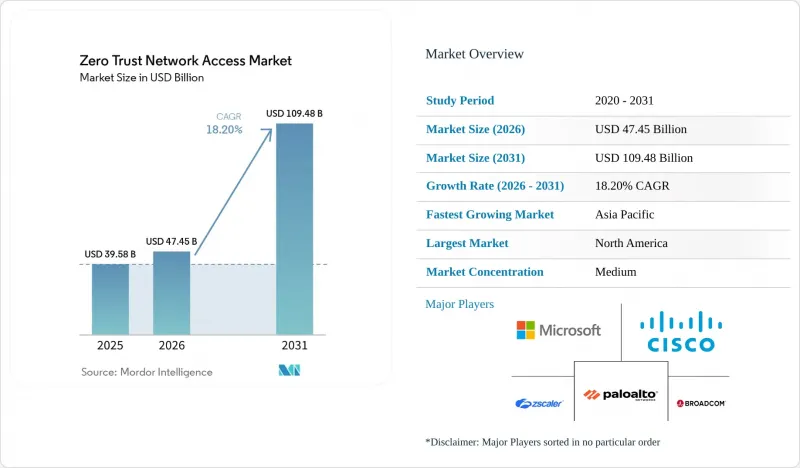
根據 Mordor Intelligence 預測,零信任網路存取(ZTNA) 市場規模預計在 2025 年達到 395.8 億美元,在 2026 年達到 474.5 億美元,在 2031 年達到 1,094.8 億美元。
預計從 2026 年到 2031 年,其複合年成長率將達到 18.20%。
本報告按組件(平台級零威脅網路分析、資料中心安全平台等)、部署類型(雲端、混合、本地部署)、組織規模(大型企業等)、產業(銀行、金融服務和保險、醫療保健、政府機構等)和地區(北美、亞太、南美等)進行細分。市場預測以美元計價。
全球零信任網路存取市場趨勢與洞察
迅速加強董事會層級的網路風險責任
美國證券交易委員會 (SEC) 於 2023 年 12 月實施的一項規則強制要求上市公司在四個工作天內披露重大安全事件,從而將董事的責任與安全措施掛鉤。董事會現在要求提供可審計的零信任日誌,以證明最小權限原則的適用,並縮短違規調查的時間。美國司法部 2027 財政年度的預算申請為零信任技術撥款 1.103 億美元,這表明公共採購將為私營部門樹立標竿。法律負責人將零信任網路存取(ZTNA) 定位為“合理安全措施的證據”,這一術語將網路風險重新定義為管治指標。因此,零信任網路存取市場正從自願的 IT 支出轉向合規主導的義務。能夠透過產品功能直接滿足揭露要求的供應商可以更快地獲得董事會的批准。
美國和歐盟強制要求公共部門 IT 支出採用零信任實務。
美國行政管理與預算辦公室 (OMB) 備忘錄 M-22-09 要求美國私人企業在 2026 年 12 月前滿足零信任的五大支柱要求。同時,網路安全和基礎設施安全局 (CISA) 關於防釣魚多因素身份驗證 (MFA) 的指令合格使用簡訊令牌。此外,歐盟的 NIS2 指令將於 2024 年 10 月前納入國家法律,該指令將義務範圍擴大到 18 個關鍵產業,並引入了經營團隊的個人責任制。獲得 FedRAMP High 或歐盟認證的供應商將獲得優先競標資格,並在採購中獲得優勢。這些義務確立了私人企業必須遵守的最低全球合規標準,從而推動了零信任網路存取市場的持續成長。北美和歐洲的支出將率先加速成長,亞太地區的各國政府也將迅速做出反應,以確保其供應鏈合約的合格。
分散的傳統 IAM 架構會阻礙策略一致性。
企業通常會同時使用 Active Directory、Okta、Ping Identity 和自訂 LDAP 系統,每個系統都有不同的架構和會話生命週期。美國網路安全與基礎設施安全局 (CISA) 的「已知和已利用漏洞清單」列出了截至 2025 年 3 月的 1143 個與身分相關的漏洞,凸顯了攻擊者如何利用這些孤島之間的漏洞。在整合過程中並行執行身份驗證會削弱零信任的效能。 2023 年 10 月發生的 Okta 安全漏洞事件(支援門戶令牌被盜)表明,單一易受攻擊的環節就足以破壞聯合信任。在身分整合加速推進之前,零信任網路聯盟 (ZTNA) 專案可能會耗時更長、成本更高。
細分市場分析
安全服務邊緣 (SSE) 解決方案預計將以 18.96% 的複合年成長率成長,超過傳統平台產品(後者在 2025 年將佔據 38.18% 的市場佔有率)。這項轉變主要得益於整合堆疊,它將安全 Web 閘道、雲端存取安全代理程式 (CASB) 和零威脅網路代理程式 (ZTNA) 整合到單一雲端策略中,從而降低了整合開銷。 Dell'Oro 預測,到 2030 年,SASE 和 SSE 的總合支出將接近 970 億美元,這證實了這種整合模式已成為當前的主流採購模式。獨立平台在混合環境中仍然很重要,但隨著超大規模資料中心業者將存取控制納入大規模的契約,它們正面臨價格壓力。以資料為中心的安全平台透過在敏感運算區域內對工作負載進行令牌化來應對受監管的資料流。身分識別和存取管理 (IAM) 套件仍然是身分管理的基礎,但跨多重雲端環境同步屬性的需求正在減緩專案進度。
在本地資料中心依然存在的環境中,平台級零信任網路存取 (ZTNA) 保持著策略價值。思科收購 Armorblox 後,協作工具中用於偵測網路釣魚的自然語言分析功能得以增強。一些細分領域的供應商正致力於 OT 分段,提供 SSE 供應商所不具備的協定感知控制功能。在預測期間內,按組件類別分類的零信任網路存取(ZTNA) 市場規模將取決於買家將各種獨立工具整合到統一雲端平台的速度。
預計到 2025 年,基於雲端的採用將佔支出的 63.71%,複合年成長率 (CAGR) 為 18.57%。收費使用者計費的 SaaS 使用模式消除了與裝置更新週期相關的資本障礙。 Zscaler 的雲端平台每天在 150 個節點上處理超過 5,000 億筆交易,充分展現了其規模經濟效益。混合模式對受資料居住法律約束的產業極具吸引力,因為供應商可以將策略節點部署在本國境內。本地部署在空氣間隙環境和敏感網路中仍然普遍存在,但面臨人才短缺的問題。美國網路安全與基礎設施安全局 (CISA) 估計,安全飛地所需的零信任專業人員缺口高達 50 萬人。
就營運成本而言,雲端服務具有優勢。每月每用戶 5 至 15 美元的費用比動輒數十萬美元的硬體採購更容易獲得批准。混合解決方案需要在雲端引擎和本地閘道器之間持續進行策略同步,而像 Palo Alto Networks 這樣的供應商正試圖透過自動複製來簡化這一複雜性。本地閘道器在需要協議轉換的工業環境中仍然有用,但由於資本支出 (CAPEX) 的限制,其普及速度正在放緩。
區域分析
北美繼續保持主導地位,市佔率高達41.24%,這得益於美國聯邦政府的強制性規定、美國證券交易委員會(SEC)的資訊揭露規則以及成熟的整合商生態系統。美國司法部在2027財政年度的預算提案中累計1.103億美元用於零信任措施,顯示市場需求持續強勁。加拿大提案的《關鍵網路系統保護法案》將要求擴展至通訊和能源領域,這正在提振國內供應商。墨西哥在預算方面落後於北美,但美國製造業的近岸外包正在推動跨境零信任網路應用,以保護資料流。
亞太地區預計將以18.91%的複合年成長率實現最高成長,這主要得益於各國政府將網路監管與數位經濟目標相協調。日本在2024年將其112億美元的數位預算中的3,000億日圓(約20億美元)用於網路安全。印度的CERT-In指令要求在六小時內通報安全漏洞,並將日誌保留180天。新加坡的「智慧國家」計畫要求對公民服務進行身份驗證,而韓國則強制要求生物識別資料處理者遵循零信任原則。中國的安全審查傾向國內供應商,這使得全球市場被分割成不同的政策領域。
在歐洲,NIS2 的採用率並不均衡,但市場正在擴張。德國已於 2024 年通過相關立法,而義大利和西班牙則將其推遲至 2025 年。英國國家網路安全中心 (NCSC) 的指南建議分階段實施零信任,首先從高價值資產入手。在中東,對主權雲的投資正在推進,沙烏地阿拉伯已強制要求使用國內數據存儲,阿拉伯聯合大公國也發布了符合聯合國電子政府排名的國家標準。南美洲和非洲仍處於起步階段。儘管巴西的《一般資料保護法》(LGPD) 和南非的《個人資訊保護法》(POPIA) 都存在合規促進因素,但預算和技能短缺導致實施進程延遲。
其他好處:
- Excel格式的市場預測(ME)表
- 3個月的分析師支持
目錄
第1章:引言
- 研究假設和市場定義
- 調查範圍
第2章:調查方法
第3章執行摘要
第4章 市場狀況
- 市場概覽
- 市場促進因素
- (美國證券交易委員會規則生效後)董事會層級迅速追究網路風險課責
- 美國和歐盟強制要求公共部門的 IT 支出採用零信任實務。
- 需要身份感知微隔離的雲端原生資料架構
- 生成式人工智慧擴大了威脅的範圍。
- 令牌化和保密計算的引入
- 抗量子密碼學試點項目
- 市場限制因素
- 分散的傳統 IAM 架構正在減緩策略整合速度。
- 在現有OT網路內進行遷移需要大量資本投資。
- 缺乏零信任架構師和零信任管理 (ZTMM) 技能
- 對專有策略引擎導致供應商鎖定的擔憂
- 宏觀經濟因素對市場的影響
- 產業價值鏈分析
- 監理情勢
- 技術展望
- 波特五力分析
第5章 市場規模與成長預測
- 按組件
- 平台級零信任網路存取(ZTNA)
- 以資料為中心的安全平台
- 身分和存取管理 (IAM) 套件
- 安全服務邊緣 (SSE) 解決方案
- 部署模式
- 基於雲端的
- 混合
- 現場
- 按組織規模
- 大公司
- 中小企業
- 按行業分類
- 銀行、金融服務和保險(BFSI)
- 醫療保健和生命科學
- 政府/公共部門
- 資訊科技/通訊
- 製造業和關鍵基礎設施
- 零售與電子商務
- 按地區
- 北美洲
- 美國
- 加拿大
- 墨西哥
- 歐洲
- 英國
- 德國
- 法國
- 義大利
- 其他歐洲國家
- 亞太地區
- 中國
- 日本
- 印度
- 韓國
- 其他亞太國家
- 南美洲
- 中東和非洲
- 北美洲
第6章 競爭情勢
- 市場集中度
- 策略趨勢
- 市佔率分析
- 公司簡介
- Microsoft Corporation
- Cisco Systems, Inc.
- Palo Alto Networks, Inc.
- Zscaler, Inc.
- Broadcom Inc.
- Okta, Inc.
- Fortinet, Inc.
- Check Point Software Technologies Ltd.
- CrowdStrike Holdings, Inc.
- IBM Corporation
- Google LLC
- Cloudflare, Inc.
- Akamai Technologies, Inc.
- Illumio, Inc.
- Forcepoint LLC
- Tenable Holdings, Inc.
- Trend Micro Incorporated
- Ping Identity Holding Corp.
- SailPoint Technologies Holdings, Inc.
- Cyxtera Technologies, Inc.
第7章 市場機會與未來展望
According to Mordor Intelligence, the zero trust network access market size is projected to be USD 39.58 billion in 2025, USD 47.45 billion in 2026, and reach USD 109.48 billion by 2031, growing at an 18.20% CAGR from 2026 to 2031.
This report is Segmented by Component (Platform-Level ZTNA, Data-Centric Security Platforms, and More), Deployment Mode (Cloud-Based, Hybrid, and On-Premises), Organization Size (Large Enterprises, and More), Industry Vertical (BFSI, Healthcare, Government, and More), and Geography (North America, Asia-Pacific, South America, and More). The Market Forecasts are Provided in Terms of Value (USD).
Global Zero Trust Network Access Market Trends and Insights
Rapid Board-Level Cyber-Risk Accountability
The U.S. Securities and Exchange Commission rule that came into force in December 2023 forces listed companies to disclose material incidents within four business days, linking director liability to security controls. Boards now demand auditable zero-trust logs that prove least-privilege enforcement and shorten breach investigations. U.S. Department of Justice budget requests for fiscal 2027 earmark USD 110.3 million for zero-trust, signaling that public procurement will set the private-sector baseline. Legal counsel describes ZTNA as evidence of reasonable safeguards, a phrase that redefines cyber-risk as a governance metric. As a result, the Zero Trust Network Access market is moving from discretionary IT spending to compliance-driven obligations. Vendors able to map product features directly to disclosure requirements win faster board approval.
Mandates for Zero-Trust by U.S. and EU Public-Sector IT Spending
OMB memorandum M-22-09 sets a December 2026 deadline for U.S. civilian agencies to satisfy five zero-trust pillars, while CISA's directive on phishing-resistant MFA disqualifies SMS tokens. In parallel, the EU NIS2 Directive, transposed into national law by October 2024, expands obligations across 18 critical sectors and introduces personal liability for management. Vendors with FedRAMP High or EU certification gain preferred-bidder status, creating a procurement edge. These mandates establish a global compliance floor that private firms must match, driving sustained growth in the Zero Trust Network Access market. Spending accelerates first in North America and Europe, with Asia-Pacific governments quickly aligning to remain eligible for supply-chain contracts.
Fragmented Legacy IAM Stacks Slowing Policy Unification
Enterprises often juggle Active Directory, Okta, Ping Identity, and bespoke LDAP systems, each with different schemas and session lifetimes. CISA's Known Exploited Vulnerabilities list registered 1,143 identity-related flaws by March 2025, illustrating how attackers chain gaps across these silos. Running parallel authentication during consolidation dilutes zero-trust coverage. The October 2023 Okta breach, where support-portal tokens were stolen, showed that a single weak link undermines federated trust. Until identity harmonization accelerates, ZTNA projects face longer timelines and higher costs.
Other drivers and restraints analyzed in the detailed report include:
- Cloud-Native Data Fabrics Needing Identity-Aware Micro-Segmentation
- Generative-AI Threat Surface Expansion
- High Transition CAPEX for Brown-Field OT Networks
For complete list of drivers and restraints, kindly check the Table Of Contents.
Segment Analysis
Security Service Edge solutions are forecast to expand at an 18.96% CAGR, eclipsing traditional platform offerings that held a 38.18% share in 2025. The shift arises because converged stacks bundle secure web gateway, CASB, and ZTNA into a single cloud policy, cutting integration overhead. Dell'Oro projects combined SASE and SSE spending to approach USD 97 billion by 2030, reinforcing that convergence is now the mainstream buying pattern. Standalone platforms remain relevant for hybrid estates, but face price pressure as hyperscalers embed access control into larger deals. Data-centric security platforms address regulated data flows by wrapping tokenization around workloads in confidential-computing enclaves. IAM suites continue as the identity backbone, yet must synchronize attributes across multicloud deployments, a task that slows projects.
Platform-level ZTNA keeps strategic value where on-premises data centers persist. Cisco's Armorblox buy added natural-language analytics to detect phishing in collaboration tools. Niche providers target OT segmentation, offering protocol-aware controls that SSE vendors do not. Over the forecast horizon, the Zero Trust Network Access market size for component categories will hinge on how quickly buyers collapse point tools into unified clouds.
Cloud-based deployments accounted for 63.71% of spending in 2025 and are projected to grow at a 18.57% CAGR. SaaS consumption models priced per user remove the capital hurdle of appliance refresh cycles. Zscaler's cloud processes more than 500 billion daily transactions across 150 nodes, illustrating the scale advantage. Hybrid models appeal to sectors bound by data-residency laws because vendors can place policy nodes within national borders. On-premises deployments persist in air-gapped or classified networks but face staffing shortages; CISA counts a 500,000-person gap in zero-trust talent for secure enclaves.
Operational economics favor cloud because monthly fees of USD 5-15 per user are easier to approve than six-figure hardware buys. Hybrid solutions must constantly sync policies between cloud engines and local gateways, a complexity that vendors like Palo Alto Networks attempt to mask through automated replication. On industrial sites that require protocol translation, on-premises gateways remain relevant, though uptake is slower due to CAPEX constraints.
Geography Analysis
North America continues to lead with 41.24% share, supported by U.S. federal mandates, SEC disclosure rules, and a mature ecosystem of integrators. The U.S. justice budget seeks USD 110.3 million for zero-trust in fiscal 2027, signaling sustained demand. Canada's proposed Critical Cyber Systems Protection Act extends requirements to telecom and energy, boosting homegrown suppliers. Mexico lags on budgets, yet near-shoring of U.S. manufacturing drives cross-border ZTNA to secure data flows.
Asia-Pacific is forecast to have the fastest 18.91% CAGR as governments align cyber rules with digital-economy goals. Japan earmarked JPY 300 billion (USD 2 billion) of its USD 11.2 billion digital budget to cybersecurity in 2024. India's CERT-In directive mandates breach reporting within 6 hours and 180-day log retention. Singapore's Smart Nation program requires identity-aware access for citizen services, and South Korea mandates zero-trust for biometric data processors. China's security reviews favor domestic vendors, fragmenting the global market into separate policy domains.
Europe grows despite uneven NIS2 adoption, with Germany passing its law in 2024, while Italy and Spain delayed into 2025. The UK's NCSC principles recommend phased zero-trust rollouts starting with high-value assets. The Middle East invests in sovereign clouds: Saudi Arabia mandates in-country data storage, and the UAE published national standards aligned to UN e-government rankings. South America and Africa remain early-stage; compliance drivers exist under Brazil's LGPD and South Africa's POPIA, but budgets and skill shortages slow uptake.
- Microsoft Corporation
- Cisco Systems, Inc.
- Palo Alto Networks, Inc.
- Zscaler, Inc.
- Broadcom Inc.
- Okta, Inc.
- Fortinet, Inc.
- Check Point Software Technologies Ltd.
- CrowdStrike Holdings, Inc.
- IBM Corporation
- Google LLC
- Cloudflare, Inc.
- Akamai Technologies, Inc.
- Illumio, Inc.
- Forcepoint LLC
- Tenable Holdings, Inc.
- Trend Micro Incorporated
- Ping Identity Holding Corp.
- SailPoint Technologies Holdings, Inc.
- Cyxtera Technologies, Inc.
Additional Benefits:
- The market estimate (ME) sheet in Excel format
- 3 months of analyst support
TABLE OF CONTENTS
1 INTRODUCTION
- 1.1 Study Assumptions And Market Definition
- 1.2 Scope Of The Study
2 RESEARCH METHODOLOGY
3 EXECUTIVE SUMMARY
4 MARKET LANDSCAPE
- 4.1 Market Overview
- 4.2 Market Drivers
- 4.2.1 Rapid Board-Level Cyber-Risk Accountability (Post-SEC Rule)
- 4.2.2 Mandates For Zero-Trust By U.S. And EU Public-Sector IT Spending
- 4.2.3 Cloud-Native Data Fabrics Needing Identity-Aware Micro-Segmentation
- 4.2.4 Generative-AI Threat Surface Expansion
- 4.2.5 Tokenisation And Confidential-Computing Adoption
- 4.2.6 Quantum-Resistant Encryption Pilots
- 4.3 Market Restraints
- 4.3.1 Fragmented Legacy IAM Stacks Slowing Policy Unification
- 4.3.2 High Transition CAPEX For Brown-Field OT Networks
- 4.3.3 Shortage Of Zero-Trust Architects And ZTMM Skillsets
- 4.3.4 Vendor Lock-In Concerns Around Proprietary Policy Engines
- 4.4 Impact Of Macroeconomic Factors On The Market
- 4.5 Industry Value-Chain Analysis
- 4.6 Regulatory Landscape
- 4.7 Technological Outlook
- 4.8 Porter's Five Forces Analysis
- 4.8.1 Threat Of New Entrants
- 4.8.2 Bargaining Power Of Buyers
- 4.8.3 Bargaining Power Of Suppliers
- 4.8.4 Threat Of Substitutes
- 4.8.5 Competitive Rivalry
5 MARKET SIZE AND GROWTH FORECASTS (VALUE)
- 5.1 By Component
- 5.1.1 Platform-Level Zero Trust Network Access (ZTNA)
- 5.1.2 Data-Centric Security Platforms
- 5.1.3 Identity And Access Management (IAM) Suites
- 5.1.4 Security Service Edge (SSE) Solutions
- 5.2 By Deployment Mode
- 5.2.1 Cloud-Based
- 5.2.2 Hybrid
- 5.2.3 On-Premises
- 5.3 By Organization Size
- 5.3.1 Large Enterprises
- 5.3.2 Small And Mid-Sized Enterprises (SME)
- 5.4 By Industry Vertical
- 5.4.1 Banking, Financial Services And Insurance (BFSI)
- 5.4.2 Healthcare And Life Sciences
- 5.4.3 Government And Public Sector
- 5.4.4 IT And Telecom
- 5.4.5 Manufacturing And Critical Infrastructure
- 5.4.6 Retail And E-Commerce
- 5.5 By Geography
- 5.5.1 North America
- 5.5.1.1 United States
- 5.5.1.2 Canada
- 5.5.1.3 Mexico
- 5.5.2 Europe
- 5.5.2.1 United Kingdom
- 5.5.2.2 Germany
- 5.5.2.3 France
- 5.5.2.4 Italy
- 5.5.2.5 Rest of Europe
- 5.5.3 Asia-Pacific
- 5.5.3.1 China
- 5.5.3.2 Japan
- 5.5.3.3 India
- 5.5.3.4 South Korea
- 5.5.3.5 Rest of Asia-Pacific
- 5.5.4 South America
- 5.5.5 Middle East and Africa
- 5.5.1 North America
6 COMPETITIVE LANDSCAPE
- 6.1 Market Concentration
- 6.2 Strategic Moves
- 6.3 Market Share Analysis
- 6.4 Company Profiles (includes Global Level Overview, Market Level Overview, Core Segments, Financials As Available, Strategic Information, Market Rank/Share, Products And Services, Recent Developments)
- 6.4.1 Microsoft Corporation
- 6.4.2 Cisco Systems, Inc.
- 6.4.3 Palo Alto Networks, Inc.
- 6.4.4 Zscaler, Inc.
- 6.4.5 Broadcom Inc.
- 6.4.6 Okta, Inc.
- 6.4.7 Fortinet, Inc.
- 6.4.8 Check Point Software Technologies Ltd.
- 6.4.9 CrowdStrike Holdings, Inc.
- 6.4.10 IBM Corporation
- 6.4.11 Google LLC
- 6.4.12 Cloudflare, Inc.
- 6.4.13 Akamai Technologies, Inc.
- 6.4.14 Illumio, Inc.
- 6.4.15 Forcepoint LLC
- 6.4.16 Tenable Holdings, Inc.
- 6.4.17 Trend Micro Incorporated
- 6.4.18 Ping Identity Holding Corp.
- 6.4.19 SailPoint Technologies Holdings, Inc.
- 6.4.20 Cyxtera Technologies, Inc.
7 MARKET OPPORTUNITIES AND FUTURE OUTLOOK
- 7.1 White-Space And Unmet-Need Assessment


