


 |
市場調查報告書
商品編碼
2063275
汽車嵌裝玻璃:市場佔有率分析、產業趨勢與統計、成長預測(2026-2031)Automotive Glazing - Market Share Analysis, Industry Trends & Statistics, Growth Forecasts (2026 - 2031) |
||||||

※ 本網頁內容可能與最新版本有所差異。詳細情況請與我們聯繫。
根據 Mordor Intelligence 預測,汽車嵌裝玻璃市場將從 2025 年的 279.3 億美元成長到 2026 年的 296.4 億美元,到 2031 年達到 398.9 億美元,2026 年至 2031 年的複合年成長率為 6.12%。
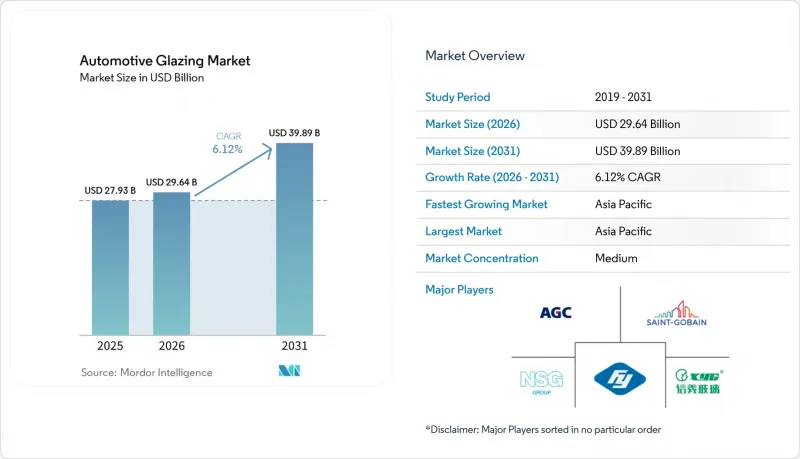
本報告按產品類型(夾層玻璃、強化玻璃等)、應用類型(擋風玻璃、後窗等)、車輛類型(乘用車、輕型商用車等)、驅動系統(內燃機等)、分銷管道和地區進行細分。市場預測以美元計價。
全球汽車嵌裝玻璃市場趨勢及洞察
新興國家汽車產量增加
印度和東協走廊的工廠生產正在擴張,推動玻璃供應鏈轉向在地化的管線生產模式。福耀的雙廠體系藍圖——以中國為規模化生產的引擎,匈牙利為其歐洲準時制(JIT)項目的基地——展現了在新組裝廠獲得首批訂單所需的應對力。隨著本地一級供應商產能的提升,曾經僅用於豪華車的紫外線阻隔塗層和低輻射(Low-E)塗層等技術也開始應用於量產車型。
輕質玻璃可以提高電動車的續航里程和燃油效率。
在電動車(EV)平台上,即使減重一公斤也能直接轉換為更長的續航里程。聚碳酸酯的重量約為玻璃的一半,且導熱係數低,因此可以減輕空調(HVAC)系統的負荷,從而降低電池容量消耗。 AGC和聖戈班已展示了混合夾層玻璃,該玻璃在滿足正面碰撞安全標準的同時實現了減重。中國製造商正在透過在純電動車(BEV)側窗中使用薄夾層來進一步減輕重量。在那些對車隊平均二氧化碳排放標準要求嚴格、需要在不增加電池組尺寸的情況下減輕重量的地區,全球汽車製造商正在加速採用這種技術。
先進玻璃製品製造流程成本高且複雜。
在複合材料中加入光伏、電致變色或HUD中間層,迫使供應商投入大量資金升級爐體、加強無塵室控制並建立新的線上檢測流程。每增加一層,良率風險都會增加,因為一張板材上的單一缺陷就會導致整張層壓板報廢,這可能導致一段學習曲線,在實現規模經濟之前,廢料會擠壓利潤空間。對於價格彈性較低的大型大量生產品牌而言,這種成本負擔尤其顯著,使得原始設備製造商(OEM)難以將材料成本的上漲轉嫁給消費者。此外,全球安全標準強制要求的衝擊和紫外線老化測試等認證測試,會進一步延長開發週期並佔用營運資金。
細分市場分析
到2025年,夾層玻璃仍將佔據汽車嵌裝玻璃市場62.35%的佔有率,證明其符合全球衝擊吸收標準。聚碳酸酯是成長最快的替代材料,預計將以7.13%的複合年成長率成長,汽車製造商正利用其輕量化特性將其應用於側窗和車頂模組。供應商正在探索將夾層玻璃擋風玻璃與聚碳酸酯側窗結合的混合結構,使車輛平台能夠在滿足安全標準的同時,又不影響重量目標。儘管在耐刮擦性和長期透明度方面仍存在技術挑戰,但塗層技術的持續進步最終可能會促使擋風玻璃相關法規放寬,從而進一步刺激市場需求。
隨著下一代電動車架構設計的最終定型,能夠儘早獲得多材料解決方案認證的公司將在規範採納方面獲得競爭優勢。持續的研發將透過結合薄層壓板和聚合物芯材,模糊不同材料類別之間的界限,使現有製造商能夠在維持現有生產設施的同時滿足減重標準。短期內全面轉型不太可能,因為原始設備製造商 (OEM) 非常重視層壓結構的聲學性能和紅外線屏蔽效果。取而代之的是,一種共存模式正在興起,即根據車輛的特定區域分配不同的基材,以最佳化成本、重量和法規要求。
預計到2025年,前擋風玻璃將佔汽車嵌裝玻璃市場規模的47.22%,這主要得益於對夾層結構的法律要求以及零件較大的表面積。同時,隨著全景天窗從高階品牌逐漸普及到緊湊型跨界車,天窗市場正以7.96%的複合年成長率持續成長。設計師強調整個車頂的透明度,以營造車廂內的開闊感;供應商們則將可調光和太陽能薄膜整合到車頂中,在不改變車身鈑金結構的前提下提升功能性。車頂玻璃是汽車製造商實現獲利策略的關鍵,因為它既能提供高水準的豪華感,又能最大限度地減少平台重新設計。
擋風玻璃正從被動屏障向數位顯示器同步演變,這得益於楔形夾層技術的應用,該技術可支援抬頭顯示器 (HUD) 投影機和擴增實境(AR) 疊加層。這些光學元件對錶面平整度和屈光公差要求極高,從而縮小了玻璃製造商的規格範圍。側窗和後窗在採用這些功能方面相對滯後,但它們正逐步繼承擋風玻璃上成熟的塗層技術,從而產生向下滲透的需求。跨應用過渡的速度取決於供應商能否快速實現新型夾層結構的標準化,以滿足不同的曲率和厚度要求。
區域分析
預計到2025年,亞太地區將維持45.81%的汽車嵌裝玻璃市場佔有率,複合年成長率(CAGR)最高,達7.31%。這一成長主要得益於中國電池式電動車(BEV)的激增、印度產能的提升以及來自日本和韓國的技術交流。當地供應商正在擴大浮法玻璃產能,而各國政府也積極吸引投資,特別是透過節能熔爐和強制性回收等獎勵。
儘管歐洲和北美在產量上落後於其他國家,但它們在汽車零件的附加價值方面卻表現出色。在歐洲,有關降低噪音和回收利用廢棄玻璃的指令塑造了原始設備製造商 (OEM) 的規格。這種重視使得低噪音和易於拆卸等特性成為採購的關鍵要素。同時,北美利用其區域供應鏈,從美國中西部的浮法玻璃生產線到墨西哥的組裝工廠,有效地緩解了外匯波動和運輸成本的挑戰。
南美洲、中東和非洲目前在汽車嵌裝玻璃市場中所佔佔有率相對較小,但它們擁有巨大的成長潛力。例如,海灣國家對高階SUV的需求不斷成長,以及巴西在推廣純電動車(BEV)方面所做的嘗試,都顯示了這種成長潛力。然而,這種潛力能否實現,取決於許多因素,例如經濟穩定性、勞動力技能水平,以及與本地浮法生產線生產相關的進口關稅獎勵政策。
其他好處:
- Excel格式的市場預測(ME)表
- 3個月的分析師支持
目錄
第1章:引言
- 研究假設和市場定義
- 調查範圍
第2章:調查方法
第3章執行摘要
第4章 市場狀況
- 市場概覽
- 市場促進因素
- 新興國家汽車產量增加
- 輕質玻璃可以提高電動車的續航里程和燃油效率。
- 全景天窗的普及率正在迅速提高。
- OEM廠商正在推廣與HUD相容的「顯示」玻璃。
- 強制性的城市噪音法規正在推動對隔音玻璃的需求。
- 電動車用太陽能玻璃
- 市場限制因素
- 先進玻璃製品製造流程成本高且複雜。
- 堿灰供應短缺導致玻璃價格上漲。
- 限制在擋風玻璃中使用聚碳酸酯的法規。
- 強制回收將增加逆向物流的負擔。
- 價值供應鏈分析
- 監理情勢
- 技術展望
- 波特五力模型
第5章 市場規模與成長預測
- 依產品類型
- 夾層玻璃
- 強化玻璃
- 聚碳酸酯玻璃
- 按應用程式類型
- 擋風玻璃
- 後窗
- 側窗(側燈)
- 天窗
- 四分之一杯
- 車輛類型
- 搭乘用車
- 輕型商用車
- 中型和大型商用車輛
- 依推進類型
- 內燃機(ICE)
- 電池式電動車(BEV)
- 混合動力電動車(HEV)
- 插電式混合動力車(PHEV)
- 燃料電池汽車(FCEV)
- 透過分銷管道
- 目的地設備製造商 (OEM)
- 售後市場
- 按地區
- 北美洲
- 美國
- 加拿大
- 其他北美國家
- 南美洲
- 巴西
- 阿根廷
- 其他南美國家
- 歐洲
- 英國
- 德國
- 西班牙
- 義大利
- 法國
- 俄羅斯
- 其他歐洲國家
- 亞太地區
- 印度
- 中國
- 日本
- 韓國
- 其他亞太國家
- 中東和非洲
- 阿拉伯聯合大公國
- 沙烏地阿拉伯
- 土耳其
- 埃及
- 南非
- 其他中東和非洲國家
- 北美洲
第6章 競爭情勢
- 市場集中度
- 策略趨勢
- 市佔率分析
- 公司簡介
- AGC Inc.
- Saint-Gobain SA
- Nippon Sheet Glass Co., Ltd.
- Fuyao Glass Industry Group Co., Ltd.
- Xinyi Glass Holdings Ltd.
- Guardian Industries
- Vitro SAB de CV
- Central Glass Co., Ltd.
- Teijin Limited
- Webasto SE
- Magna International Inc.
- Gentex Corporation
- AGP eGlass
- Corning Incorporated
- Sisecam
第7章 市場機會與未來展望
According to Mordor Intelligence, the automotive glazing market size is expected to increase from USD 27.93 billion in 2025 to USD 29.64 billion in 2026 and reach USD 39.89 billion by 2031, growing at a CAGR of 6.12% over 2026-2031.
This report is Segmented by Product Type (Laminated Glass, Tempered Glass, and More), Application Type (Front Windshield, Rear Windshield, and More), Vehicle Type (Passenger Vehicles, Light Commercial Vehicles, and More ), Propulsion Type (Internal Combustion Engine (ICE) and More), Distribution Channel, and Geography. The Market Forecasts are Provided in Terms of Value (USD).
Global Automotive Glazing Market Trends and Insights
Rising Vehicle Production in Emerging Economies
Factory output in India and the ASEAN corridor is expanding, pulling glazing supply chains toward localized float lines. Fuyao's dual-plant blueprint, China as a scale engine, and Hungary for European just-in-time programs illustrate the responsiveness needed to win first-fit contracts in new assembly hubs. Technology once reserved for premium trims, such as UV-cut coatings and low-emissivity layers, is entering volume models as local tier-ones ramp capacity.
Lightweight Glazing Boosts EV Range and Fuel Efficiency
Electric-vehicle platforms treat every kilogram saved as extended driving range. Polycarbonate weighs roughly half as much as glass and shows lower thermal conductivity, easing HVAC demand that drains battery capacity. AGC and Saint-Gobain validated hybrid laminates that meet frontal-impact rules while trimming mass, and Chinese producers deploy thinner interlayers on BEV side windows to compound savings. Global OEM adoption quickens wherever stringent fleet-average CO2 standards compel weight reduction without increasing battery pack size.
High Cost and Process Complexity of Advanced Glazing
Embedding photovoltaic layers, electrochromic stacks, or HUD interlayers forces suppliers to invest in capital-intensive furnace upgrades, tighter clean-room controls, and new inline inspection steps. Each additional layer multiplies yield risk because an imperfection in any sheet can condemn the entire laminate, so learning-curve scrap can erode profit margins before scale efficiencies arrive. The expense is felt most acutely in high-volume nameplates, where price elasticity is low, making it harder for OEMs to pass on material premiums to consumers. Certification testing, such as impact and UV-aging trials required under global safety codes, further lengthens development cycles and ties up working capital.
Other drivers and restraints analyzed in the detailed report include:
- Surging Adoption of Panoramic Sunroofs
- OEM Push for HUD-Ready "Display" Glass
- Soda-Ash Supply Shocks Inflating Glass Costs
For complete list of drivers and restraints, kindly check the Table Of Contents.
Segment Analysis
Laminated glass maintained 62.35% of the automotive glazing market share in 2025, underlining its compliance with global impact-retention rules. Polycarbonate is the fastest-rising alternative, projected to expand at a 7.13% CAGR as automakers leverage its weight advantage for side windows and roof modules. Suppliers explore hybrid assemblies that pair laminated windshields with polycarbonate sidelites, enabling platforms to meet safety codes without sacrificing mass targets. Technical hurdles remain around scratch resistance and long-term clarity, yet ongoing coating advances suggest regulatory bodies could eventually relax front-glazing restrictions, opening additional volume.
Firms able to qualify multi-material solutions early will capture specification wins as next-generation electric architectures freeze designs. Continued R&D blurs categorical lines by marrying thin laminated sheets with polymer cores, helping incumbents defend their installed furnace base while meeting lightweight benchmarks. OEMs value the acoustics and infrared attenuation of laminated constructions, so a wholesale switch is unlikely in the near term. Instead, a coexistence model emerges in which each substrate is matched to specific vehicle zones to optimize cost, mass, and regulatory headroom.
Front windshields held 47.22% share of the automotive glazing market size in 2025, anchored by legal mandates for laminated construction and the sheer surface area of the part. Sunroofs, however, lead growth with a 7.96% CAGR as panoramic layouts migrate from premium badges into compact crossovers. Designers champion full-roof transparency to create an airy cabin feel, and suppliers now integrate dimmable or photovoltaic films to add functional value without altering exterior sheet metal. The upgrade path aligns with OEM revenue strategies because roof glass offers high perceived luxury while requiring minimal platform re-engineering.
Windshields are simultaneously evolving from passive barriers into digital displays, thanks to wedge interlayers that support HUD projectors and augmented-reality overlays. These optics demand pristine surface flatness and strict refractive-index tolerances, tightening specification windows for glass makers. Side and rear lights lag in feature adoption but gradually inherit coatings first proven on windshields, creating trickle-down demand. The pace of cross-application migration will hinge on how quickly suppliers standardize new stacks across varied curvature and thickness requirements.
Geography Analysis
Asia-Pacific retained 45.81% of the automotive glazing market share in 2025 and shows the quickest 7.31% CAGR outlook. This growth is largely driven by a surge in Battery Electric Vehicles (BEVs) in China, increasing production in India, and a technological exchange from Japan and South Korea. Local suppliers are expanding their float-glass capacities, while governments are enticing investment through incentives, notably energy-efficient furnaces and recycling mandates.
While Europe and North America lag in volume, they excel in the value derived from vehicle content. In Europe, directives focused on acoustic emissions and end-of-life recycling are shaping Original Equipment Manufacturer (OEM) specifications. This emphasis has made features such as low-noise, easily dismantled glass essential in procurement. Meanwhile, North America is capitalizing on its regional supply chains, which span from float lines in the United States Midwest to assembly corridors in Mexico, effectively mitigating the challenges posed by currency fluctuations and freight costs.
Though South America, the Middle East, and Africa currently represent smaller segments of the automotive glazing market, there's evident potential. For instance, the rising demand for premium SUVs in Gulf states and experimental BEV initiatives in Brazil hint at this upside. However, realizing this potential will depend on factors such as economic stability, the skill level of the workforce, and clear policies on import duties in relation to incentives for local float-line production.
- AGC Inc.
- Saint-Gobain S.A.
- Nippon Sheet Glass Co., Ltd.
- Fuyao Glass Industry Group Co., Ltd.
- Xinyi Glass Holdings Ltd.
- Guardian Industries
- Vitro SAB de CV
- Central Glass Co., Ltd.
- Teijin Limited
- Webasto SE
- Magna International Inc.
- Gentex Corporation
- AGP eGlass
- Corning Incorporated
- Sisecam
Additional Benefits:
- The market estimate (ME) sheet in Excel format
- 3 months of analyst support
TABLE OF CONTENTS
1 Introduction
- 1.1 Study Assumptions & Market Definition
- 1.2 Scope of the Study
2 Research Methodology
3 Executive Summary
4 Market Landscape
- 4.1 Market Overview
- 4.2 Market Drivers
- 4.2.1 Rising Vehicle Production in Emerging Economies
- 4.2.2 Lightweight Glazing Boosts EV Range and Fuel Efficiency
- 4.2.3 Surging Adoption of Panoramic Sunroofs
- 4.2.4 OEM Push for HUD-Ready "Display" Glass
- 4.2.5 Mandatory Urban-Noise Rules Driving Acoustic Glazing
- 4.2.6 Photovoltaic Glazing to Harvest Solar Energy for EVs
- 4.3 Market Restraints
- 4.3.1 High Cost and Process Complexity of Advanced Glazing
- 4.3.2 Soda-Ash Supply Shocks Inflating Glass Costs
- 4.3.3 Regulations Limiting Polycarbonate in Windscreens
- 4.3.4 Recycling Mandates Add Reverse-Logistics Burden
- 4.4 Value / Supply-Chain Analysis
- 4.5 Regulatory Landscape
- 4.6 Technological Outlook
- 4.7 Porter's Five Forces
- 4.7.1 Bargaining Power of Suppliers
- 4.7.2 Bargaining Power of Buyers
- 4.7.3 Threat of New Entrants
- 4.7.4 Threat of Substitutes
- 4.7.5 Competitive Rivalry
5 Market Size & Growth Forecasts (Value, USD)
- 5.1 By Product Type
- 5.1.1 Laminated Glass
- 5.1.2 Tempered Glass
- 5.1.3 Polycarbonate Glass
- 5.2 By Application Type
- 5.2.1 Front Windshield
- 5.2.2 Rear Windshield
- 5.2.3 Sidelites (Side Windows)
- 5.2.4 Sunroof
- 5.2.5 Quarter Glass
- 5.3 By Vehicle Type
- 5.3.1 Passenger Vehicles
- 5.3.2 Light Commercial Vehicles
- 5.3.3 Medium and Heavy Commercial Vehicles
- 5.4 By Propulsion Type
- 5.4.1 Internal Combustion Engine (ICE)
- 5.4.2 Battery Electric Vehicle (BEV)
- 5.4.3 Hybrid Electric Vehicle (HEV)
- 5.4.4 Plug-In Hybrid Electric Vehicle (PHEV)
- 5.4.5 Fuel-Cell Electric Vehicle (FCEV)
- 5.5 By Distribution Channel
- 5.5.1 Original Equipment Manufacturer (OEM)
- 5.5.2 Aftermarket
- 5.6 By Geography
- 5.6.1 North America
- 5.6.1.1 United States
- 5.6.1.2 Canada
- 5.6.1.3 Rest of North America
- 5.6.2 South America
- 5.6.2.1 Brazil
- 5.6.2.2 Argentina
- 5.6.2.3 Rest of South America
- 5.6.3 Europe
- 5.6.3.1 United Kingdom
- 5.6.3.2 Germany
- 5.6.3.3 Spain
- 5.6.3.4 Italy
- 5.6.3.5 France
- 5.6.3.6 Russia
- 5.6.3.7 Rest of Europe
- 5.6.4 Asia-Pacific
- 5.6.4.1 India
- 5.6.4.2 China
- 5.6.4.3 Japan
- 5.6.4.4 South Korea
- 5.6.4.5 Rest of Asia-Pacific
- 5.6.5 Middle East and Africa
- 5.6.5.1 United Arab Emirates
- 5.6.5.2 Saudi Arabia
- 5.6.5.3 Turkey
- 5.6.5.4 Egypt
- 5.6.5.5 South Africa
- 5.6.5.6 Rest of Middle East and Africa
- 5.6.1 North America
6 Competitive Landscape
- 6.1 Market Concentration
- 6.2 Strategic Moves
- 6.3 Market Share Analysis
- 6.4 Company Profiles (Includes Global Level Overview, Market Level Overview, Core Segments, Financials as Available, Strategic Information, Market Rank/Share for Key Companies, Products and Services, SWOT Analysis, and Recent Developments)
- 6.4.1 AGC Inc.
- 6.4.2 Saint-Gobain S.A.
- 6.4.3 Nippon Sheet Glass Co., Ltd.
- 6.4.4 Fuyao Glass Industry Group Co., Ltd.
- 6.4.5 Xinyi Glass Holdings Ltd.
- 6.4.6 Guardian Industries
- 6.4.7 Vitro SAB de CV
- 6.4.8 Central Glass Co., Ltd.
- 6.4.9 Teijin Limited
- 6.4.10 Webasto SE
- 6.4.11 Magna International Inc.
- 6.4.12 Gentex Corporation
- 6.4.13 AGP eGlass
- 6.4.14 Corning Incorporated
- 6.4.15 Sisecam
7 Market Opportunities & Future Outlook
- 7.1 White-Space & Unmet-Need Assessment

 2026年全球汽車車身、內裝和玻璃創新市場報告
 全球汽車嵌裝玻璃市場
 汽車用聚合物分散液晶薄膜市場:全球市場預測,2026-2032年汽車玻璃市場:2026-2032年全球市場預測(按產品類型、材料類型、車輛類型、應用和分銷管道分類)
 汽車玻璃市場預測至2034年—按材料、玻璃類型、車輛類型、技術、銷售管道和地區分類的全球分析
 汽車嵌裝玻璃市場規模、佔有率和成長分析:按產品類型、車輛類型、應用、銷售管道、技術、最終用戶和地區分類 - 產業預測,2026-2033 年汽車聚碳酸酯嵌裝玻璃市場:按車輛類型、材質等級、表面處理、厚度、應用和最終用戶分類 - 全球預測 2026-20322026年全球汽車玻璃市場報告
 汽車玻璃市場-全球產業規模、佔有率、趨勢、競爭格局、機會及預測:依產品、應用、車輛類型、地區及競爭格局分類,2021-2031年
 全球汽車嵌裝玻璃市場規模(按類型、材料、應用、區域範圍、預測)