


 |
市場調查報告書
商品編碼
2063273
工廠物流:市場佔有率分析、產業趨勢與統計、成長預測(2026-2031)In-plant Logistics - Market Share Analysis, Industry Trends & Statistics, Growth Forecasts (2026 - 2031) |
||||||

※ 本網頁內容可能與最新版本有所差異。詳細情況請與我們聯繫。
根據 Mordor Intelligence 預測,工廠內物流市場規模預計將從 2025 年的 197.6 億美元和 2026 年的 213.9 億美元成長到 2031 年的 303.5 億美元,2026 年至 2031 年的複合年成長率為 7.24%。
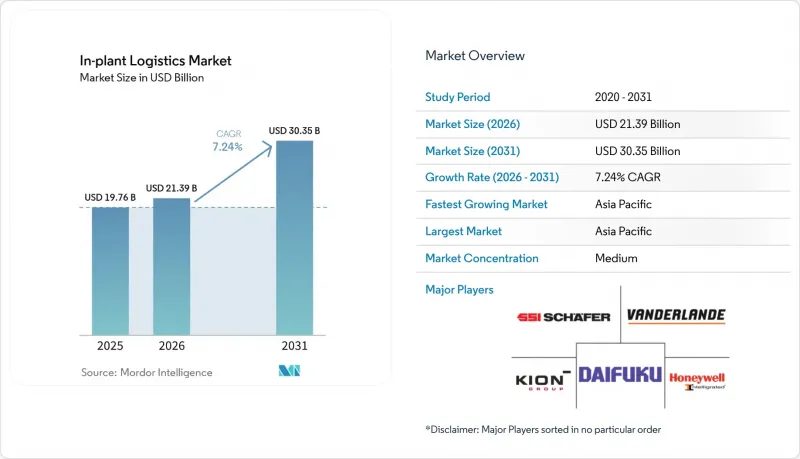
製造商正在整合倉儲、製造和運輸執行系統,而品牌所有者的範圍 3 要求正在將傳統的內部成本中心轉變為合約必需的合規平台。本報告按功能(例如,運輸管理和物料輸送)、最終用戶(例如,汽車、電子和半導體、製藥和醫療保健、食品和飲料)、工廠/設施規模(小規模、中型、大型)以及地區(例如,北美、南美、亞太地區)進行細分。市場預測以美元計價。
全球工廠物流市場趨勢與洞察
品牌擁有者要求強制執行範圍 3 可追溯性。
將於2024年生效的企業永續發展指南,透過強制揭露經獨立第三方機構檢驗的範圍3排放,正在推動供應鏈重組。這迫使供應商更深入了解其營運情況,需要掌握工廠內每個環節的詳細數據,例如能源消耗、運輸距離和包裝。同時,藥品追蹤溯源等法規結構正與永續發展目標融合,促進更一體化且透明的實施體系。這些變化共同代表著向數據驅動、端到端課責制的廣泛轉變,在這個統一的數位生態系統中,環境影響、產品完整性和營運透明度都得到了有效管理。
縮短高混合、小批量生產中「貨到人」機器人的投資回收期。
模組化立方體儲存系統和移動機器人系統正在迅速降低倉庫自動化的進入門檻。部署時間已從數月縮短至數週,即使在庫存種類極為複雜的環境中,投資回報期也遠低於兩年。 AutoStore 等解決方案顯著提高了儲存密度,同時最大限度地減少了人員移動;而 Geek+ 等供應商則透過在製藥等高要求行業提供近乎完美的精度,在全球範圍內拓展業務。總而言之,這些技術體現了一種向靈活、高精度履約模式的轉變,該模式優先考慮速度、空間效率和可靠性,而無需大規模的前期投資。
生產空間的減少限制了輸送機維修的可能性。
在都市區製造地中,用地面積的顯著減少使得傳統的物料輸送系統(例如輸送機)難以實際應用。這種空間限制促使人們採用靈活且空間利用率高的解決方案,例如自主移動機器人和垂直升降模組。這些解決方案即使在狹小的空間佈局中也能靈活移動,並最大限度地利用垂直儲存空間。因此,工廠設計正朝著更具適應性和高密度的配置方向發展,優先考慮移動性和垂直最佳化,而非線性流程。
細分市場分析
到2025年,「運輸管理和物料輸送」將佔工廠內物流市場佔有率的60.03%,這主要得益於自動駕駛車輛和人工智慧驅動的路線最佳化技術的普及。然而,涵蓋套件組裝、生產後處理和聯合包裝的附加價值服務領域預計到2031年將以8.77%的複合年成長率成長,其成長速度將超過核心運輸業務,因為製造商擴大根據訂單客製化最終產品。該領域的成長反映了品牌策略,即維持半成品庫存,並在最後一公里建立區域性SKU,從而減少產品過時並符合範圍3減排目標。製藥合約包裝公司目前正在將序列化、語言標籤和溫度感測整合到單一流程中,使物流設施能夠作為受監管生產場所的延伸,並擴大專注於增值服務的工廠內物流市場。與整合執行套件的整合確保序列化資料無需人工交接即可順暢地流向下游監管機構,滿足《藥品供應鏈安全法案》(DSCSA) 和歐盟《藥品和醫療器械指令》(EU FMD) 的要求。投資開發用於選擇合適尺寸包裝的演算法,已使紙板用量減少了 15%,這反映了降低成本和減少碳排放目標之間的協同效應。
第二段:整合到倉庫管理系統 (WMS) 中的運輸編配平衡了能源消耗和處理能力,而基於 RFID 的庫存管理則能以亞秒級的精度定位資訊。這種融合也推動了對各種技能的需求。技術人員不僅需要掌握 AGV(自動導引運輸車)車隊管理軟體,還需要掌握協作式包裝機器人的操作。提供這些套件服務的供應商正在獲得更長期的契約,因為客戶依賴需要耗時內部認證流程的專業能力。因此,工廠內部物流市場正在經歷從大規模資產所有權向流程智慧化的轉變,這將在未來十年重新定義競爭優勢。
區域分析
亞太地區在工廠內物流市場佔36.51%的佔有率,年複合成長率達8.41%。這主要得益於中國全自動化工廠的目標以及印度與生產連結獎勵計畫。中國汽車工廠正從人工托盤運輸車過渡到支援5G技術的自動導引車(AGV),從而在不增加工資的情況下實現全天候組裝。越南和泰國作為電子產品製造商的遷址目的地,正吸引越來越多的關注,推動了對可安裝在租賃設施中的模組化輸送機單元的需求。此外,區域各國政府也支持勞動力技能再培訓項目,以協助技術人員管理多品牌機器人。
亞太地區的發展動力主要來自中國超過1萬家私營5G工廠,以及印度依賴工業4.0的獎勵。東南亞的新建工廠從一開始就採用先進的自動化技術,並受益於從零開始的佈局設計,從而最佳化了生產流程。在北美,《CHIPS法案》和超過2,000億美元的醫藥產業回流投資仍在持續推進,優先考慮的是建立具有韌性的供應鏈,而非單純的人事費用套利。墨西哥近岸外包的激增,使得美國零件供應與墨西哥組裝之間的連接,需要透過雙邊運輸管理系統(TMS)進行整合。
歐洲碳邊境調節措施和企業永續發展報告指令 (CSRD) 要求企業提高能源密集型營運的透明度,因此整合執行套件對於合規至關重要。德國在 OPC-UA 領域的領先地位以及 5G 的普及降低了整合成本;英國正在根據不同的法規重組航太和生命科學領域的生產能力;而南歐則在利用特種產品,在這些產品中,處理精度比產量更為重要。
其他好處:
- Excel格式的市場預測(ME)表
- 3個月的分析師支持
目錄
第1章:引言
- 研究假設和市場定義
- 調查範圍
第2章:調查方法
第3章執行摘要
第4章 市場狀況
- 市場概覽
- 市場促進因素
- 品牌擁有者必須確保範圍 3 的可追溯性。
- 縮短高混合、小批量生產中「產品到人」型機器人的投資回收期。
- 全球部署 5G 專用網路,實現即時車隊編配。
- 透過整合 WMS、MES 和 TMS 實現統一執行套件。
- 採用感測器級能源採集供電系統,消除AGV充電所造成的停機時間
- 代幣化的 ESG 相關融資降低了綠色物流的資金成本。
- 市場限制因素
- 生產車間空間的減少限制了維修傳送系統的可能性。
- 在多廠商環境下,韌體過時問題依然存在。
- 磷酸鋰鐵(LFP)價格波動
- 多班制工廠缺乏經TUV/CE認證的協作機器人訓練器。
- 價值供應鏈分析
- 監理情勢
- 技術展望
- 波特五力模型
第5章 市場規模與成長預測
- 按功能
- 運輸管理及物料搬運
- 庫存管理
- 包裝和標籤服務
- 附加價值服務
- 產業最終用途
- 汽車製造
- 電子和半導體
- 藥品和醫療保健
- 食品/飲料
- 化工/石油化工
- 金屬和重型機械
- 其他(航太、消費品等)
- 按工廠/設施規模
- 小規模設施
- 中型設施
- 大型設施
- 按地區
- 北美洲
- 美國
- 加拿大
- 墨西哥
- 南美洲
- 巴西
- 秘魯
- 智利
- 阿根廷
- 其他南美國家
- 亞太地區
- 印度
- 中國
- 日本
- 澳洲
- 韓國
- 東南亞(新加坡、馬來西亞、泰國、印尼、越南、菲律賓)
- 其他亞太國家
- 歐洲
- 英國
- 德國
- 法國
- 西班牙
- 義大利
- 比荷盧經濟聯盟(比利時、荷蘭、盧森堡)
- 北歐國家(丹麥、芬蘭、冰島、挪威、瑞典)
- 其他歐洲國家
- 中東和非洲
- 阿拉伯聯合大公國
- 沙烏地阿拉伯
- 南非
- 奈及利亞
- 其他中東和非洲國家
- 北美洲
第6章 競爭情勢
- 市場集中度
- 策略趨勢
- 市佔率分析
- 公司簡介
- DHL Supply Chain
- Kuehne+Nagel International AG
- XPO Logistics Inc.
- Ryder System Inc.
- CEVA Logistics
- Penske Logistics
- FedEx Supply Chain
- Geodis
- DSV Panalpina
- CH Robinson Worldwide Inc.
- Nippon Express Co. Ltd.
- DACHSER SE
- Yusen Logistics Co. Ltd.
- Agility Logistics
- GXO Logistics Inc.
- Daifuku Co., Ltd.
- KION Group(Dematic)
- SSI Schaefer Group
- Vanderlande Industries
- Honeywell Intelligrated
第7章 市場機會與未來展望
According to Mordor Intelligence, the in-plant logistics market size is projected to expand from USD 19.76 billion in 2025 and USD 21.39 billion in 2026 to USD 30.35 billion by 2031, registering a 7.24% CAGR between 2026 and 2031.
Manufacturers are converging warehouse, manufacturing, and transport execution systems, while brand-owner Scope-3 mandates transform formerly internal cost centers into contract-critical compliance platforms. This report is Segmented by Function (Transportation Management and Material Handling, and More), by End-User (Automotive, Electronics and Semiconductor, Pharmaceuticals and Healthcare, Food and Beverage, and More), by Plant/Facility Size (Small-Scale, Medium, Large Scale), and by Geography (North America, South America, Asia Pacific, and More). The Market Forecasts are Provided in Terms of Value (USD).
Global In-plant Logistics Market Trends and Insights
Mandatory Scope-3 Traceability Demands From Brand-Owners
Corporate sustainability directives taking effect in 2024 are reshaping supply chains by requiring independently verified Scope 3 emissions disclosures. This is pushing suppliers to gain far deeper visibility into their operations, capturing granular data such as energy use, transport distances, and packaging across every in-plant movement. At the same time, regulatory frameworks like pharmaceutical track-and-trace are converging with sustainability goals, encouraging more integrated, transparent execution systems. Together, these shifts signal a broader transition toward data-driven, end-to-end accountability where environmental impact, product integrity, and operational transparency are managed within unified digital ecosystems.
Accelerating Payback on Goods-to-Person Robotics Under High-Mix, Low-Volume Production
Modular cube-storage and mobile-robot systems are rapidly lowering the barrier to warehouse automation, with deployments now measured in weeks rather than months and returns realized in well under two years even for highly complex SKU environments. Solutions like AutoStore dramatically increase storage density while minimizing human movement, while providers such as Geek+ are scaling globally to deliver near-perfect accuracy in demanding sectors like pharmaceuticals. Taken together, these technologies reflect a shift toward flexible, high-precision fulfillment models that prioritize speed, space efficiency, and reliability without requiring massive upfront transformation.
Shrinking Production-Floor Footprints Constraining Conveyor Retrofits
Urban manufacturing sites are increasingly constrained by significantly smaller footprints, making traditional straight-line material handling systems like conveyors impractical. This spatial pressure is driving greater adoption of flexible, space-efficient solutions such as autonomous mobile robots and vertical lift modules, which can navigate tighter layouts and maximize vertical storage. As a result, facility design is shifting toward more adaptive, high-density configurations that prioritize maneuverability and vertical optimization over linear flow.
Other drivers and restraints analyzed in the detailed report include:
- Global Roll-Out of 5G Private Networks Enabling Real-Time Fleet Orchestration
- Convergence of WMS, MES & TMS Into Unified Execution Suites
- Persistent Firmware Obsolescence Across Multi-Vendor Fleets
For complete list of drivers and restraints, kindly check the Table Of Contents.
Segment Analysis
Transportation Management and Material Handling accounted for 60.03% of the in-plant logistics market share in 2025, underpinned by increasingly autonomous fleets and AI route optimization. Yet the Value-Added Services segment covering kitting, postponement, and co-packing is forecast to post an 8.77% CAGR through 2031, outpacing core conveyance tasks as manufacturers push final-product customization closer to order receipt. The segment's rise mirrors brand strategies that hold semi-finished inventory and configure region-specific SKUs at the last mile, curbing obsolescence and aligning with Scope-3 reduction goals. Pharmaceutical contract packagers now integrate serialization, language labeling, and temperature sensors within the same flow, transforming logistics halls into regulated production extensions and lifting the in-plant logistics market devoted to value-add tasks. Integration with unified execution suites ensures serialized data flows to downstream regulators without manual hand-offs, meeting DSCSA and EU FMD dictates. Investments in right-size packaging algorithms trim corrugate by 15%, evidencing synergy between cost and carbon goals.
Second paragraph continues: WMS-embedded transport orchestration balances energy use with throughput, and RFID-enabled inventory controls deliver sub-second location granularity. Convergence also raises cross-skill demand; technicians must master co-packing robotics alongside AGV fleet software. Providers bundling these services capture stickier contracts, as customers depend on specialized capabilities that would require lengthy internal certifications. Consequently, the in-plant logistics market sees a tilt from asset bulk to process intelligence, redefining competitive moats for the decade ahead.
Geography Analysis
Asia-Pacific combined a 36.51% in-plant logistics market share with an 8.41% CAGR, underpinned by China's goal of fully automated factories and India's production-linked incentives that subsidize robotics purchases. Chinese automotive plants are shifting from manual pallet trains to 5G-enabled AGVs that sustain 24/7 assembly without wage escalation. Vietnam and Thailand attract electronics relocations, boosting demand for modular conveyor cells deployable in leased facilities. Regional governments also sponsor workforce reskilling programs so technicians can manage multi-brand robot fleets.
Asia Pacific is propelled by China's 10,000+ private 5G factories and India's Industry 4.0-dependent incentives. New Southeast Asian greenfields embed advanced automation from day zero, benefiting from clear-sheet layouts that streamline flows. North America follows with CHIPS-Act and pharma reshoring outlays exceeding USD 200 billion, prioritizing resilient supply chains over pure labor cost arbitrage. Mexico's near-shore surge demands bi-national TMS links that align United States component feeds with Mexican assembly gates.
Europe's carbon-border measures and Corporate Sustainability Reporting Directive push firms toward energy-intensive transparency, making unified execution suites a compliance necessity. Germany's OPC-UA leadership and 5G expansions compress integration costs, the UK rebuilds aerospace and life-science capacity under divergent regulations, and Southern Europe leverages specialty goods where handling precision overrides volume.
- DHL Supply Chain
- Kuehne + Nagel International AG
- XPO Logistics Inc.
- Ryder System Inc.
- CEVA Logistics
- Penske Logistics
- FedEx Supply Chain
- Geodis
- DSV Panalpina
- C.H. Robinson Worldwide Inc.
- Nippon Express Co. Ltd.
- DACHSER SE
- Yusen Logistics Co. Ltd.
- Agility Logistics
- GXO Logistics Inc.
- Daifuku Co., Ltd.
- KION Group (Dematic)
- SSI Schaefer Group
- Vanderlande Industries
- Honeywell Intelligrated
Additional Benefits:
- The market estimate (ME) sheet in Excel format
- 3 months of analyst support
TABLE OF CONTENTS
1 Introduction
- 1.1 Study Assumptions & Market Definition
- 1.2 Scope of the Study
2 Research Methodology
3 Executive Summary
4 Market Landscape
- 4.1 Market Overview
- 4.2 Market Drivers
- 4.2.1 Mandatory Scope-3 traceability demands from brand-owners
- 4.2.2 Accelerating payback on goods-to-person robotics under high-mix, low-volume production
- 4.2.3 Global roll-out of 5G private networks enabling real-time fleet orchestration
- 4.2.4 Convergence of WMS, MES & TMS into unified execution suites
- 4.2.5 Sensor-level energy-harvested power systems eliminating AGV charging downtimes
- 4.2.6 Tokenised ESG-linked financing lowering cost of capital for green intralogistics
- 4.3 Market Restraints
- 4.3.1 Shrinking production-floor footprints constraining conveyor retrofits
- 4.3.2 Persistent firmware obsolescence across multi-vendor fleets
- 4.3.3 Volatility in lithium-iron-phosphate (LFP) commodity pricing
- 4.3.4 Scarcity of TUV/CE-certified cobot trainers for multi-shift plants
- 4.4 Value / Supply-Chain Analysis
- 4.5 Regulatory Landscape
- 4.6 Technological Outlook
- 4.7 Porter's Five Forces
- 4.7.1 Threat of New Entrants
- 4.7.2 Bargaining Power of Suppliers
- 4.7.3 Bargaining Power of Buyers
- 4.7.4 Threat of Substitutes
- 4.7.5 Competitive Rivalry
5 Market Size & Growth Forecasts
- 5.1 By Function
- 5.1.1 Transportation Management and Material Handling
- 5.1.2 Inventory Management
- 5.1.3 Packaging and Labeling Operations
- 5.1.4 Valud-Added Services
- 5.2 By End-use Industry
- 5.2.1 Automotive Manufacturing
- 5.2.2 Electronics and Semiconductor
- 5.2.3 Pharmaceuticals and Healthcare
- 5.2.4 Food and Beverage
- 5.2.5 Chemical and Petrochemical
- 5.2.6 Metals and Heavy Machinery
- 5.2.7 Others (Aerospace, Consumer Goods, etc.)
- 5.3 By Plant/Facility Size
- 5.3.1 Small-scale Facilities
- 5.3.2 Medium Facilities
- 5.3.3 Large Scale Facilities
- 5.4 By Geography
- 5.4.1 North America
- 5.4.1.1 United States
- 5.4.1.2 Canada
- 5.4.1.3 Mexico
- 5.4.2 South America
- 5.4.2.1 Brazil
- 5.4.2.2 Peru
- 5.4.2.3 Chile
- 5.4.2.4 Argentina
- 5.4.2.5 Rest of South America
- 5.4.3 Asia-Pacific
- 5.4.3.1 India
- 5.4.3.2 China
- 5.4.3.3 Japan
- 5.4.3.4 Australia
- 5.4.3.5 South Korea
- 5.4.3.6 Southeast Asia (Singapore, Malaysia, Thailand, Indonesia, Vietnam, and Philippines)
- 5.4.3.7 Rest of Asia-Pacific
- 5.4.4 Europe
- 5.4.4.1 United Kingdom
- 5.4.4.2 Germany
- 5.4.4.3 France
- 5.4.4.4 Spain
- 5.4.4.5 Italy
- 5.4.4.6 BENELUX (Belgium, Netherlands, and Luxembourg)
- 5.4.4.7 NORDICS (Denmark, Finland, Iceland, Norway, and Sweden)
- 5.4.4.8 Rest of Europe
- 5.4.5 Middle East and Africa
- 5.4.5.1 United Arab Emirates
- 5.4.5.2 Saudi Arabia
- 5.4.5.3 South Africa
- 5.4.5.4 Nigeria
- 5.4.5.5 Rest of Middle East and Africa
- 5.4.1 North America
6 Competitive Landscape
- 6.1 Market Concentration
- 6.2 Strategic Moves
- 6.3 Market Share Analysis
- 6.4 Company Profiles (includes Global level Overview, Market level overview, Core Segments, Financials as available, Strategic Information, Market Rank/Share for key companies, Products & Services, and Recent Developments)
- 6.4.1 DHL Supply Chain
- 6.4.2 Kuehne + Nagel International AG
- 6.4.3 XPO Logistics Inc.
- 6.4.4 Ryder System Inc.
- 6.4.5 CEVA Logistics
- 6.4.6 Penske Logistics
- 6.4.7 FedEx Supply Chain
- 6.4.8 Geodis
- 6.4.9 DSV Panalpina
- 6.4.10 C.H. Robinson Worldwide Inc.
- 6.4.11 Nippon Express Co. Ltd.
- 6.4.12 DACHSER SE
- 6.4.13 Yusen Logistics Co. Ltd.
- 6.4.14 Agility Logistics
- 6.4.15 GXO Logistics Inc.
- 6.4.16 Daifuku Co., Ltd.
- 6.4.17 KION Group (Dematic)
- 6.4.18 SSI Schaefer Group
- 6.4.19 Vanderlande Industries
- 6.4.20 Honeywell Intelligrated
7 Market Opportunities & Future Outlook


