


 |
市場調查報告書
商品編碼
2063268
按需貨運:市場佔有率分析、行業趨勢和統計數據以及成長預測(2026-2031 年)On-demand Trucking - Market Share Analysis, Industry Trends & Statistics, Growth Forecasts (2026 - 2031) |
||||||

※ 本網頁內容可能與最新版本有所差異。詳細情況請與我們聯繫。
根據 Mordor Intelligence 預測,按需卡車運輸市場規模將從 2025 年的 793.5 億美元和 2026 年的 929.9 億美元成長到 2031 年的 1967.2 億美元,2026 年至 2031 年的複合年成長率為 16.17%。
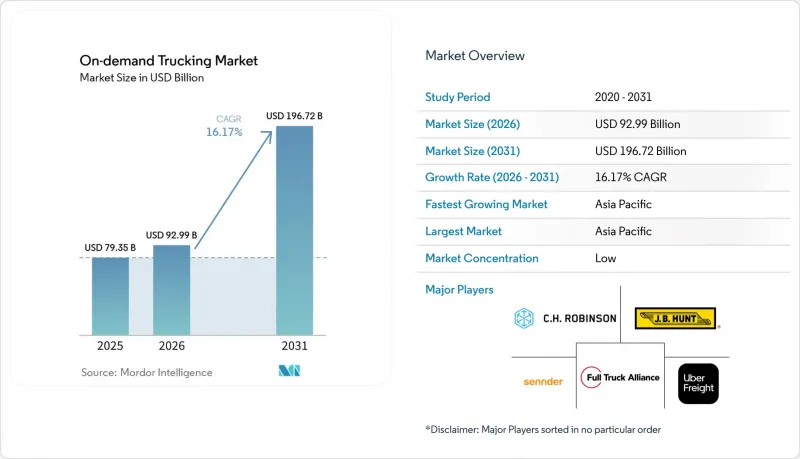
共乘帶來的即時報價需求,將貨運決策週期從耗時數天的招標流程縮短至不到一分鐘的API調用,而一體化的海關工作流程則開闢了從深圳到芝加哥的電商通道。本報告按服務類型(整車運輸、零擔運輸)、車輛類型(輕型卡車、中型卡車、重型卡車)、最終用戶(電商/零售、消費品、食品飲料等)和地區(北美、南美、亞太、歐洲、中東和非洲)進行細分。市場預測以美元計價。
全球按需卡車運輸市場趨勢及洞察
燃油價格波動促使托運人透過按需運輸來對沖其運輸能力風險。
預計2025年柴油價格平均為每加侖2.50至4.20美元,將對固定費率合約下的承運商利潤率構成壓力。在按需貨運市場,燃油風險轉化為按貨物計費,使得托運人僅在現貨價格飆升時才需支付透明的附加費。長途運輸路線的燃油成本佔營運成本的24%至38%,因此這種模式的採用速度最快,採購團隊正在利用數位貨運平台作為即時避險工具。缺乏傳統燃油價格掛鉤條款議價能力的中型出口商和農業合作社從中受益最大。同時,平台正在將波動的能源指數直接納入其估算引擎,以實現浮動費率的貨幣化,從而在高度不確定性時期擴大價差的同時維持服務水準。
範圍 3排放報告要求促進演算法回程傳輸池化。
美國證券交易委員會(SEC)和歐盟的法規將要求上市公司從2027會計年度開始揭露其上游和下游貨運排放。這促使按需貨運市場引進了符合溫室氣體會計系統(GHG Protocol)範圍3第4類和第9類標準的碳排放計算功能。一種能夠將空駛回程距離從35%減少到15%以下的演算法,在降低托運人單位排放的同時,也降低了每次運輸的成本。該平台頒發由第三方檢驗機構審核的逐條路線證書,使出口商能夠滿足投資者對環境、社會和治理(ESG)的篩檢要求。消費性電子和服裝業的先驅已經透過提供檢驗排放儀錶板的供應商安排了40%的超額運輸,這表明在競標評估中,永續性指標如今與價格和服務同等重要。
長期司機短缺和勞動力老化給該服務的可靠性帶來了壓力。
美國卡車運輸協會 (ATA) 預測,到 2031 年,美國將面臨 16 萬名卡車司機的缺口,是 2024 年預計缺口的兩倍。目前,卡車司機的平均年齡為 46 歲,其中 54% 的司機年齡在 45 歲或以上,這導致長途運輸路線的離職率不斷上升。隨著空缺職位的增加,平台在季節性高峰期訂單拒收率上升,這削弱了其「按需運輸能力」的承諾。一些市場領導正在採取措施應對,例如每週最低貨運量保證和預付停車費,以吸引年輕司機。然而,運力短缺正在阻礙本地路線和溫控路線的成長,減緩了原本強勁的按需卡車運輸市場擴張步伐。
細分市場分析
儘管小包裹零擔運輸 (LTL) 市場規模較小,但預計到 2031 年將以 17.23% 的複合年成長率成長。這一增速超過了整車運輸 (FTL),後者目前佔據按需卡車運輸市場 65.52% 的佔有率。這是因為即時取貨工具可以將來自多個托運人的貨物組裝到共用拖車上,從而降低 30-45% 的單位貨運成本。就按需卡車運輸市場的規模而言,演算法驅動的零擔運輸應用每年已處理價值 180 億美元的貨物,並逐步從傳統的樞紐輻射式運輸商手中奪取市場佔有率。人工智慧引擎能夠實現動態零擔運輸,即使是易碎電子產品也能安全運輸,它會考慮貨物運作時間、倉庫時限,從而避免因轉運造成的延誤。以前擔心貨物損壞的托運人現在也開始接受拼裝貨物,因為平台會審核包裝規格並在拖車內分配安全位置。
對於散裝貨物、農產品和危險品等對單次運輸完整性要求極高的貨物而言,整車運輸 (FTL) 仍然至關重要。然而,即使在整車運輸領域,透過平台以現貨價格預訂的貨運量也在不斷成長,預計到 2025 年將占美國長途貨運量的 28%。許多財富 100 強製造商目前正將其年度運輸合約分為 75% 的合約運輸和 25% 的數位化現貨交易,以應對燃油價格波動和貨運量不可預測的情況。這種混合模式在保持整車運輸高佔有率的同時,重新定義了合約條款,並確保在整個預算週期內持續利用按需卡車運輸市場,而不會完全取代專用合約。
區域分析
預計到2025年,亞太地區將佔全球貨運量的41.25%,並在2031年之前以18.34%的複合年成長率成長。這主要得益於中國保稅倉庫電商模式的推動,該模式將托盤貨物集中起來,並透過卡車運送至東南亞國協。印度的國家物流政策將電子報關與貨運平台連接起來,進一步擴大了次大陸的按需卡車運輸市場,將跨境清關程序從數天縮短至數小時。雅加達、曼谷和馬尼拉等都市區交通堵塞促使小型車輛的使用,而政府對電動貨車的獎勵則為平台整合的租賃池創造了先發優勢。
在歐洲,隨著《企業永續發展報告指令》(CSRD) 提高碳排放強度標準,僅要求基於演算法的共乘運輸即可達標,市場正以15%左右的成長率快速擴張。回程傳輸能夠縮短空運距離,並幫助零售商報告小包裹更低的二氧化碳排放,在德國、法國和北歐國家日益普及。然而,強制性的僱用法規增加了成本,減緩了新創企業的成長。英國脫歐後的複雜局面進一步推動了這一趨勢。提供端到端海關自動化服務的平台正在擴大其在英國和歐盟之間運輸路線中的佔有率,尤其是在高階時尚商品領域。
北美在貨運預訂數位化領域保持主導,並將貨運預訂與企業資源計劃 (ERP) 系統整合。 SAP 和 Oracle TMS 套件中嵌入的現成 API 每天可將超過 3 萬件貨物直接路由至平台的現貨市場。然而,該地區面臨最嚴重的司機短缺問題,導致每英里運費上漲,按需卡車運輸市場正轉向在 I-10 和 I-40 走廊沿線開展自動駕駛試點計畫。美國托運人也在採用金融科技公司提供的基於使用量的貨運保險,這些保險面向小規模車隊,雖然擴大了承運商的選擇範圍,但也增加了在貨物接收時驗證保險有效性的合規負擔。隨著近岸外包重塑跨境貨運格局,加拿大和墨西哥也在採用類似的模式,但落基山脈省份和安大略省北部遍遠地區寬頻基礎設施的差異仍然阻礙了即時可見性。
其他好處:
- Excel格式的市場預測(ME)表
- 3個月的分析師支持
目錄
第1章:引言
- 研究假設和市場定義
- 調查範圍
第2章:調查方法
第3章執行摘要
第4章 市場狀況
- 市場概覽
- 市場促進因素
- 燃油價格波動促使托運人對其按需運輸能力進行避險。
- 範圍 3排放報告要求促進演算法回程傳輸池化。
- 跨境電子商務的爆炸性成長催生了對能夠處理清關事宜的靈活卡車運輸的需求。
- 人們對即時獲取票價報價的期望正在加速該平台的普及。
- ERP/TMS「即時貨車預訂」API顯著降低了整合障礙。
- 基於使用量的貨物保險金融科技使微型車隊得以進入市場。
- 市場限制因素
- 長期司機短缺和勞動力老化給該服務的可靠性帶來了壓力。
- 管理勞工分類的法律(例如 AB 5、歐盟平台勞動指令)正在推高零工經濟的成本。
- 資料隱私法規限制了遠端資訊處理和基於位置的資料流的商業化。
- 由於衛星故障容錯移轉連線不足,遍遠地區出現服務等級協定 (SLA) 違規事件。
- 波特五力模型
- 價值供應鏈分析
- 產業的技術創新
- 政府法規和政策
- 地緣政治事件對市場的影響
第5章 市場規模與成長預測
- 按服務類型
- 全軌道公路(FTL)
- 低於100%的運費(零擔運輸)
- 車輛類型
- 輕型卡車(1-3級)
- 中型卡車(4-6級)
- 大型卡車(7-8級)
- 最終用戶
- 電子商務與零售
- 面向消費者的包裝商品
- 食品和飲料(包括低溫運輸)
- 醫療保健和製藥
- 工業和製造業
- 其他
- 按地區
- 北美洲
- 美國
- 加拿大
- 墨西哥
- 南美洲
- 巴西
- 秘魯
- 智利
- 阿根廷
- 其他南美國家
- 亞太地區
- 印度
- 中國
- 日本
- 澳洲
- 韓國
- 東南亞(新加坡、馬來西亞、泰國、印尼、越南、菲律賓)
- 其他亞太國家
- 歐洲
- 英國
- 德國
- 法國
- 西班牙
- 義大利
- 比荷盧經濟聯盟(比利時、荷蘭、盧森堡)
- 北歐國家(丹麥、芬蘭、冰島、挪威、瑞典)
- 其他歐洲國家
- 中東和非洲
- 阿拉伯聯合大公國
- 沙烏地阿拉伯
- 南非
- 奈及利亞
- 其他中東和非洲國家
- 北美洲
第6章 競爭情勢
- 市場集中度
- 策略趨勢
- 市佔率分析
- 公司簡介
- Uber Freight
- CH Robinson
- Full Truck Alliance(Manbang)
- DHL Supply Chain & Freight
- Sennder
- GoShare
- Loadsmart
- NEXT Trucking
- Ontruck
- Lalamove
- GoGoX
- BlackBuck
- Flock Freight
- Shipwell
- JB Hunt 360
- Schneider FreightPower
- Doft
- DAT(DAT Freight & Analytics)
- CloudTrucks
- Delhivery
- Cargomatic
第7章 市場機會與未來展望
According to Mordor Intelligence, the on-demand trucking market size is projected to expand from USD 79.35 billion in 2025 and USD 92.99 billion in 2026 to USD 196.72 billion by 2031, registering a CAGR of 16.17% between 2026 and 2031.
Instant quote expectations born in ride-hailing push freight decision cycles from multi-day RFPs to sub-minute API calls, while embedded customs workflows unlock e-commerce corridors stretching from Shenzhen to Chicago. This report is Segmented by Service Type (FTL, LTL), by Vehicle Type (Light-Duty Trucks, Medium-Duty Trucks Class, Heavy-Duty Trucks Class), by End User (E-Commerce and Retail, Consumer Packaged Goods, Food and Beverage, and More), and by Geography (North America, South America, Asia Pacific, Europe, Middle East and Africa). The Market Forecasts are Provided in Terms of Value (USD).
Global On-demand Trucking Market Trends and Insights
Fuel-price Volatility Steering Shippers Toward On-demand Capacity Hedging
Diesel averaged USD 2.50 to USD 4.20 per gallon during 2025, compressing carrier margins in fixed-rate contracts. The on-demand trucking market converts fuel risk into load-level pricing, allowing shippers to pay a transparent surcharge only when spot prices spike. Long-haul lanes, where fuel is 24-38% of operating cost, show the steepest adoption as procurement teams treat digital freight platforms as a real-time hedging tool. Mid-market exporters and agricultural co-ops without leverage for traditional fuel-escalator clauses gain the most relief. Platforms, for their part, monetize volatility by embedding rolling energy indices directly into quote engines, widening spreads during high-uncertainty windows while maintaining service levels.
Scope-3 Emission Reporting Mandates Boosting Algorithmic Back-haul Pooling
SEC and EU rules compel listed firms to disclose upstream and downstream freight emissions beginning fiscal 2027. The on-demand trucking market thus embeds carbon calculators aligned to GHG Protocol Scope-3 categories 4 and 9. Algorithms that cut empty-return miles from 35% to under 15% lower shippers' emissions intensity while trimming cost per load. Platforms issue lane-level certificates audited by third-party verifiers, enabling exporters to satisfy investor ESG screens. Early adopters in consumer electronics and apparel already route 40% of overflow volume only through providers offering verifiable emission dashboards, signaling a shift where sustainability metrics now sit beside price and service in bid evaluations.
Chronic Driver Shortage & Aging Workforce Pressuring Service Reliability
The American Trucking Associations expects a 160,000-driver gap by 2031, double the 2024 shortfall. Median driver age now sits at 46, with 54% of operators older than 45, worsening attrition for long-haul lanes. As vacancies rise, platforms experience higher load rejections during seasonal peaks, eroding the "capacity-on-tap" promise. Some market leaders counter by offering guaranteed weekly minimums and prepaid parking to attract younger drivers. Nevertheless, capacity scarcity caps growth in rural and temperature-controlled corridors, tempering otherwise robust on-demand trucking market expansion.
Other drivers and restraints analyzed in the detailed report include:
- Explosive Cross-border E-commerce Growth Demanding Customs-ready Flexible Trucking
- Instant Freight-quote Expectations Accelerating Platform Adoption
- Worker-classification Laws Inflating Gig-fleet Costs
For complete list of drivers and restraints, kindly check the Table Of Contents.
Segment Analysis
Less-than-Truckload services, while representing a smaller base, are on course for 17.23% CAGR through 2031. That outpaces Full Truckload's 65.52% dominance in the on-demand trucking market as real-time consolidation tools pool multi-shipper parcels onto shared trailers, cutting unit freight costs 30-45%. Within the on-demand trucking market size context, algorithmic LTL applications already manage USD 18 billion of annual volume, chipping away at traditional hub-and-spoke carriers. AI engines factor dwell times, warehouse operating hours, and driver Hours-of-Service windows to avoid trans-shipment delays, making dynamic LTL viable even for fragile consumer electronics. Shippers previously wary of damage now accept consolidated moves because platforms audit packaging specs and assign secure positions inside trailers.
FTL remains indispensable for bulk commodities, agricultural products, and hazardous materials where single-load integrity is paramount. Yet even in FTL, spot-rate bookings via platforms are climbing, comprising 28% of long-haul loads in the United States during 2025. Many Fortune 100 manufacturers now split annual freight commitments 75% contracted, 25% digital spot to hedge both fuel volatility and volume unpredictability. That hybrid model keeps FTL share high but redefines engagement terms, ensuring repeated references to the on-demand trucking market continue across budgeting cycles without replacing dedicated contracts entirely.
Geography Analysis
Asia Pacific captured 41.25% of global volume in 2025 and is projected to grow 18.34% CAGR through 2031, underpinned by China's bonded-warehouse e-commerce model that packs consolidated pallets for truck crossings into ASEAN. India's National Logistics Policy synchronizes customs e-filing with freight platforms, shaving trans-border clearance from days to hours and further expanding the on-demand trucking market across the subcontinent. Urban congestion in Jakarta, Bangkok, and Manila incentivizes light-duty adoption, while government incentives for EV vans create early mover opportunities for platform-linked leasing pools.
Europe advances at mid-teens percentage growth as the Corporate Sustainability Reporting Directive elevates carbon-intensity thresholds that only algorithmic pooling can meet. Germany, France, and the Nordics embrace back-haul marketplaces that cut empty kilometers and help retailers report lower grams-CO2 per parcel. Nonetheless, mandatory employment rules add cost layers that slow startup proliferation. Brexit complexities add another catalyst: platforms offering end-to-end customs automation secure an increasing United Kingdom-EU lane share, especially for high-mix fashion goods.
North America maintains digital leadership in ERP-embedded freight booking. Pre-built APIs inside SAP and Oracle TMS suites route more than 30,000 loads per day directly to platform spot boards. Yet the region feels the sharpest driver deficit, raising per-mile prices and pushing the on-demand trucking market toward autonomous pilots on I-10 and I-40 corridors. United States shippers also adopt usage-based cargo insurance fintechs for micro-fleets, expanding carrier pools but adding compliance overhead to validate insurance at load tender. Canada and Mexico court similar models as near-shoring reshapes cross-border freight flows, while rural broadband gaps still hamper real-time visibility in the Rocky Mountain states and northern Ontario.
- Uber Freight
- C.H. Robinson
- Full Truck Alliance (Manbang)
- DHL Supply Chain & Freight
- Sennder
- GoShare
- Loadsmart
- NEXT Trucking
- Ontruck
- Lalamove
- GoGoX
- BlackBuck
- Flock Freight
- Shipwell
- J.B. Hunt 360
- Schneider FreightPower
- Doft
- DAT (DAT Freight & Analytics)
- CloudTrucks
- Delhivery
- Cargomatic
Additional Benefits:
- The market estimate (ME) sheet in Excel format
- 3 months of analyst support
TABLE OF CONTENTS
1 Introduction
- 1.1 Study Assumptions and Market Definition
- 1.2 Scope of the Study
2 Research Methodology
3 Executive Summary
4 Market Landscape
- 4.1 Market Overview
- 4.2 Market Drivers
- 4.2.1 Fuel-price volatility steering shippers toward on-demand capacity hedging
- 4.2.2 Scope-3 emission reporting mandates boosting algorithmic back-haul pooling
- 4.2.3 Explosive cross-border e-commerce growth demanding customs-ready flexible trucking
- 4.2.4 Instant freight-quote expectations accelerating platform adoption
- 4.2.5 ERP/TMS "Instant Truck Book" APIs slashing integration friction
- 4.2.6 Usage-based cargo-insurance fintechs enabling micro-fleet participation
- 4.3 Market Restraints
- 4.3.1 Chronic driver-shortage & aging workforce pressuring service reliability
- 4.3.2 Worker-classification laws (e.g., AB 5, EU Platform Work Directive) inflating gig-fleet costs
- 4.3.3 Data-privacy regulations limiting monetization of telematics & location streams
- 4.3.4 Sparse satellite fail-over connectivity causing rural SLA breaches
- 4.4 Porter's Five Forces
- 4.4.1 Threat of New Entrants
- 4.4.2 Bargaining Power of Buyers
- 4.4.3 Bargaining Power of Suppliers
- 4.4.4 Threat of Substitutes
- 4.4.5 Competitive Rivalry
- 4.5 Value / Supply-Chain Analysis
- 4.6 Technological Innovations in the Industry
- 4.7 Government Regulations and Policies
- 4.8 Impact of Geopolitical Events on the Market
5 Market Size and Growth Forecasts (Value)
- 5.1 By Service Type
- 5.1.1 Full Truckload (FTL)
- 5.1.2 Less-than-Truckload (LTL)
- 5.2 By Vehicle Type
- 5.2.1 Light-Duty Trucks (Class 1-3)
- 5.2.2 Medium-Duty Trucks (Class 4-6)
- 5.2.3 Heavy-Duty Trucks (Class 7-8)
- 5.3 By End User
- 5.3.1 E-commerce and Retail
- 5.3.2 Consumer Packaged Goods
- 5.3.3 Food and Beverage (incl. Cold-chain)
- 5.3.4 Healthcare and Pharma
- 5.3.5 Industrial and Manufacturing
- 5.3.6 Others
- 5.4 By Geography
- 5.4.1 North America
- 5.4.1.1 United States
- 5.4.1.2 Canada
- 5.4.1.3 Mexico
- 5.4.2 South America
- 5.4.2.1 Brazil
- 5.4.2.2 Peru
- 5.4.2.3 Chile
- 5.4.2.4 Argentina
- 5.4.2.5 Rest of South America
- 5.4.3 Asia-Pacific
- 5.4.3.1 India
- 5.4.3.2 China
- 5.4.3.3 Japan
- 5.4.3.4 Australia
- 5.4.3.5 South Korea
- 5.4.3.6 Southeast Asia (Singapore, Malaysia, Thailand, Indonesia, Vietnam, and Philippines)
- 5.4.3.7 Rest of Asia-Pacific
- 5.4.4 Europe
- 5.4.4.1 United Kingdom
- 5.4.4.2 Germany
- 5.4.4.3 France
- 5.4.4.4 Spain
- 5.4.4.5 Italy
- 5.4.4.6 BENELUX (Belgium, Netherlands, and Luxembourg)
- 5.4.4.7 NORDICS (Denmark, Finland, Iceland, Norway, and Sweden)
- 5.4.4.8 Rest of Europe
- 5.4.5 Middle East and Africa
- 5.4.5.1 United Arab Emirates
- 5.4.5.2 Saudi Arabia
- 5.4.5.3 South Africa
- 5.4.5.4 Nigeria
- 5.4.5.5 Rest of Middle East and Africa
- 5.4.1 North America
6 Competitive Landscape
- 6.1 Market Concentration
- 6.2 Strategic Moves
- 6.3 Market Share Analysis
- 6.4 Company Profiles (includes Global level Overview, Market level overview, Core Segments, Financials as available, Strategic Information, Market Rank/Share for key companies, Products and Services, and Recent Developments)
- 6.4.1 Uber Freight
- 6.4.2 C.H. Robinson
- 6.4.3 Full Truck Alliance (Manbang)
- 6.4.4 DHL Supply Chain & Freight
- 6.4.5 Sennder
- 6.4.6 GoShare
- 6.4.7 Loadsmart
- 6.4.8 NEXT Trucking
- 6.4.9 Ontruck
- 6.4.10 Lalamove
- 6.4.11 GoGoX
- 6.4.12 BlackBuck
- 6.4.13 Flock Freight
- 6.4.14 Shipwell
- 6.4.15 J.B. Hunt 360
- 6.4.16 Schneider FreightPower
- 6.4.17 Doft
- 6.4.18 DAT (DAT Freight & Analytics)
- 6.4.19 CloudTrucks
- 6.4.20 Delhivery
- 6.4.21 Cargomatic
7 Market Opportunities and Future Outlook

 貨運卡車運輸市場:2026-2032年全球市場預測(依服務類型、車輛類型、營運模式、運輸距離、最終用戶產業和預訂管道分類)
 一般貨運市場:按類型、按卡車類型、按貨物類型、按地區分類
 2026年全球普通貨物運輸市場報告2026年全球本地普通貨運卡車運輸市場報告2026年全球特種貨物運輸市場報告2026年全球長途普通貨物運輸市場報告
 貨運卡車市場分析及預測(至2035年):依類型、產品類型、服務、技術、組件、應用、流程、最終使用者、設備及運輸方式分類
 全球貨運卡車市場規模、佔有率、趨勢和成長分析報告(2026-2034)貨運卡車市場規模、佔有率、成長及全球產業分析:按類型、應用和地區分類,並預測至2026-2034年貨運卡車市場-2026-2031年預測