


 |
市場調查報告書
商品編碼
2062461
出貨前檢定:市場佔有率分析、產業趨勢與統計、成長預測(2026-2031 年)Pre-Shipment Inspection - Market Share Analysis, Industry Trends & Statistics, Growth Forecasts (2026 - 2031) |
||||||

※ 本網頁內容可能與最新版本有所差異。詳細情況請與我們聯繫。
根據 Mordor Intelligence 預測,出貨前檢驗市場規模將從 2025 年的 165.3 億美元和 2026 年的 174.5 億美元成長到 2031 年的 220.6 億美元,2026 年至 2031 年的年複合成長率(CAGR)為 4.8%。
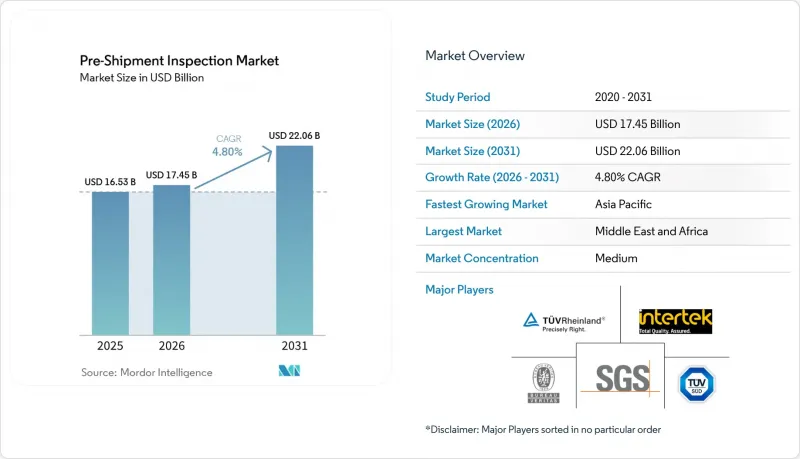
本報告依採購方式(內部採購、外包)、服務類型(產品符合性測試、文件檢驗和合規性審計等)、產業(消費品/零售、工業/製造業等)、運輸方式(海運、空運、陸運、鐵路運輸)和地區(北美、亞太等)進行細分。市場預測以美元計價。
全球裝運前檢驗市場趨勢及洞察
更嚴格的全球產品品質和安全法規
世界各國政府正將邊境管制業務外包給經認證的機構,以加速海關程序,同時確保安全標準不受影響。美國食品藥物管理局(FDA)現已強制要求高風險農產品進行批次級追溯,使裝運前證書成為一項法律要求。印度於2026年初擴大了進口檢驗法規的適用範圍,肯亞已將一項新專案的監管工作外包給九家國際公司,擴大了監管的交易量。摩洛哥的產品合格評定平台透過數位化工作流程,將證書簽發時間縮短了40%。總而言之,這些措施正在鼓勵製造商聘請第三方檢驗機構來確保合規性。
亞太地區的出口繁榮推動了對合格證書的需求。
從中國、越南和印度出口的電子設備、紡織品和機械在目的地市場面臨更嚴格的合格評定規定,許多買家要求在裝運前進行第三方檢驗。智利和美國之間一項關於新鮮水果的雙邊合作項目(預計在2025-2026年度加工超過85萬噸)表明,出口前證書可以加快清關速度。沙烏地阿拉伯的SABER認證和西班牙新的再生材料標誌也要求進行獨立檢驗,這促使企業將業務轉向亞太地區的檢驗機構。
中小企業承擔的第三方檢驗高成本。
每次檢驗費用從300美元到1500美元不等,這進一步擠壓了中小企業本來就微薄的出口利潤。許多公司按即期匯率支付檢驗費用,而且在獲得銀行貸款之前必須預付檢驗證書費用,這進一步加劇了它們的現金流量問題。阿根廷1997年第477號法令規定了固定費率,推高了低價值商品的單位成本,迫使微型出口商尋求高額的過橋貸款。非洲和南美洲貿易融資管道的匱乏也加重了這項負擔。
細分市場分析
至2025年,外包專案將佔據出貨前檢驗(PSI)市場佔有率的72.74%。這種模式對電子產品、服裝和工業零件製造商尤其有利,因為它使他們無需在檢查室進行資本投資。外包使企業能夠利用專業供應商的專業知識,同時專注於自身的核心競爭力。 2025年供應鏈的波動進一步凸顯了可變成本合約的優勢,這種合約根據訂單量進行調整,兼具柔軟性和成本效益。然而,內部部門的重要性依然存在,尤其是在某些情況下,例如出於智慧財產權考慮限制外部存取以及需要保護機密資訊時。
2026年,必維集團將檢驗資料整合到其貿易融資平台中,這表明即使是專注於特定領域的供應商也能向廣泛的客戶群證明其軟體投資的合理性。此舉凸顯了技術在提升裝運前檢驗流程的營運效率和透明度方面的潛力。亞太地區的出口商高度依賴外包合作夥伴,認為外包對於維持營運柔軟性和應對需求波動至關重要。這種依賴性不僅推動該細分市場以5.28%的複合年成長率成長,也鞏固了其在整個裝運前檢驗市場中的基礎性地位。該地區外包解決方案的日益普及反映了國際貿易營運中成本最佳化和靈活性提升的更廣泛趨勢。
預計到2025年,產品符合性測試將佔總收入的38.19%,但基於區塊鏈的證書正以5.55%的複合年成長率(CAGR)日益受到關注。同時,基於區塊鏈的證書的市場佔有率也在不斷擴大,同樣實現了5.55%的複合年成長率。傳統的檢驗方式,例如透過檢驗尺寸、標記和功能來確保產品符合性,仍然至關重要。此外,文件檢驗在海關程序中仍然是強制性的,尤其是在高關稅地區。在對成本效益日益成長的需求驅動下,托運人預計到2025年將擴大採用貨櫃裝載監管,旨在最佳化運費並減少物流低效環節。
在生產過程中進行審核對於及早發現缺陷至關重要,尤其對於高價值商品和安全至關重要的產品而言更是如此。這些審核有助於降低風險,並在出貨前確保產品品質。根據國際航空運輸協會 (IATA) 預測,到 2025 年,將有 562 家獲得 CEIV Pharma 認證的機構,所有這些機構都需要進行嚴格的溫度監控,以確保符合藥品標準。 2026 年初,摩洛哥簽發了超過 5 萬份加密簽名證書,顯示區塊鏈技術在貿易流程中的應用日益廣泛。此外,必維集團 (Bureau Veritas) 與銀行在帳本連結方面的合作,也反映出人們對數位憑證的信任度不斷提高,這一趨勢預計將重塑裝運前檢驗 (PSI) 市場的服務模式。
區域分析
亞太地區受中國機械、印度製藥和越南快速成長的家具產業的推動,預計到2025年將佔全球收入的41.68%。該地區的出口型製造商將檢驗視為進入市場的必要成本,而非可有可無的支出。數位化調度平台和高密度的檢驗人員使得當日出貨成為可能,進一步鞏固了該地區在裝運前檢驗市場的領先地位。
預計中東和非洲地區將實現最快成長,到2031年複合年成長率將達到5.16%。摩洛哥的PortNet系統透過強制主導進行合格評定,將簽發時間縮短了40%。肯亞2026年的競標新增了9家獲得認證的公司,以實施新規。對東非檢驗機構的投資將使平均認證週期從2023年的21天縮短至2025年的14天,從而降低非關稅壁壘,促進非洲大陸自由貿易區(AfCFTA)內的貿易流動。
北美和歐洲市場已趨於成熟,FDA的可追溯性法規和歐洲關於再生材料含量的指令等監管變化推動了市場成長。 SGS斥資13.25億美元收購Applied Technical Services,鞏固了其在美國的業務基礎,這表明儘管表面成長放緩,但該公司依然充滿信心。南美市場保持穩定,這得益於阿根廷的裝運前檢驗要求和智利長期實施的水果檢驗計劃,但外匯波動抑制了出口商的支出。
其他好處:
- Excel格式的市場預測(ME)表
- 3個月的分析師支持
目錄
第1章:引言
- 研究假設和市場定義
- 調查範圍
第2章:調查方法
第3章執行摘要
第4章 市場狀況
- 市場概覽
- 市場促進因素
- 全球更嚴格的產品品質和安全法規
- 電子商務中產品召回事件增加以及仿冒品問題日益嚴重
- 亞太地區的出口繁榮推動了對合格證書的需求。
- 外包趨勢旨在降低內部品質保證成本
- 受區塊鏈保護的數位驗證證書
- 保險公司對參數保險中經檢驗數據的需求
- 市場限制因素
- 中小企業承擔的第三方檢驗高成本。
- 全球範圍內未標準化的檢驗和認證體系
- 聯網檢查和遠端審計工具中的網路風險
- 旺季期間熟練檢查員短缺
- 產業價值鏈分析
- 監理情勢
- 技術展望
- 宏觀經濟因素對市場的影響
- 波特五力分析
第5章 市場規模與成長預測
- 依採購類型
- 內部
- 外包
- 按服務類型
- 產品符合性檢驗
- 文件檢驗和合規性審查
- 貨櫃裝載/裝載監督
- 生產過程檢驗(DUPRO)
- 按行業
- 消費品和零售
- 工業和製造業
- 農業和食品
- 石油、天然氣、石油化學產品
- 其他行業
- 透過交通工具
- 海上運輸
- 航空
- 公路/鐵路
- 按地區
- 北美洲
- 美國
- 加拿大
- 墨西哥
- 歐洲
- 德國
- 英國
- 法國
- 義大利
- 其他歐洲國家
- 亞太地區
- 中國
- 日本
- 印度
- 韓國
- 澳洲
- 其他亞太國家
- 南美洲
- 中東和非洲
- 北美洲
第6章 競爭情勢
- 市場集中度
- 策略趨勢
- 市佔率分析
- 公司簡介
- SGS SA
- Bureau Veritas SA
- Intertek Group plc
- TUV SUD AG
- TUV Rheinland AG
- DEKRA SE
- Cotecna Inspection SA
- ALS Limited
- HQTS Group Ltd.
- QIMA Limited
- V-Trust Inspection Service Co. Ltd.
- Asia Quality Focus Limited
- AIM Control Inspection Group Ltd.
- Pro QC International Ltd.
- Absolute Veritas Inspection Services Pvt. Ltd.
- AQI Service Co., Ltd.
- Testcoo Inspection Service Co., Ltd.
- HK QGS Limited
- Tetra Inspection FZ-LLC
- V-Link Inspection & Certification Co., Ltd.
第7章 市場機會與未來展望
According to Mordor Intelligence, the pre-Shipment inspection market size is projected to expand from USD 16.53 billion in 2025 and USD 17.45 billion in 2026 to USD 22.06 billion by 2031, registering a CAGR of 4.8% between 2026 to 2031.
This report is Segmented by Sourcing Type (In-House, Outsourced), Service Type (Product Conformity Inspection, Document Verification and Compliance Review, and More), Industry (Consumer Goods and Retail, Industrial and Manufacturing, and More), Shipment Mode (Sea, Air, Road, and Rail), and Geography (North America, Asia-Pacific, and More). The Market Forecasts are Provided in Terms of Value (USD).
Global Pre-Shipment Inspection Market Trends and Insights
Stringent Global Product-Quality and Safety Regulations
Governments outsource border-control tasks to accredited bodies to accelerate clearance without lowering safety thresholds. The United States Food and Drug Administration now requires lot-level traceability for high-risk produce, making pre-shipment certificates a legal requirement. India broadened its import inspection rules in early 2026, and Kenya contracted nine international firms to police new programs, expanding the addressable volume. Morocco's Product Conformity Assessment platform cut certificate issuance time by 40% through digital workflows. These moves collectively push manufacturers to hire third-party inspectors to stay compliant.
Asia-Pacific Export Boom Driving Compliance Certificates
Electronics, textiles, and machinery that leave China, Vietnam, and India face stricter conformity rules in destination markets; many buyers stipulate third-party inspection before shipment. Bilateral fresh-fruit programs between Chile and the United States processed more than 850 000 tonnes in the 2025-2026 season, showing how pre-export certificates speed customs clearance. Saudi Arabia's SABER and Spain's new recycled-content marks also need independent validation, channeling business toward inspection providers across Asia-Pacific.
High Cost of Third-Party Inspections for SMEs
Inspection fees ranging from USD 300 to USD 1 500 per visit erode thin export margins for small firms. Many pay spot rates and must pre-fund certificates before receiving bank credit, widening a cash-flow gap. Argentina's Decreto 477/1997 imposes flat fees that raise per-unit costs for low-value consignments, pushing micro-exporters to seek expensive bridge loans. Limited trade-finance access in Africa and South America magnifies the burden.
Other drivers and restraints analyzed in the detailed report include:
- Rising Product Recalls and E-Commerce Counterfeiting
- Blockchain-Secured Digital Inspection Certificates
- Non-Uniform Global Inspection and Certification Regimes
For complete list of drivers and restraints, kindly check the Table Of Contents.
Segment Analysis
Outsourced programs controlled 72.74% of the Pre-Shipment Inspection market share in 2025. This model is particularly advantageous for manufacturers of electronics, apparel, and industrial components, allowing them to sidestep capital expenditures on laboratories. By outsourcing, companies can focus on their core competencies while leveraging the expertise of specialized providers. The supply-chain volatility of 2025 further underscored the benefits of variable-cost contracts, which adjust according to order volume, offering flexibility and cost efficiency. However, in-house units retained their relevance in specific cases, particularly where intellectual property concerns restricted external access, ensuring sensitive information remained protected.
In 2026, Bureau Veritas integrated inspection data into a trade-finance platform, demonstrating that niche providers can validate hefty software investments for a vast clientele. This move highlighted the potential for technology to enhance operational efficiency and transparency in the Pre-Shipment Inspection process. Exporters in the Asia-Pacific region heavily rely on outsourced partners, considering them vital for maintaining operational flexibility and meeting fluctuating demand. This reliance not only propels the segment's growth at a 5.28% CAGR but also solidifies its foundational role in the overarching Pre-Shipment Inspection market. The increasing adoption of outsourced solutions in the region reflects a broader trend toward cost optimization and agility in global trade operations.
Product-conformity checks accounted for 38.19% of 2025 revenue, yet blockchain-anchored certificates are in the spotlight with a 5.55% CAGR. At the same time, blockchain-anchored certificates gained prominence, achieving a 5.55% CAGR. Traditional inspections, which ensure compliance by validating dimensions, labeling, and functionality, remain essential. Additionally, document verification continues to be mandatory for customs clearance, particularly in regions with high tariffs. The growing focus on cost efficiency led shippers to increasingly adopt container-loading supervision in 2025, aiming to optimize freight expenses and reduce logistical inefficiencies.
During-production audits have become indispensable for identifying defects early in the manufacturing process, especially for high-value or safety-critical goods. These audits help mitigate risks and ensure product quality before shipment. The International Air Transport Association reported 562 CEIV Pharma sites in 2025, all requiring rigorous temperature monitoring to maintain compliance with pharmaceutical standards. In early 2026, Morocco issued over 50,000 cryptographically signed certificates, showcasing the growing adoption of blockchain technology in trade processes. Furthermore, Bureau Veritas's collaboration with banks on ledger tie-ups reflects increasing trust in digital proofs, a trend poised to reshape service offerings in the Pre-Shipment Inspection market.
Geography Analysis
Asia-Pacific produced 41.68% of 2025 global revenue, propelled by China's machinery, India's pharmaceuticals, and Vietnam's fast-growing furniture sector. Export-oriented manufacturers here treat inspection as a cost of market entry, not a discretionary spend. Digital scheduling platforms and high inspector density allow same-day deployments, reinforcing regional dominance in the Pre-Shipment Inspection market.
The Middle East and Africa posts the quickest expansion at 5.16% CAGR to 2031. Morocco's PortNet cut issuance times by 40% after mandating importer-led conformity checks. Kenya's 2026 tender added nine accredited firms to enforce new rules. East African lab investments trimmed average certification cycles from 21 days in 2023 to 14 days in 2025, lowering non-tariff barriers and catalyzing trade flows within the African Continental Free Trade Area.
North America and Europe are mature zones where growth flows from regulatory updates such as the FDA traceability rule and European recycled-content directives. SGS deepened its U.S. footprint by buying Applied Technical Services for USD 1.325 billion, signaling confidence despite slower headline gains. South America remains steady, shaped by Argentina's pre-shipment mandates and Chile's long-running fruit program, although currency volatility tempers spending among exporters.
- SGS SA
- Bureau Veritas SA
- Intertek Group plc
- TUV SUD AG
- TUV Rheinland AG
- DEKRA SE
- Cotecna Inspection SA
- ALS Limited
- HQTS Group Ltd.
- QIMA Limited
- V-Trust Inspection Service Co. Ltd.
- Asia Quality Focus Limited
- AIM Control Inspection Group Ltd.
- Pro QC International Ltd.
- Absolute Veritas Inspection Services Pvt. Ltd.
- AQI Service Co., Ltd.
- Testcoo Inspection Service Co., Ltd.
- HK QGS Limited
- Tetra Inspection FZ-LLC
- V-Link Inspection & Certification Co., Ltd.
Additional Benefits:
- The market estimate (ME) sheet in Excel format
- 3 months of analyst support
TABLE OF CONTENTS
1 INTRODUCTION
- 1.1 Study Assumptions and Market Definition
- 1.2 Scope of the Study
2 RESEARCH METHODOLOGY
3 EXECUTIVE SUMMARY
4 MARKET LANDSCAPE
- 4.1 Market Overview
- 4.2 Market Drivers
- 4.2.1 Stringent Global Product-Quality and Safety Regulations
- 4.2.2 Rising Product Recalls and E-Commerce Counterfeiting
- 4.2.3 Asia-Pacific Export Boom Driving Compliance Certificates
- 4.2.4 Outsourcing Trend to Cut In-House QA Costs
- 4.2.5 Blockchain-Secured Digital Inspection Certificates
- 4.2.6 Insurer Demand for Verified Data for Parametric Cover
- 4.3 Market Restraints
- 4.3.1 High Cost of Third-Party Inspections for SMEs
- 4.3.2 Non-Uniform Global Inspection and Certification Regimes
- 4.3.3 Cyber-Risk in Connected Inspection, Remote-Audit Tools
- 4.3.4 Shortage of Skilled Inspectors During Peak Seasons
- 4.4 Industry Value-Chain Analysis
- 4.5 Regulatory Landscape
- 4.6 Technological Outlook
- 4.7 Impact of Macroeconomic Factors on the Market
- 4.8 Porter's Five Forces Analysis
- 4.8.1 Threat of New Entrants
- 4.8.2 Bargaining Power of Suppliers
- 4.8.3 Bargaining Power of Buyers
- 4.8.4 Threat of Substitutes
- 4.8.5 Competitive Rivalry
5 MARKET SIZE AND GROWTH FORECASTS (VALUE)
- 5.1 By Sourcing Type
- 5.1.1 In-House
- 5.1.2 Outsourced
- 5.2 By Service Type
- 5.2.1 Product Conformity Inspection
- 5.2.2 Document Verification and Compliance Review
- 5.2.3 Container Loading / Stuffing Supervision
- 5.2.4 During-Production Inspection (DUPRO)
- 5.3 By Industry
- 5.3.1 Consumer Goods and Retail
- 5.3.2 Industrial and Manufacturing
- 5.3.3 Agriculture and Food
- 5.3.4 Oil, Gas and Petrochemicals
- 5.3.5 Other Industry
- 5.4 By Shipment Mode
- 5.4.1 Sea
- 5.4.2 Air
- 5.4.3 Road / Rail
- 5.5 By Geography
- 5.5.1 North America
- 5.5.1.1 United States
- 5.5.1.2 Canada
- 5.5.1.3 Mexico
- 5.5.2 Europe
- 5.5.2.1 Germany
- 5.5.2.2 United Kingdom
- 5.5.2.3 France
- 5.5.2.4 Italy
- 5.5.2.5 Rest of Europe
- 5.5.3 Asia-Pacific
- 5.5.3.1 China
- 5.5.3.2 Japan
- 5.5.3.3 India
- 5.5.3.4 South Korea
- 5.5.3.5 Australia
- 5.5.3.6 Rest of Asia-Pacific
- 5.5.4 South America
- 5.5.5 Middle East and Africa
- 5.5.1 North America
6 COMPETITIVE LANDSCAPE
- 6.1 Market Concentration
- 6.2 Strategic Moves
- 6.3 Market Share Analysis
- 6.4 Company Profiles (includes Global Level Overview, Market Level Overview, Core Segments, Financials as available, Strategic Information, Market Rank/Share, Products and Services, Recent Developments)
- 6.4.1 SGS SA
- 6.4.2 Bureau Veritas SA
- 6.4.3 Intertek Group plc
- 6.4.4 TUV SUD AG
- 6.4.5 TUV Rheinland AG
- 6.4.6 DEKRA SE
- 6.4.7 Cotecna Inspection SA
- 6.4.8 ALS Limited
- 6.4.9 HQTS Group Ltd.
- 6.4.10 QIMA Limited
- 6.4.11 V-Trust Inspection Service Co. Ltd.
- 6.4.12 Asia Quality Focus Limited
- 6.4.13 AIM Control Inspection Group Ltd.
- 6.4.14 Pro QC International Ltd.
- 6.4.15 Absolute Veritas Inspection Services Pvt. Ltd.
- 6.4.16 AQI Service Co., Ltd.
- 6.4.17 Testcoo Inspection Service Co., Ltd.
- 6.4.18 HK QGS Limited
- 6.4.19 Tetra Inspection FZ-LLC
- 6.4.20 V-Link Inspection & Certification Co., Ltd.
7 MARKET OPPORTUNITIES AND FUTURE OUTLOOK
- 7.1 White-Space and Unmet-Need Assessment


