


 |
市場調查報告書
商品編碼
2062427
資料庫活動監控(DAM):市場佔有率分析、產業趨勢與統計資料、成長預測(2026-2031)Database Activity Monitoring (DAM) - Market Share Analysis, Industry Trends & Statistics, Growth Forecasts (2026 - 2031) |
||||||

※ 本網頁內容可能與最新版本有所差異。詳細情況請與我們聯繫。
根據 Mordor Intelligence 預測,資料庫活動監控 (DAM) 市場規模預計將在 2025 年達到 36.8 億美元,在 2026 年達到 41.9 億美元,在 2031 年達到 79.9 億美元。
預計從 2026 年到 2031 年,其複合年成長率將達到 13.79%。
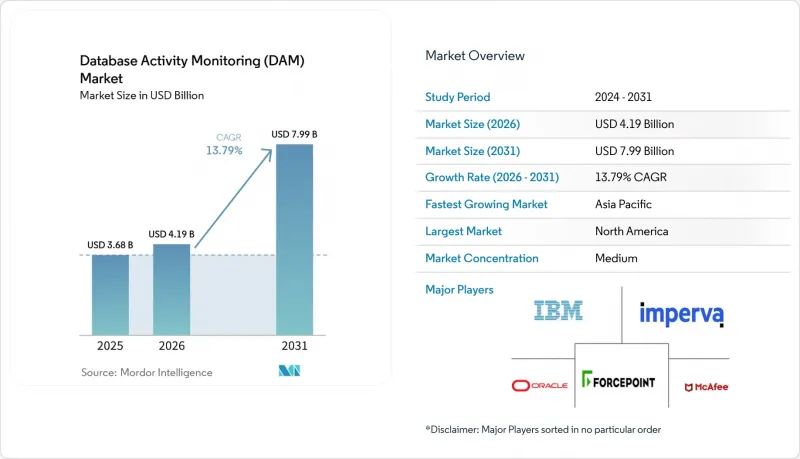
本報告按元件(軟體和服務)、部署模式(本地部署、雲端部署等)、組織規模(中小企業和大型企業)、資料庫類型(關聯式資料庫、NoSQL 資料庫等)、最終用戶產業(銀行、金融服務和保險、醫療保健、零售、政府、IT 和電信等)以及地區進行細分。市場預測以美元計價。
全球資料庫活動監控 (DAM) 市場趨勢與洞察
與資料主權相關的罰款增加將迫使企業重組合規預算。
在資料庫活動監控 (DAM) 市場,全球監管機構對違反 GDPR 的行為處以了 12 億歐元(13.5 億美元)的罰款,罰款總額預計在 2024 年達到 12 億歐元。其中包括對 LinkedIn 處以 3.1 億歐元(3.503 億美元)的罰款,以及對 Meta EDPB 處以 2.51 億歐元(2.8363 億美元)的罰款。各公司正在加大對持續查詢級審計追蹤的投入,以即時記錄所有跨境資料傳輸。美國醫療保健機構也面臨類似的壓力,HIPAA 的強制執行要求在 2026 年前實施多因素身份驗證,迫使醫院將監控作為核心安全措施。監管的加速推進解釋了為什麼資料庫活動監控市場正在從季度合規性檢查轉向運作的異常檢測基礎設施。即時可見性不再是可有可無的選項,而是董事會層級的預算項目。
將工作負載遷移到多重雲端會分散可見性
根據 Synergy Research Group 的研究,到 2024 年第四季度,AWS 佔了 31% 的基礎設施市場佔有率,Azure 為 25%,Google Cloud 為 11%,87% 的企業在多個超超大規模資料中心業者上運行工作負載。由於每個雲端平台都採用各自的日誌模式,安全團隊必須先將資料標準化處理才能進行分析。 2024 年年中發生的 Snowflake 資料外洩事件,導致 AT&T 的 7,300 萬筆記錄和 Ticketmaster 的 5.6 億筆記錄洩露,這表明跨區域會話監控的不一致會如何迅速演變成系統性安全漏洞。因此,將本地 Oracle 日誌與 Snowflake 事件整合的儀表板正在從單純的請求監控轉向實際的購買事件監控。
即時工作負載的效能開銷限制了其應用。
內聯代理程式會佔用 5% 到 15% 的 CPU 資源,這對於交易系統或黑色星期五的零售流量來說是不可接受的。此外,100 毫秒的延遲會導致購物車轉換率下降 7%。因此,企業通常只對 10% 到 20% 的查詢進行抽樣,但複雜的攻擊可能就潛伏在這 10% 到 20% 的抽樣範圍內。 PCI DSS v4.0.1 要求持續審計,這進一步加劇了這項挑戰。無代理雲端 API 在一定程度上解決了這個問題,但傳統的本地部署環境仍然面臨資源開銷過大的難題。
細分市場分析
隨著亞馬遜雲端服務 (AWS)、Azure 和Google雲端整合原生審計日誌流,預計到 2031 年,基於雲端的監控將實現 17.5% 的複合年成長率 (CAGR)。本地部署仍佔 63.5% 的收入。這是因為在數位資產管理 (DAM) 市場中,關鍵任務型 Oracle 和 IBM Db2 應用程式仍部署在企業資料中心內。混合部署使企業能夠在兩種環境中標準化日誌記錄,並滿足禁止將受監管資訊外部儲存的資料居住要求。
儘管歐盟資料傳輸法規和美國聯邦政府的零信任指令建議使用本地日誌記錄,但考慮到成本節約和CPU開銷降低,在獲得負責人批准後,基於雲端的監控方案也成為一個頗具吸引力的選擇。對於遷移週期較長的公司而言,日益成長的趨勢是將資料標準化到單一的控制面板中,該面板可以並行地整合Snowflake、MongoDB Atlas和本地SQL遙測資料。
在資料庫活動監控市場,託管服務收入的成長速度超過了整體需求,預計到2031年將以14.8%的複合年成長率成長,因為買家將偵測和控制功能外包給了全天候監控合作夥伴。由於金融機構更傾向於在本地運行工具,軟體仍然佔據主導地位,這主要得益於永久許可。基於代理的套件在Oracle和IBM Db2的詳細會話檢查方面佔據主導地位,但無代理部署(例如Microsoft Database Watcher和Datadog推出的方案)正在吸引對延遲敏感的工作負載。
第二代託管偵測與回應 (MDR) 提供者整合了規則對齊、威脅情報和自動化遏制功能。這種優勢在亞太地區尤為突出,因為該地區認證資料庫人才短缺,董事會優先考慮快速部署而非長期能力建設。隨著整合商將資料庫日誌整合到集中式安全資訊和事件管理 (SIEM) 管道中,專業服務收入也在不斷成長。
區域分析
預計2025年,北美將佔據資料庫活動監控(DAM)市場最大佔有率,銷售額達38.4%。這主要歸功於第14144號總統令與HIPAA法規的協調一致,推動了聯邦政府、醫療保健和保險業對零信任架構的採用。 Snowflake資料外洩事件提高了公眾意識,2024年第三季無代理部署的普及率成長了22%。加拿大網路安全中心也發布了類似的指南,而墨西哥的銀行正在加強日誌記錄,以滿足資料居住要求。
預計到2031年,亞太地區的年複合成長率(CAGR)將達到14.40%,位居全球最高。這主要歸功於中國的《個人資料保護法》、新加坡修訂後的《個人資料保護法》以及印度的《數位個人資料保護法》都強制要求建立在地化的審計基礎設施。日本和韓國的半導體工廠正透過持續監控來保護智慧財產權,而澳洲已將未採取合理預防措施的公司的罰款提高至5,000萬澳元(約3,300萬美元)。
歐洲仍然是至關重要的地區,預計到2024年,與GDPR相關的罰款總額將達到12億歐元(14億美元),遠高於往年。德國12個月的日誌保留要求正在樹立一項標準,並將推廣至私人採購領域。南美洲也取得了進展,包括巴西宣布首次實施其《一般資料保護法》(LGPD)。同時,中東和非洲地區的成長主要得益於阿拉伯聯合大公國和沙烏地阿拉伯的資料在地化法律,這些法律強制要求在本地或國內雲端進行日誌記錄。
其他好處:
- Excel格式的市場預測(ME)表
- 3個月的分析師支持
目錄
第1章:引言
- 研究假設和市場定義
- 調查範圍
第2章:調查方法
第3章執行摘要
第4章 市場狀況
- 市場概覽
- 市場促進因素
- 提高與資料主權相關的罰款
- 遷移多重雲端工作負載
- 利用人工智慧偵測內部威脅
- 公部門強制實施零信任政策
- SIEM與SOAR的整合
- 引進無代理遙測技術
- 市場限制因素
- 即時工作負載中的效能開銷
- DAM安全專家短缺
- 異質資料庫環境
- 假陽性疲勞
- 產業生態系分析
- 監理情勢
- 宏觀經濟因素對市場的影響
- 技術展望
- 波特五力分析
第5章 市場規模與成長預測
- 按組件
- 軟體
- 基於代理的監控
- 無代理監控
- 服務
- 專業服務
- 託管服務
- 軟體
- 部署模式
- 現場
- 基於雲端的
- 混合
- 按組織規模
- 小型企業
- 大公司
- 資料庫型
- 關聯資料庫
- NoSQL資料庫
- 巨量資料/Hadoop
- 雲端原生資料庫
- 按最終用戶行業分類
- 銀行業、金融服務業及保險業
- 醫療保健和生命科學
- 零售與電子商務
- 政府/國防
- 資訊科技/通訊
- 工業和製造業
- 能源公用事業
- 其他終端用戶產業
- 按地區
- 北美洲
- 美國
- 加拿大
- 墨西哥
- 南美洲
- 巴西
- 阿根廷
- 其他南美國家
- 歐洲
- 英國
- 德國
- 法國
- 義大利
- 其他歐洲國家
- 亞太地區
- 中國
- 日本
- 印度
- 韓國
- 其他亞太國家
- 中東和非洲
- 北美洲
第6章 競爭情勢
- 市場集中度
- 策略趨勢
- 市佔率分析
- 公司簡介
- International Business Machines Corporation
- Imperva Inc.(Thales SA)
- Oracle Corporation
- McAfee LLC
- Forcepoint LLC
- HexaTier Ltd.
- Trustwave Holdings Inc.
- SolarWinds Corporation
- Quest Software Inc.
- Guardicore Ltd.(Akamai Technologies)
- Idera Inc.
- Datadog Inc.
- Micro Focus International plc
- Amazon Web Services Inc.
- Google Cloud Platform(Chronicle Security)
- Teradata Corporation
- SAP SE
- Snowflake Inc.
- Microsoft Corporation(Azure SQL)
第7章 市場機會與未來展望
According to Mordor Intelligence, the database activity monitoring (DAM) market size was USD 3.68 billion in 2025, USD 4.19 billion in 2026, and is anticipated to reach USD 7.99 billion by 2031, growing at a CAGR of 13.79% from 2026 to 2031.
This report is Segmented by Component (Software and Services), Deployment Mode (On-Premises, Cloud-Based, and More), Organization Size (Small and Medium Enterprises, and Large Enterprises), Database Type (Relational, Nosql, and More), End-User Industry (BFSI, Healthcare, Retail, Government, IT and Telecom, and More), and Geography. The Market Forecasts are Provided in Terms of Value (USD).
Global Database Activity Monitoring (DAM) Market Trends and Insights
Escalating Data-Sovereignty Fines Reshape Compliance Budgets
In the Database Activity Monitoring (DAM) market, global regulators imposed EUR 1.2 billion (USD 1.35 billion) in GDPR penalties during 2024, led by EUR 310 million (USD 350.3 million) against LinkedIn and EUR 251 million (USD 283.63 million) against Meta EDPB. Enterprises are directing fresh capital to continuous query-level audit trails that record every cross-border transfer in real time. U.S. healthcare providers face parallel pressure as HIPAA enforcement adds mandatory multi-factor authentication by 2026, prompting hospitals to treat monitoring as a core security control. This regulatory tempo explains why the Database Activity Monitoring market is pivoting from quarterly compliance checks to always-on anomaly-detection infrastructure. Real-time visibility is now a board-level budget line rather than a discretionary item.
Multi-Cloud Workload Migration Fragments Visibility
Synergy Research Group found that AWS held 31%, Azure 25%, and Google Cloud 11% of infrastructure share in Q4 2024, while 87% of enterprises ran workloads across more than one hyperscaler. Each cloud keeps proprietary log schemas that force security teams to normalize data before analysis. The mid-2024 Snowflake breach, which exposed 73 million AT&T and 560 million Ticketmaster records, showed how inconsistent session monitoring across regions can snowball into systemic compromise. Consolidated dashboards that merge on-premises Oracle logs with Snowflake events are therefore moving from wish-list to purchase order.
Performance Overhead in Real-Time Workloads Constrains Deployment
Inline agents impose 5-15% CPU drag that trading systems and Black Friday retail traffic cannot tolerate, and a 100-millisecond delay can shave 7% off cart conversions. Merchants thus sample 10-20% of queries, but gaps let sophisticated attacks hide. PCI DSS v4.0.1 insists on continuous audit coverage, intensifying the struggle. Agentless cloud APIs solve part of the issue, but legacy on-premises estates still face the overhead dilemma.
Other drivers and restraints analyzed in the detailed report include:
- AI-Driven Insider-Threat Detection Moves Beyond Rule-Based Alerts
- SIEM-SOAR Integrations Transform Monitoring into Automated Response
- Shortage of DAM Security Specialists Limits Effective Implementation
For complete list of drivers and restraints, kindly check the Table Of Contents.
Segment Analysis
Cloud-based monitoring is projected to post a 17.5% CAGR to 2031 as Amazon Web Services, Azure, and Google Cloud embed native audit log streams. On-premises still controls 63.5% revenue because mission-critical Oracle and IBM Db2 applications remain in corporate data centers in the DAM market. Hybrid rollouts let organizations standardize logging across both environments, meeting data-residency mandates that prohibit the external storage of regulated information.
European Union transfer restrictions and United States federal zero-trust directives encourage localized logging, but cost relief and reduced CPU overhead make cloud-delivered monitoring attractive once compliance officers approve. Enterprises in long migration cycles are standardizing on single dashboards that ingest Snowflake, MongoDB Atlas, and on-premises SQL telemetry side by side.
Managed Services revenue is rising faster than overall demand in the database activity monitoring market, advancing at a 14.8% CAGR through 2031, as buyers outsource detective controls to 24-hour monitoring partners. Software still owns the majority share thanks to perpetual licensing, preferred by financial institutions that keep tooling on-premises. Agent-based suites dominate deep session inspection for Oracle and IBM Db2, while agentless deployments introduced by Microsoft Database Watcher and Datadog attract latency-sensitive workloads.
Second-generation managed detection and response providers integrate rule tuning, threat intelligence, and automated containment. This appeal is strongest in Asia-Pacific, where certified database talent is scarce, and boards seek quicker deployment over long-term capability building. Professional Services revenue also climbs as integrators stitch database logs into centralized security information and event management pipelines.
Geography Analysis
North America accounted for the largest share of the Database Activity Monitoring (DAM) market in 2025, with 38.4% revenue, as Executive Order 14144 and HIPAA rules converged, driving zero-trust rollouts across federal, healthcare, and insurance verticals. The Snowflake breach raised public awareness, leading to a 22% increase in agentless deployments in Q3 2024. Canada's cyber center issued similar directives, while Mexican banks tighten logging to meet data-residency clauses.
Asia-Pacific registers the fastest CAGR at 14.40% through 2031 as China's Personal Information Protection Law, Singapore's revised PDPA, and India's Digital Personal Data Protection Act all require localized audit infrastructure. Japanese and Korean semiconductor plants protect intellectual property with continuous monitoring, and Australia raises penalties to AUD 50 million (USD 33 million) for firms lacking reasonable safeguards.
Europe remains pivotal because GDPR fines totaled EUR 1.2 billion (USD 1.4 billion) in 2024, far exceeding prior years. Germany's 12-month log mandate sets a standard that cascades into private procurement. South America progresses as Brazil's LGPD issues its first enforcement cases, while the Middle East and Africa growth rides the UAE and Saudi data-localization statutes that push on-premises or in-country cloud logs.
- International Business Machines Corporation
- Imperva Inc. (Thales S.A.)
- Oracle Corporation
- McAfee LLC
- Forcepoint LLC
- HexaTier Ltd.
- Trustwave Holdings Inc.
- SolarWinds Corporation
- Quest Software Inc.
- Guardicore Ltd. (Akamai Technologies)
- Idera Inc.
- Datadog Inc.
- Micro Focus International plc
- Amazon Web Services Inc.
- Google Cloud Platform (Chronicle Security)
- Teradata Corporation
- SAP SE
- Snowflake Inc.
- Microsoft Corporation (Azure SQL)
Additional Benefits:
- The market estimate (ME) sheet in Excel format
- 3 months of analyst support
TABLE OF CONTENTS
1 INTRODUCTION
- 1.1 Study Assumptions and Market Definition
- 1.2 Scope of the Study
2 RESEARCH METHODOLOGY
3 EXECUTIVE SUMMARY
4 MARKET LANDSCAPE
- 4.1 Market Overview
- 4.2 Market Drivers
- 4.2.1 Escalating Data-Sovereignty Fines
- 4.2.2 Multi-cloud Workload Migration
- 4.2.3 AI-driven Insider-threat Detection
- 4.2.4 Zero-trust Mandates in Public Sector
- 4.2.5 SIEM-SOAR Integrations
- 4.2.6 Agentless Telemetry Adoption
- 4.3 Market Restraints
- 4.3.1 Performance Overhead in Real-time Workloads
- 4.3.2 Shortage of DAM Security Specialists
- 4.3.3 Heterogeneous Database Environments
- 4.3.4 False-positive Fatigue
- 4.4 Industry Ecosystem Analysis
- 4.5 Regulatory Landscape
- 4.6 Impact of Macroeconomic Factors on the Market
- 4.7 Technological Outlook
- 4.8 Porter's Five Forces Analysis
- 4.8.1 Threat of New Entrants
- 4.8.2 Bargaining Power of Suppliers
- 4.8.3 Bargaining Power of Buyers
- 4.8.4 Threat of Substitutes
- 4.8.5 Competitive Rivalry
5 MARKET SIZE AND GROWTH FORECASTS
- 5.1 By Component
- 5.1.1 Software
- 5.1.1.1 Agent-based Monitoring
- 5.1.1.2 Agentless Monitoring
- 5.1.2 Services
- 5.1.2.1 Professional Services
- 5.1.2.2 Managed Services
- 5.1.1 Software
- 5.2 By Deployment Mode
- 5.2.1 On-premises
- 5.2.2 Cloud-based
- 5.2.3 Hybrid
- 5.3 By Organization Size
- 5.3.1 Small and Medium Enterprises
- 5.3.2 Large Enterprises
- 5.4 By Database Type
- 5.4.1 Relational Databases
- 5.4.2 NoSQL Databases
- 5.4.3 Big Data / Hadoop
- 5.4.4 Cloud-native Databases
- 5.5 By End-User Industry
- 5.5.1 Banking, Financial Services and Insurance
- 5.5.2 Healthcare and Life Sciences
- 5.5.3 Retail and E-commerce
- 5.5.4 Government and Defense
- 5.5.5 IT and Telecommunications
- 5.5.6 Industrial and Manufacturing
- 5.5.7 Energy and Utilities
- 5.5.8 Other End-User Industries
- 5.6 By Geography
- 5.6.1 North America
- 5.6.1.1 United States
- 5.6.1.2 Canada
- 5.6.1.3 Mexico
- 5.6.2 South America
- 5.6.2.1 Brazil
- 5.6.2.2 Argentina
- 5.6.2.3 Rest of South America
- 5.6.3 Europe
- 5.6.3.1 United Kingdom
- 5.6.3.2 Germany
- 5.6.3.3 France
- 5.6.3.4 Italy
- 5.6.3.5 Rest of Europe
- 5.6.4 Asia-Pacific
- 5.6.4.1 China
- 5.6.4.2 Japan
- 5.6.4.3 India
- 5.6.4.4 South Korea
- 5.6.4.5 Rest of Asia-Pacific
- 5.6.5 Middle East and Africa
- 5.6.1 North America
6 COMPETITIVE LANDSCAPE
- 6.1 Market Concentration
- 6.2 Strategic Moves
- 6.3 Market Share Analysis
- 6.4 Company Profiles (includes Global level Overview, Market level overview, Core Segments, Financials as available, Strategic Information, Market Rank/Share for key companies, Products and Services, and Recent Developments)
- 6.4.1 International Business Machines Corporation
- 6.4.2 Imperva Inc. (Thales S.A.)
- 6.4.3 Oracle Corporation
- 6.4.4 McAfee LLC
- 6.4.5 Forcepoint LLC
- 6.4.6 HexaTier Ltd.
- 6.4.7 Trustwave Holdings Inc.
- 6.4.8 SolarWinds Corporation
- 6.4.9 Quest Software Inc.
- 6.4.10 Guardicore Ltd. (Akamai Technologies)
- 6.4.11 Idera Inc.
- 6.4.12 Datadog Inc.
- 6.4.13 Micro Focus International plc
- 6.4.14 Amazon Web Services Inc.
- 6.4.15 Google Cloud Platform (Chronicle Security)
- 6.4.16 Teradata Corporation
- 6.4.17 SAP SE
- 6.4.18 Snowflake Inc.
- 6.4.19 Microsoft Corporation (Azure SQL)
7 MARKET OPPORTUNITIES AND FUTURE OUTLOOK
- 7.1 White-space and Unmet-Need Assessment

 資料庫即服務 (DBaaS) 全球市場規模、佔有率、趨勢和成長分析報告,2026-2034 年
 資料庫即服務 (DBaaS) 市場預測至 2034 年—按資料庫類型、部署模式、服務類型、應用程式、最終用戶和地區分類的全球分析
 關聯資料庫市場規模、佔有率和成長分析:按部署方式、資料庫類型、組織規模、最終用戶產業、最終用戶和地區分類-2026-2033年產業預測全球資料庫軟體市場:市場規模、佔有率、趨勢和成長分析(2026-2034)
 全球混合資料庫市場報告(2026 年)
 資料庫監控軟體市場規模、佔有率和成長分析:按組件、部署模式、資料庫類型、應用、企業規模、最終用戶產業和地區分類-2026-2033年產業預測2026年全球分散式資料庫市場報告全球資料庫監控軟體市場規模、佔有率、趨勢和成長分析報告(2026-2034年)
 資料庫軟體市場:2026-2032年全球市場預測(依資料庫類型、資料庫規模、組織規模、產業及部署方式分類)2026年全球即時影片向量資料庫市場報告