


 |
市場調查報告書
商品編碼
2062419
水下通訊系統:市場佔有率分析、產業趨勢與統計、成長預測(2026-2031)Underwater Communication System - Market Share Analysis, Industry Trends & Statistics, Growth Forecasts (2026 - 2031) |
||||||

※ 本網頁內容可能與最新版本有所差異。詳細情況請與我們聯繫。
據 Mordor Intelligence 稱,2025 年水下通訊系統市值為 45.2 億美元,預計到 2031 年將從 2026 年的 48.8 億美元成長至 77.9 億美元,預測期(2026-2031 年)複合年成長率為 9.79%。
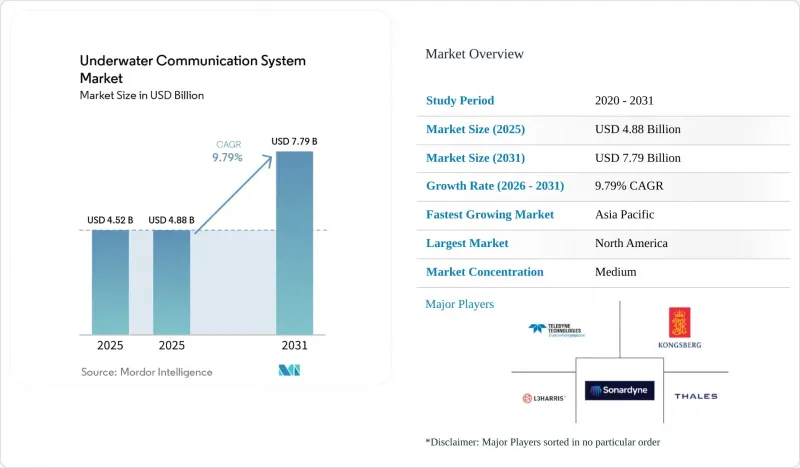
本報告按技術(聲學通訊、藍綠色雷射、電磁射頻、混合通訊)、組件(硬體、軟體和服務)、平台(潛艇和無人水下航行器 (UUV)、水面艦艇等)、應用(國防和安全等)以及地區進行細分。市場預測以美元 (USD) 為單位。
全球水下通訊系統市場趨勢及洞察
自主水下航行器的快速普及
由於超大型和中型自主潛水器能夠保持持續的水下存在,與有人駕駛潛艇相比,每巡邏小時的成本更低,因此各國海軍正在增加此類潛水器的採購量。 2026年3月,美國國防創新部門(DIU)選擇Dive-XL來展示透過開放式架構進行有效載荷整合。此型號允許在無需重新認證的情況下更換通訊模組。澳洲的「幽靈鯊」計畫交付首艘船體,並透過採用可容納第三方聲學或光學收發器的模組化艙室來縮短供應商認證時間。日本採購技術與後勤局透過結合藍綠雷射與聲學備用頻道,在50公尺深度實現了每秒1兆位元的通訊鏈路,從而強調了頻寬在新潛水器設計中的重要性。
利用超大規模資料中心業者資料中心建造水下資料中心的試點計畫正在加速推進。
微軟的「Natick專案」展示了水下資料儲存庫的低硬體故障率,但此後並未獲得進一步的契約,這表明陸上邊緣節點在維護成本方面仍然具有優勢。相反,超大規模資料中心業者正在資助海底電纜上的分散式聲學感測技術,以即時檢測機械應力。 2024年12月,橫河馬達推出了一個用於離岸風力發電電纜的1萬個感測點的平台,這表明通訊需求正在從計算卸載轉向結構健康監測。
渾濁水域中聲學通道的頻寬嚴重受限
在淺海沿岸區域,多路徑干擾、船舶環境噪音和沈積物散射會顯著降低聲學資料速率,使其僅為每秒數千比特,這對高效資料傳輸構成了重大挑戰。 IEEE Access 上的一項研究表明,當濁度超過 50 NTU 時,20 kHz 頻率的信噪比會下降 15 分貝,有效降低吞吐量一半,並影響通訊可靠性。為了緩解這些問題,營運商正在採用邊緣運算技術在上傳前壓縮數據,但這會使節點硬體成本增加 5 萬至 10 萬美元。此外,這種方法還會縮短電池壽命,進一步降低此類環境下的運作效率。
細分市場分析
至2025年,聲學鏈路將佔水下通訊系統市場收入的62.58%,其傳輸距離超過10公里,且對對準的要求較低。藍綠雷射技術正以8.45%的複合年成長率穩步發展,到2031年,實驗室已展示了170Gigabit/秒的偏振復用技術,但由於海水對波長超過550奈米的訊號吸收,其有效傳輸距離被限制在約100公尺。電磁系統仍處於小眾領域,因為頻率高於30千赫茲的訊號在幾公尺內就會被海水衰減。結合聲學骨幹網和光突發通道的混合設計正在滿足近距離高解析度視訊傳輸的需求。
軟體定義聲學調變解調器現在支援現場程式更改,使操作人員能夠在環境噪音水平激增時重新調整載波頻率。這減少了停機時間並延長了設備壽命。 EvoLogics 於 2024 年整合了 JANUS 開放協議,確保了北約各部隊設備之間的互通性。 30 kHz 以下頻率的監管不確定性仍然存在,這給設備製造商帶來了負擔,他們需要在每個司法管轄區對聲學和光學路徑進行認證。同時,氮化鎵雷射二極體的成本呈下降趨勢,預計將實現成本低於 10,000 美元的光纖通訊終端,適用於水產養殖網箱和巡檢無人機。
2025年,硬體銷售額佔總銷售額的57.53%,主要原因是感測器、數據機和水下相容連接器的價格持續高漲。然而,受雲端託管的艦隊管理和波形熱補丁等技術的推動,軟體和服務領域的成長預計將超過硬體,複合年成長率將達到8.39%,這些技術可以降低對接成本。 2026年2月,L3Harris獲得了一份契約,將供應26套支援無線加密金鑰輪換的設備,這表明軟體控制如今已成為採購中的關鍵要素。
感測器創新主要集中在壓電複合堆疊結構上,以擴展可用頻寬。這使得單一單元能夠覆蓋多個頻段,從而降低材料清單(BOM) 成本。由於需要耐壓外殼和防腐蝕保護,電纜完整性和連接器可靠性仍然佔節點硬體成本的 20% 之多。在軟體方面,基於機器學習的診斷功能可即時評估通道質量,並建議調整輸出和頻率。這會將歷史現場資料轉化為預測性維護警報,從而降低生命週期成本。隨著海上安裝商將節點試運行、培訓和多年支援納入訂閱協議,業務收益也在不斷成長。
區域分析
預計到2025年,北美將佔總收入的31.76%,這主要得益於海底通訊現代化、大西洋沿岸離岸風力發電裝置容量的擴張以及北極監測舉措的推進。 Dive-XL專案的合約以及L3Harris船上設備的訂單確保了到2033年的穩定訂單儲備。同時,隨著航道的擴展,加拿大北極感測器網路正在保護西北航道的安全。墨西哥灣深海域區塊也推動了區域需求,因為該區塊需要海底通訊節點來處理來自多個供應商的感測器資料流。
預計亞太地區2026年至2031年的複合年成長率將達到8.73%。澳洲17億澳元(11.2億美元)的「幽靈鯊」計畫投資為供應商的藍圖奠定了基礎,而日本的混合光聲數據機原型則展現了其向更高頻寬邁進的戰略舉措。中國的「透明海洋」網路正在擴展聲學監視範圍,而韓國和印度則在投資建造整合軟體定義調變解調器的新型潛艇。台灣、越南和印度離岸風力發電的部署將新增數百個可出口的電纜監視節點,但兩用技術的出口限制以及認證系統的差異構成了市場准入的障礙。
在歐洲,北海和波羅的海地區依賴分散式聲波感測技術探測錨鏈拖曳和漁具碰撞的設施,升級需求強勁。北約的「波羅的海哨兵」行動凸顯了基礎設施的脆弱性,並推動了難以截獲的聲波波形的採購。在中東,波斯灣的平台正在部署光纖繫繩,以避免聲波頻寬的限制。同時,在南美洲,巴西的鹽鹽層下區域正在尋求吞吐量可達數兆位元的光鏈路。智利的鮭魚養殖戶以及阿根廷的早期離岸風力發電研究,正在擴大區域應用範圍,並減少對石油和天然氣的依賴。
其他好處:
- Excel格式的市場預測(ME)表
- 3個月的分析師支持
目錄
第1章:引言
- 研究假設和市場定義
- 調查範圍
第2章:調查方法
第3章執行摘要
第4章 市場狀況
- 市場概覽
- 市場促進因素
- 自主水下航行器(AUV)的快速普及
- 利用超大規模資料中心業者資料中心加速水下資料中心試點項目
- 國防現代化計畫重點關注有爭議的海底區域
- 越來越多的海上可再生能源設施需要即時監測
- 擴大深海礦產探勘權
- 軟體定義聲學調變解調器的出現,使得動態頻寬利用成為可能。
- 市場限制因素
- 渾濁水中聲學通道的嚴格頻寬限制
- 混合光聲網路需要高資本投資
- 關於低於 30 kHz 的射頻頻段的監理規定存在模糊之處
- 長基線定位網路的網路安全漏洞
- 產業價值鏈分析
- 監理情勢
- 技術展望
- 波特五力分析
第5章 市場規模與成長預測
- 透過技術
- 聲學通訊
- 光(藍/綠雷射)
- 電磁波/射頻
- 混合
- 按組件
- 硬體
- 數據機
- 感應器/收發器
- 電纜和連接器
- 感測器和天線
- 軟體和服務
- 硬體
- 按平台
- 潛水艇和無人水下航行器(UUV)
- 水面艦艇
- 固定式海上平台
- 海上浮動平台
- 科學與監測浮標
- 透過使用
- 國防與安全
- 石油和天然氣探勘與生產
- 環境監測與海洋學
- 科學研究和學術機構
- 海洋工程和水產養殖
- 按地區
- 北美洲
- 美國
- 加拿大
- 墨西哥
- 南美洲
- 巴西
- 阿根廷
- 其他南美國家
- 歐洲
- 德國
- 英國
- 法國
- 俄羅斯
- 其他歐洲國家
- 亞太地區
- 中國
- 日本
- 印度
- 韓國
- 澳洲
- 其他亞太國家
- 中東和非洲
- 中東
- 沙烏地阿拉伯
- 阿拉伯聯合大公國
- 其他中東國家
- 非洲
- 南非
- 埃及
- 其他非洲國家
- 中東
- 北美洲
第6章 競爭情勢
- 市場集中度
- 策略趨勢
- 市佔率分析
- 公司簡介
- Teledyne Technologies Incorporated
- Kongsberg Gruppen ASA
- Sonardyne International Ltd.
- Ultra Electronics Maritime Systems Inc.
- L3Harris Technologies Inc.
- Thales Group
- SAAB AB
- EvoLogics GmbH
- Subnero Pte. Ltd.
- DSPComm Ltd.
- General Dynamics Mission Systems, Inc.
- Lockheed Martin Corporation
- Ocean Sonics Ltd.
- Hydroacoustics Inc.
- Nautel Ltd.(Nautel Sonar Systems)
- EdgeTech(a wholly-owned subsidiary of ORE Offshore)
- Wartsila ELAC Nautik GmbH
- Blueprint Subsea Ltd.
- JW Fishers Mfg Inc.
- CGG SA(Sercel)
第7章 市場機會與未來展望
According to Mordor Intelligence, the underwater communication system market size was valued at USD 4.52 billion in 2025 and is estimated to grow from USD 4.88 billion in 2026 to reach USD 7.79 billion by 2031, at a CAGR of 9.79% during the forecast period (2026-2031).
This report is Segmented by Technology (Acoustic Communication, Optical Blue-Green Laser, Electromagnetic Radio Frequency, and Hybrid), Component (Hardware, and Software and Services), Platform (Submarines and Unmanned Underwater Vehicles (UUVs), Surface Vessels, and More), Application (Defense and Security, and More), and Geography. The Market Forecasts are Provided in Terms of Value USD.
Global Underwater Communication System Market Trends and Insights
Rapid Adoption of Autonomous Underwater Vehicles
Procurement of extra-large and medium-class autonomous vehicles is rising because navies can maintain a persistent subsea presence at lower cost per patrol hour than crewed submarines. The United States Defense Innovation Unit selected Dive-XL in March 2026 to demonstrate open-architecture payload integration, a model that allows communication modules to be swapped without vessel recertification. Australia's Ghost Shark project delivered its first hull in January 2026 and uses modular bays that accept third-party acoustic or optical transceivers, trimming qualification time for vendors. Japan's Acquisition, Technology and Logistics Agency achieved a 1 megabit-per-second link at 50 meters using a blue-green laser paired with an acoustic fallback channel, underscoring bandwidth priorities in new vehicle designs.
Accelerated Subsea Data-Center Pilots by Hyperscalers
Microsoft's Project Natick proved submerged data vaults had lower hardware failure rates, yet follow-on contracts remain absent, implying that maintenance economics still favor land-based edge nodes. Hyperscalers instead fund distributed acoustic sensing on subsea cables to detect mechanical stress events in real time. Yokogawa Electric launched a 10 000-point sensing platform for offshore wind export cables in December 2024, revealing that communication demand is shifting toward structural health monitoring rather than compute off-loading.
Severe Bandwidth Limits of Acoustic Channels in Turbid Waters
Multipath interference, ambient shipping noise, and sediment scatter significantly reduce acoustic data rates to only a few kilobits per second in shallow coastal zones, creating substantial challenges for efficient data transmission. An IEEE Access study revealed that turbidity levels exceeding 50 NTU reduce signal-to-noise ratios by 15 decibels at 20 kilohertz, effectively halving throughput and impacting communication reliability. To mitigate these issues, operators embed edge compute to compress data before uplink, which adds USD 50,000-100,000 in node hardware costs. However, this approach also shortens battery life, further complicating operational efficiency in such environments.
Other drivers and restraints analyzed in the detailed report include:
- Defense Modernization Programs Focused on Contested Seabed Zones
- Growth in Offshore Renewable Energy Installations Needing Real-Time Monitoring
- High CAPEX for Hybrid Optical-Acoustic Networks
For complete list of drivers and restraints, kindly check the Table Of Contents.
Segment Analysis
In 2025, acoustic links held 62.58% of underwater communication system market revenue because they operate over 10 kilometers with modest alignment requirements. Optical blue-green lasers are advancing at an 8.45% CAGR through 2031 as laboratories demonstrate 170 gigabit-per-second polarization-division multiplexing, yet seawater absorption beyond 550 nanometers confines operational range to roughly 100 meters. Electromagnetic systems remain niche since seawater attenuates signals above 30 kilohertz within meters. Hybrid designs pairing an acoustic backbone with an optical burst channel satisfy missions that need high-definition video off-load during close approaches.
Software-defined acoustic modems are now field-programmable, allowing operators to retune carrier frequencies when ambient noise spikes, which reduces downtime and extends asset life. EvoLogics embedded the JANUS open protocol in 2024 to guarantee fleet interoperability across NATO forces. Regulatory uncertainty around sub-30 kilohertz spectrum continues, placing the burden on equipment makers to certify both acoustic and optical paths for each jurisdiction. Meanwhile, gallium-nitride laser diodes are trending toward lower cost curves, promising sub-USD 10 000 optical endpoints suited to aquaculture pens and inspection drones.
Hardware captured 57.53% of 2025 revenue because transducers, modems, and subsea-rated connectors still command premium prices. However, the software and services segment is projected to outpace hardware with an 8.39% CAGR, fueled by cloud-hosted fleet management and by waveform hot-patching that saves dry-dock fees. L3Harris won a USD contract in February 2026 to supply 26 shipsets that support over-the-air encryption-key rotation, illustrating how software control is now a procurement must-have.
Transducer innovation focuses on piezo-composite stacks that widen the usable bandwidth envelope, permitting a single unit to cover multiple frequency bands and thereby trim bill of materials. Cable integrity and connector reliability still represent up to 20% of node hardware cost because of pressure housing and corrosion control. On the software side, machine-learning diagnostics assess channel quality in real time and recommend power or frequency adjustments, turning historical field data into predictive maintenance alerts that lower life-cycle cost. Services revenue is rising as offshore installers bundle node commissioning, training, and multi-year support into subscription contracts.
Geography Analysis
North America generated 31.76% of 2025 revenue thanks to submarine communication modernization, increasing offshore wind capacity along the Atlantic coast, and Arctic surveillance initiatives. The Dive-XL program contracts and L3Harris shipset awards provide a visible backlog through 2033, while Canada's Arctic sensor grid protects the Northwest Passage as shipping lanes expand. Mexico's deepwater Gulf of Mexico blocks require subsea communication nodes that handle multi-vendor sensor streams, reinforcing regional demand.
Asia-Pacific is forecast to grow at an 8.73% CAGR between 2026 and 2031. Australia's AUD 1.7 billion (USD 1.12 billion) Ghost Shark investment anchors supplier roadmaps, and Japan's hybrid optical-acoustic modem prototypes signal a strategic push toward higher bandwidth. China's Transparent Ocean network extends acoustic surveillance, while South Korea and India fund new submarine builds that integrate software-defined modems. Offshore wind rollouts in Taiwan, Vietnam, and India add hundreds of export-cable monitoring nodes, though export controls on dual-use technologies and diverging certification regimes create market entry hurdles.
Europe shows robust replacement demand across North Sea and Baltic assets that rely on distributed acoustic sensing to detect anchor drags and fishing-gear strikes. NATO's Baltic Sentry operation highlights infrastructure vulnerability and spurs procurement of low-intercept acoustic waveforms. The Middle East deploys fiber-optic tethers on Persian Gulf platforms to circumvent acoustic bandwidth ceilings, whereas South America's pre-salt provinces in Brazil demand optical links capable of multimegabit throughput. Chile's salmon growers and Argentina's early offshore wind studies broaden the regional application mix, lowering dependence on oil and gas alone.
- Teledyne Technologies Incorporated
- Kongsberg Gruppen ASA
- Sonardyne International Ltd.
- Ultra Electronics Maritime Systems Inc.
- L3Harris Technologies Inc.
- Thales Group
- SAAB AB
- EvoLogics GmbH
- Subnero Pte. Ltd.
- DSPComm Ltd.
- General Dynamics Mission Systems, Inc.
- Lockheed Martin Corporation
- Ocean Sonics Ltd.
- Hydroacoustics Inc.
- Nautel Ltd. (Nautel Sonar Systems)
- EdgeTech (a wholly-owned subsidiary of ORE Offshore)
- Wartsila ELAC Nautik GmbH
- Blueprint Subsea Ltd.
- JW Fishers Mfg Inc.
- CGG S.A. (Sercel)
Additional Benefits:
- The market estimate (ME) sheet in Excel format
- 3 months of analyst support
TABLE OF CONTENTS
1 INTRODUCTION
- 1.1 Study Assumptions and Market Definition
- 1.2 Scope of the Study
2 RESEARCH METHODOLOGY
3 EXECUTIVE SUMMARY
4 MARKET LANDSCAPE
- 4.1 Market Overview
- 4.2 Market Drivers
- 4.2.1 Rapid adoption of autonomous underwater vehicles (AUVs)
- 4.2.2 Accelerated subsea data-center pilots by hyperscalers
- 4.2.3 Defense modernization programs focused on contested seabed zones
- 4.2.4 Growth in offshore renewable energy installations needing real-time monitoring
- 4.2.5 Expansion of deep-sea mineral exploration licenses
- 4.2.6 Emergence of software-defined acoustic modems enabling dynamic spectrum use
- 4.3 Market Restraints
- 4.3.1 Severe bandwidth limits of acoustic channels in turbid waters
- 4.3.2 High CAPEX for hybrid optical-acoustic networks
- 4.3.3 Regulatory ambiguity around RF spectrum below 30 kHz
- 4.3.4 Cyber-security vulnerabilities in long-baseline positioning networks
- 4.4 Industry Value Chain Analysis
- 4.5 Regulatory Landscape
- 4.6 Technological Outlook
- 4.7 Porter's Five Forces Analysis
- 4.7.1 Threat of New Entrants
- 4.7.2 Bargaining Power of Suppliers
- 4.7.3 Bargaining Power of Buyers
- 4.7.4 Threat of Substitutes
- 4.7.5 Competitive Rivalry
5 MARKET SIZE AND GROWTH FORECASTS (VALUE)
- 5.1 By Technology
- 5.1.1 Acoustic Communication
- 5.1.2 Optical (Blue/Green Laser)
- 5.1.3 Electromagnetic/Radio Frequency
- 5.1.4 Hybrid
- 5.2 By Component
- 5.2.1 Hardware
- 5.2.1.1 Modems
- 5.2.1.2 Transducers/Transceivers
- 5.2.1.3 Cables and Connectors
- 5.2.1.4 Sensors and Antennas
- 5.2.2 Software and Services
- 5.2.1 Hardware
- 5.3 By Platform
- 5.3.1 Submarines and Unmanned Underwater Vehicles (UUVs)
- 5.3.2 Surface Vessels
- 5.3.3 Offshore Fixed Platforms
- 5.3.4 Offshore Floating Platforms
- 5.3.5 Scientific and Monitoring Buoys
- 5.4 By Application
- 5.4.1 Defense and Security
- 5.4.2 Oil and Gas Exploration and Production
- 5.4.3 Environmental Monitoring and Oceanography
- 5.4.4 Scientific Research and Academia
- 5.4.5 Marine Construction and Aquaculture
- 5.5 By Geography
- 5.5.1 North America
- 5.5.1.1 United States
- 5.5.1.2 Canada
- 5.5.1.3 Mexico
- 5.5.2 South America
- 5.5.2.1 Brazil
- 5.5.2.2 Argentina
- 5.5.2.3 Rest of South America
- 5.5.3 Europe
- 5.5.3.1 Germany
- 5.5.3.2 United Kingdom
- 5.5.3.3 France
- 5.5.3.4 Russia
- 5.5.3.5 Rest of Europe
- 5.5.4 Asia-Pacific
- 5.5.4.1 China
- 5.5.4.2 Japan
- 5.5.4.3 India
- 5.5.4.4 South Korea
- 5.5.4.5 Australia
- 5.5.4.6 Rest of Asia-Pacific
- 5.5.5 Middle East and Africa
- 5.5.5.1 Middle East
- 5.5.5.1.1 Saudi Arabia
- 5.5.5.1.2 United Arab Emirates
- 5.5.5.1.3 Rest of Middle East
- 5.5.5.2 Africa
- 5.5.5.2.1 South Africa
- 5.5.5.2.2 Egypt
- 5.5.5.2.3 Rest of Africa
- 5.5.5.1 Middle East
- 5.5.1 North America
6 COMPETITIVE LANDSCAPE
- 6.1 Market Concentration
- 6.2 Strategic Moves
- 6.3 Market Share Analysis
- 6.4 Company Profiles {(includes Global level Overview, Market level overview, Core Segments, Financials as available, Strategic Information, Market Rank/Share for key companies, Products and Services, and Recent Developments)}
- 6.4.1 Teledyne Technologies Incorporated
- 6.4.2 Kongsberg Gruppen ASA
- 6.4.3 Sonardyne International Ltd.
- 6.4.4 Ultra Electronics Maritime Systems Inc.
- 6.4.5 L3Harris Technologies Inc.
- 6.4.6 Thales Group
- 6.4.7 SAAB AB
- 6.4.8 EvoLogics GmbH
- 6.4.9 Subnero Pte. Ltd.
- 6.4.10 DSPComm Ltd.
- 6.4.11 General Dynamics Mission Systems, Inc.
- 6.4.12 Lockheed Martin Corporation
- 6.4.13 Ocean Sonics Ltd.
- 6.4.14 Hydroacoustics Inc.
- 6.4.15 Nautel Ltd. (Nautel Sonar Systems)
- 6.4.16 EdgeTech (a wholly-owned subsidiary of ORE Offshore)
- 6.4.17 Wartsila ELAC Nautik GmbH
- 6.4.18 Blueprint Subsea Ltd.
- 6.4.19 JW Fishers Mfg Inc.
- 6.4.20 CGG S.A. (Sercel)
7 MARKET OPPORTUNITIES AND FUTURE OUTLOOK
- 7.1 White-space and Unmet-need Assessment

 水下通訊系統市場-2026-2032年全球市場預測水下無線通訊市場:按組件、通訊技術、安裝深度、頻段和應用分類-2026-2032年全球市場預測
 全球水下智慧通訊浮標系統市場:2026-2036年
 水下通訊系統市場規模、佔有率和成長分析:按組件、通訊技術、連接方式、平台、應用、最終用戶和地區分類-2026-2033年產業預測
 水下通訊系統市場分析及預測(至2035年):類型、產品、服務、技術、組件、應用、部署、最終用戶、功能、安裝配置
 2026年全球水下通訊系統市場報告
 全球水下通訊系統市場規模、佔有率、趨勢和成長分析報告(2026-2034年)
 水下通訊系統市場-全球產業規模、佔有率、趨勢、機會、預測:按組件、連接方式、應用、地區和競爭格局分類,2021-2031年全球水下無線通訊市場:按類型、技術、應用、產業和地區劃分 - 市場預測與分析 (2026-2035)
 全球水下通訊系統市場