


 |
市場調查報告書
商品編碼
2062418
遠端瀏覽器:市場佔有率分析、行業趨勢和統計數據、成長預測(2026-2031 年)Remote Browser - Market Share Analysis, Industry Trends & Statistics, Growth Forecasts (2026 - 2031) |
||||||

※ 本網頁內容可能與最新版本有所差異。詳細情況請與我們聯繫。
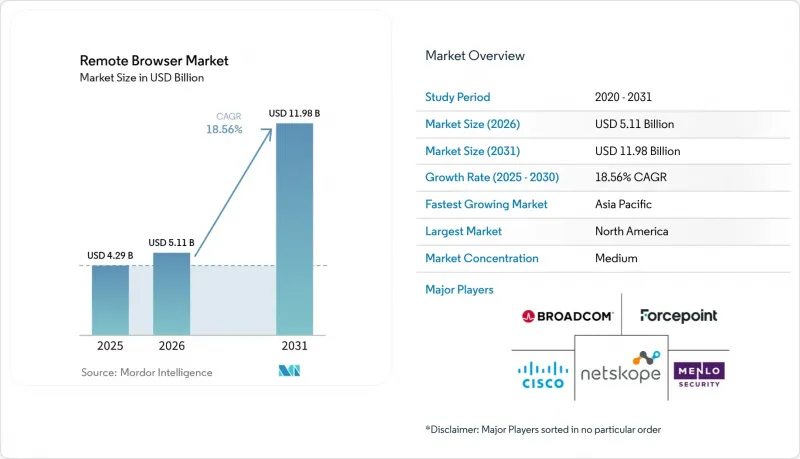
據 Mordor Intelligence 稱,2025 年遠端瀏覽器市值為 42.9 億美元,預計到 2031 年將達到 119.8 億美元,而 2026 年為 51.1 億美元,預測期(2026-2031 年)的複合年成長率為 18.56%。
本報告按部署類型(雲端、本地部署、混合部署)、技術類型(DOM 重構、像素推送等)、企業規模(大型企業、中小企業)、最終用戶行業(銀行、金融服務和保險 (BFSI)、IT 和電信、政府和國防、醫療保健、教育等)以及地區進行細分。市場預測以美元 (USD) 計價。
全球遠端瀏覽器市場趨勢及洞察
零信任安全框架的普及
美國國家標準與技術研究院 (NIST) 特別出版刊物800-207、網路安全與基礎設施安全局 (CISA) 的零信任成熟度模型以及美國國家安全局 (NSA) 的實施指南,都將遠端瀏覽器隔離定位為一種先進的資料保護控制手段,從而加速了美國聯邦政府和金融部門的預算撥款。英國的《網路安全彈性法案》對數位服務供應商提出了類似的要求,進而加速了通訊和公共服務部門對遠端瀏覽器隔離的採用。一些機構用瀏覽器原生零機芯控制取代了傳統的安全 Web 閘道器,並在一年內實現了延遲降低 30% 和橫向移動事件減少 60%。這些趨勢共同促使全球企業將遠端瀏覽器市場從實驗性試點階段提升到核心架構階段。供應商也積極回應,提供直接針對身分感知代理的模組,簡化策略執行,並將採購週期從數年縮短至數月。
關鍵基礎設施中強制實施瀏覽器隔離(NIST 和 EU-NIS2 自 2025 年起實施)
NIS2 指示強制要求關鍵服務提供者在 2024 年 10 月前實現瀏覽器隔離。同時,德國聯邦資訊安全局 (BSI) 擴大了 C5 認證的範圍,要求揭露資料處理位置,迫使受監管公司採用混合或本地部署方式。在美國,美國國家標準與技術研究院 (NIST) 自 2025 年起發布的指南將關鍵基礎設施提供商的瀏覽器隔離要求從“建議”改為“強制”,2026 會計年度聯邦預算撥款 12 億美元用於零信任瀏覽器工具。法國的 SecNumCloud 認證進一步加大了壓力,規定除非擁有自主基礎設施,否則不得從美國取得公共部門資料的管理存取權。這些法規的趨同使得合規性成為一項即時的購買因素,推動了歐洲和北美地區的短期訂單成長,並鞏固了遠端瀏覽器市場作為一項合規要求的地位。
高清網路應用中的延遲和使用者體驗問題
逐像素傳輸資料的流會導致連線延遲在 1.4 到 11.9 秒之間。對於基於瀏覽器的 CAD、視訊會議和即時交易平台而言,這是不可接受的。谷歌的「互動到下一幀渲染時間」指標已將反應速度作為關鍵排名因素,導致客戶對會降低速度的安全機制的接受度降低。雖然像 Zscaler 這樣的供應商已透過收購 SquareX 等公司採用了網路向量渲染技術,但仍有 41% 的 IT 領導者認為延遲是全面採用該技術的最大障礙。在邊緣節點稀疏的地區,這種限制最為嚴重,因為往返時間超過了互動式工作負載可接受的閾值。
細分市場分析
隨著各組織機構應對資料居住法規和效能要求,混合部署預計將在2026年至2031年間以18.22%的年均成長率成長,超過純雲端和本地部署方案。 2025年,雲端服務佔據了遠端瀏覽器市場佔有率的62.19%,這主要得益於超大規模資料中心業者雲端服務商提供的SASE捆綁包,這些捆綁包消除了整合摩擦。歐洲的《健康資料空間法規》和法國的SecNumCloud規則要求醫療服務提供者將受保護的資料保存在歐盟境內,這加速了雙棧架構的採用,該架構在本地處理敏感工作流程,同時將一般瀏覽任務卸載到雲端。
這種混合方法也有助於降低延遲。透過將風險域路由到隔離的雲端容器,同時原生載入可信任的 SaaS 服務,回應時間最多可縮短 40%。 AWS 已撥款 78 億歐元(88 億美元)用於歐洲主權區域,以確保只有營運商才能存取。這表明資料本地化不再是可選項,而是強制性要求。隨著主權雲端容量的擴展,混合隔離正成為銀行、醫療系統和公共機構的標準方案。這一趨勢正在推動遠端瀏覽器市場持續成長,並鞏固以區域合規性為中心的供應商藍圖。
DOM 重構技術兼顧了安全性和接近原生用戶體驗,在遠端瀏覽器市場佔據主導地位,預計到 2025 年將佔據 55.83% 的市場佔有率。然而,它依賴簽名更新,這造成了安全漏洞,使零日攻擊有機可乘,逃避檢測並滲透系統。像素推送技術透過提供更安全的方法有效消除了這種風險。但這項技術也存在一些顯著的權衡取捨,尤其是在複雜的應用程式中,例如頻寬消耗增加和延遲超過 200 毫秒。
網路向量渲染透過指示端點如何渲染內容而非發送完整幀,將伺服器的運算負載降低了一半,並大幅降低了延遲,其複合年成長率高達 18.91%。 Zscaler 的 SquareX 整合和 Palo Alto Networks 的瀏覽器原生引擎表明,供應商正在運行時而非遠端資料平面中整合保護機制。對延遲極為敏感的金融交易平台和放射科檢查室是這項技術的早期採用者。未來,這些優勢有望逐步削弱 DOM 重建的主導地位,並重塑遠端瀏覽器市場的收入結構。
區域分析
預計到2025年,北美將佔據遠端瀏覽器市場45.34%的佔有率。這主要得益於美國聯邦政府強制推行的零信任政策以及華爾街銀行對SASE(自簽名自動回郵)技術的快速採用。 2026年預算中持續的資金投入,以及符合加拿大GDPR(一般資料保護規範)的資料遺失法規,將維持企業需求,但隨著一級企業市場接近飽和,成長速度將會放緩。該地區密集的邊緣網路將平均延遲控制在20毫秒以下,為雲端部署提供了效能優勢。競爭日益激烈,Zscaler、Palo Alto Networks和Cloudflare等公司競相縮短會話啟動時間,而Authentic8等專注於特定領域的公司則為國防相關企業提案強大的環境。
亞太地區預計到2031年將以18.28%的複合年成長率成長,成長速度在所有地區中最高,這主要得益於中國、印度和越南的本地化法律鼓勵跨國公司建立本土渲染節點。 Akamai記錄顯示,到2024年,亞洲地區將發生超過800億次Web應用程式攻擊,其中110億次針對API,凸顯了邊界防禦的脆弱性。儘管日本和韓國已受益於歐盟的充分性認定,但國內買家仍傾向於混合模式,以滿足客戶對資料主權的期望。澳洲修訂後的《關鍵基礎設施法》和新加坡大力推動金融科技發展,使得該地區監管環境的多樣性凸顯,需要跨區域部署,從而擴大了遠端瀏覽器市場的整體潛在規模。
歐洲正乘著合規浪潮,這股浪潮的驅動力來自NIS2、數據法律以及即將訂定的《歐洲健康資料空間條例》。法國的SecNumCloud法規實際上將非主權美國供應商排除在外,除非他們建立歐盟專屬的託管域。 AWS已推出78億歐元(88億美元)的主權計畫作為回應,微軟也承諾在15個國家提供本土化的Copilot處理服務。德國聯邦資訊安全局(BSI)已在其C5審計中增加了位置透明度要求,敦促銀行轉向混合配置,將可信賴的SaaS與敏感工作負載分開。南美、中東和非洲雖然落後,但已有加速發展的跡象。巴西的銀行業監管法規、沙烏地阿拉伯的「2030願景」以及南非的金融試點計畫表明,區域性法規正在持續推動遠端瀏覽器市場的發展。
其他好處:
- Excel格式的市場預測(ME)表
- 3個月的分析師支持
目錄
第1章:引言
- 研究假設和市場定義
- 調查範圍
第2章:調查方法
第3章執行摘要
第4章 市場狀況
- 市場概覽
- 市場促進因素
- 零信任安全框架的普及
- 關鍵基礎設施中強制實施瀏覽器隔離(NIST 和 EU-NIS2 自 2025 年起實施)
- 複雜的基於網路的釣魚即服務工具包激增
- 「隨時隨地辦公」的廣泛普及擴大了 SaaS 的攻擊面。
- 針對 Edge 和 Chrome 瀏覽器的瀏覽器原生勒索軟體有效載荷
- 超大規模資料中心業者中心將RBI整合到SASE套件中
- 市場限制因素
- 高保真 Web 應用程式中的延遲和使用者體驗問題
- 中小企業網路安全架構預算削減。
- 相互競爭的客戶端安全增強功能(嵌入式安全瀏覽 API)
- 不同地區資料居住要求的差異使得雲端 RBI 的實施變得複雜。
- 產業供應鏈分析
- 監理情勢
- 技術展望
- 宏觀經濟因素對市場的影響
- 波特五力分析
第5章 市場規模與成長預測
- 部署模式
- 基於雲端的
- 現場
- 混合
- 依技術類型
- DOM重建
- 像素推播
- 網路向量渲染
- 按公司規模
- 大公司
- 中小企業
- 按最終用戶行業分類
- BFSI
- 資訊科技/通訊
- 政府/國防
- 衛生保健
- 教育
- 其他終端用戶產業
- 按地區
- 北美洲
- 美國
- 加拿大
- 墨西哥
- 南美洲
- 巴西
- 阿根廷
- 其他南美國家
- 歐洲
- 英國
- 德國
- 法國
- 義大利
- 西班牙
- 俄羅斯
- 其他歐洲國家
- 亞太地區
- 中國
- 日本
- 印度
- 韓國
- 澳洲和紐西蘭
- 其他亞太國家
- 中東和非洲
- 中東
- 沙烏地阿拉伯
- 阿拉伯聯合大公國
- 土耳其
- 其他中東國家
- 非洲
- 南非
- 奈及利亞
- 埃及
- 其他非洲國家
- 中東
- 北美洲
第6章 競爭情勢
- 市場集中度
- 策略趨勢
- 市佔率分析
- 公司簡介
- Forcepoint LLC
- Netskope, Inc.
- Menlo Security, Inc.
- Broadcom Inc.
- Cisco Systems, Inc.
- Cloudflare, Inc.
- Zscaler, Inc.
- Authentic8, Inc.
- Citrix Systems, Inc.
- Ericom Software Ltd.
- McAfee, LLC
- Cyberinc Corporation
- HP Inc.
- Kasm Technologies Inc.
- Perimeter 81 Ltd.
- Light Point Security, LLC
- Proofpoint, Inc.
- Fortinet, Inc.
- Palo Alto Networks, Inc.
- Check Point Software Technologies Ltd.
第7章 市場機會與未來展望
According to Mordor Intelligence, the remote browser market size was valued at USD 4.29 billion in 2025 and estimated to grow from USD 5.11 billion in 2026 to reach USD 11.98 billion by 2031, at a CAGR of 18.56% during the forecast period (2026-2031).
This report is Segmented by Deployment Mode (Cloud-Based, On-Premise, and Hybrid), Technology Type (DOM Reconstruction, Pixel Pushing, and More), Enterprise Size (Large Enterprises, and Small and Medium Enterprises), End-User Industry (BFSI, IT and Telecommunications, Government and Defense, Healthcare, Education, and More), and Geography. The Market Forecasts are Provided in Terms of Value (USD).
Global Remote Browser Market Trends and Insights
Proliferation of Zero-Trust Security Frameworks
NIST Special Publication 800-207, CISA's Zero Trust Maturity Model, and the National Security Agency's implementation guidance each positioned remote browser isolation as an advanced control for data protection, accelerating budget allocation across U.S. federal and financial sectors.The United Kingdom's Cyber Security and Resilience Act replicated these expectations for digital service providers, thereby driving adoption across telecommunications and public services. Agencies that replaced legacy secure web gateways with browser-native zero-trust controls reported a 30% reduction in latency and a 60% drop in lateral movement incidents within 1 year. Combined, these policies compelled global enterprises to elevate the remote browser market from experimental pilot to core architecture. Vendors responded with modules that map directly to identity-aware proxies, simplifying policy enforcement and closing procurement cycles in months rather than years.
Mandatory Browser Isolation for Critical Infrastructure (Post-2025 NIST and EU-NIS2)
The NIS2 Directive required operators of essential services to isolate browsers by October 2024, while Germany's BSI broadened C5 attestation to expose data-processing locales, forcing regulated entities toward hybrid or on-premise rendering. In the United States, post-2025 NIST guidance moved browser isolation from recommended to expected for critical infrastructure operators, and FY 2026 federal budgets earmarked USD 1.2 billion for zero-trust browser tools. France's SecNumCloud qualification compounded pressure by disallowing U.S. administrative access to public-sector data unless sovereign infrastructure is in place. These converging rules turned compliance into an immediate buying trigger, lifting near-term bookings across Europe and North America and solidifying the remote browser market as a compliance necessity.
Latency and UX Issues in High-Fidelity Web Apps
Pixel-pushing streams introduce connection delays of 1.4 to 11.9 seconds, which are unacceptable for browser-based CAD, video conferencing, and real-time trading platforms. Google's Interaction to Next Paint metric elevated responsiveness to a ranking factor, raising customer intolerance for any security overlay that hampers speed. Although vendors such as Zscaler adopted network vector rendering through the SquareX acquisition, 41% of IT leaders still cite latency as the top barrier to full deployment. The constrain is most severe in regions with sparse edge nodes, where round-trip times eclipse acceptable thresholds for interactive workloads.
Other drivers and restraints analyzed in the detailed report include:
- Surge in Sophisticated Web-Based Phishing-as-a-Service Kits
- Work-from-Anywhere Permanence Boosting SaaS Attack Surface
- Budget Compression in SME Cybersecurity Stacks
For complete list of drivers and restraints, kindly check the Table Of Contents.
Segment Analysis
Hybrid deployments are forecast to grow at 18.22% between 2026 and 2031, outpacing cloud-only and on-premise alternatives as organizations reconcile data-residency statutes with performance needs. Cloud-based services owned 62.19% of the Remote Browser Market share in 2025, propelled by SASE bundles from hyperscalers that eliminated integration friction. Europe's Health Data Space Regulation and France's SecNumCloud rules forced healthcare providers to keep protected data on EU soil, prompting dual-stack architectures that steer sensitive workflows to on-premise rendering while leaving general browsing to cloud pods.
The hybrid approach also mitigates latency, routing risky domains through isolated cloud containers while allowing trusted SaaS to load natively, slicing response times by as much as 40%. AWS earmarked EUR 7.8 billion (USD 8.8 billion) for European sovereign zones that guarantee operator-only access, a signal that data localization is now mandatory rather than discretionary. As sovereign cloud capacity scales, hybrid isolation is becoming the default blueprint for banks, health systems, and public agencies. This dynamic drives recurring revenue in the remote browser market and cements vendor roadmaps centered on regional compliance.
DOM reconstruction dominated the Remote Browser Market with a 55.83% share in 2025, as it balances security with near-native UX. However, its reliance on signature updates creates vulnerabilities, leaving gaps for zero-day exploits to bypass detection and infiltrate systems. Pixel-pushing effectively eliminates this risk by providing a more secure approach. This method comes with significant trade-offs, including increased bandwidth consumption and latency exceeding 200 milliseconds, particularly in complex applications.
Network vector rendering grew at an 18.91% CAGR by instructing endpoints on how to render content instead of shipping full frames, halving server compute load and slashing latency. Zscaler's SquareX integration and Palo Alto Networks' browser-native engine illustrate how vendors are embedding protection within the runtime rather than in a distant data plane. Financial trading desks and radiology labs, both intolerant of delay, are early adopters. Over time, these advantages are expected to erode DOM reconstruction's lead and redistribute revenue inside the remote browser market.
Geography Analysis
North America accounted for 45.34% of the Remote Browser Market size in 2025, driven by U.S. federal zero-trust mandates and rapid SASE adoption among Wall Street banks. Continued funding in FY 2026 budgets, plus Canada's GDPR-style breach rules, sustain enterprise demand, though growth moderates as saturation nears in tier-one enterprises. The region's dense edge grids hold average latency below 20 milliseconds, giving cloud deployments a performance edge. Competition is fierce, with Zscaler, Palo Alto Networks, and Cloudflare racing to compress session start times while niche players such as Authentic8 pitch hardened environments for defense contractors.
Asia-Pacific is projected to expand at 18.28% through 2031, the highest regional CAGR, spurred by localization laws in China, India, and Vietnam that push multinationals toward in-country rendering nodes. Akamai logged more than 80 billion web app attacks in Asia during 2024, including 11 billion targeting APIs, spotlighting the fragility of the perimeter. Japan and South Korea benefit from EU adequacy, yet domestic buyers still prefer hybrid modes to assuage customer data-sovereignty expectations. Australia's critical infrastructure amendments and Singapore's fintech push round out a region where regulatory heterogeneity demands multi-region deployments, thereby elevating the total addressable market for the remote browser market.
Europe rides a compliance wave triggered by NIS2, the Data Act, and the forthcoming European Health Data Space Regulation. France's SecNumCloud rule effectively bars non-sovereign U.S. vendors unless they erect EU-only administrative domains. AWS answered with a EUR 7.8 billion (USD 8.8 billion) sovereign program, while Microsoft pledged in-country Copilot processing for 15 nations. Germany's BSI added location transparency to C5 audits, driving banks toward hybrid setups that split trusted SaaS from sensitive workloads. South America, the Middle East, and Africa trail but show pockets of acceleration, Brazilian banking regulations, Saudi Vision 2030, and South African finance pilots illustrating how regional statutes continually enlarge the remote browser market.
- Forcepoint LLC
- Netskope, Inc.
- Menlo Security, Inc.
- Broadcom Inc.
- Cisco Systems, Inc.
- Cloudflare, Inc.
- Zscaler, Inc.
- Authentic8, Inc.
- Citrix Systems, Inc.
- Ericom Software Ltd.
- McAfee, LLC
- Cyberinc Corporation
- HP Inc.
- Kasm Technologies Inc.
- Perimeter 81 Ltd.
- Light Point Security, LLC
- Proofpoint, Inc.
- Fortinet, Inc.
- Palo Alto Networks, Inc.
- Check Point Software Technologies Ltd.
Additional Benefits:
- The market estimate (ME) sheet in Excel format
- 3 months of analyst support
TABLE OF CONTENTS
1 INTRODUCTION
- 1.1 Study Assumptions and Market Definition
- 1.2 Scope of the Study
2 RESEARCH METHODOLOGY
3 EXECUTIVE SUMMARY
4 MARKET LANDSCAPE
- 4.1 Market Overview
- 4.2 Market Drivers
- 4.2.1 Proliferation of Zero-Trust Security Frameworks
- 4.2.2 Mandatory Browser Isolation for Critical Infrastructure (Post-2025 NIST and EU-NIS2)
- 4.2.3 Surge in Sophisticated Web-Based Phishing-as-a-Service Kits
- 4.2.4 Work-from-Anywhere Permanence Boosting SaaS Attack Surface
- 4.2.5 Browser-Native Ransomware Payloads Targeting Edge and Chrome
- 4.2.6 Integration of RBI into SASE Suites by Hyperscalers
- 4.3 Market Restraints
- 4.3.1 Latency and UX Issues in High-Fidelity Web Apps
- 4.3.2 Budget Compression in SME Cybersecurity Stacks
- 4.3.3 Competing Client-Side Hardening (Embedded Safe-Browsing APIs)
- 4.3.4 Fragmented Regional Data-Residency Mandates Complicating Cloud RBI Rollout
- 4.4 Industry Supply-Chain Analysis
- 4.5 Regulatory Landscape
- 4.6 Technological Outlook
- 4.7 Impact of Macroeconomic Factors on the Market
- 4.8 Porter's Five Forces Analysis
- 4.8.1 Threat of New Entrants
- 4.8.2 Bargaining Power of Suppliers
- 4.8.3 Bargaining Power of Buyers
- 4.8.4 Threat of Substitutes
- 4.8.5 Competitive Rivalry
5 MARKET SIZE AND GROWTH FORECASTS (VALUE)
- 5.1 By Deployment Mode
- 5.1.1 Cloud-Based
- 5.1.2 On-Premise
- 5.1.3 Hybrid
- 5.2 By Technology Type
- 5.2.1 DOM Reconstruction
- 5.2.2 Pixel Pushing
- 5.2.3 Network Vector Rendering
- 5.3 By Enterprise Size
- 5.3.1 Large Enterprises
- 5.3.2 Small and Medium Enterprises (SMEs)
- 5.4 By End-User Industry
- 5.4.1 BFSI
- 5.4.2 IT and Telecommunications
- 5.4.3 Government and Defense
- 5.4.4 Healthcare
- 5.4.5 Education
- 5.4.6 Other End-User Industry
- 5.5 By Geography
- 5.5.1 North America
- 5.5.1.1 United States
- 5.5.1.2 Canada
- 5.5.1.3 Mexico
- 5.5.2 South America
- 5.5.2.1 Brazil
- 5.5.2.2 Argentina
- 5.5.2.3 Rest of South America
- 5.5.3 Europe
- 5.5.3.1 United Kingdom
- 5.5.3.2 Germany
- 5.5.3.3 France
- 5.5.3.4 Italy
- 5.5.3.5 Spain
- 5.5.3.6 Russia
- 5.5.3.7 Rest of Europe
- 5.5.4 Asia-Pacific
- 5.5.4.1 China
- 5.5.4.2 Japan
- 5.5.4.3 India
- 5.5.4.4 South Korea
- 5.5.4.5 Australia and New Zealand
- 5.5.4.6 Rest of Asia-Pacific
- 5.5.5 Middle East and Africa
- 5.5.5.1 Middle East
- 5.5.5.1.1 Saudi Arabia
- 5.5.5.1.2 United Arab Emirates
- 5.5.5.1.3 Turkey
- 5.5.5.1.4 Rest of Middle East
- 5.5.5.2 Africa
- 5.5.5.2.1 South Africa
- 5.5.5.2.2 Nigeria
- 5.5.5.2.3 Egypt
- 5.5.5.2.4 Rest of Africa
- 5.5.5.1 Middle East
- 5.5.1 North America
6 COMPETITIVE LANDSCAPE
- 6.1 Market Concentration
- 6.2 Strategic Moves
- 6.3 Market Share Analysis
- 6.4 Company Profiles (includes Global Level Overview, Market Level Overview, Core Segments, Financials as available, Strategic Information, Market Rank/Share, Products and Services, Recent Developments)
- 6.4.1 Forcepoint LLC
- 6.4.2 Netskope, Inc.
- 6.4.3 Menlo Security, Inc.
- 6.4.4 Broadcom Inc.
- 6.4.5 Cisco Systems, Inc.
- 6.4.6 Cloudflare, Inc.
- 6.4.7 Zscaler, Inc.
- 6.4.8 Authentic8, Inc.
- 6.4.9 Citrix Systems, Inc.
- 6.4.10 Ericom Software Ltd.
- 6.4.11 McAfee, LLC
- 6.4.12 Cyberinc Corporation
- 6.4.13 HP Inc.
- 6.4.14 Kasm Technologies Inc.
- 6.4.15 Perimeter 81 Ltd.
- 6.4.16 Light Point Security, LLC
- 6.4.17 Proofpoint, Inc.
- 6.4.18 Fortinet, Inc.
- 6.4.19 Palo Alto Networks, Inc.
- 6.4.20 Check Point Software Technologies Ltd.
7 MARKET OPPORTUNITIES AND FUTURE OUTLOOK
- 7.1 White-Space and Unmet-Need Assessment


