


 |
市場調查報告書
商品編碼
2062414
低雜訊放大器:市場佔有率分析、產業趨勢與統計資料、成長預測(2026-2031)Low Noise Amplifier - Market Share Analysis, Industry Trends & Statistics, Growth Forecasts (2026 - 2031) |
||||||

※ 本網頁內容可能與最新版本有所差異。詳細情況請與我們聯繫。
根據 Mordor Intelligence 預測,低雜訊放大器 (LNA) 市場將從 2025 年的 28.8 億美元成長到 2026 年的 32.6 億美元,到 2031 年達到 60.2 億美元,2026 年至 2031 年的複合年成長率為 13.06%。
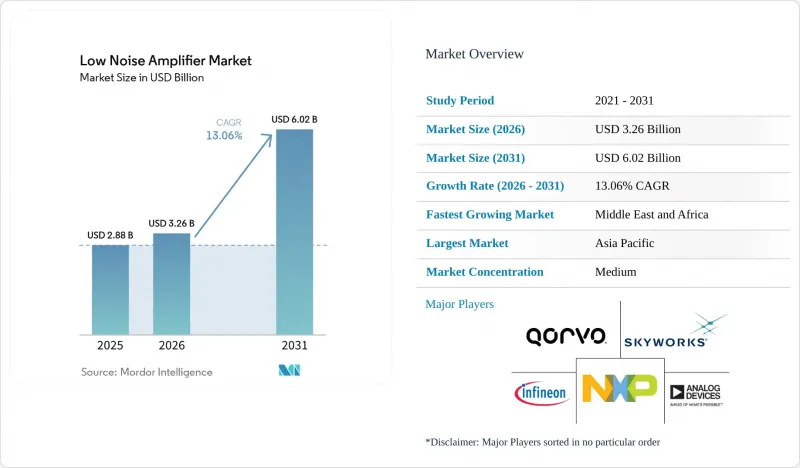
本報告按頻段(1 GHz 以下、1-6 GHz、6-18 GHz 及其他)、半導體技術(GaAs、GaN 及其他)、應用領域(通訊/5G 基礎設施、衛星通訊、航太/國防、汽車/交通運輸及其他)、架構(分離電晶體低雜訊放大器、MMIC 低雜訊放大器及其他)和地區進行細分。市場預測以美元計價。
全球低雜訊放大器市場趨勢及洞察
5G和毫米波基地台的部署正在加速基礎架構需求。
目前,n77 和 n79 頻段的商用 5G 部署要求接收連結的雜訊係數低於 2.5 dB,同時在 100 MHz 或更寬的通道寬度上保持高線性度。大規模 MIMO 陣列使每個無線電單元所需的低雜訊放大器 (LNA) 數量翻倍,而最新的 70 nm GaN-on-SiC 裝置在 83 GHz 頻段實現了 2.8 dB 的雜訊係數,證明了 GaN 適用於毫米波基地台。美國聯邦通訊委員會 (FCC) 對 24 GHz 頻段頻寬發射限值的修訂建議採用具有更強抑制濾波能力的架構。同時,包絡追蹤功率放大器技術提高了接收路徑的靈敏度要求,進一步推動了對低雜訊放大器 (LNA) 的需求。這對低雜訊放大器市場具有重大意義,因為它允許在高度整合的無線前端中使用更廣泛的材料和工藝,而這些前端必須兼顧雜訊、功率和散熱性能。高頻率接收路徑中濾波要求的日益嚴格也提高了前端的靈敏度要求,使得低雜訊放大器(LNA)的規格比無線標準建議的更為苛刻。因此,能夠同時實現低噪音係數和大規模、可重複生產的供應商將更具優勢,因為隨著用戶數量的成長以及5G無線網路密度的不斷提高,LNA市場的需求也將持續成長。
低衛星星系正在推動多頻段低雜訊放大器(LNA)的創新。
與地球靜止軌道鏈路280毫秒的延遲相比,6-30毫秒的延遲優勢迫使衛星營運商指定能夠在Ku、 Ka波段和Q頻段之間快速切換的低雜訊放大器(LNA)。弗勞恩霍夫研究所為北極氣象衛星開發的裝置在54GHz頻段實現了1.0-1.2dB的雜訊係數,凸顯了對超低雜訊和抗輻射加固設計的需求。根據3GPP Release 18,非地面電波網路的認證要求使用雙模LNA,這加速了寬頻單片微波積體電路(MMIC)的創新。因此,低雜訊放大器(LNA)市場的發展速度超過了傳統的政府採購週期,並且越來越受到商業航太專案的影響,這些專案既需要頻寬,也需要按時獲得認證。
半導體供應鏈的波動限制了產能。
由於鎵出口限制,中國的鎵出口將在2024年8月降至零,導致GaAs和GaN晶圓供應緊張,前置作業時間延長。 SDCE預測,到2030年,美國將面臨6.7萬名工程師的缺口,這可能會加劇製造業瓶頸。 SEMI預測,到2027年,對300毫米晶圓廠的投資將達到1,370億美元,但產能將集中在邏輯和記憶體領域,而非對低雜訊放大器市場至關重要的成熟射頻製程節點。這種情況表明,低雜訊放大器市場的供應韌性不再是次要問題,而是通訊、國防和衛星相關生產的核心戰略選擇。在國內獲得更多元化的化合物半導體產能之前,擁有自有工廠或優先進入許可權代工廠的供應商很可能在成本控制和準時交付方面保持持續優勢。
細分市場分析
預計到2025年,1-6 GHz頻段將佔據低雜訊放大器市佔率的42.42%。這反映了行動電話網路、Wi-Fi設備和GNSS設備在該頻段的大規模部署。這一市場佔有率並非由單一終端市場支撐,而是由廣泛的部署所支撐。即使某一類設備的需求放緩,而另一類設備的需求持續成長,該頻寬仍將展現出更強的韌性。 1 GHz以下頻寬在低功耗廣域網路(LPWAN)、智慧電錶和其他物聯網(IoT)應用中始終佔據重要地位,因為在這些應用中,電流消耗通常與表面增益和雜訊性能同等重要。同時,隨著5G毫米波無線電、 Ka波段終端和高解析度汽車雷達系統進入量產階段,預計到2031年,18-40 GHz低雜訊放大器(LNA)市場規模將以16.53%的複合年成長率成長。這種成長模式表明,市場正在從以中波頻段為中心的結構轉向更廣泛的產品範圍,其中毫米波的需求成長速度比傳統基礎更快,同時仍依賴供應鏈和整合技術專業知識。
MDPI Electronics公司報告了一款採用150 nm GaAs pHEMT的17–38 GHz頻段級聯低雜訊放大器(LNA)。此LNA透過同時進行雜訊和輸入匹配,實現了20–23 dB的平坦增益和1.1–2.1 dB的雜訊係數,展現了這些頻段的設計門檻正在降低。 6–18 GHz頻段對於國防雷達、微波回程傳輸和衛星中頻鏈路仍然至關重要,這些頻段的採購往往更多地受專案驅動,而非消費者的更換週期。 40 GHz頻寬的市場規模仍然較小,但由於衛星間鏈路、專用儀器和早期亞太赫茲感測的需求,市場正在不斷擴大。 MDPI Aerospace公司也展示了一款59–71 GHz頻段GaN/Si HEMT前端裝置,其雜訊係數為4 dB,這印證了人們的預期:對衛星交聯設計要求更為嚴格的裝置將在不久的將來遷移到這些更高的頻寬。在所有頻段,低雜訊放大器 (LNA) 市場也經歷重組,前端模組整合了 LNA、濾波器和開關功能。這降低了純分立晶片的作用,同時提高了子系統級射頻元件的比例。
預計到2025年,砷化鎵(GaAs)將佔38.52%的市佔率。這是因為其製程成熟、噪音性能穩定且代工廠供應充足,使其成為許多接收器設計的首選材料。在1-18 GHz頻段,GaAs在GNSS、衛星前端和蜂窩低噪聲放大器(LNA)領域的優勢尤為明顯,因為它在低噪聲性能和市場已充分認可的成本特性之間取得了平衡。預計到2031年,採用氮化鎵(GaN)的低雜訊放大器市場將以15.65%的複合年成長率成長,並且隨著對毫米波、熱性能和功率處理能力的需求不斷成長,GaN有望成為成長最快的材料平台。供應商向8吋晶圓生產邁進的藍圖也支持了這一轉變,這有望縮小GaN和GaAs在6-40 GHz頻段的傳統成本差距。因此,低雜訊放大器行業正在向更複合的結構轉變,GaAs 保持著廣泛的市場佔有率,而 GaN 在需要更高擊穿電壓和熱阻的應用中獲得了市場佔有率。
Springer Nature旗下的《阿拉伯科學與工程期刊》檢驗了Ku波段和Ka波段衛星通訊系統中可調諧低雜訊放大器(LNA)的設計,證實了GaAs和GaN在該衛星接收器領域仍佔據著重要地位。 SiGe BiCMOS在汽車雷達和多頻段GNSS產品中繼續佔據著重要的中間位置,它兼具接近GaAs的噪音性能和矽代工廠的整合密度。最先進的CMOS製程節點也在物聯網和消費性電子設計領域不斷擴展應用,在這些領域,功耗、面積和整合密度通常比絕對雜訊效能更為重要。美國商務部對MACOM 3.45億美元擴建計畫的支持,凸顯了政策如何透過提升國內GaAs和GaN產能來滿足通訊和國防供應需求,從而促進材料競爭的形成。 InP在100 GHz以上的測量、電波天文學和早期感測領域仍然發揮著有限但穩定的作用。這意味著低雜訊放大器 (LNA) 產業繼續在單一產品類型下涵蓋廣泛的性能和成本等級。
區域分析
預計到2025年,亞太地區將佔據低雜訊放大器(LNA)市場40.75%的佔有率,主要歸功於該地區在5G基礎設施製造、消費性電子組裝和化合物半導體供應鏈方面的強大地位。中國扮演雙重角色:既是使用LNA的射頻系統的主要組裝中心,也是鎵相關材料流的關鍵上游來源地,因此對全球供應鏈格局具有結構性影響。韓國和台灣仍然是重要的晶圓代工和半導體中心,為服務多個地區通訊、全球導航衛星系統(GNSS)和消費性電子應用的無晶圓廠LNA供應商提供支援。日本在GNSS和物聯網接收器組件領域也發揮重要作用,在這些領域,製程成熟度和產品可靠性比晶圓規模更為重要。隨著5G的加速部署以及連網設備在物流和精密農業等領域的日益普及,印度出現了一個新的需求領域,這使得低雜訊放大器(LNA)市場不再局限於傳統的東亞製造地。
北美和歐洲共同支撐著市場中附加價值最高、要求最嚴苛的領域。在北美,本土化合物半導體產能正日益戰略化。 MACOM將於2025年7月將其位於北卡羅來納州研究三角園區的GaN-on-SiC晶圓製造工廠的全面營運控制權移交給北美,這將為當地生產基地增添符合「可信代工」(Trusted Foundry)標準的產能。在歐洲,汽車雷達仍然是主要推動要素,英飛凌正透過其28nm CMOS雷達MMIC藍圖,持續瞄準L2+至L4等級的汽車平臺。歐洲航太專案也正在加強對認證低雜訊放大器(LNA)組件的採購力道。 EECL放大器在歐空局HydroGNSS系統中的在軌性能表明,認證和任務經驗仍然是決定供應商能否進入低雜訊放大器(LNA)市場的關鍵因素。
預計到2031年,中東和非洲地區的複合年成長率將達到17.98%,並有望成為成長最快的區域集團,這主要得益於海灣合作理事會(GCC)國家和多個非洲市場對行動寬頻投資的增加。沿岸地區的波灣合作理事會通訊業者部署5G網路,部分營運商積極採用毫米波(mmWave)技術,這使得該地區對28GHz級接收器組件的需求成長超過了部分歐洲地區的部署速度。此外,奈及利亞和南非的LTE和早期5G基礎設施正在大規模擴張,足以支援更直接的射頻組件需求,同時也依賴完全整合的進口系統。南美洲市場仍以巴西和阿根廷為中心,精密農業對全球導航衛星系統(GNSS)的需求,以及行動電話網路升級和衛星寬頻的需求,也推動了低雜訊放大器市場的發展。這形成了一個獨立於純電信產業成長的區域性需求流。
其他好處:
- Excel格式的市場預測(ME)表
- 3個月的分析師支持
目錄
第1章:引言
- 研究假設和市場定義
- 調查範圍
第2章:調查方法
第3章執行摘要
第4章 市場狀況
- 市場概覽
- 市場促進因素
- 5G和毫米波基地台的部署
- 低地球軌道(LEO)衛星星系的激增
- 正在部署的GNSS/IoT設備數量不斷增加。
- 汽車雷達向 77 GHz ADAS 過渡
- 用於擴展量子計算的低溫低雜訊放大器
- 用於天氣和地球觀測的微型衛星計劃
- 市場限制因素
- 設計噪音係數低於 0.5 dB 的噪音係數需要很高的研發成本
- 半導體供應鏈的波動性
- 嚴格的認證和合規成本
- 毫米波模組溫度控管的局限性
- 產業價值鏈分析
- 監理情勢
- 技術展望
- 波特五力分析
第5章 市場規模與成長預測
- 按頻段
- 小於 1 GHz
- 1~6 GHz
- 6~18 GHz
- 18~40 GHz
- 40 GHz 或更高
- 透過半導體技術
- GaAs
- GaN
- SiGe BiCMOS
- CMOS
- 輸入半導體技術
- 透過使用
- 通訊和5G基礎設施
- 衛星通訊
- 航太/國防
- 汽車和運輸業
- 物聯網和消費性設備
- 工業、測試和測量
- 按架構/按外形規格
- 分離式電晶體低雜訊放大器
- MMIC LNA
- 射頻前端模組(內建低雜訊放大器)
- 低溫/超低溫低雜訊放大器
- 按地區
- 北美洲
- 美國
- 加拿大
- 墨西哥
- 南美洲
- 巴西
- 阿根廷
- 其他南美國家
- 歐洲
- 德國
- 英國
- 法國
- 義大利
- 西班牙
- 其他歐洲國家
- 亞太地區
- 中國
- 日本
- 印度
- 韓國
- 其他亞太國家
- 中東和非洲
- 中東
- 沙烏地阿拉伯
- 阿拉伯聯合大公國
- 土耳其
- 其他中東國家
- 非洲
- 南非
- 奈及利亞
- 其他非洲國家
- 中東
- 北美洲
第6章 競爭情勢
- 市場集中度
- 策略趨勢
- 市佔率分析
- 公司簡介
- Skyworks Solutions Inc.
- Infineon Technologies AG
- Qorvo Inc.
- NXP Semiconductors NV
- Analog Devices, Inc.
- Texas Instruments Incorporated
- Teledyne Technologies Incorporated
- Microchip Technology Incorporated
- MACOM Technology Solutions Holdings Inc.
- Broadcom Inc.
- Scientific Components Corporation d/b/a Mini-Circuits
- AmpliTech Group Inc.
- Marki Microwave Inc.
- RFHIC Corporation
- Guerrilla RF Inc.
- Sivers Semiconductors AB
- Pasternack Enterprises LLC
- L3Harris Technologies Inc.
- Cobham Limited
- Kratos Defense & Security Solutions Inc.
- Giga-tronics Incorporated
第7章 市場機會與未來展望
According to Mordor Intelligence, the low noise amplifier market size is expected to increase from USD 2.88 billion in 2025 to USD 3.26 billion in 2026 and reach USD 6.02 billion by 2031, growing at a CAGR of 13.06% over 2026-2031.
This report is Segmented by Frequency Band (Less Than 1 GHz, 1-6 GHz, 6-18 GHz, and More), Semiconductor Technology (GaAs, Gan, and More), Application (Telecom and 5G Infrastructure, Satellite Communications, Aerospace and Defense, Automotive and Transportation, and More), Architecture (Discrete Transistor LNAs, MMIC LNAs, and More), and Geography. The Market Forecasts are Provided in Terms of Value (USD).
Global Low Noise Amplifier Market Trends and Insights
5G and mmWave Base-Station Rollout Accelerates Infrastructure Demand
Commercial 5G deployments in n77 and n79 bands now require receive chains with noise figures below 2.5 dB while sustaining high linearity across 100 MHz-plus channel widths. Massive-MIMO arrays multiply LNA counts per radio unit, and recent 70 nm GaN-on-SiC devices achieve 2.8 dB at 83 GHz, proving GaN's suitability for mmWave base stations. The FCC's revised out-of-band emission limits in the 24 GHz bands favor architectures with stronger rejection filtering. Simultaneously, envelope-tracking power amplifier techniques are elevating receive-path sensitivity requirements, further boosting demand for Low Noise Amplifiers. That result matters in the Low noise amplifier market because it supports a wider set of material and process choices for dense radio front ends that must balance noise, power, and thermal performance. Tighter filtering requirements in higher-frequency receive paths are also raising front-end sensitivity requirements, making LNA specifications more demanding than the radio standard alone would suggest. Vendors that can pair low noise figures with repeatable production at scale are therefore better placed as the Low noise amplifier market continues to follow 5G radio density rather than just subscriber growth.
LEO Satellite Constellations Drive Multi-Band LNA Innovation
Latency advantages of 6-30 ms, compared with 280 ms for geostationary links, compel satellite operators to specify LNAs that switch rapidly across Ku-, Ka-, and Q-bands. Fraunhofer's 1.0-1.2 dB noise-figure devices at 54 GHz on the Arctic Weather Satellite highlight demand for ultra-low-noise, radiation-tolerant designs. 3GPP Release 18 endorsement of non-terrestrial networks mandates dual-mode LNA operation, spurring wideband MMIC innovation. As a result, the Low noise amplifier market is increasingly shaped by commercial space programs that move faster than traditional government procurement cycles and demand both frequency breadth and certified delivery discipline.
Semiconductor Supply-Chain Volatility Constrains Production Capacity
Gallium export curbs reduced China's outbound volumes to zero in August 2024, throttling GaAs and GaN wafer availability and inflating lead times. SDCE projects that a 67,000-engineer talent deficit in the United States by 2030 could exacerbate fabrication bottlenecks. Although SEMI forecasts USD 137 billion in 300 mm fab equipment spending by 2027, capacity will favor logic and memory, rather than mature RF process nodes critical to the Low Noise Amplifier market.That response shows that supply resilience is no longer a background issue in the Low noise amplifier market and has become a central strategic choice for telecom, defense, and satellite-linked production. Until more domestic and diversified compound-semiconductor capacity becomes available, suppliers with captive fabs or privileged foundry access are likely to keep a durable advantage in cost control and schedule reliability.
Other drivers and restraints analyzed in the detailed report include:
- Automotive Radar Evolution Beyond 77 GHz Unlocks ADAS Potential
- Growing GNSS and IoT Device Install-Base
- High R&D Cost of Sub-0.5 dB Noise-Figure Designs
For complete list of drivers and restraints, kindly check the Table Of Contents.
Segment Analysis
The 1-6 GHz segment held 42.42% of the Low noise amplifier market share in 2025, reflecting the very large installed base of cellular networks, Wi-Fi equipment, and GNSS devices that operate across this range. That position is supported by broad deployment rather than by a single end market, which makes this band more resilient when demand softens in one device class but continues in another. The sub-1 GHz band kept steady relevance in LPWAN, smart metering, and other IoT uses where current draw often matters as much as headline gain or noise performance. At the other end, the Low noise amplifier (LNA) market size for the 18-40 GHz segment is projected to expand at a 16.53% CAGR through 2031 as 5G mmWave radios, Ka-band terminals, and higher-resolution automotive radar systems move into volume production. That growth pattern shows a market shifting from its mid-band core into a broader portfolio where millimeter-wave demand is rising faster than the legacy base but still depends on supply discipline and integration know-how.
MDPI Electronics reported a 17-38 GHz cascode LNA on 150 nm GaAs pHEMT that achieved flat 20-23 dB gain and a 1.1-2.1 dB noise figure through simultaneous noise and input matching, which illustrates how the design barriers at these frequencies are being reduced. The 6-18 GHz range remains important for defense radar, microwave backhaul, and satellite intermediate-frequency chains, where procurement is tied more to program timing than consumer replacement cycles. Above 40 GHz, the market is still narrower, but it is being pushed forward by inter-satellite links, specialized instrumentation, and early sub-THz sensing needs. MDPI Aerospace also showed 59-71 GHz GaN/Si HEMT front-end performance with a 4 dB noise figure, which supports near-term migration of more demanding satellite crosslink designs into these upper bands. Across bands, the Low noise amplifier market is also being reshaped by front-end modules that package LNA, filter, and switch functions together, which can reduce the role of pure discrete chips while increasing RF content at the subsystem level.
GaAs held 38.52% of the market in 2025 because its process maturity, stable noise performance, and broad foundry availability continue to make it the default choice for a wide share of receiver designs. That leadership is strongest in GNSS, satellite front ends, and cellular LNAs across 1-18 GHz, where GaAs balances low noise performance with a cost profile the market already understands well. The low-noise amplifier market for GaN is projected to expand at a 15.65% CAGR through 2031, making it the fastest-growing material platform as mmWave, thermal, and power-handling demands rise. This shift is supported by vendor roadmaps to 8-inch wafer production, which could narrow the historical cost gap between GaN and GaAs in the 6-40 GHz range. The low-noise amplifier industry is therefore moving toward a more mixed-material structure, where GaAs maintains its broad base while GaN gains share in applications that require higher breakdown voltage and greater heat tolerance.
Springer Nature's Arabian Journal for Science and Engineering reviewed tunable LNA design in Ku- and Ka-band SATCOM systems and confirmed that both GaAs and GaN remain strongly positioned in this satellite receiver window. SiGe BiCMOS continues to occupy a useful middle ground because it combines near-GaAs noise performance with the integration density of silicon foundries, which is valuable for automotive radar and multi-band GNSS products. Advanced CMOS nodes are also extending their reach in IoT and consumer designs where power, footprint, and integration often matter more than absolute best noise performance. The United States Department of Commerce support package for MACOM's USD 345 million expansion plan underlines how policy is now helping shape material competition by backing domestic GaAs and GaN capacity for telecom and defense-linked supply needs. InP still holds a narrow but defensible role above 100 GHz in instrumentation, radio astronomy, and early-stage sensing, which means the Low noise amplifier industry continues to span very different performance and cost tiers under one product category.
Geography Analysis
Asia-Pacific held 40.75% of the Low noise amplifier market share in 2025, and that scale stemmed from its strong position in 5G infrastructure manufacturing, consumer electronics assembly, and compound semiconductor supply chains. China plays a dual role: it is both a large assembler of RF systems that use LNAs and a critical upstream source of gallium-linked material flows, giving the region structural influence over global supply conditions. South Korea and Taiwan remain important as foundry and semiconductor hubs that support fabless LNA vendors serving telecom, GNSS, and consumer applications across several regions. Japan also keeps a meaningful role in GNSS and IoT receiver components, where process maturity and product reliability matter more than headline wafer scale. India is adding another layer of demand as 5G rollout expands and connected device use rises in sectors such as logistics and precision agriculture, which broadens the Low noise amplifier market beyond traditional East Asian manufacturing centers.
North America and Europe together anchor the highest-value, most qualification-intensive portion of demand. In North America, domestic compound-semiconductor capacity is becoming more strategic, and MACOM's July 2025 transfer of full operational control of its Research Triangle Park GaN-on-SiC wafer facility added Trusted Foundry-aligned capacity to the local base. In Europe, automotive radar remains a major pull factor because Infineon continues to target L2+ to L4 vehicle platforms with its 28 nm CMOS radar MMIC roadmap. European space programs also support procurement for qualified LNA assemblies, and the in-orbit performance of EECL's amplifiers on ESA HydroGNSS shows how certification and mission heritage still shape supplier access in this part of the Low noise amplifier (LNA) market.
The Middle East and Africa is projected to grow at a 17.98% CAGR through 2031, making it the fastest-growing regional block as mobile broadband investment rises across the Gulf Cooperation Council and several African markets. Gulf operators are adopting 5G with meaningful mmWave exposure in selected deployments, which supports demand for 28 GHz-class receive components at a faster pace than in some European rollouts. Nigeria and South Africa are also expanding LTE and early 5G infrastructure enough to support more direct RF component demand rather than relying only on fully integrated imported systems. South America remains centered on Brazil and Argentina, where cellular upgrades and satellite broadband are joined by GNSS needs in precision agriculture, which gives the Low noise amplifier market a region-specific demand stream outside pure telecom growth.
- Skyworks Solutions Inc.
- Infineon Technologies AG
- Qorvo Inc.
- NXP Semiconductors N.V.
- Analog Devices, Inc.
- Texas Instruments Incorporated
- Teledyne Technologies Incorporated
- Microchip Technology Incorporated
- MACOM Technology Solutions Holdings Inc.
- Broadcom Inc.
- Scientific Components Corporation d/b/a Mini-Circuits
- AmpliTech Group Inc.
- Marki Microwave Inc.
- RFHIC Corporation
- Guerrilla RF Inc.
- Sivers Semiconductors AB
- Pasternack Enterprises LLC
- L3Harris Technologies Inc.
- Cobham Limited
- Kratos Defense & Security Solutions Inc.
- Giga-tronics Incorporated
Additional Benefits:
- The market estimate (ME) sheet in Excel format
- 3 months of analyst support
TABLE OF CONTENTS
1 INTRODUCTION
- 1.1 Study Assumptions and Market Definition
- 1.2 Scope of the Study
2 RESEARCH METHODOLOGY
3 EXECUTIVE SUMMARY
4 MARKET LANDSCAPE
- 4.1 Market Overview
- 4.2 Market Drivers
- 4.2.1 5G and mmWave Base-Station Rollout
- 4.2.2 Proliferation of LEO Satellite Constellations
- 4.2.3 Growing GNSS/IoT Device Install-base
- 4.2.4 Automotive Radar Shift to 77 GHz ADAS
- 4.2.5 Cryogenic LNAs for Quantum-Computing Scale-Up
- 4.2.6 Weather and Earth-Observation Micro-sat Programs
- 4.3 Market Restraints
- 4.3.1 High R&D Cost of Sub-0.5 dB NF Designs
- 4.3.2 Semiconductor Supply-Chain Volatility
- 4.3.3 Stringent Qualification and Compliance Costs
- 4.3.4 Thermal-Management Limits in mmWave Modules
- 4.4 Industry Value Chain Analysis
- 4.5 Regulatory Landscape
- 4.6 Technological Outlook
- 4.7 Porter's Five Forces Analysis
- 4.7.1 Threat of New Entrants
- 4.7.2 Bargaining Power of Suppliers
- 4.7.3 Bargaining Power of Buyers
- 4.7.4 Threat of Substitutes
- 4.7.5 Competitive Rivalry
5 MARKET SIZE AND GROWTH FORECASTS (VALUE)
- 5.1 By Frequency Band
- 5.1.1 Less than 1 GHz
- 5.1.2 1 - 6 GHz
- 5.1.3 6 - 18 GHz
- 5.1.4 18 - 40 GHz
- 5.1.5 Above 40 GHz
- 5.2 By Semiconductor Technology
- 5.2.1 GaAs
- 5.2.2 GaN
- 5.2.3 SiGe BiCMOS
- 5.2.4 CMOS
- 5.2.5 InP and Other Semiconductor Technology
- 5.3 By Application
- 5.3.1 Telecom and 5G Infrastructure
- 5.3.2 Satellite Communications
- 5.3.3 Aerospace and Defense
- 5.3.4 Automotive and Transportation
- 5.3.5 IoT and Consumer Devices
- 5.3.6 Industrial, Test and Measurement
- 5.4 By Architecture / Form Factor
- 5.4.1 Discrete Transistor LNAs
- 5.4.2 MMIC LNAs
- 5.4.3 RF Front-End Modules (with LNA)
- 5.4.4 Cryogenic / Ultra-low-temp LNAs
- 5.5 By Geography
- 5.5.1 North America
- 5.5.1.1 United States
- 5.5.1.2 Canada
- 5.5.1.3 Mexico
- 5.5.2 South America
- 5.5.2.1 Brazil
- 5.5.2.2 Argentina
- 5.5.2.3 Rest of South America
- 5.5.3 Europe
- 5.5.3.1 Germany
- 5.5.3.2 United Kingdom
- 5.5.3.3 France
- 5.5.3.4 Italy
- 5.5.3.5 Spain
- 5.5.3.6 Rest of Europe
- 5.5.4 Asia-Pacific
- 5.5.4.1 China
- 5.5.4.2 Japan
- 5.5.4.3 India
- 5.5.4.4 South Korea
- 5.5.4.5 Rest of Asia-Pacific
- 5.5.5 Middle East and Africa
- 5.5.5.1 Middle East
- 5.5.5.1.1 Saudi Arabia
- 5.5.5.1.2 United Arab Emirates
- 5.5.5.1.3 Turkey
- 5.5.5.1.4 Rest of Middle East
- 5.5.5.2 Africa
- 5.5.5.2.1 South Africa
- 5.5.5.2.2 Nigeria
- 5.5.5.2.3 Rest of Africa
- 5.5.5.1 Middle East
- 5.5.1 North America
6 COMPETITIVE LANDSCAPE
- 6.1 Market Concentration
- 6.2 Strategic Moves
- 6.3 Market Share Analysis
- 6.4 Company Profiles (includes Global level Overview, Market level overview, Core Segments, Financials as available, Strategic Information, Market Rank/Share for key companies, Products and Services, and Recent Developments)
- 6.4.1 Skyworks Solutions Inc.
- 6.4.2 Infineon Technologies AG
- 6.4.3 Qorvo Inc.
- 6.4.4 NXP Semiconductors N.V.
- 6.4.5 Analog Devices, Inc.
- 6.4.6 Texas Instruments Incorporated
- 6.4.7 Teledyne Technologies Incorporated
- 6.4.8 Microchip Technology Incorporated
- 6.4.9 MACOM Technology Solutions Holdings Inc.
- 6.4.10 Broadcom Inc.
- 6.4.11 Scientific Components Corporation d/b/a Mini-Circuits
- 6.4.12 AmpliTech Group Inc.
- 6.4.13 Marki Microwave Inc.
- 6.4.14 RFHIC Corporation
- 6.4.15 Guerrilla RF Inc.
- 6.4.16 Sivers Semiconductors AB
- 6.4.17 Pasternack Enterprises LLC
- 6.4.18 L3Harris Technologies Inc.
- 6.4.19 Cobham Limited
- 6.4.20 Kratos Defense & Security Solutions Inc.
- 6.4.21 Giga-tronics Incorporated
7 MARKET OPPORTUNITIES AND FUTURE OUTLOOK
- 7.1 White-Space and Unmet-Need Assessment

 2026年全球射頻(RF)訊號放大器市場報告
 2026-2030年全球射頻放大器市場
 低雜訊放大器 (LNA) 市場規模、佔有率和成長分析:按頻段、技術、封裝類型、應用、最終用戶產業和地區分類-2026-2033 年產業預測
 高功率射頻放大器模組市場:依技術、頻段、功率輸出、架構及應用分類-2026-2032年全球市場預測低雜訊放大器市場:依模組類型、技術、頻寬、應用與銷售管道分類-2026-2032年全球市場預測
 全球高功率射頻放大器模組市場規模、佔有率、趨勢和成長分析報告(2026-2034年)2026年全球低噪音放大器市場報告2026年全球高功率射頻放大器模組市場報告
 射頻功率放大器市場-全球產業規模、佔有率、趨勢、機會及預測(依類別、技術、最終用戶、地區及競爭格局分類,2021-2031年)
 亞太地區射頻功率放大器市場預測至 2031 年 - 區域分析 - 按頻率、技術(砷化鎵、氮化鎵、矽鍺等)和應用