


 |
市場調查報告書
商品編碼
2062392
保溫運輸容器:市場佔有率分析、產業趨勢與統計、成長預測(2026-2031)Insulated Shipper - Market Share Analysis, Industry Trends & Statistics, Growth Forecasts (2026 - 2031) |
||||||

※ 本網頁內容可能與最新版本有所差異。詳細情況請與我們聯繫。
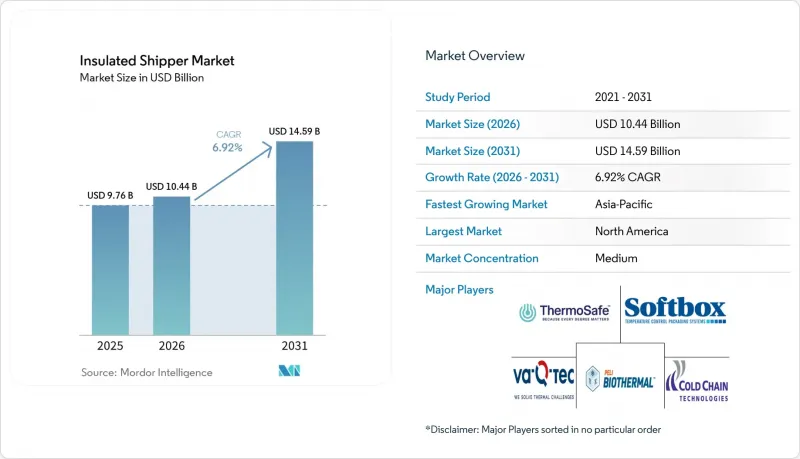
據 Mordor Intelligence 稱,2025 年冷藏運輸貨櫃市場價值為 97.6 億美元,預計到 2031 年將達到 145.9 億美元,而 2026 年為 104.4 億美元,預測期(2026-2031 年)的複合年成長率為 6.92%。
本報告按產品類型(一次性冷藏運輸容器、可重複使用冷藏運輸容器和主動溫控容器)、材料(發泡聚苯乙烯 (EPS)、聚氨酯 (PUR) 等)、應用領域(醫藥和生物技術、食品和飲料、其他)以及地區(亞太地區、北美地區、其他)進行細分。市場預測以美元 (USD) 為單位。
全球保溫運輸容器市場趨勢及洞察。
對溫度敏感型藥品和生技藥品的需求正在激增。
GLP-1製劑、mRNA疫苗和CAR-T療法在運輸過程中,尤其是在運輸過程中,越來越需要在嚴苛條件下(包括-196 度C的極低溫)進行效能檢驗。北歐冷鏈解決方案公司(Nordic Cold Chain Solutions)於2025年底發布了Nordic Express Pack,這是首款經ISTA測試的專為GLP-1分子設計的被動式包裝箱。預計到2024年,拉丁美洲的藥品銷售額將達到1,365億美元,年均成長率達9.7%,因此,符合GDP標準且具備持續監控能力的運輸路線的需求日益成長。低溫運輸物流的成長與其說是取決於藥品運輸總量的增加,不如說是取決於對高品質低溫運輸服務需求日益成長的高價值生技藥品佔有率的擴大。
電子商務食品和食材自煮包的最後一公里配送正在擴大。
食材自煮包公司和高階水產品出口商依賴使用相變材料的隔日達服務,這種材料能夠承受週末的延誤。 Pelican BioThermal 的「Credo Cargo」於 2026 年 3 月透過 Polar Group Brazil 推出,可提供 120-168 小時的保護,同時減少 75% 的乾冰用量,從而降低貨物重量和碳排放。然而,逆向物流仍然是一個挑戰,因為退回可重複使用的包裝箱可能會使運輸成本增加 15-25%。物聯網賦能的租賃模式透過自動化退貨標籤並將資產利用率提高到 80% 以上來緩解這個問題。
VIP/PCM配置總成本高
VIP泡棉的隔熱性能是EPS泡棉的10倍,但由於其會使擁有成本增加125%至180%,因此其應用僅限於高價值藥品產業。即使可以重複使用,除非每週出貨量超過500件,否則逆向物流成本也會抵銷節省的成本。像EcoFlex 3這樣的預付退貨標籤解決方案表明,可以透過流程改進來降低成本,但食品業可能仍會繼續使用發泡材,直到監管政策強制要求使用替代品。
細分市場分析
至2025年,一次性冷藏運輸貨櫃將佔冷藏運輸貨櫃市場佔有率的47.44%,預計到2031年將以7.31%的複合年成長率成長。專為需要-70 度C至-196 度C溫度控制的貨物設計的主動式溫控貨櫃,每次運輸將增加200至500美元的成本。 EcoFlex 3和Credo on Demand等技術的進步,促使醫藥行業的承運商考慮可重複使用的貨櫃方案,前提是逆向物流成本低於10 %。
在已建立高效回收循環的地區,例如大都會圈區和封閉式藥品分銷系統,藥品再利用專案已取得良好成效。歐洲2030年的藥品再利用強制目標已開始影響採購趨勢,但由於政策架構不夠嚴格,北美和亞太地區的進展較為緩慢。
區域分析
北美地區預計到2025年將佔全球銷售額的46.44%,主要得益於其成熟的醫藥供應鏈和物聯網技術的早期應用。聯邦快遞Surround和UPS Premier可在五分鐘內提供遙測服務,而DHL在該地區11億美元的投資正在提升網路密度。加拿大和墨西哥正在推動跨境物流流動,並刺激對符合ISTA標準的包裝材料的需求。
亞太地區預計將成為成長最快的地區,到2031年複合年成長率將達到7.27%。印度低溫運輸和越南同奈樞紐的投資正在推動這一成長,而中國對mRNA生產能力的投資則刺激了對-70°C運輸路線的需求。然而,由於各地區基礎設施不平衡,包裝材料的性能必須超越ISTA標準高溫通道的要求。
歐洲仍然是一個受監管主導的市場。 GDP、PPWR 和 CEIV Pharma 等認證正在加速可重複使用容器的普及,並逐步淘汰一次性發泡聚苯乙烯容器。 DHL 對其弗洛爾施塔特工廠的擴建,以及 va-Q-tec 和 Envirotainer 提供的整合平台,都表明整合服務和檢驗的硬體相結合正在成為新的競爭標準。
南美洲的藥品支出每年成長近10%,但不足的逆向物流阻礙了藥品的再利用。 「Credo Cargo」是由Pelican與Polar Group Brazil合作推出,旨在初步檢驗在不發達的回收網路中開展租賃業務的經濟可行性。
儘管中東和非洲的基礎設施正在發展,但收穫後廢棄率仍高達 40%。太陽能冷藏單元和沙烏地航空貨運公司租賃的 Tower Cold Chain 的 -80°C 冷藏箱,是針對無電地區和廣袤沙漠地區的運輸而最佳化的解決方案的典型例子。
其他好處:
- Excel格式的市場預測(ME)表
- 3個月的分析師支持
目錄
第1章:引言
- 研究假設和市場定義
- 調查範圍
第2章:調查方法
第3章執行摘要
第4章 市場狀況
- 市場概覽
- 市場促進因素
- 對溫度敏感的藥品和生物製藥的出貨量激增。
- 線上食品和食材自煮包的「最後一公里」服務正在擴大。
- 新興市場低溫運輸基礎設施現代化
- 檢驗的被動包裝的監管要求
- 引入人工智慧驅動的車道特定預測性裝箱設計
- 市場限制因素
- VIP/PCM配置總成本高
- 逐步淘汰一次性聚合物泡棉(歐盟、美國部分州)
- 高阻隔薄膜和氣相二氧化矽粉末供應瓶頸
- 價值鏈分析
- 波特五力模型
第5章 市場規模與成長預測
- 依產品類型
- 一次性保溫運輸容器
- 可重複使用的保溫運輸容器
- 主動溫度控制容器
- 材料
- 發泡聚苯乙烯(EPS)
- 聚氨酯(PUR)
- 真空絕熱(VIP)面板
- 相變材料(PCM)複合材料
- 生物基纖維和羊毛
- 其他材料
- 透過使用
- 製藥和生物技術
- 細胞及基因治療及臨床試驗
- 食品/飲料
- 化學品和特殊化學品
- 電子和半導體
- 其他用途
- 按地區
- 亞太地區
- 中國
- 印度
- 日本
- 韓國
- 東南亞國協
- 其他亞太國家
- 北美洲
- 美國
- 加拿大
- 墨西哥
- 歐洲
- 德國
- 英國
- 法國
- 義大利
- 西班牙
- 俄羅斯
- 北歐國家
- 其他歐洲國家
- 南美洲
- 巴西
- 阿根廷
- 其他南美國家
- 中東和非洲
- 沙烏地阿拉伯
- 南非
- 其他中東和非洲國家
- 亞太地區
第6章 競爭情勢
- 市場集中度
- 策略趨勢
- 市佔率和排名分析
- 公司簡介
- ACH Foam Technologies
- Aeris Dynamics Pte Ltd.
- AmerisourceBergen
- Cold Chain Technologies
- Cryopak
- CSAFE
- DHL Group
- Envirotainer
- FedEx
- Intelsius
- KODIAKOOLER
- Nordic Cold Chain Solutions.
- Panasonic Corporation
- Peli BioThermal LLC
- Sealed Air
- Sofrigam Group
- SOFTBOX SYSTEMS(I)PVT. LIMITED
- ThermoSafe
- United Parcel Service of America, Inc.
- va-Q-tec Thermal Solutions GmbH
第7章 市場機會與未來展望
According to Mordor Intelligence, the insulated shipper market size was valued at USD 9.76 billion in 2025 and is estimated to grow from USD 10.44 billion in 2026 to reach USD 14.59 billion by 2031, at a CAGR of 6.92% during the forecast period (2026-2031).
This report is Segmented by Product Type (Single-Use Insulated Shippers, Reusable Insulated Shippers, and Active Temperature-Controlled Containers), Material (Expanded Polystyrene (EPS), Polyurethane (PUR), and More), Application (Pharmaceutical and Biotechnology, Food and Beverage, and More), and Geography (Asia-Pacific, North America, and More). The Market Forecasts are Provided in Terms of Value (USD).
Global Insulated Shipper Market Trends and Insights
Temperature-Sensitive Pharma and Biologics Volume Surge
GLP-1 drugs, mRNA vaccines, and CAR-T therapies are driving the need for shippers to validate performance for extreme conditions, including temperatures as low as -196 °C for cell-and-gene therapy transportation. Nordic Cold Chain Solutions introduced the Nordic Express Pack in late 2025, the first ISTA-tested passive box designed for GLP-1 molecules. Latin American pharmaceutical sales reached USD 136.5 billion in 2024 and are growing at an annual rate of 9.7%, increasing the demand for GDP-compliant lanes with continuous monitoring. Growth in cold-chain logistics is increasingly tied to the rising share of high-value biologics, which require premium cold-chain services, rather than overall medicine volumes.
E-Grocery and Meal-Kit Last-Mile Deliveries Expand
Meal-kit companies and premium seafood exporters rely on overnight delivery services utilizing phase-change materials capable of withstanding weekend delays. Pelican BioThermal's Credo Cargo, launched through Polar Group Brazil in March 2026, offers 120-168 hours of protection while reducing dry ice usage by 75%, thereby lowering freight weight and carbon emissions. However, reverse logistics remains a challenge, as returning reusable boxes can increase delivery costs by 15%-25%. IoT-enabled lease models are mitigating this issue by automating return labels and improving asset utilization rates to over 80%.
High Total Cost of VIP/PCM Configurations
VIPs provide 10 times the insulation of EPS but increase ownership costs by 125%-180%, restricting their use to high-value pharmaceuticals. Even with reuse, reverse-logistics costs can negate savings unless shipment volumes exceed 500 per week. Solutions like EcoFlex 3's prepaid return labels demonstrate how process improvements can reduce costs, but the food industry is likely to continue using foams until regulatory changes mandate alternatives.
Other drivers and restraints analyzed in the detailed report include:
- Cold-Chain Infrastructure Modernization in Emerging Markets
- Regulatory Mandates for Validated Passive Packaging
- Single-Use Foam Phase-Outs (EU, selected U.S. states)
For complete list of drivers and restraints, kindly check the Table Of Contents.
Segment Analysis
Single-use insulated shippers held 47.44% of the insulated shipper market share in 2025 and are expected to grow at a 7.31% CAGR through 2031. Active temperature-controlled containers, designed for cargo requiring -70 °C to -196 °C, add USD 200-500 per trip. Developments like EcoFlex 3 and Credo on Demand are encouraging pharmaceutical shippers to consider reusable options, provided reverse-logistics costs drop below a 10% threshold.
Reusable programs perform well in areas with efficient return loops, such as metro corridors or closed pharmaceutical distribution systems. Europe's 2030 reuse mandate is already influencing purchasing trends, while North America and Asia-Pacific lag due to less stringent policy frameworks.
Geography Analysis
North America's 46.44% of the 2025 revenue share stems from mature pharma supply chains and early IoT adoption. FedEx Surround and UPS Premier provide sub-five-minute telemetry, and DHL's USD 1.1 billion regional spend deepens network density. Canada and Mexico contribute cross-border flows that reinforce demand for ISTA-graded packaging.
Asia-Pacific is the fastest region at a 7.27% CAGR through 2031. India's cold-chain outlays, and Vietnam's Dong Nai hub underpin growth, while China invests in mRNA capacity that triggers demand for -70 °C lanes. However, uneven rural infrastructure means that boxes must perform beyond the standard ISTA hot-lane baselines.
Europe remains regulation-led: GDP, PPWR, and CEIV Pharma certifications accelerate reusable uptake and single-use foam withdrawals. DHL's Florstadt expansion and va-Q-tec's merged platform with Envirotainer underscore that integrated service plus validated hardware is the new competitive norm.
South America's pharma spend is rising nearly 10% per year, but gaps in reverse logistics hamper reuse. Pelican's Credo Cargo launch with Polar Group Brazil is an early test of rental economics under less-developed retrieval networks.
Middle-East and Africa show infrastructure growth yet live with 40% post-harvest spoilage. Solar-assisted cold rooms and Tower Cold Chain's -80 °C boxes leased by Saudia Cargo illustrate solutions tuned for grid interruptions and vast desert transits.
- ACH Foam Technologies
- Aeris Dynamics Pte Ltd.
- AmerisourceBergen
- Cold Chain Technologies
- Cryopak
- CSAFE
- DHL Group
- Envirotainer
- FedEx
- Intelsius
- KODIAKOOLER
- Nordic Cold Chain Solutions.
- Panasonic Corporation
- Peli BioThermal LLC
- Sealed Air
- Sofrigam Group
- SOFTBOX SYSTEMS (I) PVT. LIMITED
- ThermoSafe
- United Parcel Service of America, Inc.
- va-Q-tec Thermal Solutions GmbH
Additional Benefits:
- The market estimate (ME) sheet in Excel format
- 3 months of analyst support
TABLE OF CONTENTS
1 Introduction
- 1.1 Study Assumptions and Market Definition
- 1.2 Scope of the Study
2 Research Methodology
3 Executive Summary
4 Market Landscape
- 4.1 Market Overview
- 4.2 Market Drivers
- 4.2.1 Temperature-sensitive pharma and biologics volume surge
- 4.2.2 E-grocery and meal-kit last-mile deliveries expand
- 4.2.3 Cold-chain infrastructure modernization in emerging markets
- 4.2.4 Regulatory mandates for validated passive packaging
- 4.2.5 AI-driven lane-specific predictive pack-out design adoption
- 4.3 Market Restraints
- 4.3.1 High total cost of VIP/PCM configurations
- 4.3.2 Single-use polymer foam phase-outs (EU, selected US states)
- 4.3.3 Supply bottlenecks in high-barrier films and fumed-silica powders
- 4.4 Value Chain Analysis
- 4.5 Porter's Five Forces
- 4.5.1 Bargaining Power of Suppliers
- 4.5.2 Bargaining Power of Buyers
- 4.5.3 Threat of New Entrants
- 4.5.4 Threat of Substitutes
- 4.5.5 Competitive Rivalry
5 Market Size and Growth Forecasts (Value)
- 5.1 By Product Type
- 5.1.1 Single-use Insulated Shippers
- 5.1.2 Reusable Insulated Shippers
- 5.1.3 Active Temperature-Controlled Containers
- 5.2 By Material
- 5.2.1 Expanded Polystyrene (EPS)
- 5.2.2 Polyurethane (PUR)
- 5.2.3 Vacuum-Insulated (VIP) Panels
- 5.2.4 Phase-Change-Material (PCM) Composites
- 5.2.5 Bio-based Fiber and Wool
- 5.2.6 Other Materials
- 5.3 By Application
- 5.3.1 Pharmaceutical and Biotechnology
- 5.3.2 Cell/Gene Therapy and Clinical Trials
- 5.3.3 Food and Beverage
- 5.3.4 Chemicals and Specialty Chemicals
- 5.3.5 Electronics and Semiconductors
- 5.3.6 Other Applications
- 5.4 By Geography
- 5.4.1 Asia-Pacific
- 5.4.1.1 China
- 5.4.1.2 India
- 5.4.1.3 Japan
- 5.4.1.4 South Korea
- 5.4.1.5 ASEAN Countries
- 5.4.1.6 Rest of Asia-Pacific
- 5.4.2 North America
- 5.4.2.1 United States
- 5.4.2.2 Canada
- 5.4.2.3 Mexico
- 5.4.3 Europe
- 5.4.3.1 Germany
- 5.4.3.2 United Kingdom
- 5.4.3.3 France
- 5.4.3.4 Italy
- 5.4.3.5 Spain
- 5.4.3.6 Russia
- 5.4.3.7 NORDIC Countries
- 5.4.3.8 Rest of Europe
- 5.4.4 South America
- 5.4.4.1 Brazil
- 5.4.4.2 Argentina
- 5.4.4.3 Rest of South America
- 5.4.5 Middle-East and Africa
- 5.4.5.1 Saudi Arabia
- 5.4.5.2 South Africa
- 5.4.5.3 Rest of Middle-East and Africa
- 5.4.1 Asia-Pacific
6 Competitive Landscape
- 6.1 Market Concentration
- 6.2 Strategic Moves
- 6.3 Market Share (%)/Ranking Analysis
- 6.4 Company Profiles (includes Global level Overview, Market level overview, Core Segments, Financials as available, Strategic Information, Products and Services, and Recent Developments)
- 6.4.1 ACH Foam Technologies
- 6.4.2 Aeris Dynamics Pte Ltd.
- 6.4.3 AmerisourceBergen
- 6.4.4 Cold Chain Technologies
- 6.4.5 Cryopak
- 6.4.6 CSAFE
- 6.4.7 DHL Group
- 6.4.8 Envirotainer
- 6.4.9 FedEx
- 6.4.10 Intelsius
- 6.4.11 KODIAKOOLER
- 6.4.12 Nordic Cold Chain Solutions.
- 6.4.13 Panasonic Corporation
- 6.4.14 Peli BioThermal LLC
- 6.4.15 Sealed Air
- 6.4.16 Sofrigam Group
- 6.4.17 SOFTBOX SYSTEMS (I) PVT. LIMITED
- 6.4.18 ThermoSafe
- 6.4.19 United Parcel Service of America, Inc.
- 6.4.20 va-Q-tec Thermal Solutions GmbH
7 Market Opportunities and Future Outlook
- 7.1 White-space and Unmet-need Assessment


