


 |
市場調查報告書
商品編碼
2062391
井蓋:市場佔有率分析、產業趨勢與統計、成長預測(2026-2031)Manhole Covers - Market Share Analysis, Industry Trends & Statistics, Growth Forecasts (2026 - 2031) |
||||||

※ 本網頁內容可能與最新版本有所差異。詳細情況請與我們聯繫。
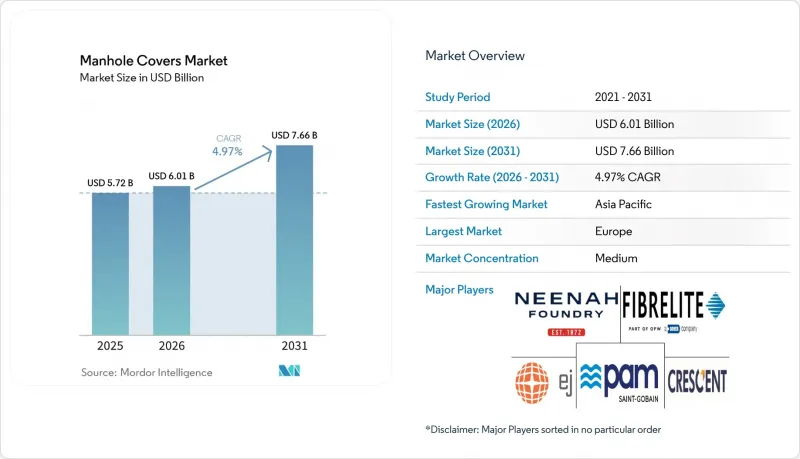
根據 Mordor Intelligence 預測,井蓋市場規模將從 2025 年的 57.2 億美元成長到 2026 年的 60.1 億美元,到 2031 年達到 76.6 億美元,2026 年至 2031 年的複合年成長率預計為 4.97%。
本報告按材料類型(鑄鐵、球墨鑄鐵、鋼、鋼筋混凝土等)、應用領域(道路基礎設施、用水和污水、電信和數據、電力和能源、天然氣供應等)以及地區(亞太地區、北美地區、歐洲地區、南美地區、中東和非洲)進行細分。市場預測以美元計價。
全球井蓋市場趨勢及洞察
與都市化相關的大型企劃儲備
到2025年,亞太地區的基礎設施支出將達到1.7兆美元,其中包括公路、鐵路和公共產業項目所需的大規模井蓋採購。預計到2030年,中國的井蓋產能將達到1,765萬個,超過國內需求,並加劇東協和中東地區的價格競爭。印度的「智慧城市計畫」撥款4.8兆盧比(約58億美元),但60%的競標仍授予了競標低於認證供應商的非正規鑄造廠。這種分散的採購體系減緩了物聯網升級的進程,並導致井蓋竊盜率居高不下。例如,在孟買,儘管每個井蓋的維修僅為50-100美元,但2023年仍通報了791起井蓋竊盜案。預計到2029年,中國的產能過剩將使該地區的平均售價(ASP)保持穩定。
智慧城市強制性即時資產監控
2021年孟買的一個試點計畫以失敗告終,該計畫安裝的感測器單元中有40%在六個月內失效,這凸顯了重複使用傳統鑄鐵井蓋所面臨的整合挑戰。 Fibrelite公司的FL60RF複合材料井蓋無需外部天線支架,從而降低了30%的安裝成本。廣州邦迅公司的NB-IoT井蓋,一次性購買價格為110至165美元,可將傾斜和氣體偵測資料傳輸到城市管理平台。已部署感測器井蓋的城市,緊急呼叫事件減少了25%至35%。然而,北美和歐洲仍有5,000萬至7,000萬個舊井蓋,因此已建立起一種逐步更換的模式,即在道路維修工程中分階段引入智慧井蓋,以控制資本支出。
球墨鑄鐵廢料價格的波動給利潤率帶來了壓力。
2025年,廢鋼價格在每噸1,800美元至2,200美元之間波動,導致鑄造廠的息稅折舊攤銷前利潤(EBITDA)下降約18%。麥克韋恩公司在奧斯卡魯薩投資8,000萬美元進行設備升級(包括高效能熔爐和長期廢鋼合約),旨在降低原物料風險,但這個問題至少要到2027年才能徹底解決。缺乏避險機制的中小型鑄造廠會將價格上漲的影響落後六個月才轉嫁給市政當局,這促使買家考慮轉向樹脂價格更穩定的複合材料。在印度,使用低品質廢鋼會導致爐蓋過早破損,但成本因素仍然是市政競標決策的主要考量,安全問題仍未解決。
細分市場分析
複合材料預計到2031年將以5.88%的複合年成長率成長,但2025年鑄鐵的銷售額僅佔45.89%。球墨鑄鐵對於F900交通荷載仍然至關重要,麥克韋恩公司擴建其位於奧斯卡魯薩的工廠,使其能夠滿足北美公路到2030年的需求。鋼材產品用於鐵路和機場,但需要鍍鋅,這會使成本增加20-25%。鋼筋混凝土是供水事業的一種經濟高效的選擇,但在凍融循環條件下容易開裂,因此沙漠地區的城市開始採用聚合物混凝土嵌件,使其使用壽命延長一倍。
複合材料的成本在 300 美元到 800 美元之間,大約是鑄鐵價格的兩倍,但它具有防盜、降低人體工學風險和感測器相容性等優勢。由於通訊業者將訊號完整性放在首位,Fibrelite 的射頻滲透性產品預計到 2025 年將溢價 40%。聚合物混凝土產品耐酸,但在歐盟的滲濾法規下面臨監管挑戰,促使供應商轉向纖維增強塑膠領域。材料策略正在分化。一條供應鏈專注於為高流量區域提供承重球墨鑄鐵,而另一條供應鏈則瞄準盜竊風險高且需要整合感測器的都市區,這兩個細分市場之間的競爭有限。
區域分析
預計到2025年,歐洲將佔40.38%的井蓋市場。 EN 124:2015標準支持此預測,該標準統一了A15至F900的荷載等級。德國、英國、法國和義大利佔據了該地區銷售量的大部分佔有率,其中北歐公共產業更傾向於使用複合材料,因為其具有良好的抗凍融循環性能。雖然西班牙巴塞隆納和馬德里正在試驗使用相容LoRaWAN技術的井蓋,但決策權掌握在地方政府手中,這減緩了標準化進程。俄羅斯依靠合資企業供應國內的球墨鑄鐵井蓋,但制裁阻礙了技術升級。
預計亞太地區將錄得最高成長率,到2031年複合年成長率將達5.73%。這主要得益於中國產能到2030年將激增至1,765萬台,因而對整個東協地區的價格構成壓力。印度的非標準競標規則允許非正式研討會參與,但「智慧城市計畫」的資金仍支撐著需求,使得該地區主要受價格主導。在日本和韓國,強制安裝除臭過濾器,每18至24個月的更換週期利潤豐厚。儘管印尼和越南的「一帶一路」計畫正在拓展交通走廊,但由於低成本鑄鐵產品仍是首選,複合材料的滲透率仍然很低。
北美地區積壓了價值1760億美元的未處理污水處理項目,其中包括人孔更換。夏洛特管道公司(Charlotte Pipe)計劃於2026年收購尼娜公司(Nina),旨在整合鑄鐵產品生產,以期在利潤率波動的情況下實現規模經濟。儘管亞利桑那州吉爾伯特市採用聚合物混凝土表明,其全生命週期成本降低的優勢超過了對初始成本的擔憂,但由於AASHTO M306標準的要求,球墨鑄鐵仍然是公路路段的主要材料。墨西哥依賴近岸外包來建設工業設施,而巴西和阿根廷對價格仍然非常敏感,僅在盜竊頻繁的地區採用複合材料。中東特大城市會發布規模龐大但不規律的競標,因此供應商的預測很容易受到少數超級項目的影響。
其他好處:
- Excel格式的市場預測(ME)表
- 3個月的分析師支持
目錄
第1章:引言
- 研究假設和市場定義
- 調查範圍
第2章:調查方法
第3章執行摘要
第4章 市場狀況
- 市場概覽
- 市場促進因素
- 與都市化相關的大型企劃儲備
- 智慧城市對即時資產監控的需求
- 過渡到複合材料和輕質防盜罩
- 地下光纖網路的擴展和5G密度的增加
- 在高密度城市強制使用阻隔異味的生物過濾蓋
- 市場限制因素
- 球墨鑄鐵廢料價格的波動給利潤率帶來了壓力。
- 缺乏組織、小規模的鑄造廠阻礙了標準化進程。
- 有關微塑膠滲漏的法規限制了聚合物混凝土的使用。
- 價值鏈分析
- 波特五力模型
第5章 市場規模與成長預測
- 依材料類型
- 鑄鐵
- 球墨鑄鐵
- 鋼
- 鋼筋混凝土
- 聚合物混凝土
- 複合材料
- 其他材料類型(HDPE、FRP 等)
- 透過使用
- 道路基礎設施
- 供水和污水處理
- 通訊和數據
- 電力和能源業務
- 天然氣供應
- 鐵路和機場
- 工業和商業設施
- 按地區
- 亞太地區
- 中國
- 印度
- 日本
- 韓國
- 東南亞國協
- 其他亞太國家
- 北美洲
- 美國
- 加拿大
- 墨西哥
- 歐洲
- 德國
- 英國
- 法國
- 義大利
- 西班牙
- 俄羅斯
- 北歐國家
- 其他歐洲國家
- 南美洲
- 巴西
- 阿根廷
- 其他南美國家
- 中東和非洲
- 沙烏地阿拉伯
- 南非
- 其他中東和非洲國家
- 亞太地區
第6章 競爭情勢
- 市場集中度
- 策略趨勢
- 市佔率和排名分析
- 公司簡介
- ACO Pty Ltd.
- Aliaxis
- Clark-Drain Ltd.
- Crescent Foundry
- Ducast Factory LLC
- Eagle Technocast
- EJ Group, Inc.
- Fibrelite Composites Ltd.
- Fibrocast
- Forecourt Solutions
- HAURATON GmbH & Co. KG
- HYDROTEC Technologies AG
- McWane, LLC
- Neenah Foundry
- Polieco Group
- Poly Products(I)Pvt. Ltd.
- Prime Composites Australia Pty Ltd.
- PROLONG COMPOSITES INDIA PVT. LTD.
- Saint-Gobain PAM
- SMC BMC Manhole Cover
- Terra Firma Industries
- THERMODRAIN
- United States Foundries Inc.
- Vikrant Manhole Covers
第7章 市場機會與未來展望
According to Mordor Intelligence, the manhole covers market size is expected to increase from USD 5.72 billion in 2025 to USD 6.01 billion in 2026 and reach USD 7.66 billion by 2031, growing at a CAGR of 4.97% over 2026-2031.
This report is Segmented by Material Type (Cast Iron, Ductile Iron, Steel, Reinforced Concrete, and More), Application (Road Infrastructure, Water and Waste-Water, Telecommunication and Data, Electric and Power Utility, Gas Distribution, and More), and Geography (Asia-Pacific, North America, Europe, South America, and Middle-East and Africa). The Market Forecasts are Provided in Terms of Value (USD).
Global Manhole Covers Market Trends and Insights
Urbanization-Linked Megaproject Pipelines
Asia-Pacific infrastructure spending reached USD 1.7 trillion in 2025, embedding large-scale manhole procurement across road, rail, and utility projects. China's production capacity is expected to rise to 17.65 million units by 2030, surpassing domestic demand and intensifying price competition in ASEAN and the Middle-East. India's Smart Cities Mission allocated INR 48,000 crore (USD 5.8 billion), but 60% of tenders are still awarded to unorganized foundries that undercut certified suppliers. This fragmented sourcing delays IoT-ready upgrades and contributes to high theft rates; for example, Mumbai reported 791 cover thefts in 2023 despite grill retrofits costing USD 50-100 per site. Excess production in China is likely to cap regional average selling prices (ASPs) through 2029.
Smart-City Mandates for Real-Time Asset Monitoring
Pilot failures in Mumbai, where 40% of sensor units installed in 2021 malfunctioned within six months, highlight integration challenges when legacy cast-iron lids are reused. Fibrelite's FL60RF composite lids eliminate the need for external antenna mounts and reduce installation costs by 30%. Guangzhou Bangxun's NB-IoT lids, priced at USD 110-165 in bulk, support tilt and gas detection data streaming to city dashboards. Cities deploying sensor-ready covers have reduced emergency callouts by 25-35%. However, the presence of 50-70 million legacy lids in North America and Europe creates a gradual replacement cycle, with procurement phasing in smart lids during scheduled resurfacing to manage capital expenditures.
Volatile Ductile-Iron Scrap Prices Squeezing Margins
Scrap prices fluctuated between USD 1,800 and USD 2,200 per ton in 2025, reducing foundry EBITDA by approximately 18%. McWane's USD 80 million upgrade in Oskaloosa, which includes melt-efficiency furnaces and long-term scrap contracts, aims to mitigate raw material risks but will not fully address the issue until at least 2027. Smaller foundries, lacking hedging mechanisms, pass price spikes to municipalities with a six-month lag, prompting buyers to explore composites with stable resin pricing. In India, the use of low-grade scrap leads to premature lid failures, but cost considerations continue to dominate municipal tender decisions, leaving safety concerns unresolved.
Other drivers and restraints analyzed in the detailed report include:
- Shift Toward Composite/Lightweight Anti-theft Covers
- Growth in Underground Fiber and 5G Densification
- Unorganized Small Foundries Limiting Standardization
For complete list of drivers and restraints, kindly check the Table Of Contents.
Segment Analysis
Composite materials are projected to grow at a CAGR of 5.88% through 2031, while cast iron accounted for 45.89% of revenue in 2025. Ductile iron remains essential for F900 traffic loads, and McWane's Oskaloosa expansion positions the company to meet North American highway demands through 2030. Steel variants are utilized in rail and airfield applications but require galvanization, which increases costs by 20-25%. Reinforced concrete is a cost-effective option for water utilities but is prone to cracking under freeze-thaw conditions, leading desert municipalities to adopt polymer-concrete inserts that double the lifespan.
Composite materials, priced at USD 300-800, are approximately twice as expensive as cast iron but offer advantages such as theft prevention, reduced ergonomic risks, and compatibility with sensors. Fibrelite's RF-transparent products commanded a 40% premium in 2025 because telecom buyers prioritized signal integrity. Polymer-concrete variants resist acids but face regulatory challenges under EU leach rules, prompting suppliers to diversify into fiber-reinforced plastics. Material strategies are diverging: one supply chain focuses on weight-bearing ductile iron for heavy traffic, while another targets theft-prone, sensor-integrated urban areas, limiting competition between the two segments.
Geography Analysis
Europe accounted for 40.38% of the manhole covers market share in 2025, underpinned by EN 124:2015, which harmonizes load classes A15-F900. Germany, the UK, France, and Italy represent the majority of regional volume, and NORDIC utilities favor composites for freeze-thaw durability. Spain's Barcelona and Madrid pilots integrate LoRaWAN lids, yet decision rights lie with regional councils, slowing standard adoption. Russia relies on joint ventures to supply ductile-iron lids domestically, but sanctions have stunted technology upgrades.
Asia-Pacific will post the fastest 5.73% CAGR through 2031, propelled by China's capacity jump to 17.65 million units by 2030, which overhangs prices across ASEAN. India's non-standard tender rules allow unorganized shops, yet Smart Cities Mission funds still provide volume, making the region primarily price-led. Japan and South Korea enforce odor-filter mandates, producing a high-margin replacement cycle every 18-24 months. Belt-and-Road projects in Indonesia and Vietnam expand transport corridors but specify low-cost cast iron, so composite inroads stay niche.
North America faces a USD 176 billion wastewater backlog, and manhole upgrades fold into that capex. Charlotte Pipe's 2026 Neenah takeover consolidates cast-iron output, aiming for scale against margin volatility. Gilbert, Arizona's polymer-concrete rollout proves that documented lifecycle savings override upfront cost objections, but AASHTO M306 still guards highway segments for ductile iron. Mexico leans on industrial builds tied to near-shoring, while Brazil and Argentina stay price sensitive, adopting composites only in theft hot-spots. Middle-East megacities like NEOM issue large but lumpy tenders; thus, supplier forecasts hinge on a handful of giga-projects.
- ACO Pty Ltd.
- Aliaxis
- Clark-Drain Ltd.
- Crescent Foundry
- Ducast Factory LLC
- Eagle Technocast
- EJ Group, Inc.
- Fibrelite Composites Ltd.
- Fibrocast
- Forecourt Solutions
- HAURATON GmbH & Co. KG
- HYDROTEC Technologies AG
- McWane, LLC
- Neenah Foundry
- Polieco Group
- Poly Products (I) Pvt. Ltd.
- Prime Composites Australia Pty Ltd.
- PROLONG COMPOSITES INDIA PVT. LTD.
- Saint-Gobain PAM
- SMC BMC Manhole Cover
- Terra Firma Industries
- THERMODRAIN
- United States Foundries Inc.
- Vikrant Manhole Covers
Additional Benefits:
- The market estimate (ME) sheet in Excel format
- 3 months of analyst support
TABLE OF CONTENTS
1 Introduction
- 1.1 Study Assumptions and Market Definition
- 1.2 Scope of the Study
2 Research Methodology
3 Executive Summary
4 Market Landscape
- 4.1 Market Overview
- 4.2 Market Drivers
- 4.2.1 Urbanisation-linked megaproject pipelines
- 4.2.2 Smart-city mandates for real-time asset monitoring
- 4.2.3 Shift toward composite/lightweight anti-theft covers
- 4.2.4 Growth in underground fibre and 5G densification
- 4.2.5 Mandated anti-odour bio-filter covers in high-density cities
- 4.3 Market Restraints
- 4.3.1 Volatile ductile-iron scrap prices squeezing margins
- 4.3.2 Unorganised small foundries limiting standardisation
- 4.3.3 Micro-plastic leach regulations curbing polymer-concrete use
- 4.4 Value Chain Analysis
- 4.5 Porter's Five Forces
- 4.5.1 Threat of New Entrants
- 4.5.2 Bargaining Power of Buyers
- 4.5.3 Bargaining Power of Suppliers
- 4.5.4 Threat of Substitutes
- 4.5.5 Competitive Rivalry
5 Market Size and Growth Forecasts (Value)
- 5.1 By Material Type
- 5.1.1 Cast Iron
- 5.1.2 Ductile Iron
- 5.1.3 Steel
- 5.1.4 Reinforced Concrete
- 5.1.5 Polymer Concrete
- 5.1.6 Composite Materials
- 5.1.7 Other Material Types (HDPE, FRP, etc.)
- 5.2 By Application
- 5.2.1 Road Infrastructure
- 5.2.2 Water and Waste-water
- 5.2.3 Telecommunication and Data
- 5.2.4 Electric and Power Utility
- 5.2.5 Gas Distribution
- 5.2.6 Rail and Airport
- 5.2.7 Industrial and Commercial Facilities
- 5.3 By Geography
- 5.3.1 Asia-Pacific
- 5.3.1.1 China
- 5.3.1.2 India
- 5.3.1.3 Japan
- 5.3.1.4 South Korea
- 5.3.1.5 ASEAN Countries
- 5.3.1.6 Rest of Asia-Pacific
- 5.3.2 North America
- 5.3.2.1 United States
- 5.3.2.2 Canada
- 5.3.2.3 Mexico
- 5.3.3 Europe
- 5.3.3.1 Germany
- 5.3.3.2 United Kingdom
- 5.3.3.3 France
- 5.3.3.4 Italy
- 5.3.3.5 Spain
- 5.3.3.6 Russia
- 5.3.3.7 NORDIC Countries
- 5.3.3.8 Rest of Europe
- 5.3.4 South America
- 5.3.4.1 Brazil
- 5.3.4.2 Argentina
- 5.3.4.3 Rest of South America
- 5.3.5 Middle-East and Africa
- 5.3.5.1 Saudi Arabia
- 5.3.5.2 South Africa
- 5.3.5.3 Rest of Middle-East and Africa
- 5.3.1 Asia-Pacific
6 Competitive Landscape
- 6.1 Market Concentration
- 6.2 Strategic Moves
- 6.3 Market Share (%)/Ranking Analysis
- 6.4 Company Profiles (includes Global level Overview, Market level overview, Core Segments, Financials as available, Strategic Information, Products and Services, and Recent Developments)
- 6.4.1 ACO Pty Ltd.
- 6.4.2 Aliaxis
- 6.4.3 Clark-Drain Ltd.
- 6.4.4 Crescent Foundry
- 6.4.5 Ducast Factory LLC
- 6.4.6 Eagle Technocast
- 6.4.7 EJ Group, Inc.
- 6.4.8 Fibrelite Composites Ltd.
- 6.4.9 Fibrocast
- 6.4.10 Forecourt Solutions
- 6.4.11 HAURATON GmbH & Co. KG
- 6.4.12 HYDROTEC Technologies AG
- 6.4.13 McWane, LLC
- 6.4.14 Neenah Foundry
- 6.4.15 Polieco Group
- 6.4.16 Poly Products (I) Pvt. Ltd.
- 6.4.17 Prime Composites Australia Pty Ltd.
- 6.4.18 PROLONG COMPOSITES INDIA PVT. LTD.
- 6.4.19 Saint-Gobain PAM
- 6.4.20 SMC BMC Manhole Cover
- 6.4.21 Terra Firma Industries
- 6.4.22 THERMODRAIN
- 6.4.23 United States Foundries Inc.
- 6.4.24 Vikrant Manhole Covers
7 Market Opportunities and Future Outlook
- 7.1 White-space and Unmet-need Assessment


