


 |
市場調查報告書
商品編碼
2062385
吹塑成型容器:市場佔有率分析、產業趨勢與統計、成長預測(2026-2031 年)Blow Molded Containers - Market Share Analysis, Industry Trends & Statistics, Growth Forecasts (2026 - 2031) |
||||||

※ 本網頁內容可能與最新版本有所差異。詳細情況請與我們聯繫。
根據 Mordor Intelligence 預測,吹塑成型容器市場規模將從 2025 年的 903.5 億美元和 2026 年的 953.3 億美元成長到 2031 年的 1,246.5 億美元,2026 年至 2031 年的複合年成長率為 5.51%。
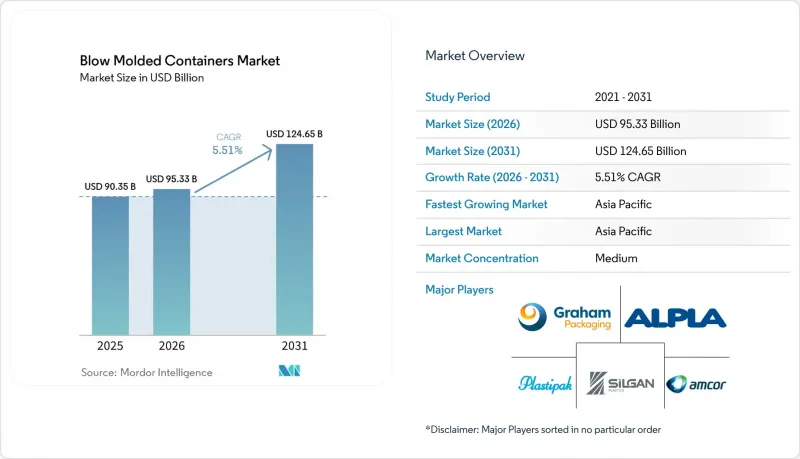
本報告按材料(例如,高密度聚苯乙烯(HDPE))、容器類型(例如,瓶子、罐子/壺)、技術(例如,擠出吹塑成型(EBM))、終端用戶行業(例如,食品和飲料)以及地區(亞太地區、北美地區、歐洲地區、南美地區、中東和非洲地區)進行細分。市場預測以美元 (USD) 為單位。
全球吹塑成型容器市場趨勢及洞察
單份裝和攜帶式飲料的成長
在飲料和製藥業,單劑量產品(SKU)的種類正在不斷增加,其中容量小於500毫升的輕質聚對苯二甲酸乙二醇酯(PET)瓶更受青睞。採用模組化模具系統的製造商能夠應對日益複雜的產品種類,而無需面臨庫存管理方面的挑戰。例如,FlexBlow平台可在5分鐘內完成模具更換,進而提高營運效率。瓶蓋設計也在不斷發展,翻蓋式運動瓶蓋和內置吸管的出現,將價值重心從瓶身轉移到了瓶頸部分,從而提升了產品的功能性和便利性。
電子商務宅配物流的擴張
在自動化履約中心,更高的跌落高度和更強的振動強度要求採用加強筋側壁和加強底部。雖然這些設計變更會使樹脂用量增加 8-12%,但它們有助於防止運輸過程中因損壞而引起的索賠,並確保產品完整性。此外,歐盟關於小包裹內空隙率過高的法規也迫使品牌採用尺寸合適的包裝形狀,以高效最佳化運輸紙板的使用,從而降低運輸成本並永續性。
石化原料價格波動
2026年初,聚乙烯價格年減15%,但此後每月波動幅度仍維持在18%至22%之間,對簽訂固定價格合約的加工商造成了影響。再生聚對苯二甲酸乙二醇酯(rPET)薄片的價格仍比原生樹脂高出25%至35%。這是因為歐洲回收的聚對苯二甲酸乙二醇酯(PET)中只有58%合格於食品級應用。這種價格差異源自於食品級rPET供應有限,而回收過程的低效率又進一步限制了其供應。
細分市場分析
2025年,高密度聚苯乙烯(HDPE)的銷售額佔比將達到35.11%,這主要得益於其在牛奶、清潔劑和工業化學品包裝領域至關重要的耐化學性和抗衝擊性。與生物基和再生塑膠相關的吹塑成型容器市場預計到2031年將以5.64%的複合年成長率成長,這主要得益於投資者在環境、社會和管治(ESG)舉措。 Total Energy Corbion公司的聚乳酸(PLA)「Luminy」在2025年產能將達到7.5萬噸,以支持瓶裝水先導計畫計畫。同時,聚對苯二甲酸乙二醇酯(PET)繼續主導15克500毫升碳酸飲料包裝市場,但由於市場飽和以及可重複填充玻璃容器項目的興起,其進一步成長受到限制。再生聚烯在價值鏈中不斷進步,INEOS 的 rPP1025C 滿足化妝品級應用的剛性要求,同時含有 70% 的再生材料。
由於鄰苯二甲酸酯的危害,聚氯乙烯(PVC)在西歐的市佔率大幅下降,跌至個位數。聚羥基烷酯(PHA)雖然具有在海洋中生物分解的潛力,但其產能不足5000噸,仍受到限制。高密度聚乙烯(HDPE)在擠出吹塑成型(EBM)領域的既有地位使其在一定程度上免受快速替代,但隨著生產者延伸責任(EPR)費用的日益嚴格,HDPE的競爭力將越來越依賴於再生高密度聚乙烯(rHDPE)共混物和顏色分選系統的進步。
2025年,瓶裝產品佔總銷售額的64.12%,但帶把手的罐裝產品、雙腔分配器和真空幫浦等特種產品預計將以更高的複合年成長率(5.88%)成長。 Greif的雙腔槽透過將反應性黏合劑分離直至使用,可將保存期限延長四倍。真空聚對苯二甲酸乙二醇酯(PET)容器透過防止氧氣滲入來維持維生素C精華液的效力,從而在護膚市場實現高價定價。 Graham Packaging的AccuStrength軟體可將帶把手容器的重量減輕11%至15%,每年在北美地區節省8000至10000噸高密度聚乙烯(HDPE)。
罐子和瓶子的材質正從射出成型的聚丙烯 (PP) 轉向擠出吹塑成型聚乙烯 (HDPE),這加速了模具的更新換代。同時,桶和中型散貨箱(IBC) 也正逐步標準化,以符合聯合國認證標準。隨著瓶子作為可回收產品越來越普及,分配器機制和人體工學設計的創新正成為維持品牌獲利能力的關鍵差異化因素。
區域分析
預計到2025年,亞太地區將佔全球銷售額的41.18%,年複合成長率達6.22%。中國廣東和浙江兩省的綜合石化叢集正在提升原料流通效率。同時,印度的《藥品和化妝品法》強制要求1萬家製藥廠使用防篡改包裝瓶。
在北美,自2020年以來,塑膠產業140億美元的投資回報,以及現場吹塑成型的引入,為Logoplaste的發展提供了強勁動力。 Logoplaste營運62家現場工廠,每年可減少客戶12,000噸二氧化碳排放。在歐洲,儘管面臨樹脂價格上漲和能源價格波動等挑戰,該公司仍在投資再生聚對苯二甲酸乙二醇酯(rPET)生產線,以滿足《包裝和包裝廢棄物法規》(PPWR)對再生材料含量的要求。在中東和非洲,包括Asept在埃及投資1.26億美元的無菌生產線在內的新設施的投產,正使該地區成為獨立國協(CIS)和撒哈拉以南非洲市場的潛在出口中心。
德國和斯堪地那維亞的押金返還計劃促進了聚對苯二甲酸乙二醇酯(PET)的回收利用,但再生PET(rPET)的供不應求高達每年70萬噸,需要從土耳其和沙烏地阿拉伯進口。這些原料供需趨勢正在鞏固亞太地區的成本優勢,該地區在吹塑成型容器市場中佔有較大佔有率。
其他好處:
- Excel格式的市場預測(ME)表
- 3個月的分析師支持
目錄
第1章:引言
- 研究假設和市場定義
- 調查範圍
第2章:調查方法
第3章執行摘要
第4章 市場狀況
- 市場概覽
- 市場促進因素
- 單份裝和攜帶式飲料的成長
- 電子商務宅配物流的擴張
- 品牌轉型採用單一材料設計,以提高可回收性
- 等離子塗層PET,其阻隔性可與玻璃媲美。
- 灌裝線上的現場即時吹塑成型
- 市場限制因素
- 石化原料價格波動
- 歐盟規定,PPWR(電力採購材料)必須含有 30% 的回收材料。
- Pilot品牌,採用紙質硬包裝。
- 價值鏈分析
- 波特五力分析
第5章 市場規模與成長預測
- 材料
- 高密度聚苯乙烯(HDPE)
- 聚對苯二甲酸乙二醇酯(PET)
- 低密度聚乙烯/線性低密度聚乙烯(LD/LLDPE)
- 聚丙烯(PP)
- 聚氯乙烯(PVC)
- 生物基和再生塑膠(rPET、rHDPE、PLA、PHA)
- 按容器類型
- 瓶子
- 瓶子和罐子
- 果凍罐和F型容器
- 桶和中型散貨箱(IBC)
- 特殊形狀(帶把手的容器、雙層壁容器等)
- 透過技術
- 擠出吹塑成型(EBM)
- 射出吹塑成型(IBM)
- 拉伸吹塑成型(SBM)
- 按最終用戶行業分類
- 食品/飲料
- 個人護理化妝品
- 藥品和醫療保健
- 家居護理和家用化學品
- 工業化學品和潤滑劑
- 汽車用液體和冷卻液
- 農業和園藝
- 按地區
- 亞太地區
- 中國
- 印度
- 日本
- 韓國
- 東南亞國協
- 其他亞太國家
- 北美洲
- 美國
- 加拿大
- 墨西哥
- 歐洲
- 德國
- 英國
- 法國
- 義大利
- 西班牙
- 俄羅斯
- 北歐國家
- 其他歐洲國家
- 南美洲
- 巴西
- 阿根廷
- 其他南美國家
- 中東和非洲
- 沙烏地阿拉伯
- 南非
- 其他中東和非洲國家
- 亞太地區
第6章 競爭情勢
- 市場集中度
- 策略趨勢
- 市佔率和排名分析
- 公司簡介
- Alpha Packaging
- ALPLA
- Amcor plc
- APEX Plastics
- Comar
- Graham Packaging
- Greif
- Jokey SE
- Logoplaste
- Pharmapack Co., Ltd.
- Plastipak Holdings, Inc.
- Pretium Packaging
- RESILUX NV
- Retal Industries LTD
- Sidel
- Silgan Plastics
- SRPCO Packaging
- Takween Advanced Industries
- Time Technoplast Ltd.
- Zhejiang Zhink New Materials Co., Ltd.
第7章 市場機會與未來展望
According to Mordor Intelligence, the blow molded containers market size is projected to expand from USD 90.35 billion in 2025 and USD 95.33 billion in 2026 to USD 124.65 billion by 2031, registering a CAGR of 5.51% between 2026 to 2031.
This report is Segmented by Material (High-Density Polyethylene (HDPE) and More), Container Type (Bottles, Jars and Pots, and More), Technology (Extrusion Blow Molding (EBM) and More), End-User Industry (Food and Beverages and More), and Geography (Asia-Pacific, North America, Europe, South America, and Middle-East and Africa). The Market Forecasts are Provided in Terms of Value (USD).
Global Blow Molded Containers Market Trends and Insights
Growth in Single-Serve and On-the-Go Beverages
Unit-dose formats are expanding in both beverage and pharmaceutical stock-keeping units (SKUs), with a preference for lightweight polyethylene terephthalate (PET) bottles under 500 milliliters. Manufacturers using modular tooling systems are addressing the increasing complexity of SKUs without incurring inventory challenges. For example, FlexBlow platforms enable mold changes in less than five minutes, improving operational efficiency. Closure designs are also evolving, with developments such as flip-top sports caps and built-in straws shifting value emphasis from bottle bodies to neck finishes, enhancing functionality and convenience.
E-commerce Home-Delivery Logistics Expansion
Automated fulfillment centers are introducing higher drop heights and vibration profiles, leading to the adoption of ribbed sidewalls and reinforced bases. These design changes increase resin usage by 8-12% but help prevent damage claims, ensuring product integrity during transit. Additionally, European Union (EU) regulations penalizing empty space within parcels are driving brands to adopt right-sized geometries that optimize the use of shipping cartons efficiently, reducing shipping costs and improving sustainability.
Petrochemical Feedstock Price Volatility
Polyethylene prices decreased by 15% year-on-year in early 2026; however, monthly fluctuations of 18-22% continue to impact converters operating under fixed-price sales agreements. Recycled Polyethylene Terephthalate (rPET) flake is priced at a 25-35% premium over virgin resin, as only 58% of collected Polyethylene Terephthalate (PET) in Europe qualifies for food-grade applications. This disparity in pricing is driven by the limited availability of food-grade rPET, which is further constrained by inefficiencies in the recycling process.
Other drivers and restraints analyzed in the detailed report include:
- Brand Shift to Mono-Material Designs for Recyclability
- Plasma-Coated PET Enabling Glass-Like Barrier
- European Union PPWR 30% Recycled-Content Mandate
For complete list of drivers and restraints, kindly check the Table Of Contents.
Segment Analysis
High-density polyethylene (HDPE) accounted for 35.11% of 2025 revenue, driven by its chemical resistance and impact durability, which are essential for packaging milk, detergents, and industrial chemicals. The blow-molded containers market linked to bio-based and recycled plastics is projected to grow at a compound annual growth rate (CAGR) of 5.64% through 2031, supported by environmental, social, and governance (ESG) initiatives from investors. TotalEnergies Corbion's Luminy polylactic acid (PLA) reached a production capacity of 75,000 tons in 2025 to support bottled water pilot projects. While polyethylene terephthalate (PET) continues to dominate carbonated soft drink packaging with lightweight 15-gram 500-milliliter bottles, market saturation and the rise of refillable glass programs limit further growth. Recycled-content polyolefins are advancing in the value chain, with INEOS's rPP1025C containing 70% recyclate while meeting the stiffness requirements for cosmetics-grade applications.
Polyvinyl chloride (PVC) is losing market share in Western Europe, dropping to single-digit levels due to concerns over phthalates. Polyhydroxyalkanoates (PHA), despite their marine biodegradability potential, remain constrained by production capacities below 5,000 tons. HDPE's established presence in extrusion blow molding (EBM) provides some insulation against rapid displacement, but the competitiveness of HDPE will increasingly depend on recycled HDPE (rHDPE) blends and advancements in color-sorted separation systems as extended producer responsibility (EPR) fees become more stringent.
Bottles accounted for 64.12% of 2025 revenue, but specialty shapes, such as handleware jugs, dual-chamber dispensers, and airless pumps, are expected to grow at a faster CAGR of 5.88%. Greif's dual-compartment canisters, which separate reactive adhesives until use, extend shelf life by four times. Airless polyethylene terephthalate (PET) containers preserve the potency of vitamin-C serums by preventing oxygen ingress, enabling premium pricing in the skincare market. Graham Packaging's AccuStrength software reduces handleware gram weights by 11-15%, saving 8,000-10,000 tons of HDPE annually across North America.
Jars and pots are transitioning from injection-molded polypropylene (PP) to extrusion-blown HDPE, which allows for faster tool changes. Meanwhile, drums and intermediate bulk containers (IBCs) are consolidating around United Nations (UN)-certified formats. As bottles increasingly become recyclable commodities, innovations in dispensing mechanisms and ergonomic designs are emerging as key differentiators to maintain brand margins.
Geography Analysis
Asia-Pacific accounted for 41.18% of the projected 2025 revenue and is growing at a compound annual growth rate (CAGR) of 6.22%. China's integrated petrochemical clusters in Guangdong and Zhejiang improve raw material flow efficiency, while India's Drugs and Cosmetics Act mandates tamper-evident bottles across 10,000 drug manufacturing plants.
North America benefits from the adoption of on-site blow molding and USD 14 billion in reshored plastics investments since 2020. Logoplaste operates 62 embedded plants, reducing clients' carbon dioxide (CO2) emissions by 12,000 tons annually. Europe faces challenges such as resin premiums and energy price volatility, but is investing in recycled polyethylene terephthalate (rPET) production lines to meet Packaging and Packaging Waste Regulation (PPWR) recycled-content requirements. In the Middle East and Africa, new installations, including Asepto's USD 126 million aseptic line in Egypt, position the region as a potential export hub for the Commonwealth of Independent States (CIS) and Sub-Saharan markets.
Deposit-return schemes in Germany and Scandinavia support polyethylene terephthalate (PET) collection; however, rPET shortfalls persist at 0.7 million tons annually, necessitating imports from Turkey and Saudi Arabia. These feedstock dynamics reinforce Asia-Pacific's cost advantage and sustain its significant share in the blow molded containers market.
- Alpha Packaging
- ALPLA
- Amcor plc
- APEX Plastics
- Comar
- Graham Packaging
- Greif
- Jokey SE
- Logoplaste
- Pharmapack Co., Ltd.
- Plastipak Holdings, Inc.
- Pretium Packaging
- RESILUX NV
- Retal Industries LTD
- Sidel
- Silgan Plastics
- SRPCO Packaging
- Takween Advanced Industries
- Time Technoplast Ltd.
- Zhejiang Zhink New Materials Co., Ltd.
Additional Benefits:
- The market estimate (ME) sheet in Excel format
- 3 months of analyst support
TABLE OF CONTENTS
1 Introduction
- 1.1 Study Assumptions and Market Definition
- 1.2 Scope of the Study
2 Research Methodology
3 Executive Summary
4 Market Landscape
- 4.1 Market Overview
- 4.2 Market Drivers
- 4.2.1 Growth in single-serve and on-the-go beverages
- 4.2.2 E-commerce home-delivery logistics expansion
- 4.2.3 Brand shift to mono-material designs for recyclability
- 4.2.4 Plasma-coated PET enabling glass-like barrier
- 4.2.5 On-site, just-in-time blow-molding at fillers
- 4.3 Market Restraints
- 4.3.1 Petrochemical feedstock price volatility
- 4.3.2 European Union PPWR 30 % recycled-content mandate
- 4.3.3 Brand pilots of paper-based rigid packs
- 4.4 Value Chain Analysis
- 4.5 Porter's Five Forces Analysis
- 4.5.1 Bargaining Power of Suppliers
- 4.5.2 Bargaining Power of Buyers
- 4.5.3 Threat of New Entrants
- 4.5.4 Threat of Substitutes
- 4.5.5 Competitive Rivalry
5 Market Size and Growth Forecasts (Value)
- 5.1 By Material
- 5.1.1 High-Density Polyethylene (HDPE)
- 5.1.2 Polyethylene Terephthalate (PET)
- 5.1.3 Low-Density/Linear-Low-Density Polyethylene (LD/LLDPE)
- 5.1.4 Polypropylene (PP)
- 5.1.5 Polyvinyl Chloride (PVC)
- 5.1.6 Bio-based and Recycled Plastics (rPET, rHDPE, PLA, PHA)
- 5.2 By Container Type
- 5.2.1 Bottles
- 5.2.2 Jars and Pots
- 5.2.3 Jerry Cans and F-style Containers
- 5.2.4 Drums and Intermediate Bulk Containers (IBCs)
- 5.2.5 Specialty Shapes (Handleware, Dual-chamber, Etc.)
- 5.3 By Technology
- 5.3.1 Extrusion Blow Molding (EBM)
- 5.3.2 Injection Blow Molding (IBM)
- 5.3.3 Stretch Blow Molding (SBM)
- 5.4 By End-User Industry
- 5.4.1 Food and Beverages
- 5.4.2 Personal Care and Cosmetics
- 5.4.3 Pharmaceutical and Healthcare
- 5.4.4 Home Care and Household Chemicals
- 5.4.5 Industrial Chemicals and Lubricants
- 5.4.6 Automotive Fluids and Coolants
- 5.4.7 Agriculture and Horticulture
- 5.5 By Geography
- 5.5.1 Asia-Pacific
- 5.5.1.1 China
- 5.5.1.2 India
- 5.5.1.3 Japan
- 5.5.1.4 South Korea
- 5.5.1.5 ASEAN Countries
- 5.5.1.6 Rest of Asia-Pacific
- 5.5.2 North America
- 5.5.2.1 United States
- 5.5.2.2 Canada
- 5.5.2.3 Mexico
- 5.5.3 Europe
- 5.5.3.1 Germany
- 5.5.3.2 United Kingdom
- 5.5.3.3 France
- 5.5.3.4 Italy
- 5.5.3.5 Spain
- 5.5.3.6 Russia
- 5.5.3.7 NORDIC Countries
- 5.5.3.8 Rest of Europe
- 5.5.4 South America
- 5.5.4.1 Brazil
- 5.5.4.2 Argentina
- 5.5.4.3 Rest of South America
- 5.5.5 Middle-East and Africa
- 5.5.5.1 Saudi Arabia
- 5.5.5.2 South Africa
- 5.5.5.3 Rest of Middle-East and Africa
- 5.5.1 Asia-Pacific
6 Competitive Landscape
- 6.1 Market Concentration
- 6.2 Strategic Moves
- 6.3 Market Share(%)/Ranking Analysis
- 6.4 Company Profiles (includes Global Overview, Market Overview, Core Segments, Financials, Strategic Information, Products and Services, and Recent Developments)
- 6.4.1 Alpha Packaging
- 6.4.2 ALPLA
- 6.4.3 Amcor plc
- 6.4.4 APEX Plastics
- 6.4.5 Comar
- 6.4.6 Graham Packaging
- 6.4.7 Greif
- 6.4.8 Jokey SE
- 6.4.9 Logoplaste
- 6.4.10 Pharmapack Co., Ltd.
- 6.4.11 Plastipak Holdings, Inc.
- 6.4.12 Pretium Packaging
- 6.4.13 RESILUX NV
- 6.4.14 Retal Industries LTD
- 6.4.15 Sidel
- 6.4.16 Silgan Plastics
- 6.4.17 SRPCO Packaging
- 6.4.18 Takween Advanced Industries
- 6.4.19 Time Technoplast Ltd.
- 6.4.20 Zhejiang Zhink New Materials Co., Ltd.
7 Market Opportunities and Future Outlook
- 7.1 White-space and Unmet-Need Assessment

 一次性微波爐適用容器市場:全球市場預測,2026-2032年
 堆疊和包裝解決方案市場規模、佔有率和成長分析:按解決方案類型、自動化程度、包裝類型、應用、最終用戶產業和地區分類-2026-2033年產業預測
 卡扣式密封容器市場:依材料類型、應用、容器類型、最終用戶、國家及地區分類-全球產業分析、市場規模、市場佔有率及2026年至2033年預測
 折疊式套筒容器市場:策略性洞察與預測(2026-2031 年)
 容器清洗系統市場規模、佔有率和成長分析:按自動化技術、設備配置、目標容器分類、製程/應用/化學品基礎和地區分類-2026-2033年產業預測
 折疊式散裝容器市場預測至2034年-全球材料、產品類型、容量、分銷管道、應用、最終用戶和區域分析吹塑成型容器市場:全球市場按產品類型、材料、容量範圍和應用分類的預測 - 2026-2032年貨櫃捆綁系統市場:依產品類型、材質、貨櫃類型、應用、產業和通路分類-2026-2032年全球預測預開袋製袋機市場:依包裝材料、技術、類型、薄膜類型、產能、最終用途產業和銷售管道,全球預測,2026-2032年捲裝預開袋市場按材料類型、袋子尺寸、分銷管道和最終用途行業分類,全球預測,2026-2032年