


 |
市場調查報告書
商品編碼
2062288
乙二醇:市佔率分析、產業趨勢與統計、成長預測(2026-2031)Ethylene Glycol - Market Share Analysis, Industry Trends & Statistics, Growth Forecasts (2026 - 2031) |
||||||

※ 本網頁內容可能與最新版本有所差異。詳細情況請與我們聯繫。
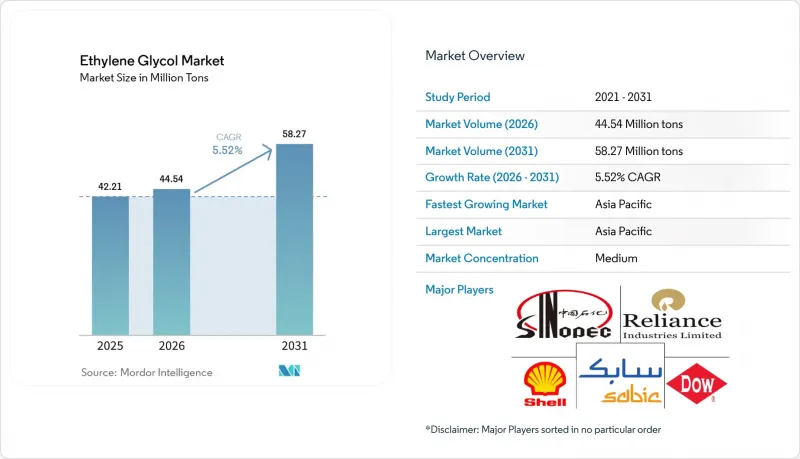
根據 Mordor Intelligence 預測,乙二醇市場規模將從 2025 年的 4,221 萬噸和 2026 年的 4,454 萬噸成長到 2031 年的 5,827 萬噸,2026 年至 2031 年的年複合成長率(CAGR)為 5.52%。
本報告按產品類型(單乙二醇、二伸乙甘醇、三甘醇)、生產流程(環氧乙烷法、煤基單乙二醇法、生物基法)、應用領域(聚酯纖維、PET等)、終端用戶產業(紡織服裝、汽車等)和地區(亞太地區、北美地區等)進行細分。市場預測以噸為單位。
全球乙二醇市場趨勢與洞察
電動車溫度控管用冷卻劑需求激增
電池式電動車(BEV)的液冷電池組、電力電子設備和馬達通常需要50-60%的乙二醇-水混合液進行溫度調節。特斯拉2026款Model Y的使用手冊規定,北美地區使用HTF-LS,歐洲地區使用G48,中國地區使用LC100,所有產品的濃度均在50-60%範圍內,以確保耐腐蝕性和熱效率。 800V驅動系統的日益普及推動了車輛中乙二醇的整體使用量,進而促進了乙二醇市場的長期成長。比亞迪等中國汽車製造商已經在每輛車上採用多個乙二醇迴路,而美國的超級工廠則在定製冷卻液等級以防止交叉污染。介電浸沒式冷卻液可能在高性能汽車領域找到一些小眾應用,但主流電動車市場仍依賴水-乙二醇混合液,預計需求將穩定成長。
亞洲巨型裂解裝置產能擴張
計劃於2025年底至2027年間在中國和韓國運作的六套大型乙烯聯合裝置預計將新增超過300萬噸的MEG(亞甲基醚)額定產能。沙烏地阿美和中國石化在亞斯瑞煉廠建設的180萬噸裂解裝置是「液態原料製化學品」轉型的一個典型例子,該裝置利用利潤豐厚的原油原料生產乙二醇及其衍生物。短期供應過剩可能導致中國產運轉率下降1-2個百分點。然而,一體化生產系統的成本優勢將使煤基MEG生產商能夠在利潤率下降的情況下維持產量。新增產能將增強下游聚酯出口商的區域供應穩定性,並有助於穩定紡織企業的原料成本。
歐盟REACH法規關於職場接觸二甘醇的規定
荷蘭衛生委員會建議二伸乙甘醇(DEG) 的 8 小時暴露限值為 70 mg/m³,並附有皮膚注記,指出有經皮吸收的風險。各國限值差異較大,從丹麥的 11 mg/m³ 到英國的 101 mg/m³ 不等,這使得合規性更加複雜,並增加了通風、監測和個人防護設備的成本。因此,下游用戶,例如煞車油和溶劑調配商,可能會轉向使用丙二醇或更高純度的乙二醇衍生物,這可能會降低二甘醇在乙二醇市場的成長前景。
細分市場分析
在聚酯纖維和PET樹脂供應鏈的支撐下,單乙二醇在2025年佔總出貨量的86.44%。儘管由於特種產品的快速成長導致MEG佔有率下降,但該細分市場的絕對銷售成長仍推動乙二醇市場保持強勁成長勢頭。預計到2031年,二伸乙甘醇甘醇將以8.47%的複合年成長率成長,這主要得益於依賴甲基二甘醇和甲基三甘醇的高級制動液的需求,而甲基二甘醇和甲基三甘醇是通過二甘醇中間體生產的。三甘醇仍然是一個穩定的利基市場,與天然氣脫水有關,其趨勢反映了上游鑽井週期。
產能投資也反映了這些趨勢。BASF湛江甲基乙二醇廠計畫於2025年下半年運作,屆時將把二乙二醇(DEG)原料用於生產中國日益成長的汽車保有量所需的新型煞車油。然而,監管機構對其毒性的審查可能會抑制對二乙二醇的需求,迫使生產商在食品和製藥領域用更安全的丙二醇取代它。由於特種混合物享有溢價,均衡的產品組合有助於生產商降低大宗甲基乙二醇(MEG)利潤率的波動,並保持其在乙二醇市場的領先地位。
到2025年,77.79%的產量將來自環氧乙烷工藝,這得益於與北美裂解裝置的整合以及有利的乙烷價格。過去十年,中國新增產量主要來自煤製乙二醇,但目前正面臨碳成本上升和運轉率下降的雙重挑戰。運作約150萬噸煤製乙二醇產能的可能性不大,將進一步降低未來的供應量。
生物基路線是成長最快的領域,預計到2031年將以9.23%的複合年成長率成長。 Sustainea公司的Lafayette計畫就是一個典型的例子,它提供了一種擴充性的、可直接取代現有PET設備的可再生MEG產品;而UPM公司以硬木為原料的BioPura產品則有望在中期內供應碳負排放的乙二醇。一家採用MOSAIK公司糖分解化學技術的示範工廠正在向聚酯品牌商分發樣品,以評估其在整個生命週期中的二氧化碳排放指標。隨著買家將範圍3目標納入採購流程,檢驗的低碳乙二醇的溢價可能會使生物基MEG成為乙二醇市場的主流供應層。
區域分析
亞太地區到2025年將佔全球產量的59.22%,預計到2031年將以5.78%的複合年成長率成長。儘管由於中國接近自給自足,進口量正在減少,但2026年的新運作將在短期內對利潤率構成壓力。沙烏地阿拉伯憑藉其成本優勢的液態化工一體化產業鏈(包括YASREF的擴建),在2024年至2025年期間供應了中國一半以上的乙二醇進口量。印度對聚酯的需求不斷成長,以及信實工業在國內提價,顯示南亞地區的供需關係正在趨於緊張。
北美正受惠於頁岩氣帶來的成本優勢。陶氏化學每年向MEGlobal的Oyster Creek工廠增供10萬噸乙烯,埃克森美孚和沙烏地基礎工業公司(SABIC)的年產110萬噸乙二醇(MEG)生產線也增強了該地區的出口能力。 Sustenia的生物乙二醇工廠正在引進再生能源來源,這與美國企業的脫碳策略相符。
歐洲正面臨高昂的能源成本,迫使超過50家化工廠在2023年至2025年中期期間關閉或縮減生產規模。英力士(INEOS)於2025年10月停止在科隆生產丙二醇,清楚地顯示了利潤率所承受的壓力。同時,歐盟關於循環經濟的法規正在推動對化學品回收的投資。因此,歐洲對乙二醇進口的依賴程度正在逐漸增加。
我們在南美洲、中東和非洲的市佔率仍然很小。 Indorama Ventures位於拉各斯的年產4000噸rPET工廠計劃於2027年運作,這將成為非洲首個大規模再生乙二醇價值鏈的基礎。沙烏地阿美價值1000億美元的「液體到化學品」藍圖將進一步增強中東的出口能力,並確保全球乙二醇市場供應鏈的平衡。
其他好處:
- Excel格式的市場預測(ME)表
- 3個月的分析師支持
目錄
第1章:引言
- 研究假設和市場定義
- 調查範圍
第2章:調查方法
第3章執行摘要
第4章 市場狀況
- 市場概覽
- 市場促進因素
- 電動車溫度控管冷卻劑的需求正在激增。
- 亞洲巨型裂解裝置產能擴張
- 向生物基MEG的轉變正在加速。
- 人工智慧驅動的需求預測最佳化有助於提高庫存週轉率。
- 來自化學回收循環的專用rMEG
- 市場限制因素
- 歐盟REACH法規對職場接觸二甘醇的限制
- 2028年強制回收後,對原生PET的需求將會下降。
- 煤製乙二醇轉化項目的碳價格波動
- 價值鏈分析
- 波特五力模型
第5章 市場規模與成長預測
- 依產品類型
- 單乙二醇(MEG)
- 二伸乙甘醇(DEG)
- 三甘醇(TEG)
- 透過製造程序
- 環氧乙烷工藝
- 煤製乙二醇(CTM)
- 生物基途徑
- 透過使用
- 聚酯纖維
- PET
- 防凍液和冷卻液
- 工業薄膜和片材
- 其他用途
- 按最終用戶行業分類
- 紡織服裝
- 車
- 石油和天然氣
- 塑膠和包裝
- 醫療和製藥
- 其他終端用戶產業
- 按地區
- 亞太地區
- 中國
- 印度
- 日本
- 韓國
- 東南亞國協
- 其他亞太國家
- 北美洲
- 美國
- 加拿大
- 墨西哥
- 歐洲
- 德國
- 英國
- 法國
- 義大利
- 俄羅斯
- 其他歐洲國家
- 南美洲
- 巴西
- 阿根廷
- 其他南美國家
- 中東和非洲
- 沙烏地阿拉伯
- 南非
- 其他中東和非洲國家
- 亞太地區
第6章 競爭情勢
- 市場集中度
- 策略趨勢
- 市佔率和排名分析
- 公司簡介
- BASF
- China Petrochemical Corporation
- Dow
- Equate Petrochemical Company
- Formosa Plastics Corporation, USA
- Indorama Ventures Public Company Limited
- INEOS
- LOTTE Chemical Corporation
- Mitsubishi Chemical Group Corporation
- PTT Global Chemical Public Company Limited
- Reliance Industries Limited
- SABIC
- Sasol
- Shell plc
- Technip Energies NV
第7章 市場機會與未來展望
According to Mordor Intelligence, the ethylene glycol market size is projected to expand from 42.21 Million tons in 2025 and 44.54 Million tons in 2026 to 58.27 Million tons by 2031, registering a CAGR of 5.52% between 2026 to 2031.
This report is Segmented by Product Type (Monoethylene Glycol, Diethylene Glycol, and Triethylene Glycol), Manufacturing Process (Ethylene-Oxide Route, Coal-To-MEG, Bio-Based Route), Application (Polyester Fiber, PET, and More), End-User Industry (Textiles and Apparel, Automotive, and More), and Geography (Asia-Pacific, North America, and More). The Market Forecasts are Provided in Terms of Volume (Tons).
Global Ethylene Glycol Market Trends and Insights
Electric Vehicle Thermal-Management Coolant Demand Surge
Liquid-cooled battery packs, power electronics, and e-motors in BEVs generally require 50-60% ethylene-glycol-water mixtures for temperature regulation. Tesla's 2026 Model Y manuals specify HTF-LS for North America, G48 for Europe, and LC100 for China, all within the 50-60% concentration range to ensure corrosion resistance and thermal efficiency. As 800-volt drivetrains become more common, vehicle-level glycol volumes are increasing, driving long-term growth in the ethylene glycol market. Chinese OEMs like BYD are already incorporating multiple glycol circuits per vehicle, while U.S. gigafactories are customizing coolant grades to prevent cross-contamination. While dielectric immersion coolants may find niche applications in high-performance vehicles, mainstream electrified fleets continue to rely on water-glycol mixtures, ensuring steady demand growth.
Mega-Cracker Capacity Additions in Asia
Six large ethylene complexes planned for start-up between late 2025 and 2027 in China and South Korea are expected to add over 3 million tons of new MEG nameplate capacity. Saudi Aramco and Sinopec's 1.8-million-ton cracker at the YASREF refinery exemplifies the shift toward liquids-to-chemicals production, utilizing advantaged crude feedstocks for glycols and derivatives. Short-term oversupply may reduce Chinese operating rates by 1-2 percentage points, but integrated cost advantages allow coal-to-MEG producers to maintain throughput despite narrower margins. This additional capacity improves regional availability for downstream polyester exporters and helps stabilize raw material costs for fiber spinners.
EU REACH Limits on DEG Workplace Exposure
The Health Council of the Netherlands has recommended an 8-hour exposure limit of 70 mg/m3 for diethylene glycol (DEG), with a skin notation indicating dermal absorption risks Variations in national limits, ranging from Denmark's 11 mg/m3 to the UK's 101 mg/m3, complicate compliance and increase costs for ventilation, monitoring, and personal protective equipment. As a result, downstream users, such as brake-fluid and solvent blenders, may shift toward propylene glycol or higher-purity MEG derivatives, potentially reducing DEG's growth prospects within the ethylene glycol market.
Other drivers and restraints analyzed in the detailed report include:
- Accelerating Shift to Bio-Based MEG
- AI-Optimized Demand Forecasting Boosts Inventory Pull-Through
- Virgin-PET Demand Erosion After 2028 Recycling Mandates
For complete list of drivers and restraints, kindly check the Table Of Contents.
Segment Analysis
Monoethylene glycol captured 86.44% of 2025 shipments, anchored by polyester fiber and PET resin chains. The segment's absolute volume rise keeps the ethylene glycol market size on a solid trajectory, even as MEG's proportional share edges lower due to faster-growing specialties. Diethylene glycol is projected to grow at a 8.47% CAGR to 2031, energized by higher-spec brake fluids that rely on methyl diglycol and methyl triglycol, both manufactured via DEG intermediates. Triethylene glycol remains a stable niche tied to natural-gas dehydration; its fortunes mirror upstream drilling cycles.
Capacity investments echo these trends. BASF's Zhanjiang methyl-glycols plant, starting late-2025, will channel DEG feed into modern brake-fluid grades for China's expanding auto parc. Regulatory toxicity scrutiny, however, could constrain DEG, nudging formulators toward safer propylene glycol alternatives in food and pharma uses. As specialty blends claim a price premium, balanced portfolios help producers buffer swings in commodity MEG margins and sustain ethylene glycol market share leadership.
The ethylene-oxide process supplied 77.79% of the 2025 output, leveraging cracker integration and advantaged ethane in North America. Coal-to-MEG supplied much of China's incremental volume over the last decade but now faces tightening carbon costs and lower run rates. Approximately 1.5 million tons of coal-based capacity is unlikely to restart, trimming future supply slack.
Bio-based route is the fastest-growing slice at a 9.23% CAGR to 2031. Sustainea's Lafayette project exemplifies scalable, drop-in renewable MEG compatible with legacy PET assets, and UPM's hardwood-based BioPura could deliver negative-carbon glycols mid-term. Demonstration units employing MOSAIK sugar-cracking chemistry are distributing samples to polyester brands evaluating full-cycle CO2 metrics. As buyers embed Scope 3 targets into procurement, premiums for verified low-carbon glycols may cement bio-MEG as a mainstream supply tier within the ethylene glycol market.
Geography Analysis
Asia-Pacific accounted for 59.22% of the 2025 volume and is forecast to expand at a 5.78% CAGR to 2031. China's near-self-sufficiency compresses imports, while 2026 start-ups add short-term pressure on margins. Saudi Arabia supplied over half of China's MEG imports in 2024-2025, leveraging cost-advantaged liquids-to-chemicals complexes such as the YASREF expansion. India's polyester uptick and Reliance Industries' domestic price increases signal tightening balances in South Asia.
North America enjoys shale-gas cost leadership. Dow's 100,000 tons per year ethylene supply boost to MEGlobal's Oyster Creek unit and ExxonMobil-SABIC's 1.1 million tons per year MEG line reinforce the region's export posture. Sustainea's bio-MEG plant introduces a renewable stream that aligns with U.S. corporate decarbonization agendas.
Europe battles high energy costs; over 50 chemical sites either closed or curtailed between 2023 and mid-2025. INEOS' Cologne shutdown of propylene glycol in October 2025 illustrates margin pressure, while EU circular-economy statutes nudge investment toward chemical recycling. Import-reliance for glycols is therefore inching upward.
South America and the Middle-East and Africa capture smaller share. Indorama Ventures' 4,000 tons per year Lagos rPET plant, slated for 2027, underpins Africa's first large-scale recycled-glycol value chain. Saudi Aramco's USD 100 billion liquids-to-chemicals roadmap further entrenches Middle-East export heft, ensuring the ethylene glycol market retains globally balanced supply nodes.
- BASF
- China Petrochemical Corporation
- Dow
- Equate Petrochemical Company
- Formosa Plastics Corporation, U.S.A.
- Indorama Ventures Public Company Limited
- INEOS
- LOTTE Chemical Corporation
- Mitsubishi Chemical Group Corporation
- PTT Global Chemical Public Company Limited
- Reliance Industries Limited
- SABIC
- Sasol
- Shell plc
- Technip Energies N.V.
Additional Benefits:
- The market estimate (ME) sheet in Excel format
- 3 months of analyst support
TABLE OF CONTENTS
1 Introduction
- 1.1 Study Assumptions and Market Definition
- 1.2 Scope of the Study
2 Research Methodology
3 Executive Summary
4 Market Landscape
- 4.1 Market Overview
- 4.2 Market Drivers
- 4.2.1 Electric vehicle thermal-management coolant demand surge
- 4.2.2 Mega-cracker capacity additions in Asia
- 4.2.3 Accelerating shift to bio-based MEG
- 4.2.4 AI-optimised demand-forecasting boosts inventory pull-through
- 4.2.5 On-purpose rMEG from chemical recycling loops
- 4.3 Market Restraints
- 4.3.1 EU REACH limits on DEG workplace exposure
- 4.3.2 Virgin-PET demand erosion after 2028 recycling mandates
- 4.3.3 Carbon-pricing shocks on coal-to-MEG projects
- 4.4 Value Chain Analysis
- 4.5 Porter's Five Forces
- 4.5.1 Bargaining Power of Suppliers
- 4.5.2 Bargaining Power of Buyers
- 4.5.3 Threat of New Entrants
- 4.5.4 Threat of Substitutes
- 4.5.5 Degree of Competition
5 Market Size and Growth Forecasts (Volume)
- 5.1 By Product Type
- 5.1.1 Monoethylene Glycol (MEG)
- 5.1.2 Diethylene Glycol (DEG)
- 5.1.3 Triethylene Glycol (TEG)
- 5.2 By Manufacturing Process
- 5.2.1 Ethylene-Oxide Route
- 5.2.2 Coal-to-MEG (CTM)
- 5.2.3 Bio-Based Route
- 5.3 By Application
- 5.3.1 Polyester Fibre
- 5.3.2 PET
- 5.3.3 Antifreeze and Coolant
- 5.3.4 Industrial Films and Sheets
- 5.3.5 Other Applications
- 5.4 By End-user Industry
- 5.4.1 Textiles and Apparel
- 5.4.2 Automotive
- 5.4.3 Oil and Gas
- 5.4.4 Plastics and Packaging
- 5.4.5 Medical and Pharmaceutical
- 5.4.6 Other End-user Industries
- 5.5 By Geography
- 5.5.1 Asia-Pacific
- 5.5.1.1 China
- 5.5.1.2 India
- 5.5.1.3 Japan
- 5.5.1.4 South Korea
- 5.5.1.5 ASEAN Countries
- 5.5.1.6 Rest of Asia-Pacific
- 5.5.2 North America
- 5.5.2.1 United States
- 5.5.2.2 Canada
- 5.5.2.3 Mexico
- 5.5.3 Europe
- 5.5.3.1 Germany
- 5.5.3.2 United Kingdom
- 5.5.3.3 France
- 5.5.3.4 Italy
- 5.5.3.5 Russia
- 5.5.3.6 Rest of Europe
- 5.5.4 South America
- 5.5.4.1 Brazil
- 5.5.4.2 Argentina
- 5.5.4.3 Rest of South America
- 5.5.5 Middle-East and Africa
- 5.5.5.1 Saudi Arabia
- 5.5.5.2 South Africa
- 5.5.5.3 Rest of Middle-East and Africa
- 5.5.1 Asia-Pacific
6 Competitive Landscape
- 6.1 Market Concentration
- 6.2 Strategic Moves
- 6.3 Market Share (%)/Ranking Analysis
- 6.4 Company Profiles (includes Global level Overview, Market level overview, Core Segments, Financials as available, Strategic Information, Products and Services, and Recent Developments)
- 6.4.1 BASF
- 6.4.2 China Petrochemical Corporation
- 6.4.3 Dow
- 6.4.4 Equate Petrochemical Company
- 6.4.5 Formosa Plastics Corporation, U.S.A.
- 6.4.6 Indorama Ventures Public Company Limited
- 6.4.7 INEOS
- 6.4.8 LOTTE Chemical Corporation
- 6.4.9 Mitsubishi Chemical Group Corporation
- 6.4.10 PTT Global Chemical Public Company Limited
- 6.4.11 Reliance Industries Limited
- 6.4.12 SABIC
- 6.4.13 Sasol
- 6.4.14 Shell plc
- 6.4.15 Technip Energies N.V.
7 Market Opportunities and Future Outlook
- 7.1 White-space and Unmet-need Assessment

 三甘醇市場:按等級、包裝、應用、終端用戶產業和分銷管道分類的全球市場預測,2026-2032年煤基乙二醇市場:依技術類型、製程類型、純度類型、產能及終端用戶產業分類-2026-2032年全球市場預測
 乙二醇市場機會、成長要素、產業趨勢分析及2026-2035年預測。
 乙二醇市場規模、佔有率、趨勢和預測:按產品、製造流程、應用、終端用戶產業和地區分類(2026-2034 年)乙二醇市場:依產品類型、純度等級、生產方法、應用和終端用戶產業分類-2026-2032年全球市場預測
 乙二醇市場規模、佔有率、成長及全球產業分析:按類型、應用和地區分類,並提供2026-2034年的洞察與預測
 乙二醇市場分析及預測(至2035年):依類型、產品類型、應用、最終用戶、技術、製程、功能、安裝類型、解決方案分類二異丙醚 (DIPE) 市場分析及至 2035 年預測:類型、應用、最終用戶、技術、形態、組件、製程、功能、安裝類型、設備
 乙二醇市場規模、佔有率和成長分析(按衍生類型、應用、最終用途和地區分類)—產業預測:2026-2033年
 2025-2029年全球乙二醇市場