


 |
市場調查報告書
商品編碼
2062281
腐植酸鉀:市場佔有率分析、產業趨勢與統計、成長預測(2026-2031)Potassium Humate - Market Share Analysis, Industry Trends & Statistics, Growth Forecasts (2026 - 2031) |
||||||

※ 本網頁內容可能與最新版本有所差異。詳細情況請與我們聯繫。
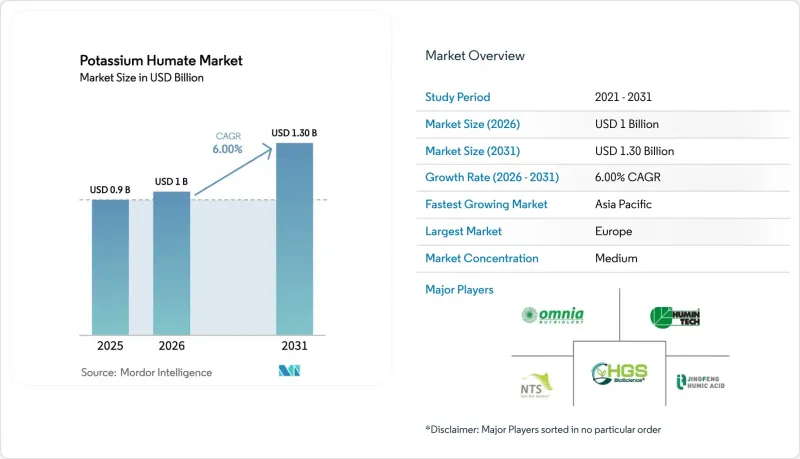
據估計,2025 年腐植酸鉀市值為 9 億美元,預計在預測期(2026-2031 年)內將以 6.0% 的複合年成長率成長,從 2026 年的 10 億美元成長到 2031 年的 13 億美元。
本報告按形態(粉末、顆粒/片狀、濃縮液液)、應用領域(大田作物、園藝/果樹、水耕/溫室栽培)和地區(北美、歐洲、亞太、南美、中東和非洲)進行細分。市場預測以美元計價。
全球腐植酸鉀市場趨勢及洞察
對永續農業材料的需求日益成長
企業永續發展政策正促使採購預算從單純的合成肥料轉向能夠減少氮肥依賴的土壤改良劑。歐洲的「從農場到餐桌」策略旨在2030年將化肥用量減少20%,這一目標正推動生產商轉向以腐植酸鉀為基礎的產品。這些產品能夠在不影響產量的前提下提高養分利用效率。腐植酸鉀透過增加土壤有機質和促進微生物活性來幫助固碳,這與企業的範圍3排放目標相符。領先的相關企業和食品公司正在擴大可再生農業材料的使用,這使得腐植酸基產品在永續採購舉措中更具吸引力。
全球有機農業面積的擴大
根據FiBL的統計數據,2023年全球有機認證農地面積達9,890萬公頃,比上年增加2.6%。歐洲在面積上領先,而亞太地區的生產者數量成長率最高,這反映了印度、中國和印尼小規模農業轉型的趨勢。光是在西班牙,就有299萬公頃土地依照有機農業標準進行管理,但腐植酸在集約化蔬菜種植系統的應用率仍高於大面積糧食種植。腐植酸鉀提取自天然褐煤,加工過程極少,因此符合全球有機物質清單的要求。其主要競爭對手是農場自製堆肥,後者俱有原料豐富、人事費用低的優勢,但在需要清潔滴灌系統和快速釋放養分的場合,腐植酸則更具優勢。
與微生物生物促效劑的競爭
微生物生物促效劑透過為農民提供改善土壤肥力、養分吸收和植物生長的替代方案,正日益影響腐植酸鉀市場。這些產品通常以環保或生物衍生的名義進行銷售。這種趨勢造成了替代壓力,可能會降低對腐植酸鉀的需求,同時也為生產者帶來了價格挑戰。與腐植酸基產品相比,一些微生物混合物在較低的施用量下可實現更高的產量,這進一步加劇了價格競爭。微生物產品也存在一些局限性,例如保存期限較短和對pH值波動敏感,而化學性質穩定的腐植酸基產品則不存在這些問題。為了解決這些問題,供應商正在將腐植酸與微生物產品混合以留住客戶。雖然這種策略可能在一定程度上緩解競爭壓力,但並不能完全消除腐植酸鉀市場的挑戰。
細分市場分析
到2025年,粉狀腐植酸鉀將佔據47%的市場佔有率,成為最大的細分市場。這反映了其與自動化施肥系統的兼容性,而自動化施肥系統目前在保護性耕作主導。這項優勢源自於其用途廣泛、保存期限長且易於運輸。農民傾向於選擇粉末狀腐植酸鉀進行大規模田間施用,因為它可以與其他固態肥料混合,並均勻撒播於大片田地。此外,粉末狀產品的單位成本通常較低,使其成為主要農業區傳統土壤改良工作中切實可行的選擇。
液態濃縮液是成長最快的細分市場,預計2026年至2031年將以12.4%的複合年成長率成長。這一成長主要得益於精密農業技術的日益普及,例如施肥灌溉和葉面噴布,這些技術能夠更精準、更有效率地輸送養分。液態濃縮液尤其適用於高價值作物、溫室系統和水耕設施,因為它們與自動化灌溉系統相容,並且能夠促進養分吸收。
區域分析
到2025年,歐洲將佔據全球鉀腐植酸市場佔有率的34%,位居榜首。這一區域主導地位得益於完善的農業基礎設施、對永續土壤管理實踐的高度重視,以及鼓勵使用土壤改良劑和特殊肥料的法規結構。歐洲農民正在擴大鉀腐植酸的使用,以提高土壤肥力、增加作物產量並確保符合土壤健康標準,從而保障了該地區的穩定需求。
亞太地區是成長最快的地區,預計2026年至2031年複合年成長率將達到11.9%。這一成長主要得益於農業的快速現代化、高效肥料的日益普及以及為滿足不斷成長的人口需求而提高作物產量。全部區域對精密農業、溫室種植和營養管理技術改進的投資,正在推動對粉狀和液態腐植酸鉀產品需求的成長。
在北美,受排碳權支付、溫室種植面積擴大以及HumiK ONE等專利保護產品的推動,強勁的需求基礎正在形成,並帶動了該地區的顯著成長。在南美,市場正在擴張,這得益於巴西對進口營養物質的依賴以及阿根廷為實現生物投入品本地化生產所做的努力。將採礦和混合環節整合起來的國內腐植酸供應商可以利用成品肥料進口關稅上漲的機會獲利。非洲市場正從較低的基數成長,這主要得益於南非、肯亞和埃及新興的溫室叢集以及政府對滴灌基礎設施的津貼。
其他好處:
- Excel格式的市場預測(ME)表
- 3個月的分析師支持
目錄
第1章:引言
- 研究假設和市場定義
- 調查範圍
第2章:調查方法
第3章執行摘要
第4章 市場狀況
- 市場概覽
- 市場促進因素
- 對永續農業材料的需求日益成長
- 全球有機農業面積的擴大
- 推動制定減少化肥使用量的法規
- 擴大水溶性肥料在滴灌中的使用
- 將腐植酸添加土壤中的排碳權貨幣化
- 聚合物包覆尿素專利到期,可添加腐植酸鹽。
- 市場限制因素
- 優質腐植酸物質的價格波動
- 與微生物生物促效劑的競爭
- 對褐煤衍生的原料實施嚴格的重金屬管制。
- 從環境、社會和管治(ESG) 的角度檢驗脆弱泥炭地中的褐煤露天開採。
- 監理情勢
- 技術展望
- 波特五力模型
第5章 市場規模與成長預測
- 按形式
- 粉末
- 顆粒/片狀
- 濃縮液
- 透過使用
- 田間作物
- 園藝和水果
- 水耕法和溫室
- 按地區
- 北美洲
- 美國
- 加拿大
- 其他北美國家
- 南美洲
- 巴西
- 阿根廷
- 其他南美國家
- 歐洲
- 德國
- 法國
- 俄羅斯
- 其他歐洲國家
- 亞太地區
- 中國
- 印度
- 日本
- 其他亞太國家
- 中東
- 沙烏地阿拉伯
- 阿拉伯聯合大公國
- 其他中東國家
- 非洲
- 南非
- 埃及
- 其他非洲國家
- 北美洲
第6章 競爭情勢
- 市場集中度
- 策略趨勢
- 市佔率分析
- 公司簡介
- HGS BioScience(Paine Schwartz Partners, LLC)
- Humintech GmbH
- Nutri-Tech Solutions Pty Ltd
- Omnia Specialities
- Jing Feng Humic Acid
- FMC Corporation
- Criyagen
- Zhengzhou Shengda Khumic Biotechnology Co
- Humico Minerals
- Hebei Shuanglian Biotechnology Co.Ltd.
- Huma, Inc.
- Black Earth Humic LP
- The Andersons Plant Nutrient
第7章 市場機會與未來展望
According to Mordor Intelligence, the potassium humate market size was valued at USD 0.9 billion in 2025 and is estimated to grow from USD 1.0 billion in 2026 to USD 1.3 billion by 2031, at a CAGR of 6.0% during the forecast period (2026-2031).
This report is Segmented by Form (Powder, Granules/Flakes, Liquid Concentrate), by Application (Field Crops, Horticulture and Fruits, and Hydroponics and Greenhouse), and by Geography (North America, Europe, Asia-Pacific, South America, Middle East, and Africa). The Market Forecasts are Provided in Terms of Value (USD).
Global Potassium Humate Market Trends and Insights
Rising Demand for Sustainable Agricultural Inputs
Corporate sustainability mandates are shifting procurement budgets away from synthetic-only fertilizers toward soil conditioners that reduce nitrogen dependence. The European Farm to Fork strategy aims for a 20% reduction in fertilizer use by 2030, a target that is pushing growers toward humate blends, which improve nutrient-use efficiency without harming yields. Potassium humate aids carbon sequestration by enhancing soil organic matter and promoting microbial activity, aligning with corporate Scope 3 emission-reduction goals. Major agribusinesses and food companies are increasingly adopting regenerative agriculture inputs, thereby increasing the appeal of humate-based products in sustainable sourcing initiatives.
Increasing Global Organic-Farming Acreage
According to FiBL statistics, certified organic cropland reached 98.9 million hectares in 2023, adding 2.6% year on year. Europe leads by land area, but Asia-Pacific adds producers the fastest, reflecting smallholder conversions in India, China, and Indonesia. Spain alone manages 2.99 million hectares under organic rules, although humate uptake is still higher in intensive vegetable systems than in broad-acre cereals. Because potassium humate is mined from naturally occurring leonardite and undergoes minimal processing, it qualifies for organic input lists worldwide. Its main competition is on-farm compost, where feedstocks are abundant, and labor is cheap, yet humate wins where clean drip systems and fast nutrient release are critical.
Competition from Microbial Biostimulants
Microbial biostimulants are increasingly influencing the potassium humate market by providing farmers with alternative solutions that improve soil fertility, nutrient uptake, and plant growth, often marketed with eco-friendly or bio-based attributes. This trend introduces substitution pressure, potentially decreasing the demand for potassium humate while also creating pricing challenges for producers. Some microbial blends achieve higher yields at lower application rates compared to humates, further intensifying price competition. Microbial products face limitations such as shorter shelf life and sensitivity to pH variations, issues that chemically stable humates do not encounter. To address this, suppliers are co-formulating humic acids with microbial products to retain customers. While this strategy may mitigate some of the competitive pressures, it does not fully eliminate the challenges faced by the potassium humate market.
Other drivers and restraints analyzed in the detailed report include:
- Regulatory Push to Reduce Chemical-Fertilizer Use
- Growing Use of Water-Soluble Fertilizers in Drip Irrigation
- Environmental, Social, and Governance (ESG) Scrutiny of Leonardite Strip-Mining in Sensitive Peatlands
For complete list of drivers and restraints, kindly check the Table Of Contents.
Segment Analysis
Powder held the largest segment, 47% of the potassium humate market share in 2025, reflecting its fit with automated fertigation that now commands protected-crop production. This dominance is attributed to its versatility, extended shelf life, and ease of transportation. Farmers often prefer powdered potassium humate for large-scale field applications due to its ability to blend with other solid fertilizers and ensure uniform distribution across extensive farmland. Additionally, powdered forms are generally more cost-effective per metric ton, making them a practical choice for traditional soil amendment practices in key agricultural regions.
Liquid concentrate is the fastest-growing, forecast to expand at a 12.4% CAGR through 2026-2031. This growth is driven by the increasing adoption of precision agriculture techniques, such as fertigation and foliar spraying, which enable more targeted and efficient nutrient delivery. Liquid concentrates are particularly favored for high-value crops, greenhouse systems, and hydroponic setups due to their compatibility with automated irrigation systems and their ability to facilitate faster nutrient uptake.
Geography Analysis
Europe led the potassium humate market size with 34% in 2025, this regional leadership is supported by a well-established agricultural infrastructure, high awareness of sustainable soil management practices, and regulatory frameworks that encourage the use of soil conditioners and specialty fertilizers. European farmers increasingly utilize potassium humate to improve soil fertility, boost crop productivity, and comply with soil health standards, ensuring steady demand in the region.
Asia-Pacific is the fastest-growing, projected to grow at a 11.9% CAGR through 2026-2031, this growth is driven by the rapid modernization of agriculture, increased adoption of high-efficiency fertilizers, and the need to enhance crop yields to meet the demands of growing populations. Investments in precision agriculture, greenhouse farming, and improved nutrient management practices across the region are driving rising demand for both powdered and liquid potassium humate products.
North America delivers the significant regional growth driven by carbon-credit payments, expanding greenhouse acreage, and patent-protected products such as HumiK ONE, creating a robust demand stack. South America expands, driven by Brazil's dependency on imported nutrients and Argentina's efforts to localize bioinput production. Domestic humate suppliers that integrate mining into blending can tap into rising import duties on finished fertilizers. Africa grows from a low base, powered by nascent greenhouse clusters in South Africa, Kenya and Egypt along with drip infrastructure subsidized by governments.
- HGS BioScience (Paine Schwartz Partners, LLC)
- Humintech GmbH
- Nutri-Tech Solutions Pty Ltd
- Omnia Specialities
- Jing Feng Humic Acid
- FMC Corporation
- Criyagen
- Zhengzhou Shengda Khumic Biotechnology Co
- Humico Minerals
- Hebei Shuanglian Biotechnology Co.Ltd.
- Huma, Inc.
- Black Earth Humic LP
- The Andersons Plant Nutrient
Additional Benefits:
- The market estimate (ME) sheet in Excel format
- 3 months of analyst support
TABLE OF CONTENTS
1 Introduction
- 1.1 Study Assumptions and Market Definition
- 1.2 Scope of the Study
2 Research Methodology
3 Executive Summary
4 Market Landscape
- 4.1 Market Overview
- 4.2 Market Drivers
- 4.2.1 Rising demand for sustainable agricultural inputs
- 4.2.2 Increasing global organic-farming acreage
- 4.2.3 Regulatory push to reduce chemical-fertilizer use
- 4.2.4 Growing use of water-soluble fertilizers in drip irrigation
- 4.2.5 Carbon-credit monetization for humate-amended soils
- 4.2.6 Patent cliff for polymer-coated urea enabling humate integration
- 4.3 Market Restraints
- 4.3.1 Price volatility of high-grade humic substances
- 4.3.2 Competition from microbial biostimulants
- 4.3.3 Stringent heavy-metal limits on leonardite-derived inputs
- 4.3.4 Environmental, Social, and Governance (ESG) scrutiny of leonardite strip-mining in sensitive peatlands
- 4.4 Regulatory Landscape
- 4.5 Technological Outlook
- 4.6 Porter's Five Forces
- 4.6.1 Threat of New Entrants
- 4.6.2 Bargaining Power of Suppliers
- 4.6.3 Bargaining Power of Buyers
- 4.6.4 Threat of Substitutes
- 4.6.5 Competitive Rivalry
5 Market Size and Growth Forecasts (Value)
- 5.1 By Form
- 5.1.1 Powder
- 5.1.2 Granules/Flakes
- 5.1.3 Liquid Concentrate
- 5.2 By Application
- 5.2.1 Field Crops
- 5.2.2 Horticulture and Fruits
- 5.2.3 Hydroponics and Greenhouse
- 5.3 By Geography
- 5.3.1 North America
- 5.3.1.1 United States
- 5.3.1.2 Canada
- 5.3.1.3 Rest of North America
- 5.3.2 South America
- 5.3.2.1 Brazil
- 5.3.2.2 Argentina
- 5.3.2.3 Rest of South America
- 5.3.3 Europe
- 5.3.3.1 Germany
- 5.3.3.2 France
- 5.3.3.3 Russia
- 5.3.3.4 Rest of Europe
- 5.3.4 Asia-Pacific
- 5.3.4.1 China
- 5.3.4.2 India
- 5.3.4.3 Japan
- 5.3.4.4 Rest of Asia-Pacific
- 5.3.5 Middle East
- 5.3.5.1 Saudi Arabia
- 5.3.5.2 United Arab Emirates
- 5.3.5.3 Rest of Middle East
- 5.3.6 Africa
- 5.3.6.1 South Africa
- 5.3.6.2 Egypt
- 5.3.6.3 Rest of Africa
- 5.3.1 North America
6 Competitive Landscape
- 6.1 Market Concentration
- 6.2 Strategic Moves
- 6.3 Market Share Analysis
- 6.4 Company Profiles (Includes Global Level Overview, Market Level Overview, Core Segments, Financials as Available, Strategic Information, Market Rank/Share, Products And Services, And Recent Developments)
- 6.4.1 HGS BioScience (Paine Schwartz Partners, LLC)
- 6.4.2 Humintech GmbH
- 6.4.3 Nutri-Tech Solutions Pty Ltd
- 6.4.4 Omnia Specialities
- 6.4.5 Jing Feng Humic Acid
- 6.4.6 FMC Corporation
- 6.4.7 Criyagen
- 6.4.8 Zhengzhou Shengda Khumic Biotechnology Co
- 6.4.9 Humico Minerals
- 6.4.10 Hebei Shuanglian Biotechnology Co.Ltd.
- 6.4.11 Huma, Inc.
- 6.4.12 Black Earth Humic LP
- 6.4.13 The Andersons Plant Nutrient
7 Market Opportunities and Future Outlook

 2026年全球硫酸銨市場研究報告
 硫酸銨市場-2026-2032年全球市場預測
 硫酸銨市場規模、佔有率和成長分析:按類型、應用、分銷管道和地區分類-2026-2033年產業預測
 鈰銨硝酸鹽市場報告:按類型、應用和地區分類(2026-2034 年)
 2026-2034年全球硫酸銨市場規模、佔有率、趨勢和成長分析報告
 硫酸銨市場規模、平均價格及預測(2018-2034 年)
 全球硫酸銨市場:按類型、應用和地區分類-預測至2030年
 2026年全球硫酸銨市場報告
 2025-2029年全球硫酸銨市場
 硫酸銨:全球市佔率及排名、總銷售額及需求預測(2025-2031 年)