


 |
市場調查報告書
商品編碼
2062276
合板:市場佔有率分析、產業趨勢與統計、成長預測(2026-2031)Veneer Sheets - Market Share Analysis, Industry Trends & Statistics, Growth Forecasts (2026 - 2031) |
||||||

※ 本網頁內容可能與最新版本有所差異。詳細情況請與我們聯繫。
根據 Mordor Intelligence 預測,單板市場預計將從 2025 年的 261.1 億美元成長到 2026 年的 274.4 億美元,到 2031 年達到 352.1 億美元,2026 年至 2031 年的複合年成長率為 5.11%。
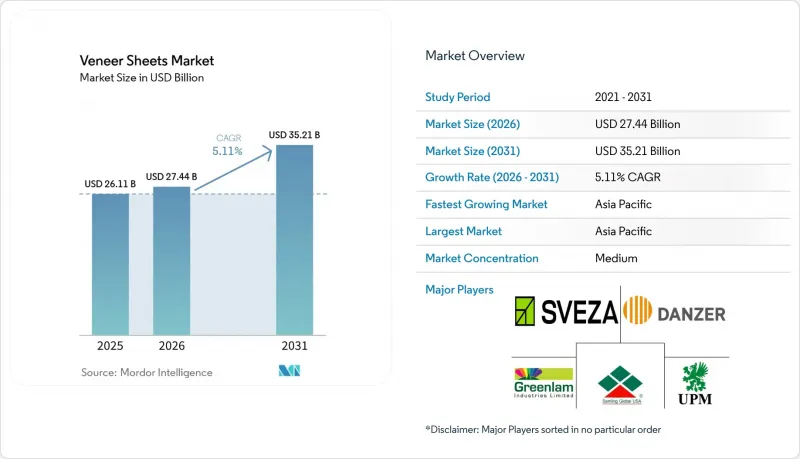
本報告按產品類型(天然刨花單板、旋切單板等)、木材種類(橡木、柚木等)、應用領域(家具製造、建築木工及細木工等)、終端用戶行業(住宅、商業等)和地區(亞太地區、北美、歐洲等)進行細分。市場預測以美元計價。
全球單板市場趨勢及洞察
擴大住宅和商業房地產的改造活動
預計到2025年,美國住宅對房屋翻新的需求將持續成長。由於實木飾面具有更高的轉售價值,因此在廚房和浴室維修,實木飾面已逐漸取代複合板材,成為首選。飯店集團在翻新大廳時,採用紋理對稱的胡桃木和燻蒸橡木,打造親近自然的居住空間,從而提升了客房價格,而目前酒店運轉率超過70%。美國主要城市(一級城市)的辦公大樓業主正在指定使用飾面牆體系統,以獲得LEED和WELL認證積分,並將原本用於塗漆石膏板的部分商業木工預算重新分配到飾面牆體系統上。醫療機構正在採用吸音飾面板,以滿足2025年更嚴格的噪音標準,從而提升其在終端市場的佔有率。這些趨勢共同推動了維修工程的持續成長,並直接帶動了飾面板材市場的發展。
過渡到使用生態標籤木材和低揮發性有機化合物(VOC)材料
2025年,FSC和PEFC認證成為歐洲公共部門室內裝修工程競標供應商的強制性要求,這實際上將來自印尼和馬來西亞的未認證出口商拒之門外。加州收緊了複合板材的甲醛含量標準,迫使美國塗裝商改用與零VOC單板產品相容的水性UV漆。地中海遊艇製造商採用FSC認證柚木以滿足租賃船東的資訊揭露要求,到2026年初,這一趨勢已蔓延至中型休閒船艇。國際熱帶木材組織(ITTO)指出,緬甸天然柚木出口量下降了12%,導致人工林木材採購量增加。雖然認證會使接收成本增加8-12%,但供應商可以接觸到拒絕使用未認證材料的斯堪地那維亞和德國OEM製造商,導致單板產業的收入重新分配到高階地區。
與LVT地板、三聚氰胺貼面板和PVC板材競爭。
2025年推出的數位印刷高級乙烯基瓷磚,外觀和觸感與橡木和胡桃木相似,但安裝成本僅為實木貼面的一半,因此在注重成本的多用戶住宅項目中越來越受歡迎。同步壓紋的三聚氰胺顆粒與紋理和印刷圖案完美匹配,縮小了傳統貼面在觸感上的優勢差距。中國PVC薄膜供應商擴大了3D層壓板的型材範圍,無需封邊,且防潮性能優於貼面。在印度和東南亞,三聚氰胺材料的應用已使櫥櫃價格降至每米150美元以下,凸顯了貼面在中階貼面市場面臨的挑戰。同時,在豪華飯店、遊艇和客製化住宅中,實木紋理和質感仍然佔據著高階市場,穩居貼面市場的頂端。
細分市場分析
天然切片飾面板佔據市場主導地位,預計到2025年將佔銷售額的48.22%,這主要得益於高階櫥櫃市場,在該市場,真正的四分之一切割橡木和升降鋸胡桃木能夠支撐其高昂的價格。同時,受模組化建築對曲面適應性需求的推動,軟性背襯飾面板預計到2031年將以5.48%的複合年成長率成長。旋切單頁紙被平板包裝家具的OEM製造商廣泛使用,因為成本穩定性是其首要考慮因素;而再生飾核心材料則使用染色楊木芯材來重現稀有木材的紋理。 2025年,由於防水的PUR黏合劑非常適合廚房應用,因此對封邊條的需求也將增加。
自動化趨勢正在加速這項變革。 Cantisa公司於2026年初推出的PVC背襯單板封邊條,可採用標準配備進行加工,兼具塑膠的柔軟性和天然木材的美觀性。工程單板的厚度公差小於±0.05毫米,使其適用於機器人操作,並推動單板市場朝向大規模生產的高產量方向發展。
由於橡木易於取得且經徑切加工後穩定性好,預計到2025年,橡木將佔據單板市場30.24%的佔有率。胡桃木預計將成為成長最快的木材,到2031年複合年成長率將達到5.61%,這主要得益於賓利汽車公司在2025年開始使用FSC認證的開孔板材。由於緬甸柚木供應有限,柚木正逐漸成為人工林木材的替代品,促使遊艇製造商轉向使用人工林木材。楓木仍然是組裝櫥櫃的主要木材,而白蠟木和櫻桃木則服務於小眾住宅設計市場。
《瀕危野生動植物種國際貿易公約》(CITES)的嚴格規定推高了紅木的價格,導致其需求量下降。在經認證的人工林木材中實現樹種多樣化,既符合買家對永續性的承諾,又能鞏固其在膠合板市場的高階地位。
區域分析
預計到2025年,亞太地區將佔全球單板市場規模的40.11%,並在2031年之前以6.29%的複合年成長率持續成長。中國福建和浙江兩省的叢集正將自動化切片技術與接近性熱帶木材進口基地的地理優勢相結合,為北美和歐洲市場供應產品。在印度,隨著中產階級住宅指定使用橡木和胡桃木打造廚房,普納、艾哈默德巴德和哥印拜陀等地的需求激增。日本則憑藉其簡約的木紋美學,在高階進口單板市場佔有了一席之地。
在北美,哥倫比亞森林產品公司於2025年收購Nova Wood Lamination公司,提振了市場需求。這增強了加拿大供應鏈,並縮短了中西部家具OEM製造商的前置作業時間。住宅裝修支撐著基本需求,而旨在獲得LEED認證的辦公大樓維修偶爾也能帶來成長。
歐洲的需求主要集中在德國、英國和斯堪地那維亞的納維亞半島,而嚴格的FSC標準正使丹澤等綜合性企業獲得越來越大的市場佔有率。 UPM計劃於2026年對其膠合板業務進行重組,這意味著產能也將進行調整,這可能會吸引新的企業進入市場。
在中東和非洲,各地區的成長率不盡相同。在杜拜和利雅德的飯店計畫中,胡桃木飾面被指定使用,但由於擔心其耐久性受氣候影響,撒哈拉以南非洲地區的推廣速度較為緩慢。南美洲仍以出口為導向,巴西出口旋切桉木,但非法伐木限制了桃花心木的供應。單板板材市場的機會格局仍受到地理分佈的影響。
其他好處:
- Excel格式的市場預測(ME)表
- 3個月的分析師支持
目錄
第1章:引言
- 研究假設和市場定義
- 調查範圍
第2章:調查方法
第3章執行摘要
第4章 市場狀況
- 市場概覽
- 市場促進因素
- 擴大住宅和商業房地產的翻新活動
- 過渡到使用環保標籤木材和低揮發性有機化合物(VOC)材料
- 採用生物基黏合劑減少甲醛
- 利用人工智慧技術進行木紋匹配,用於貼面並最大限度地減少廢棄物。
- 採用自黏裝飾層板的模組化異地牆板系統
- 市場限制因素
- 與LVT地板、三聚氰胺貼面板和PVC板材競爭。
- 未塗覆奈米塗層時,易受潮及白蟻侵害
- 全球運輸能力緊張狀況持續惡化,導致前置作業時間延長。
- 價值鏈分析
- 波特五力模型
第5章 市場規模與成長預測
- 依產品類型
- 天然切片單板
- 旋切單板
- 重建加工的單板
- 軟性背襯單板
- 用於封邊的飾面條
- 樹型
- 橡木
- 臉紅
- 楓
- 核桃
- 樺木
- 櫻桃
- 白楊
- 其他木材種類(白蠟木、桃花心木、名貴木材)
- 透過使用
- 家具製造
- 建築木工產品及細木工製品
- 牆板和天花板
- 地板材料嵌體
- 門窗
- 汽車和遊艇內飾
- 按最終用戶行業分類
- 住宅
- 商業設施(飯店、辦公室、零售)
- 機構(醫療保健、教育)
- 工業與交通運輸
- 按地區
- 亞太地區
- 中國
- 日本
- 印度
- 韓國
- 東南亞國協
- 其他亞太國家
- 北美洲
- 美國
- 加拿大
- 墨西哥
- 歐洲
- 德國
- 英國
- 法國
- 義大利
- 西班牙
- 俄羅斯
- 北歐國家
- 其他歐洲國家
- 南美洲
- 巴西
- 阿根廷
- 其他南美國家
- 中東和非洲
- 沙烏地阿拉伯
- 南非
- 其他中東和非洲國家
- 亞太地區
第6章 競爭情勢
- 市場集中度
- 策略趨勢
- 市佔率和排名分析
- 公司簡介
- CEDAN INDUSTRIES
- Austin Hardwoods & Hardware
- Columbia Forest Products
- DANZER
- Durian Industries Ltd.
- Duroply Industries Limited
- F/List
- Flexible Materials
- FormWood Industries
- Greenlam Industries Ltd.
- Herzog Veneers
- Oakwood Veneer Company
- Samling Timber Malaysia
- Sunrise Plywood
- Sveza Group
- Turakhia Overseas
- UPM
- Veneer Technologies
- Woodline Veneer
第7章 市場機會與未來展望
According to Mordor Intelligence, the veneer sheets market size is expected to increase from USD 26.11 billion in 2025 to USD 27.44 billion in 2026 and reach USD 35.21 billion by 2031, growing at a CAGR of 5.11% over 2026-2031.
This report is Segmented by Product Type (Natural Sliced Veneer Sheets, Rotary-Cut Veneer Sheets, and More), Wood Species (Oak, Teak, and More), Application (Furniture Manufacturing, Architectural Millwork and Joinery, and More), End-User Industry (Residential, Commercial, and More), and Geography (Asia-Pacific, North America, Europe, and More). The Market Forecasts are Provided in Terms of Value (USD).
Global Veneer Sheets Market Trends and Insights
Growth in Residential and Commercial Remodeling Activity
Homeowners in the United States sustained a six-year remodeling uptrend through 2025, and kitchen or bath upgrades now consistently choose real veneer over laminates for resale value advantages. Hotel chains refreshing lobbies adopted book-matched walnut and fumed oak to create biophilic spaces that yield higher room rates in markets with occupancy above 70%. Office landlords in Tier-1 U.S. cities specify veneer wall systems to earn LEED and WELL credits, redirecting a share of commercial millwork budgets historically spent on painted gypsum. Healthcare facilities incorporated acoustic veneer panels that meet tougher 2025 noise guidelines, broadening end-market exposure. Collectively, these dynamics reinforce a stable renovation pipeline that feeds directly into the veneer sheets market.
Shift Toward Eco-Labeled Wood and Low-VOC Materials
FSC and PEFC certifications became mandatory for vendors bidding on European public-sector interiors in 2025, sidelining non-certified exporters from Indonesia and Malaysia. California tightened composite-panel formaldehyde limits, prompting U.S. finishers to switch to waterborne UV lacquers that pair well with Zero-VOC veneer offerings. Mediterranean yacht builders adopted FSC-certified teak to satisfy charterer disclosure rules, and the trend cascaded into mid-size recreational boats by early 2026. The International Tropical Timber Organization noted a 12% slide in wild teak exports from Myanmar, accelerating plantation sourcing. Although certification adds 8-12% to landed cost, suppliers gain access to Scandinavian and German OEMs that refuse uncertified lumber, realigning revenue toward premium geographies within the Veneer sheets industry.
Competition from LVT, Melamine Laminates, and PVC Sheets
Digitally printed luxury vinyl tile launched in 2025 offers oak and walnut visuals at half the installed price of real veneer, winning cost-sensitive multifamily projects. Synchronized-embossed melamine particles align texture with print, narrowing the tactile gap historically favoring veneer. Chinese PVC film suppliers scaled 3D-laminated profiles that eliminate edge-sealing and outperform veneer in terms of moisture. Kitchen cabinetry in India and Southeast Asia now hits sub-USD 150 per linear meter by opting for melamine, challenging veneer in the middle tier of the Veneer sheets industry. Authentic grain and patina still command premiums in luxury hotels, yachts, and bespoke residences, insulating the upper end of the veneer sheets market.
Other drivers and restraints analyzed in the detailed report include:
- Adoption of Bio-Based Adhesives Cutting Formaldehyde
- AI-Driven Veneer Grain-Matching and Waste Minimization
- Moisture/Termite Susceptibility Without Nano-Coatings
For complete list of drivers and restraints, kindly check the Table Of Contents.
Segment Analysis
Natural sliced veneer sheets dominated with 48.22% of 2025 revenue, anchored in high-end cabinetry where authentic quarter-cut oak and rift-sawn walnut justify premium pricing. Flexible backed veneer sheets, however, are set to expand at a 5.48% CAGR through 2031, propelled by modular construction that requires conformable surfaces. Rotary-cut sheets serve flat-pack furniture OEMs prioritizing cost stability, while reconstituted veneers replicate scarce exotics through dyed poplar cores. Edge-banding strips climbed in 2025 as PUR adhesive lines delivered water-resistant bonds ideal for kitchens.
Automation trends accelerate the shift. Cantisa's PVC-backed veneer edgeband, released in early 2026, runs on standard equipment and merges plastic flexibility with real-wood aesthetics. Engineered veneer thickness tolerances below +-0.05 millimeters satisfy robotic handling, positioning the veneer sheets market for higher throughput in mass production.
Oak captured 30.24% of the veneer sheets market share in 2025 because of availability and quarter-sawn stability. Walnut, aided by Bentley's 2025 shift to FSC-certified open-pore panels, will grow fastest at a 5.61% CAGR through 2031. Teak faces limited supply from Myanmar, steering yacht builders toward plantation alternatives. Maple remains a workhorse for ready-to-assemble cabinetry, while ash and cherry feed niche residential design.
Regulatory scrutiny under CITES inflates costs for mahogany and narrows its addressable base. Species diversification into certified plantation stock aligns with buyers' sustainability pledges, reinforcing premium positioning in the veneer sheets market.
Geography Analysis
Asia-Pacific retained a 40.11% veneer sheets market size in 2025 and will compound at a 6.29% CAGR through 2031. China's Fujian and Zhejiang clusters blend automated slicing with proximity to tropical log imports, funneling output to North America and Europe. Indian demand surged in Pune, Ahmedabad, and Coimbatore, where middle-class homeowners specify oak and walnut kitchens. Japan maintains a premium import niche focused on minimalist grain aesthetics.
North America benefited from Columbia Forest Products' 2025 acquisition of Nova Wood Lamination, which tightened Canadian supply chains and trimmed lead times for Midwest furniture OEMs. Residential remodels stabilize baseline demand, while LEED-driven office retrofits generate episodic lifts.
Europe's appetite centers on Germany, the United Kingdom, and Scandinavia, where strict FSC rules elevate the share of integrated players such as Danzer. UPM's 2026 review of its plywood unit hints at capacity realignment that could invite new entrants.
The Middle-East and Africa present selective growth. Dubai and Riyadh hospitality projects specify book-matched walnut, but Sub-Saharan adoption lags due to climate durability concerns. South America remains export-oriented; Brazil ships rotary-cut eucalyptus, though illegal logging curbs mahogany flows. Geographic diversification continues to define opportunity contours across the veneer sheets market.
- CEDAN INDUSTRIES
- Austin Hardwoods & Hardware
- Columbia Forest Products
- DANZER
- Durian Industries Ltd.
- Duroply Industries Limited
- F/List
- Flexible Materials
- FormWood Industries
- Greenlam Industries Ltd.
- Herzog Veneers
- Oakwood Veneer Company
- Samling Timber Malaysia
- Sunrise Plywood
- Sveza Group
- Turakhia Overseas
- UPM
- Veneer Technologies
- Woodline Veneer
Additional Benefits:
- The market estimate (ME) sheet in Excel format
- 3 months of analyst support
TABLE OF CONTENTS
1 Introduction
- 1.1 Study Assumptions and Market Definition
- 1.2 Scope of the Study
2 Research Methodology
3 Executive Summary
4 Market Landscape
- 4.1 Market Overview
- 4.2 Market Drivers
- 4.2.1 Growth in residential and commercial remodeling activity
- 4.2.2 Shift toward eco-labeled wood and low-VOC materials
- 4.2.3 Adoption of bio-based adhesives cutting formaldehyde
- 4.2.4 AI-driven veneer grain-matching and waste minimization
- 4.2.5 Modular off-site wall-panel systems using peel-and-stick veneers
- 4.3 Market Restraints
- 4.3.1 Competition from LVT, melamine laminates and PVC sheets
- 4.3.2 Moisture/termite susceptibility without nano-coatings
- 4.3.3 Prolonged global freight-capacity constraints lengthening lead-times
- 4.4 Value Chain Analysis
- 4.5 Porter's Five Forces
- 4.5.1 Threat of New Entrants
- 4.5.2 Bargaining Power of Buyers
- 4.5.3 Bargaining Power of Suppliers
- 4.5.4 Threat of Substitutes
- 4.5.5 Competitive Rivalry
5 Market Size and Growth Forecasts (Value)
- 5.1 By Product Type
- 5.1.1 Natural Sliced Veneer Sheets
- 5.1.2 Rotary-Cut Veneer Sheets
- 5.1.3 Reconstituted/Engineered Veneer Sheets
- 5.1.4 Flexible Backed Veneer Sheets
- 5.1.5 Edge-banding Veneer Strips
- 5.2 By Wood Species
- 5.2.1 Oak
- 5.2.2 Teak
- 5.2.3 Maple
- 5.2.4 Walnut
- 5.2.5 Birch
- 5.2.6 Cherry
- 5.2.7 Poplar
- 5.2.8 Other Wood Species (Ash, Mahogany, Exotic)
- 5.3 By Application
- 5.3.1 Furniture Manufacturing
- 5.3.2 Architectural Millwork and Joinery
- 5.3.3 Wall Paneling and Ceilings
- 5.3.4 Flooring Inlays
- 5.3.5 Doors and Windows
- 5.3.6 Automotive and Yacht Interiors
- 5.4 By End-user Industry
- 5.4.1 Residential
- 5.4.2 Commercial (Hospitality, Offices, Retail)
- 5.4.3 Institutional (Healthcare, Education)
- 5.4.4 Industrial and Transportation
- 5.5 By Geography
- 5.5.1 Asia-Pacific
- 5.5.1.1 China
- 5.5.1.2 Japan
- 5.5.1.3 India
- 5.5.1.4 South Korea
- 5.5.1.5 ASEAN Countries
- 5.5.1.6 Rest of Asia-Pacific
- 5.5.2 North America
- 5.5.2.1 United States
- 5.5.2.2 Canada
- 5.5.2.3 Mexico
- 5.5.3 Europe
- 5.5.3.1 Germany
- 5.5.3.2 United Kingdom
- 5.5.3.3 France
- 5.5.3.4 Italy
- 5.5.3.5 Spain
- 5.5.3.6 Russia
- 5.5.3.7 NORDIC Countries
- 5.5.3.8 Rest of Europe
- 5.5.4 South America
- 5.5.4.1 Brazil
- 5.5.4.2 Argentina
- 5.5.4.3 Rest of South America
- 5.5.5 Middle-East and Africa
- 5.5.5.1 Saudi Arabia
- 5.5.5.2 South Africa
- 5.5.5.3 Rest of Middle-East and Africa
- 5.5.1 Asia-Pacific
6 Competitive Landscape
- 6.1 Market Concentration
- 6.2 Strategic Moves
- 6.3 Market Share(%)/Ranking Analysis
- 6.4 Company Profiles (includes Global Overview, Market Overview, Core Segments, Financials, Strategic Information, Products and Services, and Recent Developments)
- 6.4.1 CEDAN INDUSTRIES
- 6.4.2 Austin Hardwoods & Hardware
- 6.4.3 Columbia Forest Products
- 6.4.4 DANZER
- 6.4.5 Durian Industries Ltd.
- 6.4.6 Duroply Industries Limited
- 6.4.7 F/List
- 6.4.8 Flexible Materials
- 6.4.9 FormWood Industries
- 6.4.10 Greenlam Industries Ltd.
- 6.4.11 Herzog Veneers
- 6.4.12 Oakwood Veneer Company
- 6.4.13 Samling Timber Malaysia
- 6.4.14 Sunrise Plywood
- 6.4.15 Sveza Group
- 6.4.16 Turakhia Overseas
- 6.4.17 UPM
- 6.4.18 Veneer Technologies
- 6.4.19 Woodline Veneer
7 Market Opportunities and Future Outlook
- 7.1 White-space and Unmet-need Assessment


