


 |
市場調查報告書
商品編碼
2062255
冷凍式空氣乾燥機:市場佔有率分析、行業趨勢和統計數據、成長預測(2026-2031)Refrigerated Air Dryer - Market Share Analysis, Industry Trends & Statistics, Growth Forecasts (2026 - 2031) |
||||||

※ 本網頁內容可能與最新版本有所差異。詳細情況請與我們聯繫。
根據 Mordor Intelligence 預測,冷凍式空氣乾燥機市場預計將從 2025 年的 22.6 億美元成長到 2026 年的 23.9 億美元,到 2031 年達到 31.5 億美元,2026 年至 2031 年的複合年預計成長率為 5.71%。
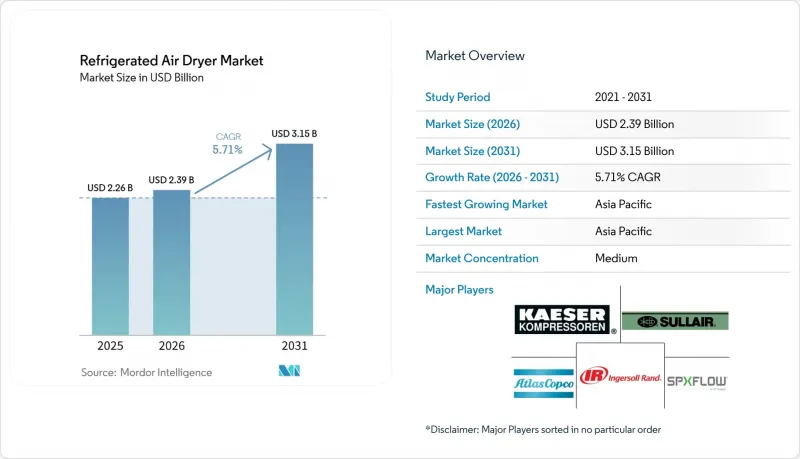
本報告按乾燥機類型(例如,循環式冷凍乾燥機)、冷媒類型(例如,HFC類冷媒)、冷卻方式(例如,風冷)、處理能力(例如,小於500立方公尺/小時)、終端用戶產業(例如,汽車產業)和地區(亞太地區、北美地區、歐洲地區、南美地區、中東和非洲地區)進行細分。市場預測以美元計價。
全球冷凍式空氣乾燥機市場趨勢及洞察
受監管產業嚴格遵守 ISO 8573 標準
監管機構現在將壓縮空氣視為關鍵公用設施,需要像製程用水一樣進行嚴格的檢驗。 ISO 8573-1 2級標準要求壓力露點上限為-40 度C,這迫使老舊的循環式乾燥機逐步淘汰,因為這些乾燥機在空載情況下露點會波動。在製藥業的無菌生產線和啤酒廠的二氧化碳注入系統中,非循環式和變頻式乾燥機的應用正在領先,因為臨時水分造成的批次損失超過了更換先進乾燥機的成本。每年第三方檢查的費用為每個系統5,000至15,000美元,以及歐盟HACCP系統的合規要求進一步增加了合規成本,但大多數工廠都接受這種權衡,因為審核不合格會導致更昂貴的停機時間。
2025年起全球個人製造能力擴張
2025年,中國各製造業領域的固定資產投資成長了8.3%。同時,在印度,作為「中國+1」供應鏈的一部分,14家新的零件工廠開始運作。 2024年至2025年間,東協電子產業吸引了220億美元的外國直接投資(FDI),每個新建廠都將冷凍式乾燥機的安裝納入一級無塵室的建設規劃。根據《晶片與科學法案》,為促進北美半導體產業的復甦,宣布了11個晶圓廠建設計畫。到2028年,這些晶圓廠每小時將消耗高達2萬立方公尺的經處理的壓縮空氣。由於大型客製化設備的訂單前置作業時間長達24至32週,買家不得不在工廠運作前18個月就進行投資。
工業級設備需要較大的初始資本投資
安裝容量為1000立方公尺/小時或以上的設備,成本在4萬至12萬美元之間,這對融資有限的新興國家工廠來說是一筆不小的開支。然而,濕度造成的停機損失在五年內可能高達安裝成本的數倍。在北美,設備即服務(EaaS)合約允許客戶按立方米乾燥空氣付費,但由於租賃基礎設施不完善,這種模式在成熟市場以外的推廣受到阻礙。此外,由於買家必須提前數月開立信用證,較長的生產前置作業時間也進一步加劇了營運資金的壓力。
細分市場分析
由於維護簡單且購置價格低20-30%,非循環式冷凍乾燥機在2025年仍將佔38.12%的市佔率。這些機型在需求低谷時會因壓縮機持續運轉而浪費10-15%的能源。變頻(VSD)冷凍乾燥機預計在預測期(2026-2031年)內將以5.92%的複合年成長率成長,它通過微調電機轉速以匹配即時負載,從而抵消了高電費地區較高的購置成本,並可節省15-25%的電力。循環式設計的發展動能正在減弱,因為啟動和關閉期間的電流高峰會影響製藥生產線對ISO 8573 2級標準的合規性。混合式(乾燥劑/冷媒組合)機組的出貨量僅佔4%,但在液化天然氣(LNG)和壓縮天然氣(CNG)燃料供應領域,由於露點溫度必須達到-70 度C,其年成長率高達8-10%。阿特拉斯·科普柯計劃於2025年擴建其位於紐約的工廠,以提高大型變頻離心式壓縮機組的產能。這顯示該公司對變頻系統將日益成為500立方公尺/小時以上設備標配充滿信心。這一整體趨勢預示著未來智慧化和速度控制將成為中型系統的標配。
變頻器 (VSD) 的普及正在改變售後市場的趨勢。變頻器能夠降低機械應力,將預期大修週期從 7 年延長至 9 年,並降低每個安裝單元的零件成本。原始設備製造商 (OEM) 透過捆綁雲端監控功能來彌補這一損失,這些功能以持續軟體的形式銷售。 300 立方米/小時以下的非循環式變頻器仍然有市場需求,尤其是在電價補貼的市場,因為僅靠節能不足以抵消變頻器的額外成本。然而,隨著電價上漲,即使是小規模維修車間也可能轉向使用變頻器,這可能會縮小變頻器與傳統變頻器之間的價格差距,並最終消除非循環式變頻器的優勢。
到2025年,氫氟碳化合物(R-134a和R-404A)將佔冷媒出貨量的47.55%,這反映了其長期以來安全性高、使用便捷。根據《基加利議定書》分階段減排的政策,向低全球暖化潛勢(GWP)的氫氟燃料油(HFO)和天然氣/碳氫化合物(R-290和二氧化碳)過渡正在推動這一趨勢,預計在預測期(2026-2031年)內,這些冷媒的年複合成長率將達到6.11%。 R-290的推廣應用受到A3可燃性標準的限制,該標準將充填量限制在150克以內。同時,由於厚壁管道和高壓的限制,二氧化碳系統目前僅限於在寒冷氣候下使用。 R-513A等氫氟燃料油提供了一種折衷選擇,但其價格仍比R-134a高出30-40%。在歐洲,禁止在新乾燥機中使用R-404A冷媒以及大幅削減R-134a冷媒配額,導致全球售後市場兩極化,使得那些較晚採用新冷媒的用戶面臨更高的維修成本。雖然多冷媒平台有助於客戶規避風險,但也會導致標價上漲8%至12%,並使庫存管理更加複雜。到2031年,已安裝的設備仍將保持多種配置,維修和維修市場的發展將取決於各地區法規的進展。
如今,維修技師需要獲得新的認證才能操作易燃或高壓冷媒。在熟練冷凍技師短缺的地區,招募變得越來越困難,導致維護成本增加15%至20%。儘早完成升級的工廠可以確保合規成本可預測,但在監管環境瞬息萬變的情況下,對原始設備製造商 (OEM) 的信任對於確保氫氟烯烴 (HFO) 和零件的長期供應至關重要。相反,延遲升級的企業則可能面臨意想不到的成本增加,因為新的氫氟碳化合物 (HFC) 配額減少,回收的 HFC 庫存也日益減少。
區域分析
預計到2025年,亞太地區將佔全球銷售額的36.11%,並預計在2031年之前維持6.63%的複合年成長率。這主要得益於中國單一製造商投資成長8.3%,以及印度製藥設施基於GMP(良好生產規範)標準的維修。在「中國製造2025」的旗幟下,中國將在2024年至2025年間動工18座半導體晶圓廠,每座晶圓廠每小時需要1萬至2萬立方公尺的超乾燥空氣。在印度的泰米爾納德邦和古吉拉突邦,新建了14家汽車零件工廠,以滿足尋求近岸外包的全球原始設備製造商(OEM)的需求。東協電子產業220億美元的外國直接投資(FDI)正在推動先進冷凍式乾燥機在新生產線上的應用。同時,在韓國,飆升的電價已將變頻驅動器(VSD)的投資回收期縮短至不到18個月,加速了循環機組的更換。供應方面的挑戰依然存在。監管方面的延誤已將ELGi公司位於金納圖卡達夫(Kinatukadav)的電廠的產能擴張計劃從2027年推遲到2028年,這表明基礎設施建設仍無法滿足需求。
在北美,預計到2028年,亞利桑那州、德克薩斯州和俄亥俄州符合CHIPS標準的晶圓廠將訂購總合350台大容量乾燥機。 《通膨控制法案》提供的稅額扣抵可涵蓋高達30%的變頻乾燥機額外成本,從而刺激了整個產業的採用。在美國,2024年至2025年間新增了127座壓縮天然氣(CNG)加氣站,每座加氣站都配備了能夠處理低至-70 度C露點的混合乾燥機。在加拿大,公共產業補貼計畫促使2025年乾燥機更換申請量較前一年增加。同時,在墨西哥,近岸外包浪潮促使新建了9家汽車零件工廠,這些工廠的空氣品質標準與其母公司保持一致。
在歐洲,由於市場成熟,成長速度有所放緩,但禁止使用R-404A並限制使用R-134a的F-gas法規重振了市場,迫使人們重新評估冷媒,並推高了設備成本30-40%。在德國——該地區最大的買家——電價已超過每千瓦時0.15美元,導致在新增的500-2000立方米/小時製冷訂單中,超過60%的訂單採用了變頻驅動器(VSD)。在南歐,由於乾旱導致水價自2024年以來加倍,人們開始轉向使用風冷式機組。在製裁下,俄羅斯正在對其國內油氣計畫進行西方設計的逆向工程,但仍被排除在全球目的地設備製造商(OEM)供應鏈之外。
市佔率在南美洲和中東/非洲地區最低。在巴西,隨著飲料填充產業的快速成長,2024年至2025年間將新建七家工廠,每家工廠都必須使用ISO 2級空氣與產品直接接觸。沙烏地阿美公司的賈夫拉計畫正在安裝多台3000立方公尺/小時的乾燥機,這些乾燥機都通過了API 618認證,用於處理酸性氣體。在南非的礦山,由於計劃內的停電導致投資轉向柴油發電機,設備升級已被推遲。同時,在奈及利亞,貨幣波動導致不符合ISO標準的未經認證的進口產品佔據市場主導地位。
其他好處:
- Excel格式的市場預測(ME)表
- 3個月的分析師支持
目錄
第1章:引言
- 研究假設和市場定義
- 調查範圍
第2章:調查方法
第3章執行摘要
第4章 市場狀況
- 市場概覽
- 市場促進因素
- 受監管產業嚴格遵守 ISO 8573 標準
- 自2025年起,全球各製造商的生產能力將有所擴張。
- 針對變頻烘乾機的節能獎勵和排碳權計畫
- 用於低露點液化天然氣燃料供應的混合吸附式和冷凍式乾燥機的成長
- 貨櫃式小型釀酒廠和牛皮紙食品廠的激增,推動了對小型設備的需求。
- 市場限制因素
- 工業單位初始資本投資成本高
- 由於逐步減少氫氟碳化合物的使用,冷媒合規成本增加(基加利修正案)
- 不銹鋼價格波動對物料清單成本的影響
- 價值鏈分析
- 波特五力模型
第5章 市場規模與成長預測
- 吹風機類型
- 循環式冷凍空氣乾燥機
- 非循環式冷凍空氣乾燥機
- 變頻(VSD)冷凍式空氣乾燥機
- 混合式(吸附冷凍)吹風機
- 依冷媒類型
- 基於氫氟碳化合物(R-134a 和 R-404A)
- HFO系列(R-1234ze和R-513A)
- 天然烴(R-290 和 CO2)
- 透過冷卻法
- 空冷式
- 水冷
- 按處理能力
- 小於 500 立方公尺/小時
- 500~2,000 m3/h
- 超過2000立方公尺/小時
- 按最終用戶行業分類
- 製造業和一般工業
- 食品/飲料
- 藥品和醫療保健
- 石油、天然氣和石化產品
- 車
- 電子和半導體
- 其他行業
- 按地區
- 亞太地區
- 中國
- 印度
- 日本
- 韓國
- 東南亞國協
- 其他亞太國家
- 北美洲
- 美國
- 加拿大
- 墨西哥
- 歐洲
- 德國
- 英國
- 法國
- 義大利
- 西班牙
- 俄羅斯
- 其他歐洲國家
- 南美洲
- 巴西
- 阿根廷
- 其他南美國家
- 中東和非洲
- 沙烏地阿拉伯
- 阿拉伯聯合大公國
- 南非
- 奈及利亞
- 其他中東和非洲國家
- 亞太地區
第6章 競爭情勢
- 市場集中度
- 策略趨勢
- 市佔率和排名分析
- 公司簡介
- Air & Gas Solutions
- ALMiG Kompressoren GmbH
- Atlas Copco AB
- BEKO TECHNOLOGIES
- BOGE
- Chicago Pneumatic
- Donaldson Company, Inc.
- ELGI
- Ingersoll Rand
- KAESER KOMPRESSOREN
- MIKROPOR MAKINA SAN.TIC.AS
- OMI Italy
- PRKER HANNIFIC CORP
- Quincy Compressor
- Risheng
- SPX Flow
- Sullair LLC
第7章 市場機會與未來展望
According to Mordor Intelligence, the refrigerated air dryer market size is expected to increase from USD 2.26 billion in 2025 to USD 2.39 billion in 2026 and reach USD 3.15 billion by 2031, growing at a CAGR of 5.71% over 2026-2031.
This report is Segmented by Dryer Type (Cycling Refrigerated Dryers and More), Refrigerant Type (HFC-Based and More), Cooling Method (Air-Cooled and More), Flow Capacity (Less Than 500 M3/H and More), End-User Industry (Automotive and More), and Geography (Asia-Pacific, North America, Europe, South America, and Middle East and Africa). The Market Forecasts are Provided in Terms of Value (USD).
Global Refrigerated Air Dryer Market Trends and Insights
Stringent ISO 8573 Compliance in Regulated Industries
Regulators now view compressed air as a critical utility with the same validation rigor as process water. ISO 8573-1 Class 2 requires a -40°C pressure-dew-point ceiling, forcing retirement of older cycling dryers that drift during off-load periods. Pharmaceutical aseptic lines and brewery carbonation systems are leading adopters of non-cycling and VSD models because batch losses linked to transient moisture exceed the replacement cost of advanced dryers. Annual third-party testing, costing USD 5,000-15,000 per system, and HACCP alignment in the European Union add to the compliance bill, yet most plants accept the trade-off because audit failures trigger costlier shutdowns.
Expansion of Global Discrete-Manufacturing Capacity Post-2025
Fixed-asset investment in China's discrete-manufacturing sector rose 8.3% in 2025, while India commissioned 14 new component plants aimed at "China Plus One" supply chains. ASEAN attracted USD 22 billion of electronics FDI in 2024-2025, and each new facility specified refrigerated dryers as part of Class 1 cleanroom builds. North America's semiconductor renaissance under the CHIPS and Science Act added 11 announced fabs that will each consume up to 20,000 m3/h of conditioned compressed air by 2028. Long order lead times, 24-32 weeks for large custom units, are prompting buyers to commit capital 18 months before plant start-up.
Large Upfront CAPEX for Industrial-Grade Units
Installed prices of USD 40,000-120,000 for 1,000 m3/h and above deter cash-constrained plants in emerging economies, even though moisture-related downtime can cost multiples of that over five years. Equipment-as-a-service contracts in North America let customers pay per cubic meter of dry air, but adoption outside mature markets is hamstrung by weak leasing infrastructure. Long fabrication lead times further strain working capital because buyers must post letters of credit months in advance.
Other drivers and restraints analyzed in the detailed report include:
- Energy-Efficiency Incentives and Carbon-Credit Schemes for VSD Dryers
- Growth of Hybrid Desiccant-Refrigerated Dryers for Low-Dew-Point LNG Fueling
- HFC Phasedown Under Kigali Amendment Raises Refrigerant-Compliance Cost
For complete list of drivers and restraints, kindly check the Table Of Contents.
Segment Analysis
Non-cycling models retained 38.12% refrigerated air dryer market share in 2025 on the back of simple maintenance and 20-30% lower purchase prices. They run compressors continuously, which wastes 10-15% energy when demand dips. Variable-speed (VSD) refrigerated dryers, growing at 5.92% CAGR for the forecast period (2026-2031), fine-tune motor speed to real-time load, harvesting 15-25% electricity savings that offset higher purchase prices in high-tariff regions. Cycling designs are losing momentum because start-stop spikes jeopardize ISO 8573 Class 2 compliance in pharmaceutical lines. Hybrid desiccant-refrigerated units sit at 4% of shipments yet clock 8-10% annual growth in LNG and CNG fueling, where -70°C dew points are mandatory. Atlas Copco's 2025 expansion in New York will add capacity for large VSD centrifugal trains, signaling confidence that installations above 500 m3/h will increasingly default to variable speed. The overall shift suggests a future where intelligence and speed modulation become baseline features even in mid-size systems.
VSD adoption changes aftermarket dynamics. Because variable-speed drives limit mechanical stress, expected overhaul intervals stretch from seven to nine years, lowering parts revenue per installed base. OEMs compensate by bundling cloud monitoring that sells as recurring software. Non-cycling units stay relevant under 300 m3/h where energy savings cannot justify the drive premium, especially in markets with subsidized electricity. As utility tariffs rise, however, even small workshops may migrate, compressing the price gap and eroding non-cycling leadership.
HFC-Based (R-134a and R-404A) powered 47.55% of 2025 shipments, reflecting historical safety and service familiarity. The Kigali phase-down shifts momentum to low-GWP HFOs and natural/hydrocarbon (R-290 and CO2), expected to expand at 6.11% CAGR during the forecast period (2026-2031). R-290 uptake is restrained by A3 flammability limits that cap charge sizes at 150g, whereas CO2 systems incur heavy-wall and high-pressure penalties that confine use to cold climates. HFOs such as R-513A offer a middle road but still carry a 30-40% price adder over R-134a. Europe banned R-404A in new dryers and slashed R-134a quotas, creating a bifurcated global aftermarket that inflates service costs for late adopters. Multirefrigerant platforms help customers hedge but add 8-12% to list prices and complicate inventory. The installed base will remain mixed through 2031, with retrofit and service markets mirroring local regulatory clocks.
Service technicians need new certifications to handle flammable or high-pressure media, tightening labor availability, and raising maintenance fees by 15-20% in regions where skilled refrigeration labor is scarce. Plants that switch early lock in predictable compliance costs yet must trust OEMs (Original Equipment Manufacturers) to secure long-term HFO and parts supply in a fluid regulatory landscape. Conversely, operators who delay upgrades risk sticker shock as virgin HFC allowances shrink and reclaimed stocks thin out.
Geography Analysis
Asia-Pacific held 36.11% of 2025 revenue and is set to notch a 6.63% CAGR through 2031 on the back of China's 8.3% jump in discrete-manufacturing investment and India's GMP-driven pharmaceutical retrofits. Eighteen Chinese semiconductor fabs broke ground in 2024-2025 under the "Made in China 2025" banner, each demanding 10,000-20,000 m3/h of ultra-dry air. India's Tamil Nadu and Gujarat added 14 new automotive-component plants aligned to global OEM near-shoring. ASEAN's USD 22 billion electronics FDI wave is equipping greenfield lines with advanced refrigerated dryers, while South Korea's power-price spike shortened VSD paybacks below 18 months, accelerating replacement of cycling units. Supply-side frictions remain: ELGi postponed a Kinathukadavu capacity expansion to 2027-2028 because of regulatory delays, showing infrastructure still lags demand.
In North America, CHIPS Act fabs in Arizona, Texas, and Ohio will collectively order more than 350 large-capacity dryers by 2028. Inflation Reduction Act credits cover up to 30% of VSD premiums, boosting adoption across the general industry. The United States opened 127 new CNG fueling stations during 2024-2025; every station installs a hybrid dryer for -70°C dew points. Canada's utility rebates drove a year-on-year rise in dryer-upgrade applications in 2025, while Mexico's near-shoring wave added nine automotive-component plants that replicate parent-company air-quality specs.
In Europe, growth is tempered by a mature base but re-energized by the F-Gas Regulation that bans R-404A and restricts R-134a, forcing a refrigerant rethink that inflates equipment cost 30-40%. Germany, the largest regional buyer, now exceeds 60% VSD penetration in new 500-2,000 m3/h orders because tariffs passed USD 0.15/kWh. Southern Europe leans toward air-cooled units as drought-related water tariffs doubled after 2024. Russia, under sanctions, reverse-engineers Western designs for domestic oil and gas projects but remains isolated from global OEM (original equipment manufacturer) supply chains.
South America and the Middle East and Africa share the least market share. Brazil's beverage-bottling boom added seven plants in 2024-2025, each mandating ISO Class 2 air for direct product contact. Saudi Aramco's Jafurah scheme is installing multiple 3,000 m3/h dryers certified to API 618 for sour-gas duty. South African mines postpone upgrades because rolling blackouts force capex into diesel generators, while Nigeria's currency volatility leaves the market to uncertified imports that underperform in ISO audits.
- Air & Gas Solutions
- ALMiG Kompressoren GmbH
- Atlas Copco AB
- BEKO TECHNOLOGIES
- BOGE
- Chicago Pneumatic
- Donaldson Company, Inc.
- ELGI
- Ingersoll Rand
- KAESER KOMPRESSOREN
- MIKROPOR MAKINA SAN.TIC.A.S.
- OMI Italy
- PRKER HANNIFIC CORP
- Quincy Compressor
- Risheng
- SPX Flow
- Sullair LLC
Additional Benefits:
- The market estimate (ME) sheet in Excel format
- 3 months of analyst support
TABLE OF CONTENTS
1 Introduction
- 1.1 Study Assumptions and Market Definition
- 1.2 Scope of the Study
2 Research Methodology
3 Executive Summary
4 Market Landscape
- 4.1 Market Overview
- 4.2 Market Drivers
- 4.2.1 Stringent ISO 8573 compliance in regulated industries
- 4.2.2 Expansion of global discrete-manufacturing capacity post-2025
- 4.2.3 Energy-efficiency incentives and carbon-credit schemes for VSD dryers
- 4.2.4 Growth of hybrid desiccant-refrigerated dryers for low-dew-point LNG fueling
- 4.2.5 Surge in containerised micro-breweries and craft food plants needing compact units
- 4.3 Market Restraints
- 4.3.1 Large upfront CAPEX for industrial-grade units
- 4.3.2 HFC phasedown (Kigali Amendment) raising refrigerant-compliance cost
- 4.3.3 Volatility in stainless-steel prices impacting BOM costs
- 4.4 Value Chain Analysis
- 4.5 Porter's Five Forces
- 4.5.1 Bargaining Power of Suppliers
- 4.5.2 Bargaining Power of Buyers
- 4.5.3 Threat of New Entrants
- 4.5.4 Threat of Substitutes
- 4.5.5 Competitive Rivalry
5 Market Size and Growth Forecasts (Value)
- 5.1 By Dryer Type
- 5.1.1 Cycling Refrigerated Dryers
- 5.1.2 Non-Cycling Refrigerated Dryers
- 5.1.3 Variable-Speed (VSD) Refrigerated Dryers
- 5.1.4 Hybrid Desiccant-Refrigerated Dryers
- 5.2 By Refrigerant Type
- 5.2.1 HFC-Based (R-134a and R-404A)
- 5.2.2 HFO-Based (R-1234ze and R-513A)
- 5.2.3 Natural/Hydrocarbon (R-290 and CO2)
- 5.3 By Cooling Method
- 5.3.1 Air-Cooled
- 5.3.2 Water-Cooled
- 5.4 By Flow Capacity
- 5.4.1 Less than 500 m3/h
- 5.4.2 500-2,000 m3/h
- 5.4.3 Greater than 2,000 m3/h
- 5.5 By End-user Industry
- 5.5.1 Manufacturing and General Industrial
- 5.5.2 Food and Beverage
- 5.5.3 Pharmaceuticals and Healthcare
- 5.5.4 Oil and Gas and Petrochemical
- 5.5.5 Automotive
- 5.5.6 Electronics and Semiconductor
- 5.5.7 Other Industries
- 5.6 By Geography
- 5.6.1 Asia-Pacific
- 5.6.1.1 China
- 5.6.1.2 India
- 5.6.1.3 Japan
- 5.6.1.4 South Korea
- 5.6.1.5 ASEAN Countries
- 5.6.1.6 Rest of Asia-Pacific
- 5.6.2 North America
- 5.6.2.1 United States
- 5.6.2.2 Canada
- 5.6.2.3 Mexico
- 5.6.3 Europe
- 5.6.3.1 Germany
- 5.6.3.2 United Kingdom
- 5.6.3.3 France
- 5.6.3.4 Italy
- 5.6.3.5 Spain
- 5.6.3.6 Russia
- 5.6.3.7 Rest of Europe
- 5.6.4 South America
- 5.6.4.1 Brazil
- 5.6.4.2 Argentina
- 5.6.4.3 Rest of South America
- 5.6.5 Middle East and Africa
- 5.6.5.1 Saudi Arabia
- 5.6.5.2 United Arab Emirates
- 5.6.5.3 South Africa
- 5.6.5.4 Nigeria
- 5.6.5.5 Rest of Middle East and Africa
- 5.6.1 Asia-Pacific
6 Competitive Landscape
- 6.1 Market Concentration
- 6.2 Strategic Moves
- 6.3 Market Share(%)/Ranking Analysis
- 6.4 Company Profiles (includes Global Overview, Market Overview, Core Segments, Financials, Strategic Information, Products and Services, and Recent Developments)
- 6.4.1 Air & Gas Solutions
- 6.4.2 ALMiG Kompressoren GmbH
- 6.4.3 Atlas Copco AB
- 6.4.4 BEKO TECHNOLOGIES
- 6.4.5 BOGE
- 6.4.6 Chicago Pneumatic
- 6.4.7 Donaldson Company, Inc.
- 6.4.8 ELGI
- 6.4.9 Ingersoll Rand
- 6.4.10 KAESER KOMPRESSOREN
- 6.4.11 MIKROPOR MAKINA SAN.TIC.A.S.
- 6.4.12 OMI Italy
- 6.4.13 PRKER HANNIFIC CORP
- 6.4.14 Quincy Compressor
- 6.4.15 Risheng
- 6.4.16 SPX Flow
- 6.4.17 Sullair LLC
7 Market Opportunities and Future Outlook
- 7.1 White-space and Unmet-Need Assessment

 冷凍式空氣乾燥機市場:全球市場預測,2026-2032年
 冷凍式空氣乾燥機市場規模、佔有率和成長分析:按類型、流量、應用、最終用戶和地區分類-2026-2033年產業預測無熱乾燥劑空氣乾燥器市場:按類型、流量、安裝方式、最終用途和銷售管道分類-2026-2032年全球預測在線連續壓縮空氣乾燥機市場:按產品類型、流量、安裝類型、分銷管道和最終用戶行業分類 - 全球預測 2026-2032鼓風機吹掃式空氣乾燥機市場:按流量、壓力範圍、控制方式和最終用戶分類 - 2026-2032年全球預測
 蒸汽乾燥機:全球市場佔有率和排名、總收入和需求預測(2025-2031年)
 乾燥劑乾燥櫃市場報告:2031 年趨勢、預測與競爭分析