


 |
市場調查報告書
商品編碼
2062247
高強度鋁合金:市場佔有率分析、產業趨勢與統計、成長預測(2026-2031)High Strength Aluminum Alloys - Market Share Analysis, Industry Trends & Statistics, Growth Forecasts (2026 - 2031) |
||||||

※ 本網頁內容可能與最新版本有所差異。詳細情況請與我們聯繫。
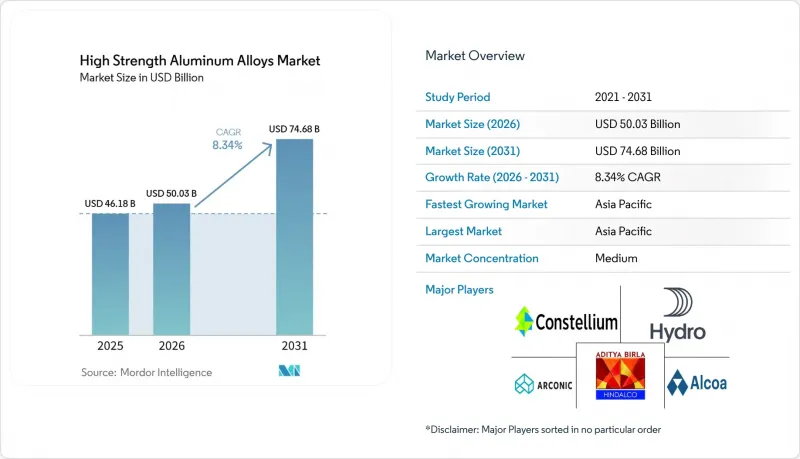
根據 Mordor Intelligence 預測,高強度鋁合金市場規模預計將從 2025 年的 461.8 億美元成長到 2026 年的 500.3 億美元,並將在 2026 年至 2031 年期間以 8.34% 的複合成長率成長,到 2031 億美元達到 746.8 億美元。
本報告按鋼種(6xxx系列及其他)、產品形態(板材及其他)、加工工藝(熱處理及其他)、終端用戶產業(航太與國防、汽車與交通運輸及其他)以及地區(亞太、北美、歐洲、南美、中東和非洲)進行細分。市場預測以美元計價。
全球高強度鋁合金市場趨勢及洞察
航太和國防領域對減輕重量的需求日益成長
為了滿足嚴格的燃油消耗目標,飛機製造商正在將高強度鋁合金的市場規格融入新的飛機平台中。波音和空中巴士已分別將單通道飛機的月產量提高到38架和75架,計劃在2026年實現這一目標。每架飛機的機身蒙皮均採用7xxx和2xxx系列鋼板,重量超過800公斤。在海軍工程中,美國海軍的DDG-51 Flight III驅逐艦被強制要求使用5xxx系列船用鋼板,以減輕上層建築12%的重量,從而可以在不影響穩定性的前提下安裝更重的雷達系統。 SpaceX等火箭製造商正在可重複使用的火箭級中使用鋁鋰複合梁,以承受反覆的低溫循環。歐洲航空安全局(EASA)和美國聯邦航空管理局(FAA)的監管機構正在嚴格執行AMS 4999和AMS 7003標準,迫使鋼鐵製造商加強製程管制。這些累積效應使得預測未來幾年的需求變得更加容易,從而鼓勵綜合製造商擴大其最終組裝附近的鍛造和熱處理能力。
擴大電動車電池機殼和平台的應用。
為了抵消電池的重量,汽車設計師正轉向採用大量鋁材打造底盤結構。諾貝麗斯公司預計,到2025年,其6xxx系列汽車用鋁板的出貨量將超過50萬噸,其中一半用於製造電池外殼,這些外殼在IIHS碰撞測試中表現優於鋼板。一體成型擠壓托盤可減少多達40個緊固件,從而縮短15%的組裝時間,並減少因進水造成的保固索賠。中國工業和資訊化部(工信部)正在對百公里耗電量低於12千瓦時的電動車進行補貼,鼓勵汽車製造商採用類似比亞迪Seal那樣的大量鋁材平台。雖然與冷軋鋼板相比,鋁材平台需要更厚的金屬板,但整車減重80-100公斤足以抵消每輛車150-200美元的材料成本增加。供應商正在將擠壓、壓製成型和摩擦攪拌焊接生產線整合到汽車製造商工廠附近,以縮短設計迭代週期。
加工成本高,且含有重要的合金元素
固溶熱處理和高達 530 度C的人工時效處理每噸鋁材消耗 1500 千瓦時電力,這使得歐洲冶煉廠極易受到能源衝擊的影響,而能源衝擊已導致 2024 年電價上漲 40%。鈧中間合金的交易價格約為每公斤 4000 美元,是鋁價格的 200 倍,這限制了其經濟可行性,使其僅適用於航太隔板和低溫儲罐等應用。鋰的價格也居高不下,交易價格在每噸 12,000 至 15,000 美元之間,給成本結構帶來了壓力。此外,地緣政治上的供應集中度也加劇了風險。凱撒鋁業公司因電價過高而關閉了位於斯波坎的熱處理生產線,這凸顯了市場兩極化的現狀:只有運作可再生能源的一體化生產商才能實現低於每噸 1800 美元的現金成本。
細分市場分析
6xxx系列鋁合金在銷售方面仍佔據領先地位,預計到2025年將佔據39.65%的市場佔有率,這主要得益於電動車電池機殼和鐵路車輛擠壓材料的訂單。隨著6xxx系列截面,高強度鋁合金的市場佔有率優勢預計將會縮小。同時,2xxx系列和5xxx系列鋁合金分別在傳統寬體火箭和低溫儲槽等細分市場保持主導地位,而大部分研發投入都集中在用於火箭的下一代可重複使用鋁鋰混合材料上。
預計到2031年,7xxx系列鋅的複合年成長率將達到9.22%。其高鋅含量使其具有超過570兆帕的超強抗張強度,這對於飛機機身和海軍雷達桅杆至關重要。波音和空中巴士的產量激增已促成了2030年的期貨採購協議,確保了冶煉廠的穩定運轉率。此外,積層製造(AM)技術的日益普及也進一步推動了7xxx系列鋅的需求,因為雷射粉末床熔融(LPBF)製程生產的積層製造鋅板與熱等靜壓(HIP)後的鍛造鋅板相比,密度差異小於0.5%。
2025年,用於飛機機身面板、鐵路車輛車頂和電動車車身面板的板材和片材佔總銷售額的41.02%。然而,受積層製造和固態電池需求成長的推動,粉末、箔材和線材預計將以9.57%的複合年成長率成長。隨著固態電池開發商指定使用10-20微米的集流體薄膜,專門用於超薄電池箔材的高強度鋁合金市場規模預計將在2026年至2031年間顯著擴大。
擠壓成型產品憑藉其優異的重量剛度比和成熟的焊接技術,繼續為汽車和建築行業提供支援。同時,鍛造產品在對可靠性要求極高的細分市場,例如起落架和船舶軸系,佔據了穩固的地位,在這些市場中,晶粒取向和疲勞壽命比成本更為重要。然而,對更輕量化產品的需求正推動資本流向粉末霧化和超薄板材軋延技術,導致半成品製造商的盈利排名重組。
區域分析
預計到2025年,亞太地區將佔全球需求的44.69%,並在2031年之前以9.56%的複合年成長率成長,這主要得益於中國鐵路網路的發展和日本航太鍛件出口計劃的推動。印度古吉拉突邦和馬哈拉斯特拉邦拉邦的擠壓工廠利用其勞動力優勢來抵消物流成本,並為歐洲一級供應商供貨。隨著原始設備製造商(OEM)降低對中國的依賴風險,東南亞國家正在探索其他供應管道。
在北美,為響應製造業回流的呼聲,產能正在擴張。到2027年,美國鋁業公司(Alcoa)位於聖西普里安(San Cyprien)的工廠和諾貝利斯公司(Novelis)位於明尼特灣(Bay Minnet)的工廠的重組將使每年總合67.5萬噸的板材和鍛造產能。國防訂單推動了7xxx系列鋼材的穩定訂單,而美國基礎設施法案則撥款用於鐵路現代化項目,這些項目需要大量6xxx系列擠壓鋼材。
在歐洲,積極的碳排放政策和輕量化汽車的推廣並進。挪威海德魯水電站冶煉廠供應符合CBAM減量措施要求的高品質低碳鋼坯。鐵路走廊的投資以及汽車製造商採用多材料車身,要求鋼廠生產種類齊全的特殊產品,例如鋼板、擠壓件和箔材。南美洲和中東地區雖然規模較小,但也對用於液化天然氣裝運船隻和離岸風力發電輔助船的5xxx系列鋼板產生了需求。
其他好處
- Excel格式的市場預測(ME)表
- 3個月的分析師支持
目錄
第1章:引言
- 研究假設和市場定義
- 調查範圍
第2章:調查方法
第3章執行摘要
第4章 市場狀況
- 市場概覽
- 市場促進因素
- 航太和國防領域對減輕重量的需求日益成長
- 電動汽車電池機殼和平台的廣泛應用
- 高速鐵路和城市交通項目的擴建
- 促進建築和工業設備的減重
- 低溫儲氫容器的廣泛應用(氫能經濟)
- 來自衛星星系和可重複使用火箭的需求
- 市場限制因素
- 加工成本高,且含有重要的合金元素
- 某些鋼材牌號的焊接性和應力腐蝕敏感性
- 來自先進鋼材和碳複合材料混合料的競爭
- 超高強度系列鈧鋰合金的供應風險
- 價值鏈分析
- 波特五力模型
第5章 市場規模與成長預測
- 按年級
- 6xxx系列(Al-Mg-Si)
- 2xxx系列(鋁銅合金)
- 5xxx系列(鋁鎂合金)
- 7xxx系列(鋁鋅合金)
- 其他高強度牌號(Sc、Li-Al 等)
- 按產品形式
- 板材和薄板
- 擠壓產品
- 鍛件
- 鑄件
- 桿,桿,管
- 其他形式(粉末、箔片、線材)
- 透過加工技術
- 熱處理
- 非熱處理
- 冷加工
- 粉末冶金及積層製造
- 按最終用戶行業分類
- 航太/國防
- 汽車和運輸業
- 船舶/造船
- 建設基礎設施
- 電子與電機工程
- 工業設備
- 其他終端使用者(能源和包裝)
- 按地區
- 亞太地區
- 中國
- 日本
- 印度
- 韓國
- ASEAN
- 其他亞太國家
- 北美洲
- 美國
- 加拿大
- 墨西哥
- 歐洲
- 德國
- 英國
- 法國
- 義大利
- 西班牙
- 俄羅斯
- 其他歐洲國家
- 南美洲
- 巴西
- 阿根廷
- 其他南美國家
- 中東和非洲
- 沙烏地阿拉伯
- 南非
- 其他中東和非洲國家
- 其他中東和非洲國家
- 亞太地區
第6章 競爭情勢
- 市場集中度
- 策略趨勢
- 市佔率和排名分析
- 公司簡介
- Akshay Aluminium Alloys
- Alcoa Corporation
- Aluminum Corporation of China(Chalco)
- AMAG Austria Metall AG
- Arconic
- Belmont Metals
- Constellium SE
- ElvalHalcor
- Emirates Global Aluminium PJSC
- Fischer Group
- GARMCO
- Granges
- Hindalco Industries Ltd.
- Kaiser Aluminum Corp.
- KOBE STEEL, LTD.
- Norsk Hydro ASA
- Rio Tinto
- UACJ Corporation
第7章 市場機會與未來展望
According to Mordor Intelligence, the high strength aluminum alloys market size is expected to grow from USD 46.18 billion in 2025 to USD 50.03 billion in 2026 and is forecast to reach USD 74.68 billion by 2031 at 8.34% CAGR over 2026-2031.
This report is Segmented by Grade (6xxx Series, and More), Product Form (Plates and Sheets, and More), Processing Technique (Heat-Treated, and More), End-User Industry (Aerospace and Defense, Automotive and Transportation, and More), and Geography (Asia-Pacific, North America, Europe, South America, and the Middle East and Africa). The Market Forecasts are Provided in Terms of Value (USD).
Global High Strength Aluminum Alloys Market Trends and Insights
Growing Demand from Aerospace and Defense for Lightweighting
Airframe manufacturers are embedding high strength aluminum alloys market specifications into new platforms to hit stringent fuel-burn targets. Boeing and Airbus increased single-aisle build rates to 38 and 75 units per month, respectively, in 2026, each fuselage skin containing more than 800 kg of 7xxx and 2xxx plate. In naval programs, the U.S. Navy's DDG-51 Flight III destroyer mandates 5xxx-series marine plate to cut topside weight by 12%, permitting heavier radar systems without compromising stability. Rocket manufacturers such as SpaceX employ Al-Li stringers in reusable stages to survive repeated cryogenic cycles. Regulators at the European Union Aviation Safety Agency (EASA) and the Federal Aviation Administration (FAA) enforce AMS 4999 and AMS 7003 compliance, driving mills to tighten process control. The cumulative effect lifts multi-year demand visibility, incentivizing integrated producers to expand forging and heat-treat capacity adjacent to final-assembly lines.
Increasing Adoption in EV Battery Enclosures and Platforms
Automotive architects are converging on aluminum-intensive underbodies to offset battery mass. Novelis shipped more than 500,000 tons of 6xxx automotive sheet in 2025, half earmarked for battery enclosures that outperform steel in IIHS crash protocols. One-piece extrusion trays eliminate up to 40 fasteners, cutting assembly time 15% and reducing warranty claims tied to water ingress. China's MIIT awards subsidies to EVs under 12 kWh/100 km, nudging OEMs toward aluminum-rich platforms like BYD Seal. While thicker gauges are needed versus press-hardened steel, total curb-weight savings of 80-100 kg justify a USD 150-200 per vehicle material premium. Suppliers co-locate extrusion, stamping, and friction-stir welding cells near OEM plants to shorten design iterations.
High Cost of Processing and Critical Alloying Elements
Solution heat treatment at up to 530°C and artificial aging regimes consume 1,500 kWh per ton, exposing European mills to energy shocks that pushed electricity prices 40% higher in 2024. Scandium master alloy trades around USD 4,000/kg, 200 times base aluminum, restricting economic viability to aerospace bulkheads or cryogenic tanks. Lithium at USD 12,000-15,000/ton also stresses cost structures, and geopolitical concentration heightens risk. Kaiser Aluminum shuttered its Spokane heat-treat line, citing unsustainable power tariffs, underscoring a two-tier market where only integrated producers running renewable power can achieve sub-USD 1,800/ton cash costs.
Other drivers and restraints analyzed in the detailed report include:
- Expansion of High-Speed Rail and Urban Transit Projects
- Lightweighting Push in Construction and Industrial Equipment
- Weldability and Stress-Corrosion Sensitivities in Some Grades
For complete list of drivers and restraints, kindly check the Table Of Contents.
Segment Analysis
The 6xxx series remains the volume leader, securing 39.65% market share in 2025 on the back of EV battery-enclosure contracts and rail-car extrusions. The high-strength aluminum alloys market share advantage is expected to narrow as cost-effective scandium micro-additions enable thinner 6xxx profiles without sacrificing crashworthiness. Meanwhile, 2xxx and 5xxx series maintain niche defensibility in legacy wide-body aircraft and cryogenic tanks, respectively, with research and development dollars mostly channeling toward aluminum-lithium hybrids for next-generation reusable launchers.
The 7xxx series is projected to expand at 9.22% CAGR to 2031. High zinc content delivers ultimate tensile strength above 570 MPa, indispensable for fuselage frames and naval radar masts. Boeing's and Airbus's production surges anchor forward-purchase agreements through 2030, ensuring consistent mill utilization. Additive manufacturing further lifts 7xxx demand as LPBF achieves density within 0.5% of wrought plate after HIP consolidation.
Plates and sheets delivered 41.02% revenue share in 2025 by serving aircraft skins, rail roofs, and EV body panels. However, powders, foils, and wires are forecast to outpace with a 9.57% CAGR, riding on additive manufacturing and solid-state battery opportunities. The high-strength aluminum alloys market size for ultra-thin battery foil alone is projected to increase significantly between 2026 and 2031 as solid-state developers specify 10-20 micron collectors.
Extrusions continue to underpin automotive and building segments thanks to favorable weight-to-stiffness economics and mature welding methods. Forgings secure ultra-high reliability niches, landing gear, and naval shafts, where grain-flow orientation and fatigue life trump cost. Mass-reduction imperatives nonetheless steer capital toward powder atomization and ultra-thin rolling capabilities, reshuffling the profitability hierarchy among semi-fabricators.
Geography Analysis
Asia-Pacific held 44.69% of 2025 demand and will compound at 9.56% CAGR through 2031, fueled by China's rail build-out and Japan's aerospace forgings export program. India's extrusion hubs in Gujarat and Maharashtra supply European tier-1s, leveraging labor advantages to offset logistics costs. Southeast Asian nations chase substitution opportunities as OEMs de-risk China exposure.
North America scales capacity under reshoring mandates: Alcoa's San Ciprian rebuild, and Novelis's Bay Minette mill inject a combined 675,000 tons of annual sheet and forging output by 2027. Defense budgets channel steady 7xxx orders, while the U.S. Infrastructure Act allocates rail modernizations that consume 6xxx extrusions.
Europe balances aggressive carbon policy with automotive lightweighting. Norsk Hydro's hydropower smelters supply premium low-carbon billet, qualifying for CBAM relief. Rail corridor investments and OEM multi-material bodies force mills to juggle plate, extrusion, and foil specialties. South America and the Middle East stay sub-scale but attract 5xxx plate demand for LNG carriers and offshore wind-support vessels.
- Akshay Aluminium Alloys
- Alcoa Corporation
- Aluminum Corporation of China (Chalco)
- AMAG Austria Metall AG
- Arconic
- Belmont Metals
- Constellium SE
- ElvalHalcor
- Emirates Global Aluminium PJSC
- Fischer Group
- GARMCO
- Granges
- Hindalco Industries Ltd.
- Kaiser Aluminum Corp.
- KOBE STEEL, LTD.
- Norsk Hydro ASA
- Rio Tinto
- UACJ Corporation
Additional Benefits:
- The market estimate (ME) sheet in Excel format
- 3 months of analyst support
TABLE OF CONTENTS
1 Introduction
- 1.1 Study Assumptions and Market Definition
- 1.2 Scope of the Study
2 Research Methodology
3 Executive Summary
4 Market Landscape
- 4.1 Market Overview
- 4.2 Market Drivers
- 4.2.1 Growing demand from aerospace and defence for lightweighting
- 4.2.2 Increasing adoption in EV battery enclosures and platforms
- 4.2.3 Expansion of high-speed rail and urban transit projects
- 4.2.4 Light-weighting push in construction and industrial equipment
- 4.2.5 Uptake in cryogenic hydrogen-storage vessels (H2 economy)
- 4.2.6 Demand from satellite constellations and re-usable launchers
- 4.3 Market Restraints
- 4.3.1 High cost of processing and critical alloying elements
- 4.3.2 Weldability and stress-corrosion sensitivities in some grades
- 4.3.3 Competition from advanced steels and carbon-composite hybrids
- 4.3.4 Supply-risk of scandium/lithium for ultra-high-strength series
- 4.4 Value Chain Analysis
- 4.5 Porter's Five Forces
- 4.5.1 Threat of New Entrants
- 4.5.2 Bargaining Power of Buyers
- 4.5.3 Bargaining Power of Suppliers
- 4.5.4 Threat of Substitutes
- 4.5.5 Competitive Rivalry
5 Market Size and Growth Forecasts (Value)
- 5.1 By Grade
- 5.1.1 6xxx Series (Al-Mg-Si)
- 5.1.2 2xxx Series (Al-Cu)
- 5.1.3 5xxx Series (Al-Mg)
- 5.1.4 7xxx Series (Al-Zn)
- 5.1.5 Other High-Strength Grades (Sc, Li-Al, and More)
- 5.2 By Product Form
- 5.2.1 Plates and Sheets
- 5.2.2 Extrusions
- 5.2.3 Forgings
- 5.2.4 Castings
- 5.2.5 Bars, Rods and Tubes
- 5.2.6 Other Forms (Powders, Foils, and Wires)
- 5.3 By Processing Technique
- 5.3.1 Heat-Treated
- 5.3.2 Non-Heat-Treated
- 5.3.3 Cold-Worked
- 5.3.4 Powder Metallurgy and Additive Manufacturing
- 5.4 By End-user Industry
- 5.4.1 Aerospace and Defence
- 5.4.2 Automotive and Transportation
- 5.4.3 Marine and Shipbuilding
- 5.4.4 Construction and Infrastructure
- 5.4.5 Electronics and Electrical
- 5.4.6 Industrial Equipment
- 5.4.7 Other End-users (Energy and Packaging)
- 5.5 By Geography
- 5.5.1 Asia-Pacific
- 5.5.1.1 China
- 5.5.1.2 Japan
- 5.5.1.3 India
- 5.5.1.4 South Korea
- 5.5.1.5 ASEAN Countries
- 5.5.1.6 Rest of Asia-Pacific
- 5.5.2 North America
- 5.5.2.1 United States
- 5.5.2.2 Canada
- 5.5.2.3 Mexico
- 5.5.3 Europe
- 5.5.3.1 Germany
- 5.5.3.2 United Kingdom
- 5.5.3.3 France
- 5.5.3.4 Italy
- 5.5.3.5 Spain
- 5.5.3.6 Russia
- 5.5.3.7 Rest of Europe
- 5.5.4 South America
- 5.5.4.1 Brazil
- 5.5.4.2 Argentina
- 5.5.4.3 Rest of South America
- 5.5.5 Middle East and Africa
- 5.5.5.1 Saudi Arabia
- 5.5.5.2 South Africa
- 5.5.5.3 Rest of Middle East and Africa
- 5.5.5.4 Rest of MEA
- 5.5.1 Asia-Pacific
6 Competitive Landscape
- 6.1 Market Concentration
- 6.2 Strategic Moves
- 6.3 Market Share(%)/Ranking Analysis
- 6.4 Company Profiles {(includes Global level Overview, Market level overview, Core Segments, Financials as available, Strategic Information, Products and Services, Recent Developments)}
- 6.4.1 Akshay Aluminium Alloys
- 6.4.2 Alcoa Corporation
- 6.4.3 Aluminum Corporation of China (Chalco)
- 6.4.4 AMAG Austria Metall AG
- 6.4.5 Arconic
- 6.4.6 Belmont Metals
- 6.4.7 Constellium SE
- 6.4.8 ElvalHalcor
- 6.4.9 Emirates Global Aluminium PJSC
- 6.4.10 Fischer Group
- 6.4.11 GARMCO
- 6.4.12 Granges
- 6.4.13 Hindalco Industries Ltd.
- 6.4.14 Kaiser Aluminum Corp.
- 6.4.15 KOBE STEEL, LTD.
- 6.4.16 Norsk Hydro ASA
- 6.4.17 Rio Tinto
- 6.4.18 UACJ Corporation
7 Market Opportunities and Future Outlook
- 7.1 White-space and Unmet-Need Assessment
- 7.2 Next-gen alloy development for aerospace electrification and EV batteries

 高強度鋁合金市場:依產品形式、製造流程、耐腐蝕性、表面光潔度及最終用途產業分類-2026-2032年全球市場預測
 2026年全球半導體合金焊粉市場報告鋁合金市場:依合金類型、產品形式、狀態、最終用途和通路分類-全球預測,2026-2032年
 航太鋁合金市場預測—全球合金系列、形狀、製造方法、技術、應用和地區分析—2034年
 鋁合金市場規模、佔有率和趨勢分析報告:按最終用途、地區和細分市場預測(2026-2033 年)
 犧牲陽極市場:依產品類型、形狀、安裝方式、終端用戶產業、通路和地區分類鋁合金6回收市場:依合金等級、產品形態、加工方法、最終用途產業及分銷通路分類-2026-2032年全球市場預測鋁合金市場:按最終用戶和地區分類
 鋁管市場規模、佔有率、成長及全球產業分析:按類型、應用和地區的洞察,2026-2034年預測
 日本鋁合金市場:規模、佔有率、趨勢和預測:按應用和地區分類,2026-2034年