


 |
市場調查報告書
商品編碼
2062233
Lyocell纖維纖維:市場佔有率分析、產業趨勢與統計、成長預測(2026-2031)Lyocell Fiber - Market Share Analysis, Industry Trends & Statistics, Growth Forecasts (2026 - 2031) |
||||||

※ 本網頁內容可能與最新版本有所差異。詳細情況請與我們聯繫。
根據 Mordor Intelligence 預測,Lyocell纖維纖維市場預計將從 2025 年的 15.8 億美元成長到 2026 年的 17.1 億美元,到 2031 年達到 25.8 億美元,2026 年至 2031 年的複合年成長率為 8.53%。
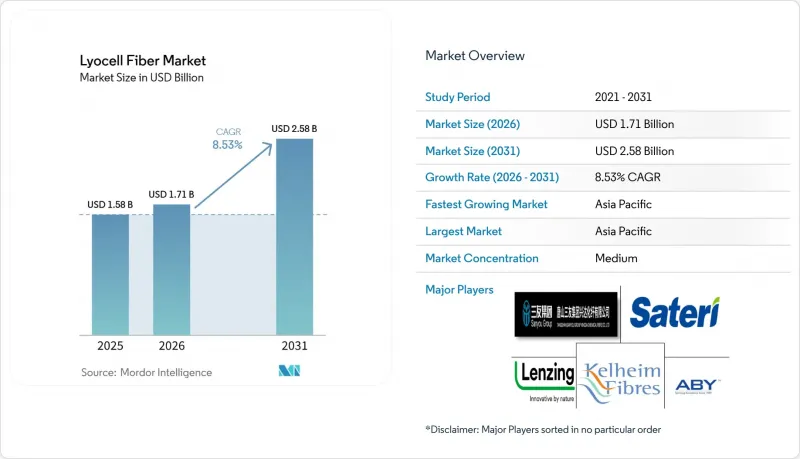
本報告按纖維類型(短纖維和長絲纖維)、生產流程(傳統Lyocell纖維和閉合迴路/新一代Lyocell纖維)、應用領域(服裝、家用紡織品等)、終端用戶行業(紡織時尚、醫療保健和衛生用品等)以及地區(亞太地區、北美地區、歐洲地區等)進行細分。市場預測以美元計價。
全球Lyocell纖維纖維市場趨勢與洞察
對永續和可生物分解纖維的需求日益成長
品牌正將生物分解性和低碳足跡置於成本之上,並加強推廣Lyocell纖維作為聚酯纖維的替代品。全球零售商已承諾在2030年實現100%使用優先纖維,為了實現循環經濟目標,他們計劃在2025年至2026年間推出結合機械回收棉花廢料和原生Lyocell纖維的自有系列產品。根據2025年發布的一項獨立實驗室研究,100%Lyocell纖維不織布在好氧土壤條件下35天內可分解83%,並在55天內完全生物分解。這比醋酸纖維素和再生聚酯纖維的分解速度快得多。歐盟的「一次性塑膠指令」正在穩步提升對無塑膠擦拭巾的需求。生命週期分析也表明,與傳統的水針法相比,萊賽爾纖維在生產過程中可減少高達42%的二氧化碳排放。這些趨勢正在建立穩定的需求基礎,並減輕服裝市場波動對銷售量的影響。
擴大在服裝和家用紡織品的應用
服裝和床上用品仍然是Lyocell纖維最大的消費領域,但需求正從高階床品轉向大眾市場的丹寧布料和休閒基本款。 2025年推出的粗紡Lyocell纖維紗線使丹寧布料製造商能夠在保持卓越吸濕排汗性能的同時,複製棉纖維特有的不規則紋理。生物基彈性纖維供應商與Lyocell纖維生產商之間的合作,促成了2025年底在各大展覽會上推出的彈性拉伸系列,預示著萊賽爾纖維將在休閒領域得到更廣泛的應用。連鎖飯店指定使用Lyocell纖維纖維床單以提升賓客舒適度,內部稽核報告顯示,升級寢具後運轉率有所提升。舒適性、美觀性和經證實的永續性相結合,正使Lyocell纖維成功打入對價格敏感的中產階級市場。
與棉和聚酯纖維相比,生產成本更高。
新建一座Lyocell纖維生產廠需要約3億美元的投資,以噸數計算,其成本是黏膠纖維的兩倍,是聚酯纖維的四倍。溶劑回收系統和高純度N-嗎福林N-氧化物(NMMO)的需求推高了營運成本。此外,歐洲能源價格飆升正在擠壓利潤空間,導致一家特種纖維製造商在2024年破產。如果沒有將環境外部性納入考量的碳定價體系,Lyocell纖維在價格敏感型市場取代聚酯纖維將面臨挑戰,其短期市場滲透率也將受到限制。
細分市場分析
截至2025年,短纖維佔Lyocell纖維纖維市佔率的64.84%。這主要歸功於其與棉紡系統的兼容性以及在服裝、床單和擦拭巾等領域的廣泛應用。長絲纖維因其抗起毛球性和光澤度而備受青睞,在運動服和功能性紡織品領域需求旺盛,預計到2031年將以9.02%的複合年成長率成長,增速超過短纖維。
短纖維預計將繼續保持其銷售領先地位,因為紡紗廠無需購置新設備即可將其與棉花和再生聚酯混紡。然而,連續長Lyocell纖維在高檔服裝和汽車內裝領域佔據更高的價格區間,儘管其產量成長較為溫和,但價值取向的轉變已初見端倪。能夠同時供應這兩種形式的生產商可以最大限度地提高盈利,並降低短纖維商品化的風險。
2025 年,傳統Lyocell纖維的銷售額佔總銷售額的 78.78%,而閉合迴路或下一代Lyocell纖維預計到 2031 年將以 9.30% 的複合年成長率成長。溶劑回收率超過 99.8% 的工廠受到主要服裝品牌的青睞,因為它們可以降低約 10% 的營運成本,並擁有低碳排放的檢驗記錄。
目前,化學回收技術已將30%的再生紙漿融入新的Lyocell纖維生產線,從而降低了木材需求,並滿足了歐洲提案的再生材料含量配額要求。推遲投資此類技術的生產商將面臨邊際效益下降的風險,因為買家越來越傾向於選擇那些提供可追溯供應鏈的再生材料產品的工廠。
區域分析
預計到2025年,亞太地區將以45.59%的市佔率佔據主導地位,並將在2031年之前以9.67%的複合年成長率持續成長。中國正在興建一座年產能60萬噸的新廠,預計將進一步提升中國的出口量。 2024年國內運轉率率達85%,而2025年1月至11月出口量成長48.7%,凸顯了中國絲綢與歐洲絲綢廠相比的運作競爭力。
由於嚴格的生態設計法規,歐洲對高品質Lyocell纖維的需求量很大,但隨著一家德國特種纖維製造商宣布將於2026年3月關閉工廠,其產能正在下降。如果亞洲供應商能夠證明其產品碳足跡低,並透過CBAM審核,那麼這個缺口將為他們贏得利潤豐厚的歐洲市場提供機會。
北美約佔全球消費量的四分之一,但仍高度依賴進口。加州《生產者責任法案》(將於2026年7月生效)以及各州層面的化學品法規正鼓勵零售商轉向使用可生物分解纖維,從而在國內供應有限的情況下,支撐了需求的穩定成長。
南美洲、中東和非洲雖然規模仍然相對較小,但蘊藏著兩位數成長的潛力。巴西桉樹原料的優勢可能會吸引未來的下游投資,而土耳其的紗線廠正在將Lyocell纖維融入出口服裝產品中,以滿足歐洲的永續發展要求。
其他好處:
- Excel格式的市場預測(ME)表
- 3個月的分析師支持
目錄
第1章:引言
- 研究假設和市場定義
- 調查範圍
第2章:調查方法
第3章執行摘要
第4章 市場狀況
- 市場概覽
- 市場促進因素
- 對永續和可生物分解纖維的需求日益成長
- 擴大在服裝和家用紡織品的應用
- 時尚品牌正在擴大其環保系列產品。
- 高吸濕性和強度使其成為高性能服裝。
- 碳關稅將加速環保纖維的採用。
- 一種從纖維到纖維的化學回收工藝,有利於Lyocell纖維的轉化。
- 市場限制因素
- 與棉和聚酯纖維相比,生產成本更高。
- 複雜的化學品回收和製造程序
- 與其他再生纖維素纖維的競爭
- 生物精煉需求導致溶解漿供應波動
- 價值鏈分析
- 監理情勢
- 技術展望
- 波特五力模型
第5章 市場規模與成長預測
- 依纖維類型
- 短纖維
- 長絲纖維
- 透過流程
- 傳統Lyocell纖維
- 閉合迴路/下一代Lyocell纖維
- 透過使用
- 服飾
- 家用紡織品
- 醫療和衛生用品
- 產業
- 其他用途(包裝、個人護理)
- 按最終用戶行業分類
- 紡織與時尚
- 醫療保健和衛生
- 汽車和運輸業
- 家居佈置
- 工業和技術纖維
- 其他終端使用者產業(零售、電子商務)
- 按地區
- 亞太地區
- 中國
- 日本
- 印度
- 韓國
- 東南亞國協
- 其他亞太國家
- 北美洲
- 美國
- 加拿大
- 墨西哥
- 歐洲
- 德國
- 英國
- 法國
- 義大利
- 西班牙
- 俄羅斯
- 其他歐洲國家
- 南美洲
- 巴西
- 阿根廷
- 其他南美國家
- 中東和非洲
- 沙烏地阿拉伯
- 南非
- 其他中東和非洲國家
- 亞太地區
第6章 競爭情勢
- 市場集中度
- 策略趨勢
- 市佔率和排名分析
- 公司簡介
- Acelon Chemicals & Fiber Corp.
- Aditya Birla Yarn
- Baoding Swan Fiber Co., Ltd.
- China Populus Textile Ltd.(CPT)
- Guangxi Sun Paper Co., Ltd.
- Kelheim Fibres GmbH
- Lenzing AG
- Sappi Ltd.
- Sateri
- SMARTFIBER AG
- Tangshan Sanyou Xingda Chemical Fiber Co., Ltd.
- Xinxiang Chemical Fiber Co., Ltd.
- Yibin Grace Group Co., Ltd.
- Zhejiang Fulida Fibre Co., Ltd.
第7章 市場機會與未來展望
According to Mordor Intelligence, the lyocell fiber market size is expected to increase from USD 1.58 billion in 2025 to USD 1.71 billion in 2026 and reach USD 2.58 billion by 2031, growing at a CAGR of 8.53% over 2026-2031.
This report is Segmented by Fiber Type (Staple Fibers and Filament Fibers), Process Type (Conventional Lyocell and Closed-loop/Next-gen Lyocell), Application (Apparel, Home Textiles, and More), End-User Industry (Textile and Fashion, Healthcare and Hygiene, and More), and Geography (Asia-Pacific, North America, Europe, and More). The Market Forecasts are Provided in Terms of Value (USD).
Global Lyocell Fiber Market Trends and Insights
Growing Demand for Sustainable and Biodegradable Fibers
Brands are increasingly promoting lyocell as a substitute for polyester, prioritizing its biodegradability and lower carbon footprint over cost concerns. Global retailers have pledged to transition to 100% preferred fibers by 2030, with in-house collections launched in 2025-2026, incorporating mechanically recovered cotton waste with virgin lyocell to meet circularity objectives. Independent laboratory studies published in 2025 revealed that 100% lyocell nonwovens disintegrated 83% within 35 days under aerobic soil conditions, achieving complete biodegradation in 55 days, significantly faster than cellulose acetate and recycled polyester. The European Union's Single-Use Plastics Directive is driving consistent demand for plastic-free wipes, while life-cycle analyses show up to 42% lower cradle-to-gate CO2 emissions compared to traditional spunlace formulations. These developments establish a stable demand base, protecting volumes from fluctuations in the apparel market.
Increasing Usage in Apparel and Home Textiles
Apparel and bedding remain the largest consumers of lyocell, but demand is shifting from premium linens to mass-market denim and casual basics. A slub-effect lyocell yarn, introduced in 2025, enables denim manufacturers to replicate the irregular textures associated with cotton while maintaining superior moisture management. Collaborations between bio-based elastane suppliers and lyocell producers resulted in active-stretch collections showcased at major trade shows in late 2025, signaling broader adoption in athleisure. Hospitality chains are specifying lyocell-rich sheets to enhance guest comfort, with internal audits reporting improved occupancy rates following bedding upgrades. The combination of comfort, aesthetics, and verified sustainability is enabling lyocell to penetrate price-sensitive mid-tier categories.
Higher Production Costs vs. Cotton and Polyester
Establishing a greenfield lyocell facility requires an investment of approximately USD 300 million, which is double the cost of viscose and four times that of polyester on a per-ton basis. The need for solvent recovery systems and high-purity N-methylmorpholine N-oxide (NMMO) increases operational expenses. Additionally, energy price spikes in Europe eroded margins, leading to the insolvency of a specialty fiber mill in 2024. Without carbon pricing to account for environmental externalities, lyocell faces challenges in displacing polyester in price-sensitive segments, limiting its short-term market penetration.
Other drivers and restraints analyzed in the detailed report include:
- High Moisture-Absorption and Strength Enabling Performance Wear
- Carbon-Border Taxes Accelerating Low-Impact Fibers
- Complex Chemical Recovery and Manufacturing Process
For complete list of drivers and restraints, kindly check the Table Of Contents.
Segment Analysis
Staple fibers accounted for 64.84% of the lyocell fiber market share in 2025, primarily due to their compatibility with cotton-spinning systems and widespread application in apparel, bed linens, and wipes. Filament fibers are projected to grow at a 9.02% CAGR through 2031, surpassing staple fibers in growth rate, as they are valued in sportswear and technical textiles for their pilling resistance and sheen.
Staple fibers are expected to maintain revenue leadership as mills can blend them with cotton or recycled polyester without requiring new equipment. However, continuous filament lyocell commands higher prices in luxury apparel and automotive interiors, indicating a shift in value even as tonnage growth remains slower. Producers capable of supplying both formats can maximize profitability and mitigate risks associated with commoditization in staple grades.
Conventional lyocell held a 78.78% revenue share in 2025, while closed-loop or next-generation lyocell is anticipated to grow at a 9.30% CAGR through 2031. Facilities recovering over 99.8% of solvents reduce operating costs by approximately 10% and provide verified low-carbon credentials, making them preferred by leading apparel brands.
Chemical recycling now integrates 30% recycled pulp into new lyocell production lines, reducing wood demand and aligning with proposed recycled-content quotas in Europe. Producers delaying investment in these technologies risk margin pressures as buyers increasingly prefer mills offering recycled-content products with traceable supply chains.
Geography Analysis
Asia-Pacific dominated with 45.59% share in 2025 and is forecast to rise at a 9.67% CAGR through 2031. China is adding a 600,000 tpa plant, which will further boost its exports. Domestic operating rates of approximately 85% in 2024 indicate healthy utilization, while export growth of 48.7% between January and November 2025 highlights cost competitiveness compared to European mills.
Europe consumes premium lyocell because of strict eco-design rules, but is losing production capacity after a German specialty mill announced closure by March 2026. The gap invites Asian suppliers to capture higher-margin European demand, provided they document low carbon footprints to satisfy CBAM audits.
North America represents roughly one-quarter of global consumption yet relies heavily on imports. California's producer-responsibility law, effective July 2026, and state-level chemical restrictions are encouraging retailers to shift toward biodegradable fibers, supporting stable demand growth despite limited domestic supply.
South America and the Middle-East and Africa remain small but show double-digit growth potential. Brazil's eucalyptus feedstock advantage could attract future downstream investments, while Turkish mills are incorporating lyocell into export-oriented apparel to meet European sustainability requirements.
- Acelon Chemicals & Fiber Corp.
- Aditya Birla Yarn
- Baoding Swan Fiber Co., Ltd.
- China Populus Textile Ltd. (CPT)
- Guangxi Sun Paper Co., Ltd.
- Kelheim Fibres GmbH
- Lenzing AG
- Sappi Ltd.
- Sateri
- SMARTFIBER AG
- Tangshan Sanyou Xingda Chemical Fiber Co., Ltd.
- Xinxiang Chemical Fiber Co., Ltd.
- Yibin Grace Group Co., Ltd.
- Zhejiang Fulida Fibre Co., Ltd.
Additional Benefits:
- The market estimate (ME) sheet in Excel format
- 3 months of analyst support
TABLE OF CONTENTS
1 Introduction
- 1.1 Study Assumptions and Market Definition
- 1.2 Scope of the Study
2 Research Methodology
3 Executive Summary
4 Market Landscape
- 4.1 Market Overview
- 4.2 Market Drivers
- 4.2.1 Growing demand for sustainable and biodegradable fibers
- 4.2.2 Increasing usage in apparel and home textiles
- 4.2.3 Expansion of eco-friendly collections by fashion brands
- 4.2.4 High moisture-absorption and strength enabling performance wear
- 4.2.5 Carbon-border taxes accelerating low-impact fibers
- 4.2.6 Textile-to-textile chemical recycling streams favoring lyocell
- 4.3 Market Restraints
- 4.3.1 Higher production costs vs. cotton and polyester
- 4.3.2 Complex chemical recovery and manufacturing process
- 4.3.3 Competition from other regenerated cellulose fibers
- 4.3.4 Volatile dissolving-pulp supply due to biorefinery demand
- 4.4 Value Chain Analysis
- 4.5 Regulatory Landscape
- 4.6 Technological Outlook
- 4.7 Porter's Five Forces
- 4.7.1 Threat of New Entrants
- 4.7.2 Bargaining Power of Buyers
- 4.7.3 Bargaining Power of Suppliers
- 4.7.4 Threat of Substitutes
- 4.7.5 Competitive Rivalry
5 Market Size and Growth Forecasts (Value)
- 5.1 By Fiber Type
- 5.1.1 Staple Fibers
- 5.1.2 Filament Fibers
- 5.2 By Process Type
- 5.2.1 Conventional Lyocell
- 5.2.2 Closed-loop/Next-gen Lyocell
- 5.3 By Application
- 5.3.1 Apparel
- 5.3.2 Home Textiles
- 5.3.3 Medical and Hygiene Products
- 5.3.4 Industrial
- 5.3.5 Other Applications (Packaging, Personal Care)
- 5.4 By End-user Industry
- 5.4.1 Textile and Fashion
- 5.4.2 Healthcare and Hygiene
- 5.4.3 Automotive and Transportation
- 5.4.4 Home Furnishing
- 5.4.5 Industrial and Technical Textiles
- 5.4.6 Other End-user Industries (Retail, E-commerce)
- 5.5 By Geography
- 5.5.1 Asia-Pacific
- 5.5.1.1 China
- 5.5.1.2 Japan
- 5.5.1.3 India
- 5.5.1.4 South Korea
- 5.5.1.5 ASEAN Countries
- 5.5.1.6 Rest of Asia-Pacific
- 5.5.2 North America
- 5.5.2.1 United States
- 5.5.2.2 Canada
- 5.5.2.3 Mexico
- 5.5.3 Europe
- 5.5.3.1 Germany
- 5.5.3.2 United Kingdom
- 5.5.3.3 France
- 5.5.3.4 Italy
- 5.5.3.5 Spain
- 5.5.3.6 Russia
- 5.5.3.7 Rest of Europe
- 5.5.4 South America
- 5.5.4.1 Brazil
- 5.5.4.2 Argentina
- 5.5.4.3 Rest of South America
- 5.5.5 Middle-East and Africa
- 5.5.5.1 Saudi Arabia
- 5.5.5.2 South Africa
- 5.5.5.3 Rest of Middle-East and Africa
- 5.5.1 Asia-Pacific
6 Competitive Landscape
- 6.1 Market Concentration
- 6.2 Strategic Moves
- 6.3 Market Share (%)/Ranking Analysis
- 6.4 Company Profiles (includes Global level Overview, Market level overview, Core Segments, Financials as available, Strategic Information, Products and Services, and Recent Developments)
- 6.4.1 Acelon Chemicals & Fiber Corp.
- 6.4.2 Aditya Birla Yarn
- 6.4.3 Baoding Swan Fiber Co., Ltd.
- 6.4.4 China Populus Textile Ltd. (CPT)
- 6.4.5 Guangxi Sun Paper Co., Ltd.
- 6.4.6 Kelheim Fibres GmbH
- 6.4.7 Lenzing AG
- 6.4.8 Sappi Ltd.
- 6.4.9 Sateri
- 6.4.10 SMARTFIBER AG
- 6.4.11 Tangshan Sanyou Xingda Chemical Fiber Co., Ltd.
- 6.4.12 Xinxiang Chemical Fiber Co., Ltd.
- 6.4.13 Yibin Grace Group Co., Ltd.
- 6.4.14 Zhejiang Fulida Fibre Co., Ltd.
7 Market Opportunities and Future Outlook
- 7.1 White-space and Unmet-need Assessment
- 7.2 Sustainable hygiene and personal-care products growth
- 7.3 Development of lyocell-blended technical and smart fabrics

 Lyocell纖維纖維布料市場:按產品類型、應用和地區分類
 Lyocell纖維纖維市場規模、佔有率、趨勢和預測:按產品、應用和地區分類,2026-2034年
 Lyocell纖維市場規模、佔有率和成長分析:按最終用途產業、產品類型、製造流程、應用領域、分銷管道和地區分類-2026-2033年產業預測
 2026年Lyocell纖維纖維全球市場報告
 Lyocell纖維纖維市場:2026-2032年全球預測(按應用、類型、原料、通路和價格範圍分類)環保Lyocell纖維纖維市場:依產品類型、應用和通路分類-全球預測(2026-2032年)
 Lyocell纖維纖維市場規模、佔有率和成長分析(按產品類型、應用和地區分類)-2026-2033年產業預測
 Lyocell纖維纖維市場報告:趨勢、預測和競爭分析(至2031年)