


 |
市場調查報告書
商品編碼
2062232
凹版印刷油墨市場:市場佔有率分析、產業趨勢與統計、成長預測(2026-2031)Rotogravure Printing Inks - Market Share Analysis, Industry Trends & Statistics, Growth Forecasts (2026 - 2031) |
||||||

※ 本網頁內容可能與最新版本有所差異。詳細情況請與我們聯繫。
據 Mordor Intelligence 稱,凹版印刷油墨市場在 2025 年的價值為 57.8 億美元,預計到 2031 年將達到 78.6 億美元,而 2026 年為 60.8 億美元,預測期(2026-2031 年)的複合年成長率為 5.26%。
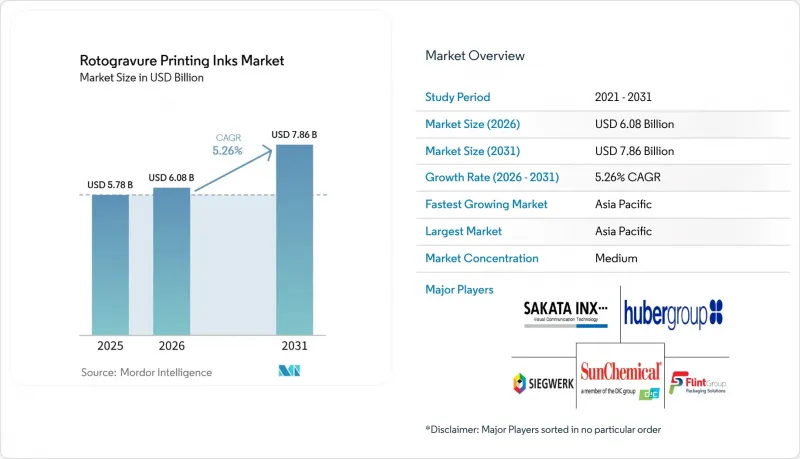
本報告按樹脂類型(硝化纖維素、聚醯胺等)、技術(溶劑型、水性、電子束/紫外光固化)、應用(軟包裝、標籤和包裝紙等)、終端用戶產業(食品飲料、個人護理和化妝品等)以及地區(亞太地區、北美地區等)進行細分。市場預測以美元計價。
全球凹版印刷油墨市場趨勢及洞察
軟包裝領域對高速印刷的需求日益成長
目前,軟包裝加工商的中央凹版印刷機持續運作速度可達每分鐘400米,較2020年提升了25%。這使得快速消費品(FMCG)產業的前置作業時間從兩週縮短至72小時。如此高速印刷所需的黏度穩定性,促使人們越來越傾向於選擇聚氨酯和丙烯酸改質黏合劑,因為它們在印刷過程中不易揮發溶劑。亞太地區的軟包裝市場預計將在2026年達到901.2億美元,並在2035年成長至1247.7億美元,這主要得益於印度、印尼和越南的都市化加快。東洋油墨於2025年11月宣布計劃將其位於古吉拉突邦的液體油墨工廠擴建1.5倍,反映出供應商對該地區高產能凹版印刷持續重要性的信心。
新興市場快速消費品及食品飲料包裝的成長
到2025年,食品飲料業將佔全球油墨使用量的48.02%,預計隨著印度和東南亞地區人均包裝食品消費量的成長,這一佔有率將保持穩定。光是在印度,預計到2025年超級市場將分店12,000家門市,每家店都需要防竄改功能和高畫質影像。對於超過10萬份的生產批量,凹版印刷比柔版印刷更具成本優勢。西格維克公司於2025年9月投資35億盧比,專注於金屬清漆的研發,預計這種清漆在高階糖果甜點領域將獲得15-20%的溢價。
加強對揮發性有機化合物和有害溶劑的監管
歐盟工業排放指令規定,新建凹版印刷生產線的二苯甲酮含量上限為50毫克/立方米;REACH法規附件十七則規定,成品中二苯甲酮含量不得超過0.6毫克/公斤。美國環保署(EPA)的類似規定也強制加工商改用水性或電子束(EB)固化化學品,除非他們投資50萬至200萬美元購買氧化設備。弗林特集團(Flint Group)獲得EcoVadis Gold認證的無硝化纖維素產品線,在RecyClass預先批准後參與了2025年的競標。這使得該公司僅用了四週時間就對品牌所有者的提案書(RFP)做出了回應,而區域競爭對手則需要12週時間。
細分市場分析
硝化纖維素在2025年佔銷售額的36.13%。聚氨酯,尤其是在生物基聚氨酯的推動下,預計到2031年將以5.89%的複合年成長率成長。聚醯胺仍然是高速出版印刷的首選材料,儘管在該應用領域的成長速度仍然緩慢。丙烯酸改質體係因其優異的抗紫外線性能,在裝飾層壓板領域保持著一定的市場需求。同時,環氧樹脂黏合劑對於抗菌功能層至關重要。
隨著碳價超過每噸 80 歐元,蓖麻油衍生多元醇與石油化工替代品之間的成本差異預計將在 2029 年消失。東洋油墨的尼姆拉納無甲苯工廠體現了供應商在確保與電暈處理薄膜黏合的同時,努力減少溶劑暴露的舉措。
預計到2025年,溶劑型凹版油墨將佔市場需求的68.92%。這主要歸功於其在PE和PP基材上能夠實現每分鐘400公尺的印刷速度。水性油墨的發展勢頭強勁,這得益於DIC的RePOS可脫墨產品線,該產品線已通過60 度C的RecyClass清潔測試。受藥品序列化需求的推動,預計到2031年,EB/UV固化型凹版油墨的複合年成長率將達到6.04%。
混合工作流程正變得越來越普遍,加工商使用高固態溶劑型油墨生產不透明白色油墨,並使用諸如“SunCure Advance ECO”之類的LED-UV油墨(該油墨可將光引發劑用量減少40%)生產CMYK覆膜。然而,高昂的資本投資成本阻礙了電子束技術的廣泛應用,使其僅限於吸塑包裝和化妝品等高利潤應用領域。
區域分析
預計到2025年,亞太地區的需求將佔全球需求的46.83%,並在2031年之前以6.37%的複合年成長率成長。 Siegwerk於2026年3月收購Hi-Tech Inks,使其在印度的市佔率超過20%,並將低轉移技術專長與本地溶劑生產系統結合。儘管中國市場成長放緩,但巧克力、咖啡和化妝品等高階包裝正逐漸轉向使用DIC的RePOS油墨。日本和韓國的成長較為溫和,但仍持續採用EB技術生產吸塑包裝。預計到2025年,東南亞國協的超級市場將增加18,000家,這將推動小包裝袋的需求。
在北美,儘管美國加工商因關稅改革面臨甲基乙基酮(MEK)價格飆升的困境,但由於歐盟對耐磨性的要求,溶劑型凹版油墨的需求仍然強勁。加拿大和墨西哥則受益於近岸外包趨勢,跨境即時供應鏈為汽車線束生產提供了支援。
在歐洲,嚴格的工業廢棄物處理法規正在加速水性和電子束技術的普及。在德國、法國和英國,RecyClass認證是必要的,主要針對藥品泡殼包裝和高階食品包裝。儘管俄羅斯市場因供應限制而萎縮,但波蘭和捷克共和國正在崛起為出版和印刷的次要中心。
南美洲的需求主要來自巴西的咖啡、糖果甜點和個人保健產品的包裝。雖然中東和非洲仍是發展中市場,但世界衛生組織支持的抗瘧疾藥序列化試點計畫正在催生對INVENTRA公司生產的RFID凹版印刷套管的需求。
其他好處:
- Excel格式的市場預測(ME)表
- 3個月的分析師支持
目錄
第1章:引言
- 市場分析與定義的前提條件
- 分析範圍
第2章 分析方法
第3章執行摘要
第4章 市場狀況
- 市場概覽
- 市場促進因素
- 軟包裝領域對高速印刷的需求日益成長
- 新興市場快速消費品、食品飲料包裝市場的成長
- 品牌所有者正在推廣在可回收的單一材料薄膜上使用高階圖形。
- 電子商務的擴張需要能夠長期使用的印刷材料。
- 一種生物基聚氨酯分散體,可製成 VOC 含量低於 5% 的凹版印刷油墨。
- 用於供應鏈追溯的嵌入式RFID/用於印刷電子產品的凹版油墨
- 市場限制因素
- 加強對揮發性有機化合物和有害溶劑的監管
- 原料價格波動(樹脂、顏料、溶劑)
- 小批量生產中向數位噴墨技術的快速轉變。
- 紫外線/電子束系統中光引發劑的毒性評估
- 價值鏈分析
- 波特五力分析
第5章:預測市場規模與成長率
- 依樹脂類型
- 硝化纖維素
- 聚醯胺
- 聚氨酯
- 丙烯酸改質樹脂
- 環氧樹脂及其他樹脂的種類
- 透過技術
- 溶劑型凹版油墨
- 水性凹版油墨
- EB/UV固化凹版油墨
- 透過使用
- 軟包裝
- 標籤和包裝紙
- 出版品印刷
- 禮品包裝膜/裝飾膜
- 裝飾層壓壁紙
- 按最終用戶行業分類
- 食品/飲料
- 個人護理和化妝品
- 藥品和醫療保健
- 家庭和工業清潔
- 家用電子電器、家用電器
- 按地區
- 亞太地區
- 中國
- 日本
- 印度
- 韓國
- 東南亞國協
- 其他亞太國家
- 北美洲
- 美國
- 加拿大
- 墨西哥
- 歐洲
- 德國
- 英國
- 法國
- 義大利
- 西班牙
- 俄羅斯
- 其他歐洲國家
- 南美洲
- 巴西
- 阿根廷
- 其他南美國家
- 中東和非洲
- 沙烏地阿拉伯
- 南非
- 其他中東和非洲國家
- 亞太地區
第6章 競爭情勢
- 市場集中度
- 策略趨勢
- 市佔率和排名分析
- 公司簡介
- Artience Co., Ltd.
- DIC Corporation
- Doneck Euroflex
- Flint Group
- hubergroup Deutschland GmbH
- Nazdar Ink Technologies
- Royal Ink & Resin
- SAKATA INX CORPORATION
- Siegwerk Druckfarben AG & Co. KGaA
- Sun Chemical
- Superior Printing Inks Co.
- Toyo Ink SC Holdings
第7章 市場機會與未來展望
According to Mordor Intelligence, the rotogravure printing inks market size was valued at USD 5.78 billion in 2025 and is estimated to grow from USD 6.08 billion in 2026 to reach USD 7.86 billion by 2031, at a CAGR of 5.26% during the forecast period (2026-2031).
This report is Segmented by Resin Type (Nitrocellulose, Polyamide, and More), Technology (Solvent-Based, Water-Based, and EB/UV-curable), Application (Flexible Packaging, Labels and Wrappers, and More), End-User Industry (Food and Beverage, Personal Care and Cosmetics, and More), and Geography (Asia-Pacific, North America, and More). The Market Forecasts are Provided in Terms of Value (USD).
Global Rotogravure Printing Inks Market Trends and Insights
Rising Demand for High-Speed Printing in Flexible Packaging
Flexible packaging converters now operate central-impression gravure presses at sustained speeds of 400 m/min, a 25% increase compared to 2020, reducing lead times from two weeks to seventy-two hours in fast-moving consumer goods segments. The viscosity stability required for such speeds has shifted preferences toward polyurethane and acrylic-modified binders that resist solvent loss during printing. Asia-Pacific's flexible packaging expenditure reached USD 90.12 billion in 2026 and is projected to grow to USD 124.77 billion by 2035, driven by urbanizing populations in India, Indonesia, and Vietnam. Toyo Ink's November 2025 plan to expand its Gujarat liquid-ink plant by 1.5 times reflects supplier confidence in the continued importance of high-throughput gravure printing in the region.
FMCG and Food-Beverage Packaging Growth in Emerging Markets
Food and beverage applications accounted for 48.02% of global ink volume in 2025 and are expected to maintain a similar share as per-capita packaged food consumption increases in India and Southeast Asia. In India alone, supermarket chains added 12,000 outlets in 2025, each requiring tamper-evident, high-definition graphics. Gravure printing offers cost advantages over flexography for production runs exceeding 100,000 impressions. Siegwerk's INR 350 crore investment in September 2025 focuses on metallic-effect varnishes, which command a 15-20% price premium in the premium confectionery segment.
Tightening VOC and Hazardous-Solvent Regulations
The EU Industrial Emissions Directive has set a 50 mg/m3 ceiling for new gravure lines, while REACH Annex XVII restricts benzophenone levels to below 0.6 mg/kg in finished articles. Similar regulations in the United States under EPA guidelines are pushing converters toward water-based or electron-beam (EB) curable chemistries unless they invest USD 0.5-2 million in oxidizers. Flint Group's EcoVadis Gold-certified nitrocellulose-free product suite entered 2025 tenders with RecyClass pre-clearance, enabling the company to respond to brand-owner requests for proposals (RFPs) in four weeks, compared to twelve weeks for regional competitors.
Other drivers and restraints analyzed in the detailed report include:
- Brand-Owner Push for Premium Graphics on Recyclable Mono-Material Films
- Expansion of E-Commerce Requiring Long-Run Durable Prints
- Photoinitiator Toxicology Scrutiny in UV/EB Systems
For complete list of drivers and restraints, kindly check the Table Of Contents.
Segment Analysis
Nitrocellulose retained 36.13% of 2025 revenue. Polyurethane, supported by bio-based grades, is projected to grow at a CAGR of 5.89% through 2031. Polyamide continues to be preferred for high-speed publication printing, although growth in this application remains slow. Acrylic-modified systems maintain niche demand in decorative laminates due to their UV resistance, while epoxy binders are critical for antimicrobial functional layers.
Carbon pricing exceeding EUR 80 per ton is expected to eliminate the cost difference between castor-oil polyols and petrochemical alternatives by 2029. Toyo Ink's toluene-free Neemrana plant highlights supplier efforts to reduce solvent exposure while ensuring adhesion on corona-treated films.
Solvent-based gravure inks accounted for 68.92% of demand in 2025, driven by their compatibility with 400 m/min press speeds on PE and PP substrates. Water-based inks are gaining traction, supported by DIC's RePOS de-inkable line, which passed RecyClass wash tests at 60°C. EB/UV-curable gravure inks are anticipated to grow at a CAGR of 6.04% through 2031, driven by drug serialization requirements.
Hybrid workflows are becoming more common, with converters using high-solids solvent inks for opaque whites and overlaying CMYK with LED-UV inks, such as SunCure Advance ECO, which reduces photoinitiator mass by 40%. However, high capital costs remain a barrier to broader adoption of EB technology, limiting its use to high-margin applications like blister packs and cosmetics.
Geography Analysis
Asia-Pacific absorbed 46.83% of 2025 demand and is projected to grow at a CAGR of 6.37% through 2031. Siegwerk's acquisition of Hi-Tech Inks in March 2026 increased its market share in India to over 20%, combining expertise in low-migration technology with local solvent production. While China's growth moderates, it is shifting toward premium packaging for chocolate, coffee, and cosmetics using DIC's RePOS inks. Japan and South Korea show slow growth but continue adopting EB technology for blister packs. ASEAN nations are expected to add 18,000 supermarkets in 2025, driving demand for sachets and pouches.
In North America, U.S. converters face rising MEK prices due to tariff reforms, but e-commerce abrasion requirements sustain demand for solvent-based gravure inks. Canada and Mexico benefit from near-shoring trends, with cross-border just-in-time supply chains supporting automotive harness production.
In Europe, stringent IED regulations are accelerating the adoption of water-based and EB technologies. In Germany, France, and the United Kingdom, primarily in pharmaceutical blister packs and premium food wraps requires RecyClass certification. Russia's market is contracting due to supply constraints, while Poland and the Czech Republic are emerging as secondary hubs for publication printing.
South America's demand is driven by Brazilian coffee, confectionery, and personal care packaging. The Middle-East and Africa remain nascent markets, but WHO-backed serialization pilots for antimalarials are creating demand for RFID-enabled gravure sleeves produced by INVENTRA.
- Artience Co., Ltd.
- DIC Corporation
- Doneck Euroflex
- Flint Group
- hubergroup Deutschland GmbH
- Nazdar Ink Technologies
- Royal Ink & Resin
- SAKATA INX CORPORATION
- Siegwerk Druckfarben AG & Co. KGaA
- Sun Chemical
- Superior Printing Inks Co.
- Toyo Ink SC Holdings
Additional Benefits:
- The market estimate (ME) sheet in Excel format
- 3 months of analyst support
TABLE OF CONTENTS
1 Introduction
- 1.1 Study Assumptions and Market Definition
- 1.2 Scope of the Study
2 Research Methodology
3 Executive Summary
4 Market Landscape
- 4.1 Market Overview
- 4.2 Market Drivers
- 4.2.1 Rising demand for high-speed printing in flexible packaging
- 4.2.2 FMCG and food-beverage packaging growth in emerging markets
- 4.2.3 Brand-owner push for premium graphics on recyclable mono-material films
- 4.2.4 Expansion of e-commerce requiring long-run durable prints
- 4.2.5 Bio-based polyurethane dispersions enabling less than 5% VOC gravure inks
- 4.2.6 Embedded RFID/printed-electronics gravure inks for supply-chain traceability
- 4.3 Market Restraints
- 4.3.1 Tightening VOC and hazardous-solvent regulations
- 4.3.2 Feedstock-price volatility (resins, pigments, solvents)
- 4.3.3 Rapid migration to digital inkjet for short runs
- 4.3.4 Photoinitiator toxicology scrutiny in UV/EB systems
- 4.4 Value Chain Analysis
- 4.5 Porter's Five Forces
- 4.5.1 Bargaining Power of Suppliers
- 4.5.2 Bargaining Power of Buyers
- 4.5.3 Threat of New Entrants
- 4.5.4 Threat of Substitutes
- 4.5.5 Competitive Rivalry
5 Market Size and Growth Forecasts (Value)
- 5.1 By Resin Type
- 5.1.1 Nitrocellulose
- 5.1.2 Polyamide
- 5.1.3 Polyurethane
- 5.1.4 Acrylic-modified Resins
- 5.1.5 Epoxy and Other Resin Types
- 5.2 By Technology
- 5.2.1 Solvent-based Gravure Inks
- 5.2.2 Water-based Gravure Inks
- 5.2.3 EB/UV-curable Gravure Inks
- 5.3 By Application
- 5.3.1 Flexible Packaging
- 5.3.2 Labels and Wrappers
- 5.3.3 Publication Printing
- 5.3.4 Gift Wrap and Decorative Films
- 5.3.5 Decorative Laminates and Wallpapers
- 5.4 By End-user Industry
- 5.4.1 Food and Beverage
- 5.4.2 Personal Care and Cosmetics
- 5.4.3 Pharmaceuticals and Healthcare
- 5.4.4 Home and Industrial Cleaning
- 5.4.5 Consumer Electronics and Appliances
- 5.5 By Geography
- 5.5.1 Asia-Pacific
- 5.5.1.1 China
- 5.5.1.2 Japan
- 5.5.1.3 India
- 5.5.1.4 South Korea
- 5.5.1.5 ASEAN Countries
- 5.5.1.6 Rest of Asia-Pacific
- 5.5.2 North America
- 5.5.2.1 United States
- 5.5.2.2 Canada
- 5.5.2.3 Mexico
- 5.5.3 Europe
- 5.5.3.1 Germany
- 5.5.3.2 United Kingdom
- 5.5.3.3 France
- 5.5.3.4 Italy
- 5.5.3.5 Spain
- 5.5.3.6 Russia
- 5.5.3.7 Rest of Europe
- 5.5.4 South America
- 5.5.4.1 Brazil
- 5.5.4.2 Argentina
- 5.5.4.3 Rest of South America
- 5.5.5 Middle-East and Africa
- 5.5.5.1 Saudi Arabia
- 5.5.5.2 South Africa
- 5.5.5.3 Rest of Middle-East and Africa
- 5.5.1 Asia-Pacific
6 Competitive Landscape
- 6.1 Market Concentration
- 6.2 Strategic Moves
- 6.3 Market Share (%)/Ranking Analysis
- 6.4 Company Profiles (includes Global level Overview, Market level overview, Core Segments, Financials as available, Strategic Information, Products and Services, and Recent Developments)
- 6.4.1 Artience Co., Ltd.
- 6.4.2 DIC Corporation
- 6.4.3 Doneck Euroflex
- 6.4.4 Flint Group
- 6.4.5 hubergroup Deutschland GmbH
- 6.4.6 Nazdar Ink Technologies
- 6.4.7 Royal Ink & Resin
- 6.4.8 SAKATA INX CORPORATION
- 6.4.9 Siegwerk Druckfarben AG & Co. KGaA
- 6.4.10 Sun Chemical
- 6.4.11 Superior Printing Inks Co.
- 6.4.12 Toyo Ink SC Holdings
7 Market Opportunities and Future Outlook
- 7.1 Eco-friendly and low-VOC gravure ink chemistries
- 7.2 White-space and Unmet-Need Assessment

 大尺寸列印油墨市場:全球市場預測,2026-2032年大尺寸戶外油墨市場:全球市場預測,2026-2032年塑膠移印油墨市場:全球市場預測,2026-2032年溶劑型凹版油墨市場:全球市場預測(2026-2032年)
 UV固化印刷油墨:市場佔有率分析、產業趨勢與統計數據以及成長預測(2026-2031年)
 粉末油墨市場規模、佔有率和成長分析:按產品類型、樹脂類型、應用、最終用戶、分銷管道和地區分類-2026-2033年產業預測凹版印刷油墨市場:2026-2032年全球市場預測(依油墨類型、形態、承印類型、包裝、顏色及最終用途產業分類)
 2034年油墨印刷市場預測-按產品類型、化學分類、最終用途產業、通路和地區分類的全球分析
 全球網版印刷油墨市場規模、佔有率、趨勢及成長分析報告(2026-2034年)印刷油墨市場:2026-2032年全球市場預測(依產品類型、印刷製程、樹脂類型、銷售管道和應用分類)