

 |
市場調查報告書
商品編碼
2062230
環烯烴共聚物:市場佔有率分析、產業趨勢與統計、成長預測(2026-2031)Cyclic Olefin Copolymer - Market Share Analysis, Industry Trends & Statistics, Growth Forecasts (2026 - 2031) |
||||||

※ 本網頁內容可能與最新版本有所差異。詳細情況請與我們聯繫。
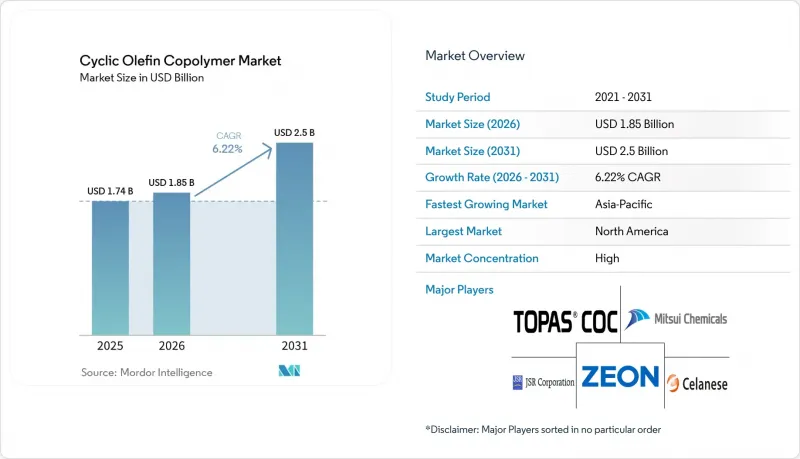
根據 Mordor Intelligence 預測,環烯烴共聚物 (COC) 的市場規模預計將從 2025 年的 17.4 億美元成長到 2026 年的 18.5 億美元,到 2031 年將達到 25 億美元。
預計從 2026 年到 2031 年,其複合年成長率將達到 6.22%。
本報告按類型(非晶態COC和半結晶質COC)、等級(射出成型級、吹塑成型級、薄膜/片材級及其他)、終端用戶行業(醫療保健/醫藥、電子/光電子及其他)和地區(亞太地區、北美地區、歐洲地區、南美地區以及中東和非洲地區)進行細分。市場預測以美元(USD)為單位。
全球環烯烴共聚物市場趨勢及洞察
對藥品泡殼包裝、預填充式注射器和管瓶。
玻璃表面會促進劣化生物製藥的蛋白質吸附,而COC表面能僅26 mN/m,可抑制蛋白質結合,進而維持藥物療效。 ZEONEX醫用注射器即使在-194 度C的低溫下仍能保持抗衝擊強度,從而能夠以低溫鏈的方式遞送mRNA和細胞療法。單一材料COC泡殼包裝的水蒸氣透過率低於0.1 g/m²/天,與鋁箔層壓板相當,同時符合歐盟可回收性法規。 Zeon垂直整合的C5供應鏈可將殘餘不飽和度控制在0.02 ZEON %以下,這是獲得FDA藥物主文件(DMF)批准的先決條件。然而,由於2026年訂單下降4%, DAICEL已將德國的投產時間推遲至2027年第一季。這暴露了其對少數幾家製藥公司的依賴性。
微流體及其在照護現場實驗室晶片設備中的應用
聚二甲基矽氧烷(PDMS)能夠吸收疏水性試劑,而市售的環烯烴共聚物(COC)溶液則能最大限度地減少小分子的擴散,從而提高檢測精度。弗勞恩霍夫實驗室利用彈性體COC尖端實現了10,000次氣動閥循環,與剛性熱塑性塑膠相比,顯著延長了設備的使用壽命。在新冠病毒螢光檢測中,從基板切換到COC基板,可將螢光雜訊降低至訊號的5%以下。 COC-PLGA混合微通道可用於製造具有整合式藥物輸送儲液器的穿戴式式胰島素幫浦。歐盟和美國在ISO 10993測試要求上的差異,為北美合約製造商創造了有利的監管套利空間。
與通用聚烯一般塑膠相比,樹脂成本較高
環狀烯烴共聚物的市場價格是線性低密度聚乙烯(LLPE)的2.5至3.5倍。這是因為降冰片烯的合成和複分解聚合需要C5裂解裝置和多級加氫工藝,涉及大量資本投資。在新興地區常見的泡殼包裝應用中,聚丙烯仍被廣泛使用,其能夠以一半的成本達到1至2克/平方公尺/天的目標含水率。中國供應商的價格比日本基準價格低15%至20%,但他們的顆粒乾燥製程不足,導致水解缺陷,因此被排除在醫藥和半導體供應鏈之外。 2025年第一季,亞洲裂解裝置的意外停產導致環戊二烯原料價格飆升18%,擠壓了與固定價格醫藥合約掛鉤的加工商的利潤空間。客戶的謹慎態度迫使DAICEL推遲了其德國工廠的運作,凸顯了價格波動如何影響長期採購合約。
細分市場分析
到了2025年,非晶態環烯烴共聚物(COC)佔據環烯烴共聚物市場佔有率的58.27%,這主要歸功於其玻璃般的透明度以及可射出成型成型並實現高精度加工的特性,適用於管瓶和微流體控裝置。這些等級的COC玻璃化轉變溫度可達101–154 度C,彈性模量接近2,900 MPa,足以滿足智慧型手機鏡頭5微米以內的對準精度要求。預計在預測期(2026–2031年)內,半結晶質級COC的複合年成長率將達到6.58%,這主要得益於汽車抬頭顯示器和ADAS(高級駕駛輔助系統)攝影機對耐高溫(超過120 度C)且不產生霧化現象的需求。
這款採用新型共聚物鏈增強的半結晶質樹脂,其延伸率從4%提升至245%,從而製造出可承受10,000次彎曲循環的折疊式顯示器背板。 ZEONEX 360R的超低屈光將色移限制在5奈米以內,支援擴增實境(AR)光學應用。住友化學的光固化COC結合了熱塑性塑膠的加工性能和熱固性樹脂的尺寸穩定性,滿足了半導體光刻技術對耐溶劑光阻劑的需求。嚴格的ISO 9001標準控制將屈光變化控制在±0.001以內,這是智慧型手機相機OEM廠商要求的基準值。
區域分析
預計到2025年,北美市場將佔總銷售額的31.16%。美國藥物輸送公司高度重視COC注射器,即使在低至-194 度C的運輸環境下也不會開裂。 ZeonZEON在美國本土的倉庫已將前置作業時間縮短至一周,相比從歐洲海運具有明顯優勢。一家加拿大微流體新創公司正因COC的染料吸收率更低而將其從聚二甲基矽氧烷(PDMS)轉向COC,而一家墨西哥透鏡成形製造商則在其用於120 度C高溫下運行的ADAS攝影機中使用APEL材料。
亞太地區是成長最快的地區,預計到2031年將以7.02%的複合年成長率成長。 ZeonZEON位於德山東部的綜合設施投資700億日圓(約4.7億美元),預計2028年將使日本的樹脂產量提高30%,達到每年5.4萬噸,從而緩解韓國顯示器工廠的樹脂供應壓力。韓國的研究表明,拉伸伸長率提高了五倍,這使得該地區的供應商在卷材型OLED基板領域處於領先地位。中國預計到2024年將每年生產1萬噸低成本射出成型樹脂,但由於顆粒劑水分含量超標,其在製藥業的佔有率仍然很低。印度正在探索用於高濕度原料藥的COC泡殼包裝,但對價格仍然非常敏感。
在歐洲,由於預計德國包裝稅(VerpackG)將於2025年上調,泡殼包裝的驗證工作正在加速。然而,由於聚丙烯樹脂(PPWR)的初期投資緩慢,Polyplastics公司已將其位於萊納(Leuna)的工廠運作時間推遲至2027年。在北歐進行的胰島素管瓶試驗測試表明,COC(冷凝凝固)製程的吸濕率低於0.1克/平方公尺/天,可確保24個月的保存期限。南美和中東/非洲地區則相對落後,因為由於運輸成本和10-15%的進口關稅,價格昂貴的樹脂的使用僅限於高階生物製藥企業。
其他好處
- Excel格式的市場預測(ME)表
- 3個月的分析師支持
目錄
第1章:引言
- 研究假設和市場定義
- 調查範圍
第2章:調查方法
第3章執行摘要
第4章 市場狀況
- 市場概覽
- 市場促進因素
- 對藥品泡殼包裝、預填充式注射器和管瓶。
- 微流體技術及其在照護現場實驗室晶片的應用
- 用於高解析度顯示器和LED的光學薄膜的生長
- EU-PPWR 推廣基於 COC 的單一材料、可回收的藥品泡殼包裝。
- 用於實現超薄折疊式微型LED面板的COC背板基板
- 市場限制因素
- 高成本樹脂與聚烯一般塑膠
- 缺乏大規模機械回收基礎設施
- 由於全球樹脂生產商數量較少,導致供應鏈集中化。
- 價值鏈分析
- 波特五力模型
第5章 市場規模與成長預測
- 按類型
- 非晶態COC
- 半結晶質COC
- 按年級
- 射出成型級
- 吹塑成型級
- 底片和紙張等級
- 醫用/製藥級
- 按最終用戶行業分類
- 醫療保健
- 電子學和光電子學
- 包裝
- 汽車和運輸業
- 其他終端用戶產業(消費品等)
- 按地區
- 亞太地區
- 中國
- 印度
- 日本
- 韓國
- ASEAN
- 其他亞太國家
- 北美洲
- 美國
- 加拿大
- 墨西哥
- 歐洲
- 德國
- 英國
- 法國
- 義大利
- 西班牙
- 俄羅斯
- 北歐國家
- 其他歐洲國家
- 南美洲
- 巴西
- 阿根廷
- 其他南美國家
- 中東和非洲
- 沙烏地阿拉伯
- 南非
- 其他中東和非洲國家
- 亞太地區
第6章 競爭情勢
- 市場集中度
- 策略趨勢
- 市佔率和排名分析
- 公司簡介
- Asahi Kasei Corporation
- Avantor Inc.
- BOREALIS GMBH.
- Celanese Corporation
- Daikyo Seiko Ltd.
- ExxonMobil Corp.
- JSR Corporation
- Mitsui Chemicals, Inc.
- Polysciences
- RTP Company
- SABIC
- Sumitomo Chemical Co., Ltd.
- TOPAS Advanced Polymers/Polyplastics
- ZEON CORPORATION
第7章 市場機會與未來展望
According to Mordor Intelligence, the cyclic olefin copolymer market size is expected to increase from USD 1.74 billion in 2025 to USD 1.85 billion in 2026 and reach USD 2.5 billion by 2031, growing at a CAGR of 6.22% over 2026-2031.
This report is Segmented by Type (Amorphous COC and Semi-Crystalline COC), Grade (Injection-Molding Grade, Blow-Molding Grade, Film and Sheet Grade, and More), End-User Industry (Healthcare and Medical, Electronics and Optoelectronics, and More), and Geography (Asia-Pacific, North America, Europe, South America, and Middle East and Africa). The Market Forecasts are Provided in Terms of Value (USD).
Global Cyclic Olefin Copolymer Market Trends and Insights
Rising Demand for Pharmaceutical Blister Packs, Pre-filled Syringes and Vials
Glass surfaces promote protein adsorption that degrades biologics, whereas COC's 26 mN/m surface energy curbs binding and maintains drug potency. ZEONEX medical-grade syringes retain impact strength at -194°C, enabling mRNA and cell-therapy distribution in ultra-cold chains. Monomaterial COC blisters reach moisture-vapor transmission rates below 0.1 g/m2/day, rivaling foil laminates and aligning with EU recyclability rules. Zeon's vertically integrated C5 chain secures residual-unsaturation levels under 0.02 wt%, a prerequisite for FDA Drug Master File acceptance. Yet Daicel shifted its German start-up to Q1 2027 after 2026 order volumes fell 4%, exposing reliance on a few pharmaceutical accounts.
Adoption in Microfluidics and Point-of-Care Lab-on-Chip Devices
Polydimethylsiloxane absorbs hydrophobic reagents, whereas cyclic olefin copolymer market solutions show negligible small-molecule partitioning, sharpening assay accuracy. Fraunhofer trials achieved 10,000 pneumatic-valve cycles in elastomeric COC chips, extending device lifetimes versus rigid thermoplastics. COVID-19 fluorescence tests lowered autofluorescence noise to under 5% of signal when switching from polystyrene to COC substrates. Hybrid COC-PLGA microchannels are enabling wearable insulin pumps with integrated drug-delivery reservoirs. Divergent ISO 10993 test regimes between the EU and the USA create regulatory arbitrage that favors North American contract molders.
High Resin Cost Versus Polyolefin Commodity Plastics
Cyclic olefin copolymer market resin sells at 2.5-3.5 times linear low-density polyethylene because norbornene synthesis and metathesis polymerization require capital-heavy C5 crackers and multi-stage hydrogenation. Generic blister applications in emerging regions stay with polypropylene that meets 1-2 g/m2/day moisture targets at half the cost. Chinese suppliers undercut Japanese benchmarks by 15-20%, but pellet-drying lapses yield hydrolysis defects that rule them out of pharma and semiconductor supply chains. Cyclopentadiene feedstock prices spiked 18% in Q1 2025 after Asian crackers shut unexpectedly, squeezing converter margins locked into fixed drug-contract pricing. Customer reticence forced Daicel to delay its German plant commissioning, highlighting how price volatility suppresses long-term offtake deals.
Other drivers and restraints analyzed in the detailed report include:
- Growth of High-Resolution Display and LED Optical Films
- EU PPWR Push for Monomaterial Recyclable Pharma Blister Formats
- Limited Large-Scale Mechanical Recycling Infrastructure
For complete list of drivers and restraints, kindly check the Table Of Contents.
Segment Analysis
Amorphous COC controlled 58.27% cyclic olefin copolymer market share in 2025, owing to glass-like clarity and tight-tolerance injection molding for vials and microfluidics. These grades deliver glass-transition points of 101-154°C and modulus near 2,900 MPa, sustaining smartphone lenses where alignment tolerances stay within 5 µm. Semi-crystalline variants are pacing a 6.58% CAGR for the forecast period (2026-2031) as automotive head-up displays and ADAS (Advanced Driver Assistance Systems) cameras need higher heat-deflection ceilings above 120°C without haze growth.
Semi-crystalline resins, strengthened through novel copolymer chains, extend elongation from 4% to 245%, permitting foldable display backplanes that endure 10,000 flex cycles. ZEONEX 360R's ultralow birefringence supports augmented-reality optics because color shift remains under 5 nm retardation. Sumitomo's photocurable COC hybridizes thermoplastic processing with thermoset dimensional stability, responding to semiconductor lithography's need for solvent-resistant photoresists. Tight ISO 9001 controls cap refractive-index variance at +-0.001, a threshold demanded by phone-camera OEMs.
Geography Analysis
North America accounted for 31.16% of 2025 sales. U.S. drug-delivery firms value COC syringes that survive -194°C transport without cracks. Zeon's domestic depots shorten lead times to one week, a clear edge over ocean freight from Europe. Canadian microfluidic start-ups pivot from Polydimethylsiloxane (PDMS) to COC for low dye absorption, while Mexican lens molders adopt APEL for ADAS cameras that function at 120°C.
Asia-Pacific is the fastest-growing geography with a 7.02% CAGR to 2031. Zeon's JPY 70 billion (USD 470 million) Tokuyama East complex will lift Japanese output 30% to 54 kilotons/year by 2028, easing resin allocations for South Korean display fabs. Korean research that multiplies tensile elongation fivefold positions regional suppliers at the forefront of rollable OLED substrates. China added 10 kilotons/year of low-cost injection resin in 2024, yet still captures a very low share of the pharmaceutical business because pellets exceed moisture specs. India explores COC blister webs for high-humidity APIs but remains price sensitive.
Europe accelerates blister-format validation following the 2025 VerpackG fee hike. Still, Polyplastics deferred its Leuna start-up to 2027 amid weak early-stage PPWR spending. Nordic insulin-vial pilots showcase COC's less than 0.1 g/m2/day moisture rate, protecting 24-month shelf lives. South America and MEA lag because freight costs and import duties add 10-15% to already premium resin, restricting use to top-tier biologics.
- Asahi Kasei Corporation
- Avantor Inc.
- BOREALIS GMBH.
- Celanese Corporation
- Daikyo Seiko Ltd.
- ExxonMobil Corp.
- JSR Corporation
- Mitsui Chemicals, Inc.
- Polysciences
- RTP Company
- SABIC
- Sumitomo Chemical Co., Ltd.
- TOPAS Advanced Polymers / Polyplastics
- ZEON CORPORATION
Additional Benefits:
- The market estimate (ME) sheet in Excel format
- 3 months of analyst support
TABLE OF CONTENTS
1 Introduction
- 1.1 Study Assumptions and Market Definition
- 1.2 Scope of the Study
2 Research Methodology
3 Executive Summary
4 Market Landscape
- 4.1 Market Overview
- 4.2 Market Drivers
- 4.2.1 Rising demand for pharmaceutical blister packs, pre-filled syringes and vials
- 4.2.2 Adoption in micro-fluidics and point-of-care lab-on-chip devices
- 4.2.3 Growth of high-resolution display and LED optical films
- 4.2.4 EU-PPWR push for monomaterial recyclable pharma blister based on COC
- 4.2.5 COC backplane substrates enabling ultra-thin foldable micro-LED panels
- 4.3 Market Restraints
- 4.3.1 High resin cost versus polyolefin commodity plastics
- 4.3.2 Limited large-scale mechanical recycling infrastructure
- 4.3.3 Supply-chain concentration with lesser global resin producers
- 4.4 Value Chain Analysis
- 4.5 Porter's Five Forces
- 4.5.1 Threat of New Entrants
- 4.5.2 Bargaining Power of Buyers
- 4.5.3 Bargaining Power of Suppliers
- 4.5.4 Threat of Substitutes
- 4.5.5 Competitive Rivalry
5 Market Size and Growth Forecasts (Value)
- 5.1 By Type
- 5.1.1 Amorphous COC
- 5.1.2 Semi-crystalline COC
- 5.2 By Grade
- 5.2.1 Injection-Molding Grade
- 5.2.2 Blow-Molding Grade
- 5.2.3 Film and Sheet Grade
- 5.2.4 Medical and Pharmaceutical Grade
- 5.3 By End-user Industry
- 5.3.1 Healthcare and Medical
- 5.3.2 Electronics and Optoelectronics
- 5.3.3 Packaging
- 5.3.4 Automotive and Transportation
- 5.3.5 Other End-user Industries (Consumer Goods, and More)
- 5.4 By Geography
- 5.4.1 Asia-Pacific
- 5.4.1.1 China
- 5.4.1.2 India
- 5.4.1.3 Japan
- 5.4.1.4 South Korea
- 5.4.1.5 ASEAN Countries
- 5.4.1.6 Rest of Asia-Pacific
- 5.4.2 North America
- 5.4.2.1 United States
- 5.4.2.2 Canada
- 5.4.2.3 Mexico
- 5.4.3 Europe
- 5.4.3.1 Germany
- 5.4.3.2 United Kingdom
- 5.4.3.3 France
- 5.4.3.4 Italy
- 5.4.3.5 Spain
- 5.4.3.6 Russia
- 5.4.3.7 NORDIC Countries
- 5.4.3.8 Rest of Europe
- 5.4.4 South America
- 5.4.4.1 Brazil
- 5.4.4.2 Argentina
- 5.4.4.3 Rest of South America
- 5.4.5 Middle-East and Africa
- 5.4.5.1 Saudi Arabia
- 5.4.5.2 South Africa
- 5.4.5.3 Rest of Middle-East and Africa
- 5.4.1 Asia-Pacific
6 Competitive Landscape
- 6.1 Market Concentration
- 6.2 Strategic Moves
- 6.3 Market Share(%)/Ranking Analysis
- 6.4 Company Profiles (includes Global Overview, Market Overview, Core Segments, Financials, Strategic Information, Products and Services, and Recent Developments)
- 6.4.1 Asahi Kasei Corporation
- 6.4.2 Avantor Inc.
- 6.4.3 BOREALIS GMBH.
- 6.4.4 Celanese Corporation
- 6.4.5 Daikyo Seiko Ltd.
- 6.4.6 ExxonMobil Corp.
- 6.4.7 JSR Corporation
- 6.4.8 Mitsui Chemicals, Inc.
- 6.4.9 Polysciences
- 6.4.10 RTP Company
- 6.4.11 SABIC
- 6.4.12 Sumitomo Chemical Co., Ltd.
- 6.4.13 TOPAS Advanced Polymers / Polyplastics
- 6.4.14 ZEON CORPORATION
7 Market Opportunities and Future Outlook
- 7.1 White-space and Unmet-need Assessment

 全球循環烯烴聚合物(COP)市場研究報告,2026版
 全球環烯烴聚合物市場:按類型、應用和最終用戶分類-市場規模、產業動態、機會分析和預測(2026-2035 年)
 2026-2034年環烯烴聚合物全球市場規模、佔有率、趨勢和成長分析報告2026-2034年環烯烴共聚物全球市場規模、佔有率、趨勢和成長分析報告
 環烯烴共聚物市場:依技術、產品等級、實體形態、終端用途產業、應用及銷售管道分類-2026-2032年全球預測環烯烴聚合物市場:按類型、製造流程、產品形式、玻璃化轉變溫度、等級、應用、通路、客戶類型分類,全球預測(2026-2032年)
 環烯烴共聚物樹脂市場-全球產業規模、佔有率、趨勢、機會和預測,按等級、最終用戶產業、地區和競爭格局分類,2020-2030年預測
 環狀聚烯:全球市場佔有率和排名、總收入和需求預測(2025-2031年)
 全球環狀烯烴聚合物市場全球環狀烯烴共聚物樹脂市場