


 |
市場調查報告書
商品編碼
2062226
身臨其境型技術:市場佔有率分析、產業趨勢與統計、成長預測(2026-2031)Immersive Technologies - Market Share Analysis, Industry Trends & Statistics, Growth Forecasts (2026 - 2031) |
||||||

※ 本網頁內容可能與最新版本有所差異。詳細情況請與我們聯繫。
根據 Mordor Intelligence 預測,身臨其境型技術市場預計將在 2025 年達到 446.2 億美元,並在 2030 年擴展到 1527.3 億美元,在此期間的複合年成長率為 27.90%。
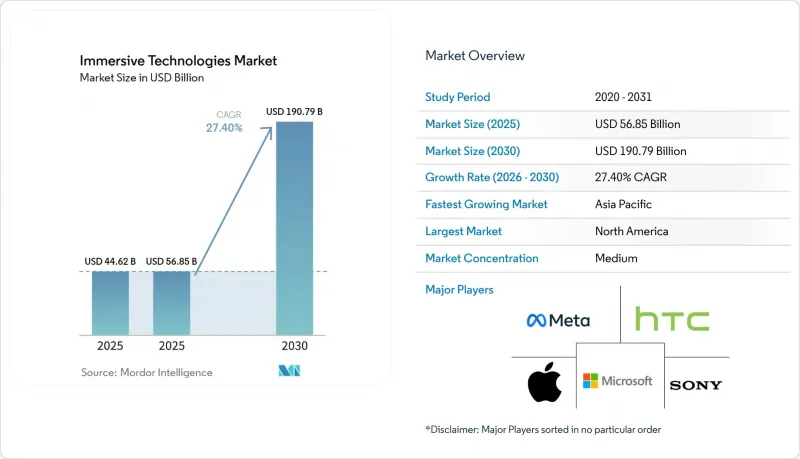
本報告按技術(擴增實境、虛擬實境、混合實境等)、組件(硬體、軟體、服務等)、應用(培訓和模擬、遠端協作、產品設計和原型製作等)、終端用戶產業(遊戲和娛樂、醫療和生命科學等)以及地區進行細分。市場預測以美元計價。
全球身臨其境型技術市場趨勢與洞察
企業努力降低訓練和模擬成本
當財務模型顯示縮短的訓練週期能夠抵銷初始設備成本時,企業便會認可採用身臨其境型技術。在整形外科手術演練中,平均手術時間縮短了18分鐘,併發症減少了15%至20%。像羅氏這樣的製造商利用數位雙胞胎,將其藥品線的檢驗週期從六個月縮短至八週。大規模部署超過500台頭戴式設備,可以將每台設備的授權成本降低35%,而原本的實驗性先導計畫也可轉換為標準作業流程。這些優勢使得身臨其境型科技市場即使對預算有限、尋求可衡量生產力提升的產業也極具吸引力。
用於遊戲和娛樂的AR/ VR頭戴裝置消費市場正在迅速擴張。
隨著員工逐漸習慣使用頭戴式設備並將其帶入職場,消費市場的這股動能正蔓延至企業市場。預計到2025年,中國消費級頭戴式設備的出貨量將達到1,800萬台,一年內成長50%。 Meta的Ray-Ban智慧眼鏡預計到2025年中期銷售量將突破100萬台,顯示其更纖薄的設計越來越受歡迎。隨著虛擬音樂會和虛擬形象交易實現長期用戶互動帶來的利潤,預計到2026年,日本與元宇宙相關的支出將達到1兆日圓(約73億美元)。如今,獨立頭戴式裝置的啟動時間不到3分鐘,這種易用性的顯著提升使得Meta生態系統的每日有效用戶數量增加了40%。因此,用戶對這項技術更加熟悉,企業採用的速度也更快,新的身臨其境型服務項目核准速度也正在加快。
企業級實施需要較高的初始資本投入。
一套完整的部署方案通常需要 5 萬至 50 萬美元的硬體設備、軟體授權和整合成本,導致投資回收期遠超典型的 IT 更新週期。新興市場的中小型企業面臨本地整合商短缺的問題,迫使他們以每天超過 2000 美元的價格引進專業技術,使專案預算增加 25% 至 30%。諸如「XR 即服務」之類的融資模式採用率仍然不足 15%,因為至少三年的合約期限和兩位數的實際利率抵消了其流動性優勢。財務長通常會等到試點營運證明投資回報率後才下單,從而延緩了從概念驗證到生產的過渡。雖然隨著硬體生命週期的延長,這種限制有望逐步緩解,但該市場資本密集的本質仍然對身臨其境型技術的短期前景構成壓力。
細分市場分析
到2025年,虛擬實境(VR)將佔銷售額的31.8%,推動娛樂和身臨其境型培訓計畫的發展。混合實境(MR)憑藉其全彩透視功能,使用戶能夠在數位互動中看到工具和隊友,正逐步擴大其在身臨其境型技術市場的佔有率,預計到2031年將以32.3%的複合年成長率成長。 Apple Vision Pro和MetaQuest 3都允許使用者在VR和MR模式之間切換,從而解決了採購難題並減少了裝置庫存。在生產線和手術室中,團隊傾向於使用MR進行長達數小時的工作流程,因為在這些場景下,對周圍情境察覺至關重要。擴增實境(AR)在現場服務的指導應用中佔據著獨特的地位,因為它允許在不使用戶與周圍環境隔離的情況下疊加圖表。擴增實境(XR)正逐漸成為多模態部署中的採購簡稱,並且擴大出現在企業招標書(提案)中。隨著軟體平台支援與設備無關的運行時,融合成為可能,這將使公司能夠實現適合任務的模式,而無需受限於單一用途的硬體。
隨著市場對混合實境(MR)的需求不斷成長,整合電腦視覺、空間映射和安全認證的服務合約也日益增多。整合商報告稱,由於需要精確地保持現實世界的遮蔽和物體錨定位置,MR部署所需時間比虛擬實境(VR)部署長30%。然而,一旦部署規模達到500台設備,由於工程成本可以透過共用內容庫分攤,每個用戶的成本效益就會提高。隨著供應商改進板載深度感測器,並將傳輸延遲降低到15毫秒以下,用戶舒適度也得到提升,遊戲時間也隨之延長。由此帶來的生產力提升,鞏固了MR作為身臨其境型技術市場主要成長引擎的地位。
到2025年,硬體支出將佔總支出的63.9%,這反映了頭戴式設備的廣泛部署,以及眾多概念驗證(PoC)先導計畫的推出。然而,服務領域的複合年成長率(CAGR)高達31.8%。這是因為企業擴大購買包含內容更新、分析和使用者支援等內容的多年期託管服務。隨著買家從資本支出(CAPEX)轉向可預測的營運支出(OPEX),身臨其境型技術市場的服務市場規模預計到2031年將超過設備銷售額。整合商正在將硬體租賃、客製化3D資產創建和全天候服務台等服務納入年度契約,合約金額從10萬美元到200萬美元不等。軟體平台也間接受益,因為強大的服務團隊推動了軟體利用率的提高和授權續約的增加。
由內而外的光學追蹤技術無需外部基地台,將設置時間從 45 分鐘縮短至 5 分鐘,使得在工廠車間建造臨時教室成為可能。共享顯示牆在設計評審中再次受到關注,因為它允許 10 位相關人員無需佩戴個人頭顯即可查看同一影像。服務供應商透過精心打造這些多模態環境並確保跨裝置和雲端點的資料安全來提升價值。隨著生物辨識資訊監管日益嚴格,合規諮詢進一步拓展了服務市場的機會。硬體供應商透過發布 SDK 並與整合商合作來積極回應,這種互惠互利的關係正在鞏固服務領域作為身臨其境型技術市場成長最快領域的地位。
區域分析
北美地區預計到2025年將佔總收入的27.4%,並將繼續作為製造業、醫療保健和國防領域企業最佳實踐的標竿地區。買家重視與現有IT系統的整合,並傾向於選擇能夠提供網路安全合規性證明的供應商。聯邦訓練預算和國防研究津貼確保了多年持續的需求基礎,即使消費者情緒有所波動。服務合作夥伴集中在大都會圈中心,從而能夠在不降低服務品質的前提下實現全國範圍的服務覆蓋。
亞太地區預計將成為成長最快的地區,到2031年複合年成長率將達到32.6%,因為世界各國政府都將身臨其境型實驗室視為戰略基礎設施。中國的目標是到2025年實現45%的設備國產化率和60%在地採購,以保護生產免受出口限制的影響。印度已撥款39.115億印度盧比(約4,680萬美元)用於印度創新科技學院和AVGC實驗室的建設,計劃在15,000所中小學和500所高校中安裝這些實驗室。此類公共投資創造了可預測的需求管道,創業投資資金可以從中獲利。像Pico這樣的區域供應商在中國的出貨量佔比超過25%,這表明主要企業可以與跨國公司並駕齊驅,蓬勃發展。
歐洲受益於《一般資料保護規則》(GDPR) 和歐盟人工智慧法,這兩項法規明確了生物識別資料的規則,並縮短了受監管產業企業的採購週期。清晰的主權準則增強了買家的信心,但合規性需要諮詢費用,這使得擁有專業法律團隊的供應商更具優勢。南美、中東和非洲地區發展落後,因為5G部署和設備進口關稅導致頭戴式設備的實際價格上漲了高達50%。然而,巴西和沙烏地阿拉伯的試驗計畫表明,一旦連接障礙消除,被壓抑的需求將會釋放。整體而言,地域分散有利於身臨其境型技術市場的長期韌性。
其他好處:
- Excel格式的市場預測(ME)表
- 3個月的分析師支持
目錄
第1章:引言
- 市場分析與定義的前提條件
- 分析範圍
第2章 分析方法
第3章執行摘要
第4章 市場狀況
- 市場概覽
- 產業價值/價值鏈分析
- 宏觀經濟因素對市場的影響
- 市場促進因素
- 消費級AR/ VR頭戴裝置在遊戲和娛樂領域的廣泛應用。
- 企業訓練和模擬中的成本削減措施
- 由於下一代晶片組的應用,硬體的平均售價(ASP)降低
- CaaS(內容即服務)經營模式所產生的經常性收入。
- 5G邊緣渲染技術使更輕、更便宜的穿戴式設備成為可能。
- 基於攝影測量技術的數位雙胞胎可以加快設計週期。
- 市場限制因素
- 企業級設備的購置需要較高的初始資本投入。
- 健康與安全問題(眼睛疲勞、網路暈動症)
- 對觸覺設備用稀土元素磁鐵供應鏈的依賴
- 關於空間資料隱私和主權的法規
- 監理情勢
- 技術展望
- 波特五力分析
第5章:預測市場規模與成長率
- 透過技術
- 擴增實境(AR)
- 虛擬實境(VR)
- 混合實境(MR)
- 擴增實境(XR)
- 按組件
- 硬體
- 頭戴式顯示器(HMD)
- 抬頭顯示器(HUD)
- 投影顯示牆
- 感測器和追蹤系統
- 軟體
- AR/VR內容創作平台
- 模擬軟體
- 即時渲染引擎
- 服務
- 整合與部署
- 諮詢和培訓
- 支援和維護
- 硬體
- 透過使用
- 訓練與模擬
- 遠端協作
- 產品設計與原型製作
- 行銷和廣告
- 零售視覺化
- 患者治療和手術計劃
- 娛樂遊戲
- 其他用途
- 按最終用戶行業分類
- 遊戲與娛樂
- 醫學與生命科學
- 教育/教育科技
- 製造業和工業
- 零售與電子商務
- 航太/國防
- 車
- 房地產與建築
- 其他終端用戶產業
- 按地區
- 北美洲
- 美國
- 加拿大
- 墨西哥
- 南美洲
- 巴西
- 阿根廷
- 其他南美國家
- 歐洲
- 德國
- 英國
- 法國
- 義大利
- 西班牙
- 俄羅斯
- 其他歐洲國家
- 亞太地區
- 中國
- 日本
- 韓國
- 印度
- 澳洲
- 其他亞太國家
- 中東和非洲
- 中東
- 沙烏地阿拉伯
- 阿拉伯聯合大公國
- 土耳其
- 其他中東國家
- 非洲
- 南非
- 奈及利亞
- 其他非洲國家
- 中東
- 北美洲
第6章 競爭情勢
- 市場集中度
- 策略趨勢
- 市佔率分析
- 公司簡介
- Meta Platforms(Reality Labs)
- Microsoft Corporation
- Apple Inc.
- HTC Corporation(Vive)
- Sony Group Corporation
- Alphabet Inc.(Google)
- Qualcomm Technologies Inc.
- Samsung Electronics Co., Ltd.
- Magic Leap, Inc.
- Unity Technologies
- NVIDIA Corporation
- PTC Inc.(Vuforia)
- Varjo Technologies
- Lenovo Group Limited
- Ultraleap Ltd.
- Pico Interactive
- DPVR(Deepoon)
- TeamViewer(Frontline)
- Epson(Moverio)
- Avegant Corporation
- Valve Corporation
- Snap Inc.
- Niantic, Inc.
- Vuzix Corporation
- Autodesk Inc.
第7章 市場機會與未來展望
According to Mordor Intelligence, the immersive technologies market size reached USD 44.62 billion in 2025 and is forecast to expand to USD 152.73 billion by 2030, reflecting a 27.90% CAGR during the period.
This report is Segmented by Technology (Augmented Reality, Virtual Reality, Mixed Reality, and More, Component (Hardware, Software, and Services), Application (Training and Simulation, Remote Collaboration), Product Design and Prototyping, and More), End-User Industry (Gaming and Entertainment, Healthcare and Life Sciences, and More), and Geography. The Market Forecasts are Provided in Terms of Value (USD).
Global Immersive Technologies Market Trends and Insights
Enterprise Training and Simulation Cost-Reduction Initiatives
Enterprises validate immersive deployments when financial models prove that shorter training cycles offset upfront device costs. Surgical rehearsal in orthopedics trimmed average operating-room time by 18 minutes and lowered complications by 15-20%. Manufacturers such as Roche compressed pharmaceutical line validation from six months to eight weeks using digital twins. At scale, fleets above 500 headsets reduce per-seat licensing by 35%, turning previously experimental pilots into standard operating procedure. These gains make the immersive technologies market attractive even to budget-constrained sectors seeking measurable productivity boosts.
Surging Consumer AR and VR Headset Adoption for Gaming and Entertainment
Consumer momentum spills into the enterprise when employees bring headset familiarity to work. China shipped 18 million consumer units in 2025, a 50% jump in one year. Meta's Ray-Ban smart glasses surpassed 1 million sales by mid-2025, showing that slimmer designs broaden appeal. Japan's metaverse spending is tracking toward JPY 1 trillion (USD 7.3 billion) in 2026 because virtual concerts and avatar commerce monetize longer engagement. Stand-alone headsets now launch in under three minutes, a usability leap that raised daily active users by 40% in Meta's ecosystem. The resulting familiarity lowers corporate onboarding time and accelerates project approval for new immersive rollouts.
High Upfront Capex for Enterprise-Grade Deployments
Comprehensive rollouts often require USD 50,000-USD 500,000 for hardware fleets, software licenses, and integration, which stretches payback beyond typical IT refresh windows. Smaller firms in emerging markets face scarce local integrators and must import expertise at daily rates above USD 2,000, adding 25-30% to project budgets. Financing models such as XR as a Service remain below 15% penetration because three-year minimum terms and double-digit effective interest rates blunt liquidity benefits. CFOs delay fleet orders until pilots prove ROI, slowing conversion from proof of concept to production use. Longer hardware life cycles will gradually ease this restraint, but capital intensity still tempers the near-term outlook for the immersive technologies market.
Other drivers and restraints analyzed in the detailed report include:
- 5G Edge Rendering Enabling Lighter, Cheaper Wearables
- Photogrammetry-Based Digital Twins Accelerating Design Cycles
- Health and Safety Concerns (Eye Strain, Cybersickness)
For complete list of drivers and restraints, kindly check the Table Of Contents.
Segment Analysis
Virtual reality accounted for 31.8% of revenue in 2025, dominating entertainment and fully immersive training programs. The immersive technologies market share is gradually shifting as mixed reality accelerates at a 32.3% CAGR through 2031, thanks to full-color passthrough that lets users see tools and teammates during digital interaction. Apple Vision Pro and Meta Quest 3 both toggle between VR and MR modes, eliminating procurement dilemmas and cutting device inventory. In manufacturing lines and operating rooms, teams favor MR for multi-hour workflows where physical situational awareness is mandatory. Augmented reality maintains a niche for field-service guidance because it overlays schematics without isolating the wearer. Extended reality serves as procurement shorthand for multi-modal deployments and increasingly appears in enterprise RFPs. Convergence is likely as software platforms speak to device-agnostic runtimes, letting firms deploy the right mode for each task without locking into single-use hardware.
Demand for MR elevates service engagements that integrate computer vision, spatial mapping, and safety certification. Integrators report that MR rollouts take 30% longer than VR because physical-world occlusion and object anchoring must remain precise. Nevertheless, per seat economics improve once deployments reach 500 devices, which is when shared content libraries amortize engineering costs. As vendors refine onboard depth sensors and pass-through latency falls below fifteen milliseconds, user comfort grows and dwell times lengthen. The resulting productivity boost reinforces MR's position as the primary growth engine for the immersive technologies market.
Hardware captured 63.9% of 2025 spending, reflecting the headset fleets that launched many proof-of-concept pilots. Yet services are scaling at a 31.8% CAGR because enterprises now purchase multi-year managed offerings that include content refresh, analytics, and user support. The immersive technologies market size for services is projected to outpace device revenue before 2031 as buyers trade capital expense for predictable operating budgets. Integrators bundle hardware leasing, custom 3D asset creation, and 24-hour help desks into contracts priced at USD 100,000-USD 2 million per year. Software platforms benefit indirectly because robust services teams drive higher seat utilization and license renewals.
Inside-out optical tracking has eliminated external base stations, shrinking set-up from forty-five to five minutes and making pop-up classrooms possible on factory floors. Collaborative display walls regain interest for design reviews because ten stakeholders can view a twin without donning separate headsets. Service providers add value by curating these multimodal environments and ensuring data security across devices and cloud endpoints. As regulations tighten around biometric information, compliance consulting further inflates the services opportunity. Hardware vendors respond by opening SDKs and partnering with integrators, a symbiosis that cements services as the fastest-growing slice of the immersive technologies market.
Geography Analysis
North America generated 27.4% of 2025 revenue and remains a reference region for enterprise best practices in manufacturing, healthcare and defense. Buyers emphasize integration with legacy IT and favor suppliers that document cybersecurity compliance. Federal training budgets and defense research grants ensure a baseline of multi-year demand, even when consumer sentiment fluctuates. Services partners cluster around metropolitan hubs, enabling nationwide coverage without diluting quality.
Asia-Pacific is the fastest climber at a 32.6% CAGR through 2031 as governments classify immersive labs as strategic infrastructure. China achieved 45% domestic device autonomy and 60% component localization in 2025, insulating production from export controls. India earmarked INR 391.15 crore (USD 46.8 million) for the Indian Institute of Creative Technologies and embedded AVGC labs in 15,000 schools and 500 colleges. Such public investment creates a predictable pipeline demand that venture funding can leverage. Regional vendors like Pico hold more than 25% of China's unit shipments, showing that local champions can thrive alongside multinationals.
Europe benefits from GDPR and the EU AI Act, which clarify biometric data rules and shorten enterprise procurement cycles in regulated sectors. Clear sovereignty guidelines lift buyer confidence, though compliance adds consulting overhead that favors vendors with dedicated legal teams. South America and the Middle East and Africa trail because 5G build-outs and device import duties raise effective headset prices by up to 50%. Nonetheless, pilot programs in Brazil and Saudi Arabia demonstrate pent-up interest once connectivity barriers fall. Overall, geographic diversification anchors the long-term resilience of the immersive technologies market.
- Meta Platforms (Reality Labs)
- Microsoft Corporation
- Apple Inc.
- HTC Corporation (Vive)
- Sony Group Corporation
- Alphabet Inc. (Google)
- Qualcomm Technologies Inc.
- Samsung Electronics Co., Ltd.
- Magic Leap, Inc.
- Unity Technologies
- NVIDIA Corporation
- PTC Inc. (Vuforia)
- Varjo Technologies
- Lenovo Group Limited
- Ultraleap Ltd.
- Pico Interactive
- DPVR (Deepoon)
- TeamViewer (Frontline)
- Epson (Moverio)
- Avegant Corporation
- Valve Corporation
- Snap Inc.
- Niantic, Inc.
- Vuzix Corporation
- Autodesk Inc.
Additional Benefits:
- The market estimate (ME) sheet in Excel format
- 3 months of analyst support
TABLE OF CONTENTS
1 INTRODUCTION
- 1.1 Study Assumptions & Market Definition
- 1.2 Scope of the Study
2 RESEARCH METHODOLOGY
3 EXECUTIVE SUMMARY
4 MARKET LANDSCAPE
- 4.1 Market Overview
- 4.2 Industry Value / Supply-Chain Analysis
- 4.3 Impact of Macroeconomic Factors on the Market
- 4.4 Market Drivers
- 4.4.1 Surging Consumer AR/VR Headset Adoption for Gaming and Entertainment
- 4.4.2 Enterprise Training and Simulation Cost-Reduction Initiatives
- 4.4.3 Declining Hardware ASPs Driven by Next-Gen Chipsets
- 4.4.4 Content-as-a-Service Business Models Unlocking Recurring Revenue
- 4.4.5 5G Edge Rendering Enabling Lighter, Cheaper Wearables
- 4.4.6 Photogrammetry-Based Digital Twins Accelerating Design Cycles
- 4.5 Market Restraints
- 4.5.1 High Upfront Capex for Enterprise-Grade Deployments
- 4.5.2 Health and Safety Concerns (Eye Strain, Cybersickness)
- 4.5.3 Supply-Chain Reliance on Rare-Earth Magnets for Haptics
- 4.5.4 Spatial-Data Privacy and Sovereignty Regulations
- 4.6 Regulatory Landscape
- 4.7 Technological Outlook
- 4.8 Porter's Five Forces Analysis
- 4.8.1 Threat of New Entrants
- 4.8.2 Bargaining Power of Buyers
- 4.8.3 Bargaining Power of Suppliers
- 4.8.4 Threat of Substitutes
- 4.8.5 Competitive Rivalry
5 MARKET SIZE AND GROWTH FORECASTS (VALUE)
- 5.1 By Technology
- 5.1.1 Augmented Reality (AR)
- 5.1.2 Virtual Reality (VR)
- 5.1.3 Mixed Reality (MR)
- 5.1.4 Extended Reality (XR)
- 5.2 By Component
- 5.2.1 Hardware
- 5.2.1.1 Head-Mounted Displays (HMDs)
- 5.2.1.2 Head-Up Displays (HUDs)
- 5.2.1.3 Projectors and Display Walls
- 5.2.1.4 Sensors and Tracking Systems
- 5.2.2 Software
- 5.2.2.1 AR/VR Content Creation Platforms
- 5.2.2.2 Simulation Software
- 5.2.2.3 Real-Time Rendering Engines
- 5.2.3 Services
- 5.2.3.1 Integration and Deployment
- 5.2.3.2 Consulting and Training
- 5.2.3.3 Support and Maintenance
- 5.2.1 Hardware
- 5.3 By Application
- 5.3.1 Training and Simulation
- 5.3.2 Remote Collaboration
- 5.3.3 Product Design and Prototyping
- 5.3.4 Marketing and Advertising
- 5.3.5 Retail Visualization
- 5.3.6 Patient Therapy and Surgical Planning
- 5.3.7 Entertainment and Gaming
- 5.3.8 Other Applications
- 5.4 By End-User Industry
- 5.4.1 Gaming and Entertainment
- 5.4.2 Healthcare and Life Sciences
- 5.4.3 Education and EdTech
- 5.4.4 Manufacturing and Industrial
- 5.4.5 Retail and E-Commerce
- 5.4.6 Aerospace and Defense
- 5.4.7 Automotive
- 5.4.8 Real Estate and Architecture
- 5.4.9 Other End-User Industries
- 5.5 By Geography
- 5.5.1 North America
- 5.5.1.1 United States
- 5.5.1.2 Canada
- 5.5.1.3 Mexico
- 5.5.2 South America
- 5.5.2.1 Brazil
- 5.5.2.2 Argentina
- 5.5.2.3 Rest of South America
- 5.5.3 Europe
- 5.5.3.1 Germany
- 5.5.3.2 United Kingdom
- 5.5.3.3 France
- 5.5.3.4 Italy
- 5.5.3.5 Spain
- 5.5.3.6 Russia
- 5.5.3.7 Rest of Europe
- 5.5.4 Asia-Pacific
- 5.5.4.1 China
- 5.5.4.2 Japan
- 5.5.4.3 South Korea
- 5.5.4.4 India
- 5.5.4.5 Australia
- 5.5.4.6 Rest of Asia-Pacific
- 5.5.5 Middle East and Africa
- 5.5.5.1 Middle East
- 5.5.5.1.1 Saudi Arabia
- 5.5.5.1.2 United Arab Emirates
- 5.5.5.1.3 Turkey
- 5.5.5.1.4 Rest of Middle East
- 5.5.5.2 Africa
- 5.5.5.2.1 South Africa
- 5.5.5.2.2 Nigeria
- 5.5.5.2.3 Rest of Africa
- 5.5.5.1 Middle East
- 5.5.1 North America
6 COMPETITIVE LANDSCAPE
- 6.1 Market Concentration
- 6.2 Strategic Moves
- 6.3 Market Share Analysis
- 6.4 Company Profiles (includes Global Level Overview, Market Level Overview, Core Segments, Financials as available, Strategic Information, Market Rank/Share, Products and Services, Recent Developments)
- 6.4.1 Meta Platforms (Reality Labs)
- 6.4.2 Microsoft Corporation
- 6.4.3 Apple Inc.
- 6.4.4 HTC Corporation (Vive)
- 6.4.5 Sony Group Corporation
- 6.4.6 Alphabet Inc. (Google)
- 6.4.7 Qualcomm Technologies Inc.
- 6.4.8 Samsung Electronics Co., Ltd.
- 6.4.9 Magic Leap, Inc.
- 6.4.10 Unity Technologies
- 6.4.11 NVIDIA Corporation
- 6.4.12 PTC Inc. (Vuforia)
- 6.4.13 Varjo Technologies
- 6.4.14 Lenovo Group Limited
- 6.4.15 Ultraleap Ltd.
- 6.4.16 Pico Interactive
- 6.4.17 DPVR (Deepoon)
- 6.4.18 TeamViewer (Frontline)
- 6.4.19 Epson (Moverio)
- 6.4.20 Avegant Corporation
- 6.4.21 Valve Corporation
- 6.4.22 Snap Inc.
- 6.4.23 Niantic, Inc.
- 6.4.24 Vuzix Corporation
- 6.4.25 Autodesk Inc.
7 MARKET OPPORTUNITIES AND FUTURE OUTLOOK
- 7.1 White-Space and Unmet-Need Assessment

 全球身臨其境型技術市場規模、佔有率、趨勢和成長分析報告(2026-2034)
 沉浸式技術市場:全球預測,2026-2032年
 身臨其境型技術市場:按組件、技術、終端用戶產業和地區分類
 2026年全球沉浸式技術市場報告
 身臨其境型技術市場分析及預測(至2035年):按類型、產品類型、服務、技術、組件、應用、設備、部署類型、最終用戶和解決方案分類
 企業沉浸式科技市場-全球產業規模、佔有率、趨勢、機會與預測:按組件、技術、應用、地區和競爭格局分類,2021-2031年採礦業身臨其境型技術市場-全球產業規模、佔有率、趨勢、機會和預測:按組件、技術、應用、地區和競爭格局分類,2021-2031年
 身臨其境型科技的全球市場
 沉浸式技術市場規模、佔有率、趨勢分析報告:按組件、按技術類型、按應用、按行業、按地區、細分市場預測,2025-2030 年