


 |
市場調查報告書
商品編碼
2062182
巰基乙酸:市場佔有率分析、產業趨勢與統計、成長預測(2026-2031)Thioglycolic Acid - Market Share Analysis, Industry Trends & Statistics, Growth Forecasts (2026 - 2031) |
||||||

※ 本網頁內容可能與最新版本有所差異。詳細情況請與我們聯繫。
根據 Mordor Intelligence 預測,巰基乙酸市場規模將從 2025 年的 1.2824 億美元成長到 2026 年的 1.3382 億美元,到 2031 年達到 1.6557 億美元,2026 年至 2031 年的複合成長率預計為 4.35%。
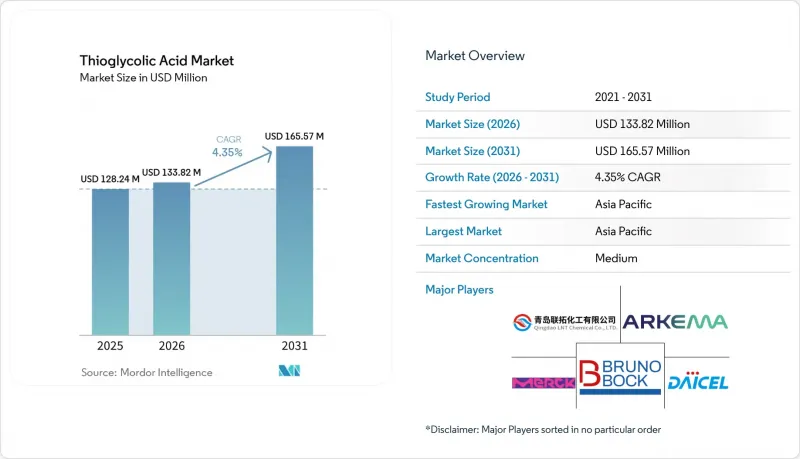
本報告按等級(技術級和高純度級)、應用領域(護髮和化妝品、石油和天然氣行業、皮革加工、紡織業、化工中間體及其他)和地區(亞太地區、北美地區、歐洲地區、南美地區以及中東和非洲地區)進行細分。市場預測以美元計價。
全球巰基乙酸市場趨勢及洞察
擴大其在油氣井酸處理中作為腐蝕抑制劑的應用
巰基乙酸 (TGA) 兼具還原劑和螯合配體的雙重作用。它在碳酸鹽儲存基質酸處理中控制鐵含量方面特別有效。在這些儲存中,氫氧化鐵沉澱會降低井口附近的滲透性,從而可能降低增產措施的效果。 TGA 即使在低濃度下也能有效發揮作用,將 Fe³⁺ 轉化為更穩定的螯合 Fe²⁺ 形式。與檸檬酸、EDTA 和 NTA 等傳統螯合劑以及異抗壞血酸和抗壞血酸等還原劑不同,TGA 即使在高溫和酸性 pH 條件下也能保持穩定。此外,TGA 的巰基在高溫下會在低碳鋼表面形成一層保護性的 Fe-S 膜。該膜能夠抑制高濃度鹽溶液和高 H₂S 環境下的腐蝕,而這些環境在深海和傳統型油井中經常遇到。包括 TGA 在內的含硫小分子透過 Fe-S 鍵結合。與鎢酸鹽和硫脲等增強劑結合使用,可顯著降低腐蝕速率。隨著產業向超高溫井(150°C以上)和頁岩地層長距離水平井轉型,對熱穩定性好、低劑量緩蝕劑的需求日益成長。這些緩蝕劑不僅能最大限度地減少對地質構造的損害,還能降低化學品的物流成本。
PVC作為熱穩定劑和其他中間體的消費量不斷擴大。
有機錫巰基乙酸酯可用作熱穩定劑,尤其是在食品接觸包裝和飲用水管的PVC配方中。鑑於嚴格的監管標準強調低毒性和最小遷移性,這些酯類已被批准用於PVC水管、泵浦和食品加工設備,可提高透明度和熱穩定性。更嚴格的法規正在推動全球逐步淘汰鉛和鎘基穩定劑,從而擴大鈣鋅和有機錫替代品的市場。然而,挑戰依然存在,主要源自於成本和整合方面的障礙。鈣基PVC穩定劑產能的擴張凸顯了監管部門敦促從液態穩定劑體係向固體穩定劑系統過渡的措施。除PVC外,巰基乙酸酯還可用作丙烯酸和丙烯酸酯乳化中的鏈轉變劑。其完全的水溶性和親核反應活性使其能夠在水性環境中實現精確的分子量控制。雖然TGA在聚合物添加劑領域佔據著一個獨特但重要的地位,但由於亞太地區靠近下游PVC和丙烯酸樹脂製造商,因此該地區在生產能力方面處於主導地位。
TGA濃度的嚴格消費者安全標準
歐盟化妝品法規的最新修訂對化妝品中的巰基乙酸(TGA)及其鹽類施加了嚴格的限制。這些法規根據產品的pH值,規定了消費者和專業人士使用燙髮和拉直產品的不同最高濃度限制。除毛產品和沖洗型護髮產品也設定了明確的濃度限制。此外,由於擔心刺激眼睛,睫毛燙髮產品僅限專業人士使用,一般消費者無法購買。諸如「請將本品放在兒童不能接觸的地方。如不慎入眼,請立即沖洗。佩戴合適的手套。含有巰基乙酸。請遵照使用說明。請將本品放在兒童不能接觸的地方」之類的標籤警告,不僅增加了成本,也限制了配方的柔軟性。東協成員國也遵循這些法規,在主要消費市場建立了嚴格的監管環境。對於消費者使用的燙髮產品,巰基乙酸和硫代乳酸的總合濃度上限限制了產品開發人員的配方能力。這導致單位盈利下降,並且隨著利潤率更高的專業配方被推向授權通路,市場也變得分散。
細分市場分析
2025年,技術級產品佔總銷售額的54.11%,在PVC穩定劑、油田化學品和皮革除毛處理劑等領域展現強勁的價格競爭力。同時,受醫藥中間體和光電子領域(這些領域對顏色和微量金屬含量要求極高)需求的推動,高純度級產品在2026年至2031年的預測期內實現了4.66%的強勁複合年成長率。線上GC/FTIR和MCA熔融結晶等創新技術有效降低了二氯乙酸雜質的含量,確保了產品的高純度和無缺陷。
需求趨勢呈現兩極化。工業買家通常可以容忍少量二硫代乙醇酸殘留,而量子點製造商和生物素生產商則願意支付更高的價格,以確保水分含量嚴格低於0.1%,金屬含量低於1ppm。隨著ESG(環境、社會和管治)驅動的熔融結晶設備升級以及ISCC+物料平衡認證原料的引入,生產商正在最大限度地提高硫代乙醇酸市場特種產品的利潤率。
區域分析
到2025年,亞太地區將佔據全球47.79%的銷售額,預計在2026年至2031年的預測期內將以5.07%的複合年成長率成長。中國是該地區MCA的主要供應國,正透過在2028年啟動大亞灣裂解裝置和高性能裝置的運作來鞏固其市場地位。這項策略性舉措旨在滿足下游對PVC穩定劑和量子點材料日益成長的需求。同時,印度的蓖麻油供應不僅支撐了生物基產品的發展,也加劇了巰基乙酸市場的競爭。日本和韓國的研究中心已成功將TGA包覆的CdTe量子點商業化,並將目光投向了下一代顯示器市場。
在北美,頁岩氣業者擴大選擇TGA而非EDTA作為腐蝕抑制劑,凸顯了TGA的重要性。這種轉變主要歸因於美國職業安全與健康管理局(OSHA)的暴露法規,該法規鼓勵使用低氣味合成方法。在歐洲,儘管供應成長放緩,但對高純度產品的需求卻在激增,尤其是製藥和專業化妝品行業。 REACH法規正引領產業朝向熔融結晶MCA和封閉回路型硫處理方法發展,而歐洲工廠在低排放技術方面處於領先地位。
南美洲、中東和非洲目前仍是小眾市場,但它們正開始展現出潛力。巴西和阿根廷的礦場正在測試非氰化浸出方法,沙烏地阿拉伯的高鹽度儲存也為引入基於TGA的酸處理混合物鋪平了道路。這些地區未來的成長軌跡取決於TGA作為傳統氰化物和硫代硫酸鹽方法的替代方案的成本效益以及監管部門的批准。
其他好處:
- Excel格式的市場預測(ME)表
- 3個月的分析師支持
目錄
第1章:引言
- 研究假設和市場定義
- 調查範圍
第2章:調查方法
第3章執行摘要
第4章 市場狀況
- 市場概覽
- 市場促進因素
- 擴大其在油氣井酸處理中作為腐蝕抑制劑的應用
- PVC熱穩定劑和其他中間體的消耗量增加。
- 量子點鈍化技術在光電子領域的應用
- 採用TGA配體的新型非氰化物金浸出技術
- 低氣味、低硫化氫的合成過程提高了環境、健康與安全合規性和工廠運轉率。
- 市場限制因素
- TGA濃度的嚴格消費者安全標準
- 原料價格波動(一氯乙酸、硫化氫)
- 生物基還原劑作為高階化妝品中TGA的替代品
- 價值鏈分析
- 波特五力分析
第5章 市場規模與成長預測
- 按年級
- 技術級
- 高純度
- 透過使用
- 護髮和化妝品
- 石油和天然氣產業
- 皮革加工
- 紡織業
- 化學中間體
- 其他
- 按地區
- 亞太地區
- 中國
- 印度
- 日本
- 韓國
- 東南亞國協
- 其他亞太國家
- 北美洲
- 美國
- 加拿大
- 墨西哥
- 歐洲
- 德國
- 英國
- 法國
- 義大利
- 西班牙
- 俄羅斯
- 其他歐洲國家
- 南美洲
- 巴西
- 阿根廷
- 其他南美國家
- 中東和非洲
- 沙烏地阿拉伯
- 南非
- 其他中東和非洲國家
- 亞太地區
第6章 競爭情勢
- 市場集中度
- 策略趨勢
- 市佔率和排名分析
- 公司簡介
- Anoky Co.,Ltd. No
- Arkema
- Biosynthetic Technologies
- BRUNO BOCK
- Daicel Corporation
- Discovery Fine Chemicals
- Hunan ke sheng new materials co., LTD
- Jinan Qinmu Fine Chemical
- Merck KGaA
- Nouryon
- Osaka Sasaki Chemical Co. Ltd
- Qingdao LNT Chemical Co., Ltd
- Quingdao Ruchang Mining Industry Co., LTD
- SASAKICHEMICAL CO.,LTD
- Shandong Xinhua Pharma
- Tokyo Chemical Industry(India)Pvt. Ltd.
- Wuhan Grand Hoyo
第7章 市場機會與未來展望
According to Mordor Intelligence, the thioglycolic acid market size is expected to increase from USD 128.24 million in 2025 to USD 133.82 million in 2026 and reach USD 165.57 million by 2031, growing at a CAGR of 4.35% over 2026-2031.
This report is Segmented by Grade (Technical Grade and High Purity Grade), Application (Hair Care and Cosmetic Products, Oil and Gas Industry, Leather Processing, Textile Industry, Chemical Intermediates, and Others), and Geography (Asia-Pacific, North America, Europe, South America, Middle-East and Africa). The Market Forecasts are Provided in Terms of Value (USD).
Global Thioglycolic Acid Market Trends and Insights
Rising Use as Corrosion Inhibitor in Oil and Gas Well Acidizing
Thioglycolic acid (TGA) serves a dual purpose: as a reducing agent and a chelating ligand. It is particularly effective in controlling iron during the matrix acidizing of carbonate reservoirs. In these reservoirs, ferric hydroxide precipitation can hinder near-wellbore permeability, reducing stimulation effectiveness. TGA operates efficiently at low concentrations, converting Fe3+ to the more stable chelated Fe2+ form. Unlike traditional chelants, such as citric acid, EDTA, and NTA, or reducers like erythorbic and ascorbic acids, TGA remains stable even at high temperatures and acidic pH levels. Additionally, TGA's thiol group forms a protective Fe-S film on mild steel at elevated temperatures. This film inhibits corrosion in concentrated salt solutions and high-H2S environments, conditions often encountered in deepwater and unconventional wells. Small sulfur-containing molecules, including TGA, bond through Fe-S connections. When paired with intensifiers like tungstate or thiourea, they can drastically cut corrosion rates. As the industry pivots to ultra-high-temperature wells (over 150 degrees Celsius) and extended-reach horizontal laterals in shale plays, there is a rising demand for thermally stable, low-dosage inhibitors. These inhibitors not only minimize formation damage but also reduce chemical logistics costs.
Growing Consumption as PVC Heat Stabilizer and Other Intermediates
Organotin thioglycolates are being adopted as thermal stabilizers in PVC formulations, especially for food-contact packaging and potable-water piping. Given the stringent regulatory standards emphasizing low toxicity and minimal migration, these esters have gained approval for use in PVC water pipes, pumps, and food-processing equipment, boosting both transparency and thermal stability. The global move away from lead and cadmium-based stabilizers, due to regulatory crackdowns, has expanded the market for calcium-zinc and organotin alternatives. Yet, challenges persist, primarily due to cost and integration hurdles. The ramp-up of calcium-based PVC stabilizer capacity highlights the regulatory push steering a transition from liquid to solid stabilizer systems. Beyond PVC, TGA finds application as a chain-transfer agent in the emulsion polymerization of acrylic acid and acrylates. Its complete water miscibility and nucleophilic reactivity allow for precise molecular-weight control in aqueous environments. While TGA holds a niche yet crucial position in polymer additives, the Asia-Pacific region leads in production capacity, thanks to its closeness to downstream PVC and acrylic resin manufacturers.
Strict Consumer-Safety Limits on TGA Concentration
Recent amendments to the European Union's Cosmetic Products Regulation impose stringent limits on TGA and its salts in cosmetic products. The regulation sets maximum concentrations for hair-waving or straightening products, varying for general consumers and professionals based on the product's pH. Depilatories and rinse-off hair-care items also face defined concentration caps. Due to potential eye irritation risks, products for eyelash waving are restricted to professional use, making them unavailable to general consumers. Compliance mandates, such as labeling warnings like "Avoid eye contact; rinse immediately if contact occurs; wear suitable gloves; contains thioglycolate; follow instructions; keep out of reach of children," not only increase costs but also limit formulation flexibility. ASEAN member states have mirrored these restrictions, establishing a stringent regulatory landscape across major consumer markets. In general-use hair-waving products, the cap on the combined concentration of TGA and thiolactic acid limits formulators' blending capabilities, reducing revenue potential per unit and pushing higher-margin professional formulations into licensed channels, fragmenting the market.
Other drivers and restraints analyzed in the detailed report include:
- Adoption in Quantum-Dot Passivation for Opto-Electronics
- Emerging Non-Cyanide Gold-Leaching Chemistries Using TGA Ligands
- Feedstock Volatility (Monochloroacetic Acid, H2S)
For complete list of drivers and restraints, kindly check the Table Of Contents.
Segment Analysis
In 2025, the Technical Grade accounted for 54.11% of the revenue, highlighting its pricing edge in PVC stabilizers, oilfield chemicals, and leather dehairing. Meanwhile, the High Purity Grade, driven by demand in pharmaceutical intermediates and optoelectronics, where color and trace metals are critical, experienced a robust CAGR of 4.66% during the forecast period of 2026-2031. Innovations such as Inline GC/FTIR techniques and the melt crystallization of MCA have effectively minimized dichloroacetate impurities, ensuring a flawless high-purity output.
Demand dynamics reveal a split. Industrial buyers may tolerate minor dithioglycolic acid residues, but quantum-dot manufacturers and biotin producers are willing to pay a premium for water content strictly below 0.1% and metals limited to 1 ppm. With ESG-driven upgrades in melt crystallizers and the integration of ISCC+ mass-balance feedstocks, producers are capitalizing on specialty margins in the thioglycolic acid market.
Geography Analysis
In 2025, the Asia-Pacific region commanded a dominant 47.79% share of the revenue and is set to expand at a CAGR of 5.07% through the forecast period of 2026-2031. China, a key player in the region's MCA supply, is solidifying its stance with the 2028 commissioning of a cracker and a high-performance unit at Daya Bay. This strategic move targets the burgeoning downstream demand for PVC stabilizers and quantum-dot materials. Concurrently, India's castor supply not only supports bio-based products but also intensifies competition in the thioglycolic acid market. Research hubs in Japan and South Korea are successfully commercializing TGA-capped CdTe QDs, setting their sights on the next-generation display market.
North America asserts its significance, with shale operators increasingly opting for TGA corrosion inhibitors over EDTA for their wells. This shift is largely driven by OSHA's exposure regulations advocating for low-odor synthesis. Europe, despite experiencing slower volume growth, is witnessing a surge in demand for High Purity Grade products, particularly in the pharmaceutical and professional beauty sectors. The REACH initiative is guiding the industry towards melt-crystallized MCA and a closed-loop sulfur handling approach, elevating European plants to the forefront of low-emission technologies.
While South America, the Middle-East and Africa remain niche players, they are beginning to show potential. Mines in Brazil and Argentina are trialing non-cyanide leaching methods, and Saudi Arabia's high-salinity reservoirs are paving the way for TGA-based acidizing blends. The future growth trajectory in these regions hinges on cost validations and the regulatory acceptance of TGA over conventional cyanide or thiosulfate methods.
- Anoky Co.,Ltd. No
- Arkema
- Biosynthetic Technologies
- BRUNO BOCK
- Daicel Corporation
- Discovery Fine Chemicals
- Hunan ke sheng new materials co., LTD
- Jinan Qinmu Fine Chemical
- Merck KGaA
- Nouryon
- Osaka Sasaki Chemical Co. Ltd
- Qingdao LNT Chemical Co., Ltd
- Quingdao Ruchang Mining Industry Co., LTD
- SASAKICHEMICAL CO.,LTD
- Shandong Xinhua Pharma
- Tokyo Chemical Industry (India) Pvt. Ltd.
- Wuhan Grand Hoyo
Additional Benefits:
- The market estimate (ME) sheet in Excel format
- 3 months of analyst support
TABLE OF CONTENTS
1 Introduction
- 1.1 Study Assumptions and Market Definition
- 1.2 Scope of the Study
2 Research Methodology
3 Executive Summary
4 Market Landscape
- 4.1 Market Overview
- 4.2 Market Drivers
- 4.2.1 Rising use as corrosion inhibitor in oil and gas well acidizing
- 4.2.2 Growing consumption as PVC heat-stabilizer and other intermediates
- 4.2.3 Adoption in quantum-dot passivation for opto-electronics
- 4.2.4 Emerging non-cyanide gold-leaching chemistries using TGA ligands
- 4.2.5 Low-odor, low-H2S syntheses boosting EHS compliance and plant uptime
- 4.3 Market Restraints
- 4.3.1 Strict Consumer-Safety Limits on TGA Concentration
- 4.3.2 Feedstock Volatility (Monochloroacetic Acid, H2S)
- 4.3.3 Bio-Based Reductants Replacing TGA in Premium Cosmetics
- 4.4 Value Chain Analysis
- 4.5 Porter's Five Forces Analysis
- 4.5.1 Threat of New Entrants
- 4.5.2 Bargaining Power of Suppliers
- 4.5.3 Bargaining Power of Buyers
- 4.5.4 Threat of Substitutes
- 4.5.5 Competitive Rivalry
5 Market Size and Growth Forecasts (Value)
- 5.1 By Grade
- 5.1.1 Technical Grade
- 5.1.2 High Purity Grade
- 5.2 By Application
- 5.2.1 Hair Care and Cosmetic Products
- 5.2.2 Oil and Gas Industry
- 5.2.3 Leather Processing
- 5.2.4 Textile Industry
- 5.2.5 Chemical Intermediates
- 5.2.6 Others
- 5.3 By Geography
- 5.3.1 Asia-Pacific
- 5.3.1.1 China
- 5.3.1.2 India
- 5.3.1.3 Japan
- 5.3.1.4 South Korea
- 5.3.1.5 ASEAN Countries
- 5.3.1.6 Rest of Asia-Pacific
- 5.3.2 North America
- 5.3.2.1 United States
- 5.3.2.2 Canada
- 5.3.2.3 Mexico
- 5.3.3 Europe
- 5.3.3.1 Germany
- 5.3.3.2 United Kingdom
- 5.3.3.3 France
- 5.3.3.4 Italy
- 5.3.3.5 Spain
- 5.3.3.6 Russia
- 5.3.3.7 Rest of Europe
- 5.3.4 South America
- 5.3.4.1 Brazil
- 5.3.4.2 Argentina
- 5.3.4.3 Rest of South America
- 5.3.5 Middle-East and Africa
- 5.3.5.1 Saudi Arabia
- 5.3.5.2 South Africa
- 5.3.5.3 Rest of Middle-East and Africa
- 5.3.1 Asia-Pacific
6 Competitive Landscape
- 6.1 Market Concentration
- 6.2 Strategic Moves
- 6.3 Market Share(%)/Ranking Analysis
- 6.4 Company Profiles (includes Global Overview, Market Overview, Core Segments, Financials, Strategic Information, Products and Services, and Recent Developments)
- 6.4.1 Anoky Co.,Ltd. No
- 6.4.2 Arkema
- 6.4.3 Biosynthetic Technologies
- 6.4.4 BRUNO BOCK
- 6.4.5 Daicel Corporation
- 6.4.6 Discovery Fine Chemicals
- 6.4.7 Hunan ke sheng new materials co., LTD
- 6.4.8 Jinan Qinmu Fine Chemical
- 6.4.9 Merck KGaA
- 6.4.10 Nouryon
- 6.4.11 Osaka Sasaki Chemical Co. Ltd
- 6.4.12 Qingdao LNT Chemical Co., Ltd
- 6.4.13 Quingdao Ruchang Mining Industry Co., LTD
- 6.4.14 SASAKICHEMICAL CO.,LTD
- 6.4.15 Shandong Xinhua Pharma
- 6.4.16 Tokyo Chemical Industry (India) Pvt. Ltd.
- 6.4.17 Wuhan Grand Hoyo
7 Market Opportunities and Future Outlook
- 7.1 White-space and Unmet-Need Assessment

 乙醇酸市場-2026-2032年全球市場預測
 2026-2030年全球乙醇酸市場
 α-羥基酸(AHA)市場規模、佔有率和成長分析:按類型、原料、形態、分銷管道、最終用途和地區分類-2026-2033年產業預測
 巰基乙酸市場:依等級、應用和地區分類巰基乙酸市場:依類型、實體形態、應用、終端用戶產業及通路分類-2026-2032年全球市場預測
 2026年全球α-羥基酸市場報告
 乙醇酸市場規模、佔有率、趨勢和預測:按原料、純度、應用和地區分類,2026-2034年
 乙醇酸市場分析及預測(至2035年):類型、產品類型、應用、最終用戶、形態、技術、成分、製程、功能
 全球乙醇酸市場規模、佔有率、趨勢和成長分析報告(2026-2034)全球巰基乙酸市場規模、佔有率、趨勢和成長分析報告(2026-2034年)