


 |
市場調查報告書
商品編碼
2062167
油漆剝離劑:市場佔有率分析、產業趨勢與統計、成長預測(2026-2031)Paint Remover - Market Share Analysis, Industry Trends & Statistics, Growth Forecasts (2026 - 2031) |
||||||

※ 本網頁內容可能與最新版本有所差異。詳細情況請與我們聯繫。
根據 Mordor Intelligence 預測,油漆剝離劑市場規模將從 2025 年的 14.9 億美元成長到 2026 年的 15.8 億美元,到 2031 年將達到 21.1 億美元,2026 年至 2031 年的複合年成長率為 5.93%。
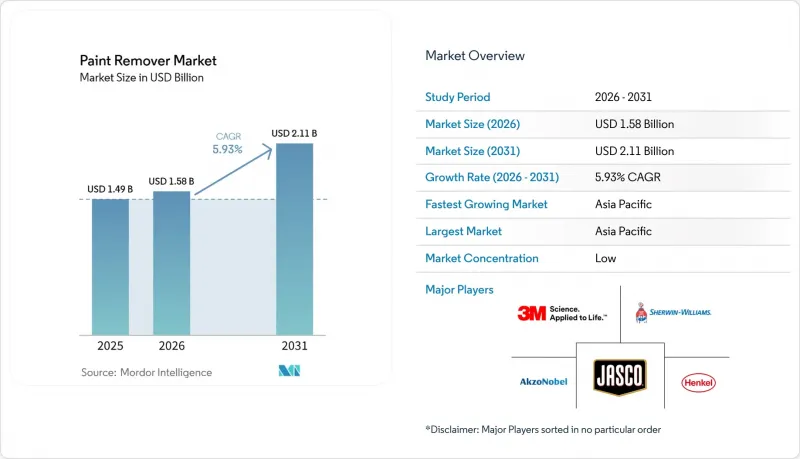
本報告按產品類型(溶劑型脫漆劑、生物基脫漆劑等)、形態(液體、凝膠、膏狀等)、應用領域(住宅DIY、商業建築維護等)、終端用戶行業(建築、交通運輸等)以及地區(亞太地區、北美地區、歐洲地區、南美地區、中東和非洲地區)進行細分。市場預測以美元(USD)計價。
全球脫漆劑市場趨勢及洞察
對二氯甲烷的監管禁令
2024年5月,美國環保署(EPA)宣布了一項法規,計畫在2025年5月前逐步淘汰消費者使用二氯甲烷,並在2026年4月前對大多數商業應用實施類似措施。這項法規迫使配方生產商考慮使用大豆甲酯、d-檸檬烯和苛性鹼混合物等替代品。持有某些有限豁免申請的公司必須實施工程措施和即時空氣監測,預計將使合規成本增加約15%至20%。第五巡迴上訴法院於2026年初恢復的訴訟推遲了部分生物基生產能力的投資。此外,美國食品藥物管理局(FDA)針對食品加工中二氯甲烷溶劑的相關行動表明,聯邦層級正在發生更廣泛的轉變,加速塗料價值鏈內的替代進程。
維修改造熱潮
中國計劃維修5.3萬套老舊城市住宅小區,到2028年將大規模拆除並重新粉刷外牆。在美國,哈佛大學住宅研究聯合中心預測,受40年以上住宅存量不斷增加的推動,房屋翻新支出將持續強勁成長至2026年。隨著建築符合綠色建築認證標準(該標準要求使用低揮發性有機化合物、可生物分解的油漆剝離劑),商業建築的維護預算也不斷增加。此外,受社群媒體趨勢的影響,人們對家具修復的興趣日益濃厚,這也推動了對凝膠狀和膏狀產品的需求,這些產品被認為更適合室內使用。
VOC法規限制溶劑的使用。
加州南海岸空氣品質管理區已將油漆剝離劑中揮發性有機化合物(VOC)的含量上限設定為50克/公升,限制了傳統二氯甲烷和N-Methyl Pyrrolidone組合藥物的使用。美國東北部和歐盟的工業排放法規也推出了類似的規定,推動了丙酮、碳酸二甲酯或水基體系的普及。然而,這些替代品的每加侖價格要高出20-30%。供應商面臨更長的研發週期,而全國經銷商必須管理種類繁多的產品以符合各種法規,這導致物流成本增加。
細分市場分析
截至2025年,溶劑型產品佔銷售額的48.22%。然而,不斷上漲的合規成本以及消費者對低氣味產品的偏好轉變,正推動對生物基替代品的需求,其年成長率高達6.44%。在生物基產品領域,大豆甲酯凝膠等產品正透過電商通路迅速普及。這些產品符合各州的VOC法規,同時維持了有效的作用時間。由於其高pH值和加速漆膜分解的能力,腐蝕性產品在重工業剝離領域仍被廣泛使用。然而,腐蝕性污泥處理成本的不斷上漲仍然是一項挑戰。酵素製劑在文化遺產保護領域佔據了一席之地,因為其作用時間長,既能防止基材損傷,又能避免VOC和毒性問題。
第二代溶劑產品是將丙酮或碳酸二甲酯與專有界面活性劑結合而成,面臨原料成本上漲擠壓利潤空間的挑戰。相較之下,源自大豆和柑橘類水果的生物基原料受益於某些地區的農業補貼。美國環保署(EPA)法規和歐盟REACH法規的監管豁免為植物來源溶劑擴大市場佔有率創造了機會。然而,d-檸檬烯的供應仍然容易受到柑橘收成波動的影響。
預計到2025年,液體產品將佔銷售額的35.45%。這主要是因為它們適用於需要低黏度和快速沖洗的自動化噴塗和浸漬過程。從現在到2031年,膏狀和凝膠狀產品預計將以每年6.47%的速度成長。這主要得益於航太、船舶和住宅DIY領域對具有良好黏著性且不易流掛的流變性能產品的需求。觸變改質劑有助於增加膜厚、延長接觸時間和縮短每平方公尺的操作時間。波音和空中巴士等航太製造商的手冊中明確規定使用凝膠剝線鉗來控制封閉式機庫中的VOC排放,促使MRO(維修、維修和大修)倉庫除了儲備液體產品外,也開始儲備膏狀產品。
氣霧劑可用於局部修補,但由於推進劑法規的限制,其生產成本增加了10-15%,因此面臨許多挑戰。粉末在工業應用中的選擇仍然有限,現場混合濃縮液有助於降低運輸成本,但需要對工人進行培訓。膏狀漿料易於操作,且洩漏風險低,這也符合美國職業安全與健康管理局 (OSHA) 關於液體飛濺事故的安全審核要求。
區域分析
到2025年,亞太地區將佔全球整體銷售額的44.28%,預計到2031年將以每年6.93%的速度成長。這一成長主要得益於中國住宅維修和印度汽車保有量的成長。在日本工業領域,熱解服務正被引入以滿足化學品消耗的需求。在韓國,造船廠在船體維修中推動了船舶脫模劑的需求。在東南亞國家,建築維修預算不斷增加,當地供應商正在開發以棕櫚油為原料的生物基凝膠。
在北美,諸如美國環保署(EPA)禁止使用二氯甲烷等監管變化正在推動產品系列的重組。加州50克/公升的揮發性有機化合物(VOC)限值正在改變產品市場,其他東北部各州也正在實施類似的法規。由於美國住宅的平均房齡超過40年,住宅維護成本仍然很高。航太領域維護、修理和大修(MRO)能力的擴張正在推動對凝膠產品需求的成長。加拿大和墨西哥正在滿足與汽車生產相關的跨境需求,但進口特殊化學品的潛在關稅風險仍然令人擔憂。
在歐洲,工業排放指令和REACH法規正在加速淘汰傳統溶劑。在德國,內燃機汽車數量的成長推動了油漆翻新產品的消費。在英國,基礎建設項目帶動了商業設施維護活動的成長。在法國和義大利,pH值中性的凝膠是文化遺產修復的首選。在西班牙旅遊業,飯店的油漆翻新週期得以維持,而東歐則因工業現代化而呈現溫和成長。在南美洲,巴西是主要需求市場,外匯波動影響籌資策略。在中東,沙烏地阿拉伯的基礎設施項目推動了成長,但撒哈拉以南非洲地區仍然面臨物流挑戰。
其他好處:
- Excel格式的市場預測(ME)表
- 3個月的分析師支持
目錄
第1章:引言
- 市場分析與定義的前提條件
- 分析範圍
第2章 分析方法
第3章執行摘要
第4章 市場狀況
- 市場概覽
- 市場促進因素
- 對二氯甲烷的監管禁令
- 房屋翻新改造熱潮
- 汽車重新噴漆的需求
- 航太和造船業的維修
- 混合雷射和化學系統的引入
- 市場限制因素
- 由於揮發性有機化合物(VOC)法規的限制,溶劑的使用受到限制。
- 健康訴訟
- 機械和雷射皮膚去除術的興起
- 價值鏈分析
- 波特五力分析
第5章:預測市場規模與成長率
- 依產品類型
- 溶劑型去除劑
- 生物衍生去除劑
- 腐蝕性鹼性去除劑
- 酸性去除劑
- 其他
- 按形狀
- 液體
- 凝膠
- 貼上
- 氣霧劑
- 粉末
- 透過使用
- 住宅DIY
- 商業建築開發
- 工業設備維修
- 汽車維修噴漆
- 航太/海洋
- 家具修復
- 按最終用戶行業分類
- 建造
- 運輸
- 製造業
- 消費品
- 按地區
- 亞太地區
- 中國
- 日本
- 印度
- 韓國
- 其他亞太國家
- 北美洲
- 美國
- 加拿大
- 墨西哥
- 歐洲
- 德國
- 英國
- 法國
- 義大利
- 西班牙
- 其他歐洲國家
- 南美洲
- 巴西
- 阿根廷
- 其他南美國家
- 中東和非洲
- 沙烏地阿拉伯
- 南非
- 其他中東和非洲國家
- 亞太地區
第6章 競爭情勢
- 市場集中度
- 策略趨勢
- 市佔率和排名分析
- 公司簡介
- 3M
- Akzo Nobel NV
- BASF
- Citristrip
- DuPont
- Franmar
- Hempel A/S
- Henkel AG & Co. KGaA
- Jasco
- Kleanstrip
- Nippon Paint Holdings Co., Ltd.
- PPG Industries, Inc.
- RPM International Inc.
- The Sherwin-Williams Company
第7章 市場機會與未來展望
According to Mordor Intelligence, the paint remover market size is expected to grow from USD 1.49 billion in 2025 to USD 1.58 billion in 2026 and is forecast to reach USD 2.11 billion by 2031 at 5.93% CAGR over 2026-2031.
This report is Segmented by Product Type (Solvent-Based Removers, Bio-Based Removers, and More), Form (Liquid, Gel, Paste, and More), Application (Residential DIY, Commercial Building Maintenance, and More), End-User Industry (Construction, Transportation, and More), and Geography (Asia-Pacific, North America, Europe, South America, Middle-East and Africa). Market Forecasts are Provided in Terms of Value (USD).
Global Paint Remover Market Trends and Insights
Regulatory Bans on Methylene Chloride
In May 2024, the EPA announced a rule to phase out consumer use of methylene chloride by May 2025, with most commercial applications to follow by April 2026. This regulation is driving formulators to explore alternatives such as soy methyl ester, d-limonene, and caustic blends. Companies maintaining certain limited exempted uses are required to implement engineering controls and real-time air monitoring, which is projected to increase compliance costs by approximately 15-20%. Litigation in the Fifth Circuit, reopened in early 2026, has introduced delays in some bio-based capacity investments. Furthermore, the FDA's related action against the solvent in food processing indicates a broader federal shift, prompting faster substitution within coatings value chains.
Renovation and Remodeling Boom
China plans to upgrade 53,000 aging urban residential complexes, with initiatives to strip and repaint extensive facade areas by 2028. In the U.S., Harvard's Joint Center for Housing Studies anticipates remodeling expenditures to remain steady through 2026, driven by an aging housing stock exceeding 40 years. Maintenance budgets in commercial buildings are increasing to comply with green-building certifications, which require the use of low-VOC, biodegradable strippers. Additionally, the growing interest in furniture restoration, influenced by social media trends, is driving demand for gel and paste products considered safer for indoor use.
VOC Limits Constrain Solvents
California's South Coast Air Quality Management District has implemented a cap on paint-remover VOC content at 50 g/L, restricting the use of traditional methylene chloride and N-methyl-pyrrolidone blends. Similar regulations in the U.S. Northeast and under the EU's Industrial Emissions rules are driving reformulation efforts toward acetone, dimethyl carbonate, or water-based systems. These alternatives, however, are priced 20-30% higher on a per-gallon basis. Suppliers are encountering longer R&D cycles, while national distributors are managing a broader range of SKUs to comply with varying regulations, which is increasing logistics costs.
Other drivers and restraints analyzed in the detailed report include:
- Automotive Refinish Demand
- Aerospace and Marine Refurbishment
- Health-Liability Litigation
For complete list of drivers and restraints, kindly check the Table Of Contents.
Segment Analysis
In 2025, solvent-based products accounted for 48.22% of the revenue share. However, increasing compliance costs and a shift in consumer preference toward low-odor profiles are driving demand for bio-based alternatives, which are growing at an annual rate of 6.44%. Within the bio-based segment, products such as soy-methyl-ester gels are gaining traction in e-commerce channels. These products meet state VOC regulations while maintaining effective dwell-time performance. Caustic products continue to be widely used in the heavy industrial stripping segment due to their high pH, which facilitates rapid film breakdown. However, rising disposal fees for corrosive sludge present a challenge. Enzymatic formulations occupy a niche in the heritage conservation segment, as their extended dwell times help prevent substrate damage while avoiding VOC and toxicity concerns.
Second-generation solvent lines, which incorporate acetone or dimethyl carbonate with proprietary surfactants, face challenges related to higher raw material costs that narrow profit margins. In contrast, bio-based feedstocks derived from soy and citrus benefit from agricultural subsidies in several regions. Regulatory exemptions under the EPA rule and EU REACH provide opportunities for plant-derived solvents to increase their market share. However, the supply of d-limonene remains vulnerable to fluctuations in citrus crop yields.
In 2025, liquids represented 35.45% of the revenue, primarily due to their suitability for automated spray or dip operations that require low viscosity and quick rinse-off. Between now and 2031, paste and gel variants are expected to grow at a rate of 6.47%, driven by demand from aerospace, marine, and residential DIY sectors for non-sag rheology that adheres to vertical panels. Thixotropic modifiers contribute to increased film thickness, extended contact duration, and reduced labor hours per square meter. Manuals from aerospace manufacturers such as Boeing and Airbus are specifying gel strippers to address VOC emissions in enclosed hangars, leading MRO depots to include paste SKUs alongside liquids.
Aerosols are used for spot repairs but face challenges due to propellant restrictions, which increase manufacturing costs by 10-15%. Powders remain a limited option in industrial applications, where on-site concentrate mixing helps reduce freight costs but requires operator training. Paste sludge is simpler to handle and poses a lower spill risk, aligning with OSHA safety audits that address liquid splash incidents.
Geography Analysis
In 2025, the Asia-Pacific region represented 44.28% of global revenue and is expected to grow at a rate of 6.93% through 2031. This growth is attributed to residential upgrades in China and the increasing vehicle parc in India. Japan's industrial sector is advancing thermal-decomposition services to align with chemical consumption. In South Korea, shipyards are driving demand for marine strippers during hull refurbishments. Southeast Asian countries are increasing budgets for building upgrades, while local suppliers are utilizing palm-oil feedstocks to develop bio-based gels.
In North America, regulatory changes, such as the EPA's ban on methylene chloride, are driving portfolio turnover. California's 50 g/L VOC cap is altering the product landscape, with similar restrictions being implemented in Northeastern states. Residential repair spending remains significant due to the median age of U.S. homes exceeding 40 years. Aerospace MRO capacity expansions are contributing to higher demand for gel volumes. Canada and Mexico are addressing cross-border demand from automotive production, although potential tariff risks on imported specialty chemicals remain a concern.
In Europe, the Industrial Emissions Directive and REACH authorizations are accelerating the shift away from legacy solvents. Germany is generating refinish consumption from its internal combustion engine vehicle stock. The United Kingdom is increasing commercial maintenance activities through infrastructure programs. In France and Italy, heritage restorations are favoring pH-neutral gels. Spain's tourism sector is maintaining hotel repaint cycles, while Eastern Europe is seeing moderate growth tied to industrial upgrades. In South America, Brazil is the primary market for demand, with currency fluctuations influencing sourcing strategies. The Middle East is experiencing growth from infrastructure projects in Saudi Arabia, although logistical challenges persist in sub-Saharan Africa.
- 3M
- Akzo Nobel N.V.
- BASF
- Citristrip
- DuPont
- Franmar
- Hempel A/S
- Henkel AG & Co. KGaA
- Jasco
- Kleanstrip
- Nippon Paint Holdings Co., Ltd.
- PPG Industries, Inc.
- RPM International Inc.
- The Sherwin-Williams Company
Additional Benefits:
- The market estimate (ME) sheet in Excel format
- 3 months of analyst support
TABLE OF CONTENTS
1 Introduction
- 1.1 Study Assumptions & Market Definition
- 1.2 Scope of the Study
2 Research Methodology
3 Executive Summary
4 Market Landscape
- 4.1 Market Overview
- 4.2 Market Drivers
- 4.2.1 Regulatory Bans on Methylene Chloride
- 4.2.2 Renovation and Remodeling Boom
- 4.2.3 Automotive Refinish Demand
- 4.2.4 Aerospace and Marine Refurbishment
- 4.2.5 Hybrid Laser-chemical Systems Adoption
- 4.3 Market Restraints
- 4.3.1 VOC-limits Constrain Solvents
- 4.3.2 Health-liability Litigation
- 4.3.3 Rise of Mechanical and Laser Stripping
- 4.4 Value Chain Analysis
- 4.5 Porter's Five Forces
- 4.5.1 Threat of New Entrants
- 4.5.2 Bargaining Power of Suppliers
- 4.5.3 Bargaining Power of Buyers
- 4.5.4 Threat of Substitutes
- 4.5.5 Competitive Rivalry
5 Market Size & Growth Forecasts (Value)
- 5.1 By Product Type
- 5.1.1 Solvent-based Removers
- 5.1.2 Bio-based Removers
- 5.1.3 Caustic-based Removers
- 5.1.4 Acidic Removers
- 5.1.5 Others
- 5.2 By Form
- 5.2.1 Liquid
- 5.2.2 Gel
- 5.2.3 Paste
- 5.2.4 Aerosol
- 5.2.5 Powder
- 5.3 By Application
- 5.3.1 Residential DIY
- 5.3.2 Commercial Building Maintenance
- 5.3.3 Industrial Equipment Repair
- 5.3.4 Automotive Refinish
- 5.3.5 Aerospace and Marine
- 5.3.6 Furniture Restoration
- 5.4 By End-user Industry
- 5.4.1 Construction
- 5.4.2 Transportation
- 5.4.3 Manufacturing
- 5.4.4 Consumer Goods
- 5.5 By Geography
- 5.5.1 Asia-Pacific
- 5.5.1.1 China
- 5.5.1.2 Japan
- 5.5.1.3 India
- 5.5.1.4 South Korea
- 5.5.1.5 Rest of Asia-Pacific
- 5.5.2 North America
- 5.5.2.1 United States
- 5.5.2.2 Canada
- 5.5.2.3 Mexico
- 5.5.3 Europe
- 5.5.3.1 Germany
- 5.5.3.2 United Kingdom
- 5.5.3.3 France
- 5.5.3.4 Italy
- 5.5.3.5 Spain
- 5.5.3.6 Rest of Europe
- 5.5.4 South America
- 5.5.4.1 Brazil
- 5.5.4.2 Argentina
- 5.5.4.3 Rest of South America
- 5.5.5 Middle-East and Africa
- 5.5.5.1 Saudi Arabia
- 5.5.5.2 South Africa
- 5.5.5.3 Rest of Middle-East and Africa
- 5.5.1 Asia-Pacific
6 Competitive Landscape
- 6.1 Market Concentration
- 6.2 Strategic Moves
- 6.3 Market Share(%)/Ranking Analysis
- 6.4 Company Profiles (includes Global Overview, Market Overview, Core Segments, Financials, Strategic Information, Products and Services, and Recent Developments)
- 6.4.1 3M
- 6.4.2 Akzo Nobel N.V.
- 6.4.3 BASF
- 6.4.4 Citristrip
- 6.4.5 DuPont
- 6.4.6 Franmar
- 6.4.7 Hempel A/S
- 6.4.8 Henkel AG & Co. KGaA
- 6.4.9 Jasco
- 6.4.10 Kleanstrip
- 6.4.11 Nippon Paint Holdings Co., Ltd.
- 6.4.12 PPG Industries, Inc.
- 6.4.13 RPM International Inc.
- 6.4.14 The Sherwin-Williams Company
7 Market Opportunities & Future Outlook
- 7.1 White-space & Unmet-need Assessment

 2026-2034年全球非塑膠塗料市場規模、佔有率、趨勢和成長分析報告
 模型丙烯顏料市場規模、佔有率和成長分析:按產品類型、應用、表面處理、最終用戶、分銷管道和地區分類-2026-2033年產業預測
 水性塗料市場:全球市場預測(2026-2032年)熱敏塗料市場:全球市場預測(2026-2032年)
 稀釋劑和脫漆劑市場規模、佔有率和成長分析:按產品類型、活性成分、應用、銷售管道和地區分類-2026-2033年產業預測全球裂紋防護塗料市場規模、佔有率、趨勢和成長分析報告(2026-2034年)
 2026年全球塗料市場報告
 鞋底塗料市場-全球產業規模、佔有率、趨勢、競爭格局、機會及預測:依技術、終端用戶、應用、地區及競爭格局分類,2021-2031年
 2026-2030年全球熱變塗層市場
 油漆剝離劑市場:按產品類型、應用和地區分類